Price is the value placed on what is exchanged.
Pricing is the act of determining the exchange
value between the purchasing power and utility or
satisfaction acquired by an individual, group or an
organization through the purchase of goods,
services, ideas, rights, etc.
1. Price affects demand
2. Price affects savings
3. Price regulates factors of production
4. Pricing a major government activity
5. Revenue and profits
6. Competition
7. Non-price competition
1. Pricing objectives
2. Marketing mix
3. Structure for pricing
4. Costs
1. Market demand
2. Prevailing market price
3. Competition
4. Government control
5. Marketing intermediaries’ interests
6. Social concerns
Cost-Based Pricing Methods
It is based on the notion that the price should cover all types of
costs and be able to give the organization a fair amount of profit.
1. Cost-plus or mark-up method
It is the simplest method of pricing which involves a calculation of
the fixed and variable costs per unit adding the desired profit
margin on the total cost.
2. Target return on investment pricing
It is popular among manufacturing organizations that need to
recover a fixed target return on their investment from the price.
Under this method, desired return on investment is added to the
total cost to arrive at the price.
3. Target profit or break-even pricing
This method uses the break even analysis to evaluate the revenue
and profit scenarios at several pricing alternatives.
The demand is bought into the pricing picture through the
sales estimates. When such sales estimates are integrated
into the flexible BEA it provides better price setting
scenario.
Value Based Pricing Method
This method is based on customers’ value perception rather than
costs of the product. There are two types of value oriented pricing
methods:
1. Perceived value pricing
This method is mainly used for new products. Under this method,
the firm collects buyers’ perception of value (price) of the product
and fixes the price around the average perceived value.
2. Customers value pricing
This method is mainly used for existing product. Under this method,
an organization may charge a very low price for a high quality
product to create special customer value for the product. The price
charged may sometimes be below the costs.
Competition Based Pricing Methods
The market oriented pricing methods are based on the
competitors prices. Under this approach, the price
setter changes the price when the competitor price
changes. It does not consider costs and demand as
major pricing factor. It can be done on basis of:
1. Going-rate pricing
Under this the organization simply bases its price at the
prevailing market price.
2. Pricing above competition
Under this the organization places its price slightly
above the prevailing market price.
3. Pricing below competition
Under this the organization places its price slightly
below the prevailing market price.
There are mainly four pricing option during the introduction stage
which a firm combines with the quality image of product. They are:
1. Premium pricing strategy
This strategy involves introducing the new product under high price
combined with high quality perception.
2. Good value pricing strategy
This strategy is implemented by offering a good quality product at
lower price.
3. Overcharging pricing strategy
Under this strategy, the firm overprices its new product in relation
to its quality.
4. Economic pricing strategy
This involves offering a low quality product and offering in low
price.
Price Lining
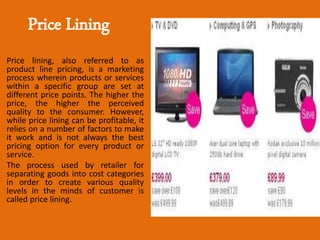
Price lining, also referred to as
product line pricing, is a marketing
process wherein products or services
within a specific group are set at
different price points. The higher the
price, the higher the perceived
quality to the consumer. However,
while price lining can be profitable, it
relies on a number of factors to make
it work and is not always the best
pricing option for every product or
service.
The process used by retailer for
separating goods into cost categories
in order to create various quality
levels in the minds of customer is
called price lining.
Some of the widely used policies are listed as follows:
A. Geographical Pricing
1. Point of purchase pricing
2. Uniform delivery pricing
i. FOB
ii. C & F
iii. CIF
B. Price Discounts and allowances
1. Quality Discount
2. Trade discount
3. Cash discount
4. Price-off
5. Seasonal discount
C.Promotional Pricing
1.Leader pricing
2.Special event pricing
3.Psychological pricing
i. Odd pricing
ii. Prestige pricing
iii. Customary pricing
iv. Superficial discounting pricing
D. Discriminating pricing
E. Product-mix pricing
1. Product line pricing
2. Optional-feature pricing
3. Captive- product pricing
4. Two part pricing
5. By product pricing
6. Product bundling pricing
Product life cycle pricing
A. Pricing strategy in introduction stage
• Market skimming
• Market penetration
• Competitive pricing
B. Pricing strategy in growth stage
C. Pricing strategy in maturity stage
D. Pricing strategy in saturation stage
E. Pricing strategy in decline stage
An organization may initiate price changes to deal with new
forecast arising within the organization or the market. The
price may:
1. Increase
- If an organization feels that the sales volume will not be
affected by small price increase, it may always be
tempted to increase the price.
- If the price is increased due to taxation policy then there
should be quick respond from firms point of view.
- When an organization can’t increase the supply of its
over demanded product, it may raise the price level to
manage the demand at the current supply point.
2. Decrease
- The firm should lower its price in order to use
excess of capacity i.e. in order to achieve
higher sales volume.
- In order to remove the old stock the firm
should decrease the price of its product.
- In order to capture the market the firm should
decrease the price of its product.
Responding to Price Changes
- If the price cut is has been initiated in order to use the
excess capacity or to cover rising costs, it does not
warrant any response.
- If the price change is temporary or short-term, initiated
to clear old stocks, there is no need for response.
- If the objective is to dominate the market and the price
change is a long-term, the organization has to respond
quickly and effectively.
- The organization should also evaluate the consequences
of non-response to the price change.
- If the price change does not seriously effect its current
sales and market share, there is no need for response.
- Before showing any response, it should carefully watch
how other competitors react to the price change.
Price & pricing factors

Price & pricing factors

  • 2.
    Price is thevalue placed on what is exchanged. Pricing is the act of determining the exchange value between the purchasing power and utility or satisfaction acquired by an individual, group or an organization through the purchase of goods, services, ideas, rights, etc.
  • 3.
    1. Price affectsdemand 2. Price affects savings 3. Price regulates factors of production 4. Pricing a major government activity 5. Revenue and profits 6. Competition 7. Non-price competition
  • 4.
    1. Pricing objectives 2.Marketing mix 3. Structure for pricing 4. Costs
  • 5.
    1. Market demand 2.Prevailing market price 3. Competition 4. Government control 5. Marketing intermediaries’ interests 6. Social concerns
  • 6.
    Cost-Based Pricing Methods Itis based on the notion that the price should cover all types of costs and be able to give the organization a fair amount of profit. 1. Cost-plus or mark-up method It is the simplest method of pricing which involves a calculation of the fixed and variable costs per unit adding the desired profit margin on the total cost. 2. Target return on investment pricing It is popular among manufacturing organizations that need to recover a fixed target return on their investment from the price. Under this method, desired return on investment is added to the total cost to arrive at the price. 3. Target profit or break-even pricing This method uses the break even analysis to evaluate the revenue and profit scenarios at several pricing alternatives.
  • 7.
    The demand isbought into the pricing picture through the sales estimates. When such sales estimates are integrated into the flexible BEA it provides better price setting scenario.
  • 8.
    Value Based PricingMethod This method is based on customers’ value perception rather than costs of the product. There are two types of value oriented pricing methods: 1. Perceived value pricing This method is mainly used for new products. Under this method, the firm collects buyers’ perception of value (price) of the product and fixes the price around the average perceived value. 2. Customers value pricing This method is mainly used for existing product. Under this method, an organization may charge a very low price for a high quality product to create special customer value for the product. The price charged may sometimes be below the costs.
  • 9.
    Competition Based PricingMethods The market oriented pricing methods are based on the competitors prices. Under this approach, the price setter changes the price when the competitor price changes. It does not consider costs and demand as major pricing factor. It can be done on basis of: 1. Going-rate pricing Under this the organization simply bases its price at the prevailing market price. 2. Pricing above competition Under this the organization places its price slightly above the prevailing market price. 3. Pricing below competition Under this the organization places its price slightly below the prevailing market price.
  • 10.
    There are mainlyfour pricing option during the introduction stage which a firm combines with the quality image of product. They are: 1. Premium pricing strategy This strategy involves introducing the new product under high price combined with high quality perception. 2. Good value pricing strategy This strategy is implemented by offering a good quality product at lower price. 3. Overcharging pricing strategy Under this strategy, the firm overprices its new product in relation to its quality. 4. Economic pricing strategy This involves offering a low quality product and offering in low price.
  • 11.
    Price Lining Price lining,also referred to as product line pricing, is a marketing process wherein products or services within a specific group are set at different price points. The higher the price, the higher the perceived quality to the consumer. However, while price lining can be profitable, it relies on a number of factors to make it work and is not always the best pricing option for every product or service. The process used by retailer for separating goods into cost categories in order to create various quality levels in the minds of customer is called price lining.
  • 12.
    Some of thewidely used policies are listed as follows: A. Geographical Pricing 1. Point of purchase pricing 2. Uniform delivery pricing i. FOB ii. C & F iii. CIF B. Price Discounts and allowances 1. Quality Discount 2. Trade discount 3. Cash discount 4. Price-off 5. Seasonal discount
  • 13.
    C.Promotional Pricing 1.Leader pricing 2.Specialevent pricing 3.Psychological pricing i. Odd pricing ii. Prestige pricing iii. Customary pricing iv. Superficial discounting pricing
  • 14.
    D. Discriminating pricing E.Product-mix pricing 1. Product line pricing 2. Optional-feature pricing 3. Captive- product pricing 4. Two part pricing 5. By product pricing 6. Product bundling pricing
  • 15.
    Product life cyclepricing A. Pricing strategy in introduction stage • Market skimming • Market penetration • Competitive pricing B. Pricing strategy in growth stage C. Pricing strategy in maturity stage D. Pricing strategy in saturation stage E. Pricing strategy in decline stage
  • 16.
    An organization mayinitiate price changes to deal with new forecast arising within the organization or the market. The price may: 1. Increase - If an organization feels that the sales volume will not be affected by small price increase, it may always be tempted to increase the price. - If the price is increased due to taxation policy then there should be quick respond from firms point of view. - When an organization can’t increase the supply of its over demanded product, it may raise the price level to manage the demand at the current supply point.
  • 17.
    2. Decrease - Thefirm should lower its price in order to use excess of capacity i.e. in order to achieve higher sales volume. - In order to remove the old stock the firm should decrease the price of its product. - In order to capture the market the firm should decrease the price of its product.
  • 18.
    Responding to PriceChanges - If the price cut is has been initiated in order to use the excess capacity or to cover rising costs, it does not warrant any response. - If the price change is temporary or short-term, initiated to clear old stocks, there is no need for response. - If the objective is to dominate the market and the price change is a long-term, the organization has to respond quickly and effectively. - The organization should also evaluate the consequences of non-response to the price change. - If the price change does not seriously effect its current sales and market share, there is no need for response. - Before showing any response, it should carefully watch how other competitors react to the price change.