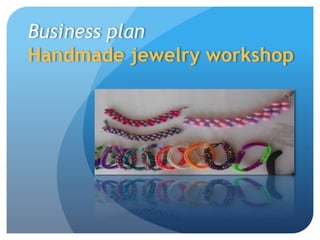
Business plan
Handmade jewelry workshop
MOTIVATION
 *Reasons underlying launch or business development
(business opportunity).
 Current trends in the jewelry and accessories show a
strong preference of customers (mostly young and
educated women) to jewelry made by hand. Offer on
the market in Romania is modest, despite growing
demand.
BUSINESS PRESENTATION
 *Description of the business idea.
 *Objectives that should be achieved.
 *Success Factors.
 Our workshop will offer customers educated, demanding
jewelry made by hand with unique design of materials such as
copper, titanium, semiprecious stones, porcelain and metal
alloys.
 Objectives are distributing our jewelery in at least 20 profile
stores in Romania’s market, increasing jewelry designs by 10%
per year and reaching the profitability within 12 months of
activity.
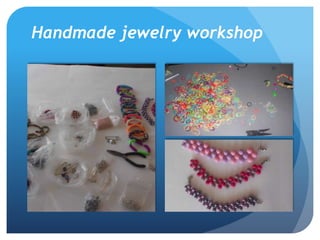
Handmade jewelry workshop
SERVICE / PRODUCT PRESENTATION
 *Description of the product or service; description of
the offer.
 *Customer benefits.
 *Advantages over the competition.
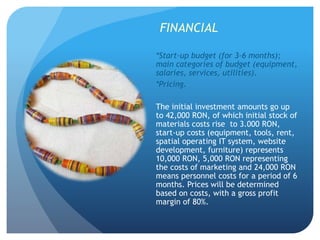
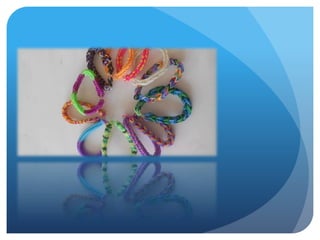
 In our own shop, we will achieve brooches, pendants,
rings, bracelets and earrings, with a unique design or in
limited series, to give our customers the opportunity to
purchase exclusive jewelry at a reasonable price.
THE MARKET
 * Market size, structure, barriers to entry, the trends
on the market.
 Precious Metals and Stones Federation estimates that
Romanians buy
 on average 15 tonnes of jewelry per year. Jewelry and
watches market is valued at about 250 million euros per
year.
 The rings represent 60% of sales, 20% are for other
pendants, necklaces and earrings, bracelets and 10%.
THE COMPETITION
 *Bidders, the competitors operating on the market.
 *Relevant details about the competition.
 In Craiova, the offer profile (the handmade jewelry or
made to order, of precious metals) is almost
nonexistent, only 4 or 5 workshops currently operating
in Craiova.
THE CLIENTS / MARKET SEGMENT
 *Target segment customer profile
 (age, education, income, consumer behavior,
preferences etc.)
 Customers are mainly educated adult women, with
middle and high incomes, aged 25-45, as well as
travelers and companies wishing to provide corporate
gifts.
LEGISLATIVE FRAMEWORK
 *Permits for the activity (environmental, health, etc.)
 In addition to the authorizations required by regulation for
the establishment business, there are no other specific
authorizations.
WORKSTATION
 *Reasons for choosing premises / working point (near markets
/ clients, infrastructure, costs, etc.)
 The headquarters of the company will be in the same place as
the workshop, within an apartment, a private residence.
SUPPLIERS / PARTNERS
 * Types of providers.
 * Modalities of cooperation.
 * Terms of delivery and payment.
 Suppliers will mainly be producers of raw materials
 (semiprecious stones, copper wire, titanium, various
alloys).
STAFF
 * Employees
 * Personnel costs
 The company will be operated by two people in the
first year of activity: business owner -who will be both
jewelry designer, who will undertake them and also the
person who will handle trade relations with distributors
and stores- and a sales representative.
 Staff costs up to 4.000 RON per month.
ORGANIZATION / MANAGEMENT
 * Activities to be covered
(purchasing, marketing, sales, accounting
 * Activities to be outsourced (accounting, etc.)
 The company will be headed by a director who is also
the owner of the business. Both the company’s website
maintenance work and the accounting will be
outsourced.
FINANCIAL
*Start-up budget (for 3-6 months);
main categories of budget (equipment,
salaries, services, utilities).
*Pricing.
The initial investment amounts go up
to 42,000 RON, of which initial stock of
materials costs rise to 3.000 RON,
start-up costs (equipment, tools, rent,
spatial operating IT system, website
development, furniture) represents
10,000 RON, 5,000 RON representing
the costs of marketing and 24,000 RON
means personnel costs for a period of 6
months. Prices will be determined
based on costs, with a gross profit
margin of 80%.
Prezentare plan afaceri

Prezentare plan afaceri

  • 1.
  • 2.
    MOTIVATION  *Reasons underlyinglaunch or business development (business opportunity).  Current trends in the jewelry and accessories show a strong preference of customers (mostly young and educated women) to jewelry made by hand. Offer on the market in Romania is modest, despite growing demand.
  • 3.
    BUSINESS PRESENTATION  *Descriptionof the business idea.  *Objectives that should be achieved.  *Success Factors.  Our workshop will offer customers educated, demanding jewelry made by hand with unique design of materials such as copper, titanium, semiprecious stones, porcelain and metal alloys.  Objectives are distributing our jewelery in at least 20 profile stores in Romania’s market, increasing jewelry designs by 10% per year and reaching the profitability within 12 months of activity.
  • 4.
  • 5.
    SERVICE / PRODUCTPRESENTATION  *Description of the product or service; description of the offer.  *Customer benefits.  *Advantages over the competition.  In our own shop, we will achieve brooches, pendants, rings, bracelets and earrings, with a unique design or in limited series, to give our customers the opportunity to purchase exclusive jewelry at a reasonable price.
  • 6.
    THE MARKET  *Market size, structure, barriers to entry, the trends on the market.  Precious Metals and Stones Federation estimates that Romanians buy  on average 15 tonnes of jewelry per year. Jewelry and watches market is valued at about 250 million euros per year.  The rings represent 60% of sales, 20% are for other pendants, necklaces and earrings, bracelets and 10%.
  • 7.
    THE COMPETITION  *Bidders,the competitors operating on the market.  *Relevant details about the competition.  In Craiova, the offer profile (the handmade jewelry or made to order, of precious metals) is almost nonexistent, only 4 or 5 workshops currently operating in Craiova.
  • 8.
    THE CLIENTS /MARKET SEGMENT  *Target segment customer profile  (age, education, income, consumer behavior, preferences etc.)  Customers are mainly educated adult women, with middle and high incomes, aged 25-45, as well as travelers and companies wishing to provide corporate gifts.
  • 9.
    LEGISLATIVE FRAMEWORK  *Permitsfor the activity (environmental, health, etc.)  In addition to the authorizations required by regulation for the establishment business, there are no other specific authorizations. WORKSTATION  *Reasons for choosing premises / working point (near markets / clients, infrastructure, costs, etc.)  The headquarters of the company will be in the same place as the workshop, within an apartment, a private residence.
  • 10.
    SUPPLIERS / PARTNERS * Types of providers.  * Modalities of cooperation.  * Terms of delivery and payment.  Suppliers will mainly be producers of raw materials  (semiprecious stones, copper wire, titanium, various alloys).
  • 11.
    STAFF  * Employees * Personnel costs  The company will be operated by two people in the first year of activity: business owner -who will be both jewelry designer, who will undertake them and also the person who will handle trade relations with distributors and stores- and a sales representative.  Staff costs up to 4.000 RON per month.
  • 12.
    ORGANIZATION / MANAGEMENT * Activities to be covered (purchasing, marketing, sales, accounting  * Activities to be outsourced (accounting, etc.)  The company will be headed by a director who is also the owner of the business. Both the company’s website maintenance work and the accounting will be outsourced.
  • 13.
    FINANCIAL *Start-up budget (for3-6 months); main categories of budget (equipment, salaries, services, utilities). *Pricing. The initial investment amounts go up to 42,000 RON, of which initial stock of materials costs rise to 3.000 RON, start-up costs (equipment, tools, rent, spatial operating IT system, website development, furniture) represents 10,000 RON, 5,000 RON representing the costs of marketing and 24,000 RON means personnel costs for a period of 6 months. Prices will be determined based on costs, with a gross profit margin of 80%.