Electric motor - miracle of applied
physics?
Adam Jerzman
UNIWERSYTET KARDYNAŁA STEFANA WYSZYŃSKIEGO
WYDZIAŁ BIOLOGII I NAUK O ŚRODOWISKU
ajjm314@gmail.com
Table of Contents:
1. What’s an electric motor?
2. How electric motor works?
3. Genesis of electric motor
4. Power calculation
5. Characteristic of electric motors and usage
6. Comparison and division of electric motors
What is an electric motor?
An electric motor is an electrical machine that converts electrical energy
into mechanical energy. The reverse of this is the conversion of
mechanical energy into electrical energy and is done by an electric
generator, which has much in common with a motor.
Principle of working
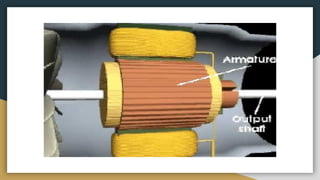
Most electric motors operate through the
interaction between an electric motor's
magnetic field and winding currents to
generate force. In certain applications, such
as in regenerative braking with traction
motors in the transportation industry, electric
motors can also be used in reverse as
generators to convert mechanical energy
into electric power.
Electric motors are used to produce linear or
rotary force (torque), and should be
distinguished from devices such as
magnetic solenoids and loudspeakers that
convert electricity into motion but do not
generate usable mechanical powers, which
are respectively referred to as actuators and
transducers.
Genesis of the electric motor
Perhaps the first electric motors were simple electrostatic devices
created by the Scottish monk Andrew Gordon in the 1740s. The
theoretical principle behind production of mechanical force by the
interactions of an electric current and a magnetic field, Ampère's force
law, was discovered later by André-Marie Ampère in 1820. The
conversion of electrical energy into mechanical energy by
electromagnetic means was demonstrated by the English scientist
Michael Faraday in 1821.
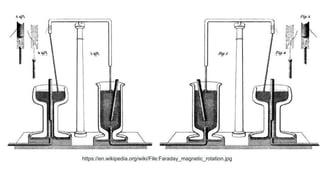
https://en.wikipedia.org/wiki/File:Faraday_magnetic_rotation.jpg
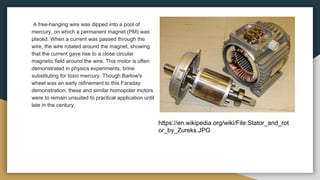
A free-hanging wire was dipped into a pool of
mercury, on which a permanent magnet (PM) was
placed. When a current was passed through the
wire, the wire rotated around the magnet, showing
that the current gave rise to a close circular
magnetic field around the wire. This motor is often
demonstrated in physics experiments, brine
substituting for toxic mercury. Though Barlow's
wheel was an early refinement to this Faraday
demonstration, these and similar homopolar motors
were to remain unsuited to practical application until
late in the century.
https://en.wikipedia.org/wiki/File:Stator_and_rot
or_by_Zureks.JPG
Power
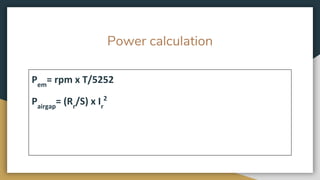
Power calculation
Pem
= rpm x T/5252
Pairgap
= (Rr
/S) x Ir
2
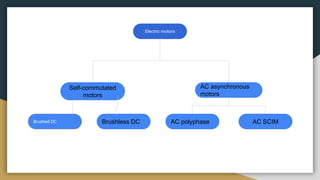
Electric motors
AC asynchronous
motors
Self-commutated
motors
Brushed DC Brushless DC AC polyphase AC SCIM
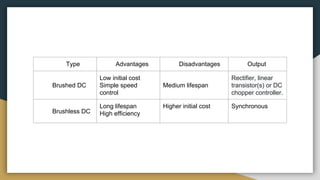
Type Advantages Disadvantages Output
Brushed DC
Low initial cost
Simple speed
control
Medium lifespan
Rectifier, linear
transistor(s) or DC
chopper controller.
Brushless DC
Long lifespan
High efficiency
Higher initial cost Synchronous
Literature
● Fink, Donald G.; Beaty, H. Wayne, Standard Handbook for Electrical Engineers,
'14th ed., McGraw-Hill, 1999, ISBN 0-07-022005-0.
● Houston, Edwin J.; Kennelly, Arthur, Recent Types of Dynamo-Electric Machinery,
American Technical Book Company 1897, published by P.F. Collier and Sons New
York, 1902
● Kuphaldt, Tony R. (2000–2006). "Chapter 13 AC MOTORS". Lessons In Electric
Circuits—Volume II. Retrieved 2006-04-11.
● Rosenblatt, Jack; Friedman, M. Harold, Direct and Alternating Current Machinery,
2nd ed., McGraw-Hill, 1963

Prezentacja

  • 1.
    Electric motor -miracle of applied physics? Adam Jerzman UNIWERSYTET KARDYNAŁA STEFANA WYSZYŃSKIEGO WYDZIAŁ BIOLOGII I NAUK O ŚRODOWISKU ajjm314@gmail.com
  • 2.
    Table of Contents: 1.What’s an electric motor? 2. How electric motor works? 3. Genesis of electric motor 4. Power calculation 5. Characteristic of electric motors and usage 6. Comparison and division of electric motors
  • 3.
    What is anelectric motor? An electric motor is an electrical machine that converts electrical energy into mechanical energy. The reverse of this is the conversion of mechanical energy into electrical energy and is done by an electric generator, which has much in common with a motor.
  • 4.
    Principle of working Mostelectric motors operate through the interaction between an electric motor's magnetic field and winding currents to generate force. In certain applications, such as in regenerative braking with traction motors in the transportation industry, electric motors can also be used in reverse as generators to convert mechanical energy into electric power. Electric motors are used to produce linear or rotary force (torque), and should be distinguished from devices such as magnetic solenoids and loudspeakers that convert electricity into motion but do not generate usable mechanical powers, which are respectively referred to as actuators and transducers.
  • 6.
    Genesis of theelectric motor
  • 7.
    Perhaps the firstelectric motors were simple electrostatic devices created by the Scottish monk Andrew Gordon in the 1740s. The theoretical principle behind production of mechanical force by the interactions of an electric current and a magnetic field, Ampère's force law, was discovered later by André-Marie Ampère in 1820. The conversion of electrical energy into mechanical energy by electromagnetic means was demonstrated by the English scientist Michael Faraday in 1821.
  • 8.
  • 9.
    A free-hanging wirewas dipped into a pool of mercury, on which a permanent magnet (PM) was placed. When a current was passed through the wire, the wire rotated around the magnet, showing that the current gave rise to a close circular magnetic field around the wire. This motor is often demonstrated in physics experiments, brine substituting for toxic mercury. Though Barlow's wheel was an early refinement to this Faraday demonstration, these and similar homopolar motors were to remain unsuited to practical application until late in the century. https://en.wikipedia.org/wiki/File:Stator_and_rot or_by_Zureks.JPG
  • 10.
  • 11.
    Power calculation Pem = rpmx T/5252 Pairgap = (Rr /S) x Ir 2
  • 14.
  • 15.
    Type Advantages DisadvantagesOutput Brushed DC Low initial cost Simple speed control Medium lifespan Rectifier, linear transistor(s) or DC chopper controller. Brushless DC Long lifespan High efficiency Higher initial cost Synchronous
  • 16.
    Literature ● Fink, DonaldG.; Beaty, H. Wayne, Standard Handbook for Electrical Engineers, '14th ed., McGraw-Hill, 1999, ISBN 0-07-022005-0. ● Houston, Edwin J.; Kennelly, Arthur, Recent Types of Dynamo-Electric Machinery, American Technical Book Company 1897, published by P.F. Collier and Sons New York, 1902 ● Kuphaldt, Tony R. (2000–2006). "Chapter 13 AC MOTORS". Lessons In Electric Circuits—Volume II. Retrieved 2006-04-11. ● Rosenblatt, Jack; Friedman, M. Harold, Direct and Alternating Current Machinery, 2nd ed., McGraw-Hill, 1963