We are Network of Engineers, Project Managers, Suppliers, and Contractors
that provide Engineering, Support and Solutions for the needs of Sales,
Engineering, Manufacturing, and Preventive Maintenance through the
systematic inspection, detection, correction, and prevention of incipient failures,
before they become actual or major failures.
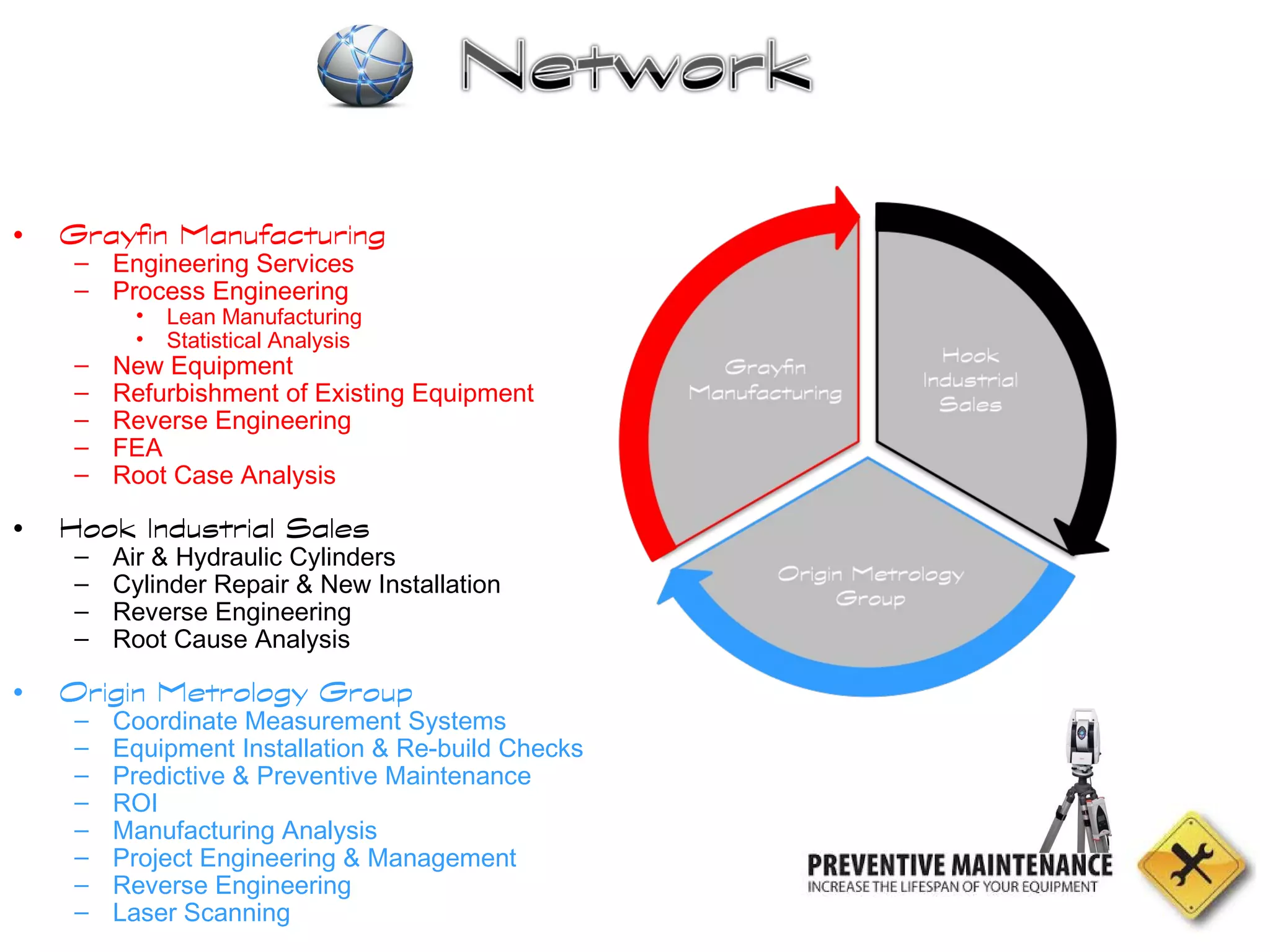
• Grayfin Manufacturing
– Engineering Services
– Process Engineering
• Lean Manufacturing
• Statistical Analysis
– New Equipment
– Refurbishment of Existing Equipment
– Reverse Engineering
– FEA
– Root Case Analysis
• Hook Industrial Sales
– Air & Hydraulic Cylinders
– Cylinder Repair & New Installation
– Reverse Engineering
– Root Cause Analysis
• Origin Metrology Group
– Coordinate Measurement Systems
– Equipment Installation & Re-build Checks
– Predictive & Preventive Maintenance
– ROI
– Manufacturing Analysis
– Project Engineering & Management
– Reverse Engineering
– Laser Scanning
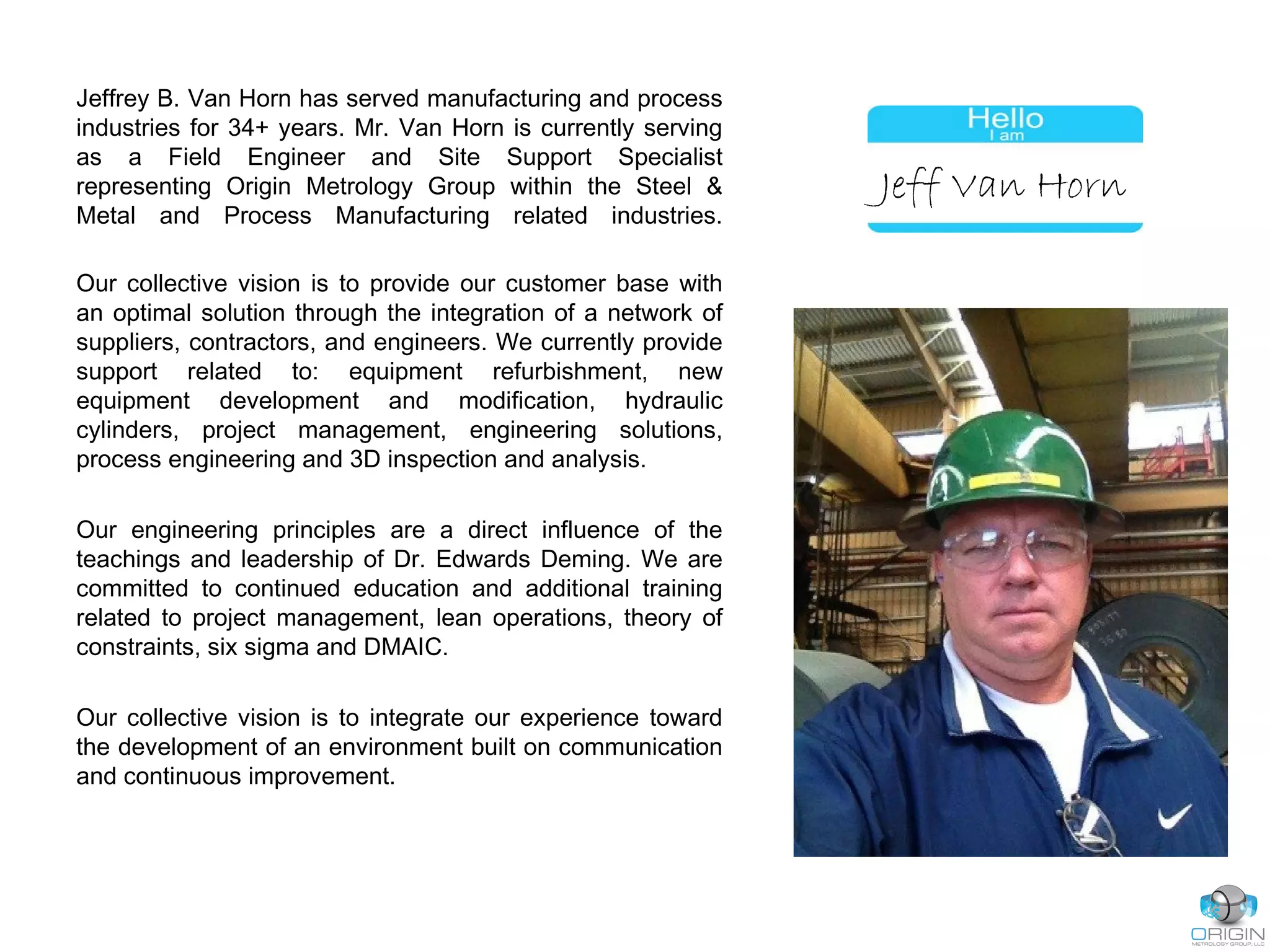
Jeffrey B. Van Horn has served manufacturing and process
industries for 34+ years. Mr. Van Horn is currently serving
as a Field Engineer and Site Support Specialist
representing Origin Metrology Group within the Steel &
Metal and Process Manufacturing related industries.
Our collective vision is to provide our customer base with
an optimal solution through the integration of a network of
suppliers, contractors, and engineers. We currently provide
support related to: equipment refurbishment, new
equipment development and modification, hydraulic
cylinders, project management, engineering solutions,
process engineering and 3D inspection and analysis.
Our engineering principles are a direct influence of the
teachings and leadership of Dr. Edwards Deming. We are
committed to continued education and additional training
related to project management, lean operations, theory of
constraints, six sigma and DMAIC.
Our collective vision is to integrate our experience toward
the development of an environment built on communication
and continuous improvement.
Jeff Van Horn
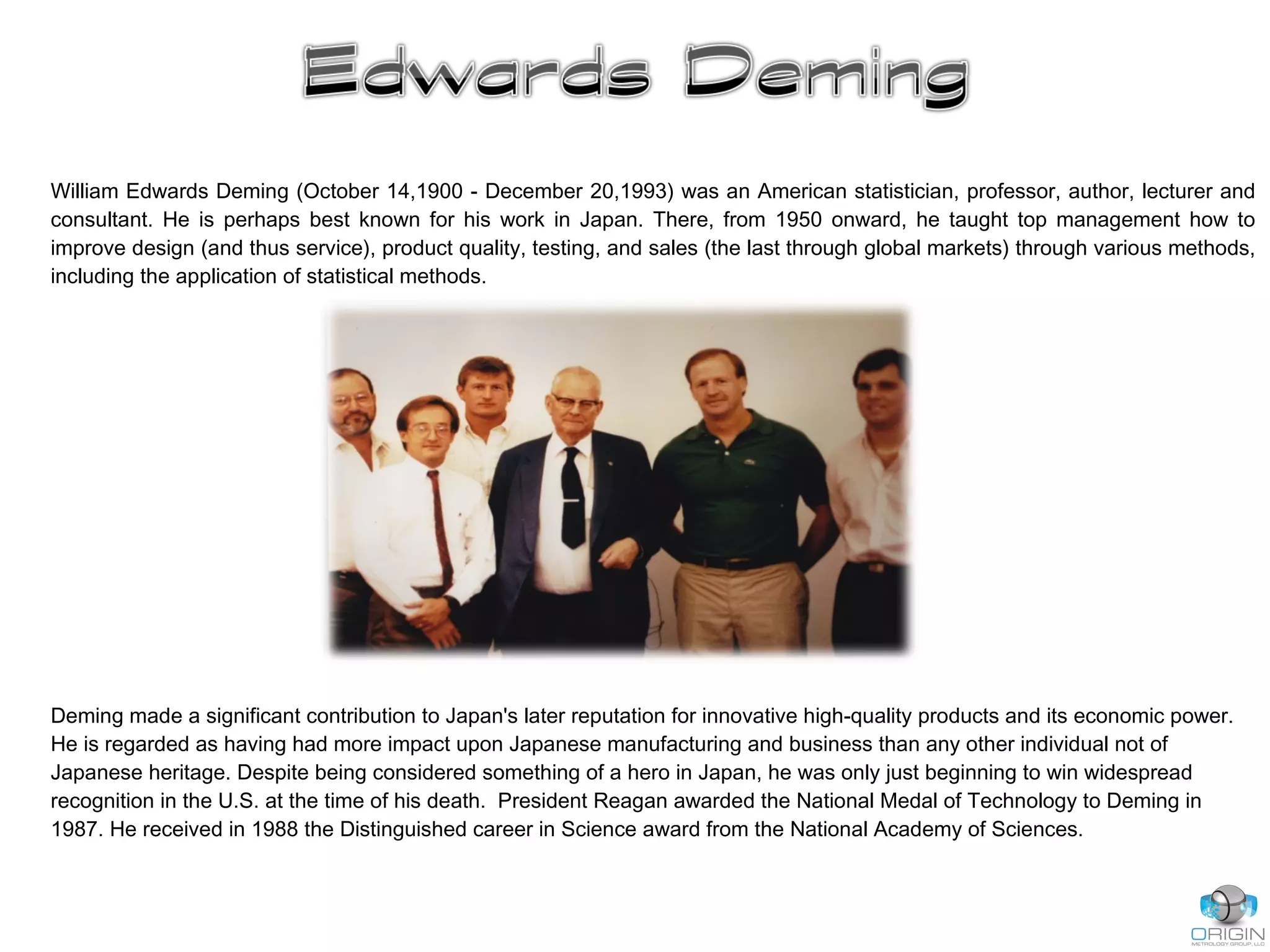
William Edwards Deming (October 14,1900 - December 20,1993) was an American statistician, professor, author, lecturer and
consultant. He is perhaps best known for his work in Japan. There, from 1950 onward, he taught top management how to
improve design (and thus service), product quality, testing, and sales (the last through global markets) through various methods,
including the application of statistical methods.
Deming made a significant contribution to Japan's later reputation for innovative high-quality products and its economic power.
He is regarded as having had more impact upon Japanese manufacturing and business than any other individual not of
Japanese heritage. Despite being considered something of a hero in Japan, he was only just beginning to win widespread
recognition in the U.S. at the time of his death. President Reagan awarded the National Medal of Technology to Deming in
1987. He received in 1988 the Distinguished career in Science award from the National Academy of Sciences.
"Create constancy of purpose towards improvement”
"Adopt the new philosophy”
"Cease dependence on inspection”
"Move towards a single supplier for any one item." Multiple suppliers mean variation between feedstock’s.
"Improve constantly and forever". Constantly strive to reduce variation.
"Institute training on the job”
"Institute leadership”
"Drive out fear”
"Break down barriers between departments”
"Eliminate slogans”
"Eliminate management by objectives". Deming saw production targets as encouraging the delivery of poor-quality goods.
"Remove barriers to pride of workmanship". Many of the other problems outlined reduce worker satisfaction.
"Institute education and self-improvement”
"The transformation is everyone's job”
Lack of constancy of purpose.
Emphasis on short-term profits.
Evaluation by performance, merit rating, or annual review of performance.
Mobility of management.
Running a company on visible figures alone.
Excessive medical costs.
Excessive costs of warranty, fueled by lawyers who work for contingency fees.
Deming’s Seven Deadly Diseases (c. 1986)
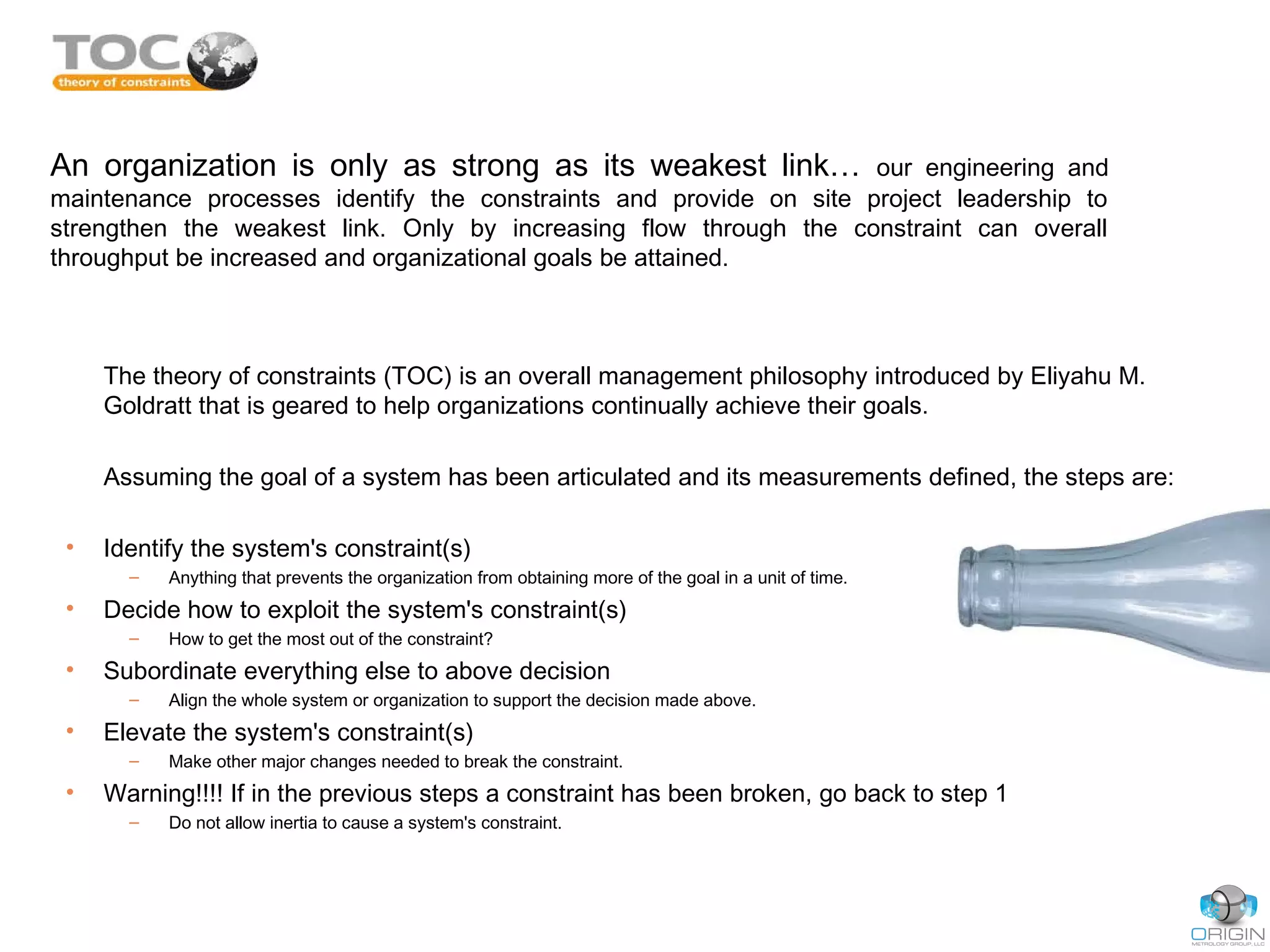
An organization is only as strong as its weakest link… our engineering and
maintenance processes identify the constraints and provide on site project leadership to
strengthen the weakest link. Only by increasing flow through the constraint can overall
throughput be increased and organizational goals be attained.
The theory of constraints (TOC) is an overall management philosophy introduced by Eliyahu M.
Goldratt that is geared to help organizations continually achieve their goals.
Assuming the goal of a system has been articulated and its measurements defined, the steps are:
• Identify the system's constraint(s)
– Anything that prevents the organization from obtaining more of the goal in a unit of time.
• Decide how to exploit the system's constraint(s)
– How to get the most out of the constraint?
• Subordinate everything else to above decision
– Align the whole system or organization to support the decision made above.
• Elevate the system's constraint(s)
– Make other major changes needed to break the constraint.
• Warning!!!! If in the previous steps a constraint has been broken, go back to step 1
– Do not allow inertia to cause a system's constraint.
Essentially, lean is centered on preserving value with less work. Lean manufacturing is a management
philosophy derived mostly from the Toyota Production System or TPS. The term… Toyotism is also
prevalent and identified as “Lean.” TPS is renowned for its focus on reduction of the original Toyota
seven wastes to improve overall customer value, but there are varying perspectives on how this is best
achieved. The steady growth of Toyota, from a small company to the world's largest automaker‘ has
focused attention on how it has achieved this success.
The original seven muda are: (Waste)
Transport (moving products that are not actually required to perform the processing)
Inventory (components, work in process and finished product not being processed)
Motion (people or equipment moving or walking more than is required to perform the processing)
Waiting (waiting for the next production step)
Over production (production ahead of demand)
Over Processing (resulting from poor tool or product design creating activity)
Defects (the effort involved in inspecting for and fixing defects)
Methods
Six Sigma projects follow two methodologies inspired by Deming’s Plan-Do-Check-Act Cycle. Each methodology
is composed of five phases, recognized by the acronyms: DMAIC and DMADV. DMAIC is used for projects
aimed at improving an existing business process where DMADV is used for projects aimed at creating new
products or process designs.
DMAIC
•Define the problem, the voice of the customer and the specific project goals.
•Measure key aspects of the current process and collect relevant data.
•Analyze the data to investigate and verify cause-and-effect relationships. Determine what the relationships are,
and attempt to ensure that all factors have been considered. Seek out root cause of the defect under
investigation.
•Improve or optimize the current process based upon data analysis using techniques such as design of
experiments, poka yoke or mistake proofing, and standard work to create a new, future state process. Set up pilot
runs to establish process capability ,
•Control the future state process to ensure that any deviations from target are corrected before they result in
defects. Implement control systems such as statistical process control, production boards, visual workplaces, and
continuously monitor the process.
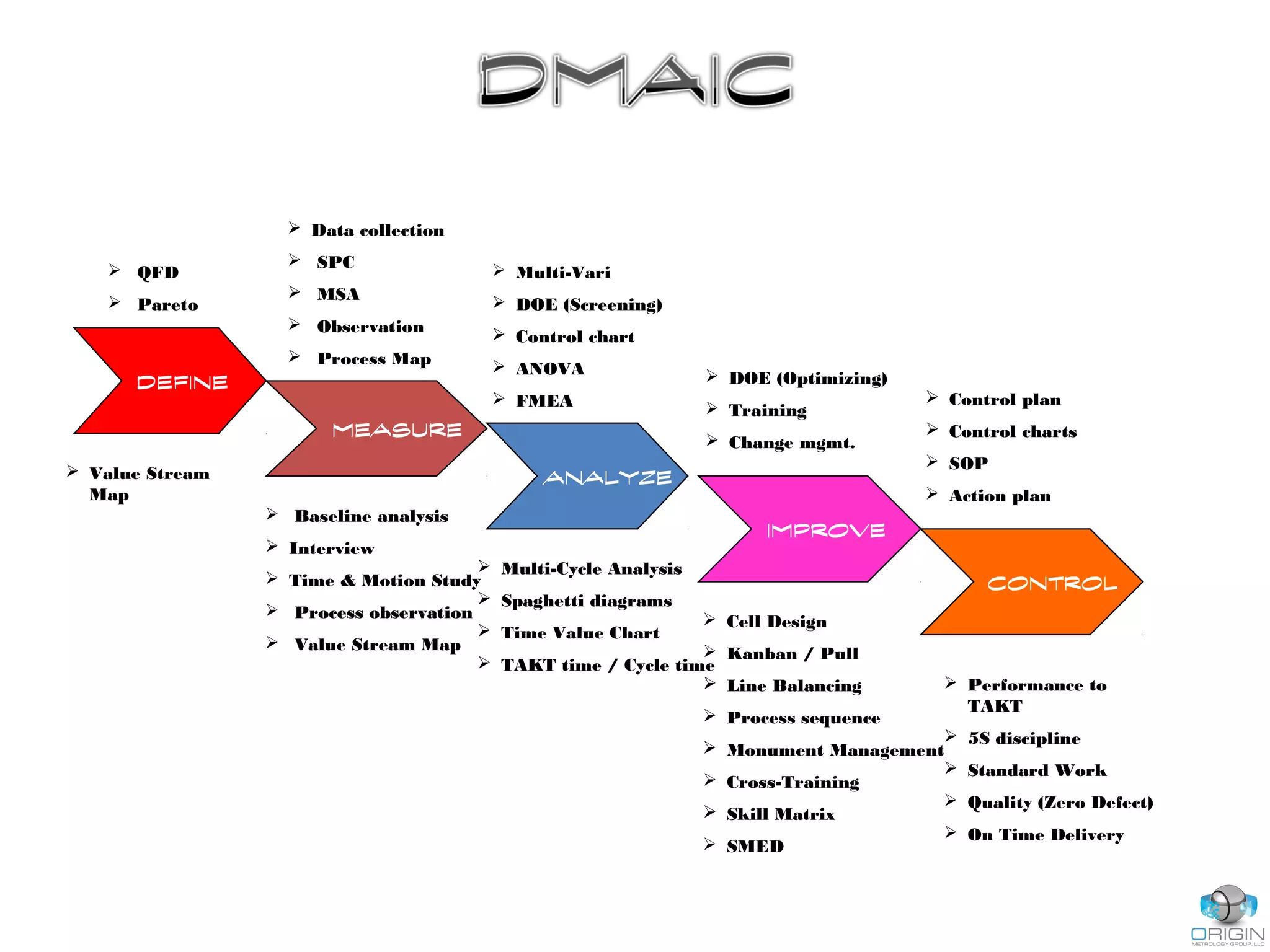
DEFINE
MEASURE
ANALYZE
IMPROVE
CONTROL
 QFD
 Pareto
 Value Stream
Map
 Data collection
 SPC
 MSA
 Observation
 Process Map
 Baseline analysis
 Interview
 Time & Motion Study
 Process observation
 Value Stream Map
 Multi-Vari
 DOE (Screening)
 Control chart
 ANOVA
 FMEA
 Multi-Cycle Analysis
 Spaghetti diagrams
 Time Value Chart
 TAKT time / Cycle time
 DOE (Optimizing)
 Training
 Change mgmt.
 Cell Design
 Kanban / Pull
 Line Balancing
 Process sequence
 Monument Management
 Cross-Training
 Skill Matrix
 SMED
 Control plan
 Control charts
 SOP
 Action plan
 Performance to
TAKT
 5S discipline
 Standard Work
 Quality (Zero Defect)
 On Time Delivery
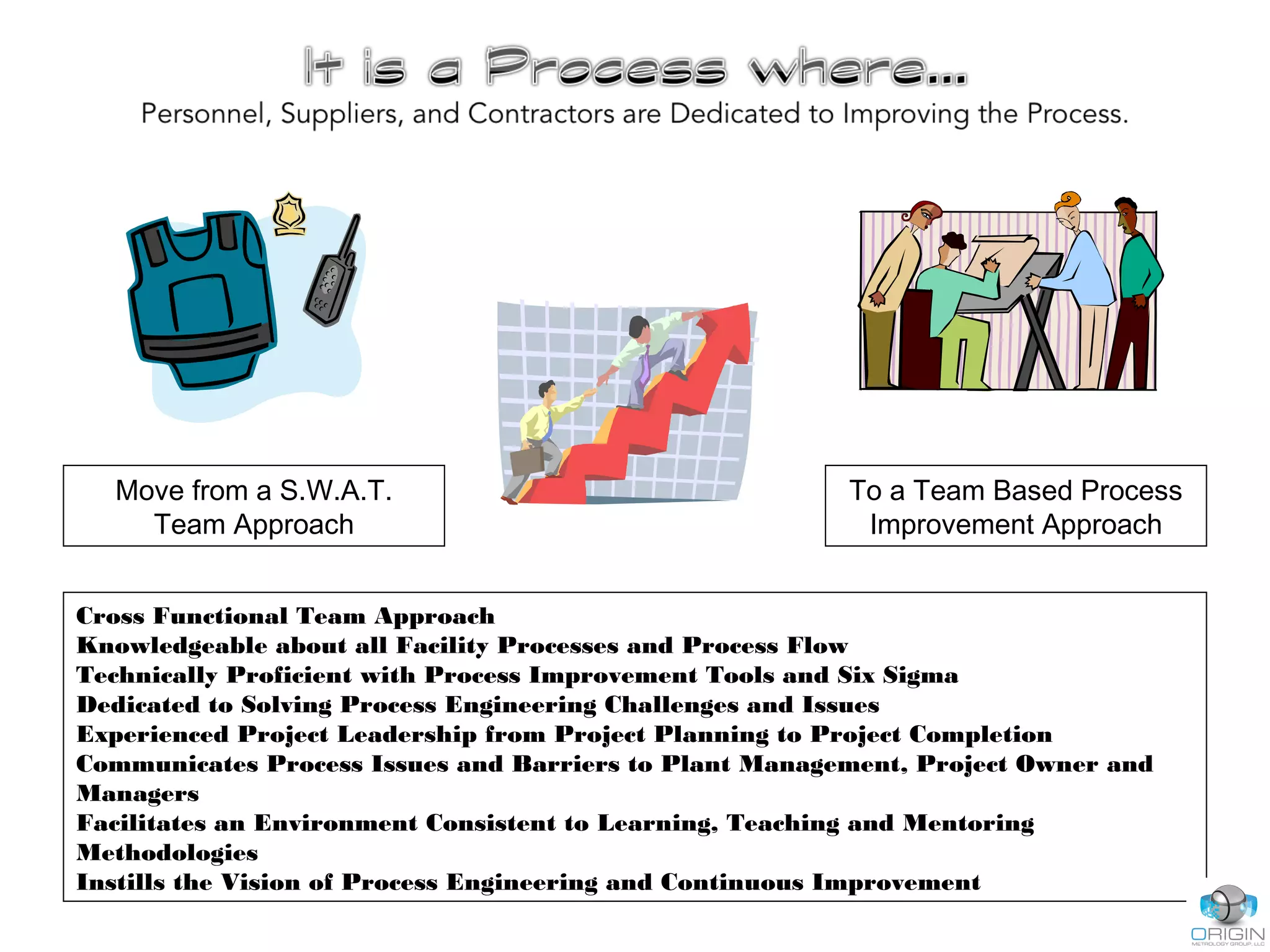
Move from a S.W.A.T.
Team Approach
To a Team Based Process
Improvement Approach
Cross Functional Team Approach
Knowledgeable about all Facility Processes and Process Flow
Technically Proficient with Process Improvement Tools and Six Sigma
Dedicated to Solving Process Engineering Challenges and Issues
Experienced Project Leadership from Project Planning to Project Completion
Communicates Process Issues and Barriers to Plant Management, Project Owner and
Managers
Facilitates an Environment Consistent to Learning, Teaching and Mentoring
Methodologies
Instills the Vision of Process Engineering and Continuous Improvement
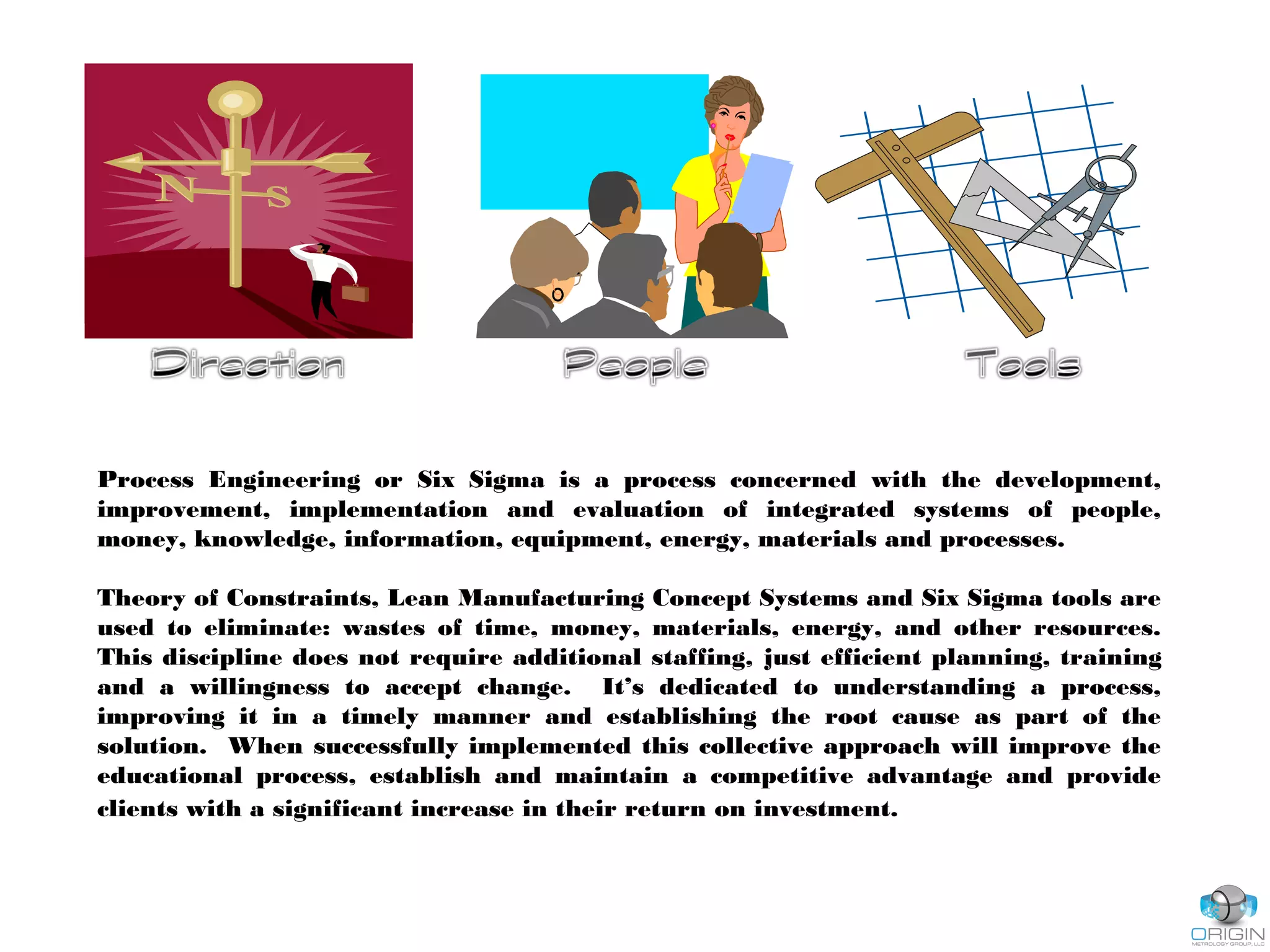
Process Engineering or Six Sigma is a process concerned with the development,
improvement, implementation and evaluation of integrated systems of people,
money, knowledge, information, equipment, energy, materials and processes.
Theory of Constraints, Lean Manufacturing Concept Systems and Six Sigma tools are
used to eliminate: wastes of time, money, materials, energy, and other resources.
This discipline does not require additional staffing, just efficient planning, training
and a willingness to accept change. It’s dedicated to understanding a process,
improving it in a timely manner and establishing the root cause as part of the
solution. When successfully implemented this collective approach will improve the
educational process, establish and maintain a competitive advantage and provide
clients with a significant increase in their return on investment.
A means to efficiently achieve the Vision of the company…
•Provide a Structured Philosophy
• Networking Opportunities
• Inter-company
• Outside Partners & Contractors
•Focus on Financial Results
• Improvement of the Bottom Line
•Engage Employees at all Levels of the Process
• Teamwork
• Project Management
• Engineering Support
•Promote an Organizational Culture of Continuous Improvement
• Lean Operations
• Six Sigma Experience
•Creates Awareness and a Sense of Urgency
• Immediate Results
• Improvements in Safety
– 6S
• Safety-Sorting-Straightening-Shine-Standardize-Sustain
• Reduction in all Factions of Waste
– Waiting (Downtime)
– Motion
– Inventory
– Defects
– Over Processing
– Human Intellect
– Over Production
– Transportation
• Identify Opportunities for Improvement
– Communication
• Inter-Company
• Departmental
– Productivity
– Profitability
• Alleviate Variability
– Achieving Control of the Process
• A Commitment from Management
• Participant Selection
• Project Selection
• Develop & Align to Corporate / Facility Goals
• Establish Key Process Indicators or KPIs
• Understand Project Metrics
• Cost Per Ton
• Return on Investment
• Baseline the Facility
• Understand & Develop the Key Metrics
• Identify & Adjust to Dynamic Targets
• Trend, Chart & Analyze
• Downtime Analysis
• Maintenance Request
• Quality External and Internal
• Waste
• 6-S
• Safety - Sort - Straighten - Shine - Standardize – Sustain
• Training
• Assign Projects to Key Personnel
• Identify Projects
• Implement Planning Sheet
• DMAIC
There are two secrecies of success… 1) To Begin 2) To Finish

OMG: Preventive Maintenance 2015

  • 1.
    We are Networkof Engineers, Project Managers, Suppliers, and Contractors that provide Engineering, Support and Solutions for the needs of Sales, Engineering, Manufacturing, and Preventive Maintenance through the systematic inspection, detection, correction, and prevention of incipient failures, before they become actual or major failures.
  • 2.
    • Grayfin Manufacturing –Engineering Services – Process Engineering • Lean Manufacturing • Statistical Analysis – New Equipment – Refurbishment of Existing Equipment – Reverse Engineering – FEA – Root Case Analysis • Hook Industrial Sales – Air & Hydraulic Cylinders – Cylinder Repair & New Installation – Reverse Engineering – Root Cause Analysis • Origin Metrology Group – Coordinate Measurement Systems – Equipment Installation & Re-build Checks – Predictive & Preventive Maintenance – ROI – Manufacturing Analysis – Project Engineering & Management – Reverse Engineering – Laser Scanning
  • 3.
    Jeffrey B. VanHorn has served manufacturing and process industries for 34+ years. Mr. Van Horn is currently serving as a Field Engineer and Site Support Specialist representing Origin Metrology Group within the Steel & Metal and Process Manufacturing related industries. Our collective vision is to provide our customer base with an optimal solution through the integration of a network of suppliers, contractors, and engineers. We currently provide support related to: equipment refurbishment, new equipment development and modification, hydraulic cylinders, project management, engineering solutions, process engineering and 3D inspection and analysis. Our engineering principles are a direct influence of the teachings and leadership of Dr. Edwards Deming. We are committed to continued education and additional training related to project management, lean operations, theory of constraints, six sigma and DMAIC. Our collective vision is to integrate our experience toward the development of an environment built on communication and continuous improvement. Jeff Van Horn
  • 4.
    William Edwards Deming(October 14,1900 - December 20,1993) was an American statistician, professor, author, lecturer and consultant. He is perhaps best known for his work in Japan. There, from 1950 onward, he taught top management how to improve design (and thus service), product quality, testing, and sales (the last through global markets) through various methods, including the application of statistical methods. Deming made a significant contribution to Japan's later reputation for innovative high-quality products and its economic power. He is regarded as having had more impact upon Japanese manufacturing and business than any other individual not of Japanese heritage. Despite being considered something of a hero in Japan, he was only just beginning to win widespread recognition in the U.S. at the time of his death. President Reagan awarded the National Medal of Technology to Deming in 1987. He received in 1988 the Distinguished career in Science award from the National Academy of Sciences.
  • 5.
    "Create constancy ofpurpose towards improvement” "Adopt the new philosophy” "Cease dependence on inspection” "Move towards a single supplier for any one item." Multiple suppliers mean variation between feedstock’s. "Improve constantly and forever". Constantly strive to reduce variation. "Institute training on the job” "Institute leadership” "Drive out fear” "Break down barriers between departments” "Eliminate slogans” "Eliminate management by objectives". Deming saw production targets as encouraging the delivery of poor-quality goods. "Remove barriers to pride of workmanship". Many of the other problems outlined reduce worker satisfaction. "Institute education and self-improvement” "The transformation is everyone's job”
  • 6.
    Lack of constancyof purpose. Emphasis on short-term profits. Evaluation by performance, merit rating, or annual review of performance. Mobility of management. Running a company on visible figures alone. Excessive medical costs. Excessive costs of warranty, fueled by lawyers who work for contingency fees. Deming’s Seven Deadly Diseases (c. 1986)
  • 7.
    An organization isonly as strong as its weakest link… our engineering and maintenance processes identify the constraints and provide on site project leadership to strengthen the weakest link. Only by increasing flow through the constraint can overall throughput be increased and organizational goals be attained. The theory of constraints (TOC) is an overall management philosophy introduced by Eliyahu M. Goldratt that is geared to help organizations continually achieve their goals. Assuming the goal of a system has been articulated and its measurements defined, the steps are: • Identify the system's constraint(s) – Anything that prevents the organization from obtaining more of the goal in a unit of time. • Decide how to exploit the system's constraint(s) – How to get the most out of the constraint? • Subordinate everything else to above decision – Align the whole system or organization to support the decision made above. • Elevate the system's constraint(s) – Make other major changes needed to break the constraint. • Warning!!!! If in the previous steps a constraint has been broken, go back to step 1 – Do not allow inertia to cause a system's constraint.
  • 8.
    Essentially, lean iscentered on preserving value with less work. Lean manufacturing is a management philosophy derived mostly from the Toyota Production System or TPS. The term… Toyotism is also prevalent and identified as “Lean.” TPS is renowned for its focus on reduction of the original Toyota seven wastes to improve overall customer value, but there are varying perspectives on how this is best achieved. The steady growth of Toyota, from a small company to the world's largest automaker‘ has focused attention on how it has achieved this success. The original seven muda are: (Waste) Transport (moving products that are not actually required to perform the processing) Inventory (components, work in process and finished product not being processed) Motion (people or equipment moving or walking more than is required to perform the processing) Waiting (waiting for the next production step) Over production (production ahead of demand) Over Processing (resulting from poor tool or product design creating activity) Defects (the effort involved in inspecting for and fixing defects)
  • 9.
    Methods Six Sigma projectsfollow two methodologies inspired by Deming’s Plan-Do-Check-Act Cycle. Each methodology is composed of five phases, recognized by the acronyms: DMAIC and DMADV. DMAIC is used for projects aimed at improving an existing business process where DMADV is used for projects aimed at creating new products or process designs. DMAIC •Define the problem, the voice of the customer and the specific project goals. •Measure key aspects of the current process and collect relevant data. •Analyze the data to investigate and verify cause-and-effect relationships. Determine what the relationships are, and attempt to ensure that all factors have been considered. Seek out root cause of the defect under investigation. •Improve or optimize the current process based upon data analysis using techniques such as design of experiments, poka yoke or mistake proofing, and standard work to create a new, future state process. Set up pilot runs to establish process capability , •Control the future state process to ensure that any deviations from target are corrected before they result in defects. Implement control systems such as statistical process control, production boards, visual workplaces, and continuously monitor the process.
  • 10.
    DEFINE MEASURE ANALYZE IMPROVE CONTROL  QFD  Pareto Value Stream Map  Data collection  SPC  MSA  Observation  Process Map  Baseline analysis  Interview  Time & Motion Study  Process observation  Value Stream Map  Multi-Vari  DOE (Screening)  Control chart  ANOVA  FMEA  Multi-Cycle Analysis  Spaghetti diagrams  Time Value Chart  TAKT time / Cycle time  DOE (Optimizing)  Training  Change mgmt.  Cell Design  Kanban / Pull  Line Balancing  Process sequence  Monument Management  Cross-Training  Skill Matrix  SMED  Control plan  Control charts  SOP  Action plan  Performance to TAKT  5S discipline  Standard Work  Quality (Zero Defect)  On Time Delivery
  • 11.
    Move from aS.W.A.T. Team Approach To a Team Based Process Improvement Approach Cross Functional Team Approach Knowledgeable about all Facility Processes and Process Flow Technically Proficient with Process Improvement Tools and Six Sigma Dedicated to Solving Process Engineering Challenges and Issues Experienced Project Leadership from Project Planning to Project Completion Communicates Process Issues and Barriers to Plant Management, Project Owner and Managers Facilitates an Environment Consistent to Learning, Teaching and Mentoring Methodologies Instills the Vision of Process Engineering and Continuous Improvement
  • 12.
    Process Engineering orSix Sigma is a process concerned with the development, improvement, implementation and evaluation of integrated systems of people, money, knowledge, information, equipment, energy, materials and processes. Theory of Constraints, Lean Manufacturing Concept Systems and Six Sigma tools are used to eliminate: wastes of time, money, materials, energy, and other resources. This discipline does not require additional staffing, just efficient planning, training and a willingness to accept change. It’s dedicated to understanding a process, improving it in a timely manner and establishing the root cause as part of the solution. When successfully implemented this collective approach will improve the educational process, establish and maintain a competitive advantage and provide clients with a significant increase in their return on investment.
  • 13.
    A means toefficiently achieve the Vision of the company… •Provide a Structured Philosophy • Networking Opportunities • Inter-company • Outside Partners & Contractors •Focus on Financial Results • Improvement of the Bottom Line •Engage Employees at all Levels of the Process • Teamwork • Project Management • Engineering Support •Promote an Organizational Culture of Continuous Improvement • Lean Operations • Six Sigma Experience •Creates Awareness and a Sense of Urgency • Immediate Results
  • 14.
    • Improvements inSafety – 6S • Safety-Sorting-Straightening-Shine-Standardize-Sustain • Reduction in all Factions of Waste – Waiting (Downtime) – Motion – Inventory – Defects – Over Processing – Human Intellect – Over Production – Transportation • Identify Opportunities for Improvement – Communication • Inter-Company • Departmental – Productivity – Profitability • Alleviate Variability – Achieving Control of the Process
  • 15.
    • A Commitmentfrom Management • Participant Selection • Project Selection • Develop & Align to Corporate / Facility Goals • Establish Key Process Indicators or KPIs • Understand Project Metrics • Cost Per Ton • Return on Investment • Baseline the Facility • Understand & Develop the Key Metrics • Identify & Adjust to Dynamic Targets • Trend, Chart & Analyze • Downtime Analysis • Maintenance Request • Quality External and Internal • Waste • 6-S • Safety - Sort - Straighten - Shine - Standardize – Sustain • Training • Assign Projects to Key Personnel • Identify Projects • Implement Planning Sheet • DMAIC There are two secrecies of success… 1) To Begin 2) To Finish