Cloud security snippets on the use case of the cloud
1.
CLOUD SECURITY
FOR BUSINESSES
Fromaccess control to data encryption—how to
ensure your cloud infrastructure is protected against
modern threats.
PRANAY SINGH CHAUHAN
WHATEVERYORGANIZATION
MUSTKNOW
2.
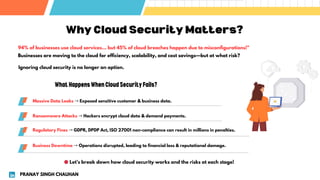
Why Cloud SecurityMatters?
94% of businesses use cloud services… but 45% of cloud breaches happen due to misconfigurations!"
Businesses are moving to the cloud for efficiency, scalability, and cost savings—but at what risk?
Massive Data Leaks → Exposed sensitive customer & business data.
Ransomware Attacks → Hackers encrypt cloud data & demand payments.
Regulatory Fines → GDPR, DPDP Act, ISO 27001 non-compliance can result in millions in penalties.
Business Downtime → Operations disrupted, leading to financial loss & reputational damage.
WhatHappensWhenCloudSecurityFails?
Ignoring cloud security is no longer an option.
🛑Let’s break down how cloud security works and the risks at each stage!
PRANAY SINGH CHAUHAN
3.
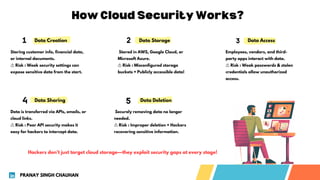
How Cloud SecurityWorks?
Data Creation
Storing customer info, financial data,
or internal documents.
⚠️ Risk : Weak security settings can
expose sensitive data from the start.
Data Storage
Stored in AWS, Google Cloud, or
Microsoft Azure.
⚠️ Risk : Misconfigured storage
buckets = Publicly accessible data!
Data Access
Employees, vendors, and third-
party apps interact with data.
⚠️ Risk : Weak passwords & stolen
credentials allow unauthorized
access.
Data Sharing
Data is transferred via APIs, emails, or
cloud links.
⚠️ Risk : Poor API security makes it
easy for hackers to intercept data.
Data Deletion
Securely removing data no longer
needed.
⚠️ Risk : Improper deletion = Hackers
recovering sensitive information.
Hackers don’t just target cloud storage—they exploit security gaps at every stage!
PRANAY SINGH CHAUHAN
4.
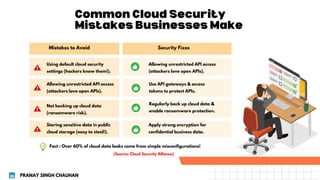
Common Cloud Security
MistakesBusinesses Make
Mistakes to Avoid Security Fixes
Using default cloud security
settings (hackers know them!).
Allowing unrestricted API access
(attackers love open APIs).
Allowing unrestricted API access
(attackers love open APIs).
Use API gateways & access
tokens to protect APIs.
Not backing up cloud data
(ransomware risk).
Regularly back up cloud data &
enable ransomware protection.
Storing sensitive data in public
cloud storage (easy to steal!).
Apply strong encryption for
confidential business data.
Fact : Over 60% of cloud data leaks come from simple misconfigurations!
PRANAY SINGH CHAUHAN
(Source: Cloud Security Alliance)
5.
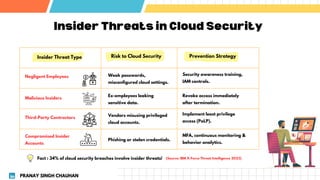
Insider Threats inCloud Security
Insider Threat Type Risk to Cloud Security Prevention Strategy
Negligent Employees
Malicious Insiders
Third-Party Contractors
Compromised Insider
Accounts
Weak passwords,
misconfigured cloud settings.
Ex-employees leaking
sensitive data.
Vendors misusing privileged
cloud accounts.
Phishing or stolen credentials.
Security awareness training,
IAM controls.
Revoke access immediately
after termination.
Implement least privilege
access (PoLP).
MFA, continuous monitoring &
behavior analytics.
Fact : 34% of cloud security breaches involve insider threats! (Source: IBM X-Force Threat Intelligence 2023)
PRANAY SINGH CHAUHAN
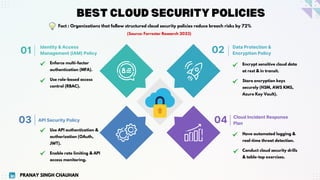
Data Protection &
EncryptionPolicy
Identity & Access
Management (IAM) Policy
01
Enforce multi-factor
authentication (MFA).
Use role-based access
control (RBAC).
Use API authentication &
authorization (OAuth,
JWT).
Enable rate limiting & API
access monitoring.
API Security Policy
Cloud Incident Response
Plan
Encrypt sensitive cloud data
at rest & in transit.
Store encryption keys
securely (HSM, AWS KMS,
Azure Key Vault).
Have automated logging &
real-time threat detection.
Conduct cloud security drills
& table-top exercises.
02
03 04
BEST CLOUD SECURITY POLICIES
Fact : Organizations that follow structured cloud security policies reduce breach risks by 72%
(Source: Forrester Research 2023)
PRANAY SINGH CHAUHAN
8.
Cloud Security Frameworks
SecurityFramework Purpose Best For
CIS Benchmarks
Zero Trust Architecture
(ZTA)
NIST Cybersecurity
Framework
Shared Responsibility
Model
SOC 2 Compliance
Secure cloud configuration
guidelines.
Blocks unauthorized access at
all levels.
Identifies & mitigates cloud
security risks.
Defines cloud security
responsibilities.
Verifies secure cloud service
provider practices.
AWS, Azure, Google Cloud
security best practices.
Organizations using multi-
cloud & remote workforce.
Enterprises with strict
regulatory compliance needs.
Businesses that assume "cloud
providers handle everything."
SaaS companies handling
sensitive customer data
Fact : Companies using structured cloud security frameworks reduce breach risks by 65%!
PRANAY SINGH CHAUHAN
9.
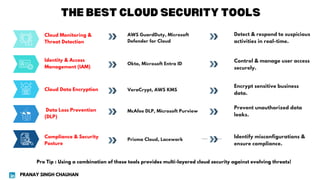
AWS GuardDuty, Microsoft
Defenderfor Cloud
Okta, Microsoft Entra ID
VeraCrypt, AWS KMS
Prisma Cloud, Lacework
Detect & respond to suspicious
activities in real-time.
Cloud Monitoring &
Threat Detection
Identity & Access
Management (IAM)
Cloud Data Encryption
Data Loss Prevention
(DLP)
Compliance & Security
Posture
THE BEST CLOUD SECURITY TOOLS
McAfee DLP, Microsoft Purview
Control & manage user access
securely.
Encrypt sensitive business
data.
Prevent unauthorized data
leaks.
Identify misconfigurations &
ensure compliance.
Pro Tip : Using a combination of these tools provides multi-layered cloud security against evolving threats!
PRANAY SINGH CHAUHAN
10.
What’s the biggestcloud
security risk your business is facing?
Comment below!
PRANAY SINGH CHAUHAN
11.
DID YOU FINDTHIS POST USEFUL
LIKE, SHARE AND FOLLOW
TO STAY UPDATED ON THE LATEST
CYBERSECURITY STRATEGIES FOR
YOUR BUSINESS
PRANAY SINGH CHAUHAN