Answer
1. Why it is important to do Bed Making?
2. How many times a day a patient in ICU needs a bed
making?
Mr. Satish T R
Nursing Tutor RKM SON,
VIJAYAPUR
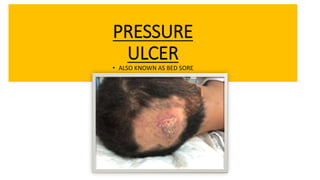
PRESSURE
ULCER
• ALSO KNOWN AS BED SORE
• In 1859 Florence Nightingale wrote, “If he has a bed
sore, it’s generally not the fault of the disease, but of
the nursing.”
Definition
• Ulcer :- an open sore on an external or internal surface of the body,
caused by a break in the skin or mucous membrane which fails to heal
• A pressure ulcer is localized injury to the skin and/or underlying tissue
(usually over bony prominence) as a result of pressure or pressure in
combination with shear and/or friction.
• Continuous prolonged pressure of >30mmHg
Risk Factors
• Advanced age
• Anemia
• D.M
• Immobility
• Impaired circulation
• Low diastolic B.P <60mmHg
• Obesity
• Vascular disease
• Neurological disorders
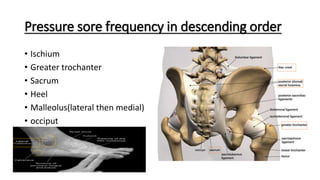
Pressure sore frequency in descending order
• Ischium
• Greater trochanter
• Sacrum
• Heel
• Malleolus(lateral then medial)
• occiput
Factors influencing
1. Intensity
2. Duration
3. Shearing force
4. Friction
5. Excessive moisture
6. Ability of patient’s tissue to tolerate the externally applied pressure.
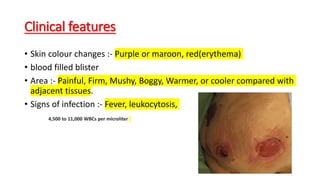
Clinical features
• Skin colour changes :- Purple or maroon, red(erythema)
• blood filled blister
• Area :- Painful, Firm, Mushy, Boggy, Warmer, or cooler compared with
adjacent tissues.
• Signs of infection :- Fever, leukocytosis,
4,500 to 11,000 WBCs per microliter
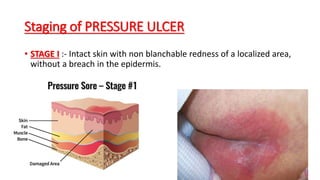
Staging of PRESSURE ULCER
• STAGE I :- Intact skin with non blanchable redness of a localized area,
without a breach in the epidermis.
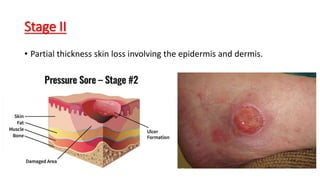
Stage II
• Partial thickness skin loss involving the epidermis and dermis.
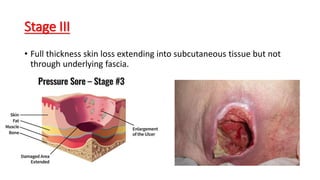
Stage III
• Full thickness skin loss extending into subcutaneous tissue but not
through underlying fascia.
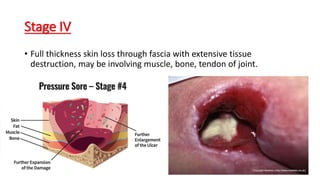
Stage IV
• Full thickness skin loss through fascia with extensive tissue
destruction, may be involving muscle, bone, tendon of joint.
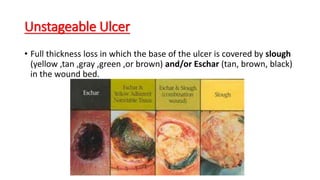
Unstageable Ulcer
• Full thickness loss in which the base of the ulcer is covered by slough
(yellow ,tan ,gray ,green ,or brown) and/or Eschar (tan, brown, black)
in the wound bed.
Management of Ulcers.
• Collaborative Care:- Medical, Surgical And nursing
• Debridement
• Dressing
• Flap cover
• Vac Dressing
• Hyperbaric oxygen therapy
• Pain management
• Nutrition
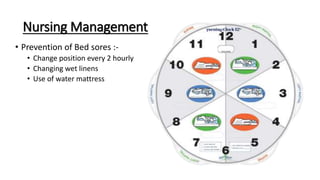
Nursing Management
• Prevention of Bed sores :-
• Change position every 2 hourly
• Changing wet linens
• Use of water mattress
Dressing
• Pre procedure
• Perform hand hygiene
• Provide patient privacy
• Introduce yourself
• Use two patient identification
• Ensure patient safety
• Ensure proper body mechanics
• Gather all supplies
• During Procedure
• Assess the patient
• Explain the procedure to patient
• Remove old dressing and assess the wound :- Edges and wound bed(Sloughs and
eschar)
• Assess the wound for presence of infection, granulated tissue, exudates, sloughs,
eschar
• Assess the wound healing and any signs of complications.
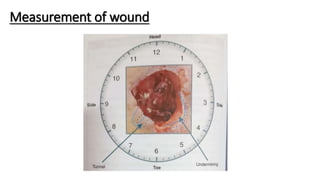
• Measurement of the wound.
• Irrigation
• Repack wound
• Apply sterile top dressing
• Secure dressing
• After the procedure
• Label
• Dispose
• Wash hands
• Documentation
Measurement of wound
Surgical Management
• Debridement
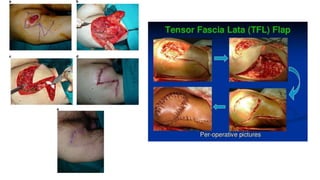
• Flap cover
• Tensor Fascia Lata (TFL): It is a fusiform muscle enclosed between two layers
of fascia lata with a length of 15cm approximately and overlying the gluteus
minimus and some part of the gluteus medius.
Medical Management
• Nonsteroidal anti-inflammatory drugs — such as ibuprofen (Advil, Motrin IB, others)
and naproxen sodium (Aleve).
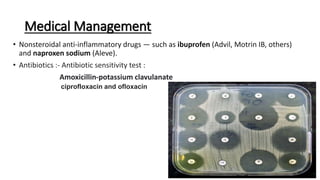
• Antibiotics :- Antibiotic sensitivity test :
Amoxicillin-potassium clavulanate
ciprofloxacin and ofloxacin
Therapies
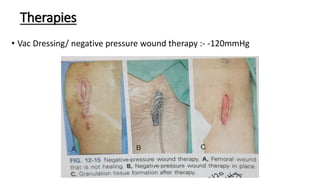
• Vac Dressing/ negative pressure wound therapy :- -120mmHg
Hyperbaric Oxygen therapy
Administration of 100% oxygen to patient placed inside a chamber pressurized to
greater than 1 atmosphere i.e. where oxygen dissolve in arterial blood plasma in
increased amount thus this dissolved plasma oxygen is carried to different tissues.
MOA :- Angiogenesis :- Increase oxygen tension increases vascular endothelial
growth factor function as well secretion of matrix by fibroblasts
Pressure :- 2.4 atm, Max : 3atm, 4 atm induces seizures
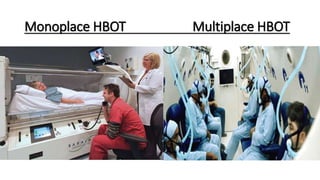
Monoplace HBOT Multiplace HBOT
Nursing assessment
• Assess patients for pressure ulcer risk initially on admission and at periodic intervals based
on the patient’s condition.
• Subjective data :-
• Important health information : Past health history, medication
• Functional health patterns : Nutritional metabolic, elimination, activity-exercise, cognitive-
perceptual
• Objective data:-
• General : Fever
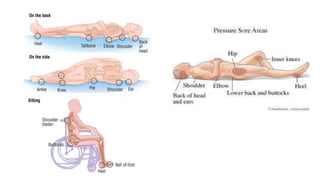
• Integumentary :Diaphoresis, edema, discoloration especially over bony areas such as sacrum,
hips, elbows, heels, keens, ankles, shoulders and ear rims, progressing to increased tissue
damage characteristic of ulcer stages
• Possible diagnostic findings: leukocytosis, positive cultures for microorganism from pressure
ulcer.
• Safety alert :-
• In acute care reassess patient for pressure ulcer every 24 hrs.
• In long term care reassess residents weekly for the first four weeks after
admission and then at least monthly or quarterly.
• In home care reassess patients at every nurse visit.
NURSING DIAGNOSIS
• Nursing diagnosis for the patients with a pressure ulcer may include, but are not
limited to, the following
• Impaired skin integrity related to mechanical factors and physical
immobilization.
• Impaired tissue integrity related to impaired circulation and imbalanced
nutritional state.
Planning
1. Have no deterioration of the ulcer
2. Reduce or eliminate the factors that lead to pressure ulcers
3. Not develop an infection in the pressure ulcers
4. Have healing of pressure ulcers
5. Have no recurrence
Nursing Implementation
• Health Promotion: identification of patient’s at risk for developing
pressure ulcers and implementation of pressure ulcer prevention
strategies for those who are at risk
Safety Alert
• Reposition patients frequently to prevent pressure ulcers every 2 hrs
• Use device to reduce pressure and shearing force : low-air loss mattress,
foam mattress, wheelchair cushions, padded commode seats, as
appropriate.
• These device do not replace the need for frequent repositioning
• Acute intervention :
• Wound and support measures
• Adequate nutrition
• Pain management
• Control of other medical conditions
• Pressure relief
• Ambulatory and home care
• Teaching prevention techniques to both the patient and the care giver is
extremely important.
PRESSURE ULCER / BED SORE

PRESSURE ULCER / BED SORE

  • 1.
    Answer 1. Why itis important to do Bed Making? 2. How many times a day a patient in ICU needs a bed making? Mr. Satish T R Nursing Tutor RKM SON, VIJAYAPUR
  • 2.
  • 3.
    • In 1859Florence Nightingale wrote, “If he has a bed sore, it’s generally not the fault of the disease, but of the nursing.”
  • 4.
    Definition • Ulcer :-an open sore on an external or internal surface of the body, caused by a break in the skin or mucous membrane which fails to heal • A pressure ulcer is localized injury to the skin and/or underlying tissue (usually over bony prominence) as a result of pressure or pressure in combination with shear and/or friction. • Continuous prolonged pressure of >30mmHg
  • 5.
    Risk Factors • Advancedage • Anemia • D.M • Immobility • Impaired circulation • Low diastolic B.P <60mmHg • Obesity • Vascular disease • Neurological disorders
  • 6.
    Pressure sore frequencyin descending order • Ischium • Greater trochanter • Sacrum • Heel • Malleolus(lateral then medial) • occiput
  • 8.
    Factors influencing 1. Intensity 2.Duration 3. Shearing force 4. Friction 5. Excessive moisture 6. Ability of patient’s tissue to tolerate the externally applied pressure.
  • 9.
    Clinical features • Skincolour changes :- Purple or maroon, red(erythema) • blood filled blister • Area :- Painful, Firm, Mushy, Boggy, Warmer, or cooler compared with adjacent tissues. • Signs of infection :- Fever, leukocytosis, 4,500 to 11,000 WBCs per microliter
  • 10.
    Staging of PRESSUREULCER • STAGE I :- Intact skin with non blanchable redness of a localized area, without a breach in the epidermis.
  • 11.
    Stage II • Partialthickness skin loss involving the epidermis and dermis.
  • 12.
    Stage III • Fullthickness skin loss extending into subcutaneous tissue but not through underlying fascia.
  • 13.
    Stage IV • Fullthickness skin loss through fascia with extensive tissue destruction, may be involving muscle, bone, tendon of joint.
  • 14.
    Unstageable Ulcer • Fullthickness loss in which the base of the ulcer is covered by slough (yellow ,tan ,gray ,green ,or brown) and/or Eschar (tan, brown, black) in the wound bed.
  • 15.
    Management of Ulcers. •Collaborative Care:- Medical, Surgical And nursing • Debridement • Dressing • Flap cover • Vac Dressing • Hyperbaric oxygen therapy • Pain management • Nutrition
  • 16.
    Nursing Management • Preventionof Bed sores :- • Change position every 2 hourly • Changing wet linens • Use of water mattress
  • 17.
    Dressing • Pre procedure •Perform hand hygiene • Provide patient privacy • Introduce yourself • Use two patient identification • Ensure patient safety • Ensure proper body mechanics • Gather all supplies
  • 18.
    • During Procedure •Assess the patient • Explain the procedure to patient • Remove old dressing and assess the wound :- Edges and wound bed(Sloughs and eschar) • Assess the wound for presence of infection, granulated tissue, exudates, sloughs, eschar • Assess the wound healing and any signs of complications. • Measurement of the wound. • Irrigation • Repack wound • Apply sterile top dressing • Secure dressing • After the procedure • Label • Dispose • Wash hands • Documentation
  • 19.
  • 20.
    Surgical Management • Debridement •Flap cover • Tensor Fascia Lata (TFL): It is a fusiform muscle enclosed between two layers of fascia lata with a length of 15cm approximately and overlying the gluteus minimus and some part of the gluteus medius.
  • 22.
    Medical Management • Nonsteroidalanti-inflammatory drugs — such as ibuprofen (Advil, Motrin IB, others) and naproxen sodium (Aleve). • Antibiotics :- Antibiotic sensitivity test : Amoxicillin-potassium clavulanate ciprofloxacin and ofloxacin
  • 23.
    Therapies • Vac Dressing/negative pressure wound therapy :- -120mmHg
  • 24.
    Hyperbaric Oxygen therapy Administrationof 100% oxygen to patient placed inside a chamber pressurized to greater than 1 atmosphere i.e. where oxygen dissolve in arterial blood plasma in increased amount thus this dissolved plasma oxygen is carried to different tissues. MOA :- Angiogenesis :- Increase oxygen tension increases vascular endothelial growth factor function as well secretion of matrix by fibroblasts Pressure :- 2.4 atm, Max : 3atm, 4 atm induces seizures
  • 25.
  • 27.
    Nursing assessment • Assesspatients for pressure ulcer risk initially on admission and at periodic intervals based on the patient’s condition. • Subjective data :- • Important health information : Past health history, medication • Functional health patterns : Nutritional metabolic, elimination, activity-exercise, cognitive- perceptual • Objective data:- • General : Fever • Integumentary :Diaphoresis, edema, discoloration especially over bony areas such as sacrum, hips, elbows, heels, keens, ankles, shoulders and ear rims, progressing to increased tissue damage characteristic of ulcer stages • Possible diagnostic findings: leukocytosis, positive cultures for microorganism from pressure ulcer.
  • 28.
    • Safety alert:- • In acute care reassess patient for pressure ulcer every 24 hrs. • In long term care reassess residents weekly for the first four weeks after admission and then at least monthly or quarterly. • In home care reassess patients at every nurse visit. NURSING DIAGNOSIS • Nursing diagnosis for the patients with a pressure ulcer may include, but are not limited to, the following • Impaired skin integrity related to mechanical factors and physical immobilization. • Impaired tissue integrity related to impaired circulation and imbalanced nutritional state.
  • 29.
    Planning 1. Have nodeterioration of the ulcer 2. Reduce or eliminate the factors that lead to pressure ulcers 3. Not develop an infection in the pressure ulcers 4. Have healing of pressure ulcers 5. Have no recurrence
  • 30.
    Nursing Implementation • HealthPromotion: identification of patient’s at risk for developing pressure ulcers and implementation of pressure ulcer prevention strategies for those who are at risk Safety Alert • Reposition patients frequently to prevent pressure ulcers every 2 hrs • Use device to reduce pressure and shearing force : low-air loss mattress, foam mattress, wheelchair cushions, padded commode seats, as appropriate. • These device do not replace the need for frequent repositioning
  • 31.
    • Acute intervention: • Wound and support measures • Adequate nutrition • Pain management • Control of other medical conditions • Pressure relief • Ambulatory and home care • Teaching prevention techniques to both the patient and the care giver is extremely important.