Why Should the Project Team Develop a BIM
Project Execution Plan?
Introduction to BIM Execution Plan
Purpose of a BIM Project Execution Plan (BIM Plan):
• Provides a vision and implementation roadmap
• Ensures structured integration of BIM throughout project phases
• Promotes team alignment and clarity of roles
Timing and Evolution of the BIM Plan
•Initiated early in the project lifecycle
•Developed continuously as team members join
•Monitored, updated, and revised throughout implementation
Key Elements of a BIM Plan
• A comprehensive BIM Plan should:
• Define scope of BIM implementation
• Identify BIM task process flows
• Define information exchanges between parties
• Describe required project and company infrastructure
Value of a BIM Plan – Strategic Alignment
1. Clear understanding of strategic goals for BIM use
2. Defines roles and responsibilities of each organization
3. Customizable to fit each team's business practices and workflows
Value of a BIM Plan – Operational Benefits
1. Identifies needed resources, training, and competencies
2. Acts as a benchmark for onboarding new participants
3. Helps contract divisions define enforceable BIM obligations
4. Provides a baseline for measuring implementation progress
Risk Reduction Through Planning
• BIM introduces process risks if not planned properly
• Lack of team experience or coordination increases risk
• A well-developed BIM Plan:
• Reduces unknowns
• Minimizes overall project risk
• Enhances team coordination and confidence
The BIM Project Execution Planning Procedure
A four steps procedure to develop a detailed BIM Plan consist
of
1.identifying the appropriate BIM goals and uses on a project
2.designing the BIM execution process
3.defining the BIM deliverables
4.identifying the supporting infrastructure to successfully
implement the plan.
Identify BIM Goals and Uses
Defining the overall goals for BIM implementation that could be based on project performance and include
items such as
• reducing the schedule duration,
• achieving higher field productivity,
• increasing quality,
• Reducing cost of change orders,
• or obtaining important operational data for the facility.
Once the team has defined measurable goals, both from a project perspective and company perspective, then
the specific BIM uses on the project can be identified.
Design the BIM Execution Process
• Once the team has identified the BIM Uses, a process mapping procedure for
planning the BIM implementation needs to be performed. Initially, a high level map
showing the sequencing and interaction between the primary BIM Uses on the
project is developed After the high level map is developed, then more detailed
process maps should be selected or designed by the team members responsible for
each detailed BIM Use.
Develop Information
Exchanges
• Once the appropriate
process maps have been
developed, the
information exchanges
which occur between the
project participants
should be clearly
identified. It is important
for the team members, in
particular the author and
receiver for each
information exchange
transaction, to clearly
understand the
information content.
Define Supporting Infrastructure for BIM Implementation
• After the BIM uses for the project have been identified, the project process maps are customized, and the
BIM deliverables are defined, the team must develop the infrastructure needed on the project to support
the planned BIM process. This will include the definition of the delivery structure and contract language;
defining the communication procedures; defining the technology infrastructure; and identifying quality
control procedures to ensure high quality information models.
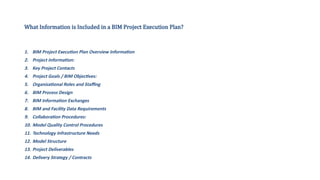
What Information is Included in a BIM Project Execution Plan?
1. BIM Project Execution Plan Overview Information
2. Project Information:
3. Key Project Contacts
4. Project Goals / BIM Objectives:
5. Organizational Roles and Staffing
6. BIM Process Design
7. BIM Information Exchanges
8. BIM and Facility Data Requirements
9. Collaboration Procedures:
10. Model Quality Control Procedures
11. Technology Infrastructure Needs
12. Model Structure
13. Project Deliverables
14. Delivery Strategy / Contracts
Who Should Develop the BIM Plan?
• To develop the BIM Plan, a planning team should be assembled in the early stages of a project. This
• team should consist of representatives from all the primary project team members including the owner,
• designers, contractors, engineers, major specialty contractors, facility manager, and project owner.
• The lead party for coordinating and compiling the BIM Plan should be clearly identified. This role may
• vary based on the project delivery method, the timing of the BIM Plan development, and the expertise
• of the participants. Parties who may lead this planning initiative could include the owner, architect,
• program manager, or construction manager.
What Meetings are Needed to Successfully Develop the BIM Plan?
• The planning team should conduct a series of
• planning meetings to develop the execution plan. On most projects a minimum of two or three
• meetings will be needed to develop the overall BIM Plan. The initial meeting will need to have key
• decision makers for all organizations. Follow-up meetings will require fewer people, and be more
• targeted on the details related to execution.
The BIM Project Execution Planning Concept
BIM Uses throughout a Building Lifecycle
BIM Use Selection Procedure
New Microsoft PowerPoint Presentation.pptx

New Microsoft PowerPoint Presentation.pptx

  • 2.
    Why Should theProject Team Develop a BIM Project Execution Plan?
  • 3.
    Introduction to BIMExecution Plan Purpose of a BIM Project Execution Plan (BIM Plan): • Provides a vision and implementation roadmap • Ensures structured integration of BIM throughout project phases • Promotes team alignment and clarity of roles
  • 4.
    Timing and Evolutionof the BIM Plan •Initiated early in the project lifecycle •Developed continuously as team members join •Monitored, updated, and revised throughout implementation
  • 5.
    Key Elements ofa BIM Plan • A comprehensive BIM Plan should: • Define scope of BIM implementation • Identify BIM task process flows • Define information exchanges between parties • Describe required project and company infrastructure
  • 6.
    Value of aBIM Plan – Strategic Alignment 1. Clear understanding of strategic goals for BIM use 2. Defines roles and responsibilities of each organization 3. Customizable to fit each team's business practices and workflows
  • 7.
    Value of aBIM Plan – Operational Benefits 1. Identifies needed resources, training, and competencies 2. Acts as a benchmark for onboarding new participants 3. Helps contract divisions define enforceable BIM obligations 4. Provides a baseline for measuring implementation progress
  • 8.
    Risk Reduction ThroughPlanning • BIM introduces process risks if not planned properly • Lack of team experience or coordination increases risk • A well-developed BIM Plan: • Reduces unknowns • Minimizes overall project risk • Enhances team coordination and confidence
  • 9.
    The BIM ProjectExecution Planning Procedure A four steps procedure to develop a detailed BIM Plan consist of 1.identifying the appropriate BIM goals and uses on a project 2.designing the BIM execution process 3.defining the BIM deliverables 4.identifying the supporting infrastructure to successfully implement the plan.
  • 10.
    Identify BIM Goalsand Uses Defining the overall goals for BIM implementation that could be based on project performance and include items such as • reducing the schedule duration, • achieving higher field productivity, • increasing quality, • Reducing cost of change orders, • or obtaining important operational data for the facility. Once the team has defined measurable goals, both from a project perspective and company perspective, then the specific BIM uses on the project can be identified.
  • 11.
    Design the BIMExecution Process • Once the team has identified the BIM Uses, a process mapping procedure for planning the BIM implementation needs to be performed. Initially, a high level map showing the sequencing and interaction between the primary BIM Uses on the project is developed After the high level map is developed, then more detailed process maps should be selected or designed by the team members responsible for each detailed BIM Use.
  • 12.
    Develop Information Exchanges • Oncethe appropriate process maps have been developed, the information exchanges which occur between the project participants should be clearly identified. It is important for the team members, in particular the author and receiver for each information exchange transaction, to clearly understand the information content.
  • 13.
    Define Supporting Infrastructurefor BIM Implementation • After the BIM uses for the project have been identified, the project process maps are customized, and the BIM deliverables are defined, the team must develop the infrastructure needed on the project to support the planned BIM process. This will include the definition of the delivery structure and contract language; defining the communication procedures; defining the technology infrastructure; and identifying quality control procedures to ensure high quality information models.
  • 14.
    What Information isIncluded in a BIM Project Execution Plan? 1. BIM Project Execution Plan Overview Information 2. Project Information: 3. Key Project Contacts 4. Project Goals / BIM Objectives: 5. Organizational Roles and Staffing 6. BIM Process Design 7. BIM Information Exchanges 8. BIM and Facility Data Requirements 9. Collaboration Procedures: 10. Model Quality Control Procedures 11. Technology Infrastructure Needs 12. Model Structure 13. Project Deliverables 14. Delivery Strategy / Contracts
  • 15.
    Who Should Developthe BIM Plan? • To develop the BIM Plan, a planning team should be assembled in the early stages of a project. This • team should consist of representatives from all the primary project team members including the owner, • designers, contractors, engineers, major specialty contractors, facility manager, and project owner. • The lead party for coordinating and compiling the BIM Plan should be clearly identified. This role may • vary based on the project delivery method, the timing of the BIM Plan development, and the expertise • of the participants. Parties who may lead this planning initiative could include the owner, architect, • program manager, or construction manager.
  • 16.
    What Meetings areNeeded to Successfully Develop the BIM Plan? • The planning team should conduct a series of • planning meetings to develop the execution plan. On most projects a minimum of two or three • meetings will be needed to develop the overall BIM Plan. The initial meeting will need to have key • decision makers for all organizations. Follow-up meetings will require fewer people, and be more • targeted on the details related to execution.
  • 17.
    The BIM ProjectExecution Planning Concept
  • 18.
    BIM Uses throughouta Building Lifecycle
  • 19.