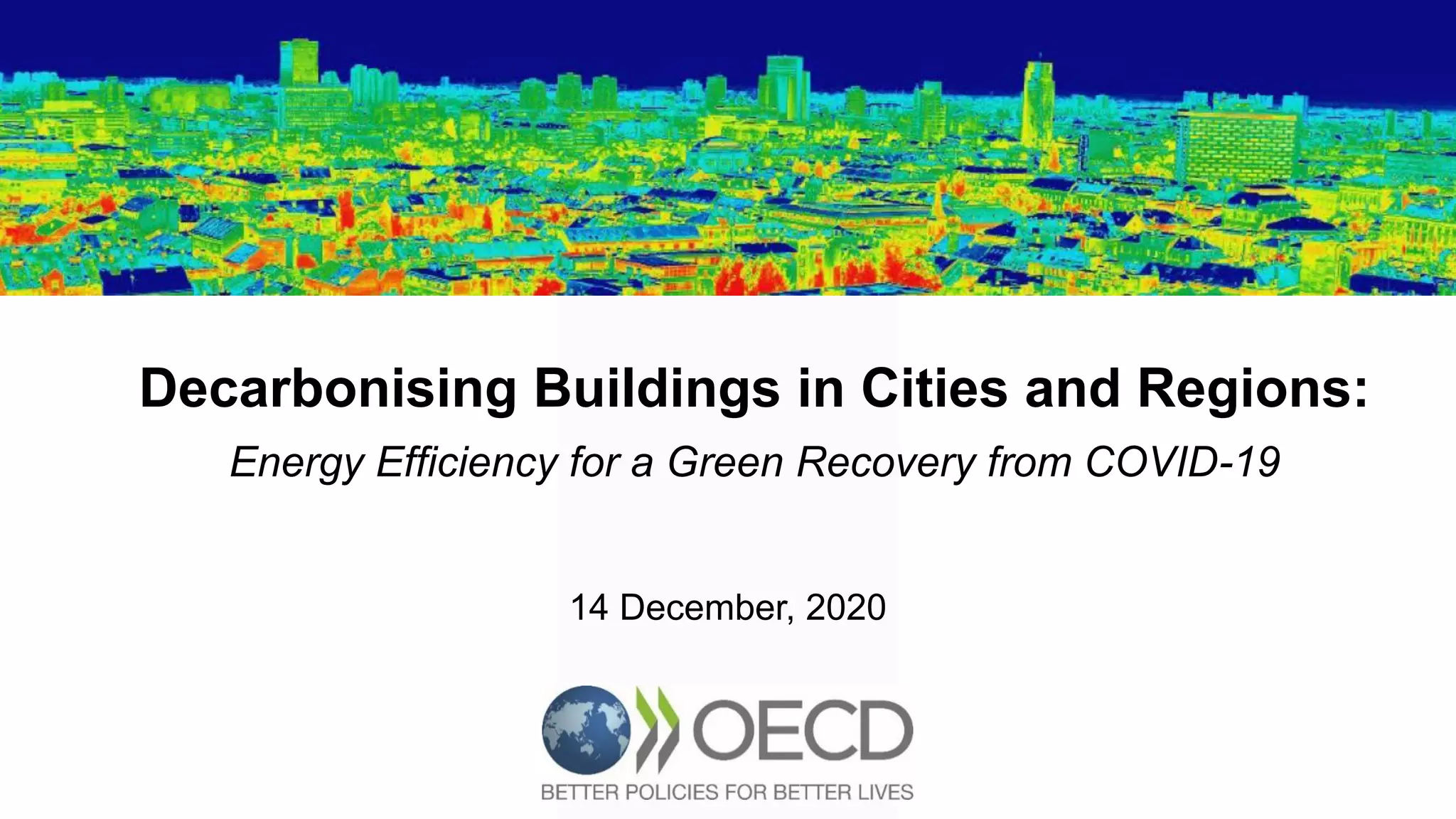
Decarbonising Buildings in Cities and Regions:
Energy Efficiency for a Green Recovery from COVID-19
14 December, 2020
Aziza Akhmouch
Head of Division
Cities, Urban Policies and Sustainable Development, OECD
Welcome
Time to hear from you – Poll
Setting the Scene
Atsuhito Oshima
Senior Policy Analyst
Cities, Urban Policies and Sustainable Development, OECD
Put picture
DECARBONISING BUILDINGS IN
CITIES AND REGIONS
CFE webinar: Decarbonising buildings in cities and regions
14 December 2020
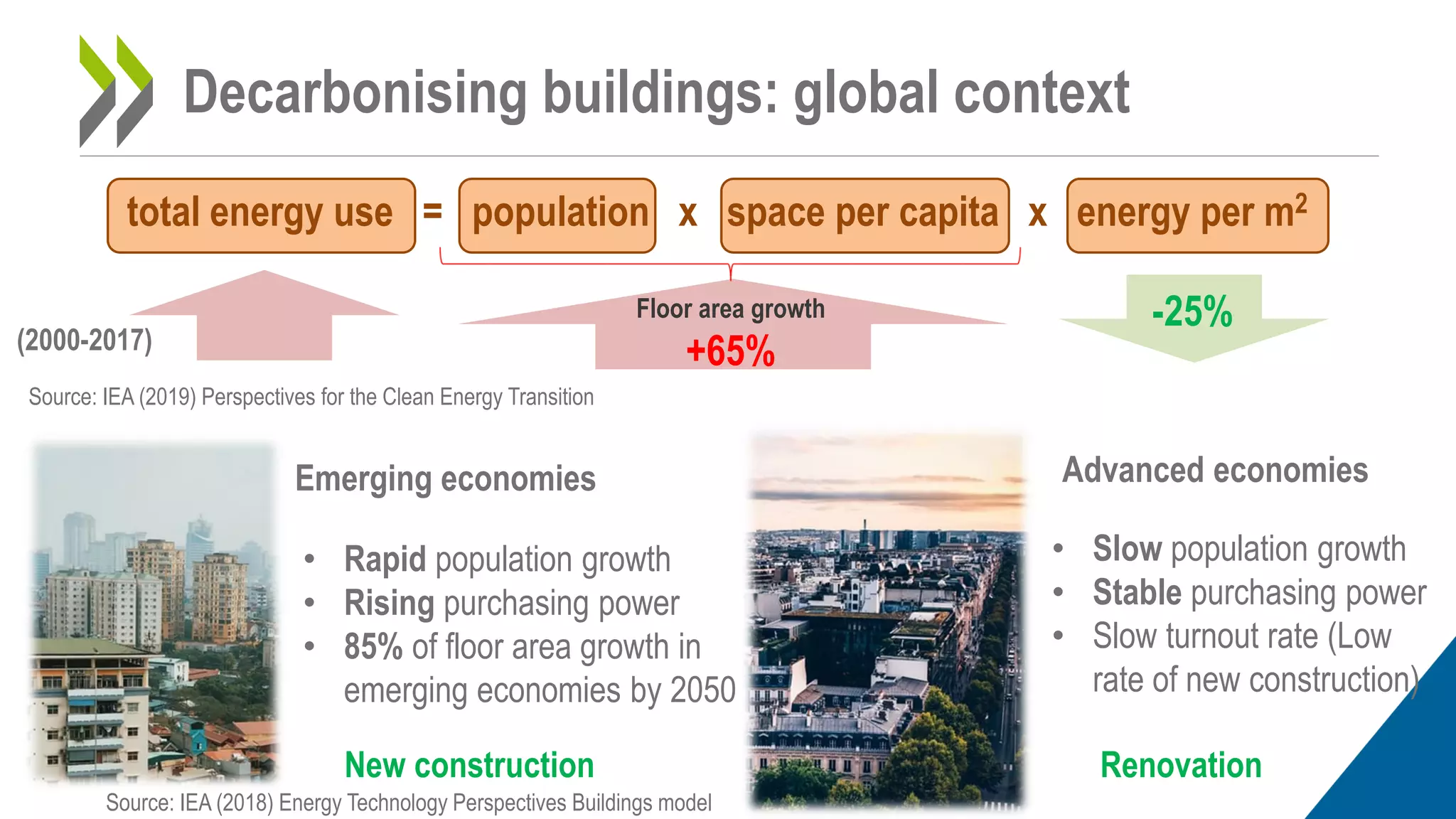
Decarbonising buildings: global context
total energy use = population x space per capita x energy per m2
-25%
(2000-2017)
Emerging economies Advanced economies
• Rapid population growth
• Rising purchasing power
• 85% of floor area growth in
emerging economies by 2050
• Slow population growth
• Stable purchasing power
• Slow turnout rate (Low
rate of new construction)
New construction Renovation
Floor area growth
+65%
Source: IEA (2019) Perspectives for the Clean Energy Transition
Source: IEA (2018) Energy Technology Perspectives Buildings model
Renovating buildings - key in COVID-19 recovery
7 7
Breakdown of residential building by constructions year, EU, 2014
Source: EU Buildings Database
A large portion of existing buildings were
built before the first thermal regulations.
Old buildings continue to consume energy
that could be saved in recent buildings.
Source: EU Buildings Database
U-value of external wall by building age (W/m2K, 2017)
Energy consumption differs across regions
Source: Joint Research Centre of the European Commission, OECD calculations.
Note: 2018, OECD, Romania and Bulgaria. Regional estimates exclude emissions from land use and land use change. National emissions are attributed to proxies,
including locations according to population, buildings, industrial and energy supply point sources, infrastructure, traffic flows and local data on agricultural activity.
Metro regions emit 60% of GHG emissions
in OECD, with high share from buildings.
Best-performing regions consume 3 times
less energy at home.
Disparities in energy consumption per capita, large regions (TL2), 2018Greenhouse gas emissions by types of regions
OECD (2020), Regions and Cities at a Glance
Energy efficiency as a way to ensure well-being
Housing energy performance
and excess winter mortality
Housing deprivation rate by degree of urbanization (EU-SILC)
Excess winter mortality is associated with
housing quality (deprivation).
Housing deprivation rate differs across places
and is higher in cities in most countries.
Source: Eurostat (EU-SILC survey)Source: Toshiharu Ikaga, Keio University
• Excess winter mortality is low in the regions with
higher percentage of energy-efficient houses.
Excess winter mortality rate
by prefecture
Percentage of energy-efficient houses by
prefecture
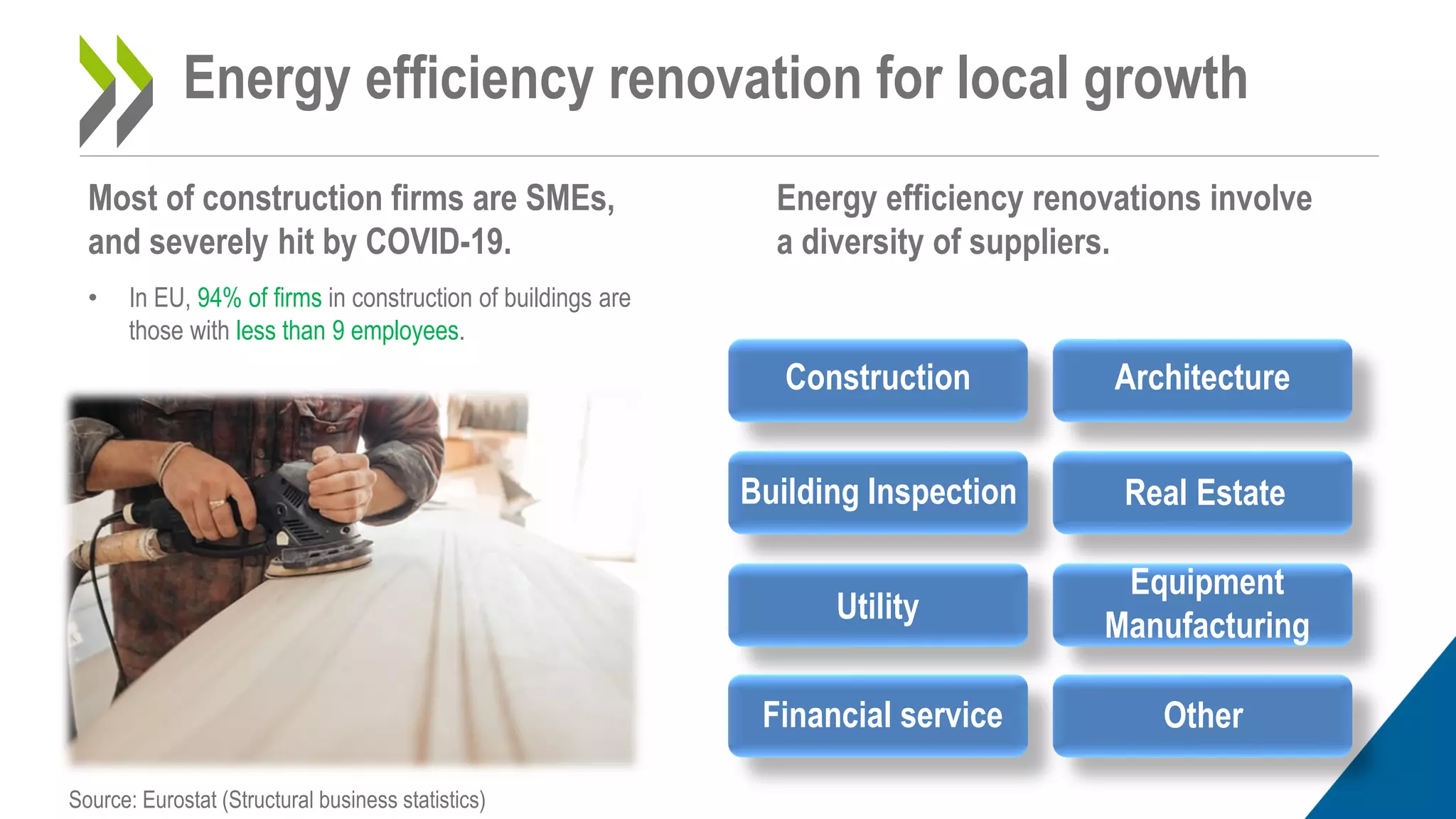
Energy efficiency renovation for local growth
Most of construction firms are SMEs,
and severely hit by COVID-19.
• In EU, 94% of firms in construction of buildings are
those with less than 9 employees.
Energy efficiency renovations involve
a diversity of suppliers.
Construction Architecture
Building Inspection Real Estate
Utility
Equipment
Manufacturing
Financial service Other
Source: Eurostat (Structural business statistics)
Cities and regions have a unique ability
Cities and regions can leverage public
building procurement for energy efficiency.
Cities and regions are familiar with key
local factors.
• Strategic approach to building stock
• Building database development
• Subnational governments account for 60% of public
investment in OECD countries.
OECD (2020), Regions and Cities at a Glance
Cities and regions are taking lead in local
innovation and experimentation.
Cities and regions can engage citizens and
local businesses effectively.
Homeowners
• Ambitious target setting / regulations
• Low-carbon district development / smart grids
• New business model & financing scheme
• Assistance to low-income households (energy poor)
• “One-stop shop” services for citizens
• Bundling renovations needs
Cities and regions are taking innovative actions
Decarbonising buildings: shared responsibility
13
National governments can play a vital
role to create enabling environments
for cities and regions.
Potential challenges at local scale
Insufficient local
market size
Barriers in
national regulations
Insufficient data
Insufficient
resources
OECD programme Building Energy Efficiency in Cities and Regions
Knowledge
sharing
Self-
assessment
tool
Case study
Questions for discussions
1. What are major policy challenges to decarbonise building stock
and how do these differ across cities and regions in your country?
2. What key roles can cities & regions play to decarbonise buildings?
Best practices or lessons learned from your country/region/city?
3. How can national governments support cities and regions in
unlocking their potential and enhancing innovative local actions?
4. What are impacts and implications of COVID-19 and how can we
support Green Recovery through EE measures in buildings?
THANK YOU FOR YOUR ATTENTION!
JOIN US  Atsuhito.Oshima@oecd.org
Panel discussion
Joram Snijders
Netherlands
Harunobu Murakami
Japan
Yves-Laurent Sapoval
France
Zachary May
British Columbia, Canada
Paula Rey Garcia
European Commission
Sara De Pablos
Council of Europe Development Bank
Joram Snijders
Senior Policy Officer
Ministry of the Interior and Kingdom Relations, Netherlands
Panellist (I)
15 december 2020 | Voettekst
Sustainability in the built
enviroment
Lessons learned and experiences from
the Netherlands
› Joram Snijders
› Ministry of the Interior and Kingdom Relations
› Joram.Snijders@minbzk.nl
19
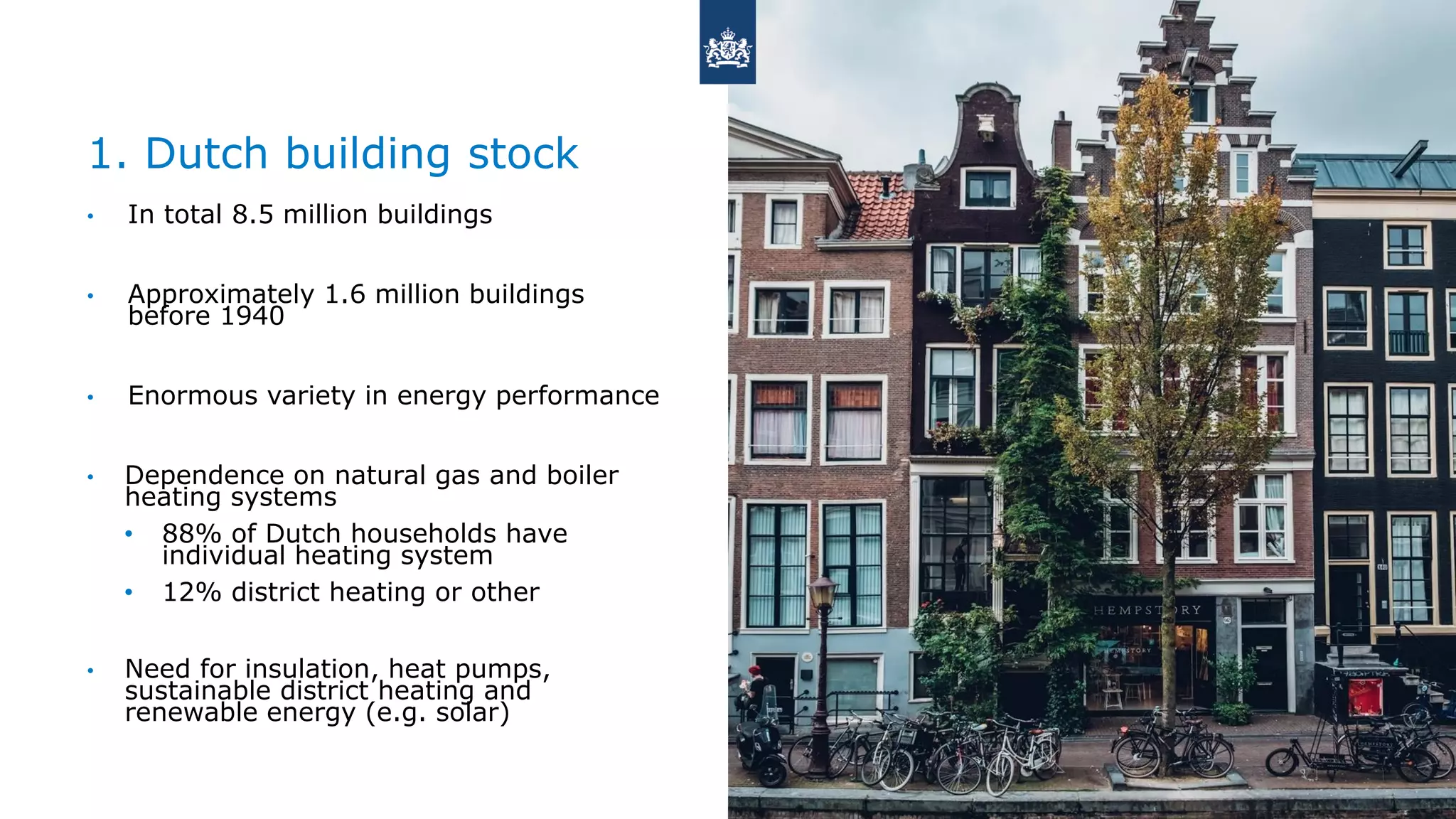
• In total 8.5 million buildings
• Approximately 1.6 million buildings
before 1940
• Enormous variety in energy performance
• Dependence on natural gas and boiler
heating systems
• 88% of Dutch households have
individual heating system
• 12% district heating or other
• Need for insulation, heat pumps,
sustainable district heating and
renewable energy (e.g. solar)
1. Dutch building stock
19
Dutch Climate Agreement over 100 parties
involved in negotiations.
Main challenges: affordability, speeding up
the process, public support and
participation.
Municipalities in charge of planning and
coordination. Provinces: spatial planning
and regional cooperation.
› Regional Energy Strategies
› Heat Transition Vision and plans
› District oriented approach
Dutch Climate Agreement
Role of municipalities and provinces
21
District-oriented approach
• 27 pilot neighbourhoods in 2019
• 19 pilot neighbourhoods in 2020
• Municipalities are in the lead,
participation of inhabitants, planning,
coordination of investments
• National government facilitates
We want to learn, share knowledge and
experience with different heating and
insulation techniques in different types of
buildings and neighbourhoods in close
collaboration with the inhabitants
 affordability, technical support, socio-
economic issues, public space
Harunobu Murakami
Director
International Affairs Office, Housing Bureau, Ministry of Land,
Infrastructure, Transport and Tourism, Japan
Panellist (II)
Ministry of Land, Infrastructure, Transport and Tourism
Decarbonising Buildings
in Cities and Regions in JAPAN
December 14, 2020
MURAKAMI Harunobu
MLIT, JAPAN
Carbon Neutral Society by 2050
Prime Minister’s Statement in Diet (Oct. 26, 2020)
• Japan will reduce greenhouse gas emissions to zero
as a whole by 2050.
• Japan aims to realize a carbon-neutral, carbon-free
society in 2050.
Local Governments
• An increasing number of local governments are
declaring a zero carbon city.
Major Policy Challenge & Roles
- Developing regulatory framework
• Conformity Obligation
• Notification Obligation
• Explanation Obligation, etc.
Local Government
Building Energy Conservation Act
National Government
- Enforcing building energy-
efficiency standards
- Environmental consideration
building systems
- CASBEE
- Setting energy-efficiency
standards in buildings
Considering for Japanese
Traditional Construction
Method
Comprehensive Assessment System for
Built Environment Efficiency (CASBEE)
Support by National Government (1)
• Pilot projects (Housing, buildings and districts with
high energy-efficiency performance)
• Energy-efficient renovation
• Seminars (for people and related industries)
1) Financial Support
Support by National Government (2)
3) Support for Small Contractors & Home Builders
• Seminars
• Subsidy
• Effects of thermal environment on health
non energy benefit
2) Survey
Insulating
renovation
Before After
Maximum blood
pressure dropped
by average of
3.5mmHg.
Conclusion
• An increasing number of cities in Japan
are proclaiming zero carbon in 2050.
• With regard to building and housing
policies, it is important to support local
efforts.
Yves-Laurent Sapoval
Senior Advisor
Ministry of Ecological and Inclusive Transition - Ministry of
Territorial Cohesion and Relations with Local Authorities,
France
Panellist (III)
Zachary May
Director
Strategic Policy, Ministry of Municipal Affairs and Housing,
Province of British Columbia, Canada
Panellist (IV)
31
Zachary May
Director, Strategic Policy
Province of British Columbia December 14, 2020
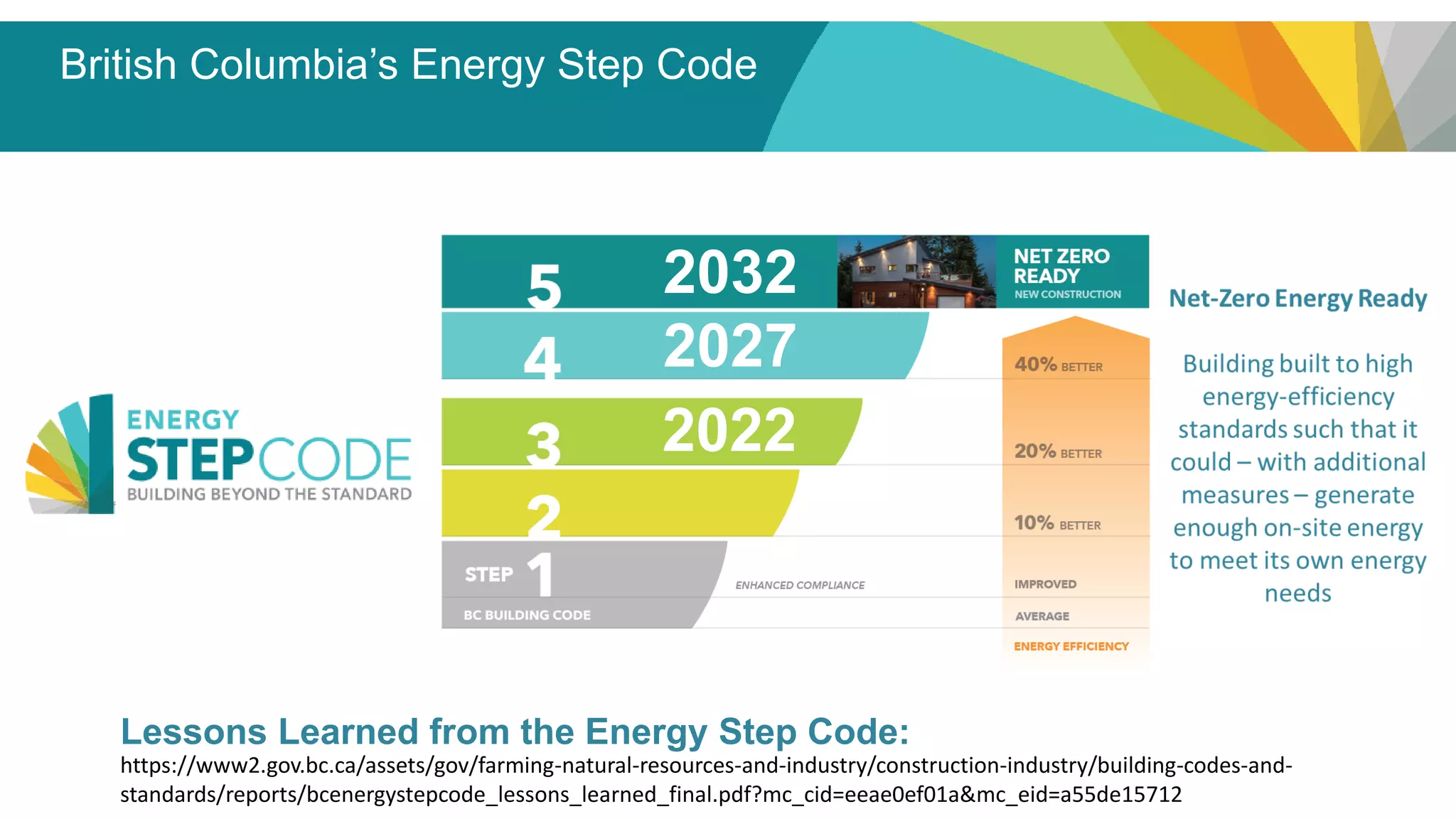
Energy Step Code – OverviewBritish Columbia’s Energy Step Code
2022
2027
2032
https://www2.gov.bc.ca/assets/gov/farming-natural-resources-and-industry/construction-industry/building-codes-and-
standards/reports/bcenergystepcode_lessons_learned_final.pdf?mc_cid=eeae0ef01a&mc_eid=a55de15712
Lessons Learned from the Energy Step Code:
Energy Step Code – OverviewNational Policy to Local Action
Energy Step Code – OverviewNeeded Supports
Remove Traditional Barriers
 Training for capacity building and improving skills
 Financial incentives for key barriers
 heat pumps, high performance windows, energy modelling services
• Support for emerging technologies
Integrate Change Across Society
 Align regulatory signals (e.g. safety codes, product standards, energy policy)
 Expand the message of transformation beyond energy to all parts of the sector (e.g.
insurance, procurement, real estate)
Integrate Data Transparency
 Strategy to improve availability of data related to building assets and operations
 Key for validating effectiveness of changes, maintaining confidence, improving
 Essential to address climate mitigation and adaptation/resilience in existing buildings
Paula Rey Garcia
Deputy Head of Unit
DG Energy, Unit C4- Energy Efficiency: Buildings and Products,
European Commission
Panellist (V)
DG Energy presentation Task Force Sector Coupling – Subgroup on Sector Integration
Renovation Wave
OECD WEBINAR DECARBONISING BUILDINGS IN CITIES AND REGIONS
Panel discussion
Paula Rey Garcia, deputy Head of Unit Energy efficiency: buildings and products
European Commission DG Energy
14 December 2020
for climate neutrality and recovery
Energy
A Renovation Wave for Europe –greening
our buildings, creating jobs, improving lives
Key messages
Mobilise forces at all levels in order to at least double the
annual energy renovation rate.
01
02
03
Energy efficient homes can, through renovation & new technology reduce
energy bills, improve health and living conditions and help our climate.
Around EUR 275 billion of additional investments in building
renovation is needed per year to achieve the 2030 targets.
Building renovation is EU's biggest job creator with
12-18 local jobs/million euro invested.
Focus areas: energy poverty & worst
performing buildings, public buildings,
heating & cooling.
05
04
https://ec.europa.eu/energy/topics/energy-efficiency/energy-efficient-buildings/renovation-wave_en
Energy
 Regions and cities directly manage large parts of the building
stock, including: schools, hospitals and service buildings.
 Local authorities have an important role in shaping the
regulatory framework, market conditions and skills and in
creating a robust pipeline of projects to finance the
modernisation of buildings and their heating and cooling
systems. They can drive district approaches to decarbonising
the built environment.
 Close partnership with the Committee of the Regions,
Covenant of mayors, and local and municipal authorities, and
the Smart cities marketplace. And strengthening of technical
assistance for local and regional authorities.
Renovation Wave: a shared project with regions
and cities playing a central role
Energy
 The Recovery Plan makes available to Member States
substantial funds under the Recovery and Resilience Facility,
which can be used for building renovations.
 “Renovate” as one of the priority flagship component.
 Member States, regions and local authorities should
seize the opportunity to finance investments in a local
context as part of the territorial instruments within the
various financing instruments
Renovation at the heart of a green recovery
Thank you!
Sara De Pablos
Environmental and Social Sustainability Advisor
Council of Europe Development Bank
Panellist (VI)
December 2020
Energy Efficiency for a Green Recovery
OECD
The social development bank in Europe
Profile and mission
 Multilateral development bank
 The oldest international financial institution in Europe (1956)and the only one with
an exclusively social mandate
 Initially established to tackle the problems of refugees, its scope has progressively
widened to other sectors strengthening social cohesion in Europe
Strategic priorities of the Development Plan 2020-2022
 Inclusive growth
 Support for vulnerable groups
 Environmental sustainability
Focus on further engaging with subnational entities- cities and regions.
In line with its social mandate the CEB is fully committed to providing timely, flexible and
targeted financing.
The CEB: Europe’s social development bank
CEB’s unique mandate – promoting social cohesion in Europe- makes it a natural
partner for regions and cities planning for a more sustainable future.
 Subnational Governments are responsible for a quarter of all public expenditures and almost half
of all public investment.
 Access to funding and knowledge is crucial at local level for creating an integrated approach to
territorial, programmatic, impact oriented and multi sectoral policies.
CEB’s increased engagement with sub-national authorities and municipalities
 Facilitate access to financial resources through flexible financing for local investments.
 Upgrade and reduce gaps in social infrastructure
 Increase access to and/or the ability to absorb EU funds.
Subnational financing at CEB is increasing
Between 2014-2019 the CEB approved almost €8 billion in loans to support social projects
locally across Europe.
1.4 billion EUR in 2019 and 1.7 billion EUR in 2020.
CEB: a trusted partner for Cities and Regions
Energy Efficiency renovation of buildings in CEB financing
 Since 2002, € 2.4 billion approved in favour of projects wholly or partially
concerned with EE. More than 75% was devoted solely to EE.
 Main focus for CEB: social housing, national public programmes, public buildings
and services from local and regional authorities, as well as EE needs for SME and
homeowners.
Supporting Energy Efficiency renovation through cities and regions
 Direct loans to municipalities, regional governments and other public entities to
support projects related to EE renovation of their own assets.
 EE renovation is included as a component of most CEB loans to subnational
authorities.
 Decarbonising building is increasingly a priority for subnational counterparties.
Decarbonising buildings in Cities and Regions
 EE renovations are linked to the specific local conditions of the building stock,
socio economic, institutional and geographical contexts.
 High level of fragmentation of the EE renovation market: larger financial flows
have to be aggregated by a single entity, such as sub-nationals, equipped to
interface with IFIs.
 Multiplicity of actors and financial sources increases complexity.
 Public authorities can optimize their financing by making best use of available
national or EU support programs or/and using innovative financing blending
mechanisms.
 Investment programs are more effective when carefully designed based on
relevant energy and climate studies and strategies (evaluation of the energy
savings potential, setting of energy and climate objectives, and preparation of an
action plan with clearly defined targets)
 Measuring and monitoring targets and results may be challenging.
Lessons learned
 Decarbonising buildings as a win win win strategy for recovery
e.g. the European Renovation Wave.
CEB stands ready to support its clients to fulfill such objectives: reduce emission,
boost recovery and reduce energy poverty.
 Key role of cities and regions in decarbonising the building stock.
Build back better locally and contribute to an inclusive and climate change resilient
recovery, while particularly enhancing social benefits at the local level.
 Challenges for Cities and Regions
 Decarbonisation of buildings face delays in many markets due to lock-downs and
social distancing (IEA report).
 Assessment of aggregated targets for decarbonising buildings, progress
monitoring and measuring potential benefits and policy outcomes.
Way forward and challenges for a green and
sustainable recovery
Thanks
For more information:
CEB Technical Brief: Investing in energy efficient renovation for a low carbon future
CEB Technical Brief: Investing in inclusive, resilient and sustainable social infrastructure
in Europe: the CEB’s experience.
https://coebank.org/en/
Questions & discussions
Wrap up and next steps
Put some picture or diagram
Thank you for participating!
@OECD_local
Follow us on Twitter and LinkedIn | Subscribe to our Newsletter|Check out our Website
cfecities@oecd.org |

Presentations: Decarbonising Buildings in Cities and Regions

  • 1.
    Decarbonising Buildings inCities and Regions: Energy Efficiency for a Green Recovery from COVID-19 14 December, 2020
  • 2.
    Aziza Akhmouch Head ofDivision Cities, Urban Policies and Sustainable Development, OECD Welcome
  • 3.
    Time to hearfrom you – Poll
  • 4.
    Setting the Scene AtsuhitoOshima Senior Policy Analyst Cities, Urban Policies and Sustainable Development, OECD Put picture
  • 5.
    DECARBONISING BUILDINGS IN CITIESAND REGIONS CFE webinar: Decarbonising buildings in cities and regions 14 December 2020
  • 6.
    Decarbonising buildings: globalcontext total energy use = population x space per capita x energy per m2 -25% (2000-2017) Emerging economies Advanced economies • Rapid population growth • Rising purchasing power • 85% of floor area growth in emerging economies by 2050 • Slow population growth • Stable purchasing power • Slow turnout rate (Low rate of new construction) New construction Renovation Floor area growth +65% Source: IEA (2019) Perspectives for the Clean Energy Transition Source: IEA (2018) Energy Technology Perspectives Buildings model
  • 7.
    Renovating buildings -key in COVID-19 recovery 7 7 Breakdown of residential building by constructions year, EU, 2014 Source: EU Buildings Database A large portion of existing buildings were built before the first thermal regulations. Old buildings continue to consume energy that could be saved in recent buildings. Source: EU Buildings Database U-value of external wall by building age (W/m2K, 2017)
  • 8.
    Energy consumption differsacross regions Source: Joint Research Centre of the European Commission, OECD calculations. Note: 2018, OECD, Romania and Bulgaria. Regional estimates exclude emissions from land use and land use change. National emissions are attributed to proxies, including locations according to population, buildings, industrial and energy supply point sources, infrastructure, traffic flows and local data on agricultural activity. Metro regions emit 60% of GHG emissions in OECD, with high share from buildings. Best-performing regions consume 3 times less energy at home. Disparities in energy consumption per capita, large regions (TL2), 2018Greenhouse gas emissions by types of regions OECD (2020), Regions and Cities at a Glance
  • 9.
    Energy efficiency asa way to ensure well-being Housing energy performance and excess winter mortality Housing deprivation rate by degree of urbanization (EU-SILC) Excess winter mortality is associated with housing quality (deprivation). Housing deprivation rate differs across places and is higher in cities in most countries. Source: Eurostat (EU-SILC survey)Source: Toshiharu Ikaga, Keio University • Excess winter mortality is low in the regions with higher percentage of energy-efficient houses. Excess winter mortality rate by prefecture Percentage of energy-efficient houses by prefecture
  • 10.
    Energy efficiency renovationfor local growth Most of construction firms are SMEs, and severely hit by COVID-19. • In EU, 94% of firms in construction of buildings are those with less than 9 employees. Energy efficiency renovations involve a diversity of suppliers. Construction Architecture Building Inspection Real Estate Utility Equipment Manufacturing Financial service Other Source: Eurostat (Structural business statistics)
  • 11.
    Cities and regionshave a unique ability Cities and regions can leverage public building procurement for energy efficiency. Cities and regions are familiar with key local factors. • Strategic approach to building stock • Building database development • Subnational governments account for 60% of public investment in OECD countries. OECD (2020), Regions and Cities at a Glance
  • 12.
    Cities and regionsare taking lead in local innovation and experimentation. Cities and regions can engage citizens and local businesses effectively. Homeowners • Ambitious target setting / regulations • Low-carbon district development / smart grids • New business model & financing scheme • Assistance to low-income households (energy poor) • “One-stop shop” services for citizens • Bundling renovations needs Cities and regions are taking innovative actions
  • 13.
    Decarbonising buildings: sharedresponsibility 13 National governments can play a vital role to create enabling environments for cities and regions. Potential challenges at local scale Insufficient local market size Barriers in national regulations Insufficient data Insufficient resources OECD programme Building Energy Efficiency in Cities and Regions Knowledge sharing Self- assessment tool Case study
  • 14.
    Questions for discussions 1.What are major policy challenges to decarbonise building stock and how do these differ across cities and regions in your country? 2. What key roles can cities & regions play to decarbonise buildings? Best practices or lessons learned from your country/region/city? 3. How can national governments support cities and regions in unlocking their potential and enhancing innovative local actions? 4. What are impacts and implications of COVID-19 and how can we support Green Recovery through EE measures in buildings?
  • 15.
    THANK YOU FORYOUR ATTENTION! JOIN US  Atsuhito.Oshima@oecd.org
  • 16.
    Panel discussion Joram Snijders Netherlands HarunobuMurakami Japan Yves-Laurent Sapoval France Zachary May British Columbia, Canada Paula Rey Garcia European Commission Sara De Pablos Council of Europe Development Bank
  • 17.
    Joram Snijders Senior PolicyOfficer Ministry of the Interior and Kingdom Relations, Netherlands Panellist (I)
  • 18.
    15 december 2020| Voettekst Sustainability in the built enviroment Lessons learned and experiences from the Netherlands › Joram Snijders › Ministry of the Interior and Kingdom Relations › Joram.Snijders@minbzk.nl
  • 19.
    19 • In total8.5 million buildings • Approximately 1.6 million buildings before 1940 • Enormous variety in energy performance • Dependence on natural gas and boiler heating systems • 88% of Dutch households have individual heating system • 12% district heating or other • Need for insulation, heat pumps, sustainable district heating and renewable energy (e.g. solar) 1. Dutch building stock 19
  • 20.
    Dutch Climate Agreementover 100 parties involved in negotiations. Main challenges: affordability, speeding up the process, public support and participation. Municipalities in charge of planning and coordination. Provinces: spatial planning and regional cooperation. › Regional Energy Strategies › Heat Transition Vision and plans › District oriented approach Dutch Climate Agreement Role of municipalities and provinces
  • 21.
    21 District-oriented approach • 27pilot neighbourhoods in 2019 • 19 pilot neighbourhoods in 2020 • Municipalities are in the lead, participation of inhabitants, planning, coordination of investments • National government facilitates We want to learn, share knowledge and experience with different heating and insulation techniques in different types of buildings and neighbourhoods in close collaboration with the inhabitants  affordability, technical support, socio- economic issues, public space
  • 22.
    Harunobu Murakami Director International AffairsOffice, Housing Bureau, Ministry of Land, Infrastructure, Transport and Tourism, Japan Panellist (II)
  • 23.
    Ministry of Land,Infrastructure, Transport and Tourism Decarbonising Buildings in Cities and Regions in JAPAN December 14, 2020 MURAKAMI Harunobu MLIT, JAPAN
  • 24.
    Carbon Neutral Societyby 2050 Prime Minister’s Statement in Diet (Oct. 26, 2020) • Japan will reduce greenhouse gas emissions to zero as a whole by 2050. • Japan aims to realize a carbon-neutral, carbon-free society in 2050. Local Governments • An increasing number of local governments are declaring a zero carbon city.
  • 25.
    Major Policy Challenge& Roles - Developing regulatory framework • Conformity Obligation • Notification Obligation • Explanation Obligation, etc. Local Government Building Energy Conservation Act National Government - Enforcing building energy- efficiency standards - Environmental consideration building systems - CASBEE - Setting energy-efficiency standards in buildings Considering for Japanese Traditional Construction Method Comprehensive Assessment System for Built Environment Efficiency (CASBEE)
  • 26.
    Support by NationalGovernment (1) • Pilot projects (Housing, buildings and districts with high energy-efficiency performance) • Energy-efficient renovation • Seminars (for people and related industries) 1) Financial Support
  • 27.
    Support by NationalGovernment (2) 3) Support for Small Contractors & Home Builders • Seminars • Subsidy • Effects of thermal environment on health non energy benefit 2) Survey Insulating renovation Before After Maximum blood pressure dropped by average of 3.5mmHg.
  • 28.
    Conclusion • An increasingnumber of cities in Japan are proclaiming zero carbon in 2050. • With regard to building and housing policies, it is important to support local efforts.
  • 29.
    Yves-Laurent Sapoval Senior Advisor Ministryof Ecological and Inclusive Transition - Ministry of Territorial Cohesion and Relations with Local Authorities, France Panellist (III)
  • 30.
    Zachary May Director Strategic Policy,Ministry of Municipal Affairs and Housing, Province of British Columbia, Canada Panellist (IV)
  • 31.
    31 Zachary May Director, StrategicPolicy Province of British Columbia December 14, 2020
  • 32.
    Energy Step Code– OverviewBritish Columbia’s Energy Step Code 2022 2027 2032 https://www2.gov.bc.ca/assets/gov/farming-natural-resources-and-industry/construction-industry/building-codes-and- standards/reports/bcenergystepcode_lessons_learned_final.pdf?mc_cid=eeae0ef01a&mc_eid=a55de15712 Lessons Learned from the Energy Step Code:
  • 33.
    Energy Step Code– OverviewNational Policy to Local Action
  • 34.
    Energy Step Code– OverviewNeeded Supports Remove Traditional Barriers  Training for capacity building and improving skills  Financial incentives for key barriers  heat pumps, high performance windows, energy modelling services • Support for emerging technologies Integrate Change Across Society  Align regulatory signals (e.g. safety codes, product standards, energy policy)  Expand the message of transformation beyond energy to all parts of the sector (e.g. insurance, procurement, real estate) Integrate Data Transparency  Strategy to improve availability of data related to building assets and operations  Key for validating effectiveness of changes, maintaining confidence, improving  Essential to address climate mitigation and adaptation/resilience in existing buildings
  • 35.
    Paula Rey Garcia DeputyHead of Unit DG Energy, Unit C4- Energy Efficiency: Buildings and Products, European Commission Panellist (V)
  • 36.
    DG Energy presentationTask Force Sector Coupling – Subgroup on Sector Integration Renovation Wave OECD WEBINAR DECARBONISING BUILDINGS IN CITIES AND REGIONS Panel discussion Paula Rey Garcia, deputy Head of Unit Energy efficiency: buildings and products European Commission DG Energy 14 December 2020 for climate neutrality and recovery
  • 37.
    Energy A Renovation Wavefor Europe –greening our buildings, creating jobs, improving lives Key messages Mobilise forces at all levels in order to at least double the annual energy renovation rate. 01 02 03 Energy efficient homes can, through renovation & new technology reduce energy bills, improve health and living conditions and help our climate. Around EUR 275 billion of additional investments in building renovation is needed per year to achieve the 2030 targets. Building renovation is EU's biggest job creator with 12-18 local jobs/million euro invested. Focus areas: energy poverty & worst performing buildings, public buildings, heating & cooling. 05 04 https://ec.europa.eu/energy/topics/energy-efficiency/energy-efficient-buildings/renovation-wave_en
  • 38.
    Energy  Regions andcities directly manage large parts of the building stock, including: schools, hospitals and service buildings.  Local authorities have an important role in shaping the regulatory framework, market conditions and skills and in creating a robust pipeline of projects to finance the modernisation of buildings and their heating and cooling systems. They can drive district approaches to decarbonising the built environment.  Close partnership with the Committee of the Regions, Covenant of mayors, and local and municipal authorities, and the Smart cities marketplace. And strengthening of technical assistance for local and regional authorities. Renovation Wave: a shared project with regions and cities playing a central role
  • 39.
    Energy  The RecoveryPlan makes available to Member States substantial funds under the Recovery and Resilience Facility, which can be used for building renovations.  “Renovate” as one of the priority flagship component.  Member States, regions and local authorities should seize the opportunity to finance investments in a local context as part of the territorial instruments within the various financing instruments Renovation at the heart of a green recovery
  • 40.
  • 41.
    Sara De Pablos Environmentaland Social Sustainability Advisor Council of Europe Development Bank Panellist (VI)
  • 42.
    December 2020 Energy Efficiencyfor a Green Recovery OECD The social development bank in Europe
  • 43.
    Profile and mission Multilateral development bank  The oldest international financial institution in Europe (1956)and the only one with an exclusively social mandate  Initially established to tackle the problems of refugees, its scope has progressively widened to other sectors strengthening social cohesion in Europe Strategic priorities of the Development Plan 2020-2022  Inclusive growth  Support for vulnerable groups  Environmental sustainability Focus on further engaging with subnational entities- cities and regions. In line with its social mandate the CEB is fully committed to providing timely, flexible and targeted financing. The CEB: Europe’s social development bank
  • 44.
    CEB’s unique mandate– promoting social cohesion in Europe- makes it a natural partner for regions and cities planning for a more sustainable future.  Subnational Governments are responsible for a quarter of all public expenditures and almost half of all public investment.  Access to funding and knowledge is crucial at local level for creating an integrated approach to territorial, programmatic, impact oriented and multi sectoral policies. CEB’s increased engagement with sub-national authorities and municipalities  Facilitate access to financial resources through flexible financing for local investments.  Upgrade and reduce gaps in social infrastructure  Increase access to and/or the ability to absorb EU funds. Subnational financing at CEB is increasing Between 2014-2019 the CEB approved almost €8 billion in loans to support social projects locally across Europe. 1.4 billion EUR in 2019 and 1.7 billion EUR in 2020. CEB: a trusted partner for Cities and Regions
  • 45.
    Energy Efficiency renovationof buildings in CEB financing  Since 2002, € 2.4 billion approved in favour of projects wholly or partially concerned with EE. More than 75% was devoted solely to EE.  Main focus for CEB: social housing, national public programmes, public buildings and services from local and regional authorities, as well as EE needs for SME and homeowners. Supporting Energy Efficiency renovation through cities and regions  Direct loans to municipalities, regional governments and other public entities to support projects related to EE renovation of their own assets.  EE renovation is included as a component of most CEB loans to subnational authorities.  Decarbonising building is increasingly a priority for subnational counterparties. Decarbonising buildings in Cities and Regions
  • 46.
     EE renovationsare linked to the specific local conditions of the building stock, socio economic, institutional and geographical contexts.  High level of fragmentation of the EE renovation market: larger financial flows have to be aggregated by a single entity, such as sub-nationals, equipped to interface with IFIs.  Multiplicity of actors and financial sources increases complexity.  Public authorities can optimize their financing by making best use of available national or EU support programs or/and using innovative financing blending mechanisms.  Investment programs are more effective when carefully designed based on relevant energy and climate studies and strategies (evaluation of the energy savings potential, setting of energy and climate objectives, and preparation of an action plan with clearly defined targets)  Measuring and monitoring targets and results may be challenging. Lessons learned
  • 47.
     Decarbonising buildingsas a win win win strategy for recovery e.g. the European Renovation Wave. CEB stands ready to support its clients to fulfill such objectives: reduce emission, boost recovery and reduce energy poverty.  Key role of cities and regions in decarbonising the building stock. Build back better locally and contribute to an inclusive and climate change resilient recovery, while particularly enhancing social benefits at the local level.  Challenges for Cities and Regions  Decarbonisation of buildings face delays in many markets due to lock-downs and social distancing (IEA report).  Assessment of aggregated targets for decarbonising buildings, progress monitoring and measuring potential benefits and policy outcomes. Way forward and challenges for a green and sustainable recovery
  • 48.
    Thanks For more information: CEBTechnical Brief: Investing in energy efficient renovation for a low carbon future CEB Technical Brief: Investing in inclusive, resilient and sustainable social infrastructure in Europe: the CEB’s experience. https://coebank.org/en/
  • 49.
  • 50.
    Wrap up andnext steps Put some picture or diagram
  • 51.
    Thank you forparticipating! @OECD_local Follow us on Twitter and LinkedIn | Subscribe to our Newsletter|Check out our Website cfecities@oecd.org |