How to Present
Presenting
 Your objectives in this step of selling are:
1. To create a differential competitive advantage for
your product with an overwhelming weight of
evidence.
2. To create value for your product
3. To build desire for your proposal
4. To establish conviction that your proposal is the best
one
5. To get a commitment
 Next steps
 A meeting with appropriate decision makers
 To move the sale forward – up the Sales Ladder
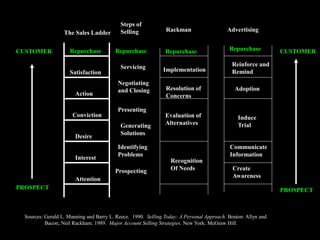
CUSTOMER
PROSPECT
Attention
Interest
Desire
Conviction
Action
Satisfaction
Repurchase
The Sales Ladder
Steps of
Selling
Repurchase
Servicing
Negotiating
and Closing
Presenting
Generating
Solutions
Identifying
Problems
Prospecting
Rackman
Implementation
Resolution of
Concerns
Evaluation of
Alternatives
Recognition
Of Needs
Advertising
Repurchase
Sources: Gerald L. Manning and Barry L. Reece. 1990. Selling Today: A Personal Approach. Boston: Allyn and
Bacon; Neil Rackham. 1989. Major Account Selling Strategies. New York: McGraw Hill.
Repurchase
Reinforce and
Remind
Adoption
Induce
Trial
Communicate
Information
Create
Awareness
PROSPECT
CUSTOMER
One-on-One Presenting
 Structure calls to take prospects up the Sales
Ladder
 Call structure allows you to set the agenda and
to keep your calls focused on selling/educating,
not extraneous matters.
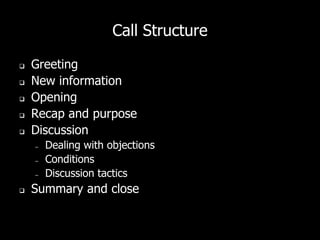
Call Structure
 Greeting
 New information
 Opening
 Recap and purpose
 Discussion
– Dealing with objections
– Conditions
– Discussion tactics
 Summary and close
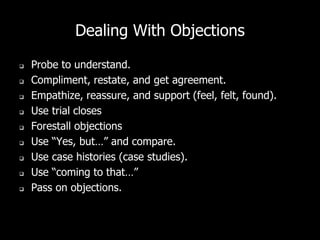
Dealing With Objections
 Probe to understand.
 Compliment, restate, and get agreement.
 Empathize, reassure, and support (feel, felt, found).
 Use trial closes
 Forestall objections
 Use “Yes, but…” and compare.
 Use case histories (case studies).
 Use “coming to that…”
 Pass on objections.
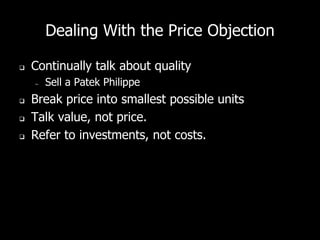
Dealing With the Price Objection
 Continually talk about quality
– Sell a Patek Philippe
 Break price into smallest possible units
 Talk value, not price.
 Refer to investments, not costs.
Conditions
 Recognize conditions
 Can’t overcome conditions
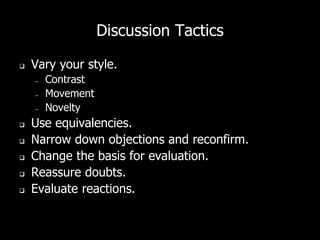
Discussion Tactics
 Vary your style.
– Contrast
– Movement
– Novelty
 Use equivalencies.
 Narrow down objections and reconfirm.
 Change the basis for evaluation.
 Reassure doubts.
 Evaluate reactions.
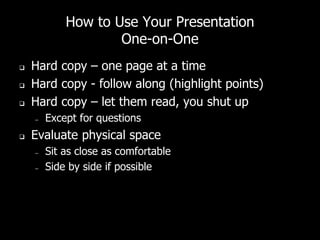
How to Use Your Presentation
One-on-One
 Hard copy – one page at a time
 Hard copy - follow along (highlight points)
 Hard copy – let them read, you shut up
– Except for questions
 Evaluate physical space
– Sit as close as comfortable
– Side by side if possible
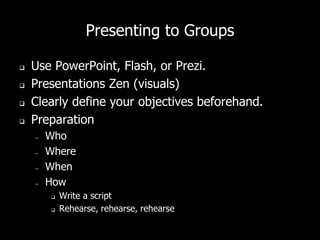
Presenting to Groups
 Use PowerPoint, Flash, or Prezi.
 Presentations Zen (visuals)
 Clearly define your objectives beforehand.
 Preparation
– Who
– Where
– When
– How
 Write a script
 Rehearse, rehearse, rehearse
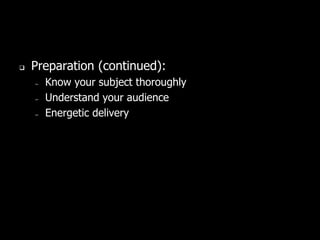
 Preparation (continued):
– Know your subject thoroughly
– Understand your audience
– Energetic delivery
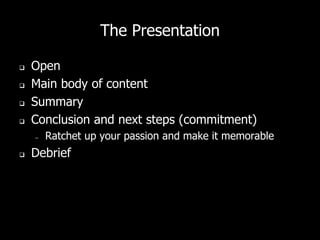
The Presentation
 Open
 Main body of content
 Summary
 Conclusion and next steps (commitment)
– Ratchet up your passion and make it memorable
 Debrief
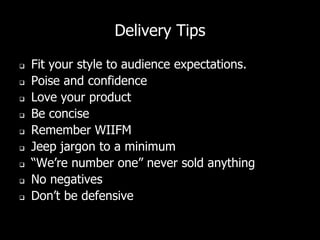
Delivery Tips
 Fit your style to audience expectations.
 Poise and confidence
 Love your product
 Be concise
 Remember WIIFM
 Jeep jargon to a minimum
 “We’re number one” never sold anything
 No negatives
 Don’t be defensive
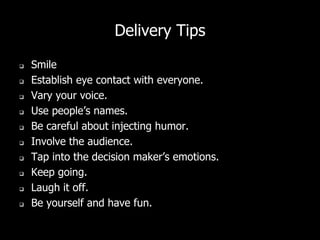
Delivery Tips
 Smile
 Establish eye contact with everyone.
 Vary your voice.
 Use people’s names.
 Be careful about injecting humor.
 Involve the audience.
 Tap into the decision maker’s emotions.
 Keep going.
 Laugh it off.
 Be yourself and have fun.
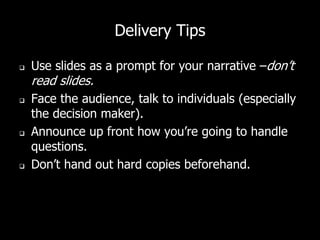
Delivery Tips
 Use slides as a prompt for your narrative –don’t
read slides.
 Face the audience, talk to individuals (especially
the decision maker).
 Announce up front how you’re going to handle
questions.
 Don’t hand out hard copies beforehand.
Killer Presentation Checklist
1. First slide with company’s name, logo, and a catchy
theme that communicates that you understand its
challenges and suggests a partnership.
2. Second slide with a concise Introduction which
includes a statement of the purpose of the presentation.
3. Agenda items or a Table of Contents
4. A list of the prospect's marketing and advertising
goals.
5. A list of the prospect's challenges in achieving those
goals.
Killer Presentations
6. A statement of the prospect's current strategy in achieving
marketing and advertising goals (differentiation, focus, low-cost
producer, e.g.).
7. A description of the prospect's primary customers/target
audience.
8. An identification of opportunities that are solutions to the
prospect's problems and challenges.
9. Present the advantages of your solution over your competition,
but don't knock the competition.
10. Present the benefits of your solutions (schedules, campaigns,
packages, etc.) to the prospect's challenges.
11. Show specifically how the solutions and recommendations
will make their business more profitable. Use an ROI
analysis if appropriate.
Killer Presentations
 Show relevant success stories and case studies from
similar customers as proof of your ability to perform and
get results.
 Show terms and conditions if they are different from
standard terms and conditions in your medium.
 A concise Summary of the main benefits and solutions.
 A Conclusion or Next Steps, both for you and for
prospects to implement the proposal and/or to advance
the partnership, which is a call for action or
commitment.
 An Appendix containing numbers and supporting
information.
Your Presentation
 Must be better, more persuasive, more
customer-focused, and offer more solutions than
your competitor’s presentations.
 Have you seen what you’re up against?

Presentations

  • 1.
  • 2.
    Presenting  Your objectivesin this step of selling are: 1. To create a differential competitive advantage for your product with an overwhelming weight of evidence. 2. To create value for your product 3. To build desire for your proposal 4. To establish conviction that your proposal is the best one 5. To get a commitment  Next steps  A meeting with appropriate decision makers  To move the sale forward – up the Sales Ladder
  • 3.
    CUSTOMER PROSPECT Attention Interest Desire Conviction Action Satisfaction Repurchase The Sales Ladder Stepsof Selling Repurchase Servicing Negotiating and Closing Presenting Generating Solutions Identifying Problems Prospecting Rackman Implementation Resolution of Concerns Evaluation of Alternatives Recognition Of Needs Advertising Repurchase Sources: Gerald L. Manning and Barry L. Reece. 1990. Selling Today: A Personal Approach. Boston: Allyn and Bacon; Neil Rackham. 1989. Major Account Selling Strategies. New York: McGraw Hill. Repurchase Reinforce and Remind Adoption Induce Trial Communicate Information Create Awareness PROSPECT CUSTOMER
  • 4.
    One-on-One Presenting  Structurecalls to take prospects up the Sales Ladder  Call structure allows you to set the agenda and to keep your calls focused on selling/educating, not extraneous matters.
  • 5.
    Call Structure  Greeting New information  Opening  Recap and purpose  Discussion – Dealing with objections – Conditions – Discussion tactics  Summary and close
  • 6.
    Dealing With Objections Probe to understand.  Compliment, restate, and get agreement.  Empathize, reassure, and support (feel, felt, found).  Use trial closes  Forestall objections  Use “Yes, but…” and compare.  Use case histories (case studies).  Use “coming to that…”  Pass on objections.
  • 7.
    Dealing With thePrice Objection  Continually talk about quality – Sell a Patek Philippe  Break price into smallest possible units  Talk value, not price.  Refer to investments, not costs.
  • 8.
    Conditions  Recognize conditions Can’t overcome conditions
  • 9.
    Discussion Tactics  Varyyour style. – Contrast – Movement – Novelty  Use equivalencies.  Narrow down objections and reconfirm.  Change the basis for evaluation.  Reassure doubts.  Evaluate reactions.
  • 10.
    How to UseYour Presentation One-on-One  Hard copy – one page at a time  Hard copy - follow along (highlight points)  Hard copy – let them read, you shut up – Except for questions  Evaluate physical space – Sit as close as comfortable – Side by side if possible
  • 11.
    Presenting to Groups Use PowerPoint, Flash, or Prezi.  Presentations Zen (visuals)  Clearly define your objectives beforehand.  Preparation – Who – Where – When – How  Write a script  Rehearse, rehearse, rehearse
  • 12.
     Preparation (continued): –Know your subject thoroughly – Understand your audience – Energetic delivery
  • 13.
    The Presentation  Open Main body of content  Summary  Conclusion and next steps (commitment) – Ratchet up your passion and make it memorable  Debrief
  • 14.
    Delivery Tips  Fityour style to audience expectations.  Poise and confidence  Love your product  Be concise  Remember WIIFM  Jeep jargon to a minimum  “We’re number one” never sold anything  No negatives  Don’t be defensive
  • 15.
    Delivery Tips  Smile Establish eye contact with everyone.  Vary your voice.  Use people’s names.  Be careful about injecting humor.  Involve the audience.  Tap into the decision maker’s emotions.  Keep going.  Laugh it off.  Be yourself and have fun.
  • 16.
    Delivery Tips  Useslides as a prompt for your narrative –don’t read slides.  Face the audience, talk to individuals (especially the decision maker).  Announce up front how you’re going to handle questions.  Don’t hand out hard copies beforehand.
  • 17.
    Killer Presentation Checklist 1.First slide with company’s name, logo, and a catchy theme that communicates that you understand its challenges and suggests a partnership. 2. Second slide with a concise Introduction which includes a statement of the purpose of the presentation. 3. Agenda items or a Table of Contents 4. A list of the prospect's marketing and advertising goals. 5. A list of the prospect's challenges in achieving those goals.
  • 18.
    Killer Presentations 6. Astatement of the prospect's current strategy in achieving marketing and advertising goals (differentiation, focus, low-cost producer, e.g.). 7. A description of the prospect's primary customers/target audience. 8. An identification of opportunities that are solutions to the prospect's problems and challenges. 9. Present the advantages of your solution over your competition, but don't knock the competition. 10. Present the benefits of your solutions (schedules, campaigns, packages, etc.) to the prospect's challenges. 11. Show specifically how the solutions and recommendations will make their business more profitable. Use an ROI analysis if appropriate.
  • 19.
    Killer Presentations  Showrelevant success stories and case studies from similar customers as proof of your ability to perform and get results.  Show terms and conditions if they are different from standard terms and conditions in your medium.  A concise Summary of the main benefits and solutions.  A Conclusion or Next Steps, both for you and for prospects to implement the proposal and/or to advance the partnership, which is a call for action or commitment.  An Appendix containing numbers and supporting information.
  • 20.
    Your Presentation  Mustbe better, more persuasive, more customer-focused, and offer more solutions than your competitor’s presentations.  Have you seen what you’re up against?