Candida
By-Amit Kumar 87b
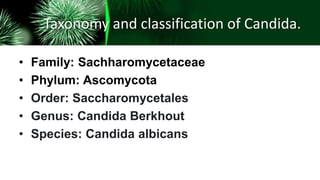
Taxonomy and classification of Candida.
• Family: Sachharomycetaceae
• Phylum: Ascomycota
• Order: Saccharomycetales
• Genus: Candida Berkhout
• Species: Candida albicans
Morphology
• Solitary,unicellular
• Reproduction via budding
• Rounded shape
• Moist and mucous colonies
• 10-12 microns in diameter
• Gram positive
• Grows overnight on most bacterial and fungal media
• Spores may be formed on the oseudomyceliym called chlamydospores and can be
used to identify different species of Candida.
Formation of Chlamydospres by candida albicans when cultured on cornmeat agar at 25 C.
Common species
Cultivation
Cultivation
Cultivation
Specific media such as ~abouraud dextrose agar
(Sabouraud glucose neo11eptone agar), which may
have an acid (pH 5.1:) or neutral pH, and to which
antibacterials may be added.
• Non-specific media can be made specific for the
isolation of fungi by the addition of antibacterials.
Examples are blood agar, brain heart infusion agar
or brain heart infusion broth.
C.Albicans C.glabrate C.tropicalis C.krusei
Candida on Chrome agar
Virulence factors of candida
• Adhesins are crucial in colonization and biofilm formation, an important
virulence factor for candidiasis. Calcineurin is involved in membrane and CW
stress as well as virulence
• The hyphae-specific toxin, named candidalysin, invades mucosal cells
facilitating fungal invasion into deeper tissues
• Candida albicans is a producer of extracellular hydrolytic enzymes. Among
them lipases, phospholipases and secreted aspartyl proteinases (Sap) are
most significant in virulence
• The main fungal virulence factors consist of its ability to grow at body
temperature, polysaccharide capsule, phospholipases and production of
melanin and extracellular vesicles.
Virulence factors of candida
Epidemiology
Epidemiology
Epidemiology
Epidemiology
(Nail infection)
Epidemiology
(GI tract)
Laboratory Diagnosis of Candida
Treatment
• Commonly treated with anitmycotics including topical clotrimazole
topical nystatin, fluconzale and topical ketoconazole.
• For blood infection one can take intravenous fluconazole or and
echinocandin such as caspofungin.
• For vaginal yeast infection in pregnancy topical imidazole or triazole
antifungals.
Presentation1.pptxPresentation1.pptxPresentation1.pptx

Presentation1.pptxPresentation1.pptxPresentation1.pptx