A GROUP OF MIDDLE SCHOOL STUDENTS TRYING TO
CHANGE THE WORLD ONE ANIMAL AT A TIME.
We may be young but we need your help to save something that keeps our world
running. We are their voice.
Find us on social media by searching any of the following:
Instagram: WAConservations
Pinterest/Email: waconservations@gmail.com
Twitter: Wacgroup2015
We are kids going to make a difference.
BOG TURTLES
Annabell Swank, Devlyn Yaroslawski, Christopher
Cornelison and Vonnya Summers
INFORMATION
• Bog turtles are one of the many endangered animals in PA
• They are one of the smallest turtles in the country!
• They are mainly endangered because they have little habitat
left.
• They have been endangered for almost more than 40
years!!
• Current bog turtle population is unknown, but
estimates range from 2,500 to 10,000.
• Invasive plants such as the purple loosestrife can dry
out large areas of suitable habitat.
Bog turtles are extremely sensitive to the effects of global warming.
Global Warming??
More Facts
• Bog turtles are omnivorous, plant and meat-eating animals.
• Their diet consists of insects, beetles, seeds, pondweeds, berries,
and snails.
• The life span of bog turtles is not known for certain, but may be
about 40 years.
Delmarva Fox Squirrel
The Peregrine Falcon
In Pennsylvania this bird is on the
endangered list. In the early 1900’s
there were about 350 nesting pairs
throughout the state. In 2011 there
was only about 30 pairs and most of
the nest were all man made. 2014
there were only 40 known nest.
That is a decline of about 310
mating pairs. The breeding pairs are
partners for life. That means if
something happens to one of them
the other will not reproduce with
anyone. They only lay 3 to 5 eggs at
a time. They keep taking care of
their babies until they are 4 to 5
months old.
Short Eared Owl
Its so sad that they
have to go so soon.
First I’m going to tell you so facts
about them
They fly as slow
as a moth.
They fly lower
than normal
owls.
They only eat
small mammals.
Is this true?????
 They are only
found in PA and NJ
 But everywhere
else they are very
uncommon.
 They were mainly
hunted for food.
 Just like we hunt
deer.
 They decrease
from 3.5% to
11.5% every year.
How Small They Are
They do not
weigh that
much, they
are only 10-
15ozs
They can only
grow up to
340in to 423
in long.
Wings
Its only
279in to
314 in long
The wing
span can
range from
39in to 44
in.
The Piping Plover
Many plovers undertake spectacular migrations, the best known of which is that
of the American golden plover, Pluvialis Dominica. Adults of the eastern form
make a nonstop, 3,900-km (2,400-mi) transatlantic flight from Nova Scotia to
northern South America and then to the southern regions of South America.
The young move at a more leisurely rate down the Mississippi Valley to
Argentina. In the spring all the birds return north by way of the Mississippi
Valley. The western form of the golden plover nests in Alaska and migrates in the
fall by way of the Hawaiian Islands to winter grounds in southern Asia, Australia,
and New Zealand.
Many plovers undertake spectacular migrations, the best known of which is that
of the American golden plover, Pluvialis Dominica. Adults of the eastern form
make a nonstop, 3,900-km (2,400-mi) transatlantic flight from Nova Scotia to
northern South America and then to the southern regions of South America.
The young move at a more leisurely rate down the Mississippi Valley to Argentina.
In the spring all the birds return north by way of the Mississippi Valley. The
western form of the golden plover nests in Alaska and migrates in the fall by way
of the Hawaiian Islands to winter grounds in southern Asia, Australia, and New
Zealand.
ping plovers eat freshwater and marine
invertebrates that have been washed up on shore,
as well as other invertebrates. This may include
marine worms, insects (fly larvae and beetles),
crustaceans, mollusks and other small marine
animals and their eggs.
Piping plovers breed mostly along the Atlantic coast, from North Carolina
northward to eastern Canada and the French Islands of Saint Pierre and
Miquelon. A second population breeds inland along rivers and wetlands of
the northern Great Plains, from Nebraska to the southern Prairie Provinces,
as well as portions of the western Great Lakes in the U.S. and western
Ontario. During winter months, most individuals occur on coastal beaches,
sandflats and mudflats from the Carolinas to Mexico’s Yucatan, with a very
few dispersed through the Bahamas and West Indies.
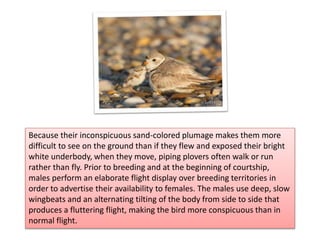
Because their inconspicuous sand-colored plumage makes them more
difficult to see on the ground than if they flew and exposed their bright
white underbody, when they move, piping plovers often walk or run
rather than fly. Prior to breeding and at the beginning of courtship,
males perform an elaborate flight display over breeding territories in
order to advertise their availability to females. The males use deep, slow
wingbeats and an alternating tilting of the body from side to side that
produces a fluttering flight, making the bird more conspicuous than in
normal flight.
As of 2001, it is estimated that there are no
more than 3,000 breeding pairs of piping
plovers across the U.S. and Canada
Credits
Members of WAC

Presentation1 etited (2)

  • 1.
    A GROUP OFMIDDLE SCHOOL STUDENTS TRYING TO CHANGE THE WORLD ONE ANIMAL AT A TIME. We may be young but we need your help to save something that keeps our world running. We are their voice.
  • 2.
    Find us onsocial media by searching any of the following: Instagram: WAConservations Pinterest/Email: waconservations@gmail.com Twitter: Wacgroup2015 We are kids going to make a difference.
  • 3.
    BOG TURTLES Annabell Swank,Devlyn Yaroslawski, Christopher Cornelison and Vonnya Summers
  • 4.
    INFORMATION • Bog turtlesare one of the many endangered animals in PA • They are one of the smallest turtles in the country! • They are mainly endangered because they have little habitat left. • They have been endangered for almost more than 40 years!! • Current bog turtle population is unknown, but estimates range from 2,500 to 10,000. • Invasive plants such as the purple loosestrife can dry out large areas of suitable habitat.
  • 5.
    Bog turtles areextremely sensitive to the effects of global warming. Global Warming??
  • 6.
    More Facts • Bogturtles are omnivorous, plant and meat-eating animals. • Their diet consists of insects, beetles, seeds, pondweeds, berries, and snails. • The life span of bog turtles is not known for certain, but may be about 40 years.
  • 7.
  • 11.
    The Peregrine Falcon InPennsylvania this bird is on the endangered list. In the early 1900’s there were about 350 nesting pairs throughout the state. In 2011 there was only about 30 pairs and most of the nest were all man made. 2014 there were only 40 known nest. That is a decline of about 310 mating pairs. The breeding pairs are partners for life. That means if something happens to one of them the other will not reproduce with anyone. They only lay 3 to 5 eggs at a time. They keep taking care of their babies until they are 4 to 5 months old.
  • 12.
    Short Eared Owl Itsso sad that they have to go so soon.
  • 13.
    First I’m goingto tell you so facts about them They fly as slow as a moth. They fly lower than normal owls. They only eat small mammals.
  • 14.
    Is this true????? They are only found in PA and NJ  But everywhere else they are very uncommon.  They were mainly hunted for food.  Just like we hunt deer.  They decrease from 3.5% to 11.5% every year.
  • 15.
    How Small TheyAre They do not weigh that much, they are only 10- 15ozs They can only grow up to 340in to 423 in long.
  • 16.
    Wings Its only 279in to 314in long The wing span can range from 39in to 44 in.
  • 17.
  • 18.
    Many plovers undertakespectacular migrations, the best known of which is that of the American golden plover, Pluvialis Dominica. Adults of the eastern form make a nonstop, 3,900-km (2,400-mi) transatlantic flight from Nova Scotia to northern South America and then to the southern regions of South America. The young move at a more leisurely rate down the Mississippi Valley to Argentina. In the spring all the birds return north by way of the Mississippi Valley. The western form of the golden plover nests in Alaska and migrates in the fall by way of the Hawaiian Islands to winter grounds in southern Asia, Australia, and New Zealand.
  • 19.
    Many plovers undertakespectacular migrations, the best known of which is that of the American golden plover, Pluvialis Dominica. Adults of the eastern form make a nonstop, 3,900-km (2,400-mi) transatlantic flight from Nova Scotia to northern South America and then to the southern regions of South America. The young move at a more leisurely rate down the Mississippi Valley to Argentina. In the spring all the birds return north by way of the Mississippi Valley. The western form of the golden plover nests in Alaska and migrates in the fall by way of the Hawaiian Islands to winter grounds in southern Asia, Australia, and New Zealand.
  • 20.
    ping plovers eatfreshwater and marine invertebrates that have been washed up on shore, as well as other invertebrates. This may include marine worms, insects (fly larvae and beetles), crustaceans, mollusks and other small marine animals and their eggs.
  • 21.
    Piping plovers breedmostly along the Atlantic coast, from North Carolina northward to eastern Canada and the French Islands of Saint Pierre and Miquelon. A second population breeds inland along rivers and wetlands of the northern Great Plains, from Nebraska to the southern Prairie Provinces, as well as portions of the western Great Lakes in the U.S. and western Ontario. During winter months, most individuals occur on coastal beaches, sandflats and mudflats from the Carolinas to Mexico’s Yucatan, with a very few dispersed through the Bahamas and West Indies.
  • 22.
    Because their inconspicuoussand-colored plumage makes them more difficult to see on the ground than if they flew and exposed their bright white underbody, when they move, piping plovers often walk or run rather than fly. Prior to breeding and at the beginning of courtship, males perform an elaborate flight display over breeding territories in order to advertise their availability to females. The males use deep, slow wingbeats and an alternating tilting of the body from side to side that produces a fluttering flight, making the bird more conspicuous than in normal flight.
  • 23.
    As of 2001,it is estimated that there are no more than 3,000 breeding pairs of piping plovers across the U.S. and Canada
  • 24.