INTRODUCTION TO ARCHITECTURE
EG 402 AR
Year I Part I
Lecture – 1
Prof. Dr. Bharat Sharma/Shova Thapa
2019
IOE, Pulchowk Campus
• Lecture : 2 hr/week
• Final Examination : 1.5 hr : 40 Marks/ out of 50
• Assessments: 10 Marks (Exam + Report)
– Report on architecture of a Building: Form, Style, Materials,
Technology, socio-cultural and religious aspects
– Presentation (group work)
• Attendance requirement: 75% (i.e. IOE requirement)
• Class lectures: notes will be provided
Reference : Any Architectural related books, History of
Architecture
Course Objective: To introduce the field of architecture and its relation with society,
culture, religion, technology and build environment. To understand the profession of
architecture and its relation with allied profession. To understand the role of
architecture in Nepal and the career opportunities scene.
• The field of architecture brief Survey from beginning of architecture
to present times (2 hours)
• The study of architecture and its features under TU. (1 hour)
• Architecture, built environment and the society. (6 hours)
• Socio-culture and religious context of architecture. (4 hours)
• Technology and material context of architecture. (4 hours)
• Site, City and ecological contest of architecture. (2 hours)
• The architecture profession and its interactive relationship with
allied professionals such as planners, engineers, interior designers,
landscape architects etc. (4 hours)
• The profession of architecture of Nepal-its practice both public and
private, career opportunities. (2 hours)
• Architect, client and contractor, planning and building controls in
force.
The field of Architecture:
• ARCHITECTURE:
• Architecture is the scientific art of designing built spaces. It involves
conceptual study, design, and visualization of the site before it is
constructed. Art and Aesthetics, Form and Function, material and
technology all melt together in architecture.
• Architecture acts as a bridge between the science and art.
• Art : Creative, Expression, Utilitarian, Social art
• Science : systematic process, principal, laws
• Technology : safety and protection, Proper use of material
• Design: systematic activity to serve a purpose
• Structure : organization, arrangement of parts, elements
• Built space: man made space
• Building: an enclosed space or relates to the activity of construction
• Architecture is the art, science and designing & constructing
functionally graceful structures to serve the user well &
satisfy his varying complex needs.
• It interacts with the natural & surrounding world.
• It is a social artifact - society, religion & culture are
influenced
• It relates to history, historical evidences and the availability
of materials & technology.
• It is a product of culture & environmental factors,
expressions of the way of life of people.
• Innovative and creative work for human physical and
psychological comfort.
• It is influenced on economical, political or symbolic
intentions
• Architecture is the “Mother of all Arts”.
• Architecture in a word…is reflection… the reflection of …?
• Power, Culture, Money, Influence, Philosophy,
• Architecture transformation happens in specific time and
space.
• Profession of architecture is produced and consumed with
market economy.
• Design of the total built environment,
• The macro level - town planning, urban design and
landscape architecture
• The micro level - architectural or construction details,
furniture.
• Systematic arrangement of forms, shapes, spaces and light
to change the environment.
In conclusion:
The Architecture is
• Versions of the past: Different versions of the past human
achievements
• Reflections of the present: Reflection of present condition of
economy, society and political
environments
• Visions for the future: Environmental sustainability, and need for
the future with visions.
Definitions:
• Vitruvius, the 1st Century Roman Author on Architecture – principles follows:
• Utilitas (Utility): Building should have its Practical Functions/
Commodity
• Firmitas (Structured): Building should be technically, structurally
sound
• Venustas (Beauty): Building should be beautiful and artistic/
aesthetic or visual quality
• Architecture is nothing more and nothing less than the gift of making places
for human purposes.
Spiro Kostof (an architectural historian)
• MAYAMATA "Experts call all places where immortals and mortals dwell,
"dwelling sites" (VASTU ). The Earth is the principal dwelling place because it is
on Her that constructed dwellings (VASTU )
• " All habitations are defined by their dimensions" Mayamata 5.1
The study of architecture at IOE and its features
• Architectural education in Nepal
• Bachelor of Architecture (B. Arch) -1996 under the affiliation
of Tribhuvan University (TU) at Institute of Engineering,
Pulchowk Campus.
• Nepal Engineering College (nec) -1997 in affiliation with TU,
started B. Arch in private sector.
• By this time, more than hundreds of architects have been
produced.
• Kathmandu Engineering College (KEC),
• Khwopa engineering College
• Acme Engineering College have also been running B. Arch
course.
• Himalaya College of Engineering
• Thapathali Engg. College
• Chitawan Engg. College
BACHELOR OF ARCHITECTURE
Philosophy of the course: a compromise response to the nature of
works performed by architects in Nepal/upcoming areas such as
urban renewal (aesthetic design, construction and technology), and
conservation, planning.
Communications: Communication, Drafting I, Drafting II, Computer
Aided Design and Drafting, Art and Graphics, Free Hand Sketching I,
Free Hand Sketching II Working Drawings
Humanities and Basic Sciences:
• Mathematics I, Mathematics II, Applied Mechanics, Sociology,
Building Economics
Skills: Basic Skills Workshop
Construction Sciences and Technology:
• Building Materials I & II, Building Science I & II, Building Construction
I, II, III, IV
• Building Services I, II & III
• Surveying, Estimating & Costing, Specification
• Structures I, II, III & IV
Theory, Criticism and History of Architecture:
• Introduction to Architecture, Design Theory I & II
• History of Architecture I (Western and Eastern), History
Architecture II (Nepalese)
• Contemporary Architecture
• Architectural Conservation
Management and Practice:
• Construction Management, Professional Practice
Planning:
• Urban Planning and Design, Landscape Design and Site Planning
Electives and Research:
• Elective I, Seminar & Directed Studies, Elective II
Design:
• Basic Design I & II, Design Studio III, IV, V, VI, VII, VIII
Practicum
Thesis
The brief Survey from beginning of architecture
to present times
• Primitive times, Earlymans‘ - to protect himself from
the attacks of wild animals and rigorousness of
weather condition, nature.
• Created his dwelling to keep on changing with time
and the need.
• Building began to develop in Paleolithic Period -
created structures in wood and stone.
• NO CLEAR EXAMPLES EXIST.
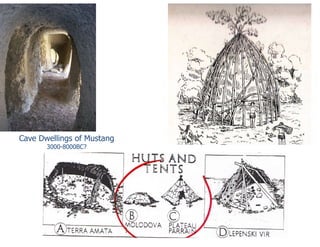
• Example ; cave dwellings, tents of saplings sheathed in
bark or brushwood, huts of reed, thatch, branches of
trees, round houses in stone.
Cave Dwellings of Mustang
3000-8000BC?
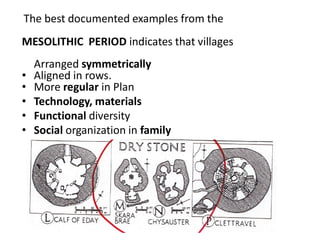
The best documented examples from the
MESOLITHIC PERIOD indicates that villages
Arranged symmetrically
• Aligned in rows.
• More regular in Plan
• Technology, materials
• Functional diversity
• Social organization in family
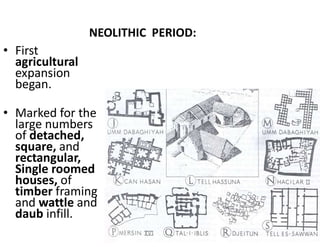
NEOLITHIC PERIOD:
• First
agricultural
expansion
began.
• Marked for the
large numbers
of detached,
square, and
rectangular,
Single roomed
houses, of
timber framing
and wattle and
daub infill.
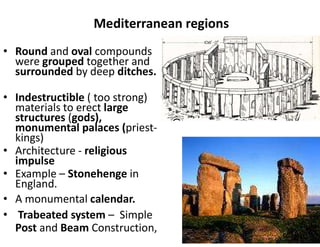
Mediterranean regions
• Round and oval compounds
were grouped together and
surrounded by deep ditches.
• Indestructible ( too strong)
materials to erect large
structures (gods),
monumental palaces (priest-
kings)
• Architecture - religious
impulse
• Example – Stonehenge in
England.
• A monumental calendar.
• Trabeated system – Simple
Post and Beam Construction,
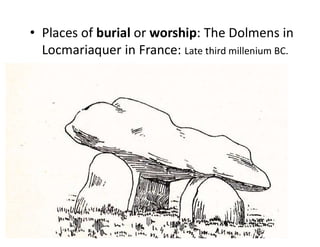
• Places of burial or worship: The Dolmens in
Locmariaquer in France: Late third millenium BC.
CIVILIZATIONS : EGYPT
•First advanced civilization (3000 BC) – along Nile River,
• Built of durable materials .
•Improved technique and good farming, Richer society
•The ancient Egyptians were very religious, SUN (chief god)
• The pyramids as a symbolic staircase.
•They believed in a life after death at first only for kings
and nobles.
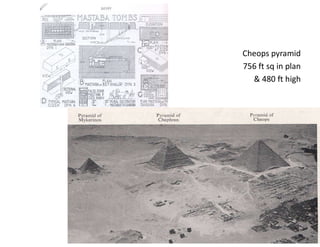
•Three main types: Mastabas, Royal Pyramids and Rock-
hewn Tombs.
Cheops pyramid
756 ft sq in plan
& 480 ft high
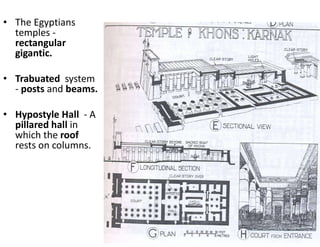
• The Egyptians
temples -
rectangular
gigantic.
• Trabuated system
- posts and beams.
• Hypostyle Hall - A
pillared hall in
which the roof
rests on columns.
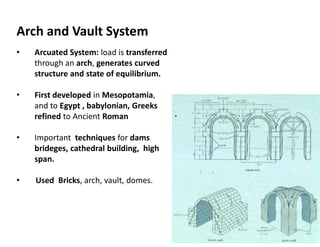
Arch and Vault System
• Arcuated System: load is transferred
through an arch, generates curved
structure and state of equilibrium.
• First developed in Mesopotamia,
and to Egypt , babylonian, Greeks
refined to Ancient Roman
• Important techniques for dams
brideges, cathedral building, high
span.
• Used Bricks, arch, vault, domes.
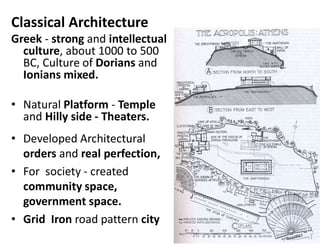
Classical Architecture
Greek - strong and intellectual
culture, about 1000 to 500
BC, Culture of Dorians and
Ionians mixed.
• Natural Platform - Temple
and Hilly side - Theaters.
• Developed Architectural
orders and real perfection,
• For society - created
community space,
government space.
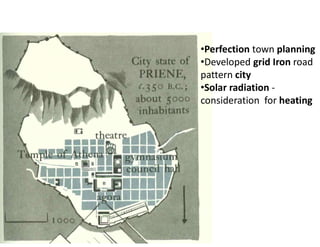
• Grid Iron road pattern city
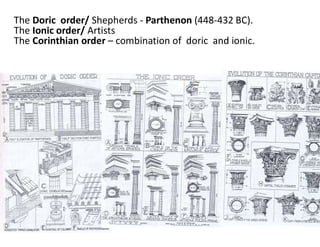
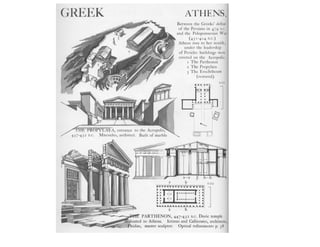
The Doric order/ Shepherds - Parthenon (448-432 BC).
The Ionic order/ Artists
The Corinthian order – combination of doric and ionic.
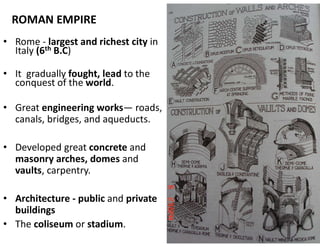
ROMAN EMPIRE
• Rome - largest and richest city in
Italy (6th B.C)
• It gradually fought, lead to the
conquest of the world.
• Great engineering works— roads,
canals, bridges, and aqueducts.
• Developed great concrete and
masonry arches, domes and
vaults, carpentry.
• Architecture - public and private
buildings
• The coliseum or stadium.
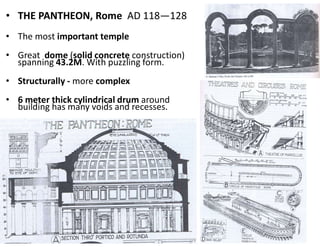
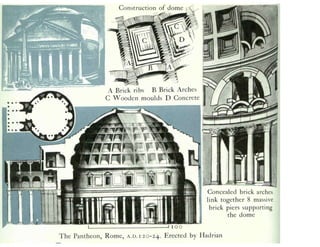
• THE PANTHEON, Rome AD 118—128
• The most important temple
• Great dome (solid concrete construction)
spanning 43.2M. With puzzling form.
• Structurally - more complex
• 6 meter thick cylindrical drum around
building has many voids and recesses.
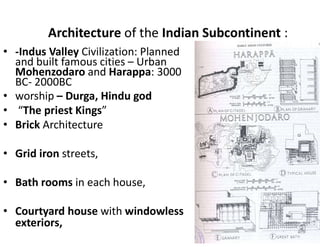
Architecture of the Indian Subcontinent :
• -Indus Valley Civilization: Planned
and built famous cities – Urban
Mohenzodaro and Harappa: 3000
BC- 2000BC
• worship – Durga, Hindu god
• “The priest Kings”
• Brick Architecture
• Grid iron streets,
• Bath rooms in each house,
• Courtyard house with windowless
exteriors,
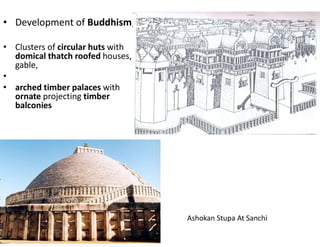
• Development of Buddhism,
• Clusters of circular huts with
domical thatch roofed houses,
gable,
•
• arched timber palaces with
ornate projecting timber
balconies
Ashokan Stupa At Sanchi
• Asoka took from contemporary Persian stone
mason (already built marvellous stone palaces)
326 BC,
• Built stone monuments for Buddhism
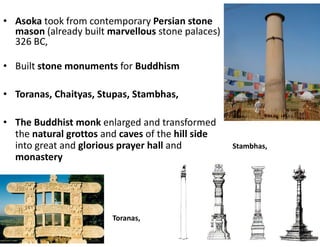
• Toranas, Chaityas, Stupas, Stambhas,
• The Buddhist monk enlarged and transformed
the natural grottos and caves of the hill side
into great and glorious prayer hall and
monastery
Toranas,
Stambhas,
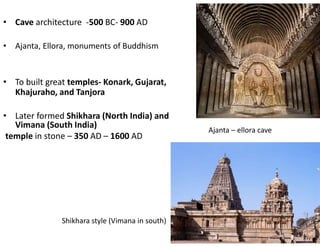
• Cave architecture -500 BC- 900 AD
• Ajanta, Ellora, monuments of Buddhism
• To built great temples- Konark, Gujarat,
Khajuraho, and Tanjora
• Later formed Shikhara (North India) and
Vimana (South India)
temple in stone – 350 AD – 1600 AD
Shikhara style (Vimana in south)
Ajanta – ellora cave
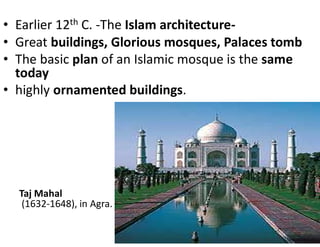
• Earlier 12th C. -The Islam architecture-
• Great buildings, Glorious mosques, Palaces tomb
• The basic plan of an Islamic mosque is the same
today
• highly ornamented buildings.
Taj Mahal
(1632-1648), in Agra.
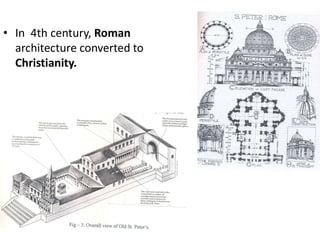
• In 4th century, Roman
architecture converted to
Christianity.
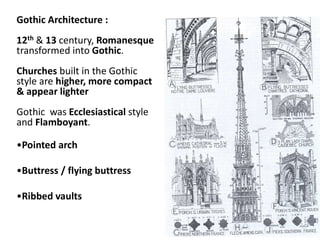
Gothic Architecture :
12th & 13 century, Romanesque
transformed into Gothic.
Churches built in the Gothic
style are higher, more compact
& appear lighter
Gothic was Ecclesiastical style
and Flamboyant.
•Pointed arch
•Buttress / flying buttress
•Ribbed vaults
The Industrial Age
• The Industrial Revolution, which began
in England about 1760, brought a flood
of new building materials— for
example, cast iron, steel, and glass.
• Rapid Urbanization, Industrialization—
employment center, railway station,
pub, coffee shop, airport, etc
• Late 18th c. designers turned toward
the original Greek and Roman
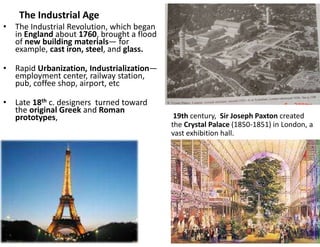
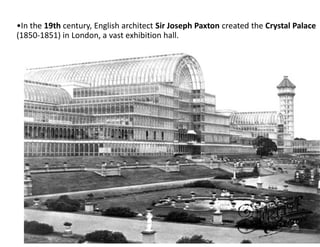
prototypes, 19th century, Sir Joseph Paxton created
the Crystal Palace (1850-1851) in London, a
vast exhibition hall.
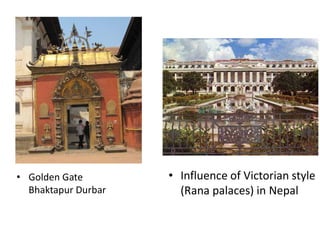
• Influence of Victorian style
(Rana palaces) in Nepal
• Golden Gate
Bhaktapur Durbar
Modern Architecture
• Master Architects, and Influential Architects.
• New Society
• Increase in Wealth, More Mobility (Transport),
Scientific Inventions,
• literature based and academic explorations,
philosophy,
• New Thinking & Challenges
• Architectural Critics and Political Reforms,
• Change of architectural style.
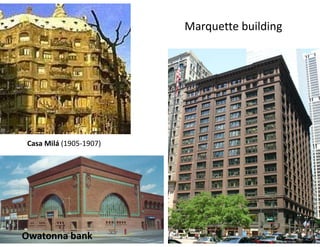
Marquette building
Owatonna bank
Casa Milá (1905-1907)
• Master Architects- Walter Gropius, Ludwig Mies van
der Rohe, Le Corbusier, Antoni Gaudí, , Frank Lloyd
Wright etc
• The style initiated by the Bauhaus architects and
termed the International Style 1930s.
• Characteristics of International Style include:
• Form follows function.
• Horizontal and vertical planes
• Use of glass and steel
• Use concrete & brick materials
• No decoration
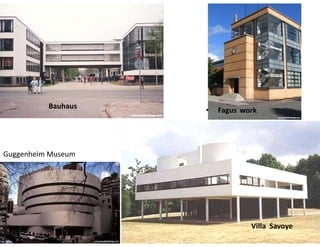
Bauhaus
• Fagus work
Villa Savoye
Guggenheim Museum
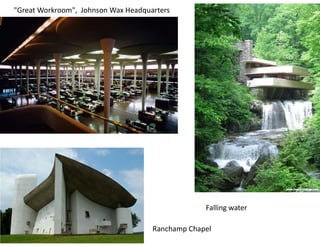
"Great Workroom", Johnson Wax Headquarters
Ranchamp Chapel
Falling water
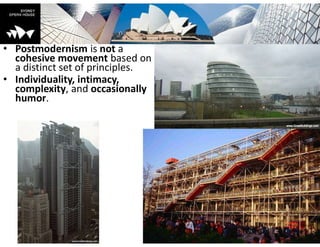
• Postmodernism is not a
cohesive movement based on
a distinct set of principles.
• Individuality, intimacy,
complexity, and occasionally
humor.
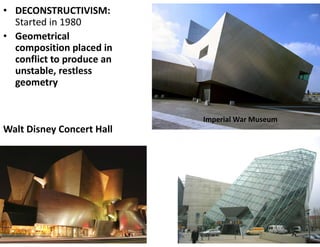
• DECONSTRUCTIVISM:
Started in 1980
• Geometrical
composition placed in
conflict to produce an
unstable, restless
geometry
Walt Disney Concert Hall
Imperial War Museum
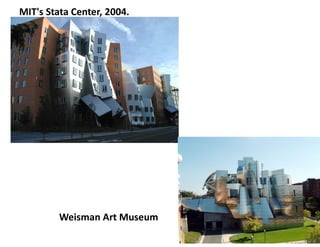
MIT's Stata Center, 2004.
Weisman Art Museum
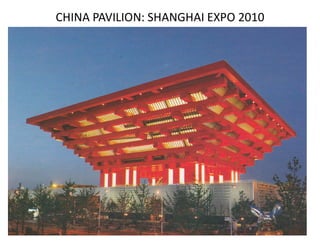
CHINA PAVILION: SHANGHAI EXPO 2010
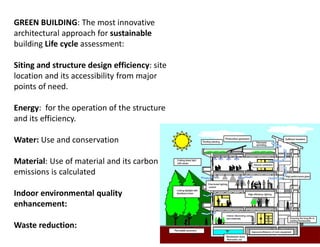
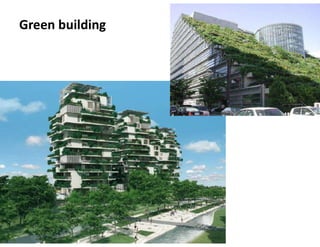
GREEN BUILDING: The most innovative
architectural approach for sustainable
building Life cycle assessment:
Siting and structure design efficiency: site
location and its accessibility from major
points of need.
Energy: for the operation of the structure
and its efficiency.
Water: Use and conservation
Material: Use of material and its carbon
emissions is calculated
Indoor environmental quality
enhancement:
Waste reduction:
Architecture and Built
Environment
Lecture – 2
IOE, Pulchowk Campus
Prof. Dr. Bharat Sharma/Shova Thapa
2019
Architecture
• Spiro Kostof : "Architecture, in the end, is nothing more and
nothing less than the gift of making places for human
purpose.“
• Architecture has to be functional, beautiful, durable, social.
• Humanistic field – human questions and society’s problems.
• Interacts with Nature ( geographical, geological, climatic), the
earlier built spaces, society, cultural, religious, technology etc .
• Buildings are not isolated objects.
• Further, "Architecture is a social act- social both in method and
purpose. Every building represents a social artifact of specific
impulse, energy and commitment." - Spiro Kostof.
Place and Space
• Architecture: Making places for human
purpose
• Built environment: Place for human purpose
• Place is a space with an identity: Physical
Space + Perceptual space (Socio-cultural) =
Relation gives identity
• Physical space > The existential space
Source : Prof. S. R. Tiwari
Place and Space
• Physical space > The existential space
– Vacant Space > Built Space
– Built space is inside or outside a building, around
a building, in front of a building etc.
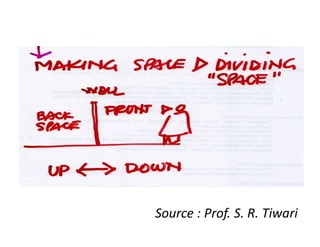
– Making Space
• Dividing/ Partitioning/Appropriating spaces
– Front & Back space
– Up & Down
– Enclosed space > open space
Source : Prof. S. R. Tiwari
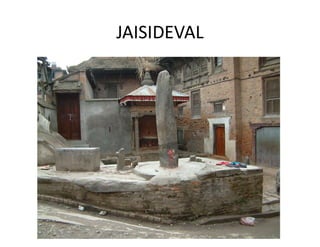
JAISIDEVAL
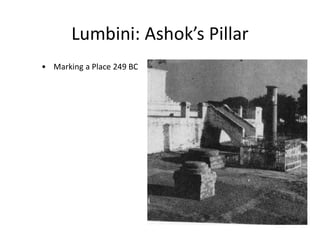
Lumbini: Ashok’s Pillar
• Marking a Place 249 BC
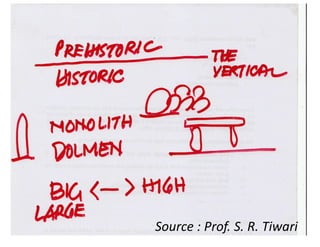
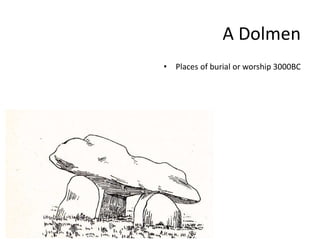
A Dolmen
• Places of burial or worship 3000BC
Dividing Space
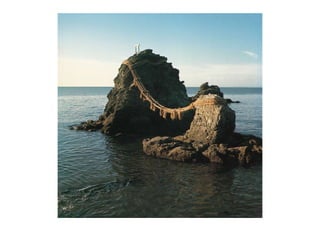
[Marking a Place of worship]
SHINTO SHRINES
Japan
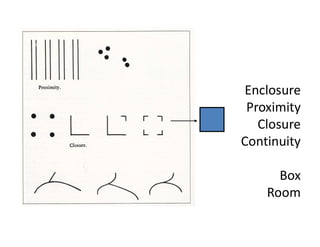
Enclosure
Proximity
Closure
Continuity
Box
Room
Built Environment
• Refers to :
• Human – made surroundings, provide the setting
for human activity.
• Ranging in scale from buildings and parks or green
spaces- to neighborhood cities.
• Provisional for supporting infrastructures- water
supply, energy networks.
• Material, spatial and cultural product of human
labor that combines physical elements and energy
in the forms for living, working and playing.
Built Environment
• Responds to an existing set of conditions – be
purely functions in nature ( social, economical,
political, symbolic intension).
• Places and spaces are created or modified by
people including buildings, parks and
transportation system.
• Concern with physical, psychological comfort and
good public health.
Two types of Built Environment :
External Built Environment :
• External spaces around the built structures
• Must be able to realize :
• how the built mass responds to the external
environment
• how the response has been made to site context / site
features
• how the existing features of the site have been used
– a created relationship between built structure and the external
environment
– Examples: Durbar Squares in Kathmandu Valley
• Chowks and various open spaces
• Plazas and forums (Roman Architecture)
• Falling Water by Frank Lloyd Wright
Internal Built Environment :
• Internal spaces within the built structures.
• Buildings create an environment within them
• Various interior spaces like lobby, foyers, corridors,
halls, etc.
• Properly planned interior should consider the
function of the space, proportions, scale,
• “The feeling of the space” and relationship of the
interior with the exterior.
Built Environment as conceptualized by
‘Siegfried Giedion’
• Giedion gives three different concepts:
• Concept One: Architecture as space radiating volumes
• Building as sculptures
• Buildings form spaces outside for the use of man
• Buildings are focused on the external aspects of the built
environment
– Little or no use of interiors
– Treated as a sculptural form in space
– Designed for viewing from outside and some calculated
distances
– External space created for experience, enjoy and utilize by the
man
– Pyramid; The Parthenon, Athens; Stupa, Temple, Chaitya
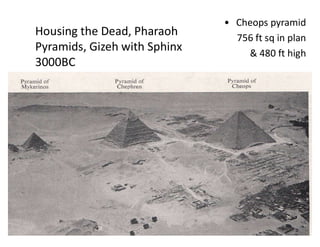
Housing the Dead, Pharaoh
Pyramids, Gizeh with Sphinx
3000BC
• Cheops pyramid
756 ft sq in plan
& 480 ft high
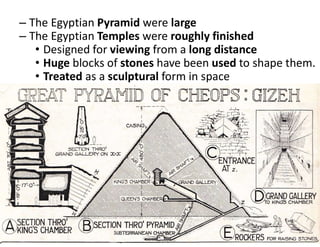
– The Egyptian Pyramid were large
– The Egyptian Temples were roughly finished
• Designed for viewing from a long distance
• Huge blocks of stones have been used to shape them.
• Treated as a sculptural form in space
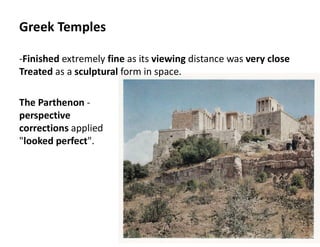
Greek Temples
-Finished extremely fine as its viewing distance was very close
Treated as a sculptural form in space.
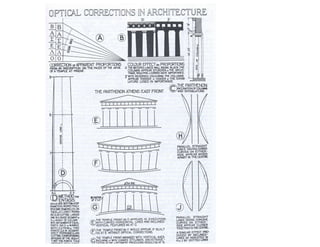
The Parthenon -
perspective
corrections applied
"looked perfect".
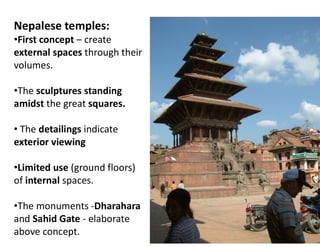
Nepalese temples:
•First concept – create
external spaces through their
volumes.
•The sculptures standing
amidst the great squares.
• The detailings indicate
exterior viewing
•Limited use (ground floors)
of internal spaces.
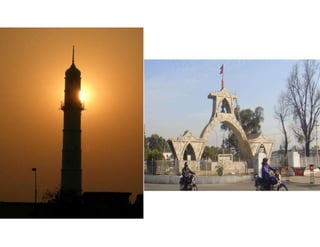
•The monuments -Dharahara
and Sahid Gate - elaborate
above concept.
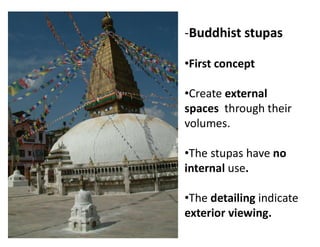
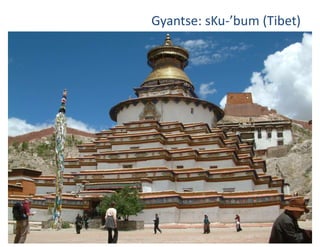
-Buddhist stupas
•First concept
•Create external
spaces through their
volumes.
•The stupas have no
internal use.
•The detailing indicate
exterior viewing.
Gyantse: sKu-’bum (Tibet)
Concept Two:
Architecture as interior space
• Deals with the internal built environment
• Building hollowed out and opened up by
means of window
• Elaboration of interior (decorations), lighting, etc
• Buildings forms spaces inside for the use of man
Examples: The Pantheon, Rome
Gothic Cathedrals
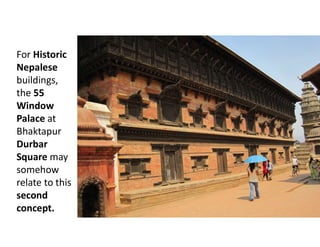
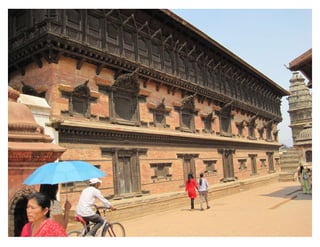
55Window Palace, Bhaktapur
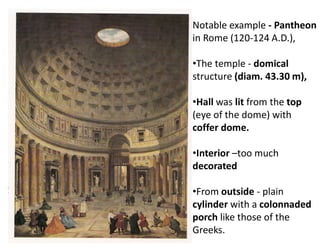
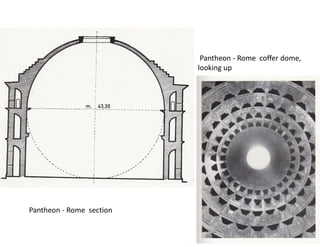
Notable example - Pantheon
in Rome (120-124 A.D.),
•The temple - domical
structure (diam. 43.30 m),
•Hall was lit from the top
(eye of the dome) with
coffer dome.
•Interior –too much
decorated
•From outside - plain
cylinder with a colonnaded
porch like those of the
Greeks.
Pantheon - Rome coffer dome,
looking up
Pantheon - Rome section
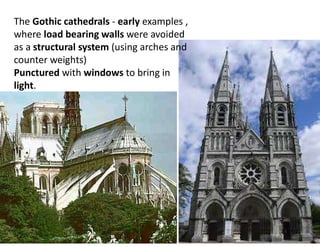
The Gothic cathedrals - early examples ,
where load bearing walls were avoided
as a structural system (using arches and
counter weights)
Punctured with windows to bring in
light.
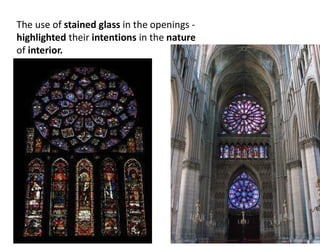
The use of stained glass in the openings -
highlighted their intentions in the nature
of interior.
For Historic
Nepalese
buildings,
the 55
Window
Palace at
Bhaktapur
Durbar
Square may
somehow
relate to this
second
concept.
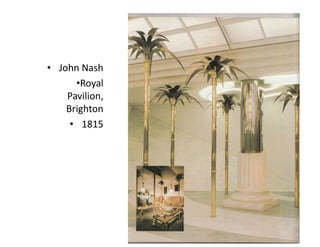
• John Nash
•Royal
Pavilion,
Brighton
• 1815
Concept Three:
Architecture as both volume and interior space
• Architecture as both exterior space forming volumes and interior
space (in total architecture or total built environment.)
• A sculpture with interior
• Come up as modern movements after industrialization
• Group design, complexes, urban design
• Examples:
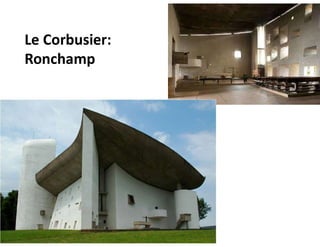
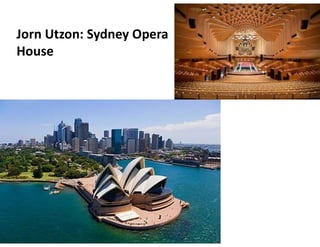
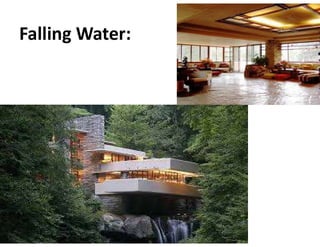
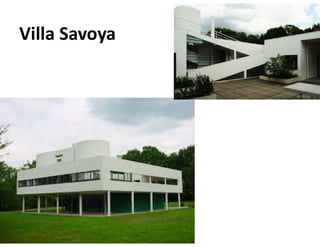
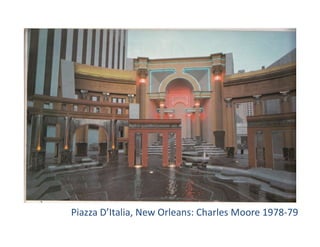
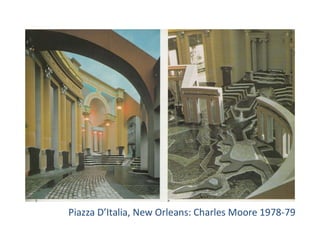
– Sydney Opera House, Piazza de Italia, Falling Water, Pennsylvania,
Villa Savoye, Poissy, France, Ronchamp, France, National Gallery or
Art, Washington D. C.,
HISEF Building at Hattisar, Kathmandu, Nepal by Rajesh Shrestha
(2002): Nepalese context
• Giedion has put forward his concepts according
to the chronological developments in
architecture from Ancient Egypt (or even earlier)
to modern movements.
• First concept, - building as volumes, relates to
buildings in the past,
• Second concept relates to buildings in Medieval
Era (buildings that are transitory in their
developments)
• Third concept is about buildings in the modern
world.
Le Corbusier:
Ronchamp
Jorn Utzon: Sydney Opera
House
Falling Water:
Villa Savoya
Piazza D’Italia, New Orleans: Charles Moore 1978-79
Building and Society
Lecture – 3
IOE, Pulchowk Campus
Prof. Dr. Bharat Sharma/Shova Thapa
2019
Building :
• Place of social action /activity
• Fulfill the human purpose: a function
– Provide space for human activity
• A framework for social action
• A social space
- Buildings reflect social needs, values and society
“Every Building represents a social artifact of specific
impulse, energy and commitment.” (Spiro Kostof in A
History of Architecture)
Society :
“Society is the union itself, the organization, the sum
of formal relations in which associating individuals
are bound together” (Giddings)
“Society is a complex of forms or processes each of
which is living and growing by interaction with the
others, the whole being so unified that what takes
place in one part affects all the rest” (Cooley)
Community :
“A community is that collectivity the members of which share a
common territorial area as their base of operation for daily
activities” (Talcott Parson)
“Any circle of people who live together and belong together in such
a way that they do not share this or that particular interest only,
but a whole set of interest”
Ex. – Locality, Permanency, Naturality, A particular name.
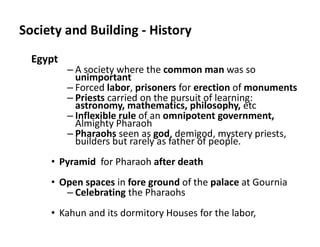
Society and Building - History
Egypt
– A society where the common man was so
unimportant
– Forced labor, prisoners for erection of monuments
– Priests carried on the pursuit of learning:
astronomy, mathematics, philosophy, etc
– Inflexible rule of an omnipotent government,
Almighty Pharaoh
– Pharaohs seen as god, demigod, mystery priests,
builders but rarely as father of people.
• Pyramid for Pharaoh after death
• Open spaces in fore ground of the palace at Gournia
– Celebrating the Pharaohs
• Kahun and its dormitory Houses for the labor,
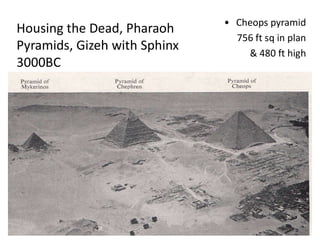
Housing the Dead, Pharaoh
Pyramids, Gizeh with Sphinx
3000BC
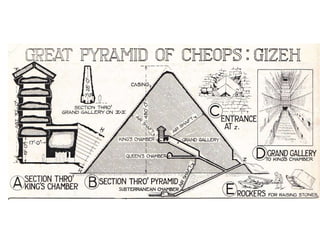
• Cheops pyramid
756 ft sq in plan
& 480 ft high
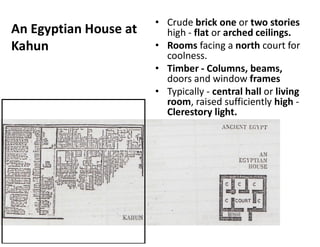
An Egyptian House at
Kahun
• Crude brick one or two stories
high - flat or arched ceilings.
• Rooms facing a north court for
coolness.
• Timber - Columns, beams,
doors and window frames
• Typically - central hall or living
room, raised sufficiently high -
Clerestory light.
Society and Building - History
Greece
 Strong and intellectual culture
 Thinking- Sociology, Psychology, Mathematics, Astronomy
: perfection in work.
 Democracy to a great deal, People mattered.
 New discipline, new dimensions in society.
 Mercantile (trade, commercial) Society
 Naval(federal or republic) empire.
 The Temples along with Games, music, dancing, boxing.
They worked for the society, created community space,
government space.
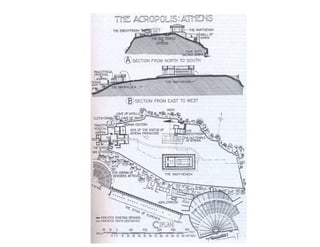
• Site selection – Natural Platform for Temple (higher hill
- Acropolis) and Hilly side for Theaters.
• Temples (Parthenon)
• Stadium
• Amphitheatre
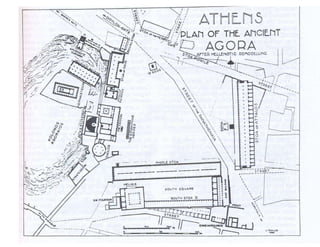
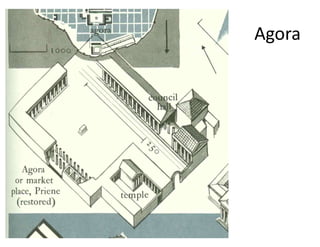
• Agora
• Stoa
• Palace missing – not an important.
• Religious building – important element
• Devotion to religion, fine arts, etc.
•Perfection town planning
•Developed grid Iron road
pattern city
•Solar radiation -
consideration for heating
Agora
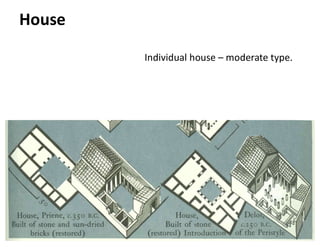
House
Individual house – moderate type.
Society and Building - History
Imperial Rome:
• The Romans were best in warfare, engineering, and government.
• Made public building (grandest and costliest structures) and
private buildings throughout the city
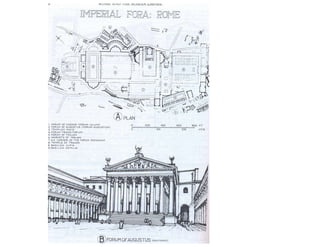
• The Forum > The meeting place.
• The Temples
• Basilica > Justice and Business
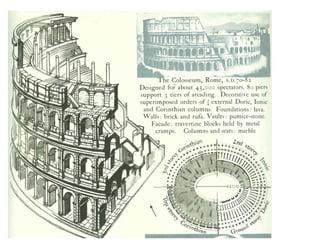
• Amphitheatres > Love of Drama, elliptical in plan with a
central arena –hearts of cities - Colosseum
• Arch - concrete and masonry arches, domes and vaults, carpentry
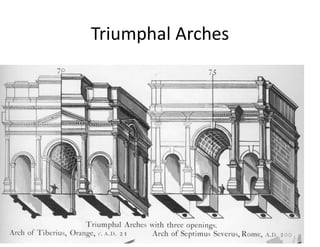
Triumphal Arches
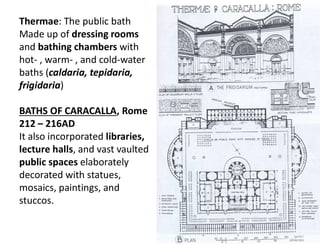
Thermae: The public bath
Made up of dressing rooms
and bathing chambers with
hot- , warm- , and cold-water
baths (caldaria, tepidaria,
frigidaria)
BATHS OF CARACALLA, Rome
212 – 216AD
It also incorporated libraries,
lecture halls, and vast vaulted
public spaces elaborately
decorated with statues,
mosaics, paintings, and
stuccos.
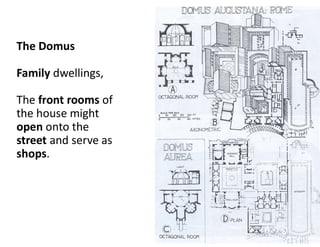
The Domus
Family dwellings,
The front rooms of
the house might
open onto the
street and serve as
shops.
Society and Building - History
• Nepal: Malla period
• Kingdom- The palace occupies the central place in the town
• Socio-political importance of the kings. scale of palace (height for
example) not imposing but ornate - shows they were not
authoritarian
• City planning- Palace, administration, temple, priest(Bhramins),
noble: center, Chhetries (defenders): outside core area, Vaishyas
(traders): commercial area and Sudras (physical labour): outskirts.
• Main gates are not monumental in character and no axiality relation
with main roads
• But Simha Durbar of the Rana Period - axially laid out , placed at
the end of the access way, imphasise authoritarian power
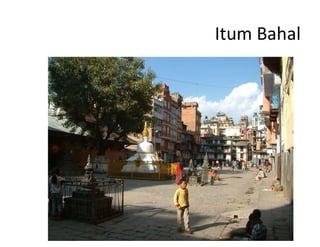
• Toles and Community - Durbar Square, market square (ex. Ason
Chowk) and neighbourhood squares ( ex. Itum Bahal) - the social
interactive nature of Newar population.
• Spaces and streets used for entertainment through Jatras and other
festivals.
Itum Bahal
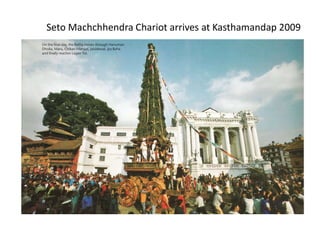
Seto Machchhendra Chariot arrives at Kasthamandap 2009
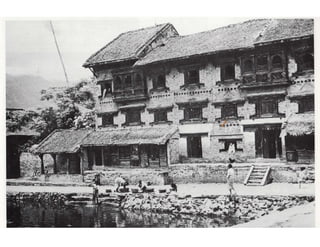
The Newar house-
• Agricultural base society,
• Building as a dormitory (sleeping and social activities during non-
agricultural season)
• The inclined main window (Sañjhya) shows the living room
• The Tiki jhya window provided privacy to bed rooms
• The Kitchen in the attic,
• No public entertainment spaces,
• Such activities incorporation in the street and temple sites and
squares.
• The shadow dance play during Indrajatra at Kathmandu Durbar
square or Awah Guthi Chapa (the Sattal of the Awales) at Chysal of
Patan.
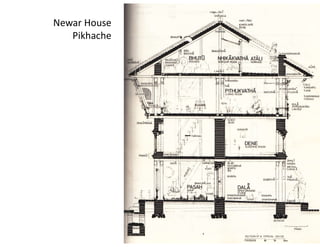
Newar House
Pikhache
Architecture, Built Environment and Society
• Architecture has a societal objectivity and a societal
responsibility
• Past buildings –depicted (draw) the nature of the society
• Present design must keep the social purpose (guiding
objectivity) and must be responsive to it.
• Architecture has the power to condition social behaviour,
values and even needs.
• Urban patterns (identify the settlements of any size and
type) change according to the nature of society.
• Architecture as a means of meeting human purpose.
• it has a purpose, any design activity, has to start by setting a goal.
• It shows the architect must have " a clear notion of the 'is
condition' and the discrepancy between it and the 'ought-to-be
condition'...
• The elaboration of strategies for dealing with the discrepancy is
influenced by one's attitudes, ideologies, political affiliations and
the resources available".
• The desirability of the ought-to-be condition may vary and indeed
it could be contrary to the goals, aspirations and beliefs of
another segment of society.
(Horst Rittel/ Rory Fonseca)
Architecture of Public Buildings
• The problem first in finding a common definition for the desired
condition to be established by the building
• The method of achieving it in such a way that societal purpose is fully
addressed.
• The question an architectural form may serve a particular purpose is not
answered by the slogan "form follows function".
• Alberti, prescribed that the most 'perfect' forms should be reserved for
the church. It came from truly understanding the functions.
• Public buildings in general should be carried out in the strictest
conformity with his formal principles.
• Alberti's understanding of public as a generalization of the individual
• Presently, all of these elements are woven together, considered with air
pollution, noise etc.
Vastusastra: Architecture of Buildings
• MAYAMATA: Mandala/Dimensions : "all habitations are
defined by their dimensions...
• The norms are regulated by various constraints
– Technique, social, cultural, religious, etc. factors,
– inextricably tied up with each other
• Social demand - absolute conformation
– to the established order in creating architectural plan and the
built up space, the hierarchy founded on the verna
• Best forms eg. squares for gods, kings and brahmins,
• Lower down the social scale you go the more elongated are
the prescribed building forms
• Proportionally ordered totality of the Hindus
Architecture and Society
• Architecture controls environment - to make interaction and
collaboration possible.
• Buildings both divide and bring together human beings.
– Architecture must aim to meet the social purpose
– Buildings provide a framework for social action
– Buildings manifest (apparent) social meaning
– A collection of buildings may represent a social system as a
whole.
• Social purpose of a building may be an expression of an activity,
a function, a role, a status, a symbol of a group, a collectivity or
an institution may represent a social system.
• Buildings as symbols of Thoughts, Values, Status
– Residence, Temple, High Class Office, Hospital, School, Brand
Shops/Luxury Store, Bank
Architecture and culture
• Architecture has to have an element of anticipation
(expectation) incorporated in the vision of the
desired ought-to-be condition.
– In that sense, it can guide social needs and values for the
future.
• Architecture, thus, should have a responsibility
towards the society of the present and also to that of
the future
– Work of architects stays beyond the present
• Buildings add to cultural accretion (accumulation) of
the society.
Architecture and socio-cultural environment
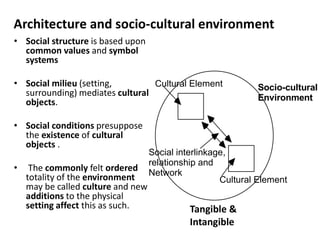
• Social structure is based upon
common values and symbol
systems
• Social milieu (setting,
surrounding) mediates cultural
objects.
• Social conditions presuppose
the existence of cultural
objects .
• The commonly felt ordered
totality of the environment
may be called culture and new
additions to the physical
setting affect this as such.
Cultural Element
Social interlinkage,
relationship and
Network
Cultural Element
Socio-cultural
Environment
Tangible &
Intangible
Social, culture and religious
context of architecture.
Lecture – 4
IOE, Pulchowk Campus
Prof. Dr. Bharat Sharma/Shova Thapa
2019
Context of Architecture
Context :
• According to dictionary definition- “The circumstances
that form the setting, or idea and in terms of which it
can be fully understood”.
• Considering the existence of architecture as an
understandable product of various interrelated
condition or an event in a given society, it has to have a
context of its origin.
• Context for architecture could be social, cultural,
religious, climate, material, technology, economic
and ecological setting of a particular society.
• Context is the integrity of local place / fabric.
Social context of Architecture
"A glance along the perspective of past ages reveals
architecture as a lithic history of social conditions,
progress and religion and of events which are
landmarks in the history of mankind...." - Sir Banister
Fletcher in “A History of Architecture”
Social context : institutional or general linkage or
relationship between humans and group or section
of human beings.
Means of relationship. Eg. family, caste, status groups, urban
institutions etc.
Framework for community living
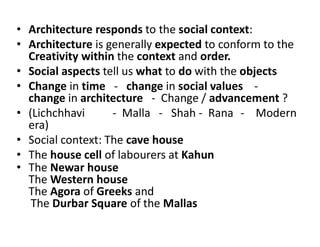
• Architecture responds to the social context:
• Architecture is generally expected to conform to the
Creativity within the context and order.
• Social aspects tell us what to do with the objects
• Change in time - change in social values -
change in architecture - Change / advancement ?
• (Lichchhavi - Malla - Shah - Rana - Modern
era)
• Social context: The cave house
• The house cell of labourers at Kahun
• The Newar house
The Western house
The Agora of Greeks and
The Durbar Square of the Mallas
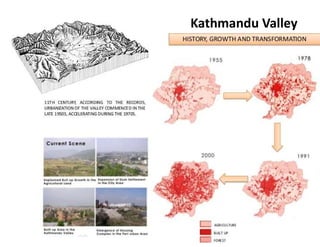
Kathmandu Valley
ljsf; s]Gb|sf] txut ;+/rgfM
s_ d"Vo gu/
v_ pk gu/
u_ gu/
3_ Onfsf IF]q – k|yd
/
låtLo txsf]
ª_ k/Dk/fut al:tx?
!#_ pkTosfsf] bL3{ljsf; cjwf/0ffsf k|:tfjgfx?M
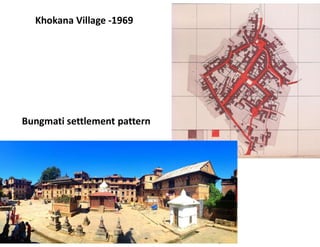
Khokana Village -1969
Bungmati settlement pattern
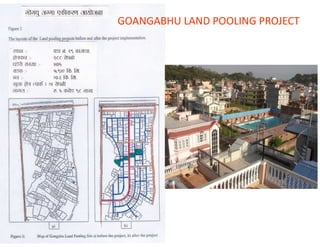
GOANGABHU LAND POOLING PROJECT
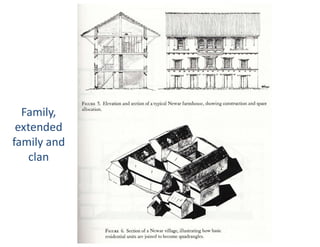
Family,
extended
family and
clan
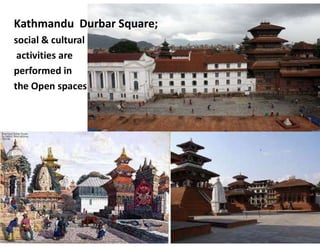
Kathmandu Durbar Square;
social & cultural
activities are
performed in
the Open spaces
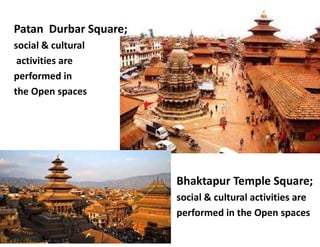
Patan Durbar Square;
social & cultural
activities are
performed in
the Open spaces
Bhaktapur Temple Square;
social & cultural activities are
performed in the Open spaces
• Cultural context: set of intellectual (non-material) and physical
(material) accretions of the past that have potential to /condition
our behavior and nature.
• The commonly felt ordered totality of the environment may be
called culture.
• Cultural objects such as common values, scientific constructs,
philosophical ideas, moral codes, etc. are non-material ones.
• Material culture :Cultural heritage, Architecture, arts, crafts,
instruments
• Culture is unique to a society
• Architecture itself is a cultural object.
Cultural context of Architecture
Earlier cultural accretions form a backdrop for new
creations.
Thoughts and artifacts from twentieth century form the
cultural context for 21st century!
The cultural accretions from the Gangatic plains - Kirat
know how & the development of Nepalese architecture in
Lichchhavi period.
The cultural accretions from the Lichchhavi period and the
development of Nepalese architecture in Malla period.
Every society seems to have progressed through various
stages of “Social refinement” and “Cultural progression”
to reach the current stage.
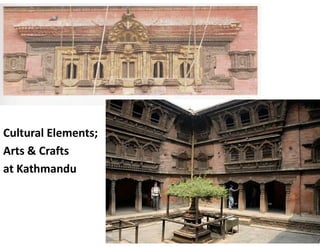
Cultural Elements;
Arts & Crafts
at Kathmandu
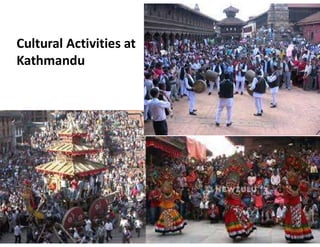
Cultural Activities at
Kathmandu
Socio-Cultural Context of Architecture
• Socio- Cultural environment provides architecture its
socio-cultural context
• Such environment is characteristic of existing social
relationship and organization, interaction, pattern, the
values, norms and beliefs.
• These characters of a particular society are reflected in
the architectural creations.
• The architecture as reflected in hierarchy of streets and
squares and the built form of a old Newar town in
Kathmandu is characteristic of Newar’s community living-
• Joint family system (reflected in house form)
• Social organization (Guthi system reflected in the function of squares)
• Cultural value system (temple along the road, middle of the square, festivals)
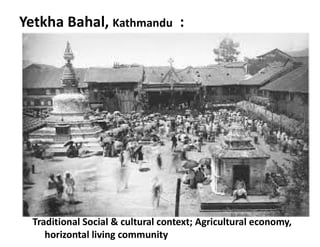
Yetkha Bahal, Kathmandu :
Traditional Social & cultural context; Agricultural economy,
horizontal living community
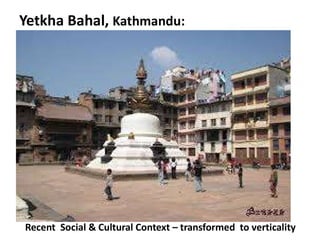
Yetkha Bahal, Kathmandu:
Recent Social & Cultural Context – transformed to verticality
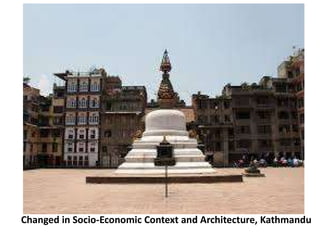
Changed in Socio-Economic Context and Architecture, Kathmandu
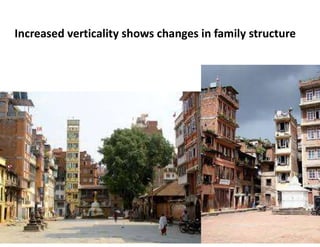
Increased verticality shows changes in family structure
• Modern movements “International Style” in
architecture have local character of building,
indigenous to the site / context.
• The changing reason - social attitudes, socio -
cultural intercourses and trends on globalizations.
• A modern building can stand / fit anywhere in the
world without any social disapproval.
• Modern scientific studies / experimentation and
industrialization - led to the dismantling of religious
framework and leading to material world.
Socio - cultural and religious context of
architecture:
•
Historic urban settlement of Kathmandu Valley
• confirms to social stratifications and hierarchies, cultural
practices and religious faiths, in organization of spaces and
street layouts and in all built environment.
• cultural activities (feasts and festivals and other rituals) have
been the prime force to shape physical attributes for the
cities.
• King Jayasthiti Malla (1380 – 1395 A. D.) introduced caste
system of Hinduism leading social stratification which
influenced upon the planning of the settlement.
• A hierarchy of physical structures maintained in the urban
pattern -status of the inhabitants.
• The central places - palaces and the Durbar Squares,
surrounding - bureaucrats and the next - lower cast
people and the fringes - lowest class people like Pode.
• Caste was the major influencing factor, cultural patterns
have played a significant role.
• Urban structures (buildings and streets) are articulated
according to the festivals (Jatra and ceremonies).
• The street festivals (chariot) are shaping of the street
patterns. The various jatras performed in the streets.
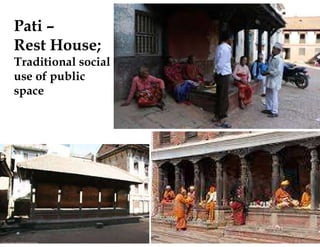
• The Pati, for public gathering, platforms, open lands at
the outskirts for a picnic - religious spots with temples for
major deities.
• In summary,
• Planning responds to life style, social behaviors
• Primarily, they were walled towns with narrow gates – defines
security as social factor
• Human scale is present in the built environment
• Adequate space for social gatherings can be found in chowks
and squares.
• Ceremonial routes are present for various jatras
• Public Buildings like Chhapa, Digi for feast and cultural
gathering
• Pati, Pauwa and Sattal are present for social functions
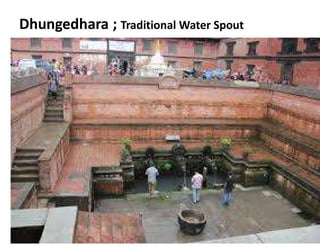
• Dhungedharas (stone water spouts) - as urban infrastructure.
• Ghats are along the periphery of town parallel to river bank for
rituals related to death
Pati –
Rest House;
Traditional social
use of public
space
Dhungedhara ; Traditional Water Spout
Religious context of Architecture
• Religious context: matters related to gods, priests, rites, rituals
etc. and Religious controls or dictates, faiths and fears.
• The belief system (individual or group) in a given culture provides
the religious context of architecture.
• Close connection between religion and architecture
• Society living in fear of nature (primitive), Worship of the sun and
earth.
• It lead to development of religious beliefs, faiths and rituals to
ward off evils - natural happenings.
• The practice of architecture concerned with the design and
construction of places of worship / sacred or international space,
Religious context
 Powerful priesthood
 Faiths have remained traditional, virtually unchangeable and
mysterious
 Gods, Kings and Priests kept them secret and mysterious!
 Natural phenomena and heavenly bodies, worship of animals
as personifications of gods
 Local gods and power places - river banks, hill tops
 No strict dividing line between the Gods, Kings and even, Priests
 Stonehenge,
 The Afterlife – tombs: Pyramid and Taj Mahal, Muslim mosque
 Temples of Kathmandu valley, stupas, synagogues (gathering
building)
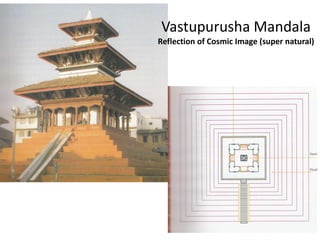
 The Vastupurusha mandala and form of house, temple and town
 The church & Cathedral
Vastupurusha Mandala
Reflection of Cosmic Image (super natural)
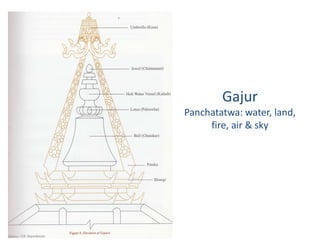
Gajur
Panchatatwa: water, land,
fire, air & sky
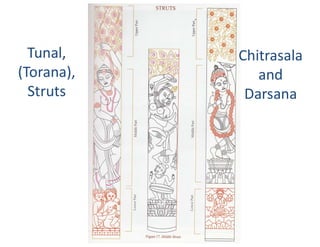
Chitrasala
and
Darsana
Tunal,
(Torana),
Struts
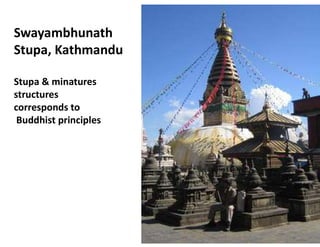
Swayambhunath
Stupa, Kathmandu
Stupa & minatures
structures
corresponds to
Buddhist principles
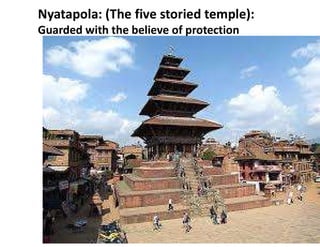
Nyatapola: (The five storied temple):
Guarded with the believe of protection
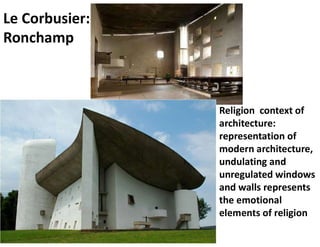
Le Corbusier:
Ronchamp
Religion context of
architecture:
representation of
modern architecture,
undulating and
unregulated windows
and walls represents
the emotional
elements of religion
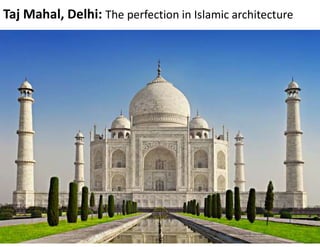
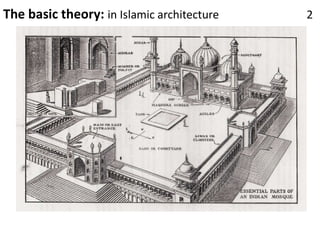
Taj Mahal, Delhi: The perfection in Islamic architecture
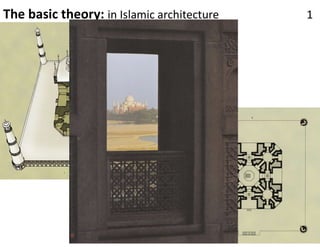
The basic theory: in Islamic architecture 1
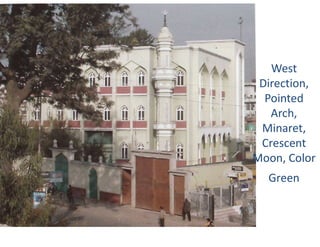
The basic theory: in Islamic architecture 2
West
Direction,
Pointed
Arch,
Minaret,
Crescent
Moon, Color
Green
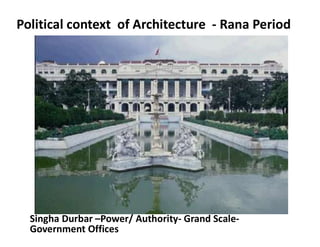
Political context of Architecture - Rana Period
Singha Durbar –Power/ Authority- Grand Scale-
Government Offices
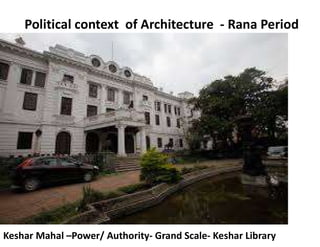
Political context of Architecture - Rana Period
Keshar Mahal –Power/ Authority- Grand Scale- Keshar Library
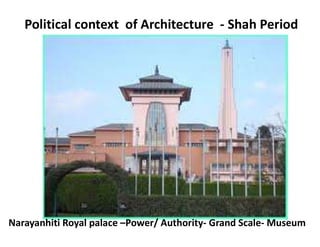
Political context of Architecture - Shah Period
Narayanhiti Royal palace –Power/ Authority- Grand Scale- Museum
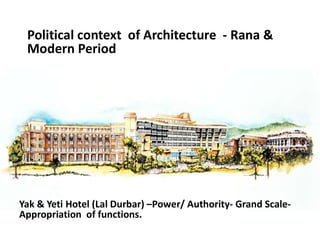
Political context of Architecture - Rana &
Modern Period
Yak & Yeti Hotel (Lal Durbar) –Power/ Authority- Grand Scale-
Appropriation of functions.
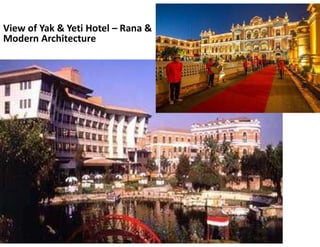
View of Yak & Yeti Hotel – Rana &
Modern Architecture
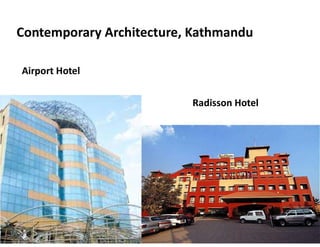
Airport Hotel
Radisson Hotel
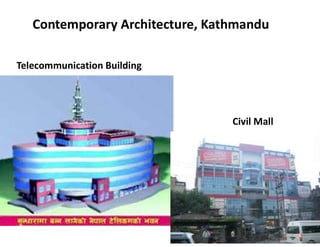
Contemporary Architecture, Kathmandu
Civil Mall
Telecommunication Building
Seminar Presentation and Report
• Make a group of four persons: Gender mix.
• Choose a topic: a building, a group of buildings or temples (from
list)
• Visit the site, and study the built environment
– for social, cultural, religious context
– for site, topography, climate and ecology
– for material and technology of construction
• Make a Seminar Presentation in power point with photographs
and sketches.
• Report for submission with photographs and sketches.
• Max. 10 pages ( 3 – 5 pages text, and 3-5 pages sketches and
other photographs (1-4 in one A4 Paper)
• Kathmandu Durbar Square
• Patan Durbar Square
• Bhaktapur Durbar Square
• Yetkha Bahal, Kathmandu
• Te Bahal / Itum Bahal
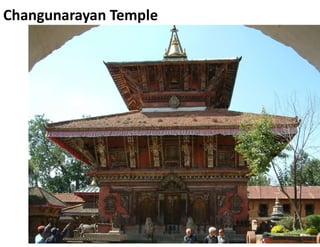
• Changunarayan temple square
• Swoyambhu complex
• Boudhanath square, Boudha
• Dattatraya temple square, Bhaktapur
• World trade centre, Tripureshwor
• Yak and yeti Hotel complex, durbar marg
• Kumarighar, Kathmandu Durbar square
• City mall – Sahidgate
• Kathmandu Mall – near NAC
• LABIM Mall – pulchowk, lalitpur
Technology and material
context of architecture.
Lecture –5
IOE, Pulchowk Campus
Prof. Dr. Bharat Sharma/Shova Thapa
2020
Technology and material context of architecture.
• It is a complementary to each other as construction technique and
material dimension of a building.
• Material + Technology = Innovative ideas / creativity – form
Building/ Architectural style
• Technology - Method of using the Materials
• Indigenous technology - based on local materials with local
technique.
• Difference in architecture style - apparent in different places –
depend - difference in material used & technology applied.
• Material of particular area depends - physical environment -
topography, climate, geology, volcanic deposits.
• In past, due to economic reason, people preferred local
material and technology .
• Materials for construction have to be local by necessity
– materials needed in bulk and transporting them over
long distances not feasible.
– In history, only few cases where materials have been
transported over great distances is evident.
• For monumental purposes , materials were transported in
Stonehenge, Ashokan pillars, Egyptian Pyramids, etc.
• Example: Romans transported materials for concrete
leading to a concrete characteristic of architecture in
Roman Empire.
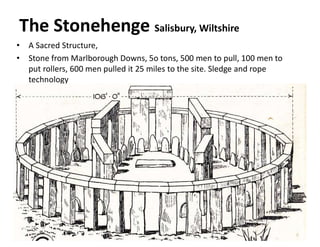
The Stonehenge Salisbury, Wiltshire
• A Sacred Structure,
• Stone from Marlborough Downs, 5o tons, 500 men to pull, 100 men to
put rollers, 600 men pulled it 25 miles to the site. Sledge and rope
technology
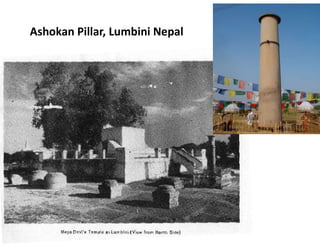
Ashokan Pillar, Lumbini Nepal
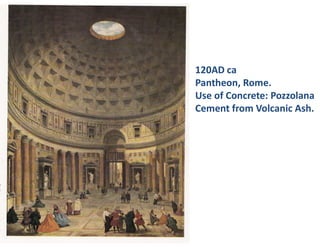
120AD ca
Pantheon, Rome.
Use of Concrete: Pozzolana
Cement from Volcanic Ash.
Technology in the past
• Trabeated System (Post and Lintel)
– Basic and Simplest structure consists of Post (vertical
member- tension) for support & Beam (lintel,
horizontal member - compression) for spanning.
• Examples - Temples from Ancient Egypt, Greek temples
(Parthenon): Development of “Colonnade Architecture”
• Greek Architecture developed simple post to the
ordered columns (Doric, Ionic, Corinthian and
Composite order / style of columns)
Technology : Historic Perspectives
Material: Historic perspectives
EGYPT:
• Stone- Lime stone, sand stone, granite & basalt – strong & durable
• Timber used only during I-II dynasties and making boats, coffins
and roof constructions
GREEK:
• High quality of building stones -lime stones and marbles.
• Good source of clay
• Timber is scarce( max. span 10m)
• Hardwood not available, for important buildings hardwood
imported.
• Shortage of firing wood, bricks are unbaked, fried terracotta tiles
used for decorative purpose
• Volcano ( metamorphic rock ) found , so created distinctive
architecture.
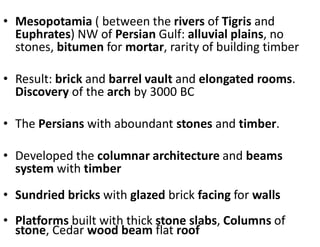
• Mesopotamia ( between the rivers of Tigris and
Euphrates) NW of Persian Gulf: alluvial plains, no
stones, bitumen for mortar, rarity of building timber
• Result: brick and barrel vault and elongated rooms.
Discovery of the arch by 3000 BC
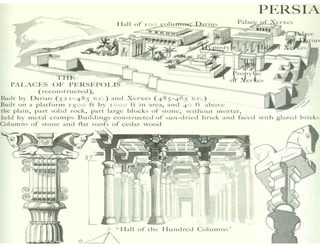
• The Persians with aboundant stones and timber.
• Developed the columnar architecture and beams
system with timber
• Sundried bricks with glazed brick facing for walls
• Platforms built with thick stone slabs, Columns of
stone, Cedar wood beam flat roof
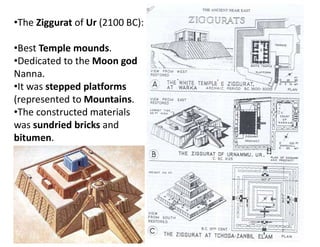
•The Ziggurat of Ur (2100 BC):
•Best Temple mounds.
•Dedicated to the Moon god
Nanna.
•It was stepped platforms
(represented to Mountains.
•The constructed materials
was sundried bricks and
bitumen.
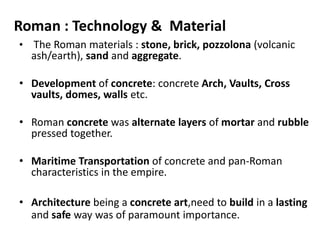
• The Roman materials : stone, brick, pozzolona (volcanic
ash/earth), sand and aggregate.
• Development of concrete: concrete Arch, Vaults, Cross
vaults, domes, walls etc.
• Roman concrete was alternate layers of mortar and rubble
pressed together.
• Maritime Transportation of concrete and pan-Roman
characteristics in the empire.
• Architecture being a concrete art,need to build in a lasting
and safe way was of paramount importance.
Roman : Technology & Material
• Building uses material and technology for
construction
–Shape and size of room, composition and
form of building
–Structure of wall, floor and roof
–Strength and durability
–Texture and Color
• Arcuated System: Instead of Horizontal beam, if
load is transferred through an arch, then it is
Arcuated system, generates curved structure and
self supporting with state of equilibrium.
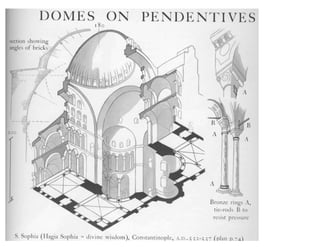
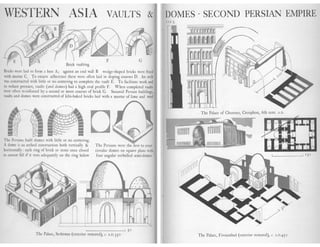
• Arch is a structure constructed of wedge shaped units (bricks
or stones) joint together with mortar.
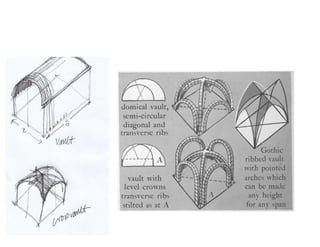
• Tunnel, barrel and groin vaults are created with repetition of
arch.
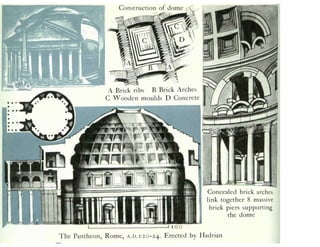
• Dome is multiple nos. of arch placed along a circumference
• This type of technology has been extensively used from Roman
to Muslim Architecture
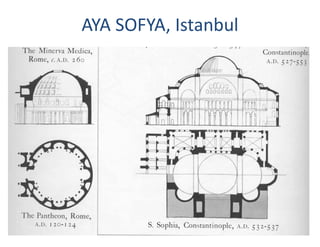
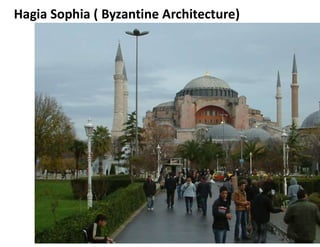
• Examples – Pantheon (Roman Architecture, 118-128 A. D.),
Hagia Sophia ( Byzantine Architecture), Taj Mahal (Muslim
Architecture)
• It is to be noted that arch terminology is never present in
Nepalese Architecture
AYA SOFYA, Istanbul
Hagia Sophia ( Byzantine Architecture)
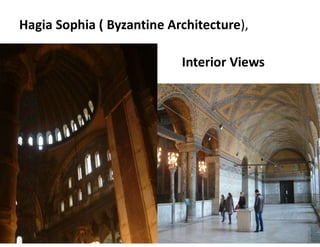
Hagia Sophia ( Byzantine Architecture),
Interior Views
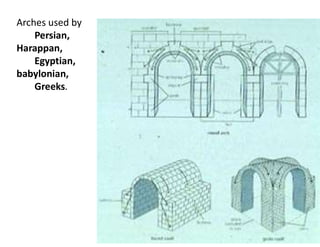
Arches used by
Persian,
Harappan,
Egyptian,
babylonian,
Greeks.
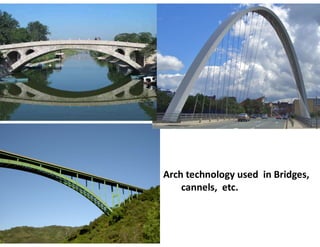
Arch technology used in Bridges,
cannels, etc.
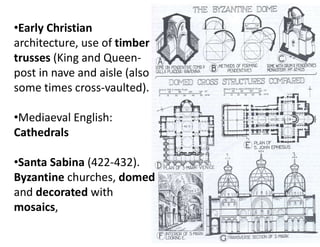
•Early Christian
architecture, use of timber
trusses (King and Queen-
post in nave and aisle (also
some times cross-vaulted).
•Mediaeval English:
Cathedrals
•Santa Sabina (422-432).
Byzantine churches, domed
and decorated with
mosaics,
Gothic :
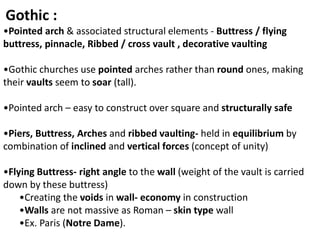
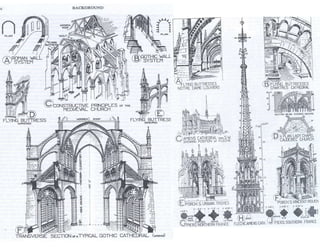
•Pointed arch & associated structural elements - Buttress / flying
buttress, pinnacle, Ribbed / cross vault , decorative vaulting
•Gothic churches use pointed arches rather than round ones, making
their vaults seem to soar (tall).
•Pointed arch – easy to construct over square and structurally safe
•Piers, Buttress, Arches and ribbed vaulting- held in equilibrium by
combination of inclined and vertical forces (concept of unity)
•Flying Buttress- right angle to the wall (weight of the vault is carried
down by these buttress)
•Creating the voids in wall- economy in construction
•Walls are not massive as Roman – skin type wall
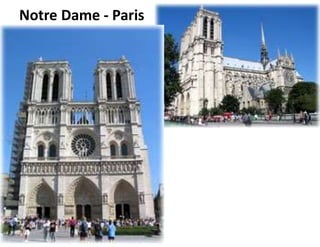
•Ex. Paris (Notre Dame).
Notre Dame - Paris
• The Industrial Revolution, which began in England
about 1760,
• Brought a flood of new building materials— cast
iron, wrought iron, steel, glass, Portland cement,
RCC and glass.
• Because of Rapid Urbanization, Industrialization—
Growth of population towards employment center,
Industrialization and modern times came.
• Mass productions, Transportation and loss of local
character.
• Eg. Crystal Palace, London 1851 AD
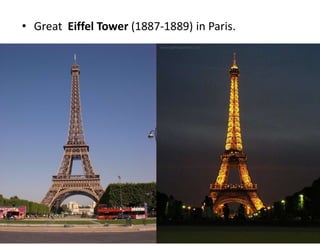
• Eifel Tower, Paris 1889 AD.
•In the 19th century, English architect Sir Joseph Paxton created the Crystal Palace
(1850-1851) in London, a vast exhibition hall.
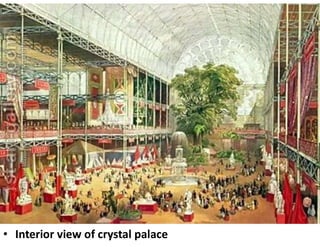
• Interior view of crystal palace
• Great Eiffel Tower (1887-1889) in Paris.
Modern Architecture
Steel Concrete and Glass
• At the beginning of the 20th century,
• Modern large scale commercial and industrial buildings
• In Modern times, things have been changing, materials
have been transported (and the cost has been heavy and
homogenizing)
– Use of man made materials such as concrete & brick
– Industrial materials – CEMENT, STEEL, GLASS, PLASTICS
– Light weight materials - Glass curtain walls
– Specialized transportation
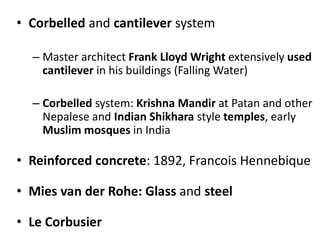
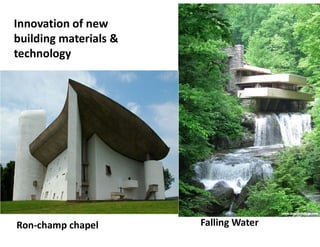
• Corbelled and cantilever system
– Master architect Frank Lloyd Wright extensively used
cantilever in his buildings (Falling Water)
– Corbelled system: Krishna Mandir at Patan and other
Nepalese and Indian Shikhara style temples, early
Muslim mosques in India
• Reinforced concrete: 1892, Francois Hennebique
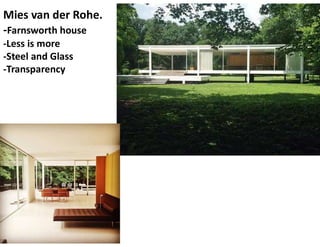
• Mies van der Rohe: Glass and steel
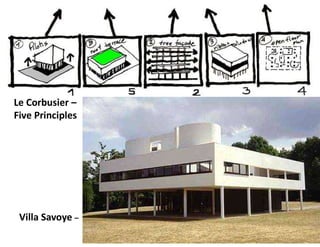
• Le Corbusier
Ron-champ chapel Falling Water
Innovation of new
building materials &
technology
Le Corbusier –
Five Principles
Villa Savoye –
Mies van der Rohe.
-Farnsworth house
-Less is more
-Steel and Glass
-Transparency
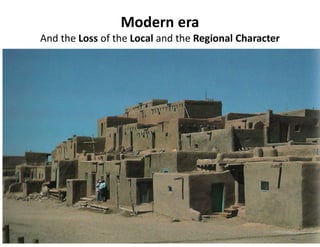
Modern era
And the Loss of the Local and the Regional Character
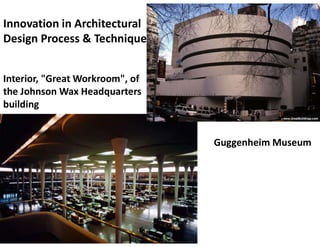
Interior, "Great Workroom", of
the Johnson Wax Headquarters
building
Guggenheim Museum
Innovation in Architectural
Design Process & Technique
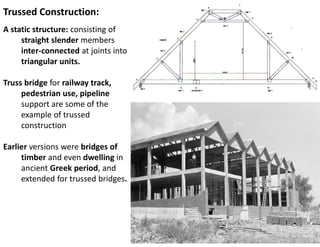
Trussed Construction:
A static structure: consisting of
straight slender members
inter-connected at joints into
triangular units.
Truss bridge for railway track,
pedestrian use, pipeline
support are some of the
example of trussed
construction
Earlier versions were bridges of
timber and even dwelling in
ancient Greek period, and
extended for trussed bridges.
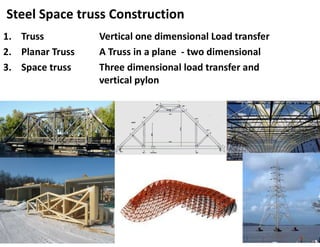
Steel Space truss Construction
1. Truss Vertical one dimensional Load transfer
2. Planar Truss A Truss in a plane - two dimensional
3. Space truss Three dimensional load transfer and
vertical pylon
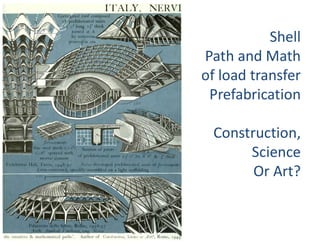
Shell
Path and Math
of load transfer
Prefabrication
Construction,
Science
Or Art?
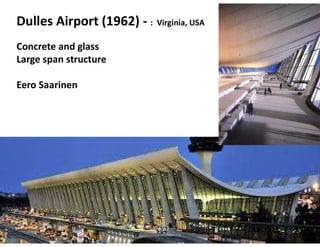
Dulles Airport (1962) - : Virginia, USA
Concrete and glass
Large span structure
Eero Saarinen
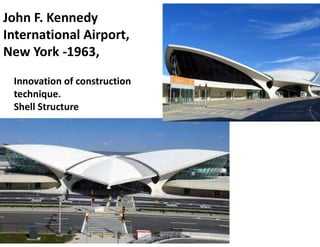
John F. Kennedy
International Airport,
New York -1963,
Innovation of construction
technique.
Shell Structure
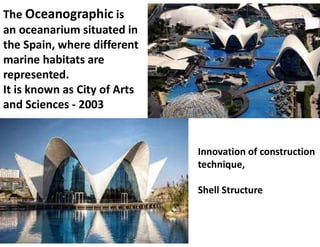
The Oceanographic is
an oceanarium situated in
the Spain, where different
marine habitats are
represented.
It is known as City of Arts
and Sciences - 2003
Innovation of construction
technique,
Shell Structure
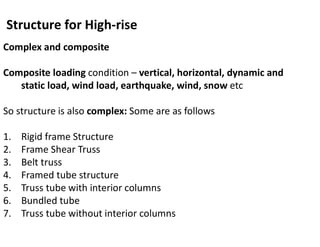
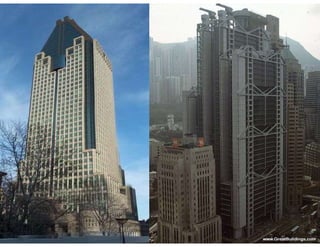
Structure for High-rise
Complex and composite
Composite loading condition – vertical, horizontal, dynamic and
static load, wind load, earthquake, wind, snow etc
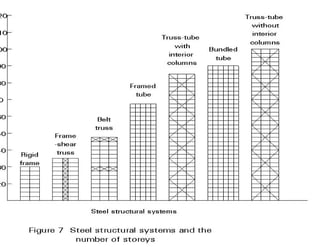
So structure is also complex: Some are as follows
1. Rigid frame Structure
2. Frame Shear Truss
3. Belt truss
4. Framed tube structure
5. Truss tube with interior columns
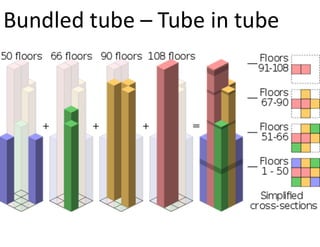
6. Bundled tube
7. Truss tube without interior columns
Bundled tube – Tube in tube
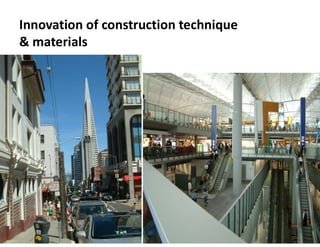
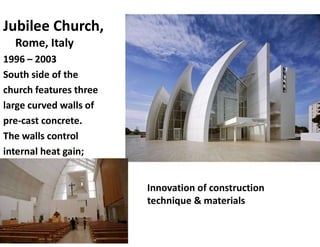
Innovation of construction technique
& materials
Jubilee Church,
Rome, Italy
1996 – 2003
South side of the
church features three
large curved walls of
pre-cast concrete.
The walls control
internal heat gain;
Innovation of construction
technique & materials
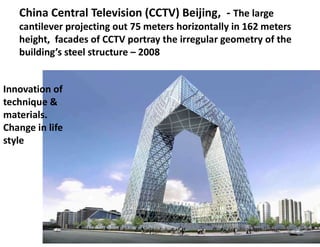
China Central Television (CCTV) Beijing, - The large
cantilever projecting out 75 meters horizontally in 162 meters
height, facades of CCTV portray the irregular geometry of the
building’s steel structure – 2008
Innovation of
technique &
materials.
Change in life
style
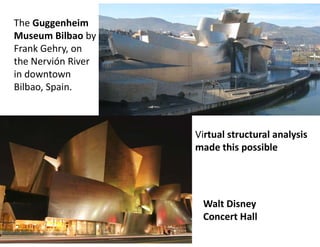
The Guggenheim
Museum Bilbao by
Frank Gehry, on
the Nervión River
in downtown
Bilbao, Spain.
Walt Disney
Concert Hall
Virtual structural analysis
made this possible
Nepalese Architecture : Materials &
Technological context
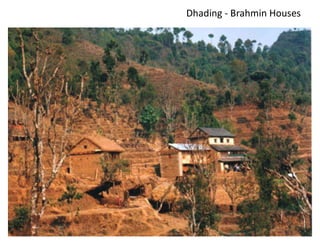
• In Nepal, Vernacular architecture retain their local material and
technology relevance
– Regional and Ethnic identity
– Ethnic groups are location specific
• Kathmandu valley and its geology: Hills and Valley floor, Monsoon
rain, fertile soil
• Locally available materials :- Clay, brick , timber, stone, tile(jhingati)
and metal.
• Limited stone deposits of working possibility and transported from
nearby area. E.g. Chobar.
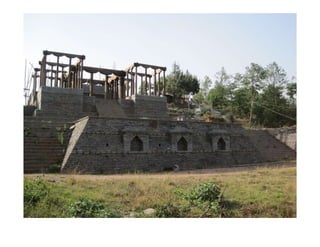
• Technology: Primarily and Mostly of trabeated (post and lintel)
structure in almost all buildings. The absence of the term “arch” .
Dhading - Brahmin Houses
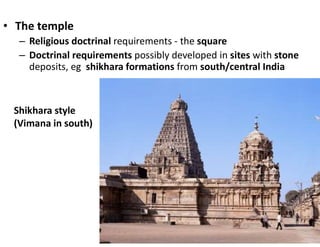
• The temple
– Religious doctrinal requirements - the square
– Doctrinal requirements possibly developed in sites with stone
deposits, eg shikhara formations from south/central India
Shikhara style
(Vimana in south)
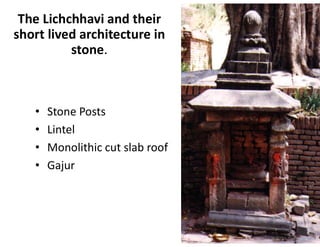
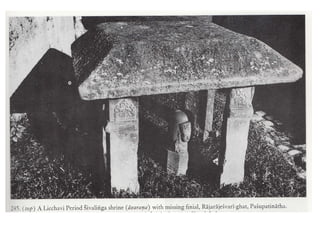
The Lichchhavi and their
short lived architecture in
stone.
• Stone Posts
• Lintel
• Monolithic cut slab roof
• Gajur
Nepalese temples :
• Learning through long periods of experience and
experiment: rain, earthquakes
• Results in derivation of the form – square in plan and
pyramid in form ( rectangular plan exceptions)
• Symmetry an answer to both religious needs and
earthquakes
• Thick load bearing walls, receding walls are used
• Trabeated system of structure
• Use of timber beams, stone bases, slope roofs, overhang
projections, struts, horizontal bands of timber, wood and
carvings etc.
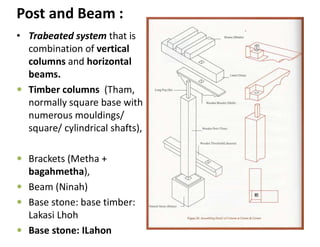
Post and Beam :
• Trabeated system that is
combination of vertical
columns and horizontal
beams.
 Timber columns (Tham,
normally square base with
numerous mouldings/
square/ cylindrical shafts),
 Brackets (Metha +
bagahmetha),
 Beam (Ninah)
 Base stone: base timber:
Lakasi Lhoh
 Base stone: ILahon
Changunarayan Temple
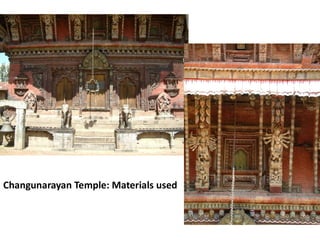
Changunarayan Temple: Materials used
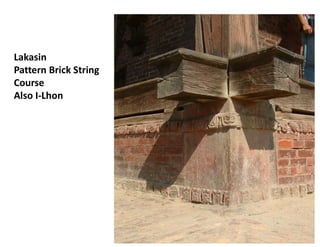
Lakasin
Pattern Brick String
Course
Also I-Lhon
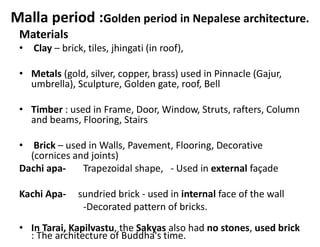
Malla period :Golden period in Nepalese architecture.
Materials
• Clay – brick, tiles, jhingati (in roof),
• Metals (gold, silver, copper, brass) used in Pinnacle (Gajur,
umbrella), Sculpture, Golden gate, roof, Bell
• Timber : used in Frame, Door, Window, Struts, rafters, Column
and beams, Flooring, Stairs
• Brick – used in Walls, Pavement, Flooring, Decorative
(cornices and joints)
Dachi apa- Trapezoidal shape, - Used in external façade
Kachi Apa- sundried brick - used in internal face of the wall
-Decorated pattern of bricks.
• In Tarai, Kapilvastu, the Sakyas also had no stones, used brick
: The architecture of Buddha's time.
Stone :
• Due to the scarcity of stone in valley the use of stone can
be mainly seen in sculptures and Shikhara type of temple.
• Used in - Foundation, Plinth, Pavement (e.g. durbar
square), Chaitya, Fountains (Dhungedhara), Steps,
Guardian, Stone pillar (ashokan pillar)
Construction Technique :
• Foundation
• Superstructure
• Symmetrical and in geometrical shapes (square,
rectangle)- earthquake resistant
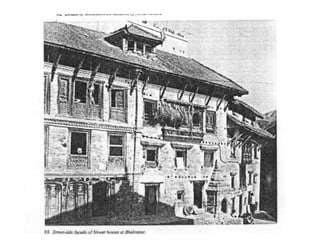
Newari house :
• Use of timber, bricks and stones with Jhingati roofing tiles
• Thick load bearing walls with minimum openings
• Short span and the span being always dictated by timber
size
• Trabeated (post and lintel) system of structure
• Symmetrical building – good looking and structurally stable
• Use of multi-layered brick walls: wedge shaped baked bricks
(Dachhi Appa) on outside (for protection of mortar from
weathering effects) and sun dried bricks on inside layer.
Site, City and Ecological context of
Architecture.
Lecture – 6
IOE, Pulchowk Campus
Prof. Dr. Bharat Sharma/Shova Thapa
2020
The Site :
• The Site : An area, where a building, or a monument, or a group of
buildings and monuments, or a town is built upon.
• The site is a complex concept that plays a vital role in dictating how a
building is to look and function.
• The site is not merely a geographical piece of land, but rather a
reflection of its surroundings.
• A site comprises of certain geographical qualities such as
Topography, Climatic conditions, Natural landscape, and existing
built environment etc.
• So, the site is reflection of the physical, social, cultural & religious
contexts.
• The Site has Background and foreground, views and
prospects
• What’s around it? Context/Environment. >>daily
variation, seasonal/annual variation
Example ;
• How the different features of its social environment affect a
site. Let us consider two geographically identical sites, the
difference being-
• i) The first one is located in the city centre and
• ii) Another is in a rural area surrounded by the fields.
• These two sites may face the same direction, same
dimension, same topographical character, a perfect
architect would never build the same building in both sites.
• The designer will consider specific privacy issues, and
security issues for the proposed function.
• The function of this site is try to fulfill, how
the proposed building is to be used,
approached, impact the surrounding buildings
and structures (shadows cast / wind blocked
etc)
• Thus Architect should be sensitive to all of
these elements when analyzing and designing
the site. Not merely consider it as a piece of
land.
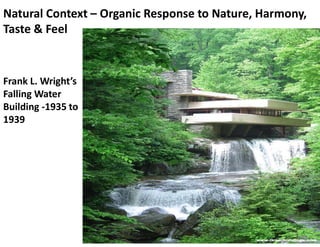
Natural Context – Organic Response to Nature, Harmony,
Taste & Feel
Frank L. Wright’s
Falling Water
Building -1935 to
1939
Natural Context – Organic Response to Nature,
Harmony, Taste & Feel
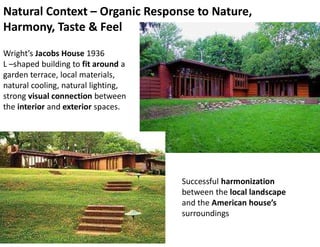
Successful harmonization
between the local landscape
and the American house’s
surroundings
Wright’s Jacobs House 1936
L –shaped building to fit around a
garden terrace, local materials,
natural cooling, natural lighting,
strong visual connection between
the interior and exterior spaces.
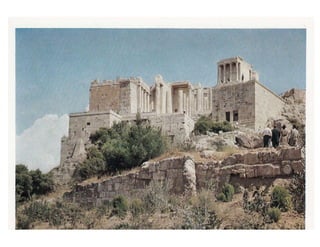
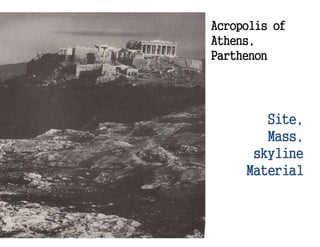
Acropolis of
Athens,
Parthenon
Site,
Mass,
skyline
Material
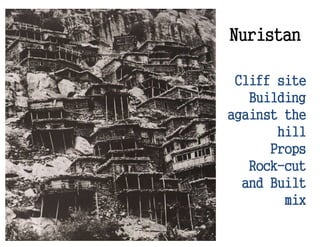
Nuristan
Cliff site
Building
against the
hill
Props
Rock-cut
and Built
mix
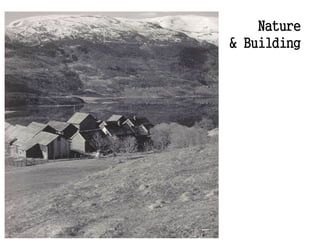
Nature
& Building
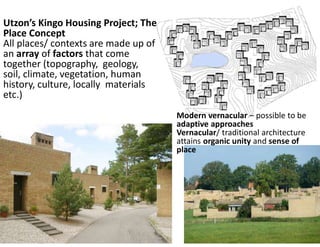
Utzon’s Kingo Housing Project; The
Place Concept
All places/ contexts are made up of
an array of factors that come
together (topography, geology,
soil, climate, vegetation, human
history, culture, locally materials
etc.)
Modern vernacular – possible to be
adaptive approaches
Vernacular/ traditional architecture
attains organic unity and sense of
place
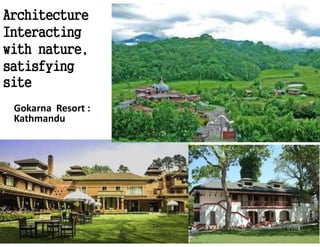
Architecture
Interacting
with nature,
satisfying
site
Gokarna Resort :
Kathmandu
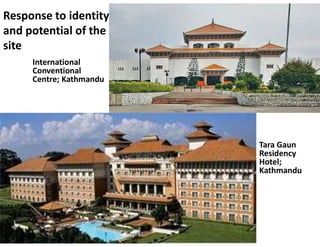
Response to identity
and potential of the
site
International
Conventional
Centre; Kathmandu
Tara Gaun
Residency
Hotel;
Kathmandu
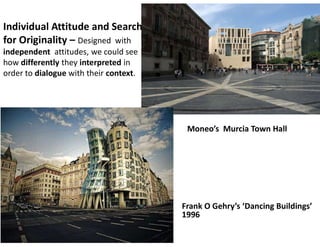
Individual Attitude and Search
for Originality – Designed with
independent attitudes, we could see
how differently they interpreted in
order to dialogue with their context.
Frank O Gehry’s ‘Dancing Buildings’
1996
Moneo’s Murcia Town Hall
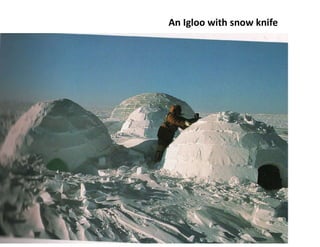
An Igloo with snow knife
The City:
• The city or town is density, heterogeneity and non-
agricultural economy with urban culture and
infrastructure suited to all.
• The City has influence in site characteristics, and the site,
in turn, over time begins to influence the evolution of the
city.
• A City and its identifying characteristics are a reflection of
the people, their values, their culture and their
architecture.
• While understanding a site, it should understand the city,
urbanization, the urban context and the impact in urban
environment – i.e. in a regional context.
• The City- A complex dense socio economic space, Urban
Fabric – a crowed city,
• City - Public space and Built Environment
• Where a direct impact of how people have dealt with their
surroundings, how they have designated the function of
each site they have constructed their buildings/ structures.
• How the inhabitants of this urban fabric have decided
these sites are connected to each other.
• This conscious connection between individuals sites
shows the urban fabric.
• The changes that are made to a city is course of actions contributed
by its inhabitants.
• The economic growth, environmental and socio-economic changes,
climatic change, pollution, congestion etc. are some of the outcome
of urbanization.
• Kathmandu valley is a best example as a case illustrating its changes.
• The Newari house remained unchanged for centuries , the city took
centuries or decades to become big and well city.
• The influential elements are technological achievements, economic
growth of the city and the change in people’s desires.
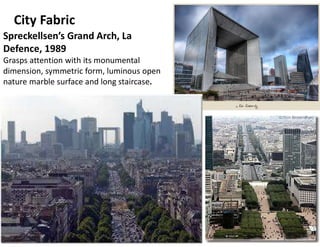
City Fabric
Spreckellsen’s Grand Arch, La
Defence, 1989
Grasps attention with its monumental
dimension, symmetric form, luminous open
nature marble surface and long staircase.
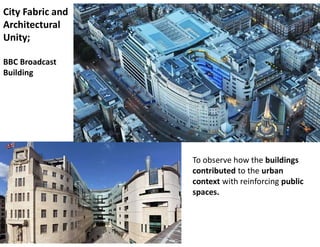
City Fabric and
Architectural
Unity;
BBC Broadcast
Building
To observe how the buildings
contributed to the urban
context with reinforcing public
spaces.
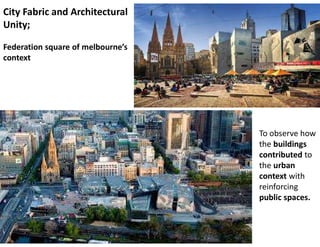
City Fabric and Architectural
Unity;
Federation square of melbourne’s
context
To observe how
the buildings
contributed to
the urban
context with
reinforcing
public spaces.
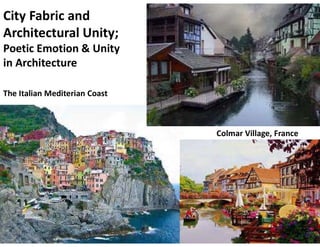
City Fabric and
Architectural Unity;
Poetic Emotion & Unity
in Architecture
The Italian Mediterian Coast
Colmar Village, France
The Ecology;
Ecology : House or environment - is the scientific
analysis and study of interactions among organisms
and their environment.
It is an interdisciplinary field that includes biology,
geography and Earth Science.
Ecology is not synonymous with environment,
It is a environmentalism, natural history,
or environmental science.
Ecology is a human science as well.
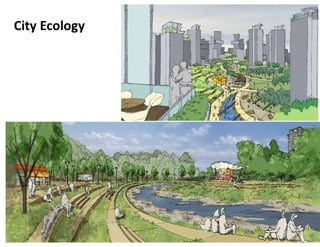
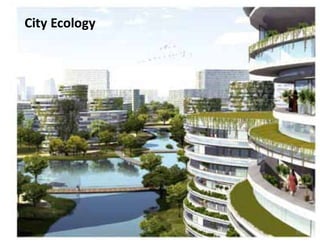
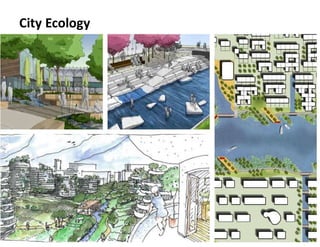
Architecture: City Ecology
• Ecology connects Natural landscape> physical, environmental,
ecological (air, water, land + heat + sky)
• Urban landscape > physical (form and stylistic context) social,
cultural such as
• Streets, squares, greens, amenities, play spaces/entertainment
• Working (economic), Living (social), Rest (individual, physical
health, recovery) and Recreation (individual and social recreation,
mental rest
• How much of Nature should there be in a city?
• Architecture > cool, wet and green? Energy efficiency, local
response (energy, material)> Disposability
• Inclusive architecture
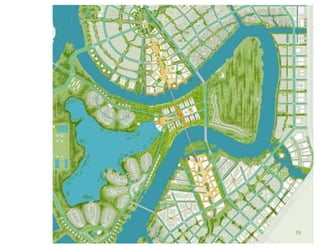
An Eco- city is an ecologically healthy settings, each city
is unique, no one size fits - all eco city model.
The concept of eco city has been evolved in line with
sustainable development to help society live in harmony
with the environment and improve overall productivity
Conceptualizing an eco-city
Through
principles of
Green Productivity
24
25
City Ecology
26
City Ecology
Green building
28
29
City Ecology
ITA NOTE .pdf.......................................

ITA NOTE .pdf.......................................

  • 1.
    INTRODUCTION TO ARCHITECTURE EG402 AR Year I Part I Lecture – 1 Prof. Dr. Bharat Sharma/Shova Thapa 2019 IOE, Pulchowk Campus
  • 2.
    • Lecture :2 hr/week • Final Examination : 1.5 hr : 40 Marks/ out of 50 • Assessments: 10 Marks (Exam + Report) – Report on architecture of a Building: Form, Style, Materials, Technology, socio-cultural and religious aspects – Presentation (group work) • Attendance requirement: 75% (i.e. IOE requirement) • Class lectures: notes will be provided Reference : Any Architectural related books, History of Architecture
  • 3.
    Course Objective: Tointroduce the field of architecture and its relation with society, culture, religion, technology and build environment. To understand the profession of architecture and its relation with allied profession. To understand the role of architecture in Nepal and the career opportunities scene. • The field of architecture brief Survey from beginning of architecture to present times (2 hours) • The study of architecture and its features under TU. (1 hour) • Architecture, built environment and the society. (6 hours) • Socio-culture and religious context of architecture. (4 hours) • Technology and material context of architecture. (4 hours) • Site, City and ecological contest of architecture. (2 hours) • The architecture profession and its interactive relationship with allied professionals such as planners, engineers, interior designers, landscape architects etc. (4 hours) • The profession of architecture of Nepal-its practice both public and private, career opportunities. (2 hours) • Architect, client and contractor, planning and building controls in force.
  • 4.
    The field ofArchitecture: • ARCHITECTURE: • Architecture is the scientific art of designing built spaces. It involves conceptual study, design, and visualization of the site before it is constructed. Art and Aesthetics, Form and Function, material and technology all melt together in architecture. • Architecture acts as a bridge between the science and art. • Art : Creative, Expression, Utilitarian, Social art • Science : systematic process, principal, laws • Technology : safety and protection, Proper use of material • Design: systematic activity to serve a purpose • Structure : organization, arrangement of parts, elements • Built space: man made space • Building: an enclosed space or relates to the activity of construction
  • 5.
    • Architecture isthe art, science and designing & constructing functionally graceful structures to serve the user well & satisfy his varying complex needs. • It interacts with the natural & surrounding world. • It is a social artifact - society, religion & culture are influenced • It relates to history, historical evidences and the availability of materials & technology. • It is a product of culture & environmental factors, expressions of the way of life of people. • Innovative and creative work for human physical and psychological comfort. • It is influenced on economical, political or symbolic intentions
  • 6.
    • Architecture isthe “Mother of all Arts”. • Architecture in a word…is reflection… the reflection of …? • Power, Culture, Money, Influence, Philosophy, • Architecture transformation happens in specific time and space. • Profession of architecture is produced and consumed with market economy. • Design of the total built environment, • The macro level - town planning, urban design and landscape architecture • The micro level - architectural or construction details, furniture. • Systematic arrangement of forms, shapes, spaces and light to change the environment.
  • 7.
    In conclusion: The Architectureis • Versions of the past: Different versions of the past human achievements • Reflections of the present: Reflection of present condition of economy, society and political environments • Visions for the future: Environmental sustainability, and need for the future with visions.
  • 8.
    Definitions: • Vitruvius, the1st Century Roman Author on Architecture – principles follows: • Utilitas (Utility): Building should have its Practical Functions/ Commodity • Firmitas (Structured): Building should be technically, structurally sound • Venustas (Beauty): Building should be beautiful and artistic/ aesthetic or visual quality • Architecture is nothing more and nothing less than the gift of making places for human purposes. Spiro Kostof (an architectural historian) • MAYAMATA "Experts call all places where immortals and mortals dwell, "dwelling sites" (VASTU ). The Earth is the principal dwelling place because it is on Her that constructed dwellings (VASTU ) • " All habitations are defined by their dimensions" Mayamata 5.1
  • 9.
    The study ofarchitecture at IOE and its features • Architectural education in Nepal • Bachelor of Architecture (B. Arch) -1996 under the affiliation of Tribhuvan University (TU) at Institute of Engineering, Pulchowk Campus. • Nepal Engineering College (nec) -1997 in affiliation with TU, started B. Arch in private sector. • By this time, more than hundreds of architects have been produced. • Kathmandu Engineering College (KEC), • Khwopa engineering College • Acme Engineering College have also been running B. Arch course. • Himalaya College of Engineering • Thapathali Engg. College • Chitawan Engg. College
  • 10.
    BACHELOR OF ARCHITECTURE Philosophyof the course: a compromise response to the nature of works performed by architects in Nepal/upcoming areas such as urban renewal (aesthetic design, construction and technology), and conservation, planning. Communications: Communication, Drafting I, Drafting II, Computer Aided Design and Drafting, Art and Graphics, Free Hand Sketching I, Free Hand Sketching II Working Drawings Humanities and Basic Sciences: • Mathematics I, Mathematics II, Applied Mechanics, Sociology, Building Economics Skills: Basic Skills Workshop Construction Sciences and Technology: • Building Materials I & II, Building Science I & II, Building Construction I, II, III, IV • Building Services I, II & III • Surveying, Estimating & Costing, Specification • Structures I, II, III & IV
  • 11.
    Theory, Criticism andHistory of Architecture: • Introduction to Architecture, Design Theory I & II • History of Architecture I (Western and Eastern), History Architecture II (Nepalese) • Contemporary Architecture • Architectural Conservation Management and Practice: • Construction Management, Professional Practice Planning: • Urban Planning and Design, Landscape Design and Site Planning Electives and Research: • Elective I, Seminar & Directed Studies, Elective II Design: • Basic Design I & II, Design Studio III, IV, V, VI, VII, VIII Practicum Thesis
  • 12.
    The brief Surveyfrom beginning of architecture to present times • Primitive times, Earlymans‘ - to protect himself from the attacks of wild animals and rigorousness of weather condition, nature. • Created his dwelling to keep on changing with time and the need. • Building began to develop in Paleolithic Period - created structures in wood and stone. • NO CLEAR EXAMPLES EXIST. • Example ; cave dwellings, tents of saplings sheathed in bark or brushwood, huts of reed, thatch, branches of trees, round houses in stone.
  • 13.
    Cave Dwellings ofMustang 3000-8000BC?
  • 14.
    The best documentedexamples from the MESOLITHIC PERIOD indicates that villages Arranged symmetrically • Aligned in rows. • More regular in Plan • Technology, materials • Functional diversity • Social organization in family
  • 15.
    NEOLITHIC PERIOD: • First agricultural expansion began. •Marked for the large numbers of detached, square, and rectangular, Single roomed houses, of timber framing and wattle and daub infill.
  • 16.
    Mediterranean regions • Roundand oval compounds were grouped together and surrounded by deep ditches. • Indestructible ( too strong) materials to erect large structures (gods), monumental palaces (priest- kings) • Architecture - religious impulse • Example – Stonehenge in England. • A monumental calendar. • Trabeated system – Simple Post and Beam Construction,
  • 17.
    • Places ofburial or worship: The Dolmens in Locmariaquer in France: Late third millenium BC.
  • 18.
    CIVILIZATIONS : EGYPT •Firstadvanced civilization (3000 BC) – along Nile River, • Built of durable materials . •Improved technique and good farming, Richer society •The ancient Egyptians were very religious, SUN (chief god) • The pyramids as a symbolic staircase. •They believed in a life after death at first only for kings and nobles. •Three main types: Mastabas, Royal Pyramids and Rock- hewn Tombs.
  • 19.
    Cheops pyramid 756 ftsq in plan & 480 ft high
  • 20.
    • The Egyptians temples- rectangular gigantic. • Trabuated system - posts and beams. • Hypostyle Hall - A pillared hall in which the roof rests on columns.
  • 21.
    Arch and VaultSystem • Arcuated System: load is transferred through an arch, generates curved structure and state of equilibrium. • First developed in Mesopotamia, and to Egypt , babylonian, Greeks refined to Ancient Roman • Important techniques for dams brideges, cathedral building, high span. • Used Bricks, arch, vault, domes.
  • 22.
    Classical Architecture Greek -strong and intellectual culture, about 1000 to 500 BC, Culture of Dorians and Ionians mixed. • Natural Platform - Temple and Hilly side - Theaters. • Developed Architectural orders and real perfection, • For society - created community space, government space. • Grid Iron road pattern city
  • 23.
    The Doric order/Shepherds - Parthenon (448-432 BC). The Ionic order/ Artists The Corinthian order – combination of doric and ionic.
  • 24.
    ROMAN EMPIRE • Rome- largest and richest city in Italy (6th B.C) • It gradually fought, lead to the conquest of the world. • Great engineering works— roads, canals, bridges, and aqueducts. • Developed great concrete and masonry arches, domes and vaults, carpentry. • Architecture - public and private buildings • The coliseum or stadium.
  • 25.
    • THE PANTHEON,Rome AD 118—128 • The most important temple • Great dome (solid concrete construction) spanning 43.2M. With puzzling form. • Structurally - more complex • 6 meter thick cylindrical drum around building has many voids and recesses.
  • 26.
    Architecture of theIndian Subcontinent : • -Indus Valley Civilization: Planned and built famous cities – Urban Mohenzodaro and Harappa: 3000 BC- 2000BC • worship – Durga, Hindu god • “The priest Kings” • Brick Architecture • Grid iron streets, • Bath rooms in each house, • Courtyard house with windowless exteriors,
  • 27.
    • Development ofBuddhism, • Clusters of circular huts with domical thatch roofed houses, gable, • • arched timber palaces with ornate projecting timber balconies Ashokan Stupa At Sanchi
  • 28.
    • Asoka tookfrom contemporary Persian stone mason (already built marvellous stone palaces) 326 BC, • Built stone monuments for Buddhism • Toranas, Chaityas, Stupas, Stambhas, • The Buddhist monk enlarged and transformed the natural grottos and caves of the hill side into great and glorious prayer hall and monastery Toranas, Stambhas,
  • 29.
    • Cave architecture-500 BC- 900 AD • Ajanta, Ellora, monuments of Buddhism • To built great temples- Konark, Gujarat, Khajuraho, and Tanjora • Later formed Shikhara (North India) and Vimana (South India) temple in stone – 350 AD – 1600 AD Shikhara style (Vimana in south) Ajanta – ellora cave
  • 30.
    • Earlier 12thC. -The Islam architecture- • Great buildings, Glorious mosques, Palaces tomb • The basic plan of an Islamic mosque is the same today • highly ornamented buildings. Taj Mahal (1632-1648), in Agra.
  • 31.
    • In 4thcentury, Roman architecture converted to Christianity.
  • 32.
    Gothic Architecture : 12th& 13 century, Romanesque transformed into Gothic. Churches built in the Gothic style are higher, more compact & appear lighter Gothic was Ecclesiastical style and Flamboyant. •Pointed arch •Buttress / flying buttress •Ribbed vaults
  • 33.
    The Industrial Age •The Industrial Revolution, which began in England about 1760, brought a flood of new building materials— for example, cast iron, steel, and glass. • Rapid Urbanization, Industrialization— employment center, railway station, pub, coffee shop, airport, etc • Late 18th c. designers turned toward the original Greek and Roman prototypes, 19th century, Sir Joseph Paxton created the Crystal Palace (1850-1851) in London, a vast exhibition hall.
  • 34.
    • Influence ofVictorian style (Rana palaces) in Nepal • Golden Gate Bhaktapur Durbar
  • 35.
    Modern Architecture • MasterArchitects, and Influential Architects. • New Society • Increase in Wealth, More Mobility (Transport), Scientific Inventions, • literature based and academic explorations, philosophy, • New Thinking & Challenges • Architectural Critics and Political Reforms, • Change of architectural style.
  • 36.
  • 37.
    • Master Architects-Walter Gropius, Ludwig Mies van der Rohe, Le Corbusier, Antoni Gaudí, , Frank Lloyd Wright etc • The style initiated by the Bauhaus architects and termed the International Style 1930s. • Characteristics of International Style include: • Form follows function. • Horizontal and vertical planes • Use of glass and steel • Use concrete & brick materials • No decoration
  • 38.
    Bauhaus • Fagus work VillaSavoye Guggenheim Museum
  • 39.
    "Great Workroom", JohnsonWax Headquarters Ranchamp Chapel Falling water
  • 40.
    • Postmodernism isnot a cohesive movement based on a distinct set of principles. • Individuality, intimacy, complexity, and occasionally humor.
  • 41.
    • DECONSTRUCTIVISM: Started in1980 • Geometrical composition placed in conflict to produce an unstable, restless geometry Walt Disney Concert Hall Imperial War Museum
  • 42.
    MIT's Stata Center,2004. Weisman Art Museum
  • 43.
  • 44.
    GREEN BUILDING: Themost innovative architectural approach for sustainable building Life cycle assessment: Siting and structure design efficiency: site location and its accessibility from major points of need. Energy: for the operation of the structure and its efficiency. Water: Use and conservation Material: Use of material and its carbon emissions is calculated Indoor environmental quality enhancement: Waste reduction:
  • 45.
    Architecture and Built Environment Lecture– 2 IOE, Pulchowk Campus Prof. Dr. Bharat Sharma/Shova Thapa 2019
  • 46.
    Architecture • Spiro Kostof: "Architecture, in the end, is nothing more and nothing less than the gift of making places for human purpose.“ • Architecture has to be functional, beautiful, durable, social. • Humanistic field – human questions and society’s problems. • Interacts with Nature ( geographical, geological, climatic), the earlier built spaces, society, cultural, religious, technology etc . • Buildings are not isolated objects. • Further, "Architecture is a social act- social both in method and purpose. Every building represents a social artifact of specific impulse, energy and commitment." - Spiro Kostof.
  • 47.
    Place and Space •Architecture: Making places for human purpose • Built environment: Place for human purpose • Place is a space with an identity: Physical Space + Perceptual space (Socio-cultural) = Relation gives identity • Physical space > The existential space Source : Prof. S. R. Tiwari
  • 48.
    Place and Space •Physical space > The existential space – Vacant Space > Built Space – Built space is inside or outside a building, around a building, in front of a building etc. – Making Space • Dividing/ Partitioning/Appropriating spaces – Front & Back space – Up & Down – Enclosed space > open space Source : Prof. S. R. Tiwari
  • 49.
    Source : Prof.S. R. Tiwari
  • 50.
    Source : Prof.S. R. Tiwari
  • 51.
  • 52.
    Lumbini: Ashok’s Pillar •Marking a Place 249 BC
  • 53.
    A Dolmen • Placesof burial or worship 3000BC
  • 55.
    Dividing Space [Marking aPlace of worship] SHINTO SHRINES Japan
  • 56.
  • 57.
    Built Environment • Refersto : • Human – made surroundings, provide the setting for human activity. • Ranging in scale from buildings and parks or green spaces- to neighborhood cities. • Provisional for supporting infrastructures- water supply, energy networks. • Material, spatial and cultural product of human labor that combines physical elements and energy in the forms for living, working and playing.
  • 58.
    Built Environment • Respondsto an existing set of conditions – be purely functions in nature ( social, economical, political, symbolic intension). • Places and spaces are created or modified by people including buildings, parks and transportation system. • Concern with physical, psychological comfort and good public health.
  • 59.
    Two types ofBuilt Environment : External Built Environment : • External spaces around the built structures • Must be able to realize : • how the built mass responds to the external environment • how the response has been made to site context / site features • how the existing features of the site have been used – a created relationship between built structure and the external environment – Examples: Durbar Squares in Kathmandu Valley • Chowks and various open spaces • Plazas and forums (Roman Architecture) • Falling Water by Frank Lloyd Wright
  • 60.
    Internal Built Environment: • Internal spaces within the built structures. • Buildings create an environment within them • Various interior spaces like lobby, foyers, corridors, halls, etc. • Properly planned interior should consider the function of the space, proportions, scale, • “The feeling of the space” and relationship of the interior with the exterior.
  • 61.
    Built Environment asconceptualized by ‘Siegfried Giedion’ • Giedion gives three different concepts: • Concept One: Architecture as space radiating volumes • Building as sculptures • Buildings form spaces outside for the use of man • Buildings are focused on the external aspects of the built environment – Little or no use of interiors – Treated as a sculptural form in space – Designed for viewing from outside and some calculated distances – External space created for experience, enjoy and utilize by the man – Pyramid; The Parthenon, Athens; Stupa, Temple, Chaitya
  • 62.
    Housing the Dead,Pharaoh Pyramids, Gizeh with Sphinx 3000BC • Cheops pyramid 756 ft sq in plan & 480 ft high
  • 63.
    – The EgyptianPyramid were large – The Egyptian Temples were roughly finished • Designed for viewing from a long distance • Huge blocks of stones have been used to shape them. • Treated as a sculptural form in space
  • 64.
    Greek Temples -Finished extremelyfine as its viewing distance was very close Treated as a sculptural form in space. The Parthenon - perspective corrections applied "looked perfect".
  • 66.
    Nepalese temples: •First concept– create external spaces through their volumes. •The sculptures standing amidst the great squares. • The detailings indicate exterior viewing •Limited use (ground floors) of internal spaces. •The monuments -Dharahara and Sahid Gate - elaborate above concept.
  • 68.
    -Buddhist stupas •First concept •Createexternal spaces through their volumes. •The stupas have no internal use. •The detailing indicate exterior viewing.
  • 69.
  • 70.
    Concept Two: Architecture asinterior space • Deals with the internal built environment • Building hollowed out and opened up by means of window • Elaboration of interior (decorations), lighting, etc • Buildings forms spaces inside for the use of man Examples: The Pantheon, Rome Gothic Cathedrals 55Window Palace, Bhaktapur
  • 71.
    Notable example -Pantheon in Rome (120-124 A.D.), •The temple - domical structure (diam. 43.30 m), •Hall was lit from the top (eye of the dome) with coffer dome. •Interior –too much decorated •From outside - plain cylinder with a colonnaded porch like those of the Greeks.
  • 72.
    Pantheon - Romecoffer dome, looking up Pantheon - Rome section
  • 74.
    The Gothic cathedrals- early examples , where load bearing walls were avoided as a structural system (using arches and counter weights) Punctured with windows to bring in light.
  • 75.
    The use ofstained glass in the openings - highlighted their intentions in the nature of interior.
  • 76.
    For Historic Nepalese buildings, the 55 Window Palaceat Bhaktapur Durbar Square may somehow relate to this second concept.
  • 77.
  • 78.
    Concept Three: Architecture asboth volume and interior space • Architecture as both exterior space forming volumes and interior space (in total architecture or total built environment.) • A sculpture with interior • Come up as modern movements after industrialization • Group design, complexes, urban design • Examples: – Sydney Opera House, Piazza de Italia, Falling Water, Pennsylvania, Villa Savoye, Poissy, France, Ronchamp, France, National Gallery or Art, Washington D. C., HISEF Building at Hattisar, Kathmandu, Nepal by Rajesh Shrestha (2002): Nepalese context
  • 79.
    • Giedion hasput forward his concepts according to the chronological developments in architecture from Ancient Egypt (or even earlier) to modern movements. • First concept, - building as volumes, relates to buildings in the past, • Second concept relates to buildings in Medieval Era (buildings that are transitory in their developments) • Third concept is about buildings in the modern world.
  • 80.
  • 81.
    Jorn Utzon: SydneyOpera House
  • 82.
  • 83.
  • 84.
    Piazza D’Italia, NewOrleans: Charles Moore 1978-79
  • 85.
    Piazza D’Italia, NewOrleans: Charles Moore 1978-79
  • 88.
    Building and Society Lecture– 3 IOE, Pulchowk Campus Prof. Dr. Bharat Sharma/Shova Thapa 2019
  • 89.
    Building : • Placeof social action /activity • Fulfill the human purpose: a function – Provide space for human activity • A framework for social action • A social space - Buildings reflect social needs, values and society “Every Building represents a social artifact of specific impulse, energy and commitment.” (Spiro Kostof in A History of Architecture)
  • 90.
    Society : “Society isthe union itself, the organization, the sum of formal relations in which associating individuals are bound together” (Giddings) “Society is a complex of forms or processes each of which is living and growing by interaction with the others, the whole being so unified that what takes place in one part affects all the rest” (Cooley)
  • 91.
    Community : “A communityis that collectivity the members of which share a common territorial area as their base of operation for daily activities” (Talcott Parson) “Any circle of people who live together and belong together in such a way that they do not share this or that particular interest only, but a whole set of interest” Ex. – Locality, Permanency, Naturality, A particular name.
  • 92.
    Society and Building- History Egypt – A society where the common man was so unimportant – Forced labor, prisoners for erection of monuments – Priests carried on the pursuit of learning: astronomy, mathematics, philosophy, etc – Inflexible rule of an omnipotent government, Almighty Pharaoh – Pharaohs seen as god, demigod, mystery priests, builders but rarely as father of people. • Pyramid for Pharaoh after death • Open spaces in fore ground of the palace at Gournia – Celebrating the Pharaohs • Kahun and its dormitory Houses for the labor,
  • 93.
    Housing the Dead,Pharaoh Pyramids, Gizeh with Sphinx 3000BC • Cheops pyramid 756 ft sq in plan & 480 ft high
  • 95.
    An Egyptian Houseat Kahun • Crude brick one or two stories high - flat or arched ceilings. • Rooms facing a north court for coolness. • Timber - Columns, beams, doors and window frames • Typically - central hall or living room, raised sufficiently high - Clerestory light.
  • 96.
    Society and Building- History Greece  Strong and intellectual culture  Thinking- Sociology, Psychology, Mathematics, Astronomy : perfection in work.  Democracy to a great deal, People mattered.  New discipline, new dimensions in society.  Mercantile (trade, commercial) Society  Naval(federal or republic) empire.  The Temples along with Games, music, dancing, boxing.
  • 97.
    They worked forthe society, created community space, government space. • Site selection – Natural Platform for Temple (higher hill - Acropolis) and Hilly side for Theaters. • Temples (Parthenon) • Stadium • Amphitheatre • Agora • Stoa • Palace missing – not an important. • Religious building – important element • Devotion to religion, fine arts, etc.
  • 102.
    •Perfection town planning •Developedgrid Iron road pattern city •Solar radiation - consideration for heating
  • 103.
  • 104.
  • 105.
    Society and Building- History Imperial Rome: • The Romans were best in warfare, engineering, and government. • Made public building (grandest and costliest structures) and private buildings throughout the city • The Forum > The meeting place. • The Temples • Basilica > Justice and Business • Amphitheatres > Love of Drama, elliptical in plan with a central arena –hearts of cities - Colosseum • Arch - concrete and masonry arches, domes and vaults, carpentry
  • 108.
  • 109.
    Thermae: The publicbath Made up of dressing rooms and bathing chambers with hot- , warm- , and cold-water baths (caldaria, tepidaria, frigidaria) BATHS OF CARACALLA, Rome 212 – 216AD It also incorporated libraries, lecture halls, and vast vaulted public spaces elaborately decorated with statues, mosaics, paintings, and stuccos.
  • 110.
    The Domus Family dwellings, Thefront rooms of the house might open onto the street and serve as shops.
  • 111.
    Society and Building- History • Nepal: Malla period • Kingdom- The palace occupies the central place in the town • Socio-political importance of the kings. scale of palace (height for example) not imposing but ornate - shows they were not authoritarian • City planning- Palace, administration, temple, priest(Bhramins), noble: center, Chhetries (defenders): outside core area, Vaishyas (traders): commercial area and Sudras (physical labour): outskirts. • Main gates are not monumental in character and no axiality relation with main roads • But Simha Durbar of the Rana Period - axially laid out , placed at the end of the access way, imphasise authoritarian power • Toles and Community - Durbar Square, market square (ex. Ason Chowk) and neighbourhood squares ( ex. Itum Bahal) - the social interactive nature of Newar population. • Spaces and streets used for entertainment through Jatras and other festivals.
  • 114.
  • 116.
    Seto Machchhendra Chariotarrives at Kasthamandap 2009
  • 117.
    The Newar house- •Agricultural base society, • Building as a dormitory (sleeping and social activities during non- agricultural season) • The inclined main window (Sañjhya) shows the living room • The Tiki jhya window provided privacy to bed rooms • The Kitchen in the attic, • No public entertainment spaces, • Such activities incorporation in the street and temple sites and squares. • The shadow dance play during Indrajatra at Kathmandu Durbar square or Awah Guthi Chapa (the Sattal of the Awales) at Chysal of Patan.
  • 118.
  • 120.
    Architecture, Built Environmentand Society • Architecture has a societal objectivity and a societal responsibility • Past buildings –depicted (draw) the nature of the society • Present design must keep the social purpose (guiding objectivity) and must be responsive to it. • Architecture has the power to condition social behaviour, values and even needs. • Urban patterns (identify the settlements of any size and type) change according to the nature of society.
  • 121.
    • Architecture asa means of meeting human purpose. • it has a purpose, any design activity, has to start by setting a goal. • It shows the architect must have " a clear notion of the 'is condition' and the discrepancy between it and the 'ought-to-be condition'... • The elaboration of strategies for dealing with the discrepancy is influenced by one's attitudes, ideologies, political affiliations and the resources available". • The desirability of the ought-to-be condition may vary and indeed it could be contrary to the goals, aspirations and beliefs of another segment of society. (Horst Rittel/ Rory Fonseca)
  • 122.
    Architecture of PublicBuildings • The problem first in finding a common definition for the desired condition to be established by the building • The method of achieving it in such a way that societal purpose is fully addressed. • The question an architectural form may serve a particular purpose is not answered by the slogan "form follows function". • Alberti, prescribed that the most 'perfect' forms should be reserved for the church. It came from truly understanding the functions. • Public buildings in general should be carried out in the strictest conformity with his formal principles. • Alberti's understanding of public as a generalization of the individual • Presently, all of these elements are woven together, considered with air pollution, noise etc.
  • 124.
    Vastusastra: Architecture ofBuildings • MAYAMATA: Mandala/Dimensions : "all habitations are defined by their dimensions... • The norms are regulated by various constraints – Technique, social, cultural, religious, etc. factors, – inextricably tied up with each other • Social demand - absolute conformation – to the established order in creating architectural plan and the built up space, the hierarchy founded on the verna • Best forms eg. squares for gods, kings and brahmins, • Lower down the social scale you go the more elongated are the prescribed building forms • Proportionally ordered totality of the Hindus
  • 125.
    Architecture and Society •Architecture controls environment - to make interaction and collaboration possible. • Buildings both divide and bring together human beings. – Architecture must aim to meet the social purpose – Buildings provide a framework for social action – Buildings manifest (apparent) social meaning – A collection of buildings may represent a social system as a whole. • Social purpose of a building may be an expression of an activity, a function, a role, a status, a symbol of a group, a collectivity or an institution may represent a social system. • Buildings as symbols of Thoughts, Values, Status – Residence, Temple, High Class Office, Hospital, School, Brand Shops/Luxury Store, Bank
  • 126.
    Architecture and culture •Architecture has to have an element of anticipation (expectation) incorporated in the vision of the desired ought-to-be condition. – In that sense, it can guide social needs and values for the future. • Architecture, thus, should have a responsibility towards the society of the present and also to that of the future – Work of architects stays beyond the present • Buildings add to cultural accretion (accumulation) of the society.
  • 127.
    Architecture and socio-culturalenvironment • Social structure is based upon common values and symbol systems • Social milieu (setting, surrounding) mediates cultural objects. • Social conditions presuppose the existence of cultural objects . • The commonly felt ordered totality of the environment may be called culture and new additions to the physical setting affect this as such. Cultural Element Social interlinkage, relationship and Network Cultural Element Socio-cultural Environment Tangible & Intangible
  • 129.
    Social, culture andreligious context of architecture. Lecture – 4 IOE, Pulchowk Campus Prof. Dr. Bharat Sharma/Shova Thapa 2019
  • 130.
    Context of Architecture Context: • According to dictionary definition- “The circumstances that form the setting, or idea and in terms of which it can be fully understood”. • Considering the existence of architecture as an understandable product of various interrelated condition or an event in a given society, it has to have a context of its origin. • Context for architecture could be social, cultural, religious, climate, material, technology, economic and ecological setting of a particular society. • Context is the integrity of local place / fabric.
  • 131.
    Social context ofArchitecture "A glance along the perspective of past ages reveals architecture as a lithic history of social conditions, progress and religion and of events which are landmarks in the history of mankind...." - Sir Banister Fletcher in “A History of Architecture” Social context : institutional or general linkage or relationship between humans and group or section of human beings. Means of relationship. Eg. family, caste, status groups, urban institutions etc. Framework for community living
  • 132.
    • Architecture respondsto the social context: • Architecture is generally expected to conform to the Creativity within the context and order. • Social aspects tell us what to do with the objects • Change in time - change in social values - change in architecture - Change / advancement ? • (Lichchhavi - Malla - Shah - Rana - Modern era) • Social context: The cave house • The house cell of labourers at Kahun • The Newar house The Western house The Agora of Greeks and The Durbar Square of the Mallas
  • 133.
  • 134.
    ljsf; s]Gb|sf] txut;+/rgfM s_ d"Vo gu/ v_ pk gu/ u_ gu/ 3_ Onfsf IF]q – k|yd / låtLo txsf] ª_ k/Dk/fut al:tx? !#_ pkTosfsf] bL3{ljsf; cjwf/0ffsf k|:tfjgfx?M
  • 135.
  • 136.
  • 137.
  • 138.
    Kathmandu Durbar Square; social& cultural activities are performed in the Open spaces
  • 139.
    Patan Durbar Square; social& cultural activities are performed in the Open spaces Bhaktapur Temple Square; social & cultural activities are performed in the Open spaces
  • 140.
    • Cultural context:set of intellectual (non-material) and physical (material) accretions of the past that have potential to /condition our behavior and nature. • The commonly felt ordered totality of the environment may be called culture. • Cultural objects such as common values, scientific constructs, philosophical ideas, moral codes, etc. are non-material ones. • Material culture :Cultural heritage, Architecture, arts, crafts, instruments • Culture is unique to a society • Architecture itself is a cultural object. Cultural context of Architecture
  • 141.
    Earlier cultural accretionsform a backdrop for new creations. Thoughts and artifacts from twentieth century form the cultural context for 21st century! The cultural accretions from the Gangatic plains - Kirat know how & the development of Nepalese architecture in Lichchhavi period. The cultural accretions from the Lichchhavi period and the development of Nepalese architecture in Malla period. Every society seems to have progressed through various stages of “Social refinement” and “Cultural progression” to reach the current stage.
  • 142.
    Cultural Elements; Arts &Crafts at Kathmandu
  • 143.
  • 144.
    Socio-Cultural Context ofArchitecture • Socio- Cultural environment provides architecture its socio-cultural context • Such environment is characteristic of existing social relationship and organization, interaction, pattern, the values, norms and beliefs. • These characters of a particular society are reflected in the architectural creations. • The architecture as reflected in hierarchy of streets and squares and the built form of a old Newar town in Kathmandu is characteristic of Newar’s community living- • Joint family system (reflected in house form) • Social organization (Guthi system reflected in the function of squares) • Cultural value system (temple along the road, middle of the square, festivals)
  • 145.
    Yetkha Bahal, Kathmandu: Traditional Social & cultural context; Agricultural economy, horizontal living community
  • 146.
    Yetkha Bahal, Kathmandu: RecentSocial & Cultural Context – transformed to verticality
  • 147.
    Changed in Socio-EconomicContext and Architecture, Kathmandu
  • 148.
    Increased verticality showschanges in family structure
  • 149.
    • Modern movements“International Style” in architecture have local character of building, indigenous to the site / context. • The changing reason - social attitudes, socio - cultural intercourses and trends on globalizations. • A modern building can stand / fit anywhere in the world without any social disapproval. • Modern scientific studies / experimentation and industrialization - led to the dismantling of religious framework and leading to material world.
  • 150.
    Socio - culturaland religious context of architecture: • Historic urban settlement of Kathmandu Valley • confirms to social stratifications and hierarchies, cultural practices and religious faiths, in organization of spaces and street layouts and in all built environment. • cultural activities (feasts and festivals and other rituals) have been the prime force to shape physical attributes for the cities. • King Jayasthiti Malla (1380 – 1395 A. D.) introduced caste system of Hinduism leading social stratification which influenced upon the planning of the settlement. • A hierarchy of physical structures maintained in the urban pattern -status of the inhabitants.
  • 151.
    • The centralplaces - palaces and the Durbar Squares, surrounding - bureaucrats and the next - lower cast people and the fringes - lowest class people like Pode. • Caste was the major influencing factor, cultural patterns have played a significant role. • Urban structures (buildings and streets) are articulated according to the festivals (Jatra and ceremonies). • The street festivals (chariot) are shaping of the street patterns. The various jatras performed in the streets. • The Pati, for public gathering, platforms, open lands at the outskirts for a picnic - religious spots with temples for major deities.
  • 152.
    • In summary, •Planning responds to life style, social behaviors • Primarily, they were walled towns with narrow gates – defines security as social factor • Human scale is present in the built environment • Adequate space for social gatherings can be found in chowks and squares. • Ceremonial routes are present for various jatras • Public Buildings like Chhapa, Digi for feast and cultural gathering • Pati, Pauwa and Sattal are present for social functions • Dhungedharas (stone water spouts) - as urban infrastructure. • Ghats are along the periphery of town parallel to river bank for rituals related to death
  • 153.
    Pati – Rest House; Traditionalsocial use of public space
  • 154.
  • 155.
    Religious context ofArchitecture • Religious context: matters related to gods, priests, rites, rituals etc. and Religious controls or dictates, faiths and fears. • The belief system (individual or group) in a given culture provides the religious context of architecture. • Close connection between religion and architecture • Society living in fear of nature (primitive), Worship of the sun and earth. • It lead to development of religious beliefs, faiths and rituals to ward off evils - natural happenings. • The practice of architecture concerned with the design and construction of places of worship / sacred or international space,
  • 156.
    Religious context  Powerfulpriesthood  Faiths have remained traditional, virtually unchangeable and mysterious  Gods, Kings and Priests kept them secret and mysterious!  Natural phenomena and heavenly bodies, worship of animals as personifications of gods  Local gods and power places - river banks, hill tops  No strict dividing line between the Gods, Kings and even, Priests  Stonehenge,  The Afterlife – tombs: Pyramid and Taj Mahal, Muslim mosque  Temples of Kathmandu valley, stupas, synagogues (gathering building)  The Vastupurusha mandala and form of house, temple and town  The church & Cathedral
  • 157.
    Vastupurusha Mandala Reflection ofCosmic Image (super natural)
  • 158.
  • 159.
  • 160.
    Swayambhunath Stupa, Kathmandu Stupa &minatures structures corresponds to Buddhist principles
  • 161.
    Nyatapola: (The fivestoried temple): Guarded with the believe of protection
  • 162.
    Le Corbusier: Ronchamp Religion contextof architecture: representation of modern architecture, undulating and unregulated windows and walls represents the emotional elements of religion
  • 163.
    Taj Mahal, Delhi:The perfection in Islamic architecture
  • 164.
    The basic theory:in Islamic architecture 1
  • 165.
    The basic theory:in Islamic architecture 2
  • 166.
  • 167.
    Political context ofArchitecture - Rana Period Singha Durbar –Power/ Authority- Grand Scale- Government Offices
  • 168.
    Political context ofArchitecture - Rana Period Keshar Mahal –Power/ Authority- Grand Scale- Keshar Library
  • 169.
    Political context ofArchitecture - Shah Period Narayanhiti Royal palace –Power/ Authority- Grand Scale- Museum
  • 170.
    Political context ofArchitecture - Rana & Modern Period Yak & Yeti Hotel (Lal Durbar) –Power/ Authority- Grand Scale- Appropriation of functions.
  • 171.
    View of Yak& Yeti Hotel – Rana & Modern Architecture
  • 172.
  • 173.
    Contemporary Architecture, Kathmandu CivilMall Telecommunication Building
  • 174.
    Seminar Presentation andReport • Make a group of four persons: Gender mix. • Choose a topic: a building, a group of buildings or temples (from list) • Visit the site, and study the built environment – for social, cultural, religious context – for site, topography, climate and ecology – for material and technology of construction • Make a Seminar Presentation in power point with photographs and sketches. • Report for submission with photographs and sketches. • Max. 10 pages ( 3 – 5 pages text, and 3-5 pages sketches and other photographs (1-4 in one A4 Paper)
  • 175.
    • Kathmandu DurbarSquare • Patan Durbar Square • Bhaktapur Durbar Square • Yetkha Bahal, Kathmandu • Te Bahal / Itum Bahal • Changunarayan temple square • Swoyambhu complex • Boudhanath square, Boudha • Dattatraya temple square, Bhaktapur • World trade centre, Tripureshwor • Yak and yeti Hotel complex, durbar marg • Kumarighar, Kathmandu Durbar square • City mall – Sahidgate • Kathmandu Mall – near NAC • LABIM Mall – pulchowk, lalitpur
  • 176.
    Technology and material contextof architecture. Lecture –5 IOE, Pulchowk Campus Prof. Dr. Bharat Sharma/Shova Thapa 2020
  • 177.
    Technology and materialcontext of architecture. • It is a complementary to each other as construction technique and material dimension of a building. • Material + Technology = Innovative ideas / creativity – form Building/ Architectural style • Technology - Method of using the Materials • Indigenous technology - based on local materials with local technique. • Difference in architecture style - apparent in different places – depend - difference in material used & technology applied. • Material of particular area depends - physical environment - topography, climate, geology, volcanic deposits.
  • 178.
    • In past,due to economic reason, people preferred local material and technology . • Materials for construction have to be local by necessity – materials needed in bulk and transporting them over long distances not feasible. – In history, only few cases where materials have been transported over great distances is evident. • For monumental purposes , materials were transported in Stonehenge, Ashokan pillars, Egyptian Pyramids, etc. • Example: Romans transported materials for concrete leading to a concrete characteristic of architecture in Roman Empire.
  • 179.
    The Stonehenge Salisbury,Wiltshire • A Sacred Structure, • Stone from Marlborough Downs, 5o tons, 500 men to pull, 100 men to put rollers, 600 men pulled it 25 miles to the site. Sledge and rope technology
  • 180.
  • 181.
    120AD ca Pantheon, Rome. Useof Concrete: Pozzolana Cement from Volcanic Ash.
  • 182.
    Technology in thepast • Trabeated System (Post and Lintel) – Basic and Simplest structure consists of Post (vertical member- tension) for support & Beam (lintel, horizontal member - compression) for spanning. • Examples - Temples from Ancient Egypt, Greek temples (Parthenon): Development of “Colonnade Architecture” • Greek Architecture developed simple post to the ordered columns (Doric, Ionic, Corinthian and Composite order / style of columns) Technology : Historic Perspectives
  • 183.
    Material: Historic perspectives EGYPT: •Stone- Lime stone, sand stone, granite & basalt – strong & durable • Timber used only during I-II dynasties and making boats, coffins and roof constructions GREEK: • High quality of building stones -lime stones and marbles. • Good source of clay • Timber is scarce( max. span 10m) • Hardwood not available, for important buildings hardwood imported. • Shortage of firing wood, bricks are unbaked, fried terracotta tiles used for decorative purpose • Volcano ( metamorphic rock ) found , so created distinctive architecture.
  • 185.
    • Mesopotamia (between the rivers of Tigris and Euphrates) NW of Persian Gulf: alluvial plains, no stones, bitumen for mortar, rarity of building timber • Result: brick and barrel vault and elongated rooms. Discovery of the arch by 3000 BC • The Persians with aboundant stones and timber. • Developed the columnar architecture and beams system with timber • Sundried bricks with glazed brick facing for walls • Platforms built with thick stone slabs, Columns of stone, Cedar wood beam flat roof
  • 186.
    •The Ziggurat ofUr (2100 BC): •Best Temple mounds. •Dedicated to the Moon god Nanna. •It was stepped platforms (represented to Mountains. •The constructed materials was sundried bricks and bitumen.
  • 188.
    • The Romanmaterials : stone, brick, pozzolona (volcanic ash/earth), sand and aggregate. • Development of concrete: concrete Arch, Vaults, Cross vaults, domes, walls etc. • Roman concrete was alternate layers of mortar and rubble pressed together. • Maritime Transportation of concrete and pan-Roman characteristics in the empire. • Architecture being a concrete art,need to build in a lasting and safe way was of paramount importance. Roman : Technology & Material
  • 189.
    • Building usesmaterial and technology for construction –Shape and size of room, composition and form of building –Structure of wall, floor and roof –Strength and durability –Texture and Color • Arcuated System: Instead of Horizontal beam, if load is transferred through an arch, then it is Arcuated system, generates curved structure and self supporting with state of equilibrium.
  • 190.
    • Arch isa structure constructed of wedge shaped units (bricks or stones) joint together with mortar. • Tunnel, barrel and groin vaults are created with repetition of arch. • Dome is multiple nos. of arch placed along a circumference • This type of technology has been extensively used from Roman to Muslim Architecture • Examples – Pantheon (Roman Architecture, 118-128 A. D.), Hagia Sophia ( Byzantine Architecture), Taj Mahal (Muslim Architecture) • It is to be noted that arch terminology is never present in Nepalese Architecture
  • 193.
  • 195.
    Hagia Sophia (Byzantine Architecture)
  • 196.
    Hagia Sophia (Byzantine Architecture), Interior Views
  • 197.
  • 199.
    Arch technology usedin Bridges, cannels, etc.
  • 200.
    •Early Christian architecture, useof timber trusses (King and Queen- post in nave and aisle (also some times cross-vaulted). •Mediaeval English: Cathedrals •Santa Sabina (422-432). Byzantine churches, domed and decorated with mosaics,
  • 201.
    Gothic : •Pointed arch& associated structural elements - Buttress / flying buttress, pinnacle, Ribbed / cross vault , decorative vaulting •Gothic churches use pointed arches rather than round ones, making their vaults seem to soar (tall). •Pointed arch – easy to construct over square and structurally safe •Piers, Buttress, Arches and ribbed vaulting- held in equilibrium by combination of inclined and vertical forces (concept of unity) •Flying Buttress- right angle to the wall (weight of the vault is carried down by these buttress) •Creating the voids in wall- economy in construction •Walls are not massive as Roman – skin type wall •Ex. Paris (Notre Dame).
  • 203.
  • 204.
    • The IndustrialRevolution, which began in England about 1760, • Brought a flood of new building materials— cast iron, wrought iron, steel, glass, Portland cement, RCC and glass. • Because of Rapid Urbanization, Industrialization— Growth of population towards employment center, Industrialization and modern times came. • Mass productions, Transportation and loss of local character. • Eg. Crystal Palace, London 1851 AD • Eifel Tower, Paris 1889 AD.
  • 205.
    •In the 19thcentury, English architect Sir Joseph Paxton created the Crystal Palace (1850-1851) in London, a vast exhibition hall.
  • 206.
    • Interior viewof crystal palace
  • 207.
    • Great EiffelTower (1887-1889) in Paris.
  • 208.
    Modern Architecture Steel Concreteand Glass • At the beginning of the 20th century, • Modern large scale commercial and industrial buildings • In Modern times, things have been changing, materials have been transported (and the cost has been heavy and homogenizing) – Use of man made materials such as concrete & brick – Industrial materials – CEMENT, STEEL, GLASS, PLASTICS – Light weight materials - Glass curtain walls – Specialized transportation
  • 209.
    • Corbelled andcantilever system – Master architect Frank Lloyd Wright extensively used cantilever in his buildings (Falling Water) – Corbelled system: Krishna Mandir at Patan and other Nepalese and Indian Shikhara style temples, early Muslim mosques in India • Reinforced concrete: 1892, Francois Hennebique • Mies van der Rohe: Glass and steel • Le Corbusier
  • 210.
    Ron-champ chapel FallingWater Innovation of new building materials & technology
  • 211.
    Le Corbusier – FivePrinciples Villa Savoye –
  • 212.
    Mies van derRohe. -Farnsworth house -Less is more -Steel and Glass -Transparency
  • 213.
    Modern era And theLoss of the Local and the Regional Character
  • 214.
    Interior, "Great Workroom",of the Johnson Wax Headquarters building Guggenheim Museum Innovation in Architectural Design Process & Technique
  • 215.
    Trussed Construction: A staticstructure: consisting of straight slender members inter-connected at joints into triangular units. Truss bridge for railway track, pedestrian use, pipeline support are some of the example of trussed construction Earlier versions were bridges of timber and even dwelling in ancient Greek period, and extended for trussed bridges.
  • 216.
    Steel Space trussConstruction 1. Truss Vertical one dimensional Load transfer 2. Planar Truss A Truss in a plane - two dimensional 3. Space truss Three dimensional load transfer and vertical pylon
  • 217.
    Shell Path and Math ofload transfer Prefabrication Construction, Science Or Art?
  • 218.
    Dulles Airport (1962)- : Virginia, USA Concrete and glass Large span structure Eero Saarinen
  • 219.
    John F. Kennedy InternationalAirport, New York -1963, Innovation of construction technique. Shell Structure
  • 220.
    The Oceanographic is anoceanarium situated in the Spain, where different marine habitats are represented. It is known as City of Arts and Sciences - 2003 Innovation of construction technique, Shell Structure
  • 221.
    Structure for High-rise Complexand composite Composite loading condition – vertical, horizontal, dynamic and static load, wind load, earthquake, wind, snow etc So structure is also complex: Some are as follows 1. Rigid frame Structure 2. Frame Shear Truss 3. Belt truss 4. Framed tube structure 5. Truss tube with interior columns 6. Bundled tube 7. Truss tube without interior columns
  • 223.
    Bundled tube –Tube in tube
  • 224.
    Innovation of constructiontechnique & materials
  • 226.
    Jubilee Church, Rome, Italy 1996– 2003 South side of the church features three large curved walls of pre-cast concrete. The walls control internal heat gain; Innovation of construction technique & materials
  • 227.
    China Central Television(CCTV) Beijing, - The large cantilever projecting out 75 meters horizontally in 162 meters height, facades of CCTV portray the irregular geometry of the building’s steel structure – 2008 Innovation of technique & materials. Change in life style
  • 228.
    The Guggenheim Museum Bilbaoby Frank Gehry, on the Nervión River in downtown Bilbao, Spain. Walt Disney Concert Hall Virtual structural analysis made this possible
  • 229.
    Nepalese Architecture :Materials & Technological context • In Nepal, Vernacular architecture retain their local material and technology relevance – Regional and Ethnic identity – Ethnic groups are location specific • Kathmandu valley and its geology: Hills and Valley floor, Monsoon rain, fertile soil • Locally available materials :- Clay, brick , timber, stone, tile(jhingati) and metal. • Limited stone deposits of working possibility and transported from nearby area. E.g. Chobar. • Technology: Primarily and Mostly of trabeated (post and lintel) structure in almost all buildings. The absence of the term “arch” .
  • 230.
  • 232.
    • The temple –Religious doctrinal requirements - the square – Doctrinal requirements possibly developed in sites with stone deposits, eg shikhara formations from south/central India Shikhara style (Vimana in south)
  • 233.
    The Lichchhavi andtheir short lived architecture in stone. • Stone Posts • Lintel • Monolithic cut slab roof • Gajur
  • 235.
    Nepalese temples : •Learning through long periods of experience and experiment: rain, earthquakes • Results in derivation of the form – square in plan and pyramid in form ( rectangular plan exceptions) • Symmetry an answer to both religious needs and earthquakes • Thick load bearing walls, receding walls are used • Trabeated system of structure • Use of timber beams, stone bases, slope roofs, overhang projections, struts, horizontal bands of timber, wood and carvings etc.
  • 236.
    Post and Beam: • Trabeated system that is combination of vertical columns and horizontal beams.  Timber columns (Tham, normally square base with numerous mouldings/ square/ cylindrical shafts),  Brackets (Metha + bagahmetha),  Beam (Ninah)  Base stone: base timber: Lakasi Lhoh  Base stone: ILahon
  • 237.
  • 238.
  • 239.
  • 240.
    Malla period :Goldenperiod in Nepalese architecture. Materials • Clay – brick, tiles, jhingati (in roof), • Metals (gold, silver, copper, brass) used in Pinnacle (Gajur, umbrella), Sculpture, Golden gate, roof, Bell • Timber : used in Frame, Door, Window, Struts, rafters, Column and beams, Flooring, Stairs • Brick – used in Walls, Pavement, Flooring, Decorative (cornices and joints) Dachi apa- Trapezoidal shape, - Used in external façade Kachi Apa- sundried brick - used in internal face of the wall -Decorated pattern of bricks. • In Tarai, Kapilvastu, the Sakyas also had no stones, used brick : The architecture of Buddha's time.
  • 241.
    Stone : • Dueto the scarcity of stone in valley the use of stone can be mainly seen in sculptures and Shikhara type of temple. • Used in - Foundation, Plinth, Pavement (e.g. durbar square), Chaitya, Fountains (Dhungedhara), Steps, Guardian, Stone pillar (ashokan pillar) Construction Technique : • Foundation • Superstructure • Symmetrical and in geometrical shapes (square, rectangle)- earthquake resistant
  • 242.
    Newari house : •Use of timber, bricks and stones with Jhingati roofing tiles • Thick load bearing walls with minimum openings • Short span and the span being always dictated by timber size • Trabeated (post and lintel) system of structure • Symmetrical building – good looking and structurally stable • Use of multi-layered brick walls: wedge shaped baked bricks (Dachhi Appa) on outside (for protection of mortar from weathering effects) and sun dried bricks on inside layer.
  • 244.
    Site, City andEcological context of Architecture. Lecture – 6 IOE, Pulchowk Campus Prof. Dr. Bharat Sharma/Shova Thapa 2020
  • 245.
    The Site : •The Site : An area, where a building, or a monument, or a group of buildings and monuments, or a town is built upon. • The site is a complex concept that plays a vital role in dictating how a building is to look and function. • The site is not merely a geographical piece of land, but rather a reflection of its surroundings. • A site comprises of certain geographical qualities such as Topography, Climatic conditions, Natural landscape, and existing built environment etc. • So, the site is reflection of the physical, social, cultural & religious contexts.
  • 246.
    • The Sitehas Background and foreground, views and prospects • What’s around it? Context/Environment. >>daily variation, seasonal/annual variation Example ; • How the different features of its social environment affect a site. Let us consider two geographically identical sites, the difference being- • i) The first one is located in the city centre and • ii) Another is in a rural area surrounded by the fields. • These two sites may face the same direction, same dimension, same topographical character, a perfect architect would never build the same building in both sites. • The designer will consider specific privacy issues, and security issues for the proposed function.
  • 247.
    • The functionof this site is try to fulfill, how the proposed building is to be used, approached, impact the surrounding buildings and structures (shadows cast / wind blocked etc) • Thus Architect should be sensitive to all of these elements when analyzing and designing the site. Not merely consider it as a piece of land.
  • 248.
    Natural Context –Organic Response to Nature, Harmony, Taste & Feel Frank L. Wright’s Falling Water Building -1935 to 1939
  • 249.
    Natural Context –Organic Response to Nature, Harmony, Taste & Feel Successful harmonization between the local landscape and the American house’s surroundings Wright’s Jacobs House 1936 L –shaped building to fit around a garden terrace, local materials, natural cooling, natural lighting, strong visual connection between the interior and exterior spaces.
  • 250.
  • 251.
  • 252.
  • 253.
    Utzon’s Kingo HousingProject; The Place Concept All places/ contexts are made up of an array of factors that come together (topography, geology, soil, climate, vegetation, human history, culture, locally materials etc.) Modern vernacular – possible to be adaptive approaches Vernacular/ traditional architecture attains organic unity and sense of place
  • 254.
  • 255.
    Response to identity andpotential of the site International Conventional Centre; Kathmandu Tara Gaun Residency Hotel; Kathmandu
  • 256.
    Individual Attitude andSearch for Originality – Designed with independent attitudes, we could see how differently they interpreted in order to dialogue with their context. Frank O Gehry’s ‘Dancing Buildings’ 1996 Moneo’s Murcia Town Hall
  • 257.
    An Igloo withsnow knife
  • 258.
    The City: • Thecity or town is density, heterogeneity and non- agricultural economy with urban culture and infrastructure suited to all. • The City has influence in site characteristics, and the site, in turn, over time begins to influence the evolution of the city. • A City and its identifying characteristics are a reflection of the people, their values, their culture and their architecture. • While understanding a site, it should understand the city, urbanization, the urban context and the impact in urban environment – i.e. in a regional context.
  • 259.
    • The City-A complex dense socio economic space, Urban Fabric – a crowed city, • City - Public space and Built Environment • Where a direct impact of how people have dealt with their surroundings, how they have designated the function of each site they have constructed their buildings/ structures. • How the inhabitants of this urban fabric have decided these sites are connected to each other. • This conscious connection between individuals sites shows the urban fabric.
  • 260.
    • The changesthat are made to a city is course of actions contributed by its inhabitants. • The economic growth, environmental and socio-economic changes, climatic change, pollution, congestion etc. are some of the outcome of urbanization. • Kathmandu valley is a best example as a case illustrating its changes. • The Newari house remained unchanged for centuries , the city took centuries or decades to become big and well city. • The influential elements are technological achievements, economic growth of the city and the change in people’s desires.
  • 261.
    City Fabric Spreckellsen’s GrandArch, La Defence, 1989 Grasps attention with its monumental dimension, symmetric form, luminous open nature marble surface and long staircase.
  • 262.
    City Fabric and Architectural Unity; BBCBroadcast Building To observe how the buildings contributed to the urban context with reinforcing public spaces.
  • 263.
    City Fabric andArchitectural Unity; Federation square of melbourne’s context To observe how the buildings contributed to the urban context with reinforcing public spaces.
  • 264.
    City Fabric and ArchitecturalUnity; Poetic Emotion & Unity in Architecture The Italian Mediterian Coast Colmar Village, France
  • 265.
    The Ecology; Ecology :House or environment - is the scientific analysis and study of interactions among organisms and their environment. It is an interdisciplinary field that includes biology, geography and Earth Science. Ecology is not synonymous with environment, It is a environmentalism, natural history, or environmental science. Ecology is a human science as well.
  • 266.
    Architecture: City Ecology •Ecology connects Natural landscape> physical, environmental, ecological (air, water, land + heat + sky) • Urban landscape > physical (form and stylistic context) social, cultural such as • Streets, squares, greens, amenities, play spaces/entertainment • Working (economic), Living (social), Rest (individual, physical health, recovery) and Recreation (individual and social recreation, mental rest • How much of Nature should there be in a city? • Architecture > cool, wet and green? Energy efficiency, local response (energy, material)> Disposability • Inclusive architecture
  • 267.
    An Eco- cityis an ecologically healthy settings, each city is unique, no one size fits - all eco city model. The concept of eco city has been evolved in line with sustainable development to help society live in harmony with the environment and improve overall productivity Conceptualizing an eco-city Through principles of Green Productivity 24
  • 268.
  • 269.
  • 270.
  • 271.
  • 272.