WHAT IS WTO
• WTO was formed on 1st Jan , 1995 .
• It took over GATT (general agreement on tariffs and
trade).
• In 8th round of GATT, popularly known as Uruguay round,
members nation of GATT decided to set up a new
organization, ‘World Trade Organization’ in place of GATT.
[World Trade Organization]
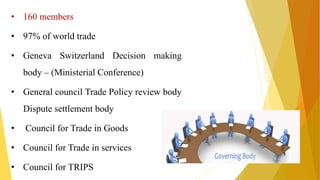
• 160 members
• 97% of world trade
• Geneva Switzerland Decision making
body – (Ministerial Conference)
• General council Trade Policy review body
Dispute settlement body
• Council for Trade in Goods
• Council for Trade in services
• Council for TRIPS
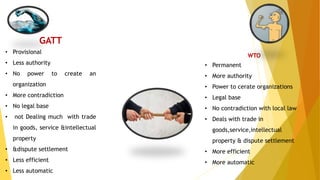
GATT
• Provisional
• Less authority
• No power to create an
organization
• More contradiction
• No legal base
• not Dealing much with trade
in goods, service &intellectual
property
• &dispute settlement
• Less efficient
• Less automatic
WTO
• Permanent
• More authority
• Power to cerate organizations
• Legal base
• No contradiction with local law
• Deals with trade in
goods,service,intellectual
property & dispute settlement
• More efficient
• More automatic
OBJECTIVES OF WTO
 To implement the new world trade agreement. Promote
multilateral trade.
 Improve the level of living and speed up economic
development
 Promote free trade enhance competitiveness Increase the
level of production and productivity with employment
 Expand and utilize world resources
 Development of poorest nation
Scope of WTO
• Trade in goods Trade related
investments Measures (TRIMs)
• General Agreements on Trade in
Services (GATTS)
• Trade Related Intellectual Property
Right’s (TRIPs)
ARGUMENTS IN FAVOUR OF WTO
• Increase in inflow of foreign investment
• Increase in agricultural export
• Increase in foreign trade Benefits for
clothing and textile industry
• Improvement in services
• Inflow of better technology and better
products
Arguments IN :
It all began with trade in goods. From 1947 to 1944, GATT was the forum for negotiation
lower customs duty rates and other trade barriers, the text of general agreement spelt
out important rules, particularly non-discrimination. Since 1995, the updated GATT has
become the WTO’s umbrella agreement for trade in goods. It has annexes dealing with
specific sectors such as agriculture and textiles, and with specific issues such as state
trading, product standards, subsidies and actions taken against dumping.
Cross–border supply
Consumption abroad
Commercial presence
Presence of natural person
Four modes of supply
Trade related investments measures
Measures prohibited by TRIM’S agreement
Local content requirement
Trade balancing requirement
Foreign exchange restriction
Export restriction
Exceptional provisions of TRIM’s agreement
Transitional period
Exception for developing countries
Equitable provisions
TRIPs
• The WTO’s intellectual property agreement amounts to rule for trade and
investment in ideas and creativity.
• The rule state how copy rights, patents, trademarks, geographical names
used to identify products, industrial designs and undisclosed information
such as trade secrets – ”intellectual property” – should be protected
when trade is involved.
• In nutshell, the TRIPs Agreement covers 7 categories of intellectual
property
 WTO and Indian Agriculture
 Introduction After over 7 years of negotiation the Uruguay Round multilateral trade negotiations were
concluded on December 1993 and were formally ratified in April 1994 at Marrakesh, Morocco. The WTO
agreement on agriculture was one of the main agreements which were negotiated during the Uruguay
round
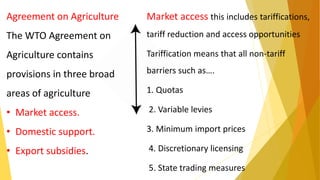
Market access this includes tariffications,
tariff reduction and access opportunities
Tariffication means that all non-tariff
barriers such as….
1. Quotas
2. Variable levies
3. Minimum import prices
4. Discretionary licensing
5. State trading measures
Agreement on Agriculture
The WTO Agreement on
Agriculture contains
provisions in three broad
areas of agriculture
• Market access.
• Domestic support.
• Export subsidies.
Domestic Support
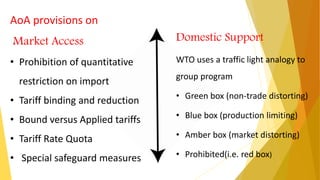
WTO uses a traffic light analogy to
group program
• Green box (non-trade distorting)
• Blue box (production limiting)
• Amber box (market distorting)
• Prohibited(i.e. red box)
AoA provisions on
Market Access
• Prohibition of quantitative
restriction on import
• Tariff binding and reduction
• Bound versus Applied tariffs
• Tariff Rate Quota
• Special safeguard measures
Measure be placed in blue box
• Be based on fixed area and
yield Be made of 85% or less of
the base level of production
• If livestock payments, be made
on fixed no of head
Amber box Product specific
domestic support Non-product
specific domestic support
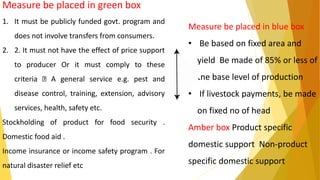
Measure be placed in green box
1. It must be publicly funded govt. program and
does not involve transfers from consumers.
2. 2. It must not have the effect of price support
to producer Or it must comply to these
criteria A general service e.g. pest and
disease control, training, extension, advisory
services, health, safety etc.
Stockholding of product for food security .
Domestic food aid .
Income insurance or income safety program . For
natural disaster relief etc
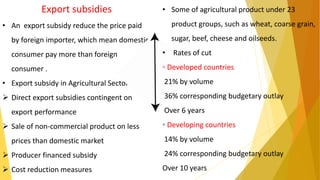
Export subsidies
• An export subsidy reduce the price paid
by foreign importer, which mean domestic
consumer pay more than foreign
consumer .
• Export subsidy in Agricultural Sector .
 Direct export subsidies contingent on
export performance
 Sale of non-commercial product on less
prices than domestic market
 Producer financed subsidy
 Cost reduction measures
• Some of agricultural product under 23
product groups, such as wheat, coarse grain,
sugar, beef, cheese and oilseeds.
• Rates of cut
◦ Developed countries
21% by volume
36% corresponding budgetary outlay
Over 6 years
◦ Developing countries
14% by volume
24% corresponding budgetary outlay
Over 10 years
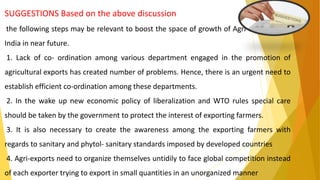
SUGGESTIONS Based on the above discussion
the following steps may be relevant to boost the space of growth of Agri-exports from
India in near future.
1. Lack of co- ordination among various department engaged in the promotion of
agricultural exports has created number of problems. Hence, there is an urgent need to
establish efficient co-ordination among these departments.
2. In the wake up new economic policy of liberalization and WTO rules special care
should be taken by the government to protect the interest of exporting farmers.
3. It is also necessary to create the awareness among the exporting farmers with
regards to sanitary and phytol- sanitary standards imposed by developed countries
4. Agri-exports need to organize themselves untidily to face global competition instead
of each exporter trying to export in small quantities in an unorganized manner
5.At present, new emerging markets like Eastern Europe, China, UAE, African countries have a lot of
potential for absorbing more Agri- exports. Hence, the efforts should be made to tap the potential of
there markets
6. The apex marketing agency like APEDA should intensify and speed- up the export procedure of quality
agricultural product. 7. High rate of interest for export finance make India's exports non- competitive.
Therefore, the rate of interest changed by financial intuitions is reasonable.
8. The government should come forward to invest on basic infrastructure. In this regard a complete cold
chain facility needs to be created on urgent basis.
9. Sincere and dedicated efforts are also needed to increase the quality of exportable fruits and
vegetables because there is immense scope for increasing exports of fruits and vegetables in India.
10. The proper branding of agricultural products needs to be promoted as the branded products gets
higher prices in comparison to unbranded items.
India as a developing economy, has been benefitted being a founding member of World trade
organization. The country at large has seen many significant changes which have taken place
after the formation of WTO. There are some issues which are yet to be sorted out with the WTO
and but by and large things are falling in shape for the Indian Economy.
Wto

Wto

  • 1.
    WHAT IS WTO •WTO was formed on 1st Jan , 1995 . • It took over GATT (general agreement on tariffs and trade). • In 8th round of GATT, popularly known as Uruguay round, members nation of GATT decided to set up a new organization, ‘World Trade Organization’ in place of GATT. [World Trade Organization]
  • 2.
    • 160 members •97% of world trade • Geneva Switzerland Decision making body – (Ministerial Conference) • General council Trade Policy review body Dispute settlement body • Council for Trade in Goods • Council for Trade in services • Council for TRIPS
  • 3.
    GATT • Provisional • Lessauthority • No power to create an organization • More contradiction • No legal base • not Dealing much with trade in goods, service &intellectual property • &dispute settlement • Less efficient • Less automatic WTO • Permanent • More authority • Power to cerate organizations • Legal base • No contradiction with local law • Deals with trade in goods,service,intellectual property & dispute settlement • More efficient • More automatic
  • 4.
    OBJECTIVES OF WTO To implement the new world trade agreement. Promote multilateral trade.  Improve the level of living and speed up economic development  Promote free trade enhance competitiveness Increase the level of production and productivity with employment  Expand and utilize world resources  Development of poorest nation
  • 5.
    Scope of WTO •Trade in goods Trade related investments Measures (TRIMs) • General Agreements on Trade in Services (GATTS) • Trade Related Intellectual Property Right’s (TRIPs)
  • 6.
    ARGUMENTS IN FAVOUROF WTO • Increase in inflow of foreign investment • Increase in agricultural export • Increase in foreign trade Benefits for clothing and textile industry • Improvement in services • Inflow of better technology and better products
  • 7.
    Arguments IN : Itall began with trade in goods. From 1947 to 1944, GATT was the forum for negotiation lower customs duty rates and other trade barriers, the text of general agreement spelt out important rules, particularly non-discrimination. Since 1995, the updated GATT has become the WTO’s umbrella agreement for trade in goods. It has annexes dealing with specific sectors such as agriculture and textiles, and with specific issues such as state trading, product standards, subsidies and actions taken against dumping.
  • 8.
    Cross–border supply Consumption abroad Commercialpresence Presence of natural person Four modes of supply
  • 9.
    Trade related investmentsmeasures Measures prohibited by TRIM’S agreement Local content requirement Trade balancing requirement Foreign exchange restriction Export restriction Exceptional provisions of TRIM’s agreement Transitional period Exception for developing countries Equitable provisions
  • 10.
    TRIPs • The WTO’sintellectual property agreement amounts to rule for trade and investment in ideas and creativity. • The rule state how copy rights, patents, trademarks, geographical names used to identify products, industrial designs and undisclosed information such as trade secrets – ”intellectual property” – should be protected when trade is involved. • In nutshell, the TRIPs Agreement covers 7 categories of intellectual property
  • 11.
     WTO andIndian Agriculture  Introduction After over 7 years of negotiation the Uruguay Round multilateral trade negotiations were concluded on December 1993 and were formally ratified in April 1994 at Marrakesh, Morocco. The WTO agreement on agriculture was one of the main agreements which were negotiated during the Uruguay round
  • 12.
    Market access thisincludes tariffications, tariff reduction and access opportunities Tariffication means that all non-tariff barriers such as…. 1. Quotas 2. Variable levies 3. Minimum import prices 4. Discretionary licensing 5. State trading measures Agreement on Agriculture The WTO Agreement on Agriculture contains provisions in three broad areas of agriculture • Market access. • Domestic support. • Export subsidies.
  • 13.
    Domestic Support WTO usesa traffic light analogy to group program • Green box (non-trade distorting) • Blue box (production limiting) • Amber box (market distorting) • Prohibited(i.e. red box) AoA provisions on Market Access • Prohibition of quantitative restriction on import • Tariff binding and reduction • Bound versus Applied tariffs • Tariff Rate Quota • Special safeguard measures
  • 14.
    Measure be placedin blue box • Be based on fixed area and yield Be made of 85% or less of the base level of production • If livestock payments, be made on fixed no of head Amber box Product specific domestic support Non-product specific domestic support Measure be placed in green box 1. It must be publicly funded govt. program and does not involve transfers from consumers. 2. 2. It must not have the effect of price support to producer Or it must comply to these criteria A general service e.g. pest and disease control, training, extension, advisory services, health, safety etc. Stockholding of product for food security . Domestic food aid . Income insurance or income safety program . For natural disaster relief etc
  • 15.
    Export subsidies • Anexport subsidy reduce the price paid by foreign importer, which mean domestic consumer pay more than foreign consumer . • Export subsidy in Agricultural Sector .  Direct export subsidies contingent on export performance  Sale of non-commercial product on less prices than domestic market  Producer financed subsidy  Cost reduction measures • Some of agricultural product under 23 product groups, such as wheat, coarse grain, sugar, beef, cheese and oilseeds. • Rates of cut ◦ Developed countries 21% by volume 36% corresponding budgetary outlay Over 6 years ◦ Developing countries 14% by volume 24% corresponding budgetary outlay Over 10 years
  • 17.
    SUGGESTIONS Based onthe above discussion the following steps may be relevant to boost the space of growth of Agri-exports from India in near future. 1. Lack of co- ordination among various department engaged in the promotion of agricultural exports has created number of problems. Hence, there is an urgent need to establish efficient co-ordination among these departments. 2. In the wake up new economic policy of liberalization and WTO rules special care should be taken by the government to protect the interest of exporting farmers. 3. It is also necessary to create the awareness among the exporting farmers with regards to sanitary and phytol- sanitary standards imposed by developed countries 4. Agri-exports need to organize themselves untidily to face global competition instead of each exporter trying to export in small quantities in an unorganized manner
  • 18.
    5.At present, newemerging markets like Eastern Europe, China, UAE, African countries have a lot of potential for absorbing more Agri- exports. Hence, the efforts should be made to tap the potential of there markets 6. The apex marketing agency like APEDA should intensify and speed- up the export procedure of quality agricultural product. 7. High rate of interest for export finance make India's exports non- competitive. Therefore, the rate of interest changed by financial intuitions is reasonable. 8. The government should come forward to invest on basic infrastructure. In this regard a complete cold chain facility needs to be created on urgent basis. 9. Sincere and dedicated efforts are also needed to increase the quality of exportable fruits and vegetables because there is immense scope for increasing exports of fruits and vegetables in India. 10. The proper branding of agricultural products needs to be promoted as the branded products gets higher prices in comparison to unbranded items.
  • 19.
    India as adeveloping economy, has been benefitted being a founding member of World trade organization. The country at large has seen many significant changes which have taken place after the formation of WTO. There are some issues which are yet to be sorted out with the WTO and but by and large things are falling in shape for the Indian Economy.