Writing
Subject: English
School: ETEC Lugano UBA
Author: Laura Pantelakis
Year:2018
Every piece of writing has
 Introduction
 Development
 Conclusion
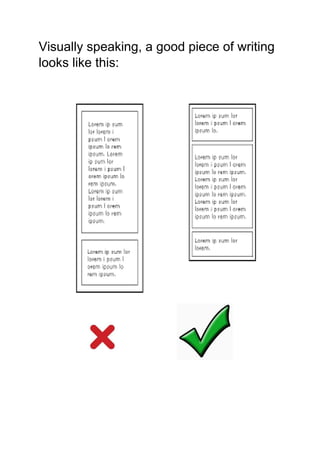
Visually speaking, a good piece of writing
looks like this:
In the case of a recipe, there are specific
sections:
 Ingredients
 Method
 Tips/variants
But still there are three sections to it.
 Ingredients
In this section, you simply list the
ingredients and their quantity. For
example:
2 lemons
100flour
 Method
In this section you list the steps to
follow. There are different styles you
can choose from.
A good strategy is to use numbers:
1. Mix the sugar and butter
2. Add the eggs
Alternatively, you can use connectors to
indicate chronology:
First, you mix the sugar with the butter.
Then, you add the eggs. After that,….
Notice that whichever style you choose,
the verb form used is the imperative:
Beat the eggs until pale.
Knead the dough and roll it out on the
counter.
If you take a closer look at the examples
provided (Add the eggs, Knead the
dough), you will realize that the imperative
does not require the use of the subject
pronoun:
Peel the potatoes and cut them into
cubes.
 Tips
In this section, there are usually some
alternatives to the suggested
ingredients or method:
Tips: use lemon grind instead.
So, the three sections for a recipe are:
 Ingredients
 Method
 Tips
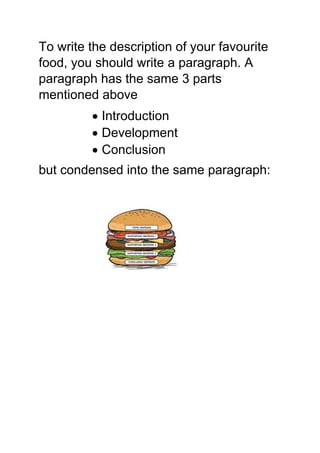
To write the description of your favourite
food, you should write a paragraph. A
paragraph has the same 3 parts
mentioned above
 Introduction
 Development
 Conclusion
but condensed into the same paragraph:
 TOPIC SENTENCE: which food it
is and why you like it
 SUPPORTING IDEAS: describe
ingredients, method of cooking,
taste, how it is served, etc.
 CONCLUSION: recommendation
Bibliography
http://learnenglishteens.britishcouncil.org/
skills/writing/elementary-a2-writing/recipe
https://www.youtube.com/watch?v=QGMS
EGRyxc0
https://www.youtube.com/watch?v=bOnm
VFww6gc

Presentation: Writing (recipe/paragraph)