Developing Writing Skills
from Sentence to Paragraphs
Power of Reading Summit
November 20, 2017
John Wolf
Indiana Academic Standards for Writing
Indiana Academic Standards require students
to become proficient in multiple text types
– Handwriting
– Persuasive
– Informative
– Narrative
– The Research Process
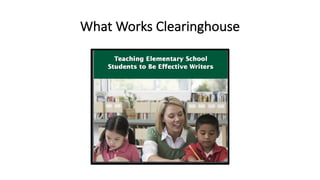
What Works Clearinghouse
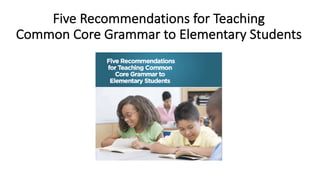
Five Recommendations for Teaching
Common Core Grammar to Elementary Students
Critical Foundational Skills
• Transcription skills
– Handwriting
– Spelling
• Composition skills
– Words to sentences, paragraphs, and essays
– Creating, organizing, elaborating ideas
– Editing, revising, sharing
(Berninger & Winn, 2006; McCloskey & Perkins, 2012)
Handwriting
• Linked to better letter perception, reading fluency, and writing
fluency (Berninger, 2012; Graham, Harris, & Fink, 2000)
• Trains the orthographic loop, which supports spelling and
composing.
• Trains serial organization
• Automaticity – quickly, accurately, effortlessly Reduces cognitive
load needed for composition
Why Handwriting Instruction?
1. Learning to form letters by hand improves perception of letters
and contributes to better reading and spelling.
2. Automatic letter writing promotes better composing—both
amount written and quality of writing. (Berninger, 2012)
What about Keyboarding?
Spelling
Spelling instruction:
– in the early grades is linked to better composition in the later
grades. (Berninger & Fayol, 2008)
– is linked to greater phonological awareness and reading
proficiency (Graham & Santangelo, 2011)
Oral Language Skills
• Vocabulary – Writers must be able to spontaneously recall words
and have a clear understanding of word meaning and usage.
(Corona, Spangenberger, & Venet, 1998)
• Sentence construction – practice in combining simple, short
sentences into complex sentences improves writing quality
(Saddler & Graham, 2005)
Writing Process
Explicit instruction in the writing process – plan, draft,
revise, edit, and publish – is supported by multiple
studies. (Graham & Perin, 2007)
Writing Instruction
• Strategy instruction is effective in increasing overall quality of
students’ writing (Graham, 2006) and has long-term impact (Fidalgo,
Torrance, & Garcia, 2008)
• Instruction should include:
– task-specific strategies (i.e., using graphic organizers) and
– metacognitive strategies (i.e., using a rubric to evaluation your draft)
Writing Instruction Recommendations
• Provide ample time for writing
• Use frequent assessment to inform instruction
• Explicitly teach writing skills, process and strategies
• Teach multiple text types
• Write across the curriculum
• Integrate appropriate technology
• Establish a positive environment for writing
(Graham, 2013)
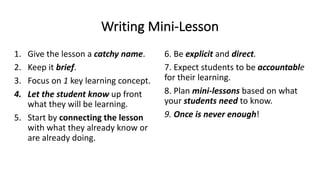
Writing Mini-Lesson
1. Give the lesson a catchy name.
2. Keep it brief.
3. Focus on 1 key learning concept.
4. Let the student know up front
what they will be learning.
5. Start by connecting the lesson
with what they already know or
are already doing.
6. Be explicit and direct.
7. Expect students to be accountable
for their learning.
8. Plan mini-lessons based on what
your students need to know.
9. Once is never enough!
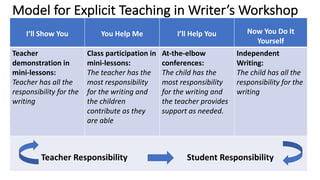
Model for Explicit Teaching in Writer’s Workshop
I’ll Show You You Help Me I’ll Help You Now You Do It
Yourself
Teacher
demonstration in
mini-lessons:
Teacher has all the
responsibility for the
writing
Class participation in
mini-lessons:
The teacher has the
most responsibility
for the writing and
the children
contribute as they
are able
At-the-elbow
conferences:
The child has the
most responsibility
for the writing and
the teacher provides
support as needed.
Independent
Writing:
The child has all the
responsibility for the
writing
Teacher Responsibility Student Responsibility
Text Structure to Improve Reading Comprehension
Understanding text structure
• Narrative - Tells a story, often about personal events or other life
experiences; may be fiction or nonfiction
• Informational -Convey facts, describe procedures, explain
something, share basic information, relate cause-effect,
compare/contrast, problem-solution structures
Text Structure Strategy:
– I like...
– I wonder ...
– I think ...
– I learned ...
– This reminds me of ...
– I am surprised ...
– I want to know ...
(Step Up To Writing, Grades K-2 Auman, 2016
Free Response – ask students to record (oral or
written) a response to queries such as:
Ask and Answer Questions about a Text
Narratives
• Who are the characters? Who is the story about?
• What is the story about? What is the problem? What might happen?
• When does the story take place?
• Where does the story take place? Where do the characters go?
• Why does the character do this? Why does the character feel this way?
• How would your retell the story? How would you describe the
character? How does the character solve
the problem?
(Step Up To Writing, Grades K-2 Auman, 2016)
Ask and Answer Questions about a Text
Informational
• What is the topic of the text? What information did you learn?
• Who is involved?
• When did this happen? When would you use this information?
• Where did this happen? Where would you see this in the world?
• Why is this topic important? Why did this happen?
• How would your describe this to someone else?
(Step Up To Writing, Grades K-2 Auman, 2016)
Writing Composition Skills
• Print conventions – capitalization, punctuation, grammar, spelling
• Language usage and style
• Ideas and content
• Organization
Writing Process
• Prewrite or draw – think about a topic
• Plan – organize ideas
• Draft – write or tell first copy
• Revise – make writing more clear and interesting
• Edit – word usage, spelling, capitals, punctuation
• Final copy and proofread
• Share and publish
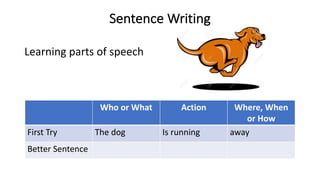
Sentence Writing
Learning parts of speech
Who or What Action Where, When
or How
First Try The dog Is running away
Better Sentence
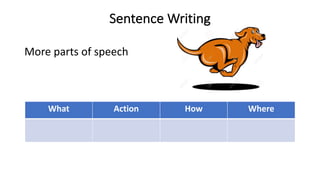
Sentence Writing
More parts of speech
What Action How Where
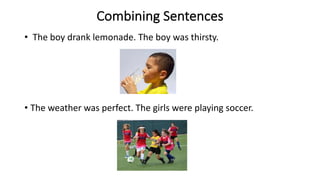
Combining Sentences
• The boy drank lemonade. The boy was thirsty.
• The weather was perfect. The girls were playing soccer.
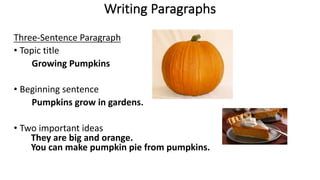
Writing Paragraphs
Three-Sentence Paragraph
• Topic title
Growing Pumpkins
• Beginning sentence
Pumpkins grow in gardens.
• Two important ideas
They are big and orange.
You can make pumpkin pie from pumpkins.
Deepen Vocabularies with Definitions
• Word
– Category
– Is like
– Is not like
– Definition
– Connection to self
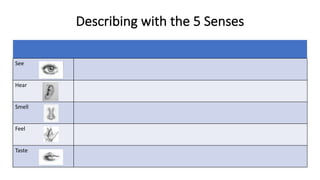
Describing with the 5 Senses
See
Hear
Smell
Feel
Taste
QUESTION-to solicit more details:
• What type of ...
• Is that allowed...
• When does he...
• What color is...
Always follow with “HOW CAN YOU ADD THOSE DETAILS?”
The focus should be on “How can you add them?”
not “Would you like to add...”
Some Positive Things to Do or Say
• Your reader will like the way
you have...
• Your reader can picture...
• This piece is easy for me to
read.
• How did you learn that?
• I do the same thing...
• Tell me again what happened.
Did you put it down that way?
• What else do you want the
reader to know?
• How did you select the topic?
• I see you have included some
words from the word wall.
• I see you used…
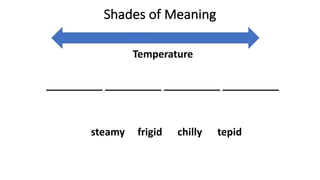
Shades of Meaning
Temperature
__________ __________ __________ __________
steamy frigid chilly tepid
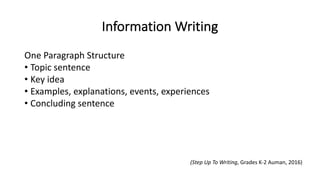
Information Writing
One Paragraph Structure
• Topic sentence
• Key idea
• Examples, explanations, events, experiences
• Concluding sentence
(Step Up To Writing, Grades K-2 Auman, 2016)
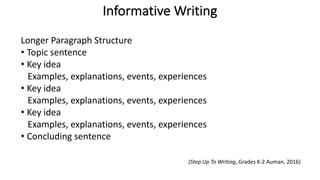
Informative Writing
Longer Paragraph Structure
• Topic sentence
• Key idea
Examples, explanations, events, experiences
• Key idea
Examples, explanations, events, experiences
• Key idea
Examples, explanations, events, experiences
• Concluding sentence
(Step Up To Writing, Grades K-2 Auman, 2016)
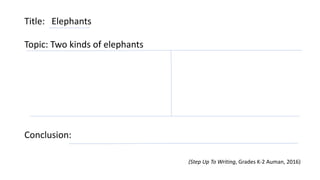
Title: Elephants
Topic: Two kinds of elephants
Conclusion:
(Step Up To Writing, Grades K-2 Auman, 2016)
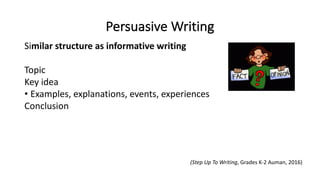
Persuasive Writing
Similar structure as informative writing
Topic
Key idea
• Examples, explanations, events, experiences
Conclusion
(Step Up To Writing, Grades K-2 Auman, 2016)
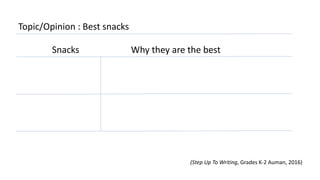
Topic/Opinion : Best snacks
Snacks Why they are the best
(Step Up To Writing, Grades K-2 Auman, 2016)
Narrative Writing
Fiction and nonfiction
• Real or imagined experiences and events
• Teach strategies to write a beginning, middle and ending
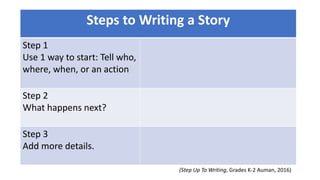
Steps to Writing a Story
Step 1
Use 1 way to start: Tell who,
where, when, or an action
Step 2
What happens next?
Step 3
Add more details.
(Step Up To Writing, Grades K-2 Auman, 2016)
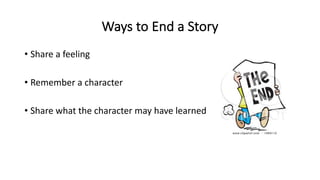
Ways to End a Story
• Share a feeling
• Remember a character
• Share what the character may have learned
Research Reports
• Model the research process by leading shared classroom
research projects.
• Help students create research questions.
• Help to identify useful sources (print and digital) related to their
topics.
• Provide practice opportunities.
• Have students present their projects.
(Step Up To Writing, Grades K-2 Auman, 2016)
Assessment Strategies
• Use student rubrics for revision based on the writing processes
– Organization
– Ideas
– Style
• Use student rubrics for editing of word usage, spelling, capitalization
and punctuation.
(Step Up To Writing, Grades K-2 Auman, 2016)
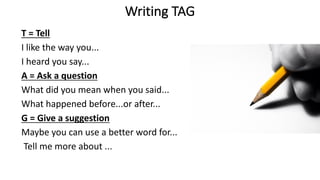
Writing TAG
T = Tell
I like the way you...
I heard you say...
A = Ask a question
What did you mean when you said...
What happened before...or after...
G = Give a suggestion
Maybe you can use a better word for...
Tell me more about ...
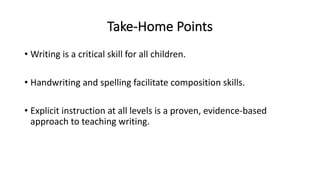
Take-Home Points
• Writing is a critical skill for all children.
• Handwriting and spelling facilitate composition skills.
• Explicit instruction at all levels is a proven, evidence-based
approach to teaching writing.
SeeSaw Digital Portfolio
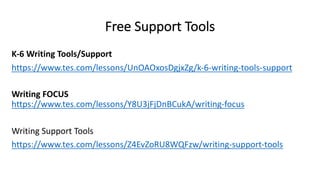
Free Support Tools
K-6 Writing Tools/Support
https://www.tes.com/lessons/UnOAOxosDgjxZg/k-6-writing-tools-support
Writing FOCUS
https://www.tes.com/lessons/Y8U3jFjDnBCukA/writing-focus
Writing Support Tools
https://www.tes.com/lessons/Z4EvZoRU8WQFzw/writing-support-tools

Developing Writing Skills from Sentence to Paragraphs.pdf

  • 1.
    Developing Writing Skills fromSentence to Paragraphs Power of Reading Summit November 20, 2017 John Wolf
  • 2.
    Indiana Academic Standardsfor Writing Indiana Academic Standards require students to become proficient in multiple text types – Handwriting – Persuasive – Informative – Narrative – The Research Process
  • 3.
  • 4.
    Five Recommendations forTeaching Common Core Grammar to Elementary Students
  • 5.
    Critical Foundational Skills •Transcription skills – Handwriting – Spelling • Composition skills – Words to sentences, paragraphs, and essays – Creating, organizing, elaborating ideas – Editing, revising, sharing (Berninger & Winn, 2006; McCloskey & Perkins, 2012)
  • 6.
    Handwriting • Linked tobetter letter perception, reading fluency, and writing fluency (Berninger, 2012; Graham, Harris, & Fink, 2000) • Trains the orthographic loop, which supports spelling and composing. • Trains serial organization • Automaticity – quickly, accurately, effortlessly Reduces cognitive load needed for composition
  • 7.
    Why Handwriting Instruction? 1.Learning to form letters by hand improves perception of letters and contributes to better reading and spelling. 2. Automatic letter writing promotes better composing—both amount written and quality of writing. (Berninger, 2012) What about Keyboarding?
  • 8.
    Spelling Spelling instruction: – inthe early grades is linked to better composition in the later grades. (Berninger & Fayol, 2008) – is linked to greater phonological awareness and reading proficiency (Graham & Santangelo, 2011)
  • 9.
    Oral Language Skills •Vocabulary – Writers must be able to spontaneously recall words and have a clear understanding of word meaning and usage. (Corona, Spangenberger, & Venet, 1998) • Sentence construction – practice in combining simple, short sentences into complex sentences improves writing quality (Saddler & Graham, 2005)
  • 10.
    Writing Process Explicit instructionin the writing process – plan, draft, revise, edit, and publish – is supported by multiple studies. (Graham & Perin, 2007)
  • 11.
    Writing Instruction • Strategyinstruction is effective in increasing overall quality of students’ writing (Graham, 2006) and has long-term impact (Fidalgo, Torrance, & Garcia, 2008) • Instruction should include: – task-specific strategies (i.e., using graphic organizers) and – metacognitive strategies (i.e., using a rubric to evaluation your draft)
  • 12.
    Writing Instruction Recommendations •Provide ample time for writing • Use frequent assessment to inform instruction • Explicitly teach writing skills, process and strategies • Teach multiple text types • Write across the curriculum • Integrate appropriate technology • Establish a positive environment for writing (Graham, 2013)
  • 13.
    Writing Mini-Lesson 1. Givethe lesson a catchy name. 2. Keep it brief. 3. Focus on 1 key learning concept. 4. Let the student know up front what they will be learning. 5. Start by connecting the lesson with what they already know or are already doing. 6. Be explicit and direct. 7. Expect students to be accountable for their learning. 8. Plan mini-lessons based on what your students need to know. 9. Once is never enough!
  • 14.
    Model for ExplicitTeaching in Writer’s Workshop I’ll Show You You Help Me I’ll Help You Now You Do It Yourself Teacher demonstration in mini-lessons: Teacher has all the responsibility for the writing Class participation in mini-lessons: The teacher has the most responsibility for the writing and the children contribute as they are able At-the-elbow conferences: The child has the most responsibility for the writing and the teacher provides support as needed. Independent Writing: The child has all the responsibility for the writing Teacher Responsibility Student Responsibility
  • 15.
    Text Structure toImprove Reading Comprehension Understanding text structure • Narrative - Tells a story, often about personal events or other life experiences; may be fiction or nonfiction • Informational -Convey facts, describe procedures, explain something, share basic information, relate cause-effect, compare/contrast, problem-solution structures
  • 16.
    Text Structure Strategy: –I like... – I wonder ... – I think ... – I learned ... – This reminds me of ... – I am surprised ... – I want to know ... (Step Up To Writing, Grades K-2 Auman, 2016 Free Response – ask students to record (oral or written) a response to queries such as:
  • 17.
    Ask and AnswerQuestions about a Text Narratives • Who are the characters? Who is the story about? • What is the story about? What is the problem? What might happen? • When does the story take place? • Where does the story take place? Where do the characters go? • Why does the character do this? Why does the character feel this way? • How would your retell the story? How would you describe the character? How does the character solve the problem? (Step Up To Writing, Grades K-2 Auman, 2016)
  • 18.
    Ask and AnswerQuestions about a Text Informational • What is the topic of the text? What information did you learn? • Who is involved? • When did this happen? When would you use this information? • Where did this happen? Where would you see this in the world? • Why is this topic important? Why did this happen? • How would your describe this to someone else? (Step Up To Writing, Grades K-2 Auman, 2016)
  • 19.
    Writing Composition Skills •Print conventions – capitalization, punctuation, grammar, spelling • Language usage and style • Ideas and content • Organization
  • 20.
    Writing Process • Prewriteor draw – think about a topic • Plan – organize ideas • Draft – write or tell first copy • Revise – make writing more clear and interesting • Edit – word usage, spelling, capitals, punctuation • Final copy and proofread • Share and publish
  • 21.
    Sentence Writing Learning partsof speech Who or What Action Where, When or How First Try The dog Is running away Better Sentence
  • 22.
    Sentence Writing More partsof speech What Action How Where
  • 23.
    Combining Sentences • Theboy drank lemonade. The boy was thirsty. • The weather was perfect. The girls were playing soccer.
  • 24.
    Writing Paragraphs Three-Sentence Paragraph •Topic title Growing Pumpkins • Beginning sentence Pumpkins grow in gardens. • Two important ideas They are big and orange. You can make pumpkin pie from pumpkins.
  • 25.
    Deepen Vocabularies withDefinitions • Word – Category – Is like – Is not like – Definition – Connection to self
  • 26.
    Describing with the5 Senses See Hear Smell Feel Taste
  • 27.
    QUESTION-to solicit moredetails: • What type of ... • Is that allowed... • When does he... • What color is... Always follow with “HOW CAN YOU ADD THOSE DETAILS?” The focus should be on “How can you add them?” not “Would you like to add...”
  • 28.
    Some Positive Thingsto Do or Say • Your reader will like the way you have... • Your reader can picture... • This piece is easy for me to read. • How did you learn that? • I do the same thing... • Tell me again what happened. Did you put it down that way? • What else do you want the reader to know? • How did you select the topic? • I see you have included some words from the word wall. • I see you used…
  • 29.
    Shades of Meaning Temperature ____________________ __________ __________ steamy frigid chilly tepid
  • 30.
    Information Writing One ParagraphStructure • Topic sentence • Key idea • Examples, explanations, events, experiences • Concluding sentence (Step Up To Writing, Grades K-2 Auman, 2016)
  • 31.
    Informative Writing Longer ParagraphStructure • Topic sentence • Key idea Examples, explanations, events, experiences • Key idea Examples, explanations, events, experiences • Key idea Examples, explanations, events, experiences • Concluding sentence (Step Up To Writing, Grades K-2 Auman, 2016)
  • 32.
    Title: Elephants Topic: Twokinds of elephants Conclusion: (Step Up To Writing, Grades K-2 Auman, 2016)
  • 33.
    Persuasive Writing Similar structureas informative writing Topic Key idea • Examples, explanations, events, experiences Conclusion (Step Up To Writing, Grades K-2 Auman, 2016)
  • 34.
    Topic/Opinion : Bestsnacks Snacks Why they are the best (Step Up To Writing, Grades K-2 Auman, 2016)
  • 35.
    Narrative Writing Fiction andnonfiction • Real or imagined experiences and events • Teach strategies to write a beginning, middle and ending
  • 36.
    Steps to Writinga Story Step 1 Use 1 way to start: Tell who, where, when, or an action Step 2 What happens next? Step 3 Add more details. (Step Up To Writing, Grades K-2 Auman, 2016)
  • 37.
    Ways to Enda Story • Share a feeling • Remember a character • Share what the character may have learned
  • 38.
    Research Reports • Modelthe research process by leading shared classroom research projects. • Help students create research questions. • Help to identify useful sources (print and digital) related to their topics. • Provide practice opportunities. • Have students present their projects. (Step Up To Writing, Grades K-2 Auman, 2016)
  • 39.
    Assessment Strategies • Usestudent rubrics for revision based on the writing processes – Organization – Ideas – Style • Use student rubrics for editing of word usage, spelling, capitalization and punctuation. (Step Up To Writing, Grades K-2 Auman, 2016)
  • 40.
    Writing TAG T =Tell I like the way you... I heard you say... A = Ask a question What did you mean when you said... What happened before...or after... G = Give a suggestion Maybe you can use a better word for... Tell me more about ...
  • 41.
    Take-Home Points • Writingis a critical skill for all children. • Handwriting and spelling facilitate composition skills. • Explicit instruction at all levels is a proven, evidence-based approach to teaching writing.
  • 42.
  • 43.
    Free Support Tools K-6Writing Tools/Support https://www.tes.com/lessons/UnOAOxosDgjxZg/k-6-writing-tools-support Writing FOCUS https://www.tes.com/lessons/Y8U3jFjDnBCukA/writing-focus Writing Support Tools https://www.tes.com/lessons/Z4EvZoRU8WQFzw/writing-support-tools