Design is Leadership

Patrick Gibson
Problem

In the typical role as tradesperson, a designer
has limited opportunity to make his or her biggest
ideas heard.
Hypothesis

By taking ownership of a client's goals, the
designer becomes a leader who can measurably
impact business and society.

When designers shoulder the risk of failure, they
possess the authority to use their conviction and
courage of imagination to profound effect.
Creative References
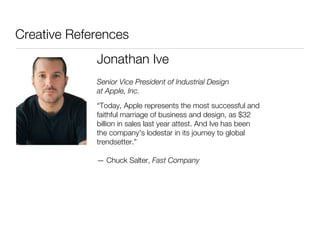
             Jonathan Ive
             Senior Vice President of Industrial Design
             at Apple, Inc.
             “Today, Apple represents the most successful and
             faithful marriage of business and design, as $32
             billion in sales last year attest. And Ive has been
             the company's lodestar in its journey to global
             trendsetter.”

             — Chuck Salter, Fast Company
Creative References
             David Plouffe
             Chief Campaign Manager for Barack Obama’s
             2008 presidential campaign
             “ The story of Mr. Obama’s journey to the pinnacle
             of American politics is the story of a campaign that
             was, even in the view of many rivals, almost
             flawless. Mr. Plouffe [was] known for his
             mathematic invocation of data in making decisions.
             When Mr. Obama decided to run for the
             presidency, Mr. Plouffe and a half-dozen staff
             members began plotting out a strategy.”

             — Adam Nagourney, Jim Rutenberg and Jeff
             Zeleny, The New York Times
             http://www.nytimes.com/2008/11/05/us/politics/05recon.html
Creative References
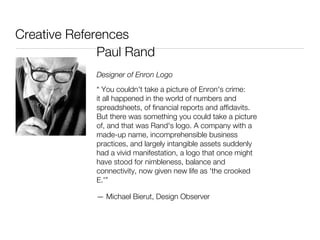
              Paul Rand
             Designer of Enron Logo
             “ You couldn't take a picture of Enron's crime:
             it all happened in the world of numbers and
             spreadsheets, of financial reports and affidavits.
             But there was something you could take a picture
             of, and that was Rand's logo. A company with a
             made-up name, incomprehensible business
             practices, and largely intangible assets suddenly
             had a vivid manifestation, a logo that once might
             have stood for nimbleness, balance and
             connectivity, now given new life as 'the crooked
             E.'”

             — Michael Bierut, Design Observer
From the Valorized Designer

"What we need in the next century are
independently-minded, creative, constructive
designers who are not just 'capitalist lackeys,'
ideologues,' or 'technical whiz-kids.'"

— Nigel Whiteley
From the Valorized Designer

Indeed, tomorrow's designer must not create mere
graphic artifact and ephemera, but instead design
larger architectures employing these artifacts to
profound and noticeable consequence, with
accountability for the results.
Content Outline

Introduction: Problem and Hypothesis

Part 1: "The Paul Rand Problem"
 • Design's Origins in the Typesetting Trade

 • Paul Rand, Enron, and the "Consumerized" Designer

 • The Design Consultant

 • Could Design be Outsourced?
Content Outline

Part 2: "Claiming Ownership"
 • The Importance of Measurable Results

 • Becoming a Leader

 • Designer as Entrepreneur

 • Examples of the New Designer

 • Barriers to this Model
Content Outline

Part 3: "The Courage of Imagination"
 • What the New Responsibility Means for the Profession

 • Design's Importance in a Complex Society/Economy

 • What a Designer-led World Could Look Like
Potential Sources

• Interviews

• TED lectures

• Fast Company

• Wired

• Good

• Chip and Dan Heath’s Switch and Made to Stick

• Philip Kotler’s On Marketing

• Malcolm Gladwell’s Tipping Point

Presentation v7

  • 1.
  • 2.
    Problem In the typicalrole as tradesperson, a designer has limited opportunity to make his or her biggest ideas heard.
  • 3.
    Hypothesis By taking ownershipof a client's goals, the designer becomes a leader who can measurably impact business and society. When designers shoulder the risk of failure, they possess the authority to use their conviction and courage of imagination to profound effect.
  • 4.
    Creative References Jonathan Ive Senior Vice President of Industrial Design at Apple, Inc. “Today, Apple represents the most successful and faithful marriage of business and design, as $32 billion in sales last year attest. And Ive has been the company's lodestar in its journey to global trendsetter.” — Chuck Salter, Fast Company
  • 5.
    Creative References David Plouffe Chief Campaign Manager for Barack Obama’s 2008 presidential campaign “ The story of Mr. Obama’s journey to the pinnacle of American politics is the story of a campaign that was, even in the view of many rivals, almost flawless. Mr. Plouffe [was] known for his mathematic invocation of data in making decisions. When Mr. Obama decided to run for the presidency, Mr. Plouffe and a half-dozen staff members began plotting out a strategy.” — Adam Nagourney, Jim Rutenberg and Jeff Zeleny, The New York Times http://www.nytimes.com/2008/11/05/us/politics/05recon.html
  • 6.
    Creative References Paul Rand Designer of Enron Logo “ You couldn't take a picture of Enron's crime: it all happened in the world of numbers and spreadsheets, of financial reports and affidavits. But there was something you could take a picture of, and that was Rand's logo. A company with a made-up name, incomprehensible business practices, and largely intangible assets suddenly had a vivid manifestation, a logo that once might have stood for nimbleness, balance and connectivity, now given new life as 'the crooked E.'” — Michael Bierut, Design Observer
  • 7.
    From the ValorizedDesigner "What we need in the next century are independently-minded, creative, constructive designers who are not just 'capitalist lackeys,' ideologues,' or 'technical whiz-kids.'" — Nigel Whiteley
  • 8.
    From the ValorizedDesigner Indeed, tomorrow's designer must not create mere graphic artifact and ephemera, but instead design larger architectures employing these artifacts to profound and noticeable consequence, with accountability for the results.
  • 9.
    Content Outline Introduction: Problemand Hypothesis Part 1: "The Paul Rand Problem" • Design's Origins in the Typesetting Trade • Paul Rand, Enron, and the "Consumerized" Designer • The Design Consultant • Could Design be Outsourced?
  • 10.
    Content Outline Part 2:"Claiming Ownership" • The Importance of Measurable Results • Becoming a Leader • Designer as Entrepreneur • Examples of the New Designer • Barriers to this Model
  • 11.
    Content Outline Part 3:"The Courage of Imagination" • What the New Responsibility Means for the Profession • Design's Importance in a Complex Society/Economy • What a Designer-led World Could Look Like
  • 12.
    Potential Sources • Interviews •TED lectures • Fast Company • Wired • Good • Chip and Dan Heath’s Switch and Made to Stick • Philip Kotler’s On Marketing • Malcolm Gladwell’s Tipping Point

Editor's Notes