1
Basics of Structural Engineering
Presentation to Interior Architecture Students
By Mark Sheldon, Technical Director, Aurecon
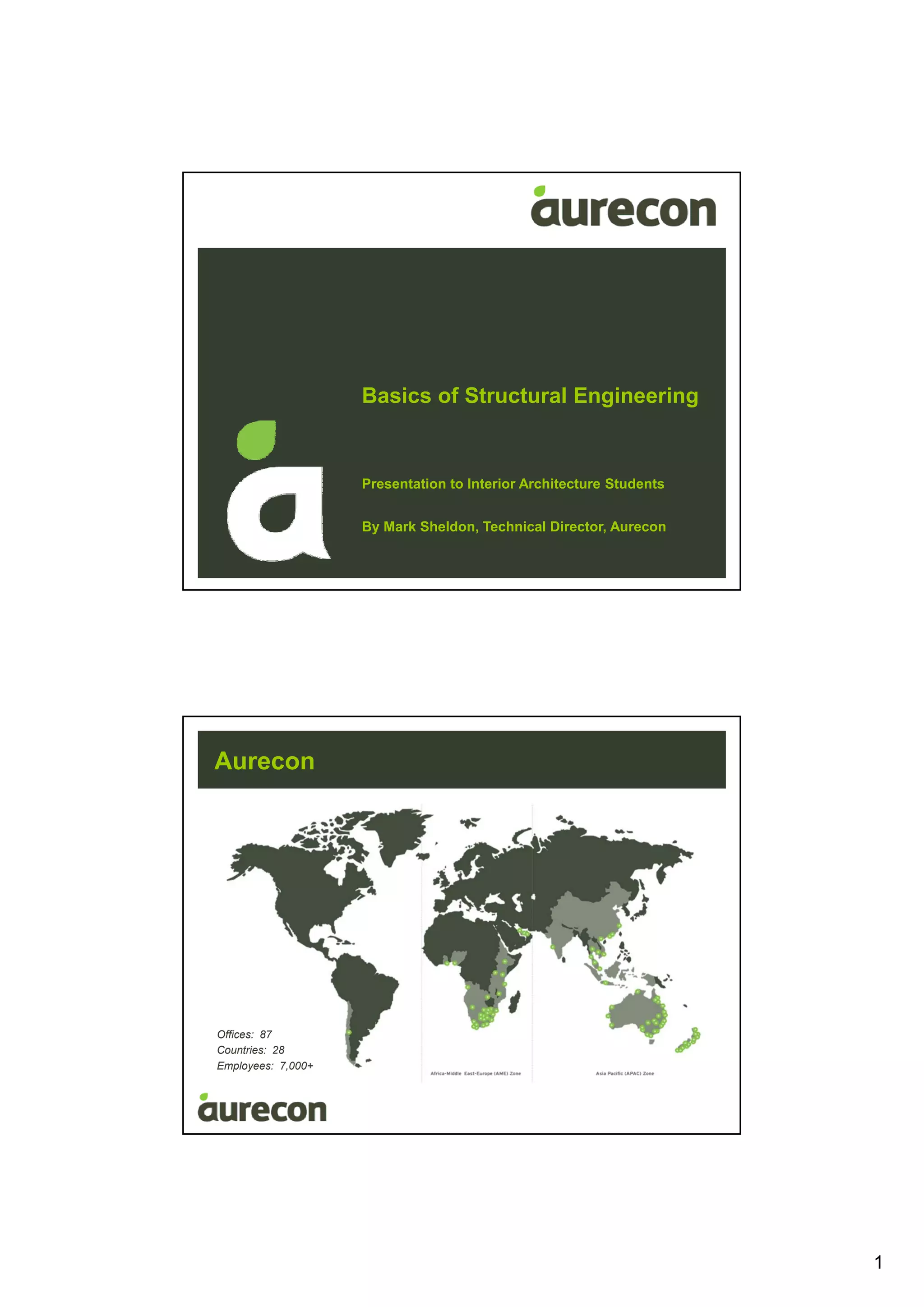
Aurecon
Offices: 87
Countries: 28
Employees: 7,000+
2
Who am I?
What we will cover
• Structural Systems
• Design Loads – what loads act on on a structure
• Design Actions – how does a structure react to these loads
• Impact of Interior Design on structure (and vice versa)
• Setdowns in the floor
• Chases into the surface of the structure (eg to Boardroom tables)
• Operable walls
• Heavy point loads on floors or ceilings
• Lintels
• Transoms supporting wall lining
• Heavy duty shelves
3
Structural Systems
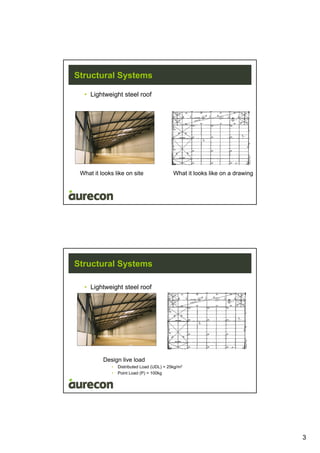
• Lightweight steel roof
What it looks like on site What it looks like on a drawing
Structural Systems
• Lightweight steel roof
Design live load
• Distributed Load (UDL) = 25kg/m2
• Point Load (P) = 100kg
4
Structural Systems
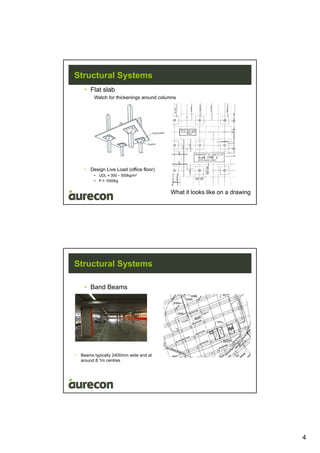
• Flat slab
Watch for thickenings around columns
• Design Live Load (office floor)
• UDL = 300 – 500kg/m2
• P = 1000kg
What it looks like on a drawing
Structural Systems
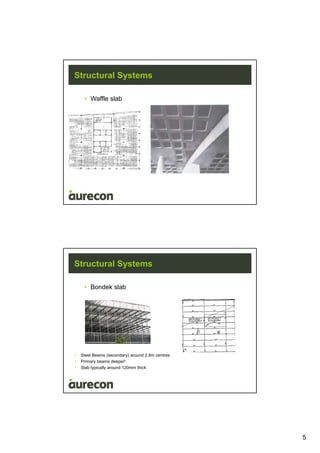
• Band Beams
• Beams typically 2400mm wide and at
around 8.1m centres
5
Structural Systems
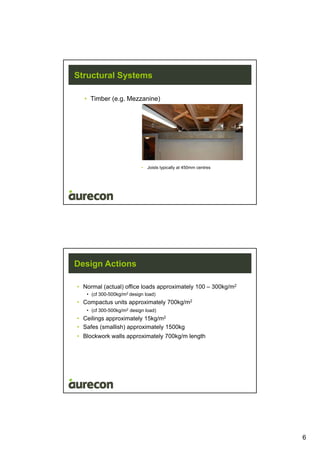
• Waffle slab
Structural Systems
• Bondek slab
• Steel Beams (secondary) around 2.8m centres
• Primary beams deeper!
• Slab typically around 120mm thick
6
Structural Systems
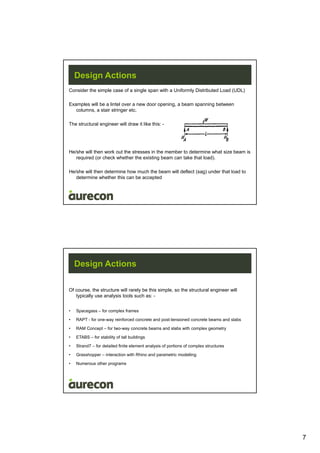
• Timber (e.g. Mezzanine)
• Joists typically at 450mm centres
Design Actions
• Normal (actual) office loads approximately 100 – 300kg/m2
• (cf 300-500kg/m2 design load)
• Compactus units approximately 700kg/m2
• (cf 300-500kg/m2 design load)
• Ceilings approximately 15kg/m2
• Safes (smallish) approximately 1500kg
• Blockwork walls approximately 700kg/m length
7
Design Actions
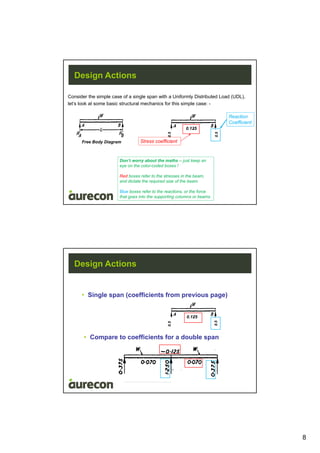
Consider the simple case of a single span with a Uniformly Distributed Load (UDL)
Examples will be a lintel over a new door opening, a beam spanning between
columns, a stair stringer etc.
The structural engineer will draw it like this: -
He/she will then work out the stresses in the member to determine what size beam is
required (or check whether the existing beam can take that load).
He/she will then determine how much the beam will deflect (sag) under that load to
determine whether this can be accepted
Design Actions
Of course, the structure will rarely be this simple, so the structural engineer will
typically use analysis tools such as: -
• Spacegass – for complex frames
• RAPT - for one-way reinforced concrete and post-tensioned concrete beams and slabs
• RAM Concept – for two-way concrete beams and slabs with complex geometry
• ETABS – for stability of tall buildings
• Strand7 – for detailed finite element analysis of portions of complex structures
• Grasshopper – interaction with Rhino and parametric modelling
• Numerous other programs
8
Design Actions
0.125
Free Body Diagram
0.5
0.5
Consider the simple case of a single span with a Uniformly Distributed Load (UDL),
let’s look at some basic structural mechanics for this simple case: -
Reaction
Coefficient
Stress coefficient
Don’t worry about the maths – just keep an
eye on the color-coded boxes !
Red boxes refer to the stresses in the beam,
and dictate the required size of the beam.
Blue boxes refer to the reactions, or the force
that goes into the supporting columns or beams
Design Actions
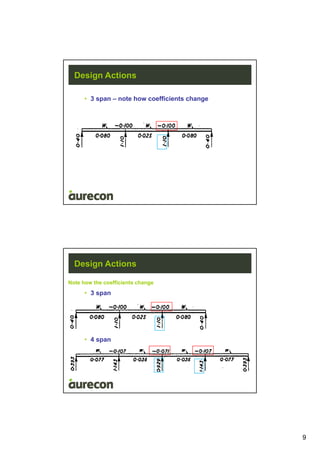
• Single span (coefficients from previous page)
0.125
0.5
0.5
• Compare to coefficients for a double span
9
Design Actions
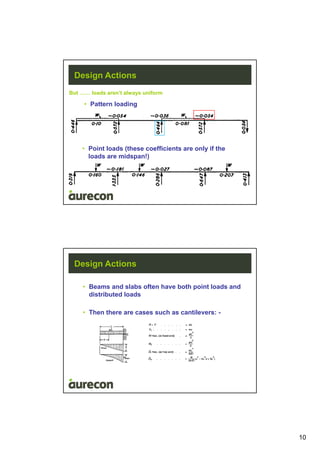
• 3 span – note how coefficients change
Design Actions
• 3 span
• 4 span
Note how the coefficients change
10
Design Actions
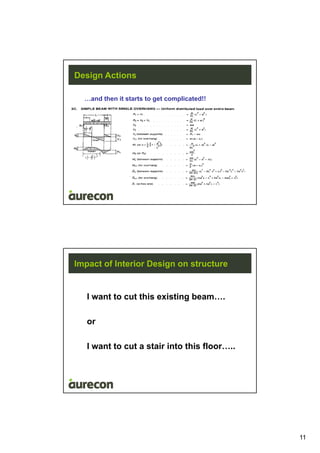
• Pattern loading
But …… loads aren’t always uniform
• Point loads (these coefficients are only if the
loads are midspan!)
Design Actions
• Then there are cases such as cantilevers: -
• Beams and slabs often have both point loads and
distributed loads
11
Design Actions
…and then it starts to get complicated!!
Impact of Interior Design on structure
I want to cut this existing beam….
or
I want to cut a stair into this floor…..
12
Impact of Interior Design on structure
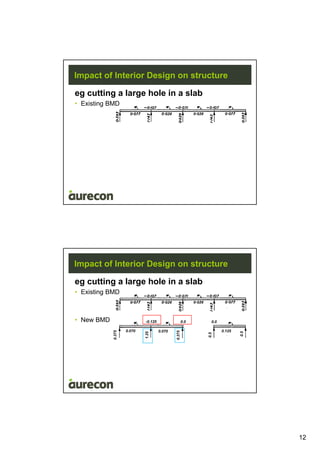
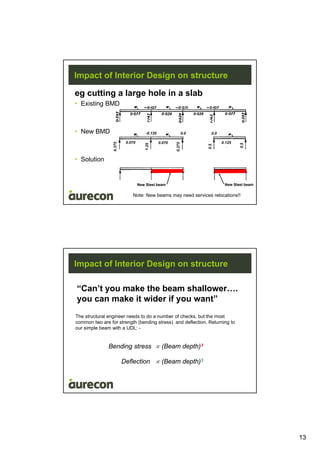
eg cutting a large hole in a slab
• Existing BMD
Impact of Interior Design on structure
eg cutting a large hole in a slab
• Existing BMD
• New BMD
0.1250.0700.070
0.0-0.125
1.25
0.375
0.375
0.5
0.5
0.0
13
Impact of Interior Design on structure
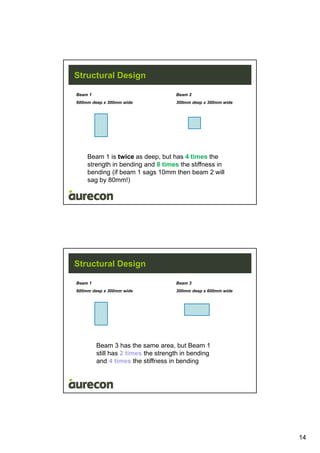
eg cutting a large hole in a slab
• Existing BMD
• New BMD
• Solution
0.1250.0700.070
0.0-0.125
1.25
0.375
0.375
0.5
0.5
Note: New beams may need services relocations!!
0.0
New Steel beam New Steel beam
Impact of Interior Design on structure
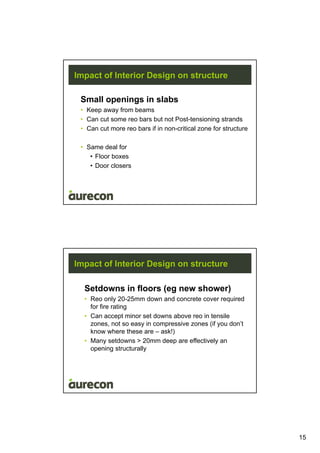
“Can’t you make the beam shallower….
you can make it wider if you want”
The structural engineer needs to do a number of checks, but the most
common two are for strength (bending stress) and deflection. Returning to
our simple beam with a UDL: -
Bending stress  (Beam depth)²
Deflection  (Beam depth)3
14
Structural Design
Beam 1
600mm deep x 300mm wide
Beam 2
300mm deep x 300mm wide
Beam 1 is twice as deep, but has 4 times the
strength in bending and 8 times the stiffness in
bending (if beam 1 sags 10mm then beam 2 will
sag by 80mm!)
Structural Design
Beam 1
600mm deep x 300mm wide
Beam 3
300mm deep x 600mm wide
Beam 3 has the same area, but Beam 1
still has 2 times the strength in bending
and 4 times the stiffness in bending
15
Impact of Interior Design on structure
Small openings in slabs
• Keep away from beams
• Can cut some reo bars but not Post-tensioning strands
• Can cut more reo bars if in non-critical zone for structure
• Same deal for
• Floor boxes
• Door closers
Impact of Interior Design on structure
Setdowns in floors (eg new shower)
• Reo only 20-25mm down and concrete cover required
for fire rating
• Can accept minor set downs above reo in tensile
zones, not so easy in compressive zones (if you don’t
know where these are – ask!)
• Many setdowns > 20mm deep are effectively an
opening structurally
16
Impact of Interior Design on structure
Chases
• Similar requirements for setdowns
• For ‘one way’ floor systems, may be able to do
floor chases (rebates) parallel to the spanning
direction but not possible perpendicular to span
Impact of Interior Design on structure
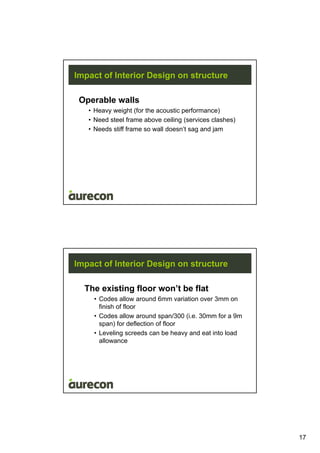
Full Height Partitions / Posts etc
• Must allow deflection
heads at top to allow
differential movements
17
Impact of Interior Design on structure
Operable walls
• Heavy weight (for the acoustic performance)
• Need steel frame above ceiling (services clashes)
• Needs stiff frame so wall doesn’t sag and jam
Impact of Interior Design on structure
The existing floor won’t be flat
• Codes allow around 6mm variation over 3mm on
finish of floor
• Codes allow around span/300 (i.e. 30mm for a 9m
span) for deflection of floor
• Leveling screeds can be heavy and eat into load
allowance
18
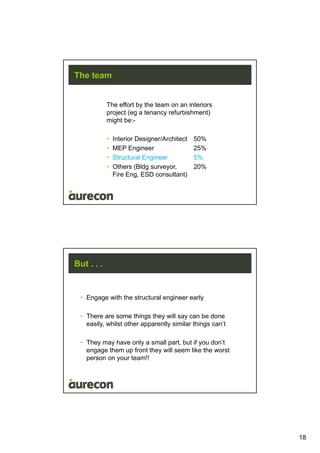
The team
The effort by the team on an interiors
project (eg a tenancy refurbishment)
might be:-
• Interior Designer/Architect 50%
• MEP Engineer 25%
• Structural Engineer 5%
• Others (Bldg surveyor, 20%
Fire Eng, ESD consultant)
But . . .
• Engage with the structural engineer early
• There are some things they will say can be done
easily, whilst other apparently similar things can’t
• They may have only a small part, but if you don’t
engage them up front they will seem like the worst
person on your team!!

Presentation to Interior Designers

  • 1.
    1 Basics of StructuralEngineering Presentation to Interior Architecture Students By Mark Sheldon, Technical Director, Aurecon Aurecon Offices: 87 Countries: 28 Employees: 7,000+
  • 2.
    2 Who am I? Whatwe will cover • Structural Systems • Design Loads – what loads act on on a structure • Design Actions – how does a structure react to these loads • Impact of Interior Design on structure (and vice versa) • Setdowns in the floor • Chases into the surface of the structure (eg to Boardroom tables) • Operable walls • Heavy point loads on floors or ceilings • Lintels • Transoms supporting wall lining • Heavy duty shelves
  • 3.
    3 Structural Systems • Lightweightsteel roof What it looks like on site What it looks like on a drawing Structural Systems • Lightweight steel roof Design live load • Distributed Load (UDL) = 25kg/m2 • Point Load (P) = 100kg
  • 4.
    4 Structural Systems • Flatslab Watch for thickenings around columns • Design Live Load (office floor) • UDL = 300 – 500kg/m2 • P = 1000kg What it looks like on a drawing Structural Systems • Band Beams • Beams typically 2400mm wide and at around 8.1m centres
  • 5.
    5 Structural Systems • Waffleslab Structural Systems • Bondek slab • Steel Beams (secondary) around 2.8m centres • Primary beams deeper! • Slab typically around 120mm thick
  • 6.
    6 Structural Systems • Timber(e.g. Mezzanine) • Joists typically at 450mm centres Design Actions • Normal (actual) office loads approximately 100 – 300kg/m2 • (cf 300-500kg/m2 design load) • Compactus units approximately 700kg/m2 • (cf 300-500kg/m2 design load) • Ceilings approximately 15kg/m2 • Safes (smallish) approximately 1500kg • Blockwork walls approximately 700kg/m length
  • 7.
    7 Design Actions Consider thesimple case of a single span with a Uniformly Distributed Load (UDL) Examples will be a lintel over a new door opening, a beam spanning between columns, a stair stringer etc. The structural engineer will draw it like this: - He/she will then work out the stresses in the member to determine what size beam is required (or check whether the existing beam can take that load). He/she will then determine how much the beam will deflect (sag) under that load to determine whether this can be accepted Design Actions Of course, the structure will rarely be this simple, so the structural engineer will typically use analysis tools such as: - • Spacegass – for complex frames • RAPT - for one-way reinforced concrete and post-tensioned concrete beams and slabs • RAM Concept – for two-way concrete beams and slabs with complex geometry • ETABS – for stability of tall buildings • Strand7 – for detailed finite element analysis of portions of complex structures • Grasshopper – interaction with Rhino and parametric modelling • Numerous other programs
  • 8.
    8 Design Actions 0.125 Free BodyDiagram 0.5 0.5 Consider the simple case of a single span with a Uniformly Distributed Load (UDL), let’s look at some basic structural mechanics for this simple case: - Reaction Coefficient Stress coefficient Don’t worry about the maths – just keep an eye on the color-coded boxes ! Red boxes refer to the stresses in the beam, and dictate the required size of the beam. Blue boxes refer to the reactions, or the force that goes into the supporting columns or beams Design Actions • Single span (coefficients from previous page) 0.125 0.5 0.5 • Compare to coefficients for a double span
  • 9.
    9 Design Actions • 3span – note how coefficients change Design Actions • 3 span • 4 span Note how the coefficients change
  • 10.
    10 Design Actions • Patternloading But …… loads aren’t always uniform • Point loads (these coefficients are only if the loads are midspan!) Design Actions • Then there are cases such as cantilevers: - • Beams and slabs often have both point loads and distributed loads
  • 11.
    11 Design Actions …and thenit starts to get complicated!! Impact of Interior Design on structure I want to cut this existing beam…. or I want to cut a stair into this floor…..
  • 12.
    12 Impact of InteriorDesign on structure eg cutting a large hole in a slab • Existing BMD Impact of Interior Design on structure eg cutting a large hole in a slab • Existing BMD • New BMD 0.1250.0700.070 0.0-0.125 1.25 0.375 0.375 0.5 0.5 0.0
  • 13.
    13 Impact of InteriorDesign on structure eg cutting a large hole in a slab • Existing BMD • New BMD • Solution 0.1250.0700.070 0.0-0.125 1.25 0.375 0.375 0.5 0.5 Note: New beams may need services relocations!! 0.0 New Steel beam New Steel beam Impact of Interior Design on structure “Can’t you make the beam shallower…. you can make it wider if you want” The structural engineer needs to do a number of checks, but the most common two are for strength (bending stress) and deflection. Returning to our simple beam with a UDL: - Bending stress  (Beam depth)² Deflection  (Beam depth)3
  • 14.
    14 Structural Design Beam 1 600mmdeep x 300mm wide Beam 2 300mm deep x 300mm wide Beam 1 is twice as deep, but has 4 times the strength in bending and 8 times the stiffness in bending (if beam 1 sags 10mm then beam 2 will sag by 80mm!) Structural Design Beam 1 600mm deep x 300mm wide Beam 3 300mm deep x 600mm wide Beam 3 has the same area, but Beam 1 still has 2 times the strength in bending and 4 times the stiffness in bending
  • 15.
    15 Impact of InteriorDesign on structure Small openings in slabs • Keep away from beams • Can cut some reo bars but not Post-tensioning strands • Can cut more reo bars if in non-critical zone for structure • Same deal for • Floor boxes • Door closers Impact of Interior Design on structure Setdowns in floors (eg new shower) • Reo only 20-25mm down and concrete cover required for fire rating • Can accept minor set downs above reo in tensile zones, not so easy in compressive zones (if you don’t know where these are – ask!) • Many setdowns > 20mm deep are effectively an opening structurally
  • 16.
    16 Impact of InteriorDesign on structure Chases • Similar requirements for setdowns • For ‘one way’ floor systems, may be able to do floor chases (rebates) parallel to the spanning direction but not possible perpendicular to span Impact of Interior Design on structure Full Height Partitions / Posts etc • Must allow deflection heads at top to allow differential movements
  • 17.
    17 Impact of InteriorDesign on structure Operable walls • Heavy weight (for the acoustic performance) • Need steel frame above ceiling (services clashes) • Needs stiff frame so wall doesn’t sag and jam Impact of Interior Design on structure The existing floor won’t be flat • Codes allow around 6mm variation over 3mm on finish of floor • Codes allow around span/300 (i.e. 30mm for a 9m span) for deflection of floor • Leveling screeds can be heavy and eat into load allowance
  • 18.
    18 The team The effortby the team on an interiors project (eg a tenancy refurbishment) might be:- • Interior Designer/Architect 50% • MEP Engineer 25% • Structural Engineer 5% • Others (Bldg surveyor, 20% Fire Eng, ESD consultant) But . . . • Engage with the structural engineer early • There are some things they will say can be done easily, whilst other apparently similar things can’t • They may have only a small part, but if you don’t engage them up front they will seem like the worst person on your team!!