PRESENTATION SYSTEMS THINKING CHAPTER 12 - KNOWLEDGE MANAGEMENT AND SPECIALIZED INFORMATION SYSTEMS.pptx
1.
REMINDERS
Upon entering themeeting, always turn off your video and mute
your mic unless the speaker tells you otherwise. This is to save your
internet bandwidth.
If you have questions, you may press the “Raise Hand” icon on your
screen, you may enter your question in the Chat Panel, or you may
unmute your mic and address your question to be recognized.
Please observe proper netiquette and be respectful towards the
speaker and other participants throughout the meeting.
Be sure to listen and take down notes.
Relax and enjoy the meeting.
Overview of KnowledgeManagement
Systems
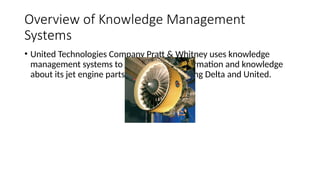
• United Technologies Company Pratt & Whitney uses knowledge
management systems to help it deliver information and knowledge
about its jet engine parts to airlines, including Delta and United.
Technology to SupportKnowledge
Management
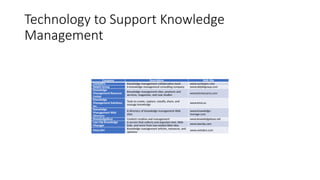
Company Description Web Site
CortexPro Knowledge management collaboration tools www.cortexpro.com
Delphi Group A knowledge management consulting company www.delphigroup.com
Knowledge
Management Resource
Center
Knowledge management sites, products and
services, magazines, and case studies
www.kmresource.com
Knowledge
Management Solutions,
Inc.
Tools to create, capture, classify, share, and
manage knowledge
www.kmsi.us
Knowledge
Management Web
Directory
A directory of knowledge management Web
sites
www.knowledge-
manage.com
KnowledgeBase Content creation and management www.knowledgebase.net
Law Clip Knowledge
Manager
A service that collects and organizes text, Web
links, and more from law-related Web sites
www.lawclip.com
Meta KM
Knowledge management articles, resources, and
opinions
www.metakm.com
The Nature ofIntelligence
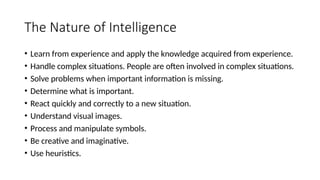
• Learn from experience and apply the knowledge acquired from experience.
• Handle complex situations. People are often involved in complex situations.
• Solve problems when important information is missing.
• Determine what is important.
• React quickly and correctly to a new situation.
• Understand visual images.
• Process and manipulate symbols.
• Be creative and imaginative.
• Use heuristics.
14.
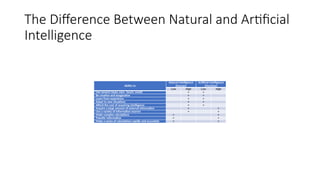
The Difference BetweenNatural and Artificial
Intelligence
Ability to
Natural Intelligence
(Human)
Artificial Intelligence
(Machine)
Low High Low High
Use sensors (eyes, ears, touch, smell) × ×
Be creative and imaginative × ×
Learn from experience × ×
Adapt to new situations × ×
Afford the cost of acquiring intelligence × ×
Acquire a large amount of external information × ×
Use a variety of information sources × ×
Make complex calculations × ×
Transfer information × ×
Make a series of calculations rapidly and accurately × ×
When to UseExpert Systems
• Provide a high potential payoff or significantly reduce downside risk
• Capture and preserve irreplaceable human expertise
• Solve a problem that is not easily solved using traditional programming techniques
• Develop a system more consistent than human experts
• Provide expertise needed to selected locations at the same time or in a hostile
environment dangerous to human health
• Provide expertise that is expensive or rare
• Develop a solution faster than human experts can
• Provide expertise needed for training and development to share the wisdom and
experience of experts with others
The User Interface
EXPERTSYSTEM: Are there any previous credit problems?
USER: No.
EXPERT SYSTEM: Is the applicant’s net income greater than four times the monthly loan payment?
USER: Yes.
EXPERT SYSTEM: Is the down payment greater than 15% of the property value?
USER: Yes.
EXPERT SYSTEM: Are the net assets of the borrower greater than $25,000?
USER: Yes.
EXPERT SYSTEM: Has the borrower worked more than three years at the same company?
USER: Yes.
EXPERT SYSTEM: Accept the loan application.
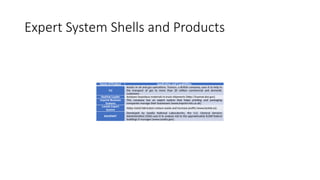
Expert System Shellsand Products
Name of Product Application and Capabilities
G2
Assists in oil and gas operations. Transco, a British company, uses it to help in
the transport of gas to more than 20 million commercial and domestic
customers.
HazMat Loader Analyzes hazardous materials in truck shipments (http://hazmat.dot.gov).
Imprint Business
Systems
This company has an expert system that helps printing and packaging
companies manage their businesses (www.imprint-mis.co.uk).
Lantek Expert
System
Helps metal fabricators reduce waste and increase profits (www.lantek.es).
RAMPART
Developed by Sandia National Laboratories, the U.S. General Services
Administration (GSA) uses it to analyze risk to the approximately 8,000 federal
buildings it manages (www.sandia.gov).
36.
Applications of ExpertSystems and Artificial
Intelligence
• Credit granting and loan analysis.
• Catching cheats and terrorists.
• Plant layout and manufacturing.
• Hospitals and medical facilities.
• Employee performance evaluation.
• Repair and maintenance.
• Shipping.
• Marketing.
#2 Knowledge management and specialized information systems are used in almost every industry. If you are a manager, you might use a knowledge management system to support decisive action to help you correct a problem. If you are a production manager at an automotive company, you might oversee robots that attach windshields to cars or paint body panels. As a young stock trader, you might use a special system called a neural network to uncover patterns and make millions of dollars trading stocks and stock options. As a marketing manager for a PC manufacturer, you might use virtual reality on a Web site to show customers your latest laptop and desktop computers. If you are in the military, you might use computer simulation as a training tool to prepare you for combat. In a petroleum company, you might use an expert system to determine where to drill for oil and gas. Learning about these systems will help you discover new ways to use information systems in your day-to-day work.
Like other aspects of an information system, the overall goal of knowledge management and the specialized systems is to help people and organizations achieve their goals. In some cases, knowledge management and these specialized systems can help an organization achieve a long-term, strategic advantage.
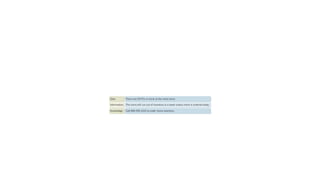
#4 Data consists of raw facts, such as an employee number, number of hours worked in a week, inventory part numbers, or sales orders. A list of the quantity available for all items in inventory is an example of data. When these facts are organized or arranged in a meaningful manner, they become information. Information is a collection of facts organized so that they have additional value beyond the value of the facts themselves. An exception report of inventory items that might be out of stock in a week because of high demand is an example of information. Knowledge is the awareness and understanding of a set of information and the ways that information can be made useful to support a specific task or reach a decision. Knowing the procedures for ordering more inventory to avoid running out is an example of knowledge. In a sense, information tells you what has to be done (low inventory levels for some items), while knowledge tells you how to do it (make two important phone calls to the right people to get the needed inventory shipped overnight).
According to Carol Csanda, director of knowledge management at State Farm Insurance, “We feel at State Farm that everybody’s role is in some way about managing and transferring knowledge.” A knowledge management system (KMS) is an organized collection of people, procedures, software, databases, and devices used to create, store, share, and use the organization’s knowledge and experience. KMSs cover a wide range of systems, from software that contains some KMS components to dedicated systems designed specifically to capture, store, and use knowledge. According to a software engineer for the Tata Group, a large Indian company, “We have learned that every time staff leaves our companies, their knowledge has gone with them and our knowledge is gradually reduced. Hence, we put knowledge management in the group’s strategy to ensure our staff at all levels can maintain knowledge at all times.”
Using KMS, the steel, software, coffee, chemicals, watches, and power company was able to win the Most Admired Knowledge Enterprise (MAKE) award in Asia. Other organizations also face the loss of knowledge when workers leave or retire. According to a spokesperson for the Aerospace and Defense (A&D) organization, “Knowledge management represents a major issue for A&D organizations, as they stand to lose decades of accumulated institutional knowledge and expertise each time an employee retires. This is particularly true for program managers and engineers, whose retirement rate nearly doubled between 2004 and 2005.”
#5 Like the other systems, knowledge management systems attempt to help organizations achieve their goals. For businesses, this usually means increasing profits or reducing costs. For nonprofit organizations, it can mean providing better customer service or providing special needs to people and groups. Many types of firms use KMSs to increase profits or reduce costs. Pratt & Whitney, for example, uses knowledge management systems to help it deliver information and knowledge about its jet engine parts to airlines, including Delta and United. The World Bank uses knowledge management to obtain, share, and use knowledge to help fight worldwide poverty and disease. According to a survey of CEOs, firms that use KMSs are more likely to innovate and perform better.
A KMS can involve different types of knowledge. Explicit knowledge is objective and can be measured and documented in reports, papers, and rules. For example, knowing the best road to take to minimize drive time from home to the office when a major highway is closed due to an accident is explicit knowledge. It can be documented in a report or a rule, as in “If I-70 is closed, take Highway 6 to town and the office.” Tacit knowledge, on the other hand, is hard to measure and document and typically is not objective or formalized. Knowing the best way to negotiate with a foreign government about nuclear disarmament or a volatile hostage situation often requires a lifetime of experience and a high level of skill. These are examples of tacit knowledge. It is difficult to write a detailed report or a set of rules that would always work in every hostage situation. Many organizations actively attempt to convert tacit knowledge to explicit knowledge to make the knowledge easier to measure, document, and share with others.
#6 The personnel involved in a KMS include data workers and knowledge workers. Secretaries, administrative assistants, bookkeepers, and similar data-entry personnel are often called data workers. Knowledge workers are people who create, use, and disseminate knowledge. They are usually professionals in science, engineering, or business, and work in offices and belong to professional organizations. Other examples of knowledge workers include writers, researchers, educators, and corporate designers.
The chief knowledge officer (CKO) is a top-level executive who helps the organization work with a KMS to create, store, and use knowledge to achieve organizational goals. The CKO is responsible for the organization’s KMS, and typically works with other executives and vice presidents, including the chief executive officer (CEO), chief financial officer (CFO), and others.
Some organizations and professions use communities of practice (COP) to create, store, and share knowledge. A COP is a group of people dedicated to a common discipline or practice, such as open-source software, auditing, medicine, or engineering. A group of oceanographers investigating climate change or a team of medical researchers looking for new ways to treat lung cancer are examples of COPs. COPs excel at obtaining, storing, sharing, and using knowledge. A COP from the International Conference on Knowledge Management in Nuclear Facilities investigates the use of knowledge management systems in the development and control of nuclear facilities. According to Yuri Sokolov, IAEA deputy director general and head of the Department of Nuclear Energy, “All applications of nuclear technology are based on nuclear knowledge, so managing, preserving, and building on the knowledge we have accumulated is both wise [in the] near term and an important intergenerational responsibility.”
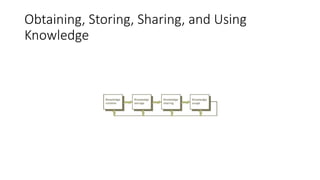
#7 Obtaining, storing, sharing, and using knowledge is the key to any KMS. A KMS can help an organization increase profits or achieve its goals, but obtaining, storing, sharing, and using knowledge can be difficult. In one survey, almost 60 percent of the respondents indicated that they couldn’t find the information and knowledge that they need to do their jobs every day. Using a KMS often leads to additional knowledge creation, storage, sharing, and usage. Business professors often conduct research in marketing strategies, management practices, corporate and individual investments and finance, effective accounting and auditing practices, and much more. Drug companies and medical researchers invest billions of dollars in creating knowledge on cures for diseases. Although knowledge workers can act alone, they often work in teams to create or obtain knowledge.
After knowledge is created, it is often stored in a knowledge repository that includes documents, reports, files, and databases. The knowledge repository can be located both inside the organization and outside. Some types of software can store and share knowledge contained in documents and reports. Adobe Acrobat PDF files, for example, allow you to store corporate reports, tax returns, and other documents and send them to others over the Internet. Traditional databases, data warehouses, and data marts often store the organization’s knowledge. Specialized knowledge bases in expert systems can also be used.
Because knowledge workers often work in groups or teams, they can use collaborative work software and group support systems to share knowledge, such as groupware, meeting software, and collaboration tools. Intranets and password-protected Internet sites also provide ways to share knowledge. The social services department of the Surrey County Council in the United Kingdom, for example, used an intranet to help it create and manipulate knowledge. Because knowledge can be critical in maintaining a competitive advantage, businesses should be careful in how they share knowledge. Although they want important decision makers inside and outside the organization to have complete and easy access to knowledge, they also need to protect knowledge from competitors, hackers, and others who shouldn’t obtain the organization’s knowledge. As a result, many businesses use patents, copyrights, trade secrets, Internet firewalls, and other measures to keep prying eyes from seeing important knowledge that is often expensive and hard to create.
In addition to using information systems and collaborative software tools to share knowledge, some organizations use nontechnical approaches. These include corporate retreats and gatherings, sporting events, informal knowledge worker lounges or meeting places, kitchen facilities, daycare centers, and comfortable workout centers.
Using a knowledge management system begins with locating the organization’s knowledge. This is often done using a knowledge map or directory that points the knowledge worker to the needed knowledge. Drug companies have sophisticated knowledge maps that include database and file systems to allow scientists and drug researchers to locate previous medical studies. Medical researchers, university professors, and even textbook authors use Lexis-Nexis to locate important knowledge. Corporations often use the Internet or corporate Web portals to help their knowledge workers find knowledge stored in documents and reports.
#8 An effective KMS is based on learning new knowledge and changing procedures and approaches as a result. A manufacturing company, for example, might learn new ways to program robots on the factory floor to improve accuracy and reduce defective parts. The new knowledge will likely cause the manufacturing company to change how it programs and uses its robots. Data mining and business intelligence are powerful tools that can be important in capturing and using knowledge. Enterprise resource planning tools, such as SAP, include knowledge management features. Groupware can also be used to help capture, store, and use knowledge. Of course, hardware, software, databases, telecommunications, and the Internet are important technologies used to support most knowledge management systems.
Hundreds of organizations provide specific KM products and services. In addition, researchers at colleges and universities have developed tools and technologies to support knowledge management. Companies such as IBM have many knowledge management tools in a variety of products, including Lotus Notes and Domino. Lotus Notes is a collection of software products that help people work together to create, share, and store important knowledge and business documents. Its knowledge management features include domain search, content mapping, and Lotus Sametime. Domain search allows people to perform sophisticated searches for knowledge in Domino databases using a single, simple query. Content mapping organizes knowledge by categories, like a table of contents for a book. Lotus Sametime helps people communicate, collaborate, and share ideas in real time. Lotus Domino Document Manager, formerly called Lotus Domino, helps people and organizations store, organize, and retrieve documents. The software can be used to write, review, archive, and publish documents throughout the organization.
#9 Microsoft offers a number of knowledge management tools, including Digital Dashboard, which is based on the Microsoft Office suite. Digital Dashboard integrates information from different sources, including personal, group, enterprise, and external information and documents. Other tools from Microsoft include Web Store Technology, which uses wireless technology to deliver knowledge to any location at any time; Access Workflow Designer, which helps database developers create effective systems to process transactions and keep work flowing through the organization; and related products. In addition to these tools, several artificial intelligence and special purpose technologies and tools can be used in a KMS.
#10 At a Dartmouth College conference in 1956, John McCarthy proposed the use of the term artificial intelligence (AI) to describe computers with the ability to mimic or duplicate the functions of the human brain. For example, advances in AI have led to systems that work like the human brain to recognize complex patterns.
Many AI pioneers attended this first conference; a few predicted that computers would be as “smart” as people by the 1960s. The prediction has not yet been realized, but the benefits of artificial intelligence in business and research can be seen today, and research continues. Science fiction novels and popular movies have featured scenarios of computer systems and intelligent machines taking over the world. Stephen Hawking, who is the Lucasian professor of mathematics at Cambridge University (a position once held by Isaac Newton) and author of A Brief History of Time, said, “In contrast with our intellect, computers double their performance every 18 months. So the danger is real that they could develop intelligence and take over the world.” Computer systems such as Hal in the classic movie 2001: A Space Odyssey and those in the movie A.I. are futuristic glimpses of what might be. These accounts are fictional, but they show the real application of many computer systems that use the notion of AI. These systems help to make medical diagnoses, explore for natural resources, determine what is wrong with mechanical devices, and assist in designing and developing other computer systems.
#11 Artificial intelligence systems include the people, procedures, hardware, software, data, and knowledge needed to develop computer systems and machines that demonstrate characteristics of intelligence. Artificial intelligence can be used by most industries and applications. Researchers, scientists, and experts on how human beings think are often involved in developing these systems.
#12 From the early AI pioneering stage, the research emphasis has been on developing machines with intelligent behavior. In a book called The Singularity Is Near and articles by and about him, Ray Kurzweil predicts computers will have humanlike intelligence in 20 years. The author also foresees that, by 2045, human and machine intelligence might merge. According to Kurzweil, “The Singularity Institute for Artificial Intelligence (SIAI) is playing a critical role in advancing humanity’s understanding of the profound promise and peril of strong AI.” Machine intelligence, however, is hard to achieve.
The Turing Test attempts to determine whether the responses from a computer with intelligent behavior are indistinguishable from responses from a human being. No computer has passed the Turing Test, developed by Alan Turing, a British mathematician. The Loebner Prize offers money and a gold medal for anyone developing a computer that can pass the Turing Test (see www.loebner.net).
20Q is an online game where users play the popular game Twenty Questions against an artificial intelligence foe.
#13 Some of the specific characteristics of intelligent behavior include the ability to do the following:
• Learn from experience and apply the knowledge acquired from experience. Learning from past situations and events is a key component of intelligent behavior and is a natural ability of humans, who learn by trial and error. This ability, however, must be carefully programmed into a computer system. Today, researchers are developing systems that can learn from experience. For instance, computerized AI chess software can learn to improve while playing human competitors. In one match, Garry Kasparov competed against a personal computer with AI software developed in Israel, called Deep Junior. This match was a 3–3 tie, but Kasparov picked up something the machine would have no interest in—$700,000. The 20 questions Web site, www.20q.net, is another example of a system that learns. The Web site is an artificial intelligence game that learns as people play.
• Handle complex situations. People are often involved in complex situations. World leaders face difficult political decisions regarding terrorism, conflict, global economic conditions, hunger, and poverty. In a business setting, top-level managers and executives must handle a complex market, challenging competitors, intricate government regulations, and a demanding workforce. Even human experts make mistakes in dealing with these situations. Developing computer systems that can handle perplexing situations requires careful planning and elaborate computer programming.
• Solve problems when important information is missing. The essence of decision making is dealing with uncertainty. Often, decisions must be made with little information or inaccurate information because obtaining complete information is too costly or impossible. Today, AI systems can make important calculations, comparisons, and decisions even when information is missing.
• Determine what is important. Knowing what is truly important is the mark of a good decision maker. Developing programs and approaches to allow computer systems and machines to identify important information is no simple task.
• React quickly and correctly to a new situation. A small child, for example, can look over a ledge or a drop-off and know not to venture too close. The child reacts quickly and correctly to a new situation. Computers, on the other hand, do not have this ability without complex programming.
• Understand visual images. Interpreting visual images can be extremely difficult, even for sophisticated computers. Moving through a room of chairs, tables, and other objects can be trivial for people but extremely complex for machines, robots, and computers. Such machines require an extension of understanding visual images, called a perceptive system. Having a perceptive system allows a machine to approximate the way a person sees, hears, and feels objects. Military robots, for example, use cameras and perceptive systems to conduct reconnaissance missions to detect enemy weapons and soldiers. Detecting and destroying them can save lives.
• Process and manipulate symbols. People see, manipulate, and process symbols every day. Visual images provide a constant stream of information to our brains. By contrast, computers have difficulty handling symbolic processing and reasoning. Although computers excel at numerical calculations, they aren’t as good at dealing with symbols and three-dimensional objects. Recent developments in machine-vision hardware and software, however, allow some computers to process and manipulate symbols on a limited basis.
• Be creative and imaginative. Throughout history, some people have turned difficult situations into advantages by being creative and imaginative. For instance, when shipped defective mints with holes in the middle, an enterprising entrepreneur decided to market these new mints as LifeSavers instead of returning them to the manufacturer. Ice cream cones were invented at the St. Louis World’s Fair when an imaginative store owner decided to wrap ice cream with a waffle from his grill for portability. Developing new and exciting products and services from an existing (perhaps negative) situation is a human characteristic. Few computers can be imaginative or creative in this way, although software has been developed to enable a computer to write short stories.
• Use heuristics. For some decisions, people use heuristics (rules of thumb arising from experience) or even guesses. In searching for a job, you might rank the companies you are considering according to profits per employee. Today, some computer systems, given the right programs, obtain good solutions that use approximations instead of trying to search for an optimal solution, which would be technically difficult or too time consuming.
This list of traits only partially defines intelligence. Unlike the terminology used in virtually every other field of IS research, in which the objectives can be clearly defined, the term intelligence is a formidable stumbling block. One of the problems in AI is arriving at a working definition of real intelligence against which to compare the performance of an AI system.
#14 Since the term artificial intelligence was defined in the 1950s, experts have disagreed about the difference between natural and artificial intelligence. Can computers be programmed to have common sense? Profound differences separate natural from artificial intelligence, but they are declining in number. One of the driving forces behind AI research is an attempt to understand how people actually reason and think. Creating machines that can reason is possible only when we truly understand our own processes for doing so.
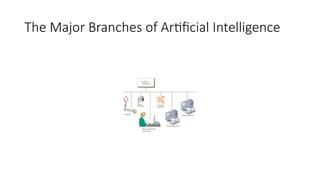
#15 AI is a broad field that includes several specialty areas, such as expert systems, robotics, vision systems, natural language processing, learning systems, and neural networks. Many of these areas are related; advances in one can occur simultaneously with or result in advances in others.
#16 Robotics involves developing mechanical or computer devices that can paint cars, make precision welds, and perform other tasks that require a high degree of precision or are tedious or hazardous for human beings. The word “robot” comes from a play by Karel Capek in the 1920s, when he used the word “robota” to describe factory machines that do drudgery work and revolt. The use of robots has expanded and is likely to increase in the future. According to Takeo Kande, “Someday, robots will do more than vacuum your floors. They’ll train you and advise you—and maybe even help out with the cooking.” Some robots are mechanical devices that don’t use the AI features. Others are sophisticated systems that use one or more AI features or characteristics, such as vision systems, learning systems, or neural networks. For many businesses, robots are used to do the three Ds—dull, dirty, and dangerous jobs. Manufacturers use robots to assemble and paint products. The NASA shuttle crash of 2003 has led some people to recommend using robots instead of people to explore space and perform scientific research. Some robots, such as the ER series by Intelitek (www.intelitek.com), can be used for training or entertainment. Contemporary robotics combine both high-precision machine capabilities and sophisticated controlling software. The controlling software in robots is what is most important in terms of AI.
#17 The field of robotics has many applications, and research into these unique devices continues. The following are a few examples:
• The Robot Learning Laboratory, part of the computer science department and the Robotics Institute at Carnegie Mellon University (www.ri.cmu.edu), conducts research into the development and use of robotics.
• IRobot (www.irobot.com) is a company that builds a number of robots, including the Roomba Floorvac for cleaning floors and the PackBot, an unmanned vehicle used to assist and protect soldiers.
• Robots are used in a variety of ways in medicine. The Porter Adventist Hospital (www.porterhospital.org) in Denver, Colorado, uses a $1.2 million Da Vinci Surgical System to perform surgery on prostate cancer patients. The robot has multiple arms that hold surgical tools. According to one doctor at Porter, “The biggest advantage is it improves recovery time. Instead of having an eight-inch incision, the patient has a ‘bandaid’ incision. It’s much quicker.” The Heart-Lander is a very small robot that is inserted below the rib cage and used to perform delicate heart surgery. Cameron Riviere at the Carnegie Mellon Robotics Institute (www.ri.cmu.edu) developed the robot along with help from John Hopkins University.
• DARPA (The Defense Advanced Research Project Agency) sponsors the DARPA Grand Challenge (www.darpagrandchallenge.com), a 132-mile race over rugged terrain for computer-controlled cars. The agency also sponsors other races and challenges.
• The Hybrid Assisted Limb (HAL) lab is developing a robotic suit to help paraplegics and stroke victims move and perform basic functions. The suit helps with lifting heavy objects, walking long distances, or performing other basic movements that can’t be done otherwise. HAL was also the name of an artificial-intelligence computer in the classic movie 2001: A Space Odyssey. The letters in HAL are one letter up from the letters in IBM.
• In the military, robots are moving beyond movie plots to become real weapons. The Air Force is developing a smart robotic jet fighter. Often called unmanned combat air vehicles (UCAVs), these robotic war machines, such as the X-45A, will be able to identify and destroy targets without human pilots. UCAVs send pictures and information to a central command center and can be directed to strike military targets. These machines extend the current Predator and Global Hawk technologies the military used in Afghanistan after the September 11 terrorist attacks and Iraq. Big Dog, made by Boston Dynamics (www.bostondynamics.com), is a robot that can carry up to 200 pounds of military gear in field conditions.
Although most of today’s robots are limited in their capabilities, future robots will find wider applications in banks, restaurants, homes, doctors’ offices, and hazardous working environments such as nuclear stations. The Repliee Q1 and Q2 robots from Japan are ultra-humanlike robots or androids that can blink, gesture, speak, and even appear to breathe. Microrobotics, also called micro-electro-mechanical systems (MEMS), are also being developed. MEMS can be used in a person’s blood to monitor the body, and for other purposes in air bags, cell phones, refrigerators, and more.
#18 Another area of AI involves vision systems. Vision systems include hardware and software that permit computers to capture, store, and manipulate visual images. The U.S. Justice Department uses vision systems to perform fingerprint analysis with almost the same level of precision as human experts. The speed with which the system can search a huge database of fingerprints has brought quick resolution to many long-standing mysteries. Vision systems are also effective at identifying people based on facial features. In another application, a California wine bottle manufacturer uses a computerized vision system to inspect wine bottles for flaws. The company produces about 2 million wine bottles per day, and the vision system saves the bottle producer both time and money. The trend toward computer vision is clear, and it will accelerate. In ten years, it wouldn’t be surprising to see computers recognizing certain levels of emotions, expressions, gestures, and behaviors, all through vision.
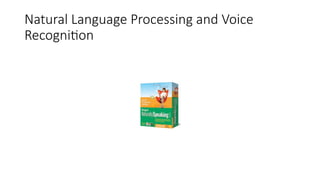
#19 Natural language processing allows a computer to understand and react to statements and commands made in a “natural” language, such as English. Google, for example, has a service called Google Voice Local Search that allows you to dial a toll-free number and search for local businesses using voice commands and statements. Restoration Hardware has developed a Web site that uses natural language processing to allow its customers to quickly find what they want. The natural language processing system corrects spelling mistakes, converts abbreviations into words and commands, and allows people to ask questions in English.
In some cases, voice recognition is used with natural language processing. Voice recognition involves converting sound waves into words. After converting sounds into words, natural language processing systems react to the words or commands by performing a variety of tasks. Brokerage services are a perfect fit for voice-recognition and natural language processing technology to replace the existing “press 1 to buy or sell a stock” touchpad telephone menu system. People buying and selling stock use a vocabulary too varied for easy access through menus and touchpads, but still small enough for software to process in real time.
Several brokerages offer these services. These systems use voice recognition and natural language processing to let customers access retirement accounts, check balances, and find stock quotes. Eventually, the technology will allow people to make transactions using voice commands over the phone and to use search engines to have their questions answered through the brokerage firm’s call center. Using voice recognition to convert recordings into text is also possible. Some companies claim that voice-recognition and natural language processing software is so good that customers forget they are talking to a computer and start discussing the weather or sports scores.
Dragon Systems’ Naturally Speaking 9 Essentials uses continuous voice recognition, or natural speech, allowing the user to speak to the computer at a normal pace without pausing between words. The spoken words are transcribed immediately onto the computer screen. (Source: Courtesy of Nuance Communications, Inc.)
#20 Another part of AI deals with learning systems, a combination of software and hardware that allows a computer to change how it functions or reacts to situations based on feedback it receives. For example, some computerized games have learning abilities. If the computer does not win a game, it remembers not to make the same moves under the same conditions again. DARPA is investing about $10 million into a learning system called Bootstrapped Learning that will help military computers learn from human instructors. If successful, the project could help the development and control of unmanned aircraft. The Center for Automated Learning and Discovery at Carnegie Mellon University is experimenting with two learning software packages that help each other learn. The hope is that two learning software packages that cooperate are better than separate learning packages.
Learning systems software requires feedback on the results of actions or decisions. At a minimum, the feedback needs to indicate whether the results are desirable (winning a game) or undesirable (losing a game). The feedback is then used to alter what the system will do in the future.
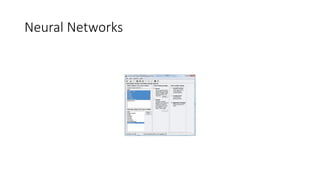
#21 An increasingly important aspect of AI involves neural networks, also called neural nets. A neural network is a computer system that can act like or simulate the functioning of a human brain. The systems use massively parallel processors in an architecture that is based on the human brain’s own mesh-like structure. In addition, neural network software simulates a neural network using standard computers. Neural networks can process many pieces of data at the same time and learn to recognize patterns. A chemical company, for example, can use neural network software to analyze a large amount of data to control chemical reactors. Neural network analysis has also helped some medical clinics diagnose cardiovascular disease. Some oil and gas exploration companies use a program called the Rate of Penetration based on neural networks to monitor and control drilling operations. The neural network program helps engineers slow or speed drilling operations to help increase drilling accuracy and reduce costs.
Some of the specific abilities of neural networks include the following:
• Retrieving information even if some of the neural nodes fail
• Quickly modifying stored data as a result of new information
• Discovering relationships and trends in large databases
• Solving complex problems for which all the information is not present
A particular skill of neural nets is analyzing detailed trends. Large amusement parks and banks use neural networks to determine staffing needs based on customer traffic—a task that requires precise analysis, down to the half-hour. Increasingly, businesses are firing up neural nets to help them navigate ever-thicker forests of data and make sense of a myriad of customer traits and buying habits.
AI Trilogy, available from the Ward Systems Group (www.wardsystems.com), is a neural network software program that can run on a standard PC. The software can make predictions with NeuroShell Predictor and classify information with NeuroShell Classifier. The software package also contains GeneHunter, which uses a special type of algorithm called a genetic algorithm to get the best result from the neural network system. Some pattern-recognition software uses neural networks to analyze hundreds of millions of bank, brokerage, and insurance accounts involving a trillion dollars to uncover money laundering and other suspicious money transfers.
NeuroShell Predictor uses recognized forecasting methods to look for future trends in data.
#22 An expert system consists of hardware and software that stores knowledge and makes inferences, similar to those of a human expert.
#23 A few other artificial intelligence applications exist. A genetic algorithm, also called a genetic program, is an approach to solving large, complex problems in which many repeated operations or models change and evolve until the best one emerges. The approach is based on the theory of evolution that requires (1) variation and (2) natural selection. The first step is to change or vary competing solutions to the problem. This can be done by changing the parts of a program or by combining different program segments into a new program, mimicking the evolution of species, in which the genetic makeup of a plant or animal mutates or changes over time. The second step is to select only the best models or algorithms, which continue to evolve. Programs or program segments that are not as good as others are discarded, similar to natural selection or “survival of the fittest,” in which only the best species survive and continue to evolve. This process of variation and natural selection continues until the genetic algorithm yields the best possible solution to the original problem. For example, some investment firms use genetic algorithms to help select the best stocks or bonds. Genetic algorithms can help companies control inventory levels and get the best usage of warehouse space. Genetic algorithms are also being used to monitor patient health.
An intelligent agent (also called an intelligent robot or bot) consists of programs and a knowledge base used to perform a specific task for a person, a process, or another program. Like a sports agent who searches for the best endorsement deals for a top athlete, an intelligent agent often searches to find the best price, schedule, or solution to a problem. The programs used by an intelligent agent can search large amounts of data as the knowledge base refines the search or accommodates user preferences. Often used to search the vast resources of the Internet, intelligent agents can help people find information on an important topic or the best price for a new digital camera. Intelligent agents can also be used to make travel arrangements, monitor incoming e-mail for viruses or junk mail, and coordinate meetings and schedules of busy executives.
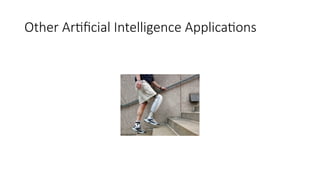
Some prosthetic limbs use AI to improve “virtual touch,” which improves sensation and mobility. The Power Knee, for example, receives information from a sensor on the shoe of the sound leg to accurately mimic movement.
#24 An expert system behaves similarly to a human expert in a particular field. Computerized expert systems have been developed to diagnose problems, predict future events, and solve energy problems. Like human experts, computerized expert systems use heuristics, or rules of thumb, to arrive at conclusions or make suggestions. The research conducted in AI during the past two decades is resulting in expert systems that explore new business possibilities, increase overall profitability, reduce costs, and provide superior service to customers and clients. The U.S. Army uses the Knowledge and Information Fusion Exchange (KnIFE) expert system to help soldiers in the field make better military decisions based on successful decisions made in previous military engagements.
Expert systems are used in metal fabrication plants to aid in decision making
#25 Sophisticated expert systems can be difficult, expensive, and time consuming to develop. The following is a list of factors that normally make expert systems worth the expenditure of time and money.
People and organizations should develop an expert system if it can do any of the following:
• Provide a high potential payoff or significantly reduce downside risk
• Capture and preserve irreplaceable human expertise
• Solve a problem that is not easily solved using traditional programming techniques
• Develop a system more consistent than human experts
• Provide expertise needed to selected locations at the same time or in a hostile environment dangerous to human health
• Provide expertise that is expensive or rare
• Develop a solution faster than human experts can
• Provide expertise needed for training and development to share the wisdom and experience of experts with others
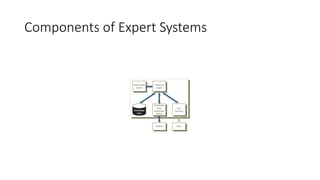
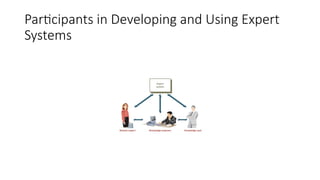
#26 An expert system consists of a collection of integrated and related components, including a knowledge base, an inference engine, an explanation facility, a knowledge base acquisition facility, and a user interface. Note that different knowledge flows can exist, depending on what the expert system is doing, and the specific expert system involved.
The user interacts with the interface, which interacts with the inference engine. The inference engine interacts with the other expert system components. These components must work together to provide expertise. This shows the inference engine coordinating the flow of knowledge to other components of the expert system.
Knowledge Base
Inference Engine
Explanation Facility
Knowledge Acquisition Facility
User Interface
Domain Expert
Knowledge Engineer and Knowledge Users
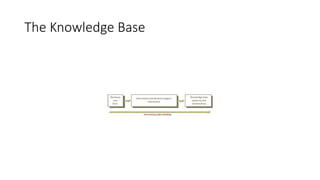
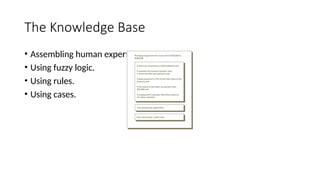
#27 The knowledge base stores all relevant information, data, rules, cases, and relationships that the expert system uses. A knowledge base is a natural extension of a database and an information and decision support system. A knowledge base must be developed for each unique application. For example, a medical expert system contains facts about diseases and symptoms. The following are some tools and techniques that can be used to create a knowledge base.
Figure 16. The Relationships Among Data, Information, and Knowledge
#28 • Assembling human experts. One challenge in developing a knowledge base is to assemble the knowledge of multiple human experts. Typically, the objective in building a knowledge base is to integrate the knowledge of people with similar expertise (for example, many doctors might contribute to a medical diagnostics knowledge base).
• Using fuzzy logic. Another challenge for designers and developers of expert systems is capturing knowledge and relationships that are not precise or exact. Instead of the black-and-white, yes/no, or true/false conditions of typical computer decisions, fuzzy logic allows shades of gray, or what is known as “fuzzy sets.” Fuzzy logic rules help computers evaluate the imperfect or imprecise conditions they encounter and make educated guesses based on the probability of correctness of the decision.
• Using rules. A rule is a conditional statement that links conditions to actions or outcomes. In many instances, these rules are stored as IF-THEN statements, such as “If a certain set of network conditions exists, then a certain network problem diagnosis is appropriate.” In an expert system for a weather forecasting operation, for example, the rules could state that, if certain temperature patterns exist with a given barometric pressure and certain previous weather patterns over the last 24 hours, then a specific forecast will be made, including temperatures, cloud coverage, and wind-chill factor. In general, as the number of rules that an expert system knows increases, the precision of the expert system also increases.
• Using cases. An expert system can use cases in developing a solution to a current problem or situation. This process involves (1) finding cases stored in the knowledge base that are similar to the problem or situation at hand and (2) modifying the solutions to the cases to fit or accommodate the current problem or situation. For example, a company might use an expert system to determine the best location for a new service facility in the state of New Mexico. The expert system might identify two previous cases involving the location of a service facility where labor and transportation costs were also important—one in the state of Colorado and the other in the state of Nevada. The expert system can modify the solution to these two cases to determine the best location for a new facility in New Mexico.
#29 The overall purpose of an inference engine is to seek information and relationships from the knowledge base and to provide answers, predictions, and suggestions similar to the way a human expert would. In other words, the inference engine is the component that delivers the expert advice. To provide answers and give advice, expert systems can use backward and forward chaining. Backward chaining is the process of starting with conclusions and working backward to the supporting facts. If the facts do not support the conclusion, another conclusion is selected and tested. This process is continued until the correct conclusion is identified. Forward chaining starts with the facts and works forward to the conclusions.
Consider the expert system that forecasts future sales for a product. Forward chaining starts with a fact such as “The demand for the product last month was 20,000 units.” With the forward-chaining approach, the expert system searches for rules that contain a reference to product demand. For example, “IF product demand is over 15,000 units, THEN check the demand for competing products.” As a result of this process, the expert system might use information on the demand for competitive products. Next, after searching additional rules, the expert system might use information on personal income or national inflation rates. This process continues until the expert system can reach a conclusion using the data supplied by the user and the rules that apply in the knowledge base.
#30 An important part of an expert system is the explanation facility, which allows a user or decision maker to understand how the expert system arrived at certain conclusions or results. A medical expert system, for example, might reach the conclusion that a patient has a defective heart valve given certain symptoms and the results of tests on the patient. The explanation facility allows a doctor to find out the logic or rationale of the diagnosis made by the expert system. The expert system, using the explanation facility, can indicate all the facts and rules that were used in reaching the conclusion. This facility allows doctors to determine whether the expert system is processing the data and information correctly and logically.
#31 A difficult task in developing an expert system is the process of creating and updating the knowledge base. In the past, when more traditional programming languages were used, developing a knowledge base was tedious and time consuming. Each fact, relationship, and rule had to be programmed into the knowledge base. In most cases, an experienced programmer had to create and update the knowledge base.
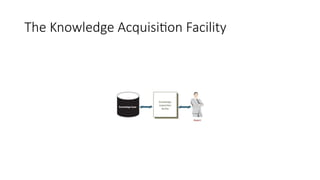
Today, specialized software allows users and decision makers to create and modify their own knowledge bases through the knowledge acquisition facility. The purpose of the knowledge acquisition facility is to provide a convenient and efficient means for capturing and storing all components of the knowledge base. Knowledge acquisition software can present users and decision makers with easy-to-use menus. After entering the appropriate attributes, the knowledge acquisition facility correctly stores information and relationships in the knowledge base, making the knowledge base easier and less expensive to set up and maintain. Knowledge acquisition can be a manual process or a mixture of manual and automated procedures. Regardless of how the knowledge is acquired, the knowledge base must be validated and updated frequently to make sure that it is still accurate.
The knowledge acquisition facility acts as an interface between experts and the knowledge base.
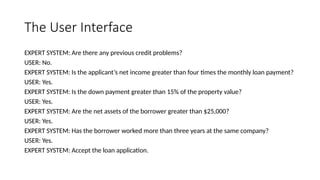
#32 Specialized user interface software is employed for designing, creating, updating, and using expert systems. The main purpose of the user interface is to make an expert system easier for users and decision makers to develop and use. At one time, skilled computer personnel created and operated most expert systems; today, the user interface permits decision makers to develop and use their own expert systems. Because expert systems place more emphasis on directing user activities than do other types of systems, text-oriented user interfaces (using menus, forms, and scripts) might be more common in expert systems than the graphical interfaces often used with DSSs.
#33 The Domain Expert
Because of the time and effort involved in the task, an expert system is developed to address only a specific area of knowledge. This area of knowledge is called the domain. The domain expert is the person or group with the expertise or knowledge the expert system is trying to capture. In most cases, the domain expert is a group of human experts. The domain expert (individual or group) usually can do the following:
• Recognize the real problem
• Develop a general framework for problem solving
• Formulate theories about the situation
• Develop and use general rules to solve a problem
• Know when to break the rules or general principles
• Solve problems quickly and efficiently
• Learn from experience
• Know what is and is not important in solving a problem
• Explain the situation and solutions of problems to others
The Knowledge Engineer and Knowledge Users
A knowledge engineer is a person who has training or experience in the design, development, implementation, and maintenance of an expert system, including training or experience with expert system shells. The knowledge user is the person or group who uses and benefits from the expert system. Knowledge users do not need any previous training in computers or expert systems.
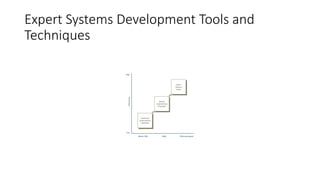
#34 Theoretically, expert systems can be developed from any programming language. Since the introduction of computer systems, programming languages have become easier to use, more powerful, and increasingly able to handle specialized requirements. In the early days of expert systems development, traditional high-level languages, including Pascal, FORTRAN, and COBOL, were used. LISP was one of the first special languages developed and used for artificial intelligence applications. PROLOG was also developed for AI applications. Since the 1990s, however, other expert system products (such as shells) have become available that remove the burden of programming, allowing nonprogrammers to develop and benefit from the use of expert systems.
Software for expert systems development has evolved greatly since 1980, from traditional programming languages to expert system shells.
#35 An expert system shell is a collection of software packages and tools used to design, develop, implement, and maintain expert systems. Expert system shells are available for both personal computers and mainframe systems. In addition, off-the-shelf expert system shells are complete and ready to run. The user enters the appropriate data or parameters, and the expert system provides output to the problem or situation.
#36 Expert systems and artificial intelligence have wide applications in business and government. A few additional applications of expert systems that are being used today or have been used in the past are summarized next.
• Credit granting and loan analysis. KPMG Peat Marwick uses an expert system called Loan Probe to review its reserves to determine whether sufficient funds have been set aside to cover the risk of some uncollectible loans.
• Catching cheats and terrorists. Some gambling casinos use expert system software to catch gambling cheats.
• Plant layout and manufacturing. FLEXPERT was an expert system that uses fuzzy logic to perform plant layout. The software helped companies determine the best placement for equipment and manufacturing facilities.
• Hospitals and medical facilities. Hospitals, pharmacies, and other healthcare providers can use Alineo by MEDecision to determine possible high-risk or high-cost patients. MYCIN is an expert system developed at Stanford University to analyze blood infections. UpToDate is another expert system used to diagnose patients. To help doctors in the diagnosis of thoracic pain, MatheMEDics has developed THORASK, a straightforward, easy-to-use program, requiring only the input of carefully obtained clinical information. The program helps the less experienced to distinguish the three principal categories of chest pain from each other.
• Employee performance evaluation. An expert system developed by Austin-Hayne, called Employee Appraiser, provides managers with expert advice for use in employee performance reviews and career development.
• Repair and maintenance. ACE is an expert system used by AT&T to analyze the maintenance of telephone networks. IET-Intelligent Electronics uses an expert system to diagnose maintenance problems related to aerospace equipment. General Electric Aircraft Engine Group uses an expert system to enhance maintenance performance levels at all sites and improve diagnostic accuracy.
• Shipping. CARGEX cargo expert system is used by Lufthansa, a German airline, to help determine the best shipping routes.
• Marketing. CoverStory is an expert system that extracts marketing information from a database and automatically writes marketing reports.
#37 The term virtual reality was initially coined by Jaron Lanier, founder of VPL Research, in 1989. Originally, the term referred to immersive virtual reality in which the user becomes fully immersed in an artificial, three-dimensional world that is completely generated by a computer. Immersive virtual reality can represent any three-dimensional setting, real or abstract, such as a building, an archaeological excavation site, the human anatomy, a sculpture, or a crime scene reconstruction. Through immersion, the user can gain a deeper understanding of the virtual world’s behavior and functionality.
A virtual reality system enables one or more users to move and react in a computer-simulated environment. Virtual reality simulations require special interface devices that transmit the sights, sounds, and sensations of the simulated world to the user. These devices can also record and send the speech and movements of the participants to the simulation program, enabling users to sense and manipulate virtual objects much as they would real objects. This natural style of interaction gives the participants the feeling that they are immersed in the simulated world. For example, an auto manufacturer can use virtual reality to help it simulate and design factories.
#38 To see in a virtual world, often the user wears a head-mounted display (HMD) with screens directed at each eye. The HMD also contains a position tracker to monitor the location of the user’s head and the direction in which the user is looking. Using this information, a computer generates images of the virtual world—a slightly different view for each eye—to match the direction that the user is looking and displays these images on the HMD. Many companies sell or rent virtual-reality interface devices, including Virtual Realities (www.vrealities.com), Amusitronix (www.amusitronix.com), I-O Display Systems (www.i-glassesstore.com), and others.
The PowerWall is a virtual reality system that displays large models in accurate dimensions.
#39 The Electronic Visualization Laboratory at the University of Illinois at Chicago introduced a room constructed of large screens on three walls and the floor on which the graphics are projected. The CAVE, as this room is called, provides the illusion of immersion by projecting stereo images on the walls and floor of a room-sized cube (http://cave.ncsa.uiuc.edu). Several persons wearing lightweight stereo glasses can enter and walk freely inside the CAVE. A head-tracking system continuously adjusts the stereo projection to the current position of the leading viewer.
Users hear sounds in the virtual world through earphones. Information reported by position trackers are also used to update audio signals. When a sound source in virtual space is not directly in front of or behind users, the computer transmits sounds to arrive at one ear earlier or later than at the other, and be louder or softer and different in pitch.
The haptic interface, which relays the sense of touch and other physical sensations in the virtual world, is the least developed and perhaps the most challenging to create. With the use of a glove and position tracker, the computer locates the user’s hand and measures finger movements. The user can reach into the virtual world and handle objects; however, it is difficult to generate the sensations of a person tapping a hard surface, picking up an object, or running a finger across a textured surface. Touch sensations also must be synchronized with sights and sounds users experience.
#40 Aside from immersive virtual reality, which we just discussed, virtual reality can also refer to applications that are not fully immersive, such as mouse-controlled navigation through a three-dimensional environment on a graphics monitor, stereo viewing from the monitor via stereo glasses, stereo projection systems, and others.
Some virtual reality applications allow views of real environments with superimposed virtual objects. Motion trackers monitor the movements of dancers or athletes for subsequent studies in immersive virtual reality. Telepresence systems (such as telemedicine and telerobotics) immerse a viewer in a real world that is captured by video cameras at a distant location and allow for the remote manipulation of real objects via robot arms and manipulators. Many believe that virtual reality will reshape the interface between people and information technology by offering new ways to communicate information, visualize processes, and express ideas creatively.
#41 You can find thousands of applications of virtual reality, with more being developed as the cost of hardware and software declines and people’s imaginations are opened to the potential of virtual reality. The following are a few virtual reality applications in medicine, education and training, business, and entertainment.
#42 Trauma and Recovery Program at Emory University School of Medicine uses an immersive virtual reality system to help in the treatment of anxiety disorders. One VR program, called SnowWorld, helps treat burn patients. Using VR, the patients can navigate through icy terrain and frigid waterfalls. VR helps because it gets a patient’s mind off the pain.
Virtual reality technology can also link stroke patients to their physical therapists. Patients put on special gloves and other virtual reality devices at home that are linked to the physical therapist’s office. The physical therapist can then see whether the patient is performing the correct exercises without having to travel to the patient’s home or hospital room. In this way, using virtual reality can cut travel time and costs.
#43 Virtual environments are used in education to bring exciting new resources into the classroom. Students can stroll among digital bookshelves, develop communication skills in front of a virtual audience, learn anatomy on a simulated cadaver, or participate in historical events—all virtually. Virtual reality, for example, has been used to help those with disabilities. The Archaeology Technologies Laboratory at North Dakota State University has developed a three-dimensional virtual reality system that displays an eighteenth-century American Indian village. Third-grade students at John Cotton Tayloe School in Washington, North Carolina, can take a virtual trip down the Nile for a cross-disciplinary lesson on ancient Egypt. This interactive virtual reality computer lesson integrates social studies, geography, music, art, science, math, and language arts.
Virtual technology has also been applied by the military. To help with aircraft maintenance, a virtual reality system has been developed to simulate an aircraft and give a user a sense of touch, while computer graphics provide a sense of sight and sound. The user sees, touches, and manipulates the various parts of the virtual aircraft during training. The Virtual Aircraft Maintenance System simulates real-world maintenance tasks that are routinely performed on the AV-8B vertical takeoff and landing aircraft used by the U.S. Marines. Also, the Pentagon is using a virtual reality training lab to prepare for a military crisis. The virtual reality system simulates various war scenarios.
Some virtual reality systems help train people to overcome their fear of public speaking.
#44 Virtual reality has been used in all areas of business. Kimberly-Clark Corporation, for example, has developed a virtual reality system to view store aisles carrying its products. This allows executives to see how Kimberly-Clark products look in stores aside competing products. The virtual reality view of store aisles should help executives monitor customer behavior and determine the best packaging and placement of their products on store aisles. Boeing uses virtual reality to help it design and manufacture airplane parts and new planes, including the 787 Dreamliner. Boeing uses 3D PLM from Dassault Systems. Clothing and fashion companies, such as Neiman Marcus and Saks Fifth Avenue, are using virtual reality on the Internet to display and promote new products and fashions. In another Web application, virtual reality was used to design a $90 million addition to the Denver Art Museum. The software can also show the picture, length, and diameter of the 50,000 bolts that are being used. Palomar Pomerado Health used Second Life to create a virtual hospital when it started construction of a real $700 million hospital in California in 2007. The purpose of the Second Life virtual hospital was to show clients and staff the layout and capabilities of the new hospital. Second Life has also been used in business and recruiting.
Boeing uses virtual reality to collaborate with customers during aircraft design.
#45 Computer-generated image technology, or CGI, has been around since the 1970s. Many movies use this technology to bring realism to the silver screen, including Finding Nemo, Spider-Man II, and Star Wars Episode II—Attack of the Clones. A team of artists rendered the roiling seas and crashing waves of Perfect Storm almost entirely on computers using weather reports, scientific formulas, and their imagination. Other films include Dinosaur with its realistic talking reptiles, Titan A.E.’s beautiful 3-D space-scapes, and the casts of computer-generated crowds and battles in Gladiator and The Patriot. CGI can also be used for sports simulation to enhance the viewers’ knowledge and enjoyment of a game. SimCity (http://simcity.ea.com/), a virtual reality game, allows people to experiment with decisions related to urban planning. Natural and man-made disasters test decisions on designing buildings and the surrounding area. Other games can display a 3-D view of the world and allow people to interact with simulated people or avatars in the game. Second Life (www.secondlife.com) allows people to play games, interact with avatars, and build structures, such as homes.
#46 In addition to artificial intelligence, expert systems, and virtual reality, other interesting specialized systems have appeared. Segway, for example, is an electric scooter that uses sophisticated software, sensors, and gyro motors to transport people through warehouses, offices, downtown sidewalks, and other spaces (www.segway.com). Originally designed to transport people around a factory or around town, more recent versions are being tested by the military for gathering intelligence and transporting wounded soldiers to safety. The military and DARPA are developing energy-efficient, mechanical computers that have the ability to operate in environments that are too harsh for traditional chip-based computers. A Japanese company is experimenting with using specially designed floor mats that contain wires and other electronic components to generate electricity when people step on them. The 3VR Security (www.3vr.com) system makes a video face-recognition system to identify people from pictures or images. According to a security officer for the Bank of Hawaii, “It seemed too good to be true, but since being installed at bank branches in December, it has reduced our surveillance time, and it’s especially useful in tracking multiple transactions by an ID thief.”
A number of special-purpose systems are now available in vehicles. Ford Motor Company and Microsoft have developed a voice-activated system called Sync that can play music, make phones calls, and more. The Advanced Warning System by Mobileye warns drivers to keep a safe distance from other vehicles and drivers. Automotive software allows cars and trucks to connect to the Internet. The software can track a driver’s speed and location, allow gas stations to remotely charge for fuel and related services, and more.
Many new computing devices, such as Microsoft’s Surface, are also becoming available. The Surface is a touch-screen computer that uses a glass-top display. It looks like a coffee table or dining room table with a built-in computer. Microsoft’s Smart Personal Objects Technology (SPOT) allows small devices to transmit data and messages over the air. SPOT is being used in wrist watches to transmit data and messages over FM radio broadcast bands. The new technology, however, requires a subscription to the Microsoft MSN Direct information service. Some manufacturing is also being done with inkjet printers to allow them to “print” 3-D parts. For example, the printer sprays layers of polymers onto circuit boards to form transistors and other electronic components. Some new computers can even be worn on your body.
#47 Increasingly, companies are using special-purpose tracking devices, chips, and bar codes. Radio Frequency Identification (RFID) tags that contain small chips with information about products or packages can be quickly scanned to perform inventory control or trace a package as it moves from a supplier to a company to its customers. Many companies have used RFID tags to reduce costs, improve customer service, and achieve a competitive advantage. When attached to clothing and worn close to a mirror, some RFID tags will display sizes, styles, color, suggested accessories, and images of models wearing the clothing on the mirror or a display screen. RFID tags are even used to help track lost airline luggage. The state of Colorado uses RFID to track elk herds. Farmers are looking into using these tags to track cattle to help identify and control mad cow disease. An Italian cheese consortium uses RFID tags in the crust of cheese wheels. The RFID tags contain information about when and where the cheese was made to ensure freshness and avoid spoilage. Two German students have developed a smart beer mat, which uses sensor chips to help determine the weight or amount of beer in a glass or beer mug. When the chips sense that the beer mug is nearly empty, the sensor chip sends an alert to a computer monitor telling the bartender that a customer needs more beer. The endorsement of an electronic product code standard will likely make RFID even more popular.
Special-purpose bar codes are also being introduced in a variety of settings. For example, to manage office space efficiently, a company gives each employee and office a bar code. Instead of having permanent offices, the employees are assigned offices and supplies as needed, and the bar codes help to make sure that an employee’s work, mail, and other materials are routed to the right place. Companies can save millions of dollars by reducing office space and supplies. Another technology is being used to create “smart containers” for ships, railroads, and trucks. NaviTag (http://navitag.com/) and other companies are developing communications systems that allow containers to broadcast the contents, location, and condition of shipments to shipping and cargo managers. A railroad company can use standard radio messages to generate shipment and tracking data for customers and managers.
Navitag, an electronic security device, is attached to a cargo container door and monitors whether the door opens and whether light, radiation, or carbon monoxide enters the container.
#48 One special application of computer technology is derived from a branch of mathematics called game theory. Game theory involves the use of information systems to develop competitive strategies for people, organizations, or even countries. Two competing businesses in the same market can use game theory to determine the best strategy to achieve their goals. The military could also use game theory to determine the best military strategy to win a conflict against another country, and individual investors could use game theory to determine the best strategies when competing against other investors in a government auction of bonds. Game theory has also been used to develop approaches to deal with terrorism. The Los Angeles airport is experimenting with the use of game theory to help security guards do a better job patrolling sensitive areas.
Informatics, another specialized system, combines traditional disciplines, such as science and medicine, with information systems and technology. Bioinformatics, for example, combines biology and computer science. Also called computational biology, bioinformatics has been used to help map the human genome and conduct research on biological organisms. Using sophisticated databases and artificial intelligence, bioinformatics helps unlock the secrets of the human genome, which could eventually prevent diseases and save lives. Stanford University has a course on bioinformatics and offers a bioinformatics certification. Medical informatics combines traditional medical research with computer science. Journals, such as Healthcare Informatics, report current research on applying computer systems and technology to reduce medical errors and improve healthcare. The University of Edinburgh in the UK even has a School of Informatics. The school has courses on the structure, behavior, and interactions of natural and artificial computational systems. The program combines artificial intelligence, computer science, engineering, and science.