LAS AGUAS SUBTERRANEASLAS AGUAS SUBTERRANEAS
pasos hacia unapasos hacia una
gestigestióón adaptiva y sosteniblen adaptiva y sostenible
Prof Dr Stephen FosterProf Dr Stephen Foster
Global Water Partnership–Senior AdviserGlobal Water Partnership–Senior Adviser
IAH–Past President 2004-08IAH–Past President 2004-08
GLOBAL WATER
PARTNERSHIP
Global Water
Partnership
GW•MATE Activities in World Bank Projects : 2001-
11Morocco (Min/BO) Argentina (SG)
Brasil (ANA/SG) Thailand
(DGR/LO)
China (MWR/CWRB) India (MWR/SG)
Mexico (CNA/SG) Peru (ANA/RO)
Tanzania (MWR/BO) Ethiopia
(MWR/RO)
‘groundwater only’ areas
conjunctive use areas
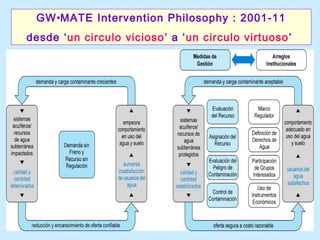
GW•MATE Intervention Philosophy : 2001-11
desde ‘un circulo vicioso’ a ‘un circulo virtuoso’
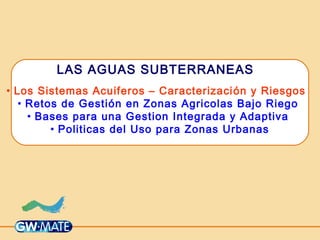
LAS AGUAS SUBTERRANEAS
• Los Sistemas Acuiferos – Caracterización y Riesgos
• Retos de Gestión en Zonas Agricolas Bajo Riego
• Bases para una Gestion Integrada y Adaptiva
• Politicas del Uso para Zonas Urbanas
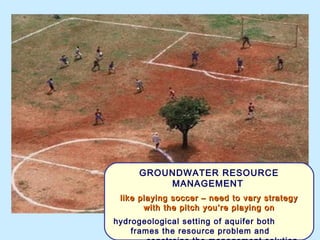
GROUNDWATER RESOURCE
MANAGEMENT
like playing soccer – need to vary strategylike playing soccer – need to vary strategy
with the pitch you’re playing onwith the pitch you’re playing on
hydrogeological setting of aquifer both
frames the resource problem and
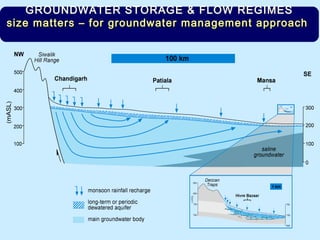
GROUNDWATER STORAGE & FLOW REGIMES
size matters – for groundwater management approachsize matters – for groundwater management approach
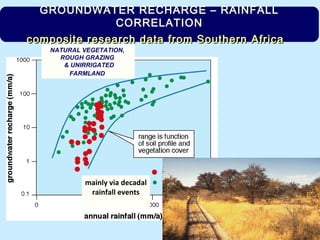
mainly via decadal
rainfall events
GROUNDWATER RECHARGE – RAINFALL
CORRELATION
composite research data from Southern Africacomposite research data from Southern Africa
NATURAL VEGETATION,
ROUGH GRAZING
& UNIRRIGATED
FARMLAND
GROUNDWATER RESOURCES & IRRIGATED AGRICULTUREGROUNDWATER RESOURCES & IRRIGATED AGRICULTURE
recharge quality & rate greatly influenced by water management
quality cannotquality cannot
be divorced frombe divorced from
quantityquantity
permeable soil profiles
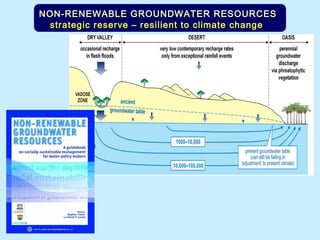
NON-RENEWABLE GROUNDWATER RESOURCESNON-RENEWABLE GROUNDWATER RESOURCES
strategic reserve – resilient to climate changestrategic reserve – resilient to climate change
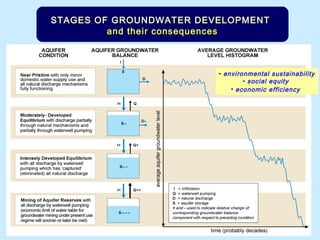
STAGES OF GROUNDWATER DEVELOPMENTSTAGES OF GROUNDWATER DEVELOPMENT
and their consequencesand their consequences
• environmental sustainability
• social equity
• economic efficiency
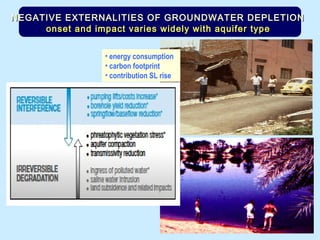
NEGATIVE EXTERNALITIES OF GROUNDWATER DEPLETIONNEGATIVE EXTERNALITIES OF GROUNDWATER DEPLETION
onset and impact varies widely with aquifer typeonset and impact varies widely with aquifer type
• energy consumption
• carbon footprint
• contribution SL rise
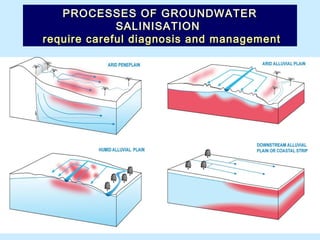
PROCESSES OF GROUNDWATERPROCESSES OF GROUNDWATER
SALINISATIONSALINISATION
require careful diagnosis and managementrequire careful diagnosis and management
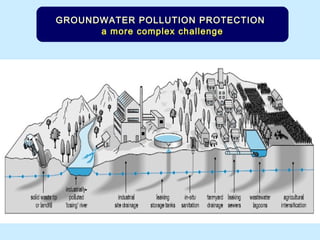
GROUNDWATER POLLUTION PROTECTIONGROUNDWATER POLLUTION PROTECTION
a more complex challengea more complex challenge
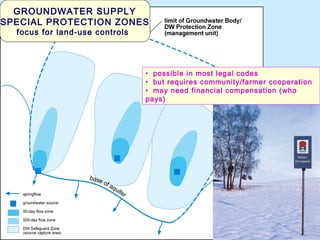
GROUNDWATER SUPPLY
SPECIAL PROTECTION ZONES
focus for land-use controls
• possible in most legal codes
• but requires community/farmer cooperation
• may need financial compensation (who
pays)
LAS AGUAS SUBTERRANEAS
• Los Sistemas Acuiferos – Caracterización y Riesgos
• Retos de Gestión en Zonas Agricolas Bajo Riego
• Bases para una Gestion Integrada y Adaptiva
• Politicas del Uso para Zonas Urbanas
Poços
Sumidouros
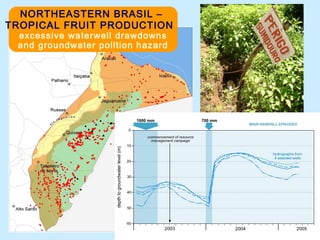
NORTHEASTERN BRASIL –
TROPICAL FRUIT PRODUCTION
excessive waterwell drawdowns
and groundwater polltion hazard
rh5
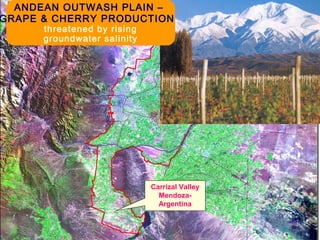
Carrizal Valley
Mendoza-
Argentina
ANDEAN OUTWASH PLAIN –
GRAPE & CHERRY PRODUCTION
threatened by rising
groundwater salinity
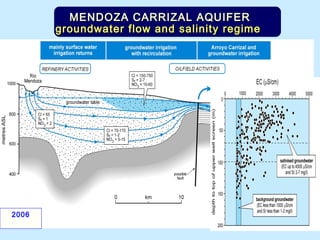
MENDOZA CARRIZAL AQUIFERMENDOZA CARRIZAL AQUIFER
groundwater flow and salinity regimegroundwater flow and salinity regime
2006
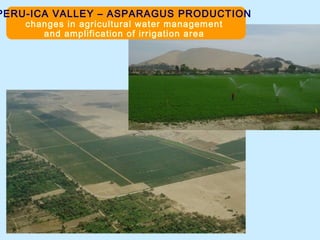
PERU-ICA VALLEY – ASPARAGUS PRODUCTION
changes in agricultural water management
and amplification of irrigation area
LAS AGUAS SUBTERRANEAS
• Los Sistemas Acuiferos – Caracterización y Riesgos
• Retos de Gestión en Zonas Agricolas Bajo Riego
• Bases para una Gestion Integrada y Adaptiva
• Politicas del Uso para Zonas Urbanas
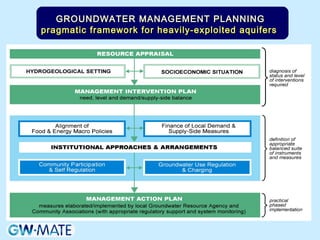
GROUNDWATER MANAGEMENT PLANNINGGROUNDWATER MANAGEMENT PLANNING
pragmatic framework for heavily-exploited aquiferspragmatic framework for heavily-exploited aquifers
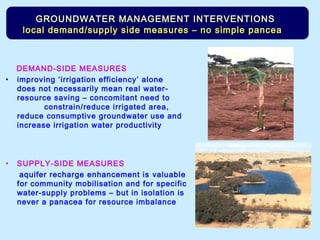
DEMAND-SIDE MEASURES
• improving ‘irrigation efficiency’ alone
does not necessarily mean real water-
resource saving – concomitant need to
constrain/reduce irrigated area,
reduce consumptive groundwater use and
increase irrigation water productivity
• SUPPLY-SIDE MEASURES
aquifer recharge enhancement is valuable
for community mobilisation and for specific
water-supply problems – but in isolation is
never a panacea for resource imbalance
GROUNDWATER MANAGEMENT INTERVENTIONSGROUNDWATER MANAGEMENT INTERVENTIONS
local demand/supply side measures – no simple pancealocal demand/supply side measures – no simple pancea
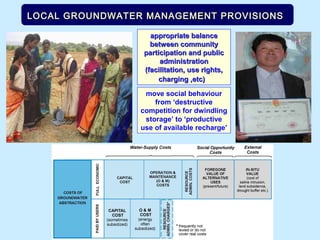
LOCAL GROUNDWATER MANAGEMENT PROVISIONSLOCAL GROUNDWATER MANAGEMENT PROVISIONS
appropriate balanceappropriate balance
between communitybetween community
participation and publicparticipation and public
administrationadministration
(facilitation, use rights,(facilitation, use rights,
charging ,etc)charging ,etc)
move social behaviour
from ‘destructive
competition for dwindling
storage’ to ‘productive
use of available recharge’
CONJUNCTIVE USE IN IRRIGATED AGRICULTURECONJUNCTIVE USE IN IRRIGATED AGRICULTURE
evolution from spontaneous to plannedevolution from spontaneous to planned
developmentdevelopment
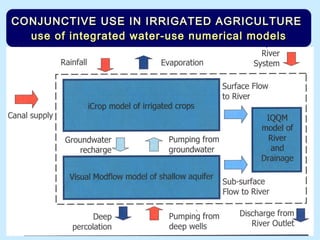
CONJUNCTIVE USE IN IRRIGATED AGRICULTURECONJUNCTIVE USE IN IRRIGATED AGRICULTURE
use of integrated water-use numerical modelsuse of integrated water-use numerical models
• uncertain water-futures due to effects of land-use
and
climate change, and varying economic drivers
• groundwater use rights should be subject to periodic
review – with ‘restriction zones’ established as
needed
• user participation essential – with full information
dissemination/transparency to counteract corruption
• much improved measurement/monitoring required to
refine resource evaluation and provide evidence for
management decision-making
• finance of agreed programme of management
measures (demand management, supply
augmentation
and crop changes as appropriate)
GROUNDWATER RESOURCESGROUNDWATER RESOURCES
key instruments and tools for adaptive managementkey instruments and tools for adaptive management
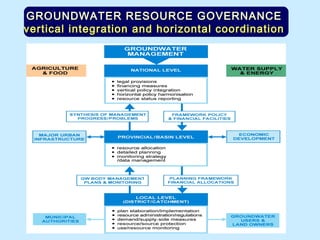
GROUNDWATER RESOURCE GOVERNANCEGROUNDWATER RESOURCE GOVERNANCE
vertical integration and horizontal coordinationvertical integration and horizontal coordination
LAS AGUAS SUBTERRANEAS
• Los Sistemas Acuiferos – Caracterización y Riesgos
• Retos de Gestión en Zonas Agricolas Bajo Riego
• Bases para una Gestion Integrada y Adaptiva
• Politicas del Uso para Zonas Urbanas
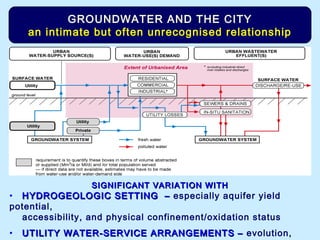
GROUNDWATER AND THE CITY
an intimate but often unrecognised relationship
SIGNIFICANT VARIATION WITHSIGNIFICANT VARIATION WITH
• HYDROGEOLOGIC SETTING –HYDROGEOLOGIC SETTING – especially aquifer yield
potential,
accessibility, and physical confinement/oxidation status
• UTILITY WATER-SERVICE ARRANGEMENTS –UTILITY WATER-SERVICE ARRANGEMENTS – evolution,
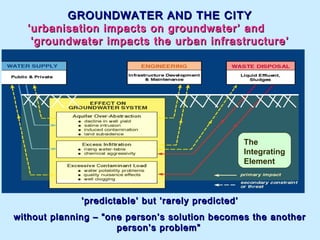
GROUNDWATER AND THE CITYGROUNDWATER AND THE CITY
‘‘urbanisation impacts on groundwater’ andurbanisation impacts on groundwater’ and
‘groundwater impacts the urban infrastructure’‘groundwater impacts the urban infrastructure’
‘‘predictable’ but ‘rarely predicted’predictable’ but ‘rarely predicted’
without planning – “one person’s solution becomes the anotherwithout planning – “one person’s solution becomes the another
person’s problem”person’s problem”
The
Integrating
Element
• groundwater use much more significant in overall
water-supply than generally appreciated, and it forms
‘invisible link’ between various facets of infrastructure
• much water use/effluent disposal is unregulated or
‘illegal’ – thus little discussed by infrastructure sector
• urban groundwater affects ‘everybody’ but often
responsibility of no ‘body’ – institutional vacuum
• broad stakeholder involvement needed through
‘standing review panel’ or ‘stakeholder consortium’
- but who should take management lead ?
(municipal authority, water resource regulatory agency,
public health ministry, water utility, chamber of commerce, etc)
URBAN GROUNDWATER MANAGEMENT
filling the ‘institutional vacuum’
LAS AGUAS SUBTERRANEASLAS AGUAS SUBTERRANEAS
pasos hacia unapasos hacia una
gestigestióón adaptiva y sosteniblen adaptiva y sostenible
GLOBAL WATER
PARTNERSHIP
Global Water
Partnership
www.worldbank.org/gwmatewww.worldbank.org/gwmate
www.gwpforum.orgwww.gwpforum.org

Presentation Stephen Foster, GWP Senior Adviser

  • 1.
    LAS AGUAS SUBTERRANEASLASAGUAS SUBTERRANEAS pasos hacia unapasos hacia una gestigestióón adaptiva y sosteniblen adaptiva y sostenible Prof Dr Stephen FosterProf Dr Stephen Foster Global Water Partnership–Senior AdviserGlobal Water Partnership–Senior Adviser IAH–Past President 2004-08IAH–Past President 2004-08 GLOBAL WATER PARTNERSHIP Global Water Partnership
  • 2.
    GW•MATE Activities inWorld Bank Projects : 2001- 11Morocco (Min/BO) Argentina (SG) Brasil (ANA/SG) Thailand (DGR/LO) China (MWR/CWRB) India (MWR/SG) Mexico (CNA/SG) Peru (ANA/RO) Tanzania (MWR/BO) Ethiopia (MWR/RO) ‘groundwater only’ areas conjunctive use areas
  • 3.
    GW•MATE Intervention Philosophy: 2001-11 desde ‘un circulo vicioso’ a ‘un circulo virtuoso’
  • 4.
    LAS AGUAS SUBTERRANEAS •Los Sistemas Acuiferos – Caracterización y Riesgos • Retos de Gestión en Zonas Agricolas Bajo Riego • Bases para una Gestion Integrada y Adaptiva • Politicas del Uso para Zonas Urbanas
  • 5.
    GROUNDWATER RESOURCE MANAGEMENT like playingsoccer – need to vary strategylike playing soccer – need to vary strategy with the pitch you’re playing onwith the pitch you’re playing on hydrogeological setting of aquifer both frames the resource problem and
  • 6.
    GROUNDWATER STORAGE &FLOW REGIMES size matters – for groundwater management approachsize matters – for groundwater management approach
  • 7.
    mainly via decadal rainfallevents GROUNDWATER RECHARGE – RAINFALL CORRELATION composite research data from Southern Africacomposite research data from Southern Africa NATURAL VEGETATION, ROUGH GRAZING & UNIRRIGATED FARMLAND
  • 9.
    GROUNDWATER RESOURCES &IRRIGATED AGRICULTUREGROUNDWATER RESOURCES & IRRIGATED AGRICULTURE recharge quality & rate greatly influenced by water management quality cannotquality cannot be divorced frombe divorced from quantityquantity permeable soil profiles
  • 10.
    NON-RENEWABLE GROUNDWATER RESOURCESNON-RENEWABLEGROUNDWATER RESOURCES strategic reserve – resilient to climate changestrategic reserve – resilient to climate change
  • 11.
    STAGES OF GROUNDWATERDEVELOPMENTSTAGES OF GROUNDWATER DEVELOPMENT and their consequencesand their consequences • environmental sustainability • social equity • economic efficiency
  • 12.
    NEGATIVE EXTERNALITIES OFGROUNDWATER DEPLETIONNEGATIVE EXTERNALITIES OF GROUNDWATER DEPLETION onset and impact varies widely with aquifer typeonset and impact varies widely with aquifer type • energy consumption • carbon footprint • contribution SL rise
  • 13.
    PROCESSES OF GROUNDWATERPROCESSESOF GROUNDWATER SALINISATIONSALINISATION require careful diagnosis and managementrequire careful diagnosis and management
  • 14.
    GROUNDWATER POLLUTION PROTECTIONGROUNDWATERPOLLUTION PROTECTION a more complex challengea more complex challenge
  • 15.
    GROUNDWATER SUPPLY SPECIAL PROTECTIONZONES focus for land-use controls • possible in most legal codes • but requires community/farmer cooperation • may need financial compensation (who pays)
  • 16.
    LAS AGUAS SUBTERRANEAS •Los Sistemas Acuiferos – Caracterización y Riesgos • Retos de Gestión en Zonas Agricolas Bajo Riego • Bases para una Gestion Integrada y Adaptiva • Politicas del Uso para Zonas Urbanas
  • 17.
    Poços Sumidouros NORTHEASTERN BRASIL – TROPICALFRUIT PRODUCTION excessive waterwell drawdowns and groundwater polltion hazard
  • 18.
    rh5 Carrizal Valley Mendoza- Argentina ANDEAN OUTWASHPLAIN – GRAPE & CHERRY PRODUCTION threatened by rising groundwater salinity
  • 19.
    MENDOZA CARRIZAL AQUIFERMENDOZACARRIZAL AQUIFER groundwater flow and salinity regimegroundwater flow and salinity regime 2006
  • 20.
    PERU-ICA VALLEY –ASPARAGUS PRODUCTION changes in agricultural water management and amplification of irrigation area
  • 21.
    LAS AGUAS SUBTERRANEAS •Los Sistemas Acuiferos – Caracterización y Riesgos • Retos de Gestión en Zonas Agricolas Bajo Riego • Bases para una Gestion Integrada y Adaptiva • Politicas del Uso para Zonas Urbanas
  • 22.
    GROUNDWATER MANAGEMENT PLANNINGGROUNDWATERMANAGEMENT PLANNING pragmatic framework for heavily-exploited aquiferspragmatic framework for heavily-exploited aquifers
  • 23.
    DEMAND-SIDE MEASURES • improving‘irrigation efficiency’ alone does not necessarily mean real water- resource saving – concomitant need to constrain/reduce irrigated area, reduce consumptive groundwater use and increase irrigation water productivity • SUPPLY-SIDE MEASURES aquifer recharge enhancement is valuable for community mobilisation and for specific water-supply problems – but in isolation is never a panacea for resource imbalance GROUNDWATER MANAGEMENT INTERVENTIONSGROUNDWATER MANAGEMENT INTERVENTIONS local demand/supply side measures – no simple pancealocal demand/supply side measures – no simple pancea
  • 24.
    LOCAL GROUNDWATER MANAGEMENTPROVISIONSLOCAL GROUNDWATER MANAGEMENT PROVISIONS appropriate balanceappropriate balance between communitybetween community participation and publicparticipation and public administrationadministration (facilitation, use rights,(facilitation, use rights, charging ,etc)charging ,etc) move social behaviour from ‘destructive competition for dwindling storage’ to ‘productive use of available recharge’
  • 25.
    CONJUNCTIVE USE INIRRIGATED AGRICULTURECONJUNCTIVE USE IN IRRIGATED AGRICULTURE evolution from spontaneous to plannedevolution from spontaneous to planned developmentdevelopment
  • 26.
    CONJUNCTIVE USE INIRRIGATED AGRICULTURECONJUNCTIVE USE IN IRRIGATED AGRICULTURE use of integrated water-use numerical modelsuse of integrated water-use numerical models
  • 27.
    • uncertain water-futuresdue to effects of land-use and climate change, and varying economic drivers • groundwater use rights should be subject to periodic review – with ‘restriction zones’ established as needed • user participation essential – with full information dissemination/transparency to counteract corruption • much improved measurement/monitoring required to refine resource evaluation and provide evidence for management decision-making • finance of agreed programme of management measures (demand management, supply augmentation and crop changes as appropriate) GROUNDWATER RESOURCESGROUNDWATER RESOURCES key instruments and tools for adaptive managementkey instruments and tools for adaptive management
  • 28.
    GROUNDWATER RESOURCE GOVERNANCEGROUNDWATERRESOURCE GOVERNANCE vertical integration and horizontal coordinationvertical integration and horizontal coordination
  • 29.
    LAS AGUAS SUBTERRANEAS •Los Sistemas Acuiferos – Caracterización y Riesgos • Retos de Gestión en Zonas Agricolas Bajo Riego • Bases para una Gestion Integrada y Adaptiva • Politicas del Uso para Zonas Urbanas
  • 30.
    GROUNDWATER AND THECITY an intimate but often unrecognised relationship SIGNIFICANT VARIATION WITHSIGNIFICANT VARIATION WITH • HYDROGEOLOGIC SETTING –HYDROGEOLOGIC SETTING – especially aquifer yield potential, accessibility, and physical confinement/oxidation status • UTILITY WATER-SERVICE ARRANGEMENTS –UTILITY WATER-SERVICE ARRANGEMENTS – evolution,
  • 31.
    GROUNDWATER AND THECITYGROUNDWATER AND THE CITY ‘‘urbanisation impacts on groundwater’ andurbanisation impacts on groundwater’ and ‘groundwater impacts the urban infrastructure’‘groundwater impacts the urban infrastructure’ ‘‘predictable’ but ‘rarely predicted’predictable’ but ‘rarely predicted’ without planning – “one person’s solution becomes the anotherwithout planning – “one person’s solution becomes the another person’s problem”person’s problem” The Integrating Element
  • 32.
    • groundwater usemuch more significant in overall water-supply than generally appreciated, and it forms ‘invisible link’ between various facets of infrastructure • much water use/effluent disposal is unregulated or ‘illegal’ – thus little discussed by infrastructure sector • urban groundwater affects ‘everybody’ but often responsibility of no ‘body’ – institutional vacuum • broad stakeholder involvement needed through ‘standing review panel’ or ‘stakeholder consortium’ - but who should take management lead ? (municipal authority, water resource regulatory agency, public health ministry, water utility, chamber of commerce, etc) URBAN GROUNDWATER MANAGEMENT filling the ‘institutional vacuum’
  • 33.
    LAS AGUAS SUBTERRANEASLASAGUAS SUBTERRANEAS pasos hacia unapasos hacia una gestigestióón adaptiva y sosteniblen adaptiva y sostenible GLOBAL WATER PARTNERSHIP Global Water Partnership www.worldbank.org/gwmatewww.worldbank.org/gwmate www.gwpforum.orgwww.gwpforum.org

Editor's Notes

  • #15 = multiple sources, time gap, contaminant attenuation by subsoil profiles + underlying strata