The Balance Between
AI & People
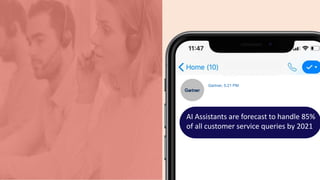
Gartner, 5:21 PM
AI Assistants are forecast to handle 85%
of all customer service queries by 2021
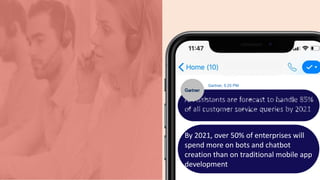
Gartner, 5:25 PM
By 2021, over 50% of enterprises will
spend more on bots and chatbot
creation than on traditional mobile app
development
Welcom Digital, 5:30 PM
75% of all customer credit interaction is
via self-service portals.
Steven Goodrich: Head of Technology, Nedbank Wealth
5:30 PM
The Electronic Virtual Assistant handles
80% of the inquiries at just 10% of the
cost of live agents.
Decision making and human
fallibility
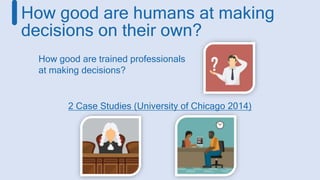
How good are humans at making
decisions on their own?
How good are trained professionals
at making decisions?
2 Case Studies (University of Chicago 2014)
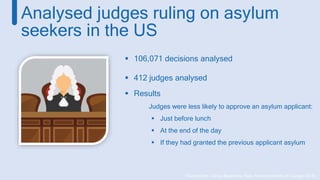
Analysed judges ruling on asylum
seekers in the US
 106,071 decisions analysed
 412 judges analysed
 Results
Judges were less likely to approve an asylum applicant:
 Just before lunch
 At the end of the day
 If they had granted the previous applicant asylum
*Daniel Chen, Tobias Moskowitz, Kelly Shue (University of Chicago 2014)
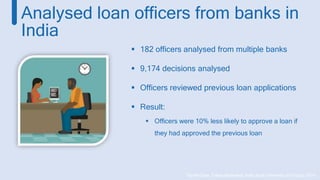
Analysed loan officers from banks in
India
 182 officers analysed from multiple banks
 9,174 decisions analysed
 Officers reviewed previous loan applications
 Result:
 Officers were 10% less likely to approve a loan if
they had approved the previous loan
4th Industrial Revolution
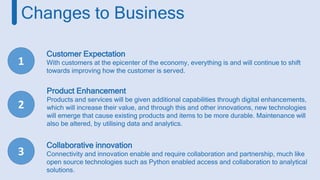
Changes to Business
Customer Expectation
With customers at the epicenter of the economy, everything is and will continue to shift
towards improving how the customer is served.
1
2
3
Product Enhancement
Products and services will be given additional capabilities through digital enhancements,
which will increase their value, and through this and other innovations, new technologies
will emerge that cause existing products and items to be more durable. Maintenance will
also be altered, by utilising data and analytics.
Collaborative innovation
Connectivity and innovation enable and require collaboration and partnership, much like
open source technologies such as Python enabled access and collaboration to analytical
solutions.
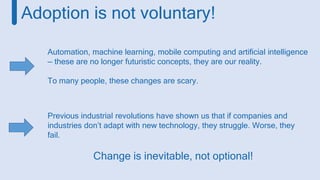
Previous industrial revolutions have shown us that if companies and
industries don’t adapt with new technology, they struggle. Worse, they
fail.
Change is inevitable, not optional!
Automation, machine learning, mobile computing and artificial intelligence
— these are no longer futuristic concepts, they are our reality.
To many people, these changes are scary.
Adoption is not voluntary!
The South African Climate
Bank union plans 'total shutdown of industry' over job losses – Times Live 6 August 2019
Hundreds of jobs at risk as Absa revamps retail bank: The shake-up comes as South African
lenders contend with slow economic growth and a consumer base battered by tax hikes and
rising fuel and utility expenses. A stubborn unemployment rate of about 27 percent and
declining business confidence is also curbing demand for loans, forcing banks to bring their
costs down. – Fin24 7 May 2019
Fear or Optimism?
"The state of retrenchments has everything to do with the fact that the economy is not
growing particularly well. That is probably even more an important factor than the 4th
Industrial revolution,“
"There is no question that the high level of industrial action in the South African economy
is promoting the use of technology as an alternative“ - Director and Chief Economist at
Econometrix, Dr Azar Jammine
Augmented Artificial
Intelligence
Humans and computers play differently, each has strengths and
weaknesses
Learnings from 22 years of AI
Deep Blue defeats Garry Kasparov in chess match.
On May 11, 1997, chess grandmaster Garry Kasparov resigns after 19 moves in a game
against Deep Blue, a chess-playing computer developed by scientists at IBM. This was
the sixth and final game of their match, during which Kasparov lost two games to one,
with three draws.
Computers prefer to retreat, but they can store massive amounts of data
and are unbiased in their decision-making
Humans can be more stubborn, but also can read their opponent’s
weaknesses, evaluate complex patterns, and make creative and
strategic decisions to win.
1
2
3
Learnings from 22 years of AI
The creators of artificial chess-
playing machines, Alex Bernstein,
an employee at IBM,
acknowledged that the best chess
player is actually a team of both
human and machine.
Theory
Utilising AI in an automated way, replacing humans, is
irresponsible and morally wrong
“Augmented intelligence (AI), also referred to as intelligence
augmentation (IA) and cognitive augmentation, is a complement—not a
replacement—to human intelligence. It’s about helping humans become
faster and smarter at the tasks they’re performing.”
“Augmented intelligence refers to the result of combining human and
machine intelligence…” - Ben Dickson (software engineer and the
founder of TechTalks)
Augmented Intelligence doesn’t oppose Artificial
Intelligence, it is a way of utilising AI in a responsible
way
Yale University’s Institute for Network Science, Hirokazu Shirado and Nicholas Christakis
Case Study
What would happen if we looked at artificial intelligence (AI) as a
companion instead of a replacement for people?
Experiment: online game that required groups of people to
coordinate their actions for a collective goal. The human players
also interacted with anonymous bots that were programmed with
three levels of behavioral randomness -- meaning the AI bots
sometimes deliberately made mistakes. In addition, sometimes the
bots were placed in different parts of the social network. More than
4,000 people participated in the experiment.
Case Study
Result: Not only did the inclusion of bots aid the overall
performance of human players, it proved particularly beneficial
when tasks became more difficult, the study found. The bots
accelerated the median time for groups to solve problems by
55.6%.
People whose performance improved when working with the
bots subsequently influenced other human players to raise their
game.
Yale University’s Institute for Network Science, Hirokazu Shirado and Nicholas Christakis
What would happen if we looked at artificial intelligence (AI) as a
companion instead of a replacement for people?
Why Augmented Intelligence?
Unintended Outcomes
AI is imperfect, like humans, and errors or unintended outcomes can be due
to: bad data, bad domain models and biases, incorrect interpretations of
outcomes etc.
The claim is not that AI will be perfect, the claim is that AI will be better than
humans, but human supervision is still required.
1
2
Empathy and trust
Larry Greenemeier (Scientific American): “We make decisions not just based
on rational thinking but also values, ethics, morality, empathy and a sense of
right and wrong — all things that machines don’t inherently have.”
So, we need humans to add that personal, social, or emotional touch to the
decisions.
Do you trust AI system more when you know that a human is supervising it?
Why Augmented Intelligence?
Improve Human Behaviour
Case Study
Augmented AI can help humans to help themselves.
3
“The more organizations implement AI, the more jobs it creates and these jobs will fall into
two categories — jobs directly related to implementing and developing AI within the
organization and jobs created by the opportunities for scale that AI provides.
Overall, AI will not eliminate jobs. By 2020, AI will become a net-positive job motivator,
eliminating 1.8 million jobs while creating 2.3 million jobs.”
Laurence Goasduff - Gartner
Job Creator
“People can be better at their jobs with the technology of today—and the technology that is
yet to come—rather than fearing that their human skills will be devalued.”
Brad Keywell - Co-founder and CEO, Uptake
“We should be reminded that when the ATM was introduced 40 years ago, there were fears that it
would make tellers redundant. Today, we have hundreds more tellers and thousands more ATMs as
well as many staff working in ancillary services around the ATM ecosystem.”
Nedbank notes that it recognises that to create great client experiences and achieve its aspirations to
be “digital first and first in digital”, its digital transformation journey must be both a people and
technology journey, where the one will not succeed without the other.
Nedbank: “We must never forget that technology is driven by people, and that transformation is really
a technology and people journey at the same time.”
Job Creator
Article: Nedbank to reskill employees as tech disrupts jobs ITWeb Admire Moyo 18 October 2019
Research conducted by the World Economic Forum: 65% of children who are entering primary school
this year, are faced with the prospect of being employed in jobs that do not exist today.
As the demand for new skills evolves, education needs to adopt, otherwise educational institutions
will fail society.
Within South Africa and Africa, education systems are not sufficiently responsive to the technology
demand, and in order to achieve the future we are capable off, we need to address the gap that exists
between what people are trained in and what is needed.
“It simply cannot be business as usual, especially when that business is not addressing the needs of
the country”
Requires Preparation
Credit: Professor Mpine Makoe of Unisa & Chairperson Commonwealth of Learning
CAPE TOWN
HEAD OFFICE
Northgate Park, Platinum Dr
Paarden Eiland 7405
+27 21 680 6000
www.principa.co.za
JOHANNESBURG
SALES OFFICE
342 Jan Smuts Ave
Hyde Park 2196
+27 11 560 6950

Presentation: Perry de Jager, Principa

  • 1.
  • 2.
    Gartner, 5:21 PM AIAssistants are forecast to handle 85% of all customer service queries by 2021
  • 3.
    Gartner, 5:25 PM By2021, over 50% of enterprises will spend more on bots and chatbot creation than on traditional mobile app development
  • 4.
    Welcom Digital, 5:30PM 75% of all customer credit interaction is via self-service portals.
  • 5.
    Steven Goodrich: Headof Technology, Nedbank Wealth 5:30 PM The Electronic Virtual Assistant handles 80% of the inquiries at just 10% of the cost of live agents.
  • 6.
    Decision making andhuman fallibility
  • 7.
    How good arehumans at making decisions on their own? How good are trained professionals at making decisions? 2 Case Studies (University of Chicago 2014)
  • 8.
    Analysed judges rulingon asylum seekers in the US  106,071 decisions analysed  412 judges analysed  Results Judges were less likely to approve an asylum applicant:  Just before lunch  At the end of the day  If they had granted the previous applicant asylum *Daniel Chen, Tobias Moskowitz, Kelly Shue (University of Chicago 2014)
  • 9.
    *Daniel Chen, TobiasMoskowitz, Kelly Shue (University of Chicago 2014) Analysed loan officers from banks in India  182 officers analysed from multiple banks  9,174 decisions analysed  Officers reviewed previous loan applications  Result:  Officers were 10% less likely to approve a loan if they had approved the previous loan
  • 10.
  • 11.
    Changes to Business CustomerExpectation With customers at the epicenter of the economy, everything is and will continue to shift towards improving how the customer is served. 1 2 3 Product Enhancement Products and services will be given additional capabilities through digital enhancements, which will increase their value, and through this and other innovations, new technologies will emerge that cause existing products and items to be more durable. Maintenance will also be altered, by utilising data and analytics. Collaborative innovation Connectivity and innovation enable and require collaboration and partnership, much like open source technologies such as Python enabled access and collaboration to analytical solutions.
  • 12.
    Previous industrial revolutionshave shown us that if companies and industries don’t adapt with new technology, they struggle. Worse, they fail. Change is inevitable, not optional! Automation, machine learning, mobile computing and artificial intelligence — these are no longer futuristic concepts, they are our reality. To many people, these changes are scary. Adoption is not voluntary!
  • 13.
  • 14.
    Bank union plans'total shutdown of industry' over job losses – Times Live 6 August 2019 Hundreds of jobs at risk as Absa revamps retail bank: The shake-up comes as South African lenders contend with slow economic growth and a consumer base battered by tax hikes and rising fuel and utility expenses. A stubborn unemployment rate of about 27 percent and declining business confidence is also curbing demand for loans, forcing banks to bring their costs down. – Fin24 7 May 2019 Fear or Optimism? "The state of retrenchments has everything to do with the fact that the economy is not growing particularly well. That is probably even more an important factor than the 4th Industrial revolution,“ "There is no question that the high level of industrial action in the South African economy is promoting the use of technology as an alternative“ - Director and Chief Economist at Econometrix, Dr Azar Jammine
  • 15.
  • 16.
    Humans and computersplay differently, each has strengths and weaknesses Learnings from 22 years of AI Deep Blue defeats Garry Kasparov in chess match. On May 11, 1997, chess grandmaster Garry Kasparov resigns after 19 moves in a game against Deep Blue, a chess-playing computer developed by scientists at IBM. This was the sixth and final game of their match, during which Kasparov lost two games to one, with three draws. Computers prefer to retreat, but they can store massive amounts of data and are unbiased in their decision-making Humans can be more stubborn, but also can read their opponent’s weaknesses, evaluate complex patterns, and make creative and strategic decisions to win. 1 2 3
  • 17.
    Learnings from 22years of AI The creators of artificial chess- playing machines, Alex Bernstein, an employee at IBM, acknowledged that the best chess player is actually a team of both human and machine.
  • 18.
    Theory Utilising AI inan automated way, replacing humans, is irresponsible and morally wrong “Augmented intelligence (AI), also referred to as intelligence augmentation (IA) and cognitive augmentation, is a complement—not a replacement—to human intelligence. It’s about helping humans become faster and smarter at the tasks they’re performing.” “Augmented intelligence refers to the result of combining human and machine intelligence…” - Ben Dickson (software engineer and the founder of TechTalks) Augmented Intelligence doesn’t oppose Artificial Intelligence, it is a way of utilising AI in a responsible way
  • 19.
    Yale University’s Institutefor Network Science, Hirokazu Shirado and Nicholas Christakis Case Study What would happen if we looked at artificial intelligence (AI) as a companion instead of a replacement for people? Experiment: online game that required groups of people to coordinate their actions for a collective goal. The human players also interacted with anonymous bots that were programmed with three levels of behavioral randomness -- meaning the AI bots sometimes deliberately made mistakes. In addition, sometimes the bots were placed in different parts of the social network. More than 4,000 people participated in the experiment.
  • 20.
    Case Study Result: Notonly did the inclusion of bots aid the overall performance of human players, it proved particularly beneficial when tasks became more difficult, the study found. The bots accelerated the median time for groups to solve problems by 55.6%. People whose performance improved when working with the bots subsequently influenced other human players to raise their game. Yale University’s Institute for Network Science, Hirokazu Shirado and Nicholas Christakis What would happen if we looked at artificial intelligence (AI) as a companion instead of a replacement for people?
  • 21.
    Why Augmented Intelligence? UnintendedOutcomes AI is imperfect, like humans, and errors or unintended outcomes can be due to: bad data, bad domain models and biases, incorrect interpretations of outcomes etc. The claim is not that AI will be perfect, the claim is that AI will be better than humans, but human supervision is still required. 1 2 Empathy and trust Larry Greenemeier (Scientific American): “We make decisions not just based on rational thinking but also values, ethics, morality, empathy and a sense of right and wrong — all things that machines don’t inherently have.” So, we need humans to add that personal, social, or emotional touch to the decisions. Do you trust AI system more when you know that a human is supervising it?
  • 22.
    Why Augmented Intelligence? ImproveHuman Behaviour Case Study Augmented AI can help humans to help themselves. 3
  • 23.
    “The more organizationsimplement AI, the more jobs it creates and these jobs will fall into two categories — jobs directly related to implementing and developing AI within the organization and jobs created by the opportunities for scale that AI provides. Overall, AI will not eliminate jobs. By 2020, AI will become a net-positive job motivator, eliminating 1.8 million jobs while creating 2.3 million jobs.” Laurence Goasduff - Gartner Job Creator “People can be better at their jobs with the technology of today—and the technology that is yet to come—rather than fearing that their human skills will be devalued.” Brad Keywell - Co-founder and CEO, Uptake
  • 24.
    “We should bereminded that when the ATM was introduced 40 years ago, there were fears that it would make tellers redundant. Today, we have hundreds more tellers and thousands more ATMs as well as many staff working in ancillary services around the ATM ecosystem.” Nedbank notes that it recognises that to create great client experiences and achieve its aspirations to be “digital first and first in digital”, its digital transformation journey must be both a people and technology journey, where the one will not succeed without the other. Nedbank: “We must never forget that technology is driven by people, and that transformation is really a technology and people journey at the same time.” Job Creator Article: Nedbank to reskill employees as tech disrupts jobs ITWeb Admire Moyo 18 October 2019
  • 25.
    Research conducted bythe World Economic Forum: 65% of children who are entering primary school this year, are faced with the prospect of being employed in jobs that do not exist today. As the demand for new skills evolves, education needs to adopt, otherwise educational institutions will fail society. Within South Africa and Africa, education systems are not sufficiently responsive to the technology demand, and in order to achieve the future we are capable off, we need to address the gap that exists between what people are trained in and what is needed. “It simply cannot be business as usual, especially when that business is not addressing the needs of the country” Requires Preparation Credit: Professor Mpine Makoe of Unisa & Chairperson Commonwealth of Learning
  • 27.
    CAPE TOWN HEAD OFFICE NorthgatePark, Platinum Dr Paarden Eiland 7405 +27 21 680 6000 www.principa.co.za JOHANNESBURG SALES OFFICE 342 Jan Smuts Ave Hyde Park 2196 +27 11 560 6950

Editor's Notes

  • #2 Recently, South Africa was faced with the threat of the biggest banking strike in our country’s history, driven by the job cuts as a result of increasing automation. Today we will look at the need of AI, the South African Climate, and how to embrace AI in a social responsible way
  • #7 We know that AI Self Service already has a big impact on CX Are humans good decision makers?
  • #11 The easiest to predict, and most widely discussed impact of 4thIR, is it’s potential to increase unemployment. Previous industrial revolutions destroyed jobs, but also created new jobs and industries. With this one, while jobs are being destroyed, there is already evidence that the established sectors are not creating enough jobs to fill the gap
  • #12 South Africa had purposefully rejected several tech advancements from the previous industrial revolutions, wisely, because they destroy jobs. Self-service fuel pumps are a prime example. If we adapt self-service, 70 000 fuel service station employees will be jobless. We need strategic adoption of 4thIR technology while ensuring that the current and future workforce, the vast majority manual workers, is retained.
  • #13 While previous industrial revolutions has shown that job losses will occur, and the fact that change is inevitable and we cannot exist without it, we need to be cognisance of our employment climate and how we adopt to this change.
  • #15 While labour intensive, union driven, emerging economies may be tempted to simply oppose the adoption of technologies born out of the 4thIR, competition, globalisation and the ever increasing efficiencies in production and services from established economies will simply result in: less foreign investment, slower economic growth and increased unemployment. The answer therefore has to lie in an aggressive but strategic adoption of technology while ensuring that the current and future workforce is adequately prepared for the demands of this rapidly changing environment.
  • #16 Progress towards AI isn’t that new, and we need to look at what we can learn from the years of use thus far?
  • #17 On the 11th of May 1997, chess grandmaster Garry Kasparov resigns after 19 moves in a game against Deep Blue, a chess-playing computer developed by scientists at IBM. This was the sixth and final game of their match, of which Kasparov lost two games to one, with three draws. The conclusions from their match were that: SLIDE
  • #18 The emphasis of this early adoption is to acknowledged that the best outcome is that of both human and machine.
  • #19 What would happen if we looked at AI as a companion instead of a replacement for people, to compliment human intelligence? Augmented Intelligence introduces the idea that utilising AI in an indiscriminate, automated way and replacing humans, is irresponsible and morally wrong. Augmented intelligence, therefore, doesn’t oppose Artificial Intelligence, rather it is a way of utilising AI responsibly.
  • #20 A case study was done by Yale University: That involving and online game that required groups of people to coordinate their actions for a collective goal The human players also interacted with anonymous bots that were programmed with three levels of behavioral randomness(meaning the AI bots sometimes deliberately made mistakes) In addition, sometimes the bots were placed in different parts of the social network. More than 4,000 people participated in the experiment.
  • #21 Not only did the inclusion of bots aid the overall performance of human players, it proved particularly beneficial when tasks became more difficult, the study found. The bots accelerated the median time for groups to solve problems by 55.6%. People whose performance improved when working with the bots subsequently influenced other human players to raise their game.
  • #22 Augmented Intelligence can therefore Eliminate unintended errors and outcomes though human supervision; Maintain humanity by offering personal, social and human touch when engaging with customers
  • #23 Improve human performance and behaviour
  • #24 It may sound optimistic to think of 4thIR as a job creator and employee empowerer, but it is our responsibility to identify new skills opportunities and empowerment possibilities that is being created, and internally advance employees towards these new possibilities.
  • #25 Several technology companies and industry role players already invest large sums of money towards machine learning technology to advance human endeavour and performance.
  • #26 Within South Africa and Africa, education systems are not sufficiently responsive to the technology demand, and in order to achieve the future we are capable off, we need to address the gap that exists between what people are trained to do and what industry demands. Equally important is that as responsible corporate citizens, we create the space and time to allow for this desperately required change to our education system without becoming less competitive. The only way to achieve that is through the aggressive but responsible adoption of machine learning technologies, to not only ensure business success, but the creation of a sustainable and prosperous South African workforce.
  • #27 So while some may stop at artificial intelligence, we at Principa prefer to go beyond and focus on Augmented Intelligence to not only drive business value but also grow human capital.