March 1, 2024
AI: Our Choices Matter
2024 US Monetary Policy Forum
Mary C. Daly, President and CEO
Federal Reserve Bank of San Francisco and
EmergingTech Economic Research Network
The views expressed here are my own and do not necessarily reflect those or anyone else in the Federal Reserve System.
AI and the Labor Market
DYSTOPIAN UTOPIAN
All jobs are taken Everyone is better off
75% of Americans
are here
(Gallup 2023)
History is here
Bentley University and Gallup. 2023. “Bentley-Gallup
Business in Society Report.”
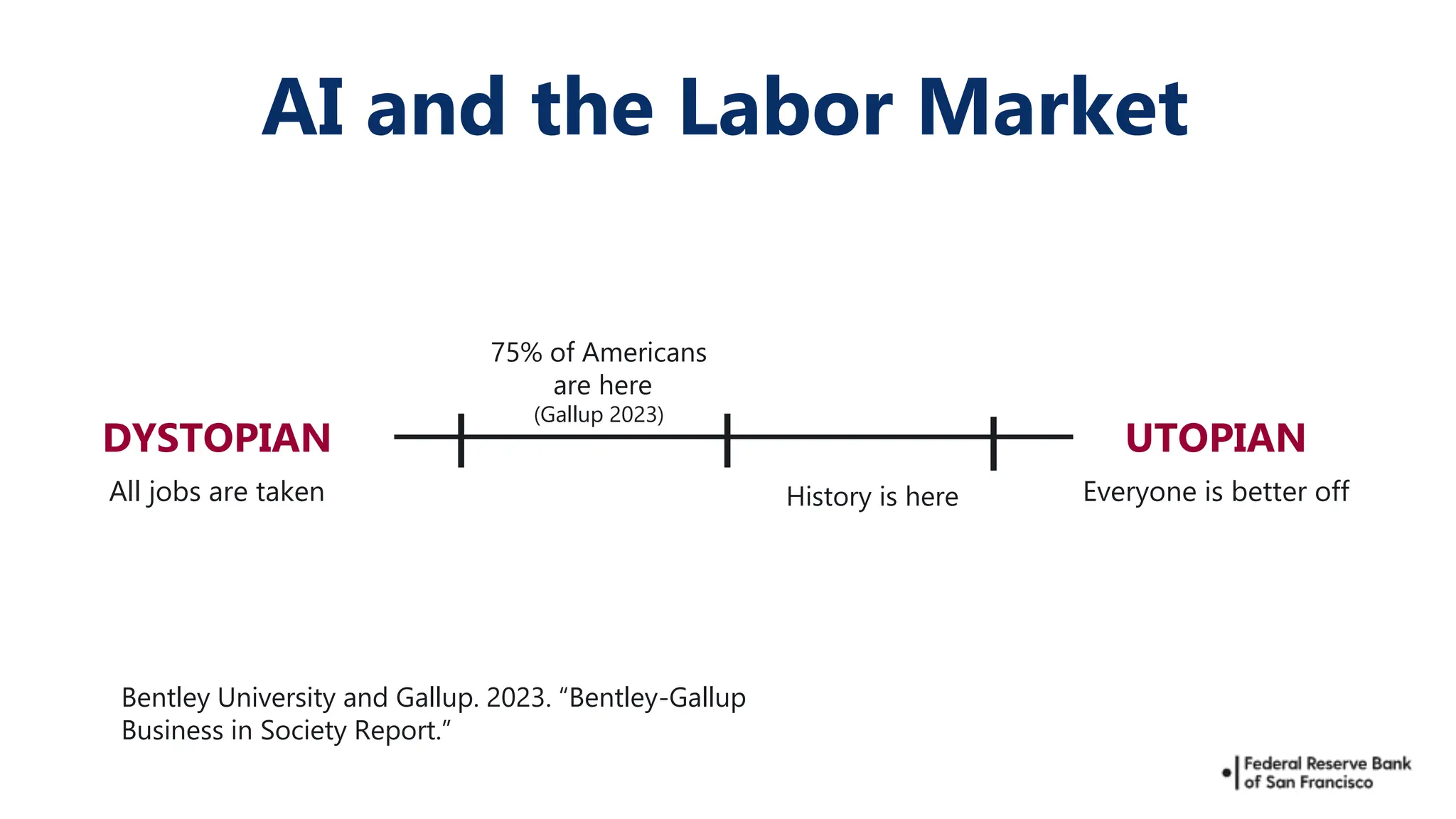
If you think about AI and the labor market, there are, right now, two views on the extremes: dystopian, where all
jobs are taken, and utopian, where everyone is better off.
75% of Americans are closer to the dystopian view.
History, on the other hand, is closer to utopian, but not fully utopian—because technology has never reduced
net jobs in the country. But it absolutely has impacted different people and the jobs they can do—often with
difficult and lasting challenges. We shouldn't expect AI to be any different.
SLIDE 2 TEXT – AI and the Labor Market
AI’s Surge Moment
Google Search Interest in Artificial Intelligence
(3.5 Release)
0
25
50
75
100
2017 2018 2019 2020 2021 2022 2023 2024
Interest
Over
Time
Source: Google
AI Ubiquity
7+ DECADES OF AI RESEARCH
November 30, 2022
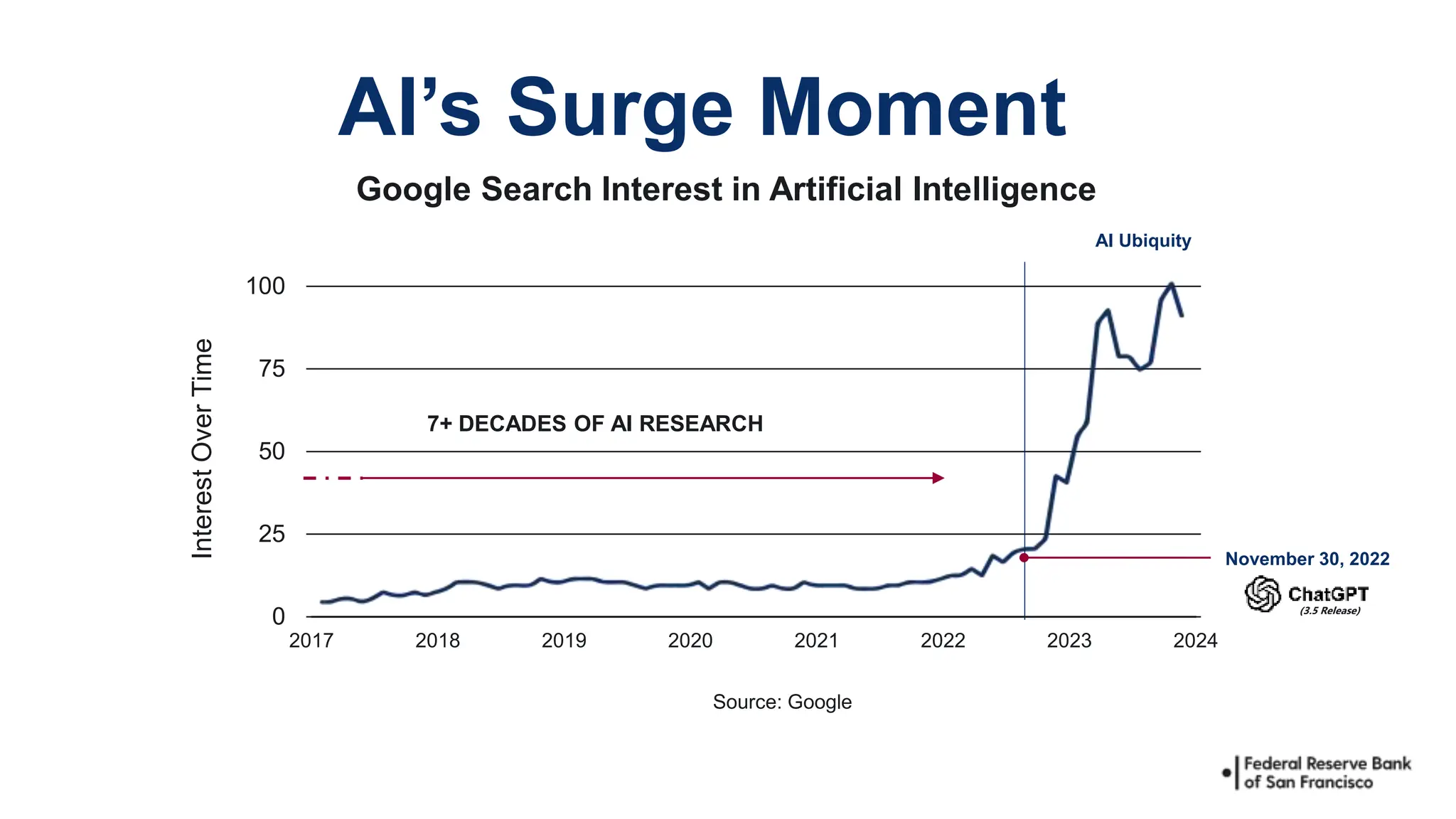
AI research has been going on for a long time—seven plus decades. The first autonomous vehicle was built in
the 1980s.
But in November of 2022, when Open AI launched its app, Generative AI had an “eternal November” moment
when anyone with a phone could access its power. Generative AI went from a thing others did to relative
ubiquity overnight.
This moment led to what I think of as “people driven diffusion.”
SLIDE 3 TEXT – AI's Surge Moment
People Driven Diffusion
Time
Cumulative
Adoption
CHATGPT Launch
Businesses/Institutions
+Competitiveness
+Harnessing
+Guardrailing
People
Experts,
Modelers,
Early
Adopters
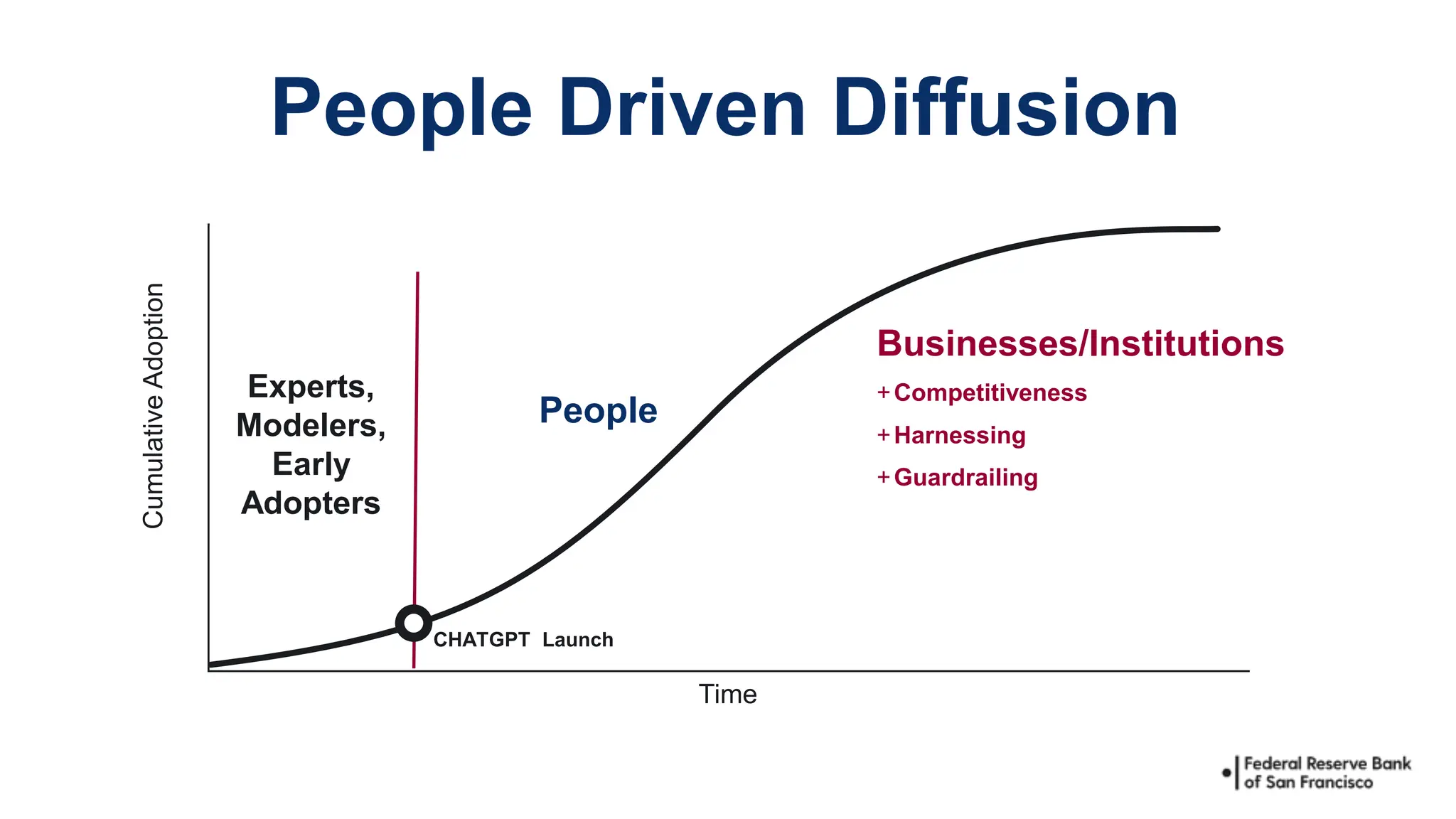
We’re now in a period unlike previous periods of technological diffusion. In previous episodes of innovation,
experts, modelers, and early adopters were the first to have access to something new, then businesses
developed applications, which were eventually used by workers. This time, experts had access first, then
people have had access—pushing businesses to speed up their timeline for adoption or at least understanding.
This suggests that the S curve is likely to be steeper than it has been in the past.
Importantly, there are many reasons businesses might move from apathy to action on AI. One is to stay
competitive. Another is to leverage or harness the new skills and abilities their employes are using. The third is
to ensure that they understand the uses well enough to set guidelines and guardrails for workers who use
personal or enterprise instances of generative AI models to do their work.
Whether businesses are learning, building, or safeguarding, a growing share are making generative AI a C-
Suite discussion item.
SLIDE 4 TEXT – People Driven Diffusion
Sequential to Simultaneous
Affected
Tasks
Replaces
Augments
Creates
Time
Creates
Augments
Replaces
Innovation
Launch
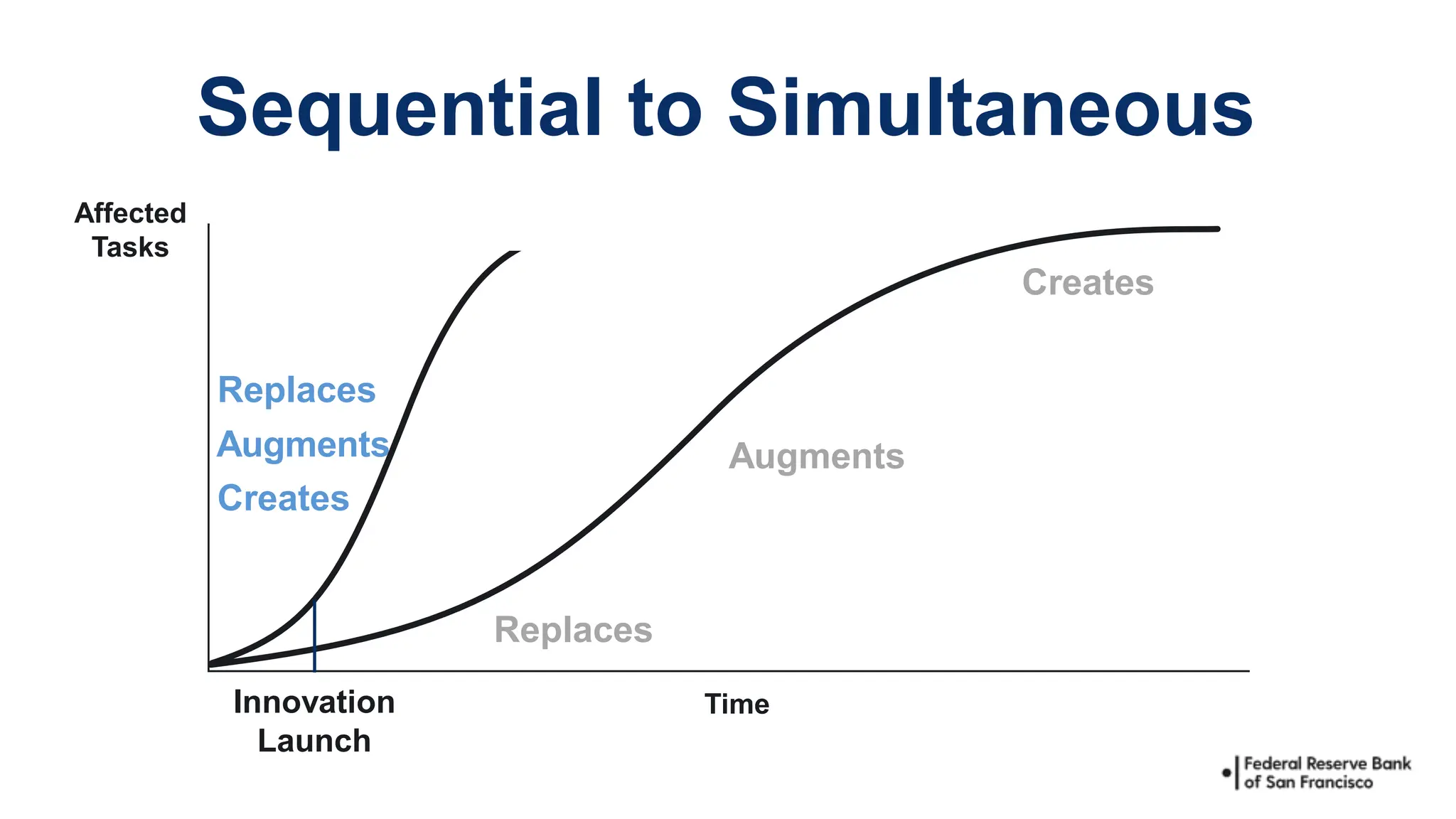
If you look at the labor market, technological diffusion generally leads to changes in how jobs—mostly tasks—
are done. The typical pattern follows this stylized S-curve. As innovations launch, businesses adopt them and
begin making efficiency gains. These investments often start by replacing tasks that can be done as, or more,
effectively with the new technology. Augmentation of jobs that combine labor with technology follow and then
eventually job creation emerges. There is very frequently a large gap in time between job replacement and job
creation which is one reason why new technologies often raise fears that workers will be left less well off.
AI is likely to follow this same model, but on a much more compressed time schedule. More simultaneous than
sequential.
Think of a firm that uses copywriters to write descriptions of items for sale. Generative AI makes it easy to get a
first pass at item descriptions. This frees up the human copywriters to work on more strategic writing for the
high-margin items and to spend more time collaborating with marketing and sales teams. Notably, for this to
continue to work well, the firm has to hire teams to lead the model training—prompt engineers for example.
This is not a stylized example. It is a real case used by a sizeable business already taking advantage of this
technology.
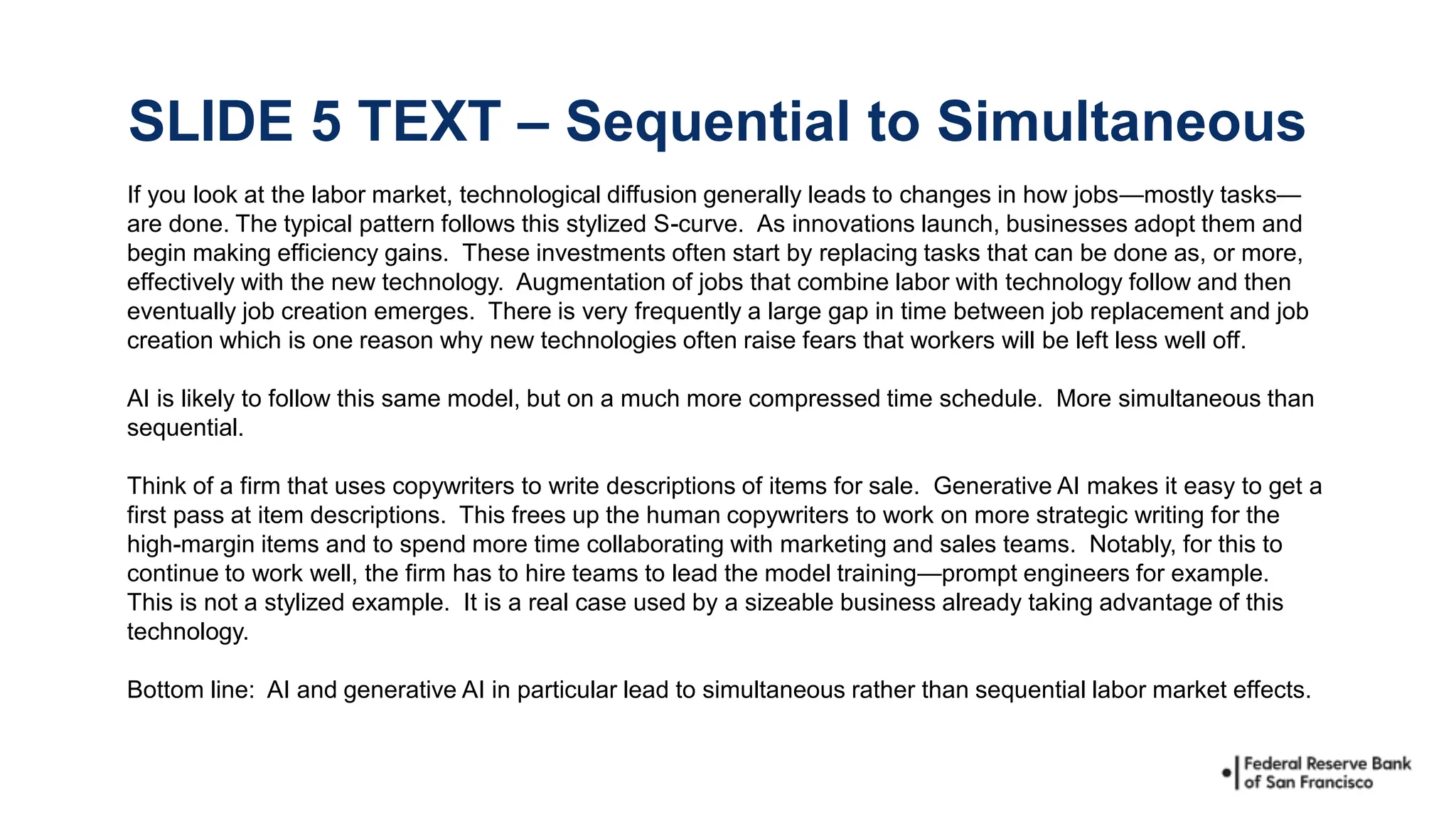
Bottom line: AI and generative AI in particular lead to simultaneous rather than sequential labor market effects.
SLIDE 5 TEXT – Sequential to Simultaneous
AI Better: Possible Not
Definite
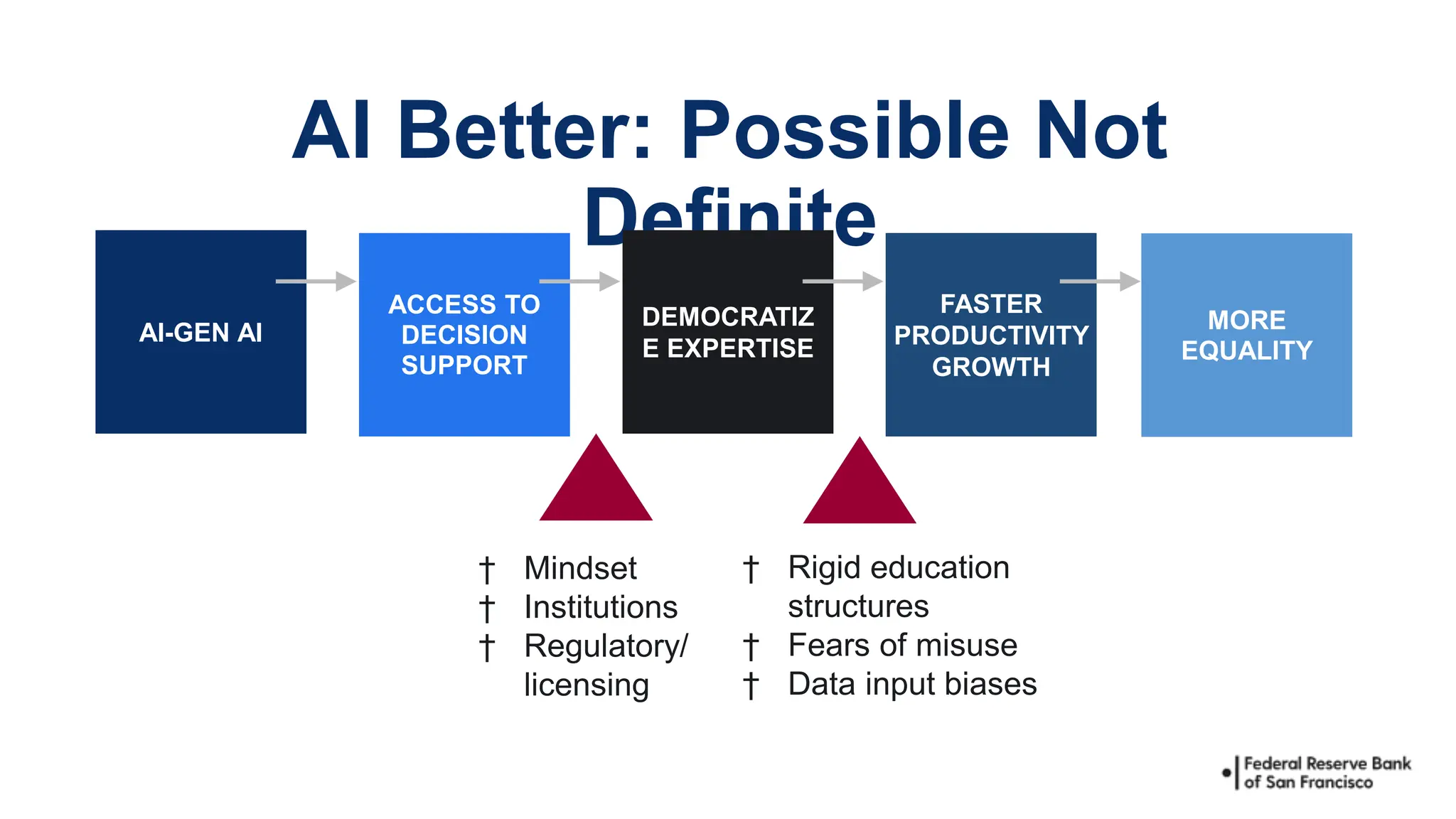
† Mindset
† Institutions
† Regulatory/
licensing
† Rigid education
structures
† Fears of misuse
† Data input biases
DEMOCRATIZ
E EXPERTISE
ACCESS TO
DECISION
SUPPORT
FASTER
PRODUCTIVITY
GROWTH
MORE
EQUALITY
AI-GEN AI
So the natural question is this: will AI make us better? Are we going to have better labor market outcomes, less
inequality, and higher productivity growth? I'd say it's possible, but not definite.
AI, and especially generative AI, has increased access to support for decision making. Workers at various skill
levels can get an assist from generative AI, allowing them to skill up on content that complements their existing
knowledge. A good example of this is outlined in Autor (2024).
In theory this could lead to more access to services and less scarcity for the skill sets of current experts.
But this possibility does not depend on the technology alone. Many other things are important and could get in
the way between what could be true and what will be true.
For example, the ability of a larger number of workers to fill roles currently occupied by experts will depend on
our mindset, institutions, and licensing and regulation. These less technological factors are just as important as
the technology itself.
The same logic holds for productivity growth and income equality. If AI moves fast and our educational system
moves slow, that could limit the gains. Fears of misuse of the product could also constrain experimentation.
Finally, data input biases brought about by siloed and unplanned model development and training could also
restrain the possibilities of productivity growth that this technology promises.
SLIDE 6 TEXT – AI Better: Possible Not
Definite
AI is a Tool—We Decide
DYSTOPIAN UTOPIAN
All jobs are taken Everyone is better off
Labor Market
Impact
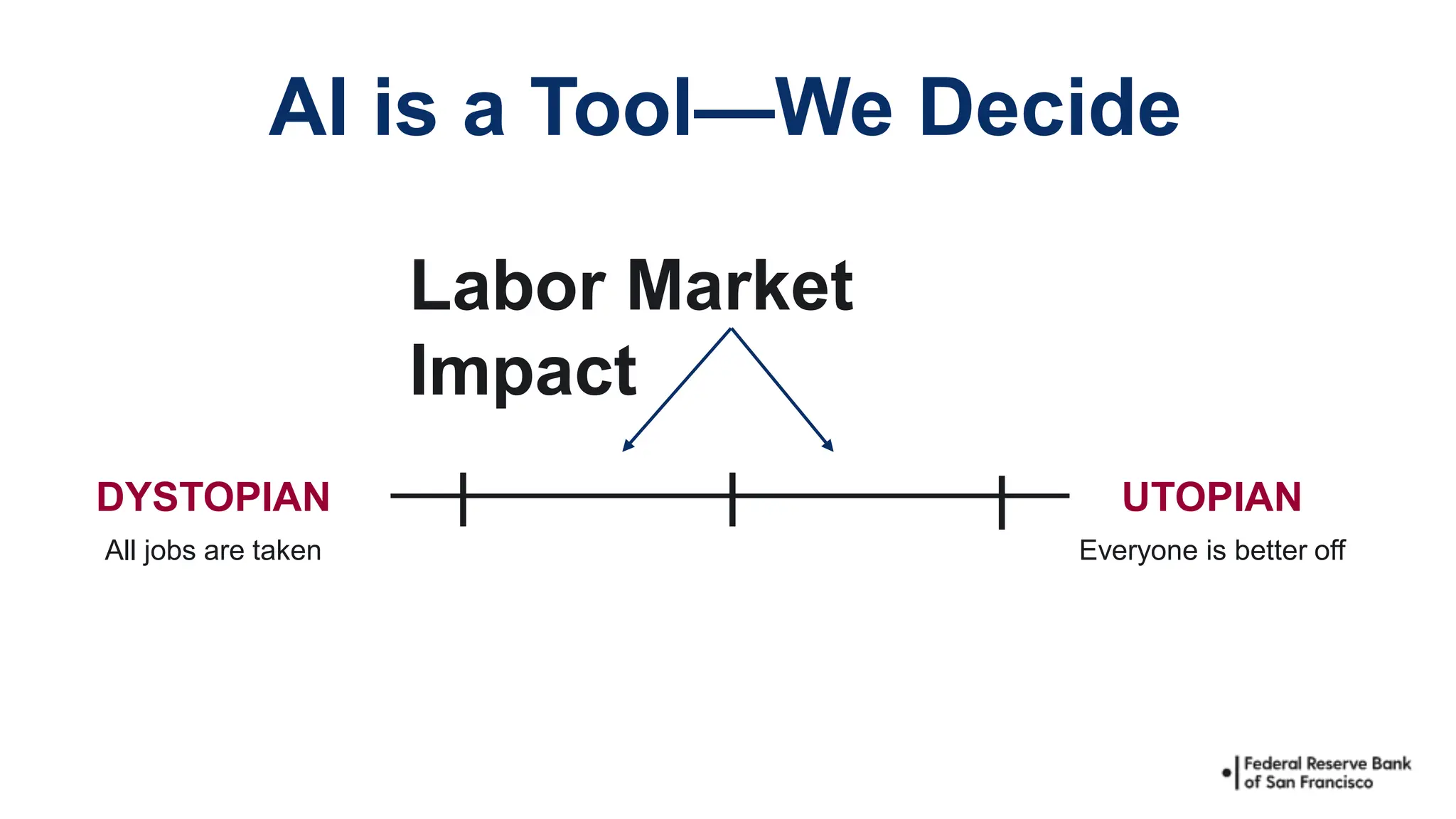
The bottom line is that AI is a tool. It has tremendous capabilities, but these are possibilities not promises.
The evolution of this technology and its impact on the labor market, growth, and the economy will depend on a
larger set of institutional changes that must be made. While we won’t know whether this technology will be
“better” until years down the road, what we know now is that our collective actions will dictate the answer.
SLIDE 7 TEXT: AI is a Tool – We Decide
Acemoglu, Daron and Restrepo, Pascual. 2019. “Automation and New Tasks: How Technology
Displaces and Reinstates Labor.” Journal of Economic Perspectives. Available at
https://economics.mit.edu/sites/default/files/publications/Automation%20and%20New%20Tasks
%20-%20How%20Technology%20Displace.pdf.
Auter, David. 2024. “AI Could Actually Help Rebuild The Middle Class.” NOEMA Magazine.
Available at https://www.noemamag.com/how-ai-could-help-rebuild-the-middle-class/.
Bentley University and Gallup. 2023. “Bentley-Gallup Business in Society Report.” Available at
https://www.bentley.edu/files/gallup/Bentley_Gallup_Business_in_Society_Report.pdf.
Lu, Yiwen. 2024. “Hottest Job in Corporate America? The Executive in Charge of A.I.” The New
York Times. Available at https://www.nytimes.com/2024/01/29/technology/us-jobs-ai-chatgpt-
tech.html.
McKinsey & Company. 2023. “What’s the future of generative AI? An early view in 15 charts.”
Available at https://www.mckinsey.com/featured-insights/mckinsey-explainers/whats-the-future-
of-generative-ai-an-early-view-in-15-charts.
Salesforce. 2023. “More than Half of Generative AI Adopters Use Unapproved Tools at Work.”
Available at https://www.salesforce.com/news/stories/ai-at-work-research/.
Recommended Reading

2024 US Monetary Policy Conference Mary C. Daly Presentation Slides

  • 1.
    March 1, 2024 AI:Our Choices Matter 2024 US Monetary Policy Forum Mary C. Daly, President and CEO Federal Reserve Bank of San Francisco and EmergingTech Economic Research Network The views expressed here are my own and do not necessarily reflect those or anyone else in the Federal Reserve System.
  • 2.
    AI and theLabor Market DYSTOPIAN UTOPIAN All jobs are taken Everyone is better off 75% of Americans are here (Gallup 2023) History is here Bentley University and Gallup. 2023. “Bentley-Gallup Business in Society Report.”
  • 3.
    If you thinkabout AI and the labor market, there are, right now, two views on the extremes: dystopian, where all jobs are taken, and utopian, where everyone is better off. 75% of Americans are closer to the dystopian view. History, on the other hand, is closer to utopian, but not fully utopian—because technology has never reduced net jobs in the country. But it absolutely has impacted different people and the jobs they can do—often with difficult and lasting challenges. We shouldn't expect AI to be any different. SLIDE 2 TEXT – AI and the Labor Market
  • 4.
    AI’s Surge Moment GoogleSearch Interest in Artificial Intelligence (3.5 Release) 0 25 50 75 100 2017 2018 2019 2020 2021 2022 2023 2024 Interest Over Time Source: Google AI Ubiquity 7+ DECADES OF AI RESEARCH November 30, 2022
  • 5.
    AI research hasbeen going on for a long time—seven plus decades. The first autonomous vehicle was built in the 1980s. But in November of 2022, when Open AI launched its app, Generative AI had an “eternal November” moment when anyone with a phone could access its power. Generative AI went from a thing others did to relative ubiquity overnight. This moment led to what I think of as “people driven diffusion.” SLIDE 3 TEXT – AI's Surge Moment
  • 6.
    People Driven Diffusion Time Cumulative Adoption CHATGPTLaunch Businesses/Institutions +Competitiveness +Harnessing +Guardrailing People Experts, Modelers, Early Adopters
  • 7.
    We’re now ina period unlike previous periods of technological diffusion. In previous episodes of innovation, experts, modelers, and early adopters were the first to have access to something new, then businesses developed applications, which were eventually used by workers. This time, experts had access first, then people have had access—pushing businesses to speed up their timeline for adoption or at least understanding. This suggests that the S curve is likely to be steeper than it has been in the past. Importantly, there are many reasons businesses might move from apathy to action on AI. One is to stay competitive. Another is to leverage or harness the new skills and abilities their employes are using. The third is to ensure that they understand the uses well enough to set guidelines and guardrails for workers who use personal or enterprise instances of generative AI models to do their work. Whether businesses are learning, building, or safeguarding, a growing share are making generative AI a C- Suite discussion item. SLIDE 4 TEXT – People Driven Diffusion
  • 8.
  • 9.
    If you lookat the labor market, technological diffusion generally leads to changes in how jobs—mostly tasks— are done. The typical pattern follows this stylized S-curve. As innovations launch, businesses adopt them and begin making efficiency gains. These investments often start by replacing tasks that can be done as, or more, effectively with the new technology. Augmentation of jobs that combine labor with technology follow and then eventually job creation emerges. There is very frequently a large gap in time between job replacement and job creation which is one reason why new technologies often raise fears that workers will be left less well off. AI is likely to follow this same model, but on a much more compressed time schedule. More simultaneous than sequential. Think of a firm that uses copywriters to write descriptions of items for sale. Generative AI makes it easy to get a first pass at item descriptions. This frees up the human copywriters to work on more strategic writing for the high-margin items and to spend more time collaborating with marketing and sales teams. Notably, for this to continue to work well, the firm has to hire teams to lead the model training—prompt engineers for example. This is not a stylized example. It is a real case used by a sizeable business already taking advantage of this technology. Bottom line: AI and generative AI in particular lead to simultaneous rather than sequential labor market effects. SLIDE 5 TEXT – Sequential to Simultaneous
  • 10.
    AI Better: PossibleNot Definite † Mindset † Institutions † Regulatory/ licensing † Rigid education structures † Fears of misuse † Data input biases DEMOCRATIZ E EXPERTISE ACCESS TO DECISION SUPPORT FASTER PRODUCTIVITY GROWTH MORE EQUALITY AI-GEN AI
  • 11.
    So the naturalquestion is this: will AI make us better? Are we going to have better labor market outcomes, less inequality, and higher productivity growth? I'd say it's possible, but not definite. AI, and especially generative AI, has increased access to support for decision making. Workers at various skill levels can get an assist from generative AI, allowing them to skill up on content that complements their existing knowledge. A good example of this is outlined in Autor (2024). In theory this could lead to more access to services and less scarcity for the skill sets of current experts. But this possibility does not depend on the technology alone. Many other things are important and could get in the way between what could be true and what will be true. For example, the ability of a larger number of workers to fill roles currently occupied by experts will depend on our mindset, institutions, and licensing and regulation. These less technological factors are just as important as the technology itself. The same logic holds for productivity growth and income equality. If AI moves fast and our educational system moves slow, that could limit the gains. Fears of misuse of the product could also constrain experimentation. Finally, data input biases brought about by siloed and unplanned model development and training could also restrain the possibilities of productivity growth that this technology promises. SLIDE 6 TEXT – AI Better: Possible Not Definite
  • 12.
    AI is aTool—We Decide DYSTOPIAN UTOPIAN All jobs are taken Everyone is better off Labor Market Impact
  • 13.
    The bottom lineis that AI is a tool. It has tremendous capabilities, but these are possibilities not promises. The evolution of this technology and its impact on the labor market, growth, and the economy will depend on a larger set of institutional changes that must be made. While we won’t know whether this technology will be “better” until years down the road, what we know now is that our collective actions will dictate the answer. SLIDE 7 TEXT: AI is a Tool – We Decide
  • 14.
    Acemoglu, Daron andRestrepo, Pascual. 2019. “Automation and New Tasks: How Technology Displaces and Reinstates Labor.” Journal of Economic Perspectives. Available at https://economics.mit.edu/sites/default/files/publications/Automation%20and%20New%20Tasks %20-%20How%20Technology%20Displace.pdf. Auter, David. 2024. “AI Could Actually Help Rebuild The Middle Class.” NOEMA Magazine. Available at https://www.noemamag.com/how-ai-could-help-rebuild-the-middle-class/. Bentley University and Gallup. 2023. “Bentley-Gallup Business in Society Report.” Available at https://www.bentley.edu/files/gallup/Bentley_Gallup_Business_in_Society_Report.pdf. Lu, Yiwen. 2024. “Hottest Job in Corporate America? The Executive in Charge of A.I.” The New York Times. Available at https://www.nytimes.com/2024/01/29/technology/us-jobs-ai-chatgpt- tech.html. McKinsey & Company. 2023. “What’s the future of generative AI? An early view in 15 charts.” Available at https://www.mckinsey.com/featured-insights/mckinsey-explainers/whats-the-future- of-generative-ai-an-early-view-in-15-charts. Salesforce. 2023. “More than Half of Generative AI Adopters Use Unapproved Tools at Work.” Available at https://www.salesforce.com/news/stories/ai-at-work-research/. Recommended Reading