INFORMATION SHARING AND ENGAMENT
ADDITIONAL DEDUCTION
FOR LEARNERSHIP
AGREEMENTS
INCOME TAX ACT 58 OF 1962
SECTION 12H
INFORMATION SHARING AND ENGAMENT
PURPOSE
• This Note provides clarity on the interpretation and application of
section 12H which provides deductions for registered learnership
agreements.
• The amendments to section 12H by the Taxation Laws Amendment Act
15 of 2016 have been taken into account in this Note and are effective
from 1 October 2016 and applicable to all learnership agreements entered
into on or after that date. This Note deals with learnership agreements
entered into from 1 October 2016. The relevant previous issue of
Interpretation Note 20 should be consulted for learnership agreements
entered into before that date.
INFORMATION SHARING AND ENGAMENT
BACKGROUND
• Section 12H provides additional deductions to employers for qualifying
learnership agreements. These additional deductions are intended as an
incentive for employers to train employees in a regulated environment in
order to encourage skills development and job creation. Training
contracts qualifying for these deductions are learnership agreement and
apprenticeships registered with a SETA. These additional deductions
consist of an annual allowance and a completion allowance. Effective
from 1 October 2016, the amount of the allowance will depend on the
NQF level held by the learner before entering into the learnership
agreement.
INFORMATION SHARING AND ENGAMENT
APPLICATION OF THE LAW
Section 12H provides a deduction to an employer in addition to
any other deductions allowable under the Act for any registered
learnership agreement if all the requirements of section 12H are
met. Use brief bullets, discuss details verbally.
an annual allowance, to which the
employer is entitled in any year of
assessment in which a learner is a party
to a registered learnership agreement
[section 12H(2) and (2A)]; and
a completion allowance during any
year of assessment in which the learner
successfully completes the learnership
[section 12H(3), (3A), (4) and 4A].
COMPLETION
ALLOWANCE
ANNUAL
ALLOWANCE
INFORMATION SHARING AND ENGAMENT
Key
Features of
Allowances
The annual allowance is subject
to a pro rata reduction if the
registered learnership
agreement does not cover the
full 12 months during any year
of assessment [section 12H(2)(b)
and (2A)(b)]
Different rules apply in
determining the completion
allowance for registered
learnership agreements
spanning periods of less than
24 months, and those which
cover 24 months or longer
[section 12H(3), (3A), (4) and
(4A)]
The quantum of these
allowances depends on the
NQF level held by the learner
[section 12H(2)(a)(i), (2A)(a)(i),
(3)(a), (3A)(a), (4)(a), (4A)(a)]
The quantum of these
allowances is increased if the
learner is a person with a
disability [section 12H(5) and
(5A)]
INFORMATION SHARING AND ENGAMENT
REGISTERED LEARNERSHIP AGREEMENT
• A “registered learnership agreement” as defined in section 12H(1) comprises an
agreement registered in accordance with the Skills Development Act and entered
into between the learner and the employer before 1 April 2022.
• The reference to “apprenticeships” was removed with the 2012 amendment with
effect from 1 January 2013. However, this does not mean that apprenticeships are no
longer provided for by the section. The definition of “learner” in section 12H refers
to a “learner” as defined in the Skills Development Act. Section 1 of the Skills
Development Act defines a “learner” as including an apprentice.
• Until 31 December 2012, the deduction was available only to those learnership
agreements which had been officially registered with a SETA. In practice
registrations were always delayed because of a variety of reasons which would then
negatively affect the deduction. This problem has been rectified by the introduction
of section 12H(2)(c)3 and (2A)(c)4 which provide that any learnership agreement
which has not been registered from the inception of the agreement will be deemed
to have been registered on the date it was entered into, provided it is registered
within 12 months after the last day of the employer’s year of assessment.
INFORMATION SHARING AND ENGAMENT
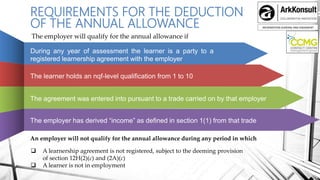
REQUIREMENTS FOR THE DEDUCTION
OF THE ANNUAL ALLOWANCE
The employer will qualify for the annual allowance if
During any year of assessment the learner is a party to a
registered learnership agreement with the employer
The learner holds an nqf-level qualification from 1 to 10
The agreement was entered into pursuant to a trade carried on by that employer
The employer has derived “income” as defined in section 1(1) from that trade
An employer will not qualify for the annual allowance during any period in which
 A learnership agreement is not registered, subject to the deeming provision
of section 12H(2)(c) and (2A)(c)
 A learner is not in employment
INFORMATION SHARING AND ENGAMENT
REQUIREMENTS FOR THE DEDUCTION
OF THE COMPLETION ALLOWANCE
The employer will qualify for the completion allowance if
During any year of assessment the learner is a party to a
registered learnership agreement with the employer
The learner holds an NQF-level qualification from 1 to 10
The employer derived “income” as defined in section 1(1) from that trade
The learner successfully completed the learnership during the year of
assessment
The agreement was entered into pursuant to a trade carried on by the employer
INFORMATION SHARING AND ENGAMENT
ENHANCED ALLOWANCES –
LEARNERS WITH A DISABILITY
In order to encourage employers to develop the skills of persons with a
disability, the annual and completion allowances are increased as follows
for a learner who has a “disability” as defined in section 6B(1) at the time of
entering into the learnership agreement
• R20 000 for a learner holding an NQF-level qualification from 1 to 6
• R30 000 for a learner holding an NQF-level qualification from 7 to 10
Form ITR-DD “Confirmation of Diagnosis of Disability”, which is available on the
SARS website, contains the criteria prescribed by the Commissioner for evaluating
whether a person has a disability.
INFORMATION SHARING AND ENGAMENT
PROHIBITION OF LEARNERSHIP
ALLOWANCES
An employer may not claim any annual allowance or any completion
allowance for a new registered learnership agreement if
• A learner, who is party to the new registered learnership agreement,
has previously failed to complete any other registered learnership
agreement to which the employer or an associated institution was a
party
• The other registered learnership agreement contains the same
education and training component as the new registered learnership
agreement
INFORMATION SHARING AND ENGAMENT
THE QUANTUM OF THE ANNUAL
ALLOWANCE
• The annual allowance is deductible in each year of assessment in which
the learnership agreement is in force
• For 12 full months during any year of assessment
• The quantum of the annual allowance is equal to –
• R40 000 for a learner holding an NQF-level qualification from 1 to 6; or
• R20 000 for a learner holding an NQF-level qualification from 7 to 10.
• If the learner is a person with a “disability” as defined in section 6B(1) –
• R60 000 (R40 000 + R20 000) for a learner holding an NQF-level qualification from 1 to 6;or
• R50 000 (R20 000 + R30 000) for a learner holding an NQF-level qualification from 7 to 10.
• For each period of less than 12 full months during any year of assessment
• The annual allowance is a pro rata portion if the learner is a party to a registered
learnership agreement for less than 12 full months during the year of assessment.
Apportionment will therefore apply if the learnership agreement commenced or
ended partway through the year of assessment.
INFORMATION SHARING AND ENGAMENT
THE QUANTUM OF THE COMPLETION
ALLOWANCE
• The completion allowance is granted once-off in addition to the annual allowance and is
deductible in the year of assessment in which the learner successfully completes the learnership
• Learnership agreements for less than 24 full months
• The quantum of the completion allowance is equal to –
• R40 000 for a learner holding an NQF-level qualification from 1 to 6; or
• R20 000 for a learner holding an NQF-level qualification from 7 to 10.
• If the learner is a person with a “disability” as defined in section 6B(1) –
• R60 000 (R40 000 + R20 000) for a learner holding an NQF-level qualification from 1 to 6; or
• R50 000 (R20 000 + R30 000) for a learner holding an NQF-level qualification from 7 to 10
• Learnership agreements equal to or exceeding 24 full months
• The quantum of the completion allowance is equal to –
• R40 000 for a learner holding an NQF-level qualification from 1 to 6 multiplied by the number of consecutive 12-month periods within
the duration of that learnership agreement;19 or
• R20 000 for a learner holding an NQF-level qualification from 7 to 10 multiplied by the number of consecutive 12-month periods within
the duration of that learnership agreement.20
• If the learner is a person with a “disability” as defined in section 6B(1) –
• R60 000 (R40 000 + R20 000) multiplied by the number of consecutive 12-month periods within the duration of that learnership
agreement; or
• R50 000 (R20 000 + R30 000) multiplied by the number of consecutive 12-month periods within the duration of that learnership
agreement.
INFORMATION SHARING AND ENGAMENT
THE LEARNER MOVES FROM NQF
LEVEL 6 TO 7
• A learner may enter into a learnership agreement and hold an NQF-level
6 qualification. During the year of assessment the learner may obtain a
higher qualification and as a result move to NQF level 7. The employer’s
claim would have to be adjusted and the allowance would be calculated
on a pro rata basis
INFORMATION SHARING AND ENGAMENT
Employers A and B will be
entitled to claim a pro rata
portion of the annual
allowance in the year of
assessment in which the
learner changes employment
Employer A will not be
entitled to any further annual
allowances or the completion
allowance
Employer B will be entitled to
the completion allowance
provided that the learner
successfully completes the
learnership while in Employer
B’s employ
Employer B will be entitled to
future annual allowances,
subject to apportionment in
the year of completion if the
final period consists of less
than 12 full months
SUBSTITUTION OF EMPLOYERS
Under section 17(5) of the Skills Development Act an employer may be
substituted with the consent of the learner and approval of the SETA that
registered the learnership agreement.
As a result, when a learner moves from Employer A to Employer B
INFORMATION SHARING AND ENGAMENT
TERMINATION OF THE LEARNERSHIP
AGREEMENT
• If a registered learnership agreement is terminated (whether by the
employee resigning or by the employer terminating the learner’s
employment), the employer will be able to deduct an amount equal to a
pro rata portion of the annual allowance in that year. The employer is not
entitled to deduct any further annual allowances or the completion
allowance, since the learnership agreement is terminated and the
learnership is not completed.
REPORTING REQUIREMENTS
• Under section 12H(8) for each year of assessment during which an
employer is eligible for an annual or completion allowance, the employer
must submit to the SETA with which the learnership agreement is
registered any information relating to that learnership agreement
required by the SETA in the form and manner and at the place and time
indicated by the SETA
INFORMATION SHARING AND ENGAMENT
CASE STUDY
• Example 9. The determination of the amount deductible as a
learnership allowance
Facts: ABC (Pty) Ltd (ABC) has a 31 March year-end.
• ABC concluded learnership agreements with employees X, Y, Z, and
employee D who is a person with a disability, pursuant to a trade carried
on by ABC. The learnership agreements with X, Y, Z and D have been
registered with the relevant SETA and titles and codes have been
allocated and issued by the Director-General: Department of Labour.
Assume that the current provisions of section 12H remain unchanged for
the duration of the learnerships.
INFORMATION SHARING AND ENGAMENT
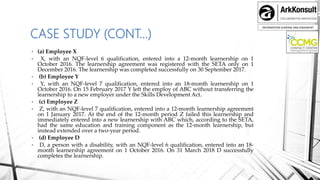
CASE STUDY (CONT…)
• (a) Employee X
• X, with an NQF-level 6 qualification, entered into a 12-month learnership on 1
October 2016. The learnership agreement was registered with the SETA only on 1
December 2016. The learnership was completed successfully on 30 September 2017.
• (b) Employee Y
• Y, with an NQF-level 7 qualification, entered into an 18-month learnership on 1
October 2016. On 15 February 2017 Y left the employ of ABC without transferring the
learnership to a new employer under the Skills Development Act.
• (c) Employee Z
• Z, with an NQF-level 7 qualification, entered into a 12-month learnership agreement
on 1 January 2017. At the end of the 12-month period Z failed this learnership and
immediately entered into a new learnership with ABC which, according to the SETA,
had the same education and training component as the 12-month learnership, but
instead extended over a two-year period.
• (d) Employee D
• D, a person with a disability, with an NQF-level 6 qualification, entered into an 18-
month learnership agreement on 1 October 2016. On 31 March 2018 D successfully
completes the learnership.
INFORMATION SHARING AND ENGAMENT
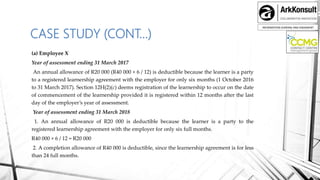
CASE STUDY (CONT…)
(a) Employee X
Year of assessment ending 31 March 2017
An annual allowance of R20 000 (R40 000 × 6 / 12) is deductible because the learner is a party
to a registered learnership agreement with the employer for only six months (1 October 2016
to 31 March 2017). Section 12H(2)(c) deems registration of the learnership to occur on the date
of commencement of the learnership provided it is registered within 12 months after the last
day of the employer’s year of assessment.
Year of assessment ending 31 March 2018
1. An annual allowance of R20 000 is deductible because the learner is a party to the
registered learnership agreement with the employer for only six full months.
R40 000 × 6 / 12 = R20 000
2. A completion allowance of R40 000 is deductible, since the learnership agreement is for less
than 24 full months.
INFORMATION SHARING AND ENGAMENT
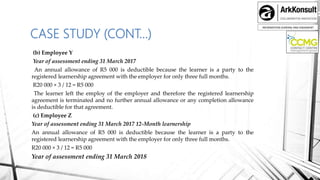
CASE STUDY (CONT…)
(b) Employee Y
Year of assessment ending 31 March 2017
An annual allowance of R5 000 is deductible because the learner is a party to the
registered learnership agreement with the employer for only three full months.
R20 000 × 3 / 12 = R5 000
The learner left the employ of the employer and therefore the registered learnership
agreement is terminated and no further annual allowance or any completion allowance
is deductible for that agreement.
(c) Employee Z
Year of assessment ending 31 March 2017 12-Month learnership
An annual allowance of R5 000 is deductible because the learner is a party to the
registered learnership agreement with the employer for only three full months.
R20 000 × 3 / 12 = R5 000
Year of assessment ending 31 March 2018
INFORMATION SHARING AND ENGAMENT
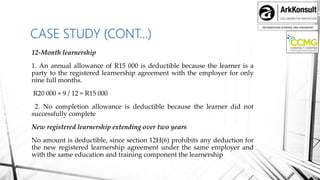
CASE STUDY (CONT…)
12-Month learnership
1. An annual allowance of R15 000 is deductible because the learner is a
party to the registered learnership agreement with the employer for only
nine full months.
R20 000 × 9 / 12 = R15 000
2. No completion allowance is deductible because the learner did not
successfully complete
New registered learnership extending over two years
No amount is deductible, since section 12H(6) prohibits any deduction for
the new registered learnership agreement under the same employer and
with the same education and training component the learnership
INFORMATION SHARING AND ENGAMENT
CASE STUDY (CONT…)
(d) Employee D
Year of assessment ending 31 March 2017
An annual allowance of R30 000 is deductible because the learner (a person
with a disability and NQF-level 6 qualification) is a party to the registered
learnership agreement with the employer for only six full months.
R60 000 × 6 / 12 = R30 000
Year of assessment ending 31 March 2018
1. An annual allowance of R60 000 is deductible because the learner (a person
with a disability and NQF-level 6 qualification) is a party to the registered
learnership agreement with the employer for twelve full months.
2. A completion allowance of R60 000 is deductible
The completion allowance in this case is R60 000 because the learnership
agreement is for a period of less than 24 months.
INFORMATION SHARING AND ENGAMENT
CONCLUSION
• Section 12H provides an annual allowance and a completion allowance to
employers that are a party to a qualifying learnership agreement with an
employee.
• The amendments to section 12H by the Taxation Laws Amendment Act 15 of
2016 are effective from 1 October 2016 and apply to all learnership agreements
entered into on or after that date. As a result, all learnership agreements entered
into before 1 October 2016 are subject to the previous legislation even if the
learnership agreement continues beyond 1 October 2016.
• The amended section now distinguishes between learners holding NQF levels 1
to 6 and NQF levels 7 to 10 qualifications. The pre-existing qualifications of the
learner entering the learnership agreement will determine the value of the claim

CCMG Knowledge Sharing Event

  • 1.
    INFORMATION SHARING ANDENGAMENT ADDITIONAL DEDUCTION FOR LEARNERSHIP AGREEMENTS INCOME TAX ACT 58 OF 1962 SECTION 12H
  • 2.
    INFORMATION SHARING ANDENGAMENT PURPOSE • This Note provides clarity on the interpretation and application of section 12H which provides deductions for registered learnership agreements. • The amendments to section 12H by the Taxation Laws Amendment Act 15 of 2016 have been taken into account in this Note and are effective from 1 October 2016 and applicable to all learnership agreements entered into on or after that date. This Note deals with learnership agreements entered into from 1 October 2016. The relevant previous issue of Interpretation Note 20 should be consulted for learnership agreements entered into before that date.
  • 3.
    INFORMATION SHARING ANDENGAMENT BACKGROUND • Section 12H provides additional deductions to employers for qualifying learnership agreements. These additional deductions are intended as an incentive for employers to train employees in a regulated environment in order to encourage skills development and job creation. Training contracts qualifying for these deductions are learnership agreement and apprenticeships registered with a SETA. These additional deductions consist of an annual allowance and a completion allowance. Effective from 1 October 2016, the amount of the allowance will depend on the NQF level held by the learner before entering into the learnership agreement.
  • 4.
    INFORMATION SHARING ANDENGAMENT APPLICATION OF THE LAW Section 12H provides a deduction to an employer in addition to any other deductions allowable under the Act for any registered learnership agreement if all the requirements of section 12H are met. Use brief bullets, discuss details verbally. an annual allowance, to which the employer is entitled in any year of assessment in which a learner is a party to a registered learnership agreement [section 12H(2) and (2A)]; and a completion allowance during any year of assessment in which the learner successfully completes the learnership [section 12H(3), (3A), (4) and 4A]. COMPLETION ALLOWANCE ANNUAL ALLOWANCE
  • 5.
    INFORMATION SHARING ANDENGAMENT Key Features of Allowances The annual allowance is subject to a pro rata reduction if the registered learnership agreement does not cover the full 12 months during any year of assessment [section 12H(2)(b) and (2A)(b)] Different rules apply in determining the completion allowance for registered learnership agreements spanning periods of less than 24 months, and those which cover 24 months or longer [section 12H(3), (3A), (4) and (4A)] The quantum of these allowances depends on the NQF level held by the learner [section 12H(2)(a)(i), (2A)(a)(i), (3)(a), (3A)(a), (4)(a), (4A)(a)] The quantum of these allowances is increased if the learner is a person with a disability [section 12H(5) and (5A)]
  • 6.
    INFORMATION SHARING ANDENGAMENT REGISTERED LEARNERSHIP AGREEMENT • A “registered learnership agreement” as defined in section 12H(1) comprises an agreement registered in accordance with the Skills Development Act and entered into between the learner and the employer before 1 April 2022. • The reference to “apprenticeships” was removed with the 2012 amendment with effect from 1 January 2013. However, this does not mean that apprenticeships are no longer provided for by the section. The definition of “learner” in section 12H refers to a “learner” as defined in the Skills Development Act. Section 1 of the Skills Development Act defines a “learner” as including an apprentice. • Until 31 December 2012, the deduction was available only to those learnership agreements which had been officially registered with a SETA. In practice registrations were always delayed because of a variety of reasons which would then negatively affect the deduction. This problem has been rectified by the introduction of section 12H(2)(c)3 and (2A)(c)4 which provide that any learnership agreement which has not been registered from the inception of the agreement will be deemed to have been registered on the date it was entered into, provided it is registered within 12 months after the last day of the employer’s year of assessment.
  • 7.
    INFORMATION SHARING ANDENGAMENT REQUIREMENTS FOR THE DEDUCTION OF THE ANNUAL ALLOWANCE The employer will qualify for the annual allowance if During any year of assessment the learner is a party to a registered learnership agreement with the employer The learner holds an nqf-level qualification from 1 to 10 The agreement was entered into pursuant to a trade carried on by that employer The employer has derived “income” as defined in section 1(1) from that trade An employer will not qualify for the annual allowance during any period in which  A learnership agreement is not registered, subject to the deeming provision of section 12H(2)(c) and (2A)(c)  A learner is not in employment
  • 8.
    INFORMATION SHARING ANDENGAMENT REQUIREMENTS FOR THE DEDUCTION OF THE COMPLETION ALLOWANCE The employer will qualify for the completion allowance if During any year of assessment the learner is a party to a registered learnership agreement with the employer The learner holds an NQF-level qualification from 1 to 10 The employer derived “income” as defined in section 1(1) from that trade The learner successfully completed the learnership during the year of assessment The agreement was entered into pursuant to a trade carried on by the employer
  • 9.
    INFORMATION SHARING ANDENGAMENT ENHANCED ALLOWANCES – LEARNERS WITH A DISABILITY In order to encourage employers to develop the skills of persons with a disability, the annual and completion allowances are increased as follows for a learner who has a “disability” as defined in section 6B(1) at the time of entering into the learnership agreement • R20 000 for a learner holding an NQF-level qualification from 1 to 6 • R30 000 for a learner holding an NQF-level qualification from 7 to 10 Form ITR-DD “Confirmation of Diagnosis of Disability”, which is available on the SARS website, contains the criteria prescribed by the Commissioner for evaluating whether a person has a disability.
  • 10.
    INFORMATION SHARING ANDENGAMENT PROHIBITION OF LEARNERSHIP ALLOWANCES An employer may not claim any annual allowance or any completion allowance for a new registered learnership agreement if • A learner, who is party to the new registered learnership agreement, has previously failed to complete any other registered learnership agreement to which the employer or an associated institution was a party • The other registered learnership agreement contains the same education and training component as the new registered learnership agreement
  • 11.
    INFORMATION SHARING ANDENGAMENT THE QUANTUM OF THE ANNUAL ALLOWANCE • The annual allowance is deductible in each year of assessment in which the learnership agreement is in force • For 12 full months during any year of assessment • The quantum of the annual allowance is equal to – • R40 000 for a learner holding an NQF-level qualification from 1 to 6; or • R20 000 for a learner holding an NQF-level qualification from 7 to 10. • If the learner is a person with a “disability” as defined in section 6B(1) – • R60 000 (R40 000 + R20 000) for a learner holding an NQF-level qualification from 1 to 6;or • R50 000 (R20 000 + R30 000) for a learner holding an NQF-level qualification from 7 to 10. • For each period of less than 12 full months during any year of assessment • The annual allowance is a pro rata portion if the learner is a party to a registered learnership agreement for less than 12 full months during the year of assessment. Apportionment will therefore apply if the learnership agreement commenced or ended partway through the year of assessment.
  • 12.
    INFORMATION SHARING ANDENGAMENT THE QUANTUM OF THE COMPLETION ALLOWANCE • The completion allowance is granted once-off in addition to the annual allowance and is deductible in the year of assessment in which the learner successfully completes the learnership • Learnership agreements for less than 24 full months • The quantum of the completion allowance is equal to – • R40 000 for a learner holding an NQF-level qualification from 1 to 6; or • R20 000 for a learner holding an NQF-level qualification from 7 to 10. • If the learner is a person with a “disability” as defined in section 6B(1) – • R60 000 (R40 000 + R20 000) for a learner holding an NQF-level qualification from 1 to 6; or • R50 000 (R20 000 + R30 000) for a learner holding an NQF-level qualification from 7 to 10 • Learnership agreements equal to or exceeding 24 full months • The quantum of the completion allowance is equal to – • R40 000 for a learner holding an NQF-level qualification from 1 to 6 multiplied by the number of consecutive 12-month periods within the duration of that learnership agreement;19 or • R20 000 for a learner holding an NQF-level qualification from 7 to 10 multiplied by the number of consecutive 12-month periods within the duration of that learnership agreement.20 • If the learner is a person with a “disability” as defined in section 6B(1) – • R60 000 (R40 000 + R20 000) multiplied by the number of consecutive 12-month periods within the duration of that learnership agreement; or • R50 000 (R20 000 + R30 000) multiplied by the number of consecutive 12-month periods within the duration of that learnership agreement.
  • 13.
    INFORMATION SHARING ANDENGAMENT THE LEARNER MOVES FROM NQF LEVEL 6 TO 7 • A learner may enter into a learnership agreement and hold an NQF-level 6 qualification. During the year of assessment the learner may obtain a higher qualification and as a result move to NQF level 7. The employer’s claim would have to be adjusted and the allowance would be calculated on a pro rata basis
  • 14.
    INFORMATION SHARING ANDENGAMENT Employers A and B will be entitled to claim a pro rata portion of the annual allowance in the year of assessment in which the learner changes employment Employer A will not be entitled to any further annual allowances or the completion allowance Employer B will be entitled to the completion allowance provided that the learner successfully completes the learnership while in Employer B’s employ Employer B will be entitled to future annual allowances, subject to apportionment in the year of completion if the final period consists of less than 12 full months SUBSTITUTION OF EMPLOYERS Under section 17(5) of the Skills Development Act an employer may be substituted with the consent of the learner and approval of the SETA that registered the learnership agreement. As a result, when a learner moves from Employer A to Employer B
  • 15.
    INFORMATION SHARING ANDENGAMENT TERMINATION OF THE LEARNERSHIP AGREEMENT • If a registered learnership agreement is terminated (whether by the employee resigning or by the employer terminating the learner’s employment), the employer will be able to deduct an amount equal to a pro rata portion of the annual allowance in that year. The employer is not entitled to deduct any further annual allowances or the completion allowance, since the learnership agreement is terminated and the learnership is not completed. REPORTING REQUIREMENTS • Under section 12H(8) for each year of assessment during which an employer is eligible for an annual or completion allowance, the employer must submit to the SETA with which the learnership agreement is registered any information relating to that learnership agreement required by the SETA in the form and manner and at the place and time indicated by the SETA
  • 16.
    INFORMATION SHARING ANDENGAMENT CASE STUDY • Example 9. The determination of the amount deductible as a learnership allowance Facts: ABC (Pty) Ltd (ABC) has a 31 March year-end. • ABC concluded learnership agreements with employees X, Y, Z, and employee D who is a person with a disability, pursuant to a trade carried on by ABC. The learnership agreements with X, Y, Z and D have been registered with the relevant SETA and titles and codes have been allocated and issued by the Director-General: Department of Labour. Assume that the current provisions of section 12H remain unchanged for the duration of the learnerships.
  • 17.
    INFORMATION SHARING ANDENGAMENT CASE STUDY (CONT…) • (a) Employee X • X, with an NQF-level 6 qualification, entered into a 12-month learnership on 1 October 2016. The learnership agreement was registered with the SETA only on 1 December 2016. The learnership was completed successfully on 30 September 2017. • (b) Employee Y • Y, with an NQF-level 7 qualification, entered into an 18-month learnership on 1 October 2016. On 15 February 2017 Y left the employ of ABC without transferring the learnership to a new employer under the Skills Development Act. • (c) Employee Z • Z, with an NQF-level 7 qualification, entered into a 12-month learnership agreement on 1 January 2017. At the end of the 12-month period Z failed this learnership and immediately entered into a new learnership with ABC which, according to the SETA, had the same education and training component as the 12-month learnership, but instead extended over a two-year period. • (d) Employee D • D, a person with a disability, with an NQF-level 6 qualification, entered into an 18- month learnership agreement on 1 October 2016. On 31 March 2018 D successfully completes the learnership.
  • 18.
    INFORMATION SHARING ANDENGAMENT CASE STUDY (CONT…) (a) Employee X Year of assessment ending 31 March 2017 An annual allowance of R20 000 (R40 000 × 6 / 12) is deductible because the learner is a party to a registered learnership agreement with the employer for only six months (1 October 2016 to 31 March 2017). Section 12H(2)(c) deems registration of the learnership to occur on the date of commencement of the learnership provided it is registered within 12 months after the last day of the employer’s year of assessment. Year of assessment ending 31 March 2018 1. An annual allowance of R20 000 is deductible because the learner is a party to the registered learnership agreement with the employer for only six full months. R40 000 × 6 / 12 = R20 000 2. A completion allowance of R40 000 is deductible, since the learnership agreement is for less than 24 full months.
  • 19.
    INFORMATION SHARING ANDENGAMENT CASE STUDY (CONT…) (b) Employee Y Year of assessment ending 31 March 2017 An annual allowance of R5 000 is deductible because the learner is a party to the registered learnership agreement with the employer for only three full months. R20 000 × 3 / 12 = R5 000 The learner left the employ of the employer and therefore the registered learnership agreement is terminated and no further annual allowance or any completion allowance is deductible for that agreement. (c) Employee Z Year of assessment ending 31 March 2017 12-Month learnership An annual allowance of R5 000 is deductible because the learner is a party to the registered learnership agreement with the employer for only three full months. R20 000 × 3 / 12 = R5 000 Year of assessment ending 31 March 2018
  • 20.
    INFORMATION SHARING ANDENGAMENT CASE STUDY (CONT…) 12-Month learnership 1. An annual allowance of R15 000 is deductible because the learner is a party to the registered learnership agreement with the employer for only nine full months. R20 000 × 9 / 12 = R15 000 2. No completion allowance is deductible because the learner did not successfully complete New registered learnership extending over two years No amount is deductible, since section 12H(6) prohibits any deduction for the new registered learnership agreement under the same employer and with the same education and training component the learnership
  • 21.
    INFORMATION SHARING ANDENGAMENT CASE STUDY (CONT…) (d) Employee D Year of assessment ending 31 March 2017 An annual allowance of R30 000 is deductible because the learner (a person with a disability and NQF-level 6 qualification) is a party to the registered learnership agreement with the employer for only six full months. R60 000 × 6 / 12 = R30 000 Year of assessment ending 31 March 2018 1. An annual allowance of R60 000 is deductible because the learner (a person with a disability and NQF-level 6 qualification) is a party to the registered learnership agreement with the employer for twelve full months. 2. A completion allowance of R60 000 is deductible The completion allowance in this case is R60 000 because the learnership agreement is for a period of less than 24 months.
  • 22.
    INFORMATION SHARING ANDENGAMENT CONCLUSION • Section 12H provides an annual allowance and a completion allowance to employers that are a party to a qualifying learnership agreement with an employee. • The amendments to section 12H by the Taxation Laws Amendment Act 15 of 2016 are effective from 1 October 2016 and apply to all learnership agreements entered into on or after that date. As a result, all learnership agreements entered into before 1 October 2016 are subject to the previous legislation even if the learnership agreement continues beyond 1 October 2016. • The amended section now distinguishes between learners holding NQF levels 1 to 6 and NQF levels 7 to 10 qualifications. The pre-existing qualifications of the learner entering the learnership agreement will determine the value of the claim