RISK IDENTIFICATION
Risk identification is a set of activities that detect ,describe and catalog
all potential risks to assets and processes that could have negatively
impact business outcomes in terms of performance ,quality ,damage,
loss or reputation
APPROACHES TO IDENTIFICATION RISK
 Checklists
 Brainstorming
CHECKLISTS
o Checklists are simply lists of the risks that have been found to occur
regularly in software development projects.
oIdeally a group of representative project stakeholders examines a checklist
identifying risks applicable to their project.
oOften the checklist suggests potential countermeasures for each risk.
CONT...
oProject management methodologies, such prince2, often recommend that
on completion of a project a review identifies any problems during the
project and the steps that were (or should have been) taken to resolve or
avoid them.
oThese problems could in some cases be added to an organizational risk
checklist for use with new projects.
BRAINSTORMING
• Ideally, representatives of the main stakeholders should be brought
together once some kind of preliminary plan has been drafted.
• They then identify, using their individual knowledge of different
parts of the project, the problems that might occur, This collaborative
approach may generate a sense of ownership in the project.
CASUAL MAPPING
• Causal mapping is method that builds or develops on reflection and
review of failure factors in cause and effect of the diagrams.
• It is very useful for facilitating learning with an organization or
system simply as method of project-post evaluation. It is also key
tool for risk assessment.
SWOT ANALYSIS
• Strengths-Weaknesses-Opportunities-Threat (SWOT) is very
technique and helpful for identifying risks within greater organization
context.
• It is generally used as planning tool for analyzing business, its
resources, and also its environment simply by looking at internal
strengths and weaknesses and opportunities and threats in external
environment. It is technique often used in formulation of strategy.
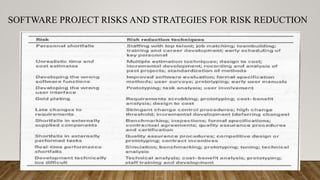
SOFTWARE PROJECT RISKS AND STRATEGIES FOR RISK REDUCTION
THANK YOU

Presentation on software project management

  • 2.
    RISK IDENTIFICATION Risk identificationis a set of activities that detect ,describe and catalog all potential risks to assets and processes that could have negatively impact business outcomes in terms of performance ,quality ,damage, loss or reputation
  • 3.
    APPROACHES TO IDENTIFICATIONRISK  Checklists  Brainstorming
  • 4.
    CHECKLISTS o Checklists aresimply lists of the risks that have been found to occur regularly in software development projects. oIdeally a group of representative project stakeholders examines a checklist identifying risks applicable to their project. oOften the checklist suggests potential countermeasures for each risk.
  • 5.
    CONT... oProject management methodologies,such prince2, often recommend that on completion of a project a review identifies any problems during the project and the steps that were (or should have been) taken to resolve or avoid them. oThese problems could in some cases be added to an organizational risk checklist for use with new projects.
  • 6.
    BRAINSTORMING • Ideally, representativesof the main stakeholders should be brought together once some kind of preliminary plan has been drafted. • They then identify, using their individual knowledge of different parts of the project, the problems that might occur, This collaborative approach may generate a sense of ownership in the project.
  • 7.
    CASUAL MAPPING • Causalmapping is method that builds or develops on reflection and review of failure factors in cause and effect of the diagrams. • It is very useful for facilitating learning with an organization or system simply as method of project-post evaluation. It is also key tool for risk assessment.
  • 8.
    SWOT ANALYSIS • Strengths-Weaknesses-Opportunities-Threat(SWOT) is very technique and helpful for identifying risks within greater organization context. • It is generally used as planning tool for analyzing business, its resources, and also its environment simply by looking at internal strengths and weaknesses and opportunities and threats in external environment. It is technique often used in formulation of strategy.
  • 9.
    SOFTWARE PROJECT RISKSAND STRATEGIES FOR RISK REDUCTION
  • 10.