



1
2
Practical and entertaining education for
attorneys, accountants, business owners and
executives, and investors.
3
Thank You To Our Sponsor
Disclaimer
The material in this webinar is for informational purposes only. It should not be considered
legal, financial or other professional advice. You should consult with an attorney or other
appropriate professional to determine what may be best for your individual needs. While
Financial Poise™ takes reasonable steps to ensure that information it publishes is accurate,
Financial Poise™ makes no guaranty in this regard.
5
Meet the Faculty
MODERATOR:
Max Stein - Boodell & Domanskis, LLC
PANELISTS:
John Levitske - Ankura
John “Jack” Burnett III – Burnett Law, PLLC
Michael Pakter - Gould & Pakter Associates LLP
Leslie Berkoff - Moritt Hock & Hamroff LLP
6
About This Webinar
Common Issues and Strategies in Business Breakups
As any entrepreneur will attest, starting and operating a business comes with unique
challenges. These challenges are a key reason that, by some estimates, half of the
companies that are founded today will not exist four years from now. It can be argued that the
effort and attention needed to find success precludes business owners from planning for
failure. This webinar focuses on the realities of a failing business from the owners‟
perspective. Join our panel of experts as they discuss the various considerations that should
be given at the outset of start-up negotiations and through business breakup, including
dispute negotiation and litigation.
7
About This Series
Complex Financial Litigation
This webinar series focuses on the legal and financial realities that accompany unanticipated
adverse events, soured business relationships, and failing organizations. Whether you are a
general litigator, business owner, aspiring shareholder, or insurance claims analyst, this
webinar series will help you to understand and prioritize key concepts associated with
business breakups, shareholder disputes, claims for lost profits, and bankruptcy avoidance
actions.
Each Financial Poise Webinar is delivered in Plain English, understandable to investors, business owners, and
executives without much background in these areas, yet is of primary value to attorneys, accountants, and other
seasoned professionals. Each episode brings you into engaging, sometimes humorous, conversations designed to
entertain as it teaches. Each episode in the series is designed to be viewed independently of the other episodes so that
participants will enhance their knowledge of this area whether they attend one, some, or all episodes.
8
Episodes in this Series
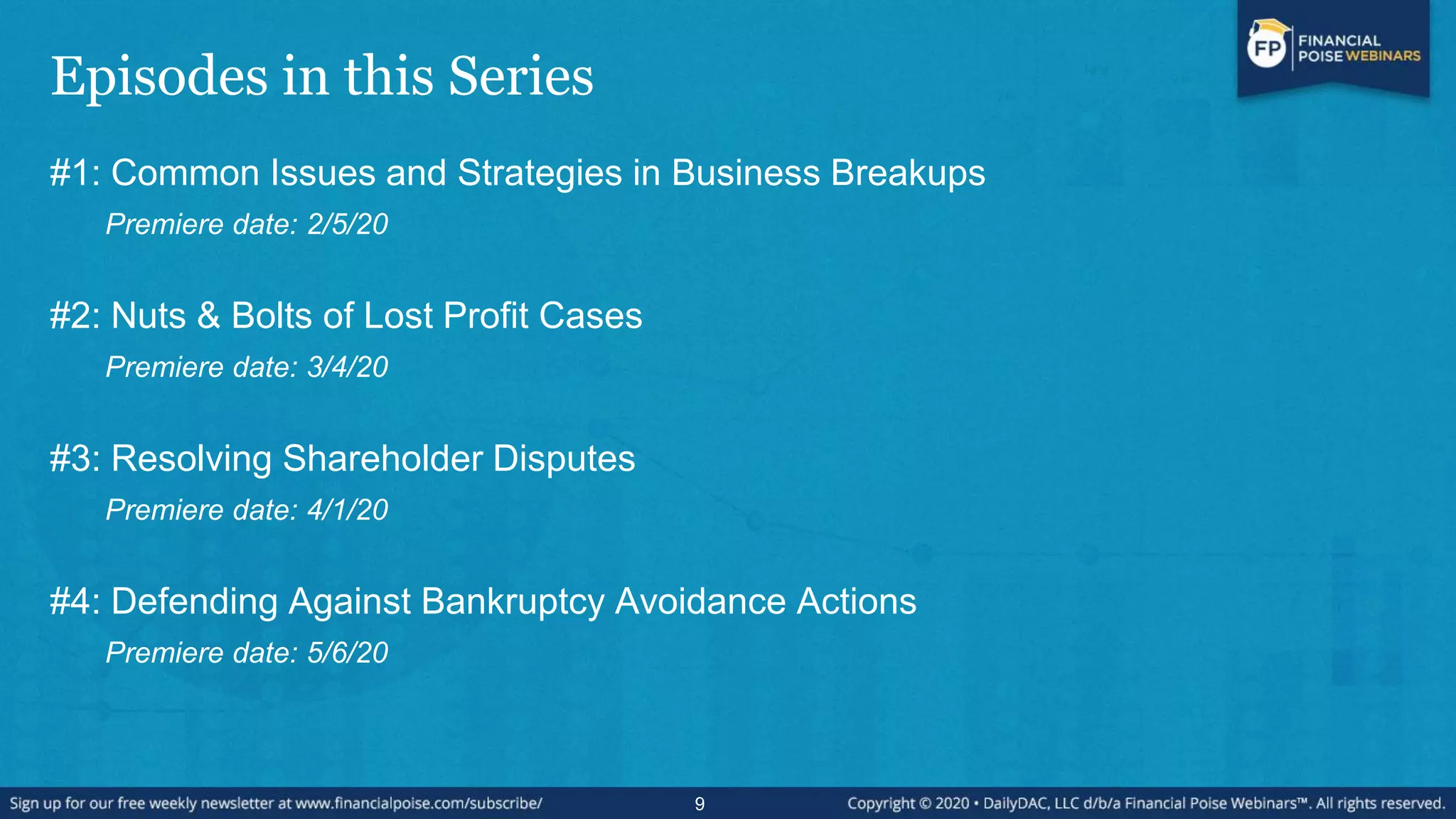
#1: Common Issues and Strategies in Business Breakups
Premiere date: 2/5/20
#2: Nuts & Bolts of Lost Profit Cases
Premiere date: 3/4/20
#3: Resolving Shareholder Disputes
Premiere date: 4/1/20
#4: Defending Against Bankruptcy Avoidance Actions
Premiere date: 5/6/20
9
Episode #1
Common Issues and Strategies in Business Breakups
10
Reasons for Business Breakups
• Emotional
 Fraud
 Perceived Inequity
• Financial
 Retirement
 Bankruptcy
 Perceived benefits elsewhere
• Unforeseen
 Death
 Disability
 Decline of Market
11
Common Issues in Business Breakups
• Accusations of shareholder oppression
• Accusations of breach of fiduciary duty
• Accusations of undue personal uses of company assets
 In particular, use of company personnel
• Accusations of self-dealing
• Accusations of asset misappropriation/fraud
• Proper valuation
12
Why Do Owners Fail to Plan?
• Lack of pragmatism and foresight
• Lack of third-party guidance (legal, insurance, operational, valuation)
• Advisor costs
• „Handshake‟ agreements, lack of formal documentation
• Operational distractions
• Relationships: Family, friends (“blood is thicker than water”)
• Unrealistic Optimism – Unrealistic projections/expectations
13
Preventive Corporate Planning
• Updated agreements (operating agreement)
 Change in assets
 Change in intentions
 Change in tax law
14
Preventive Corporate Planning
• Generally:
 Have business agreements in writing and up-to-date
 Have a dispute resolution mechanism in place
 Consider incentives in dispute resolution mechanisms, such as “Baseball” or “Texas”
arbitration provisions
15
Preventive Corporate Planning
• Buy-sell, shareholder, partnership agreements provisions:
 Eight “D‟s”
o Death, Divorce, Disability, Dissention, Dissolution, Departure (retirement), Debt
Overload (bankruptcy), and Decline of Market
• Sufficient funding vehicle
16
Preventive Corporate Planning
• Provisions to forestall squeeze-outs
 Provision that commits board to specific course of action
 Supermajority provisions (if applicable)
 Dividend triggers, declarations
 Employment contracts
 Non-competes
 Right to compel dissolution
17
Preventive Corporate Planning
• Arbitration provision
• “Baseball” or “Texas” arbitration provisions
 Parties involved submit proposals to arbitrator, and the arbitrator has to select one
proposal without modification
 Incentivizes parties to offer up more reasonable proposals
18
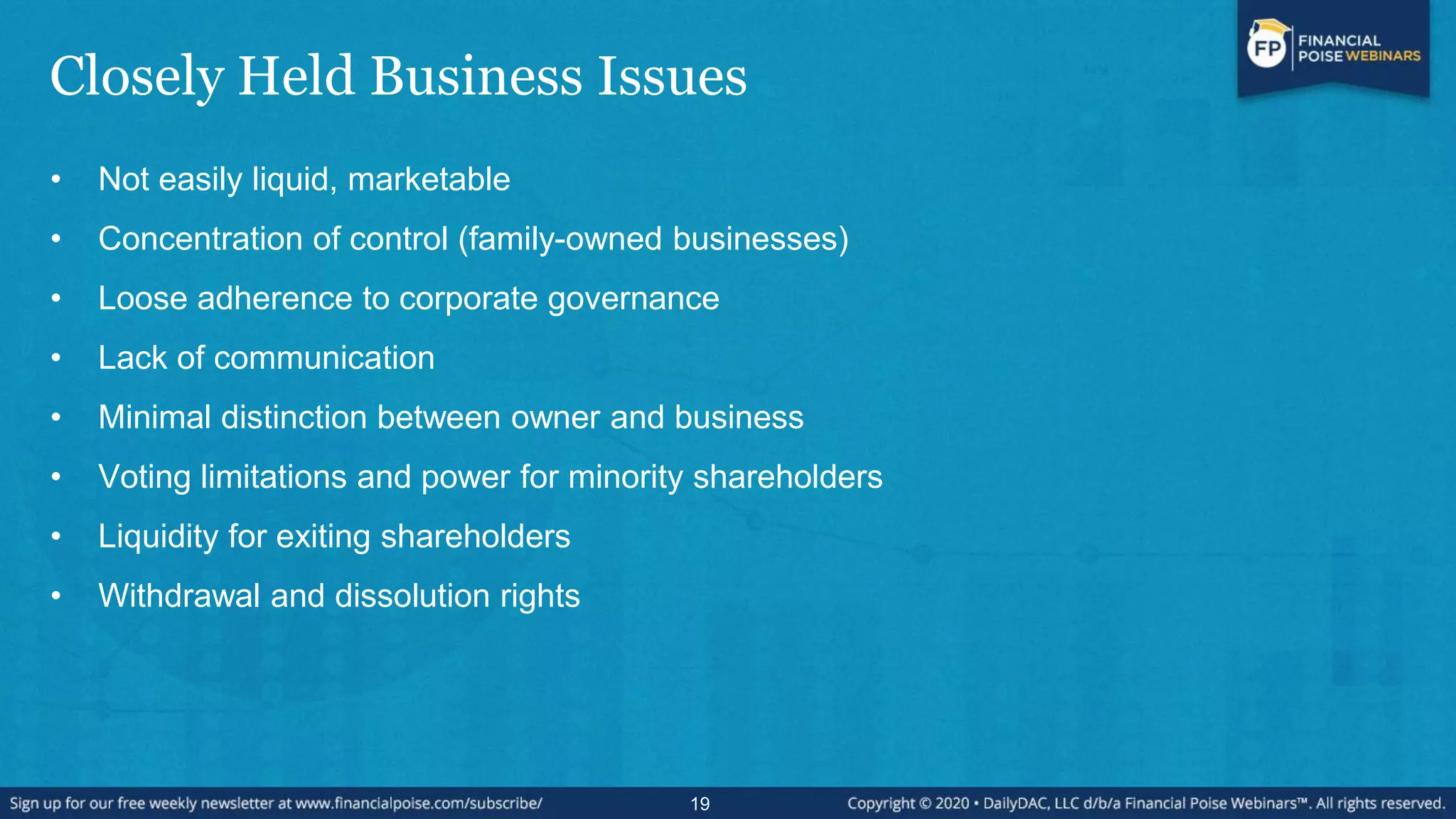
Closely Held Business Issues
• Not easily liquid, marketable
• Concentration of control (family-owned businesses)
• Loose adherence to corporate governance
• Lack of communication
• Minimal distinction between owner and business
• Voting limitations and power for minority shareholders
• Liquidity for exiting shareholders
• Withdrawal and dissolution rights
19
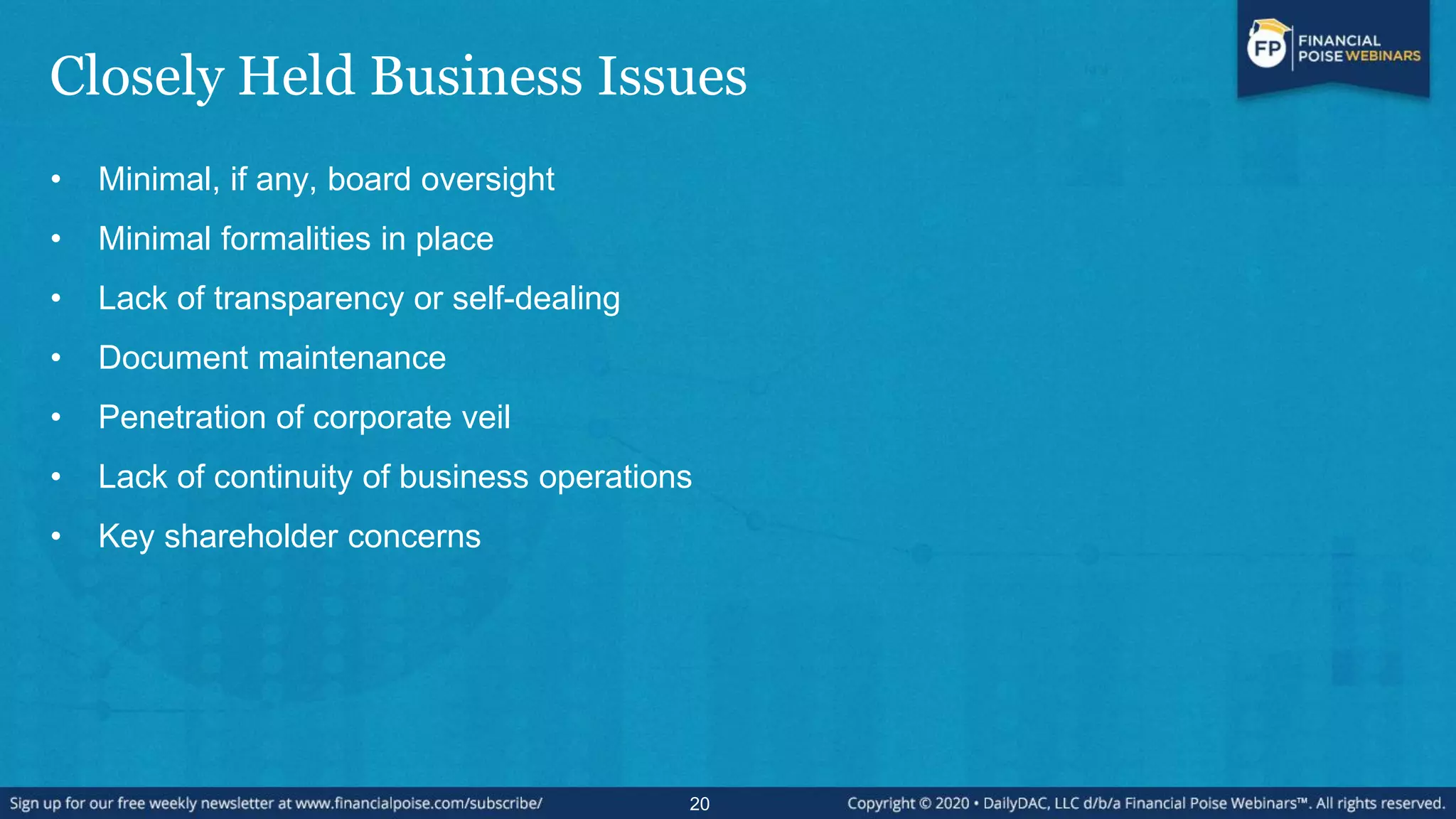
Closely Held Business Issues
• Minimal, if any, board oversight
• Minimal formalities in place
• Lack of transparency or self-dealing
• Document maintenance
• Penetration of corporate veil
• Lack of continuity of business operations
• Key shareholder concerns
20
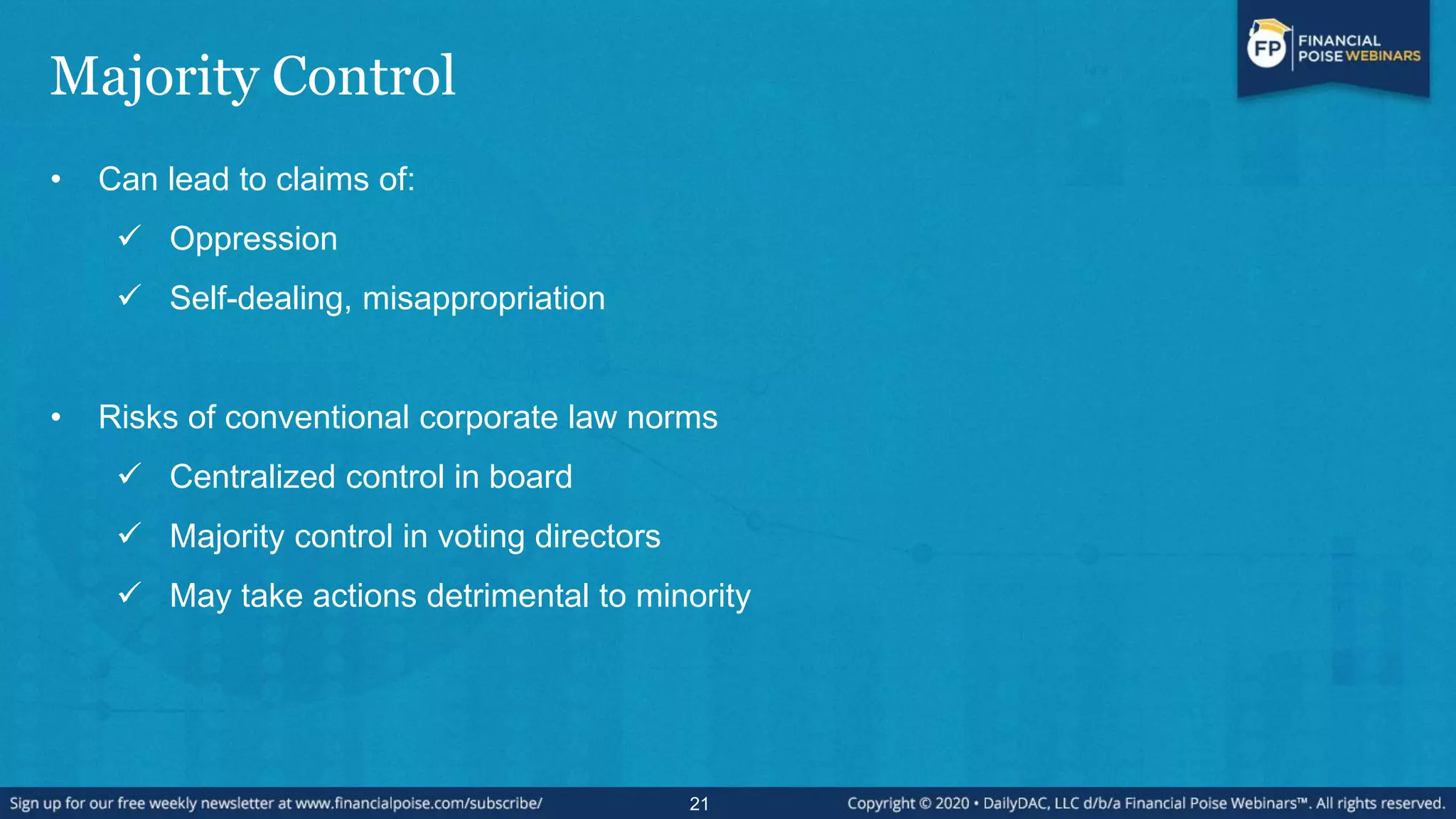
Majority Control
• Can lead to claims of:
 Oppression
 Self-dealing, misappropriation
• Risks of conventional corporate law norms
 Centralized control in board
 Majority control in voting directors
 May take actions detrimental to minority
21
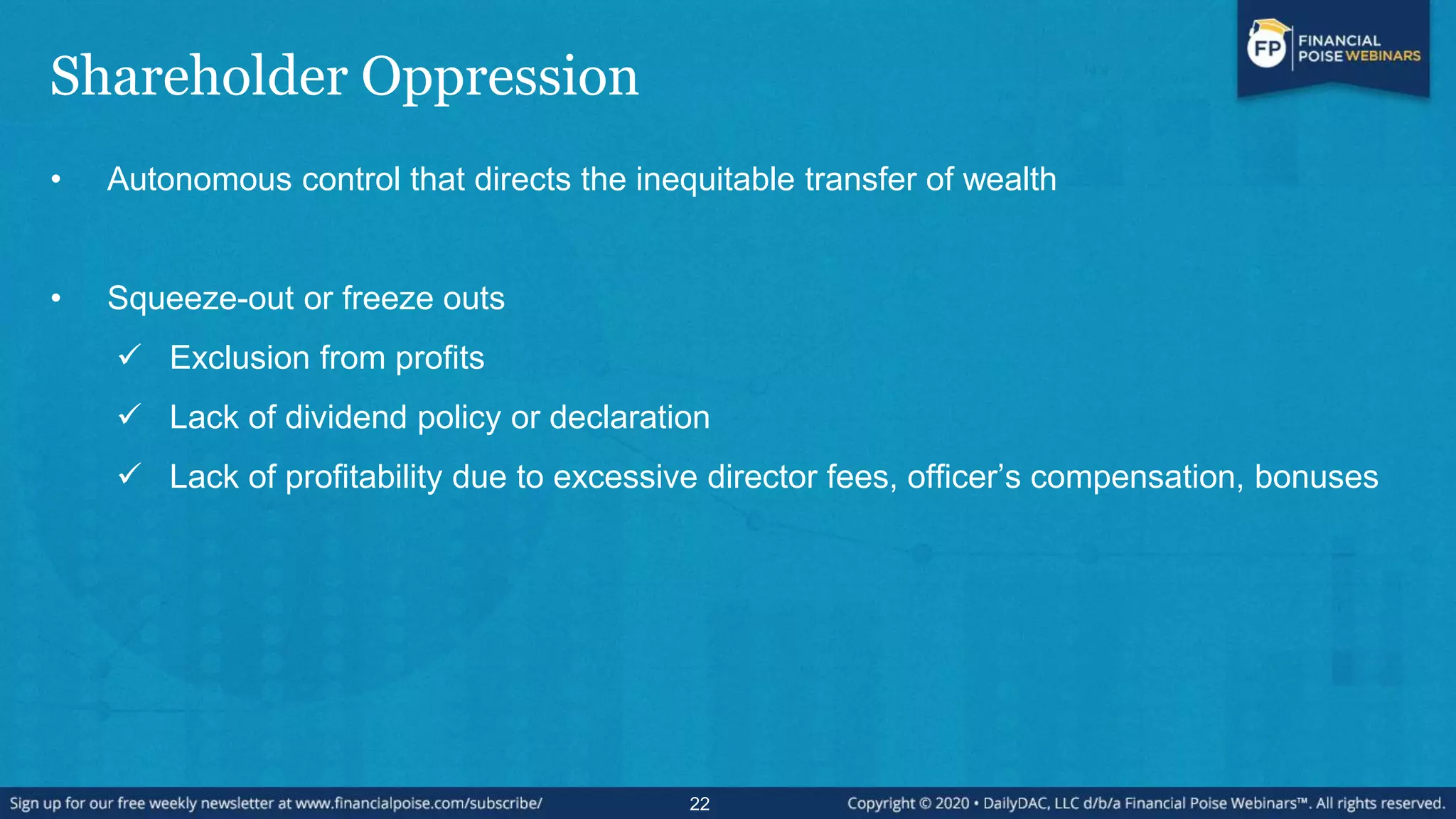
Shareholder Oppression
• Autonomous control that directs the inequitable transfer of wealth
• Squeeze-out or freeze outs
 Exclusion from profits
 Lack of dividend policy or declaration
 Lack of profitability due to excessive director fees, officer‟s compensation, bonuses
22
Shareholder Oppression
• Involuntary removal from director or officer position
 Voting powers
 Deny access to information or documents
• Formulaic or other terms of buyout at less than fair value
• Running a “Taj Mahal” and overspending company assets
23
Alternative Resolutions
• Can invite a third party to buy out part or entirety of business
 Have a 3rd party discrete investor come in and negotiate a buyout
 At the very least, can provide a “back of the envelope” valuation of the company from
an outside investor‟s perspective
24
Negotiation, Mediation, and/or Litigation?
• Consider cost/benefit of alternatives – financial, operational
• Litigation outcome can be unpredictable
 Governing state law
 Governing agreements
• Mediation
 Structured and assisted negotiation
 Can be used in conjunction with litigation
 “The Courts of this country should not be the places where resolution of disputes begins.
They should be places where disputes end after alternative methods of resolving disputes
have been considered and tried.”
o Justice Sandra Day O‟Connor
25
Why a Valuation is Essential
• Objective, third-party opinion
• Based on recognized valuation theory and methodology
• Considers any applicable valuation discounts
• Serves as a basis for negotiations
26
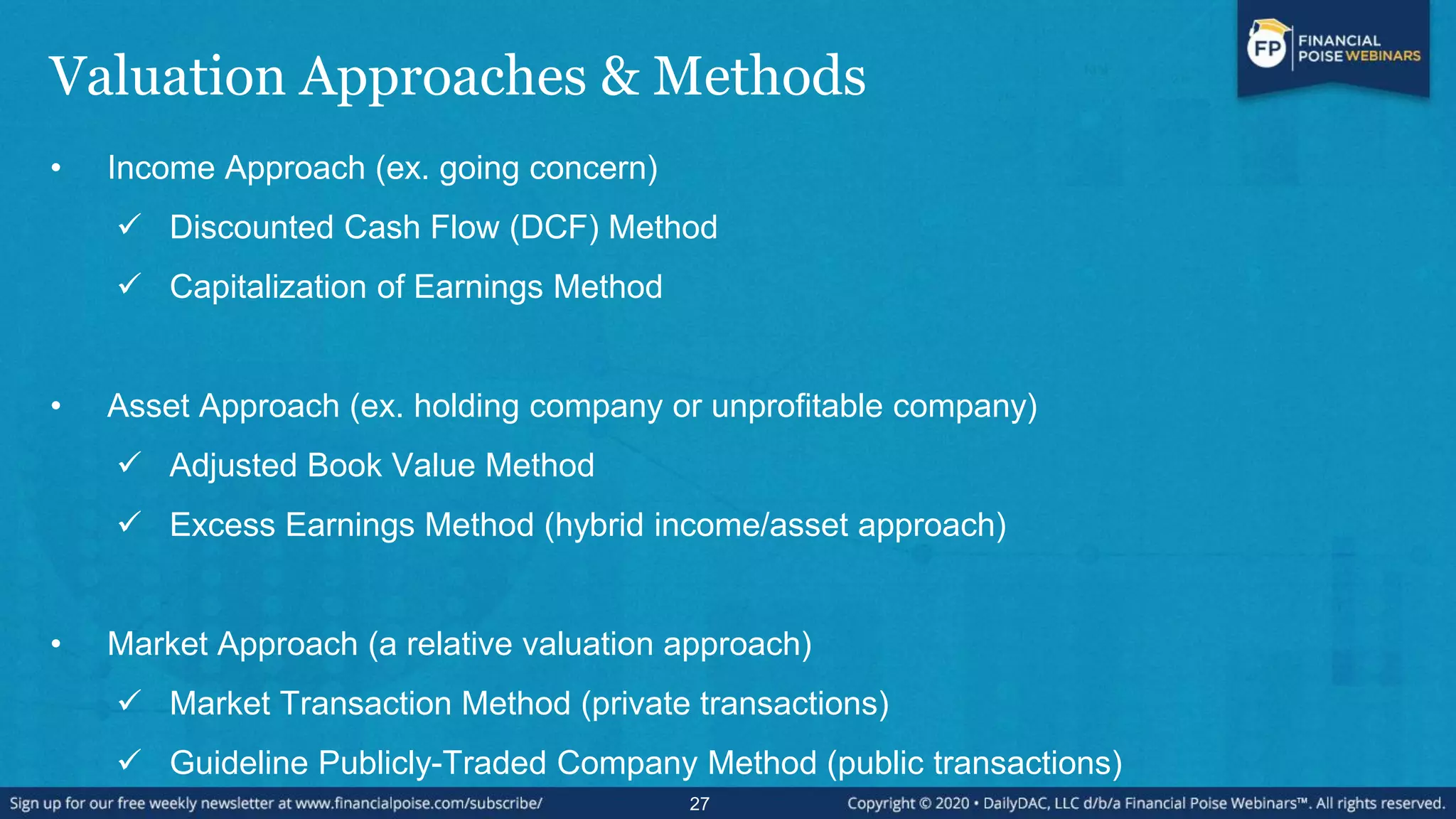
Valuation Approaches & Methods
• Income Approach (ex. going concern)
 Discounted Cash Flow (DCF) Method
 Capitalization of Earnings Method
• Asset Approach (ex. holding company or unprofitable company)
 Adjusted Book Value Method
 Excess Earnings Method (hybrid income/asset approach)
• Market Approach (a relative valuation approach)
 Market Transaction Method (private transactions)
 Guideline Publicly-Traded Company Method (public transactions)
27
Valuation: Use of Experts
• Use a qualified Business Valuation Expert
• Must be:
 Objective
 Experienced
 Credentialed
• Must apply and defend the use of judgment and estimates
• Applied methodology must be appropriately applied and fit the facts of the case or risk
being subject to Daubert challenge
• Relevant shareholder or other agreements, case law or statutes regarding valuation.
28
Valuation: Use of Experts
• Hire the correct type of expert:
 Accounting
 Forensic Accountant
 Tangible Asset Appraiser
 Business Valuation
 Lifestyle Analyst
29
Valuation: Use of Experts
• Use your expert to facilitate proper discovery and disclosure
 Adhere to the rules of evidence and procedures applicable to the case
 IMPORTANT: All work product may be discoverable if client hires expert directly
• Use the expert to educate the Court
 Expert is expected to be impartial and objective
 Testimony offered in the spirit of personal integrity, good faith and sincerity
• Use your expert to rebut the other side
30
About the Faculty
31
About The Faculty
Max Stein - MStein@boodlaw.com
Max Stein, a member of Boodell & Domanskis, LLC, is a business litigator focused on
meeting clients‟ business objectives, helping them resolve disputes at the most opportune
times. Max represents clients as both plaintiffs and defendants in a wide variety of forums.
Additionally, Max notes that one advantage of practicing at a smaller firm, is that he is able to
offer his clients high-quality, nimble representation at reasonable rates. To aid his clients in
achieving their business objectives, Max approaches cases as though they will go to trial,
utilizing his extensive trial experience. Max also counsels his clients, helping to identify and
navigate legal risks to achieve their business goals and protect their competitive interests
while managing and, where possible, avoiding the expense and uncertainty of litigation.
32
About The Faculty
Michael D. Pakter - mpakter@litcpa.com
Mr. Michael D. Pakter has 40 years of experience in accounting and forensic accounting, business
economics and investigations in numerous industries and diverse engagements, including more than 20
years of experience in economic damages and business valuations.
He has participated in public hearings and alternative dispute resolutions, submitted expert reports in
several jurisdictions and testified in arbitrations, regulatory proceedings and litigated disputes. State,
Federal and Bankruptcy Courts, as well as arbitral bodies, have recognized him as an expert in
accounting, financial analysis, forensic accounting, economic damages, business valuation and business
economics.
Mr. Pakter is a Certified Public Accountant (“CPA”), registered and licensed in the State of Illinois. The
American Institute of Certified Public Accountants (“AICPA”) has recognized him as additionally Certified
in Financial Forensics (“CFF”) and Management Accounting (“CGMA”). He can be reached
at312.229.1720, mpakter@litcpa.com or via www.litcpa.com.
33
About The Faculty
Leslie A. Berkoff - lberkoff@moritthock.com
Chair of the firm‟s Dispute Resolution Practice Group. A skilled mediator having handled
mediations in bankruptcy courts for all phases of bankruptcy-related litigation, as well as,
commercial mediations in the state and federal courts and arbitration as a panel arbitrator
through the American Arbitration Association. Ms. Berkoff is the past Chair of the firm's
Creditors' Rights and Restructuring Department and is also involved in all aspects of
creditors' rights and insolvency matters, as well as, bankruptcy cases nationwide and
related litigation, including creditor, debtor, committee, and trustee representation, as well as
corporate liquidations, reorganizations and out-of-court restructurings and assignments for
benefits of creditors. Various concentrations including equipment and asset based lending and
healthcare industries. Ms. Berkoff speaks and publishes extensively and is a recognized leader
in her field.
34
About The Faculty
Jack Burnett - jack@jkbiiilaw.com
John K Burnett III is the founding partner of Burnett Law, PLLC. Prior to establishing this Firm,
John was a partner /member at boutique firms in Chicago and Michigan. John has a broad
range of experience that focuses on business counseling, litigation and arbitration in a variety
of areas. John continually closes transactions and deals for his clients, and has represented
his clients before numerous federal and state courts around the country, as well as in ADR
forums. John advises his clients and helps them grow and diversify through start-up ventures
and emerging markets. Moreover, John works with his clients to develop successful strategies
to prosecute and defend their interests so his clients can confidently focus their efforts on
their business objectives.
35
About The Faculty
John Levitske - John.Levitske@ankura.com
John Levitske is a Senior Managing Director at Ankura, focused on business valuation and complex financial
disputes. He has served as a senior advisor to companies, owners, executives, and legal counsel in business
disputes, shareholder disputes, and M&A transactions regarding issues of valuation, finance, damages, and
accounting. John is based in Chicago. With more than two decades of Big Four public accounting and
international consulting experience, John is seasoned in business valuation, financial analysis, economic
damage quantification, forensic accounting, retrospective solvency analysis, and post-merger & acquisition
accounting calculations. He handles appraisals of healthy and distressed companies for buyouts of shareholders
and creditors, transaction planning, estate and gift taxation, financial accounting, bankruptcy proceedings, and
litigation disputes. John has provided consulting and expert witness testimony services and has served as a
neutral party in arbitration and mediation. He has testified as an expert witness in the US and Europe in
depositions, hearings, bench and jury court trials, and domestic and international arbitration (ICC, SCC, AAA,
JAMS, FINRA, and ad hoc arbitrations) and has served as a neutral arbitrator. In addition, he has rendered
binding decisions on disputed matters.
To read more, go to https://www.financialpoise.com/financialpoisewebinars/faculty/john-levitske/.
36
Questions or Comments?
If you have any questions about this webinar that you did not get to ask during the live
premiere, or if you are watching this webinar On Demand, please do not hesitate to email us
at info@financialpoise.com with any questions or comments you may have. Please include
the name of the webinar in your email and we will do our best to provide a timely response.
IMPORTANT NOTE: The material in this presentation is for general educational purposes
only. It has been prepared primarily for attorneys and accountants for use in the pursuit of
their continuing legal education and continuing professional education.
37
About Financial Poise
38
Financial Poise™ has one mission: to provide
reliable plain English business, financial, and legal
education to individual investors, entrepreneurs,
business owners and executives.
Visit us at www.financialpoise.com
Our free weekly newsletter, Financial Poise
Weekly, updates you on new articles published
on our website and Upcoming Webinars you
may be interested in.
To join our email list, please visit:
https://www.financialpoise.com/subscribe/

Common Issues and Strategies in Business Breakups (Series: Complex Financial Litigation 2020)

  • 1.
  • 2.
    2 Practical and entertainingeducation for attorneys, accountants, business owners and executives, and investors.
  • 3.
    3 Thank You ToOur Sponsor
  • 5.
    Disclaimer The material inthis webinar is for informational purposes only. It should not be considered legal, financial or other professional advice. You should consult with an attorney or other appropriate professional to determine what may be best for your individual needs. While Financial Poise™ takes reasonable steps to ensure that information it publishes is accurate, Financial Poise™ makes no guaranty in this regard. 5
  • 6.
    Meet the Faculty MODERATOR: MaxStein - Boodell & Domanskis, LLC PANELISTS: John Levitske - Ankura John “Jack” Burnett III – Burnett Law, PLLC Michael Pakter - Gould & Pakter Associates LLP Leslie Berkoff - Moritt Hock & Hamroff LLP 6
  • 7.
    About This Webinar CommonIssues and Strategies in Business Breakups As any entrepreneur will attest, starting and operating a business comes with unique challenges. These challenges are a key reason that, by some estimates, half of the companies that are founded today will not exist four years from now. It can be argued that the effort and attention needed to find success precludes business owners from planning for failure. This webinar focuses on the realities of a failing business from the owners‟ perspective. Join our panel of experts as they discuss the various considerations that should be given at the outset of start-up negotiations and through business breakup, including dispute negotiation and litigation. 7
  • 8.
    About This Series ComplexFinancial Litigation This webinar series focuses on the legal and financial realities that accompany unanticipated adverse events, soured business relationships, and failing organizations. Whether you are a general litigator, business owner, aspiring shareholder, or insurance claims analyst, this webinar series will help you to understand and prioritize key concepts associated with business breakups, shareholder disputes, claims for lost profits, and bankruptcy avoidance actions. Each Financial Poise Webinar is delivered in Plain English, understandable to investors, business owners, and executives without much background in these areas, yet is of primary value to attorneys, accountants, and other seasoned professionals. Each episode brings you into engaging, sometimes humorous, conversations designed to entertain as it teaches. Each episode in the series is designed to be viewed independently of the other episodes so that participants will enhance their knowledge of this area whether they attend one, some, or all episodes. 8
  • 9.
    Episodes in thisSeries #1: Common Issues and Strategies in Business Breakups Premiere date: 2/5/20 #2: Nuts & Bolts of Lost Profit Cases Premiere date: 3/4/20 #3: Resolving Shareholder Disputes Premiere date: 4/1/20 #4: Defending Against Bankruptcy Avoidance Actions Premiere date: 5/6/20 9
  • 10.
    Episode #1 Common Issuesand Strategies in Business Breakups 10
  • 11.
    Reasons for BusinessBreakups • Emotional  Fraud  Perceived Inequity • Financial  Retirement  Bankruptcy  Perceived benefits elsewhere • Unforeseen  Death  Disability  Decline of Market 11
  • 12.
    Common Issues inBusiness Breakups • Accusations of shareholder oppression • Accusations of breach of fiduciary duty • Accusations of undue personal uses of company assets  In particular, use of company personnel • Accusations of self-dealing • Accusations of asset misappropriation/fraud • Proper valuation 12
  • 13.
    Why Do OwnersFail to Plan? • Lack of pragmatism and foresight • Lack of third-party guidance (legal, insurance, operational, valuation) • Advisor costs • „Handshake‟ agreements, lack of formal documentation • Operational distractions • Relationships: Family, friends (“blood is thicker than water”) • Unrealistic Optimism – Unrealistic projections/expectations 13
  • 14.
    Preventive Corporate Planning •Updated agreements (operating agreement)  Change in assets  Change in intentions  Change in tax law 14
  • 15.
    Preventive Corporate Planning •Generally:  Have business agreements in writing and up-to-date  Have a dispute resolution mechanism in place  Consider incentives in dispute resolution mechanisms, such as “Baseball” or “Texas” arbitration provisions 15
  • 16.
    Preventive Corporate Planning •Buy-sell, shareholder, partnership agreements provisions:  Eight “D‟s” o Death, Divorce, Disability, Dissention, Dissolution, Departure (retirement), Debt Overload (bankruptcy), and Decline of Market • Sufficient funding vehicle 16
  • 17.
    Preventive Corporate Planning •Provisions to forestall squeeze-outs  Provision that commits board to specific course of action  Supermajority provisions (if applicable)  Dividend triggers, declarations  Employment contracts  Non-competes  Right to compel dissolution 17
  • 18.
    Preventive Corporate Planning •Arbitration provision • “Baseball” or “Texas” arbitration provisions  Parties involved submit proposals to arbitrator, and the arbitrator has to select one proposal without modification  Incentivizes parties to offer up more reasonable proposals 18
  • 19.
    Closely Held BusinessIssues • Not easily liquid, marketable • Concentration of control (family-owned businesses) • Loose adherence to corporate governance • Lack of communication • Minimal distinction between owner and business • Voting limitations and power for minority shareholders • Liquidity for exiting shareholders • Withdrawal and dissolution rights 19
  • 20.
    Closely Held BusinessIssues • Minimal, if any, board oversight • Minimal formalities in place • Lack of transparency or self-dealing • Document maintenance • Penetration of corporate veil • Lack of continuity of business operations • Key shareholder concerns 20
  • 21.
    Majority Control • Canlead to claims of:  Oppression  Self-dealing, misappropriation • Risks of conventional corporate law norms  Centralized control in board  Majority control in voting directors  May take actions detrimental to minority 21
  • 22.
    Shareholder Oppression • Autonomouscontrol that directs the inequitable transfer of wealth • Squeeze-out or freeze outs  Exclusion from profits  Lack of dividend policy or declaration  Lack of profitability due to excessive director fees, officer‟s compensation, bonuses 22
  • 23.
    Shareholder Oppression • Involuntaryremoval from director or officer position  Voting powers  Deny access to information or documents • Formulaic or other terms of buyout at less than fair value • Running a “Taj Mahal” and overspending company assets 23
  • 24.
    Alternative Resolutions • Caninvite a third party to buy out part or entirety of business  Have a 3rd party discrete investor come in and negotiate a buyout  At the very least, can provide a “back of the envelope” valuation of the company from an outside investor‟s perspective 24
  • 25.
    Negotiation, Mediation, and/orLitigation? • Consider cost/benefit of alternatives – financial, operational • Litigation outcome can be unpredictable  Governing state law  Governing agreements • Mediation  Structured and assisted negotiation  Can be used in conjunction with litigation  “The Courts of this country should not be the places where resolution of disputes begins. They should be places where disputes end after alternative methods of resolving disputes have been considered and tried.” o Justice Sandra Day O‟Connor 25
  • 26.
    Why a Valuationis Essential • Objective, third-party opinion • Based on recognized valuation theory and methodology • Considers any applicable valuation discounts • Serves as a basis for negotiations 26
  • 27.
    Valuation Approaches &Methods • Income Approach (ex. going concern)  Discounted Cash Flow (DCF) Method  Capitalization of Earnings Method • Asset Approach (ex. holding company or unprofitable company)  Adjusted Book Value Method  Excess Earnings Method (hybrid income/asset approach) • Market Approach (a relative valuation approach)  Market Transaction Method (private transactions)  Guideline Publicly-Traded Company Method (public transactions) 27
  • 28.
    Valuation: Use ofExperts • Use a qualified Business Valuation Expert • Must be:  Objective  Experienced  Credentialed • Must apply and defend the use of judgment and estimates • Applied methodology must be appropriately applied and fit the facts of the case or risk being subject to Daubert challenge • Relevant shareholder or other agreements, case law or statutes regarding valuation. 28
  • 29.
    Valuation: Use ofExperts • Hire the correct type of expert:  Accounting  Forensic Accountant  Tangible Asset Appraiser  Business Valuation  Lifestyle Analyst 29
  • 30.
    Valuation: Use ofExperts • Use your expert to facilitate proper discovery and disclosure  Adhere to the rules of evidence and procedures applicable to the case  IMPORTANT: All work product may be discoverable if client hires expert directly • Use the expert to educate the Court  Expert is expected to be impartial and objective  Testimony offered in the spirit of personal integrity, good faith and sincerity • Use your expert to rebut the other side 30
  • 31.
  • 32.
    About The Faculty MaxStein - MStein@boodlaw.com Max Stein, a member of Boodell & Domanskis, LLC, is a business litigator focused on meeting clients‟ business objectives, helping them resolve disputes at the most opportune times. Max represents clients as both plaintiffs and defendants in a wide variety of forums. Additionally, Max notes that one advantage of practicing at a smaller firm, is that he is able to offer his clients high-quality, nimble representation at reasonable rates. To aid his clients in achieving their business objectives, Max approaches cases as though they will go to trial, utilizing his extensive trial experience. Max also counsels his clients, helping to identify and navigate legal risks to achieve their business goals and protect their competitive interests while managing and, where possible, avoiding the expense and uncertainty of litigation. 32
  • 33.
    About The Faculty MichaelD. Pakter - mpakter@litcpa.com Mr. Michael D. Pakter has 40 years of experience in accounting and forensic accounting, business economics and investigations in numerous industries and diverse engagements, including more than 20 years of experience in economic damages and business valuations. He has participated in public hearings and alternative dispute resolutions, submitted expert reports in several jurisdictions and testified in arbitrations, regulatory proceedings and litigated disputes. State, Federal and Bankruptcy Courts, as well as arbitral bodies, have recognized him as an expert in accounting, financial analysis, forensic accounting, economic damages, business valuation and business economics. Mr. Pakter is a Certified Public Accountant (“CPA”), registered and licensed in the State of Illinois. The American Institute of Certified Public Accountants (“AICPA”) has recognized him as additionally Certified in Financial Forensics (“CFF”) and Management Accounting (“CGMA”). He can be reached at312.229.1720, mpakter@litcpa.com or via www.litcpa.com. 33
  • 34.
    About The Faculty LeslieA. Berkoff - lberkoff@moritthock.com Chair of the firm‟s Dispute Resolution Practice Group. A skilled mediator having handled mediations in bankruptcy courts for all phases of bankruptcy-related litigation, as well as, commercial mediations in the state and federal courts and arbitration as a panel arbitrator through the American Arbitration Association. Ms. Berkoff is the past Chair of the firm's Creditors' Rights and Restructuring Department and is also involved in all aspects of creditors' rights and insolvency matters, as well as, bankruptcy cases nationwide and related litigation, including creditor, debtor, committee, and trustee representation, as well as corporate liquidations, reorganizations and out-of-court restructurings and assignments for benefits of creditors. Various concentrations including equipment and asset based lending and healthcare industries. Ms. Berkoff speaks and publishes extensively and is a recognized leader in her field. 34
  • 35.
    About The Faculty JackBurnett - jack@jkbiiilaw.com John K Burnett III is the founding partner of Burnett Law, PLLC. Prior to establishing this Firm, John was a partner /member at boutique firms in Chicago and Michigan. John has a broad range of experience that focuses on business counseling, litigation and arbitration in a variety of areas. John continually closes transactions and deals for his clients, and has represented his clients before numerous federal and state courts around the country, as well as in ADR forums. John advises his clients and helps them grow and diversify through start-up ventures and emerging markets. Moreover, John works with his clients to develop successful strategies to prosecute and defend their interests so his clients can confidently focus their efforts on their business objectives. 35
  • 36.
    About The Faculty JohnLevitske - John.Levitske@ankura.com John Levitske is a Senior Managing Director at Ankura, focused on business valuation and complex financial disputes. He has served as a senior advisor to companies, owners, executives, and legal counsel in business disputes, shareholder disputes, and M&A transactions regarding issues of valuation, finance, damages, and accounting. John is based in Chicago. With more than two decades of Big Four public accounting and international consulting experience, John is seasoned in business valuation, financial analysis, economic damage quantification, forensic accounting, retrospective solvency analysis, and post-merger & acquisition accounting calculations. He handles appraisals of healthy and distressed companies for buyouts of shareholders and creditors, transaction planning, estate and gift taxation, financial accounting, bankruptcy proceedings, and litigation disputes. John has provided consulting and expert witness testimony services and has served as a neutral party in arbitration and mediation. He has testified as an expert witness in the US and Europe in depositions, hearings, bench and jury court trials, and domestic and international arbitration (ICC, SCC, AAA, JAMS, FINRA, and ad hoc arbitrations) and has served as a neutral arbitrator. In addition, he has rendered binding decisions on disputed matters. To read more, go to https://www.financialpoise.com/financialpoisewebinars/faculty/john-levitske/. 36
  • 37.
    Questions or Comments? Ifyou have any questions about this webinar that you did not get to ask during the live premiere, or if you are watching this webinar On Demand, please do not hesitate to email us at info@financialpoise.com with any questions or comments you may have. Please include the name of the webinar in your email and we will do our best to provide a timely response. IMPORTANT NOTE: The material in this presentation is for general educational purposes only. It has been prepared primarily for attorneys and accountants for use in the pursuit of their continuing legal education and continuing professional education. 37
  • 38.
    About Financial Poise 38 FinancialPoise™ has one mission: to provide reliable plain English business, financial, and legal education to individual investors, entrepreneurs, business owners and executives. Visit us at www.financialpoise.com Our free weekly newsletter, Financial Poise Weekly, updates you on new articles published on our website and Upcoming Webinars you may be interested in. To join our email list, please visit: https://www.financialpoise.com/subscribe/