INTRODUCTION TO PSYCHOLOGY
NSC 240:
PSYCHOLOGY APPLIED TO
NURSING
PSYCHOLOGY
 The scientific study of behavior and the
mental process that is tested through
scientific research.
 The field is scientific in that approaches
(should be systematic in approach) to
studies are done orderly and systematically
in order to obtain objective evidence.
PSYCHOLOGY
 Psychologists study overt and covert behavior.
 The overt behaviors are observable behavior, while
covert behaviors include private mental processes
that cannot be directly observed or measured and
must be inferred from overt behavior.
 Examples of overt behaviours are; laughing,
walking, eating, gestures, facial expression etc and
covert behaviour include the following; Perceiving,
remembering, reasoning, thinking, creating,
feelings etc
GOALS OF PSYCHOLOGY
 Psychologists seek to do four things when studying
behaviors:
 Describe: What is the nature of the behavior? It gathers
information on studied behavior and present what is
known.
 Explain: Why does it occur? Creating a hypothesis
(educated guess) to understand why a behavior is
practiced.
 Predict: By studying past behaviors, future behaviors
can be predicted based upon theory
 Control behavior: What factors influence the
behavior? Influence- using what is known to influence
future behavior.
HISTORICAL APPROACH TO
PSYCHOLOGY
 Structuralism – Study of basic elements that make up
human experiences.
 Wilhelm Wundt – In 1879, used people’s self
observations about their thoughts (introspection) to map
out structure of the thought process.
 Functionalism – study of the function or how people &
animals adapt to environment. William James – known
as the “father of psychology” taught first psych class in
1875 and wrote first textbook in 1890. He was concerned
with ongoing conscious experience and the functions of
mental processes. His views gave rise to the branch of
psychology called Functionalism.
HISTORICAL APPROACH (Cont’d)
 Inheritable Traits – study of how heredity
influences a person’s ability, character, and behavior.
Is behavior determined by heredity or environment?
 Sir Francis Galton – Concluded that intelligence
was hereditary / good marriages would supply the
world with talented offspring. (1883).
 Gestalt Psychology - Perception is more than the
sum of its parts – it involves a whole pattern. German
group that picked apart cognitive thought process.
HISTORICAL APPROACH (Cont’d)
 Contemporary Approaches to Psychology (mid
1900’s to Present)
 Psychoanalytic Psychology- study of unconscious
motives & conflict determine behavior. Sigmund
Freud – used free association and dream analysis to
study behavior (1940).
 Behaviorism – Study of how organisms learn or
change behavior based upon responses to events in their
environment. (Early-mid1900’s). it held the view that
only overt behavior can be studied scientifically. They
advocated the use of strict experimental procedure in
psychology.
Contemporary Approaches to Psychology
(mid 1900’s to Present)
 Strict behaviorists believed that all behaviours are
shaped by the environment. “Give me a dozen
healthy infants, well-formed,….. regardless of his
talents, penchants, tendencies, abilities, vocations,
and race of his ancestors”…….John Watson.
 Ivan Pavlov – Classical conditioning experiment with
dog’s salivation.
 B.F. Skinner – Introduced concept reinforcement to
show how behaviors repeat.
 John B. Watson –Behavior occurs due to stimuli in
environment.
Contemporary Approaches
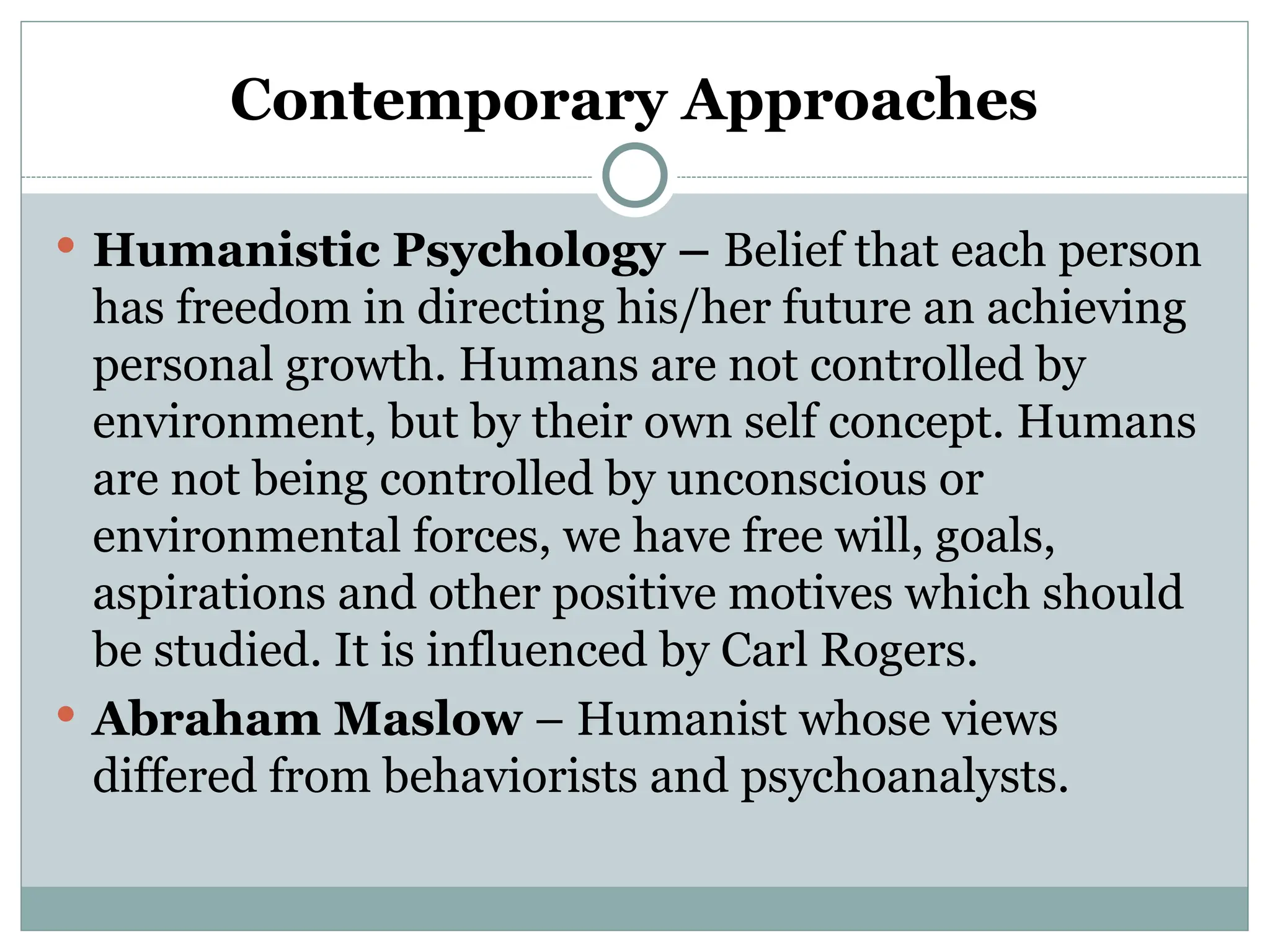
 Humanistic Psychology – Belief that each person
has freedom in directing his/her future an achieving
personal growth. Humans are not controlled by
environment, but by their own self concept. Humans
are not being controlled by unconscious or
environmental forces, we have free will, goals,
aspirations and other positive motives which should
be studied. It is influenced by Carl Rogers.
 Abraham Maslow – Humanist whose views
differed from behaviorists and psychoanalysts.
Contemporary Approaches
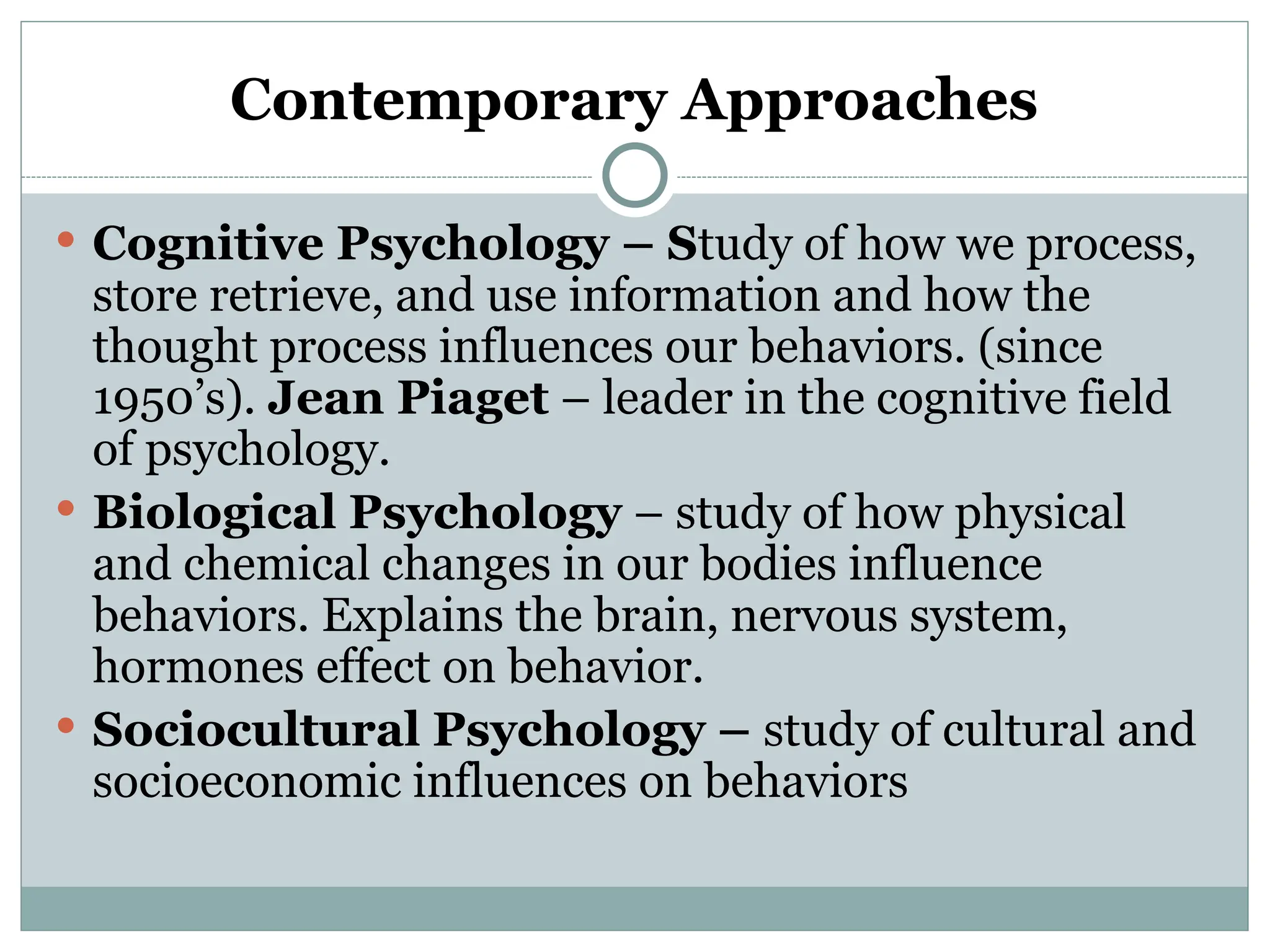
 Cognitive Psychology – Study of how we process,
store retrieve, and use information and how the
thought process influences our behaviors. (since
1950’s). Jean Piaget – leader in the cognitive field
of psychology.
 Biological Psychology – study of how physical
and chemical changes in our bodies influence
behaviors. Explains the brain, nervous system,
hormones effect on behavior.
 Sociocultural Psychology – study of cultural and
socioeconomic influences on behaviors
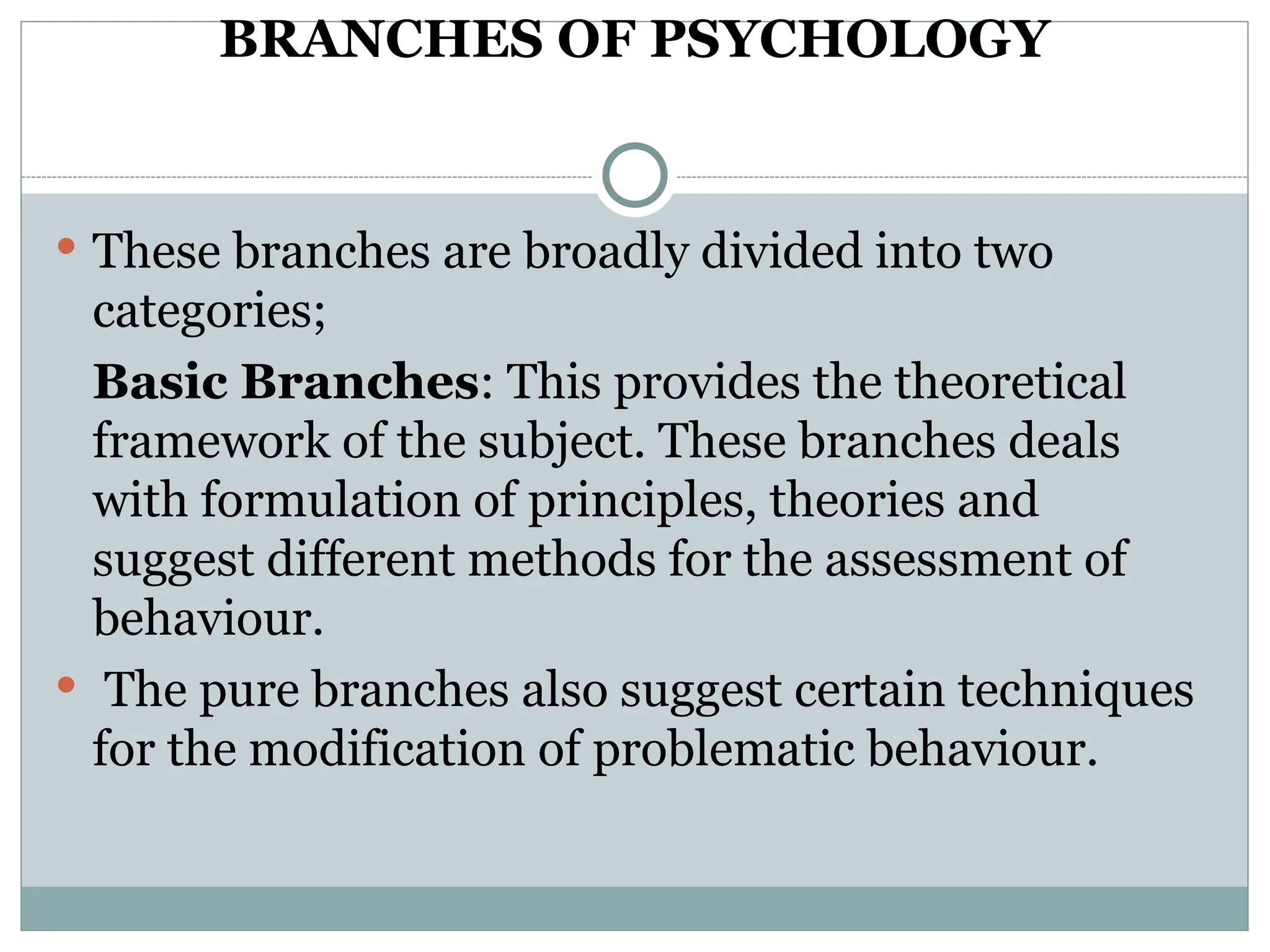
BRANCHES OF PSYCHOLOGY
 These branches are broadly divided into two
categories;
Basic Branches: This provides the theoretical
framework of the subject. These branches deals
with formulation of principles, theories and
suggest different methods for the assessment of
behaviour.
 The pure branches also suggest certain techniques
for the modification of problematic behaviour.
BRANCHES (Cont’d)
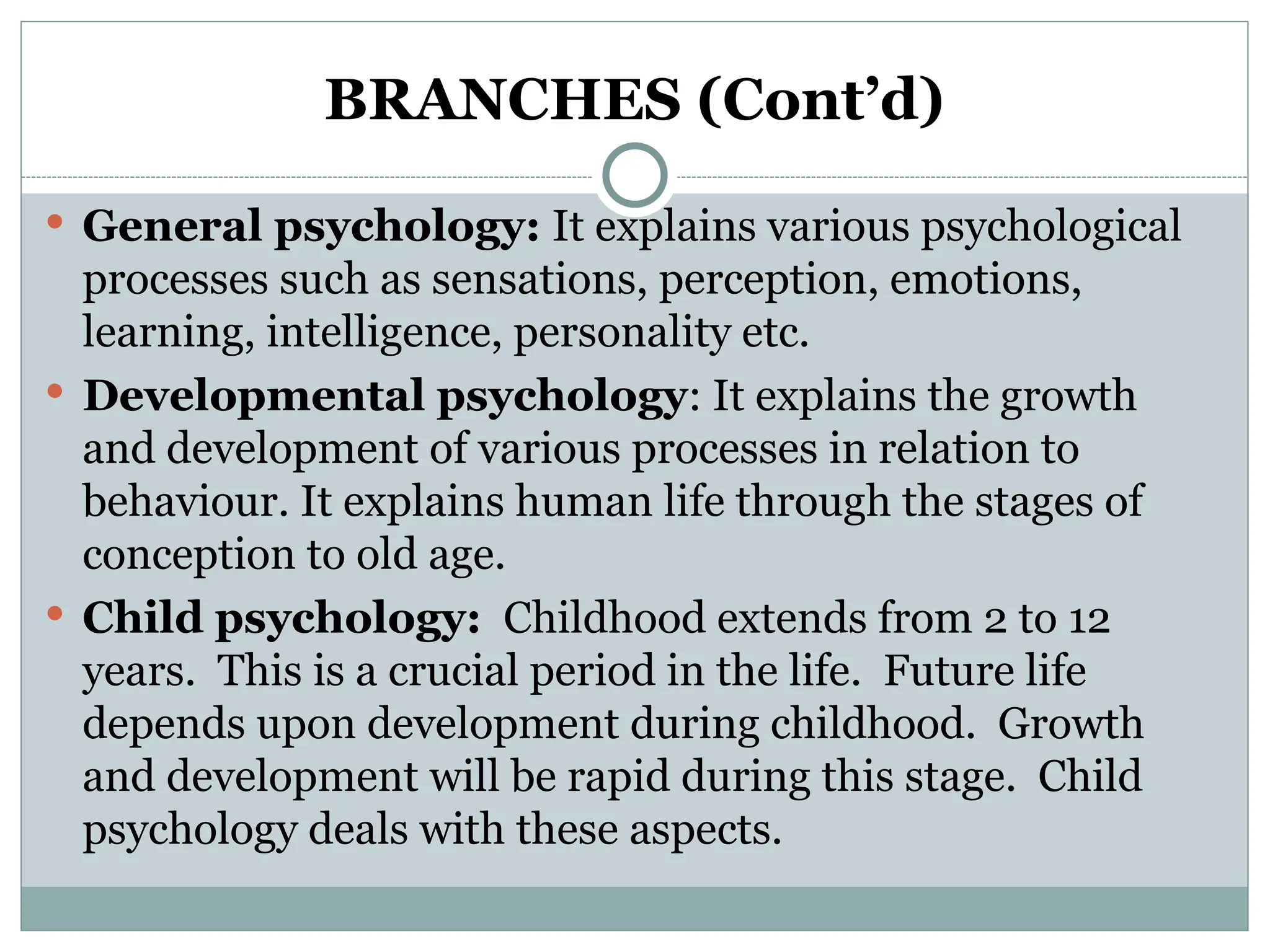
 General psychology: It explains various psychological
processes such as sensations, perception, emotions,
learning, intelligence, personality etc.
 Developmental psychology: It explains the growth
and development of various processes in relation to
behaviour. It explains human life through the stages of
conception to old age.
 Child psychology: Childhood extends from 2 to 12
years. This is a crucial period in the life. Future life
depends upon development during childhood. Growth
and development will be rapid during this stage. Child
psychology deals with these aspects.
BRANCHES (Cont’d)
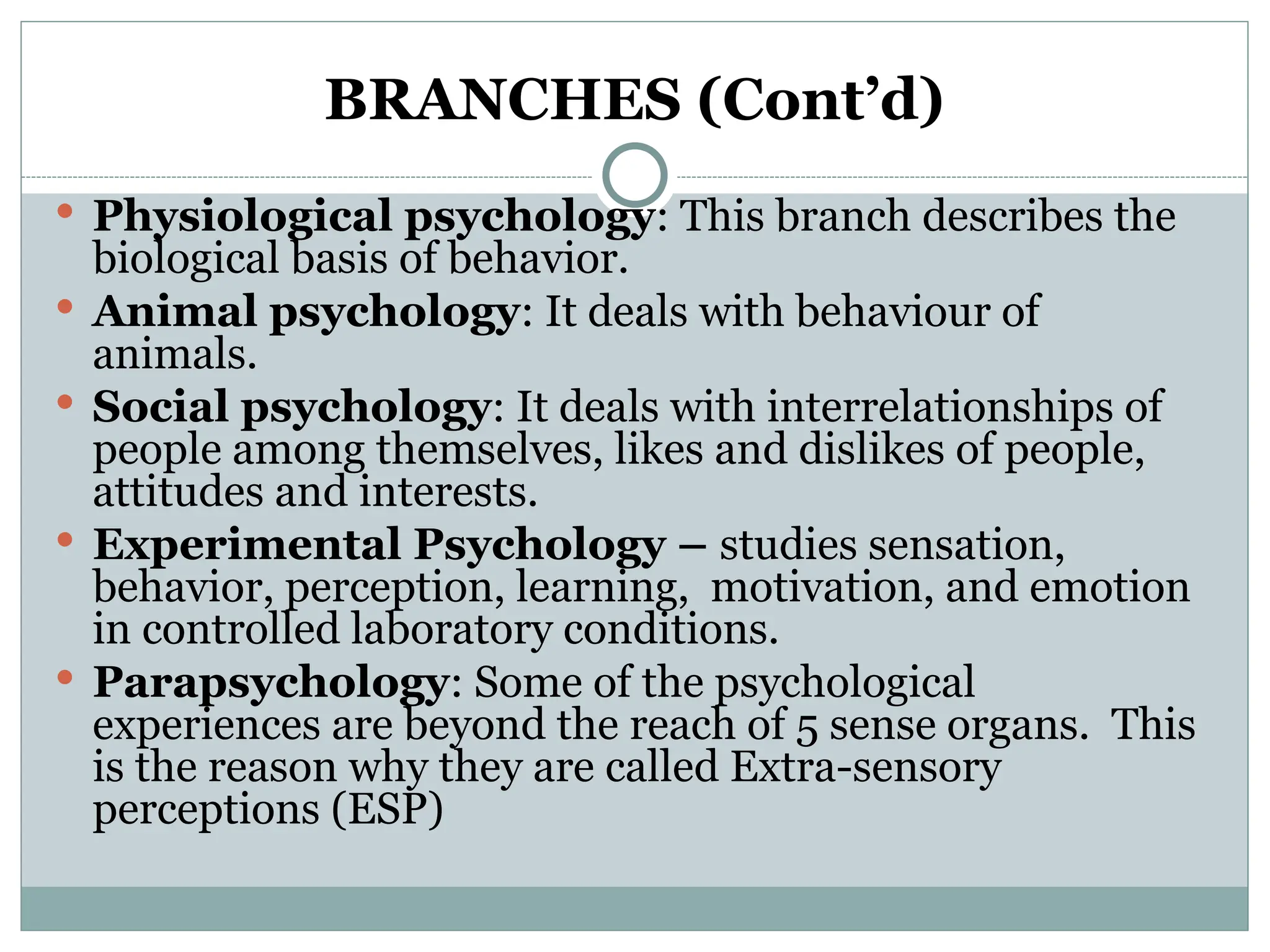
 Physiological psychology: This branch describes the
biological basis of behavior.
 Animal psychology: It deals with behaviour of
animals.
 Social psychology: It deals with interrelationships of
people among themselves, likes and dislikes of people,
attitudes and interests.
 Experimental Psychology – studies sensation,
behavior, perception, learning, motivation, and emotion
in controlled laboratory conditions.
 Parapsychology: Some of the psychological
experiences are beyond the reach of 5 sense organs. This
is the reason why they are called Extra-sensory
perceptions (ESP)
BRANCHES (Cont’d)
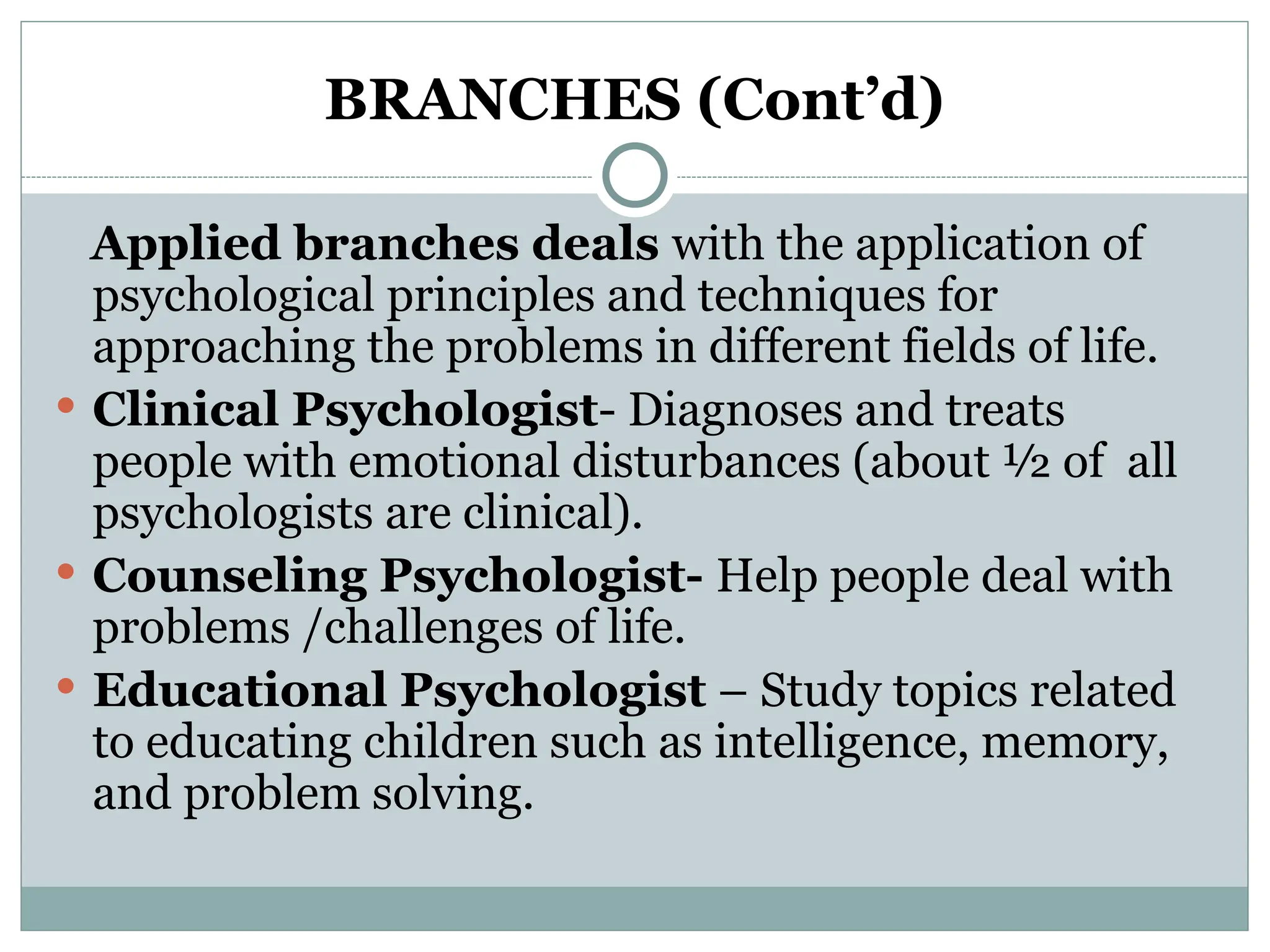
Applied branches deals with the application of
psychological principles and techniques for
approaching the problems in different fields of life.
 Clinical Psychologist- Diagnoses and treats
people with emotional disturbances (about ½ of all
psychologists are clinical).
 Counseling Psychologist- Help people deal with
problems /challenges of life.
 Educational Psychologist – Study topics related
to educating children such as intelligence, memory,
and problem solving.
BRANCHES (Cont’d)
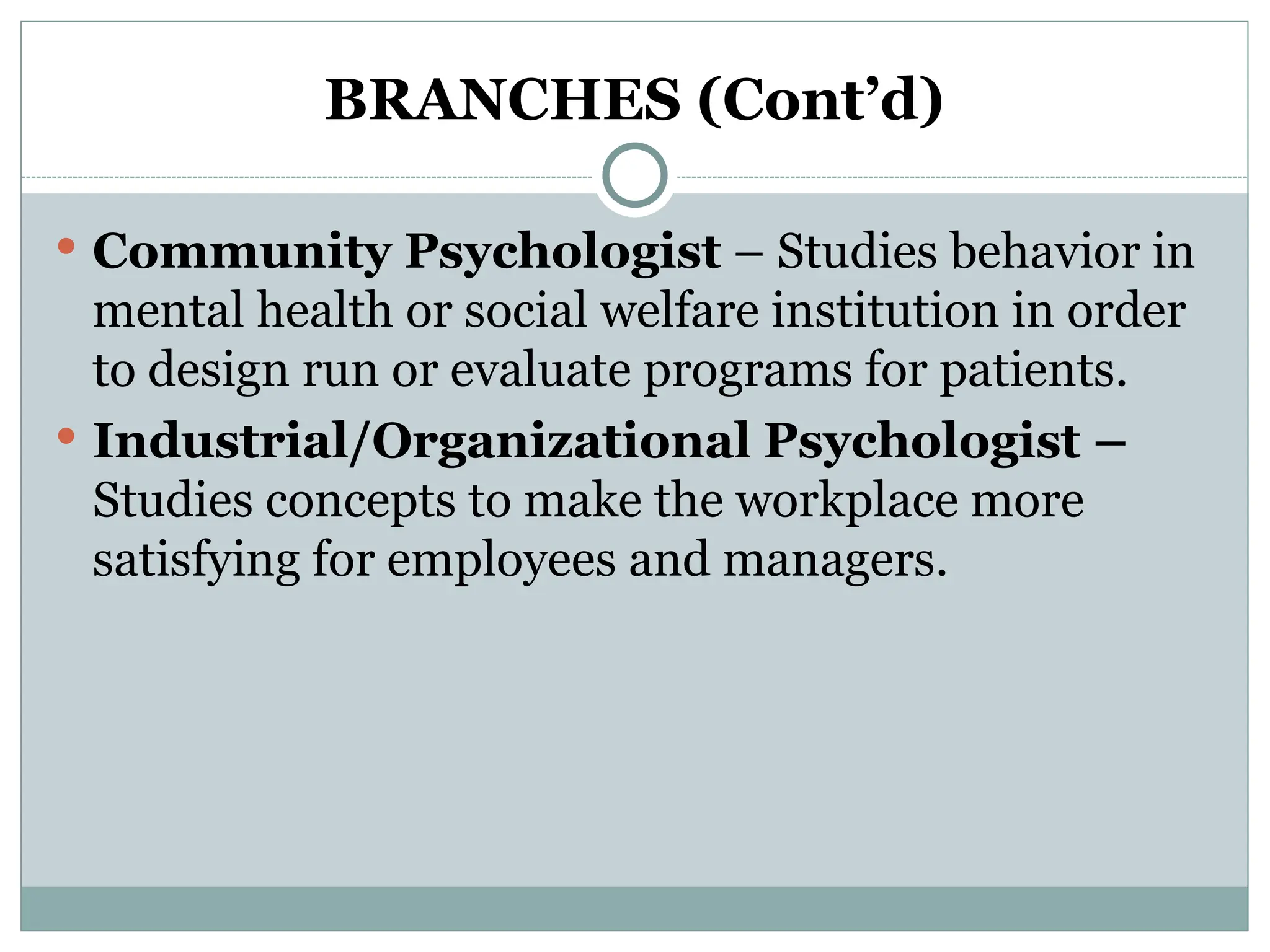
 Community Psychologist – Studies behavior in
mental health or social welfare institution in order
to design run or evaluate programs for patients.
 Industrial/Organizational Psychologist –
Studies concepts to make the workplace more
satisfying for employees and managers.
BRANCHES (End)
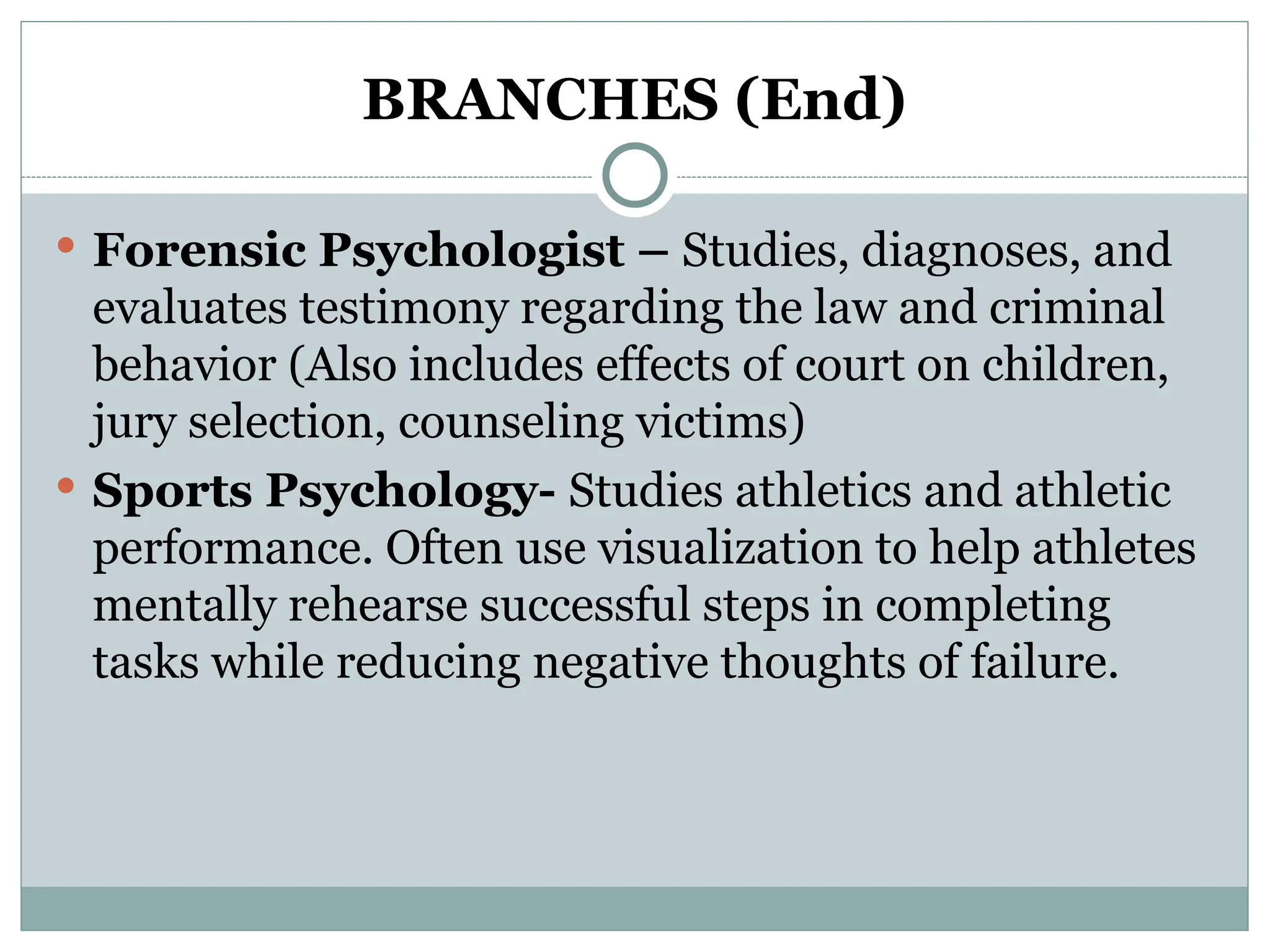
 Forensic Psychologist – Studies, diagnoses, and
evaluates testimony regarding the law and criminal
behavior (Also includes effects of court on children,
jury selection, counseling victims)
 Sports Psychology- Studies athletics and athletic
performance. Often use visualization to help athletes
mentally rehearse successful steps in completing
tasks while reducing negative thoughts of failure.

PRESENTATION ON INTRODUCTION TO PSYCHOLOGY--.ppt

  • 1.
    INTRODUCTION TO PSYCHOLOGY NSC240: PSYCHOLOGY APPLIED TO NURSING
  • 2.
    PSYCHOLOGY  The scientificstudy of behavior and the mental process that is tested through scientific research.  The field is scientific in that approaches (should be systematic in approach) to studies are done orderly and systematically in order to obtain objective evidence.
  • 3.
    PSYCHOLOGY  Psychologists studyovert and covert behavior.  The overt behaviors are observable behavior, while covert behaviors include private mental processes that cannot be directly observed or measured and must be inferred from overt behavior.  Examples of overt behaviours are; laughing, walking, eating, gestures, facial expression etc and covert behaviour include the following; Perceiving, remembering, reasoning, thinking, creating, feelings etc
  • 4.
    GOALS OF PSYCHOLOGY Psychologists seek to do four things when studying behaviors:  Describe: What is the nature of the behavior? It gathers information on studied behavior and present what is known.  Explain: Why does it occur? Creating a hypothesis (educated guess) to understand why a behavior is practiced.  Predict: By studying past behaviors, future behaviors can be predicted based upon theory  Control behavior: What factors influence the behavior? Influence- using what is known to influence future behavior.
  • 5.
    HISTORICAL APPROACH TO PSYCHOLOGY Structuralism – Study of basic elements that make up human experiences.  Wilhelm Wundt – In 1879, used people’s self observations about their thoughts (introspection) to map out structure of the thought process.  Functionalism – study of the function or how people & animals adapt to environment. William James – known as the “father of psychology” taught first psych class in 1875 and wrote first textbook in 1890. He was concerned with ongoing conscious experience and the functions of mental processes. His views gave rise to the branch of psychology called Functionalism.
  • 6.
    HISTORICAL APPROACH (Cont’d) Inheritable Traits – study of how heredity influences a person’s ability, character, and behavior. Is behavior determined by heredity or environment?  Sir Francis Galton – Concluded that intelligence was hereditary / good marriages would supply the world with talented offspring. (1883).  Gestalt Psychology - Perception is more than the sum of its parts – it involves a whole pattern. German group that picked apart cognitive thought process.
  • 7.
    HISTORICAL APPROACH (Cont’d) Contemporary Approaches to Psychology (mid 1900’s to Present)  Psychoanalytic Psychology- study of unconscious motives & conflict determine behavior. Sigmund Freud – used free association and dream analysis to study behavior (1940).  Behaviorism – Study of how organisms learn or change behavior based upon responses to events in their environment. (Early-mid1900’s). it held the view that only overt behavior can be studied scientifically. They advocated the use of strict experimental procedure in psychology.
  • 8.
    Contemporary Approaches toPsychology (mid 1900’s to Present)  Strict behaviorists believed that all behaviours are shaped by the environment. “Give me a dozen healthy infants, well-formed,….. regardless of his talents, penchants, tendencies, abilities, vocations, and race of his ancestors”…….John Watson.  Ivan Pavlov – Classical conditioning experiment with dog’s salivation.  B.F. Skinner – Introduced concept reinforcement to show how behaviors repeat.  John B. Watson –Behavior occurs due to stimuli in environment.
  • 9.
    Contemporary Approaches  HumanisticPsychology – Belief that each person has freedom in directing his/her future an achieving personal growth. Humans are not controlled by environment, but by their own self concept. Humans are not being controlled by unconscious or environmental forces, we have free will, goals, aspirations and other positive motives which should be studied. It is influenced by Carl Rogers.  Abraham Maslow – Humanist whose views differed from behaviorists and psychoanalysts.
  • 10.
    Contemporary Approaches  CognitivePsychology – Study of how we process, store retrieve, and use information and how the thought process influences our behaviors. (since 1950’s). Jean Piaget – leader in the cognitive field of psychology.  Biological Psychology – study of how physical and chemical changes in our bodies influence behaviors. Explains the brain, nervous system, hormones effect on behavior.  Sociocultural Psychology – study of cultural and socioeconomic influences on behaviors
  • 11.
    BRANCHES OF PSYCHOLOGY These branches are broadly divided into two categories; Basic Branches: This provides the theoretical framework of the subject. These branches deals with formulation of principles, theories and suggest different methods for the assessment of behaviour.  The pure branches also suggest certain techniques for the modification of problematic behaviour.
  • 12.
    BRANCHES (Cont’d)  Generalpsychology: It explains various psychological processes such as sensations, perception, emotions, learning, intelligence, personality etc.  Developmental psychology: It explains the growth and development of various processes in relation to behaviour. It explains human life through the stages of conception to old age.  Child psychology: Childhood extends from 2 to 12 years. This is a crucial period in the life. Future life depends upon development during childhood. Growth and development will be rapid during this stage. Child psychology deals with these aspects.
  • 13.
    BRANCHES (Cont’d)  Physiologicalpsychology: This branch describes the biological basis of behavior.  Animal psychology: It deals with behaviour of animals.  Social psychology: It deals with interrelationships of people among themselves, likes and dislikes of people, attitudes and interests.  Experimental Psychology – studies sensation, behavior, perception, learning, motivation, and emotion in controlled laboratory conditions.  Parapsychology: Some of the psychological experiences are beyond the reach of 5 sense organs. This is the reason why they are called Extra-sensory perceptions (ESP)
  • 14.
    BRANCHES (Cont’d) Applied branchesdeals with the application of psychological principles and techniques for approaching the problems in different fields of life.  Clinical Psychologist- Diagnoses and treats people with emotional disturbances (about ½ of all psychologists are clinical).  Counseling Psychologist- Help people deal with problems /challenges of life.  Educational Psychologist – Study topics related to educating children such as intelligence, memory, and problem solving.
  • 15.
    BRANCHES (Cont’d)  CommunityPsychologist – Studies behavior in mental health or social welfare institution in order to design run or evaluate programs for patients.  Industrial/Organizational Psychologist – Studies concepts to make the workplace more satisfying for employees and managers.
  • 16.
    BRANCHES (End)  ForensicPsychologist – Studies, diagnoses, and evaluates testimony regarding the law and criminal behavior (Also includes effects of court on children, jury selection, counseling victims)  Sports Psychology- Studies athletics and athletic performance. Often use visualization to help athletes mentally rehearse successful steps in completing tasks while reducing negative thoughts of failure.