CROWDFUNDING – WILL IT WORK IN INDIA?
BANKING AND FINANCIAL SERVICES CONFERENCE
ON SATURDAY, 14TH FEBRUARY, 2015
WHAT IS CROWDFUNDING
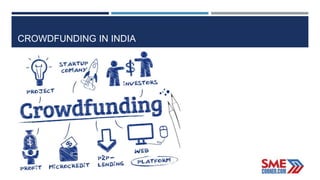
 Crowdfunding is the practice of funding a project or venture by raising many small amounts of money
from a large number of people, typically via the Internet.*
 The project owners / companies that are looking for crowd-funding own 100% of their company
 Crowdfunding has existed for centuries – where artists worked in similar ways through patrons and
subscribers
 But, in recent years it is considered a new phenomenon, turbo charged by the internet
 Backing a project is more than just giving money
 The idea behind crowdfunding is to help and create a collaborative eco-system where the entire
economy benefits
 Encouraging new & small businesses to think creative and innovate, growing the overall economy &
increasing the customer base
• Source – investopedia
• kickstarter
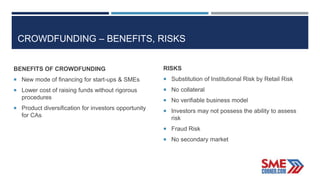
CROWDFUNDING – BENEFITS, RISKS
BENEFITS OF CROWDFUNDING
 New mode of financing for start-ups & SMEs
 Lower cost of raising funds without rigorous
procedures
 Product diversification for investors opportunity
for CAs
RISKS
 Substitution of Institutional Risk by Retail Risk
 No collateral
 No verifiable business model
 Investors may not possess the ability to assess
risk
 Fraud Risk
 No secondary market
HOW DOES CROWDFUNDING WORK
1. Registration on a good Crowdfunding portal
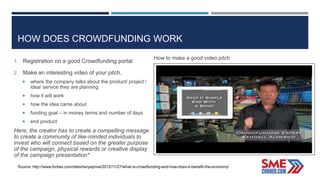
2. Make an interesting video of your pitch.
 where the company talks about the product/ project /
idea/ service they are planning
 how it will work
 how the idea came about
 funding goal – in money terms and number of days
 end product
Here, the creator has to create a compelling message
to create a community of like-minded individuals to
invest who will connect based on the greater purpose
of the campaign, physical rewards or creative display
of the campaign presentation*
Source: http://www.forbes.com/sites/tanyaprive/2012/11/27/what-is-crowdfunding-and-how-does-it-benefit-the-economy/
How to make a good video pitch
HOW DOES CROWDFUNDING WORK…..
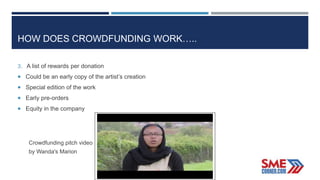
3. A list of rewards per donation
 Could be an early copy of the artist’s creation
 Special edition of the work
 Early pre-orders
 Equity in the company
Crowdfunding pitch video
by Wanda's Marion
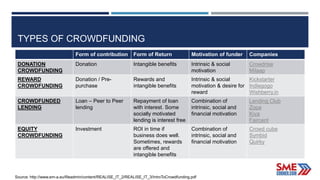
TYPES OF CROWDFUNDING
Form of contribution Form of Return Motivation of funder Companies
DONATION
CROWDFUNDING
Donation Intangible benefits Intrinsic & social
motivation
Crowdrise
Milaap
REWARD
CROWDFUNDING
Donation / Pre-
purchase
Rewards and
intangible benefits
Intrinsic & social
motivation & desire for
reward
Kickstarter
Indiegogo
Wishberry.in
CROWDFUNDED
LENDING
Loan – Peer to Peer
lending
Repayment of loan
with interest. Some
socially motivated
lending is interest free
Combination of
intrinsic, social and
financial motivation
Lending Club
Zopa
Kiva
Faircent
EQUITY
CROWDFUNDING
Investment ROI in time if
business does well.
Sometimes, rewards
are offered and
intangible benefits
Combination of
intrinsic, social and
financial motivation
Crowd cube
Symbid
Quirky
Source: http://www.em-a.eu/fileadmin/content/REALISE_IT_2/REALISE_IT_3/IntroToCrowdfunding.pdf
CROWDFUNDING – WHAT, HOW, WHY, WHEN…
TRENDS IN CROWDFUNDING
 Crowdfunding has emerged as a viable and scalable alternative to public and private finance
 In 2011, crowdfunding platforms raised $1.5 bn. In 2012, the platforms raised $2.7 bn – 80% up
 In 2013, over $ 5.1 bn was raised – almost double of 2012. This number has gone up exponentially in
2014.
 More than a million campaigns have been successfully funded through crowdfunding
 More than 400 campaigns are launched on a daily basis using crowdfunding platforms
 More than $60k are raised hourly
Source:
• http://en.wikipedia.org/wiki/Crowdfunding
• http://www.crowdsourcing.org/editorial/2013cf-the-crowdfunding-industry-
report/25107?utm_source=website&utm_medium=text&utm_content=LP+bottom&utm_campaign=2013CF+Launch
• Catherine Clifford (19 May 2014). "Crowdfunding Generates More Than $60,000 an Hour (Infographic)". Entrepreneur. Entrepreneur Media, Inc.
Retrieved 25 May 2014.
CROWDFUNDING IN INDIA
1. www.start51.com
2. www.wishberry.in
3. www.catapoolt.com
4. www.indiegogo.com
5. www.bitgiving.com
6. www.igniteintent.com
7. www.thelotstart.com
8. www.funddreamsindia.com
9. www.milaap.org – Donation based
10. www.pikaventure.com
11. www.makeitnow.com
12. www.fundbased.com
Fees typically vary between 5-10% fees + set up fee of Rs. 2500-5000
LEGAL ASPECTS OF CROWDFUNDING
 Raising funds regulated under Companies Act 2013, SEBI Act 1992, Securities Contracts (Regulation) Act
1956 and Depositories Act 1996.
 Companies Act 2013 requires a company seeking funding from general public to do so through a
regulated document if more than 50 persons are offered to invest.
 As per chapter III –The Companies (Prospectus and Allotment of Securities) Rules 2014, in the case of
private placement of securities, invitation cannot be made to more than 200 persons in a year.
 SEBI has already given its consultation paper on Crowdfunding and has sought feedback on the
proposed regulations.
SEBI ROLE IN CROWDFUNDING
 Recognition of the Crowdfunding portals
 Oversight and Regulation of Crowdfunding market in India
 Playing NO role in vetting of the Private placements offer letter
 Issuance of guidelines/circular regarding information to be disclosed in the private placement offer letter
 Conduct of periodic inspections or audits of Crowdfunding platforms
SEBI PROPOSED CF GUIDELINES
It is, proposed that the additional channel of crowdfunding platform to raise modest amount of funds is allowed to
be accessed by early stage start-up or SME which is an unlisted public company incorporated in India, provided it
is:
 A company intending to raise capital not exceeding Rs. 10 Crores in a period of 12 months. Companies which
intend to make issue more than size of Rs.10 Crores may raise funds by complying with the provisions of SEBI
(ICDR) Regulations and list them on a SME Platform or main board of a recognized stock exchange
 A company which is not promoted, sponsored or related to an industrial group which has a turnover in excess of
Rs. 25 Crores or has an established business
 A company which is not listed on any exchange
 A company which is not more than 48 months old
 A company which proposes to engage in non-financing ventures, i.e. funds raised through the crowdfunding
platform will not be further used for providing loans or investments in other entities, and
 A company which is not engaged in real estate and activities which are not permitted under industrial policy of
Government of India
SEBI PROPOSED CF GUIDELINES…..
To ensure only genuine entities raise funds through this mode:
 The issuing company, its directors, promoters or associates have not been prohibited from accessing or
operating in the capital markets or restrained from buying, selling or dealing in securities under any order or
direction passed by the SEBI.
 The issuing company, its directors, promoters or associates are not mentioned as a 'defaulter' or a ‘wilful
defaulter' by RBI or CIBIL.
 The director(s) or promoter(s) are not disqualified to be appointed as director(s) under the Companies Act 2013.
 The issuing company, its directors, promoters or associates are 'fit and proper' persons as specified under the
Schedule II of the SEBI (Intermediaries) Regulations, 2008.
SEBI PROPOSED CF GUIDELINES…..
The issuers must also comply with the following:
 In a given period of 12 months, Issuers shall not use multiple crowdfunding platforms to raise funds.
 Issuers shall not directly or indirectly advertise their offering to public in general or solicit investments from the
public.
 Issuer shall compulsorily route all crowdfunding issues through a SEBI recognized Crowdfunding Platform.
 Issuers shall not directly or indirectly incentivize or compensate any person to promote its offering.
 Issuers shall provide provisions for oversubscription. This may include maximum oversubscription amount to be
retained, which should not exceed 25% of the actual issue size; intended usage of the oversubscribed amount.
The total amount retained, including the actual issue size and oversubscription, shall not exceed the limit of Rs.
10 Crores.
SEBI PROPOSED CF GUIDELINES…..
It is proposed that the entities who fall in any of the following classes be allowed to set up a crowdfunding platform.
Class I Entities:
 Recognized Stock Exchanges with nationwide terminal presence (RSEs)
 SEBI registered Depositories
In addition to the entities mentioned above, it is proposed that the another class of entities with relevant experience
and domain knowledge be allowed to launch Crowdfunding platforms to ensure a healthy competition in the
market, provided they satisfy the requirements specified by SEBI.
Class II Entities:
 Technology Business Incubators (TBIs)
 Promoted by Central Government or any State Government through bodies such as NSTEDB (National
Science & Technology Entrepreneurship Development Board) under Department of Science & Technology
SEBI PROPOSED CF GUIDELINES….
 Functioning as a society registered under societies act of 1860/or as a non-profit making section 8 company,
 Having at least 5 years of experience,
 Having a minimum net worth of Rs. 10 Crores o should have attained self-sufficiency and,
 Should display only those companies which share a common focus thrust areas as the TBI
Class III Entities:
 Associations and Networks of PE or Angel Investors
 With a track record of a minimum of 3 years
 With a minimum member strength of 100 active members from the relevant industry
 Which are registered as Section 8 companies under Companies Act 2013 with a paid up share capital of Rs. 2
Crores
CONCLUSION
 Crowdfunding set to explode globally in the coming years
 India market also ready and prepared to introduce and accept Crowdfunding as a concept
 SEBI has already framed the proposed regulation which should be passed in 2015
 Huge opportunities for CAs to play a big role in this area
Thank You
SAMIR BHATIA

Crowdfunding - Will it work in India?

  • 1.
    CROWDFUNDING – WILLIT WORK IN INDIA? BANKING AND FINANCIAL SERVICES CONFERENCE ON SATURDAY, 14TH FEBRUARY, 2015
  • 2.
    WHAT IS CROWDFUNDING Crowdfunding is the practice of funding a project or venture by raising many small amounts of money from a large number of people, typically via the Internet.*  The project owners / companies that are looking for crowd-funding own 100% of their company  Crowdfunding has existed for centuries – where artists worked in similar ways through patrons and subscribers  But, in recent years it is considered a new phenomenon, turbo charged by the internet  Backing a project is more than just giving money  The idea behind crowdfunding is to help and create a collaborative eco-system where the entire economy benefits  Encouraging new & small businesses to think creative and innovate, growing the overall economy & increasing the customer base • Source – investopedia • kickstarter
  • 3.
    CROWDFUNDING – BENEFITS,RISKS BENEFITS OF CROWDFUNDING  New mode of financing for start-ups & SMEs  Lower cost of raising funds without rigorous procedures  Product diversification for investors opportunity for CAs RISKS  Substitution of Institutional Risk by Retail Risk  No collateral  No verifiable business model  Investors may not possess the ability to assess risk  Fraud Risk  No secondary market
  • 4.
    HOW DOES CROWDFUNDINGWORK 1. Registration on a good Crowdfunding portal 2. Make an interesting video of your pitch.  where the company talks about the product/ project / idea/ service they are planning  how it will work  how the idea came about  funding goal – in money terms and number of days  end product Here, the creator has to create a compelling message to create a community of like-minded individuals to invest who will connect based on the greater purpose of the campaign, physical rewards or creative display of the campaign presentation* Source: http://www.forbes.com/sites/tanyaprive/2012/11/27/what-is-crowdfunding-and-how-does-it-benefit-the-economy/ How to make a good video pitch
  • 5.
    HOW DOES CROWDFUNDINGWORK….. 3. A list of rewards per donation  Could be an early copy of the artist’s creation  Special edition of the work  Early pre-orders  Equity in the company Crowdfunding pitch video by Wanda's Marion
  • 6.
    TYPES OF CROWDFUNDING Formof contribution Form of Return Motivation of funder Companies DONATION CROWDFUNDING Donation Intangible benefits Intrinsic & social motivation Crowdrise Milaap REWARD CROWDFUNDING Donation / Pre- purchase Rewards and intangible benefits Intrinsic & social motivation & desire for reward Kickstarter Indiegogo Wishberry.in CROWDFUNDED LENDING Loan – Peer to Peer lending Repayment of loan with interest. Some socially motivated lending is interest free Combination of intrinsic, social and financial motivation Lending Club Zopa Kiva Faircent EQUITY CROWDFUNDING Investment ROI in time if business does well. Sometimes, rewards are offered and intangible benefits Combination of intrinsic, social and financial motivation Crowd cube Symbid Quirky Source: http://www.em-a.eu/fileadmin/content/REALISE_IT_2/REALISE_IT_3/IntroToCrowdfunding.pdf
  • 7.
    CROWDFUNDING – WHAT,HOW, WHY, WHEN…
  • 8.
    TRENDS IN CROWDFUNDING Crowdfunding has emerged as a viable and scalable alternative to public and private finance  In 2011, crowdfunding platforms raised $1.5 bn. In 2012, the platforms raised $2.7 bn – 80% up  In 2013, over $ 5.1 bn was raised – almost double of 2012. This number has gone up exponentially in 2014.  More than a million campaigns have been successfully funded through crowdfunding  More than 400 campaigns are launched on a daily basis using crowdfunding platforms  More than $60k are raised hourly Source: • http://en.wikipedia.org/wiki/Crowdfunding • http://www.crowdsourcing.org/editorial/2013cf-the-crowdfunding-industry- report/25107?utm_source=website&utm_medium=text&utm_content=LP+bottom&utm_campaign=2013CF+Launch • Catherine Clifford (19 May 2014). "Crowdfunding Generates More Than $60,000 an Hour (Infographic)". Entrepreneur. Entrepreneur Media, Inc. Retrieved 25 May 2014.
  • 9.
  • 10.
    CROWDFUNDING IN INDIA 1.www.start51.com 2. www.wishberry.in 3. www.catapoolt.com 4. www.indiegogo.com 5. www.bitgiving.com 6. www.igniteintent.com 7. www.thelotstart.com 8. www.funddreamsindia.com 9. www.milaap.org – Donation based 10. www.pikaventure.com 11. www.makeitnow.com 12. www.fundbased.com Fees typically vary between 5-10% fees + set up fee of Rs. 2500-5000
  • 11.
    LEGAL ASPECTS OFCROWDFUNDING  Raising funds regulated under Companies Act 2013, SEBI Act 1992, Securities Contracts (Regulation) Act 1956 and Depositories Act 1996.  Companies Act 2013 requires a company seeking funding from general public to do so through a regulated document if more than 50 persons are offered to invest.  As per chapter III –The Companies (Prospectus and Allotment of Securities) Rules 2014, in the case of private placement of securities, invitation cannot be made to more than 200 persons in a year.  SEBI has already given its consultation paper on Crowdfunding and has sought feedback on the proposed regulations.
  • 12.
    SEBI ROLE INCROWDFUNDING  Recognition of the Crowdfunding portals  Oversight and Regulation of Crowdfunding market in India  Playing NO role in vetting of the Private placements offer letter  Issuance of guidelines/circular regarding information to be disclosed in the private placement offer letter  Conduct of periodic inspections or audits of Crowdfunding platforms
  • 13.
    SEBI PROPOSED CFGUIDELINES It is, proposed that the additional channel of crowdfunding platform to raise modest amount of funds is allowed to be accessed by early stage start-up or SME which is an unlisted public company incorporated in India, provided it is:  A company intending to raise capital not exceeding Rs. 10 Crores in a period of 12 months. Companies which intend to make issue more than size of Rs.10 Crores may raise funds by complying with the provisions of SEBI (ICDR) Regulations and list them on a SME Platform or main board of a recognized stock exchange  A company which is not promoted, sponsored or related to an industrial group which has a turnover in excess of Rs. 25 Crores or has an established business  A company which is not listed on any exchange  A company which is not more than 48 months old  A company which proposes to engage in non-financing ventures, i.e. funds raised through the crowdfunding platform will not be further used for providing loans or investments in other entities, and  A company which is not engaged in real estate and activities which are not permitted under industrial policy of Government of India
  • 14.
    SEBI PROPOSED CFGUIDELINES….. To ensure only genuine entities raise funds through this mode:  The issuing company, its directors, promoters or associates have not been prohibited from accessing or operating in the capital markets or restrained from buying, selling or dealing in securities under any order or direction passed by the SEBI.  The issuing company, its directors, promoters or associates are not mentioned as a 'defaulter' or a ‘wilful defaulter' by RBI or CIBIL.  The director(s) or promoter(s) are not disqualified to be appointed as director(s) under the Companies Act 2013.  The issuing company, its directors, promoters or associates are 'fit and proper' persons as specified under the Schedule II of the SEBI (Intermediaries) Regulations, 2008.
  • 15.
    SEBI PROPOSED CFGUIDELINES….. The issuers must also comply with the following:  In a given period of 12 months, Issuers shall not use multiple crowdfunding platforms to raise funds.  Issuers shall not directly or indirectly advertise their offering to public in general or solicit investments from the public.  Issuer shall compulsorily route all crowdfunding issues through a SEBI recognized Crowdfunding Platform.  Issuers shall not directly or indirectly incentivize or compensate any person to promote its offering.  Issuers shall provide provisions for oversubscription. This may include maximum oversubscription amount to be retained, which should not exceed 25% of the actual issue size; intended usage of the oversubscribed amount. The total amount retained, including the actual issue size and oversubscription, shall not exceed the limit of Rs. 10 Crores.
  • 16.
    SEBI PROPOSED CFGUIDELINES….. It is proposed that the entities who fall in any of the following classes be allowed to set up a crowdfunding platform. Class I Entities:  Recognized Stock Exchanges with nationwide terminal presence (RSEs)  SEBI registered Depositories In addition to the entities mentioned above, it is proposed that the another class of entities with relevant experience and domain knowledge be allowed to launch Crowdfunding platforms to ensure a healthy competition in the market, provided they satisfy the requirements specified by SEBI. Class II Entities:  Technology Business Incubators (TBIs)  Promoted by Central Government or any State Government through bodies such as NSTEDB (National Science & Technology Entrepreneurship Development Board) under Department of Science & Technology
  • 17.
    SEBI PROPOSED CFGUIDELINES….  Functioning as a society registered under societies act of 1860/or as a non-profit making section 8 company,  Having at least 5 years of experience,  Having a minimum net worth of Rs. 10 Crores o should have attained self-sufficiency and,  Should display only those companies which share a common focus thrust areas as the TBI Class III Entities:  Associations and Networks of PE or Angel Investors  With a track record of a minimum of 3 years  With a minimum member strength of 100 active members from the relevant industry  Which are registered as Section 8 companies under Companies Act 2013 with a paid up share capital of Rs. 2 Crores
  • 18.
    CONCLUSION  Crowdfunding setto explode globally in the coming years  India market also ready and prepared to introduce and accept Crowdfunding as a concept  SEBI has already framed the proposed regulation which should be passed in 2015  Huge opportunities for CAs to play a big role in this area
  • 19.