

History of Comics
And Comics as an Educational Tool
      By: Samantha Abela
Who are we?

 • A group of people who
 Like comics and manga

 We organize various activities through out
  the year and participate in others in
  order to promote comic culture in Malta
  and abroad.
What do we
   do?
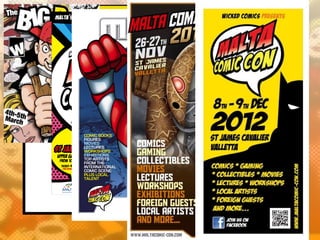
 We promote comic c ulture.      We provide various
                                 opportunities of
 We encourage the c reation      expos ure for Maltes e
 of c omics
                                 artis ts .
 We inform the public about      We organize activities
 new comic publications          to bring comics
 through reviews on our
 webs ite                        clos er to the public
                                 and provide a
 We provide a platform for       ‘cultural encounter’
 dis c us s ion about c omic s   with foreign comic
 and their us e in education.
                                 creators .
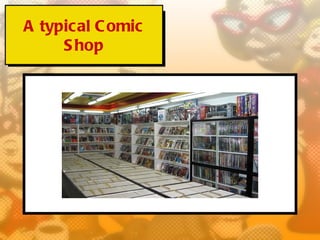
A typical C omic
     S hop
• “A comic book or comicbook is a magazine
  or book containing sequential art in the
  form of a narrative. Comic books are
  often called comics for short. Although
  the term implies otherwise, the subject
  matter in comic books is not necessarily
  humorous, and in fact its dramatic
  seriousness varies widely.”
• - Wikipedia, The Free Encyclopedia
C omic B ooks are wildly
        popular!


  • p From 2001-2006, comic books have grown
    from
  • a $75 million to a $330 million industry
  • a Movies and novels are now being made into
  • comic books specifically aimed at children
  • c Many popular writers, musicians and creative
  • designers are working with comics.
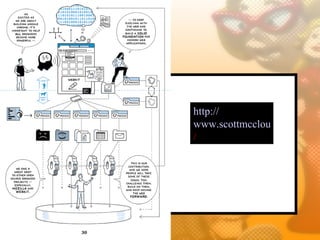
  • d Google Chrome presented by Scott McCloud.
http://
www.scottmccloud.com/goog
/
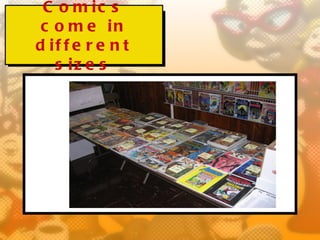
C o m ic s
 c o m e in
d if f e r e n t
   s iz e s
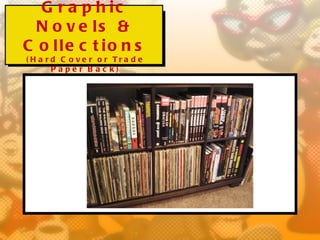
G r a p h ic
  N o v e ls &
C o lle c t io n s
( H a r d C o ve r o r Tr a d e
        Paper B ac k)
Dis s ecting a
 C omic (the
  bas ics )?
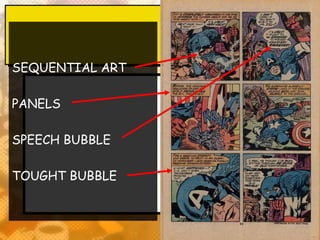
SEQUENTIAL ART

PANELS

SPEECH BUBBLE

TOUGHT BUBBLE
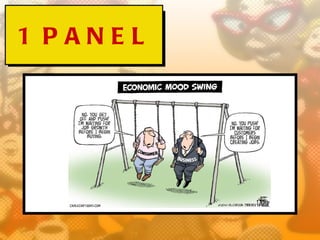
1 PANEL
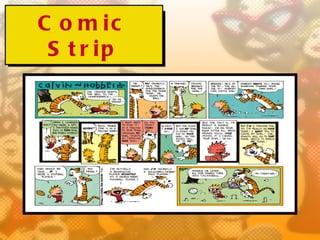
C o m ic
 S t r ip
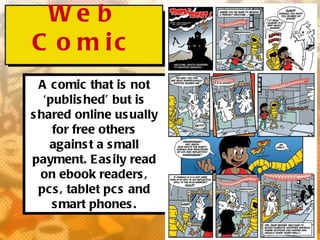
We b
C o m ic
  A comic that is not
   ‘publis hed’ but is
s hared online us ually
     for free others
    agains t a s mall
payment. E as ily read
  on ebook readers ,
  pcs , tablet pcs and
     s mart phones .
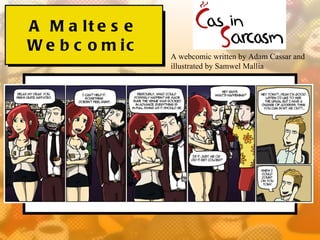
A M a lt e s e
W e b c o m ic
                 A webcomic written by Adam Cassar and
                 illustrated by Samwel Mallia
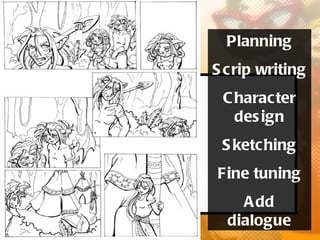
Planning
S crip writing
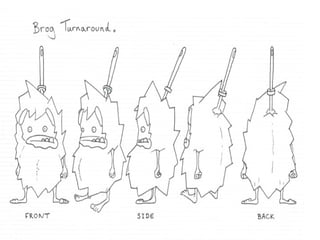
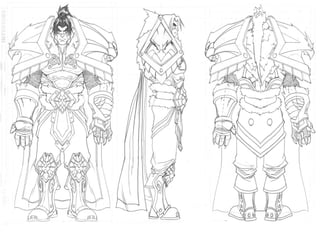
 C haracter
   des ign
 S ketching
Fine tuning
    A dd
  dialogue
C haracter
  Des ign
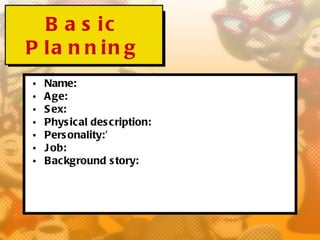
B a s ic
P la n n in g
•   Name:
•   A ge:
•   S ex:
•   Phys ic al des cription:
•   Pers onality:’
•   J ob:
•   B ackground s tory:
The C omic
A udience?

They are for everyone, from
toddlers , pre-readers up to
 grandparents ! A s long as
   you like a good s tory,
     reading and A rt!
Why create
 comics ?

• To s e nd a m e s s age
• F or fu n
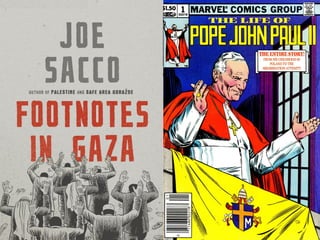
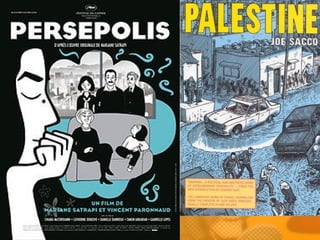
• To re cou nt tru e s torie s
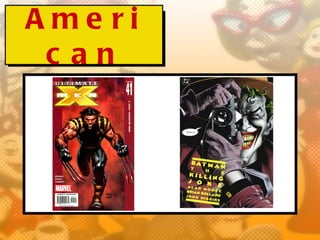
Ame ri
 c an
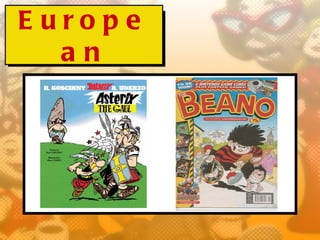
E urope
   an
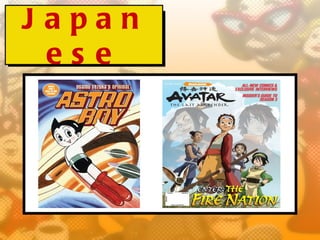
Japan
 ese
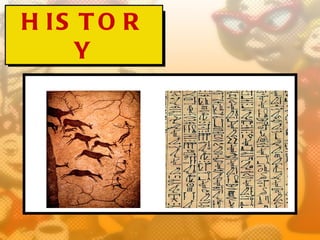
H IS T O R
     Y
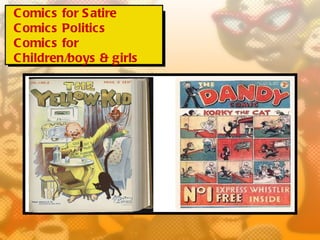
C omics for S atire
C omics Politics
C omics for
C hildren/boys & girls
THE
GOLDEN AGE
1930’s to mid 1950’s
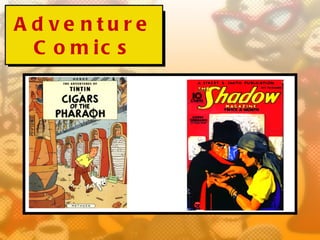
A d ve nture
  C o m ic s
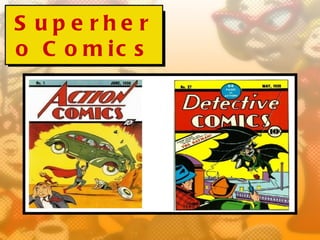
S upe rhe r
o C o m ic s
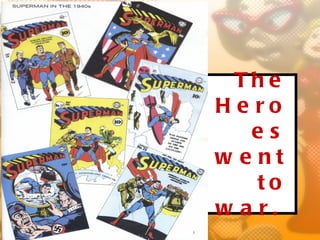
Th e
H e ro
   es
w e nt
    to
w a r.
THE
SILVER AGE
MID 50’s TO EARLY 70’s
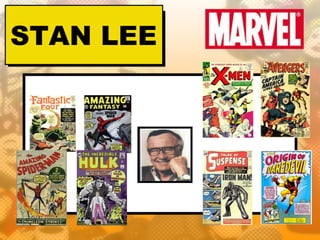
STAN LEE
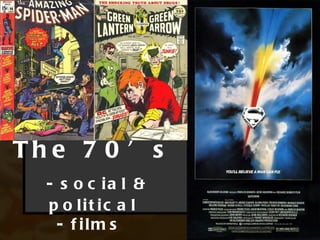
Th e 7 0 ’ s
  - s o c ia l &
  p o lit ic a l
    - f ilm s
TH E
M OD E R N
  A GE
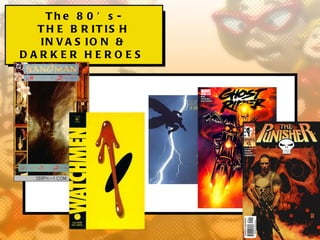
Th e 8 0 ’ s -
  T H E B R IT IS H
  IN V A S IO N &
DARKER HEROES
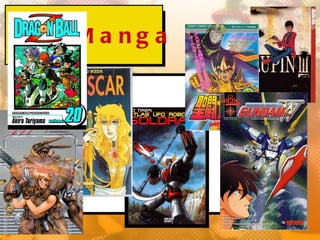
Ma ng a
90s
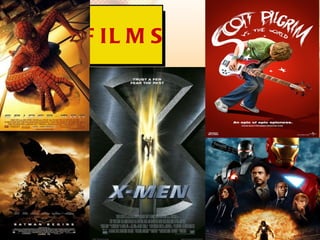
F IL M S
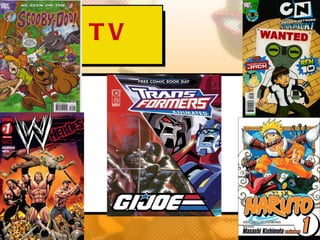
TV
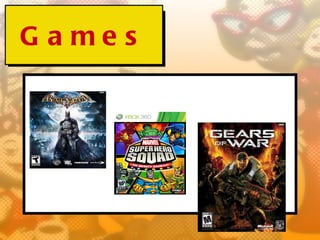
G a me s
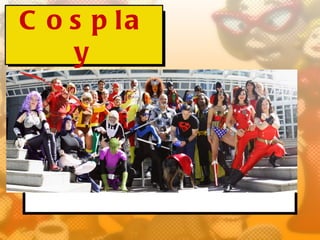
C o s p la
    y
C o m ic
C o n v e n t io n
        s
COMICS

•   FUN
•   SATISFACTION
•   INVESTMENT
•   COLLECTION


    READ and CREATE COMICS
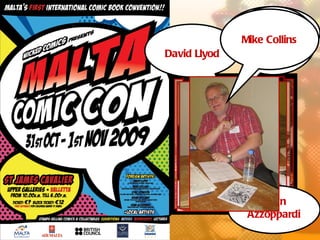
Mike Perkins
              Tim Collins
                 Warren
David Llyod      Pleece


                 Sean
               Azzoppardi
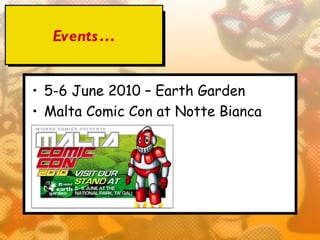
Events …


• 5-6 June 2010 – Earth Garden
• Malta Comic Con at Notte Bianca
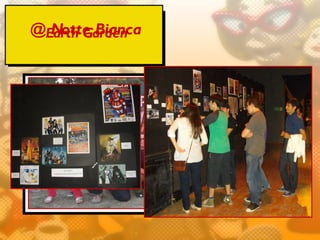
@Earth Garden
  Notte Bianca
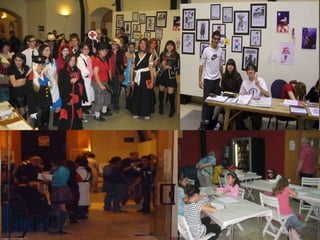
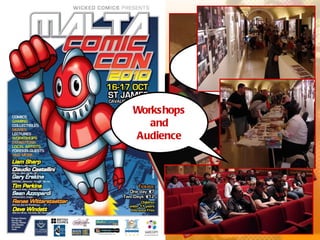
Dave Windett
              & Renee
            Witterstaette

Workshops
   and
Audience
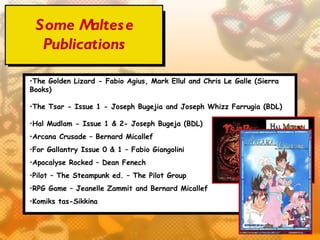
Some M  altes e
  Publications

•The Golden Lizard - Fabio Agius, Mark Ellul and Chris Le Galle (Sierra
Books)

•The Tsar - Issue 1 - Joseph Bugejia and Joseph Whizz Farrugia (BDL) 

•Hal Mudlam - Issue 1 & 2- Joseph Bugeja (BDL) 
•Arcana Crusade – Bernard Micallef
•For Gallantry Issue 0 & 1 – Fabio Giangolini
•Apocalyse Rocked – Dean Fenech
•Pilot – The Steampunk ed. – The Pilot Group
•RPG Game – Jeanelle Zammit and Bernard Micallef
•Komiks tas-Sikkina
Contact Us


• Facebook Group :
  http://www.facebook.com/profile.php?id
• Website:
  http://www.maltacomic-con.com/
Comics as an
Educational Tool
A brief history of
Comics in Education


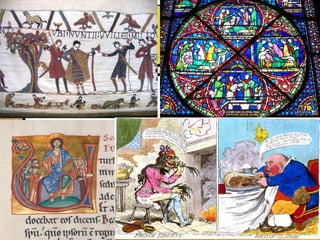
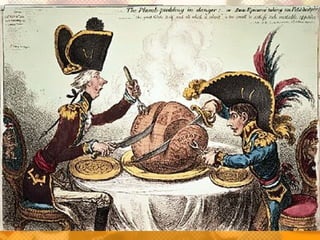
  • The first comics used to ‘educate’
    people were the political cartoons
    used to send messages about
    politics and social issues to the
    illiterate public
T h e f ir s t
 c o m ic s


• They were issued in the 1930’s (pre-
  WWII) and by the 1940’s an
  estimate of 95% of all 8-14 year
  olds read comics.
• 65% of the 15-18 year olds read
  comics too!
Whilst some see the
positive in the use of
 Comics in education
  others criticize…


  •   A stumbling block to literacy
  •   Impede reading comprehension
  •   Reduce imagination
  •   Provide eyestrain
Nonetheless…


• A ‘Scholarship on the Educational
  Value of Comics’ was established in
  America in the second half of the
  20th century
Still…


• Some criticized comics as promoting
  ‘violence’ and ‘delinquency’
• Of using ‘slang’ and ‘dialect’ too
  much…
Can comics be used
   as an effective
medium in education?


  • Yes! Comics can be used to transfer
    Knowledge!
  • They can be used as a ‘TOOL’ or
  • Use ‘Educational Comics’.
What are
Educational Comics?


  • These are comics devised on
    purpose to teach a subject / with a
    clear intent and message.
  • = a comic on Maltese legends /
    important events – Great Siege +
    Consalvo Monroy
Comics as
educational tool


 • These are comics that their initial
   purpose was not to ‘educate’ but for
   leisure. Nonetheless teachers and
   parents use them to teach:
•   History           • Science
•   Reading           • Social studies
•   Language
•   Culture context
•   Science
•   Story telling
Why use comics
in the classroom?


  • For pre-readers they provide
    practice for:
  • - sequencing
  • - prompts for language use (visual
    cues)
  • -connect words with images
• For Advance Readers
• - complexity of normal written word
  with visuals
• - a step-stone to more complex
  texts
• -make reading more approachable
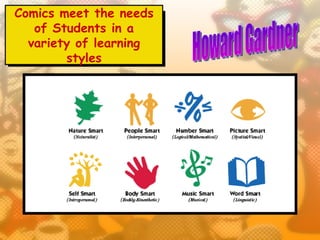
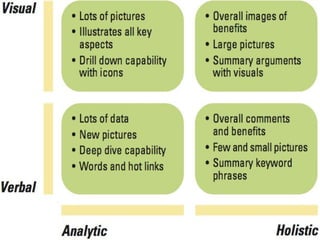
Comics meet the needs
   of Students in a
  variety of learning
        styles
L e a r n in
         g
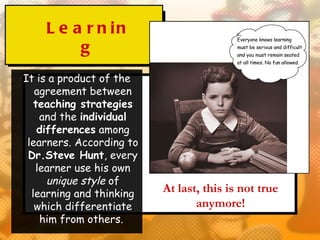
It is a product of the
   agreement between
   teaching strategies
    and the individual
    differences among
 learners. According to
 Dr.Steve Hunt, every
   learner use his own
      unique style of
  learning and thinking   At last, this is not true
   which differentiate           anymore!
    him from others.
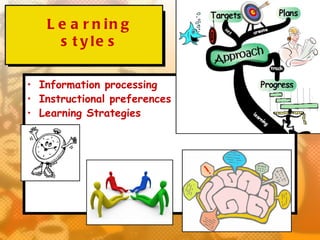
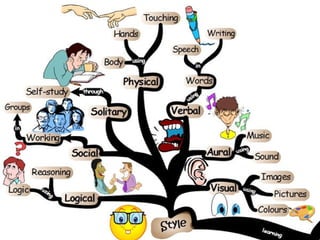
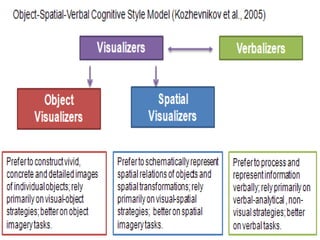
L e a r n in g
     s t y le s

• Information processing
• Instructional preferences
• Learning Strategies
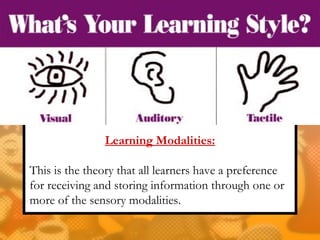
Learning Modalities:

This is the theory that all learners have a preference
for receiving and storing information through one or
more of the sensory modalities.
How to use comics
in the classroom?


 • The teacher provides the material
 • The students create their own
   comic
 • Use IT Skills through various
   software to create comics
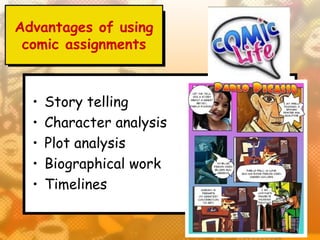
Advantages of using
 comic assignments


  •   Story telling
  •   Character analysis
  •   Plot analysis
  •   Biographical work
  •   Timelines
The use of
Graphic Novels

• They offer value, variety and a new medium for
  literacy that acknowledges visuals. They are
  useful across the curriculum depending on the
  creativity of the teacher and students.
• (Lavin 1998) suggested that reading Graphic
  Novels employs more cognitive skills.
• Graphic Novels present an alternative view of
  culture, history and human life in accessible
  ways giving voice to minorities and those with
  diverse view points.
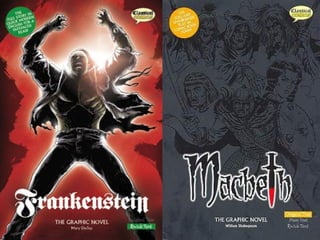
• Ex: Classic Comics lead to the reading of the full
  ‘novel’
Graphic Novels:

 • Brain Food
 • Gentle Persuasion
 • Think small (don’t go into the big titles)
 • Improve reading comprehension
 • Promote Socialisation
 • Motivate
 • Help students with reading difficulties
 • Leave a permananet mark
 • Provide intermediary link to other subjects
 • Are popular and cool – bring youth culture to the
   classroom
 • Ideal for differentiated teaching
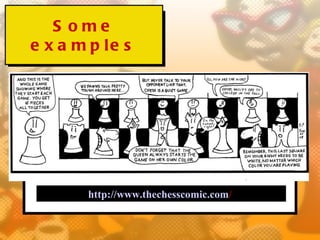
S ome
e x a m p le s


        http://www.thechesscomic.com/
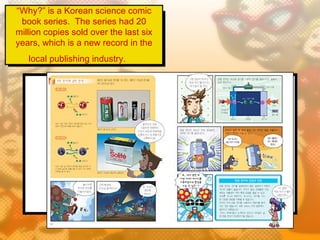
“Why?” is a Korean science comic
 book series.  The series had 20
million copies sold over the last six
years, which is a new record in the
   local publishing industry.  
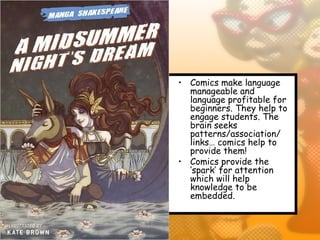
• Comics make language
  manageable and
  language profitable for
  beginners. They help to
  engage students. The
  brain seeks
  patterns/association/
  links… comics help to
  provide them!
• Comics provide the
  ‘spark’ for attention
  which will help
  knowledge to be
  embedded.
• Comics used as a means to teacher
  dialect
• To engage reluctant readers
• Also a defence against the enemy of
  literacy - TELEVISION
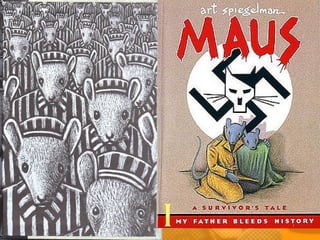
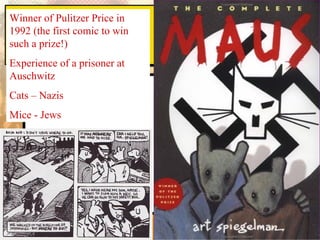
Winner of Pulitzer Price in
1992 (the first comic to win
such a prize!)
Experience of a prisoner at
Auschwitz
Cats – Nazis
Mice - Jews
Comics for
  awareness
  campaigns


• A comic by a US hospital about
  testicular cancer using patient
  stories
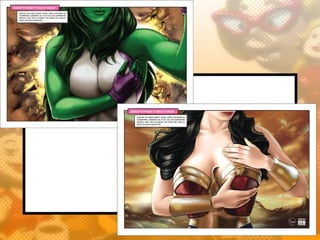
• Marvel / DC campaign against
  breast cancer
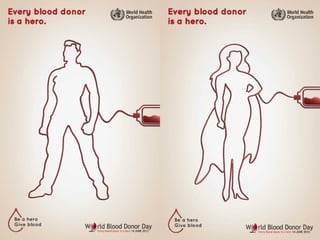
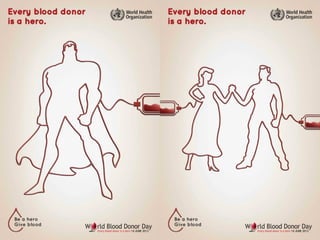
• ‘Donate Blood’ campaign – Malta
  Blood unit
C o m ic s a n d
  h e r it a g e

 • Exercise in Empathy
 • Help to illustrate ‘Causes and
   Consequences’
 • Offer visual aids to ‘Chronology’ in
   history
 • Political Cartoons offer a platform to
   discuss ‘bias’ and ‘perspectives’
 • Make history more exciting and engaging
S o m e id e a s :


  •   Time traveller
  •   Bios of Historical Figures
  •   Re-telling of an important battle
  •   Adventure story leading to
      discovery of artefacts – Indiana
      Jones style
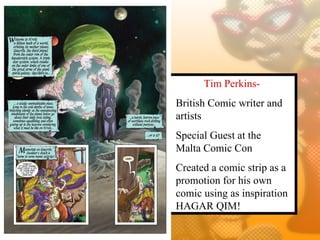
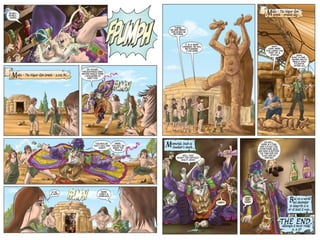
Tim Perkins-
British Comic writer and
artists
Special Guest at the
Malta Comic Con
Created a comic strip as a
promotion for his own
comic using as inspiration
HAGAR QIM!
Hagar qim   wicked comics presentation

Hagar qim wicked comics presentation

  • 1.
    History of Comics AndComics as an Educational Tool By: Samantha Abela
  • 2.
    Who are we? • A group of people who Like comics and manga We organize various activities through out the year and participate in others in order to promote comic culture in Malta and abroad.
  • 3.
    What do we do? We promote comic c ulture. We provide various opportunities of We encourage the c reation expos ure for Maltes e of c omics artis ts . We inform the public about We organize activities new comic publications to bring comics through reviews on our webs ite clos er to the public and provide a We provide a platform for ‘cultural encounter’ dis c us s ion about c omic s with foreign comic and their us e in education. creators .
  • 5.
    A typical Comic S hop
  • 6.
    • “A comicbook or comicbook is a magazine or book containing sequential art in the form of a narrative. Comic books are often called comics for short. Although the term implies otherwise, the subject matter in comic books is not necessarily humorous, and in fact its dramatic seriousness varies widely.” • - Wikipedia, The Free Encyclopedia
  • 7.
    C omic Books are wildly popular! • p From 2001-2006, comic books have grown from • a $75 million to a $330 million industry • a Movies and novels are now being made into • comic books specifically aimed at children • c Many popular writers, musicians and creative • designers are working with comics. • d Google Chrome presented by Scott McCloud.
  • 8.
  • 9.
    C o mic s c o m e in d if f e r e n t s iz e s
  • 10.
    G r ap h ic N o v e ls & C o lle c t io n s ( H a r d C o ve r o r Tr a d e Paper B ac k)
  • 11.
    Dis s ectinga C omic (the bas ics )?
  • 12.
  • 13.
  • 14.
    C o mic S t r ip
  • 15.
    We b C om ic A comic that is not ‘publis hed’ but is s hared online us ually for free others agains t a s mall payment. E as ily read on ebook readers , pcs , tablet pcs and s mart phones .
  • 16.
    A M alt e s e W e b c o m ic A webcomic written by Adam Cassar and illustrated by Samwel Mallia
  • 20.
    Planning S crip writing C haracter des ign S ketching Fine tuning A dd dialogue
  • 21.
    C haracter Des ign
  • 22.
    B a sic P la n n in g • Name: • A ge: • S ex: • Phys ic al des cription: • Pers onality:’ • J ob: • B ackground s tory:
  • 25.
    The C omic Audience? They are for everyone, from toddlers , pre-readers up to grandparents ! A s long as you like a good s tory, reading and A rt!
  • 26.
    Why create comics? • To s e nd a m e s s age • F or fu n • To re cou nt tru e s torie s
  • 34.
  • 35.
  • 36.
  • 37.
    H IS TO R Y
  • 39.
    C omics forS atire C omics Politics C omics for C hildren/boys & girls
  • 40.
  • 41.
    A d venture C o m ic s
  • 42.
    S upe rher o C o m ic s
  • 43.
    Th e H ero es w e nt to w a r.
  • 44.
  • 45.
  • 46.
    Th e 70 ’ s - s o c ia l & p o lit ic a l - f ilm s
  • 47.
    TH E M ODE R N A GE
  • 48.
    Th e 80 ’ s - T H E B R IT IS H IN V A S IO N & DARKER HEROES
  • 49.
  • 50.
  • 51.
  • 52.
  • 53.
  • 54.
    C o sp la y
  • 55.
    C o mic C o n v e n t io n s
  • 56.
    COMICS • FUN • SATISFACTION • INVESTMENT • COLLECTION READ and CREATE COMICS
  • 57.
    Mike Perkins Tim Collins Warren David Llyod Pleece Sean Azzoppardi
  • 59.
    Events … • 5-6June 2010 – Earth Garden • Malta Comic Con at Notte Bianca
  • 60.
    @Earth Garden Notte Bianca
  • 61.
    Dave Windett & Renee Witterstaette Workshops and Audience
  • 62.
    Some M altes e Publications •The Golden Lizard - Fabio Agius, Mark Ellul and Chris Le Galle (Sierra Books) •The Tsar - Issue 1 - Joseph Bugejia and Joseph Whizz Farrugia (BDL)  •Hal Mudlam - Issue 1 & 2- Joseph Bugeja (BDL)  •Arcana Crusade – Bernard Micallef •For Gallantry Issue 0 & 1 – Fabio Giangolini •Apocalyse Rocked – Dean Fenech •Pilot – The Steampunk ed. – The Pilot Group •RPG Game – Jeanelle Zammit and Bernard Micallef •Komiks tas-Sikkina
  • 63.
    Contact Us • FacebookGroup : http://www.facebook.com/profile.php?id • Website: http://www.maltacomic-con.com/
  • 64.
  • 65.
    A brief historyof Comics in Education • The first comics used to ‘educate’ people were the political cartoons used to send messages about politics and social issues to the illiterate public
  • 67.
    T h ef ir s t c o m ic s • They were issued in the 1930’s (pre- WWII) and by the 1940’s an estimate of 95% of all 8-14 year olds read comics. • 65% of the 15-18 year olds read comics too!
  • 68.
    Whilst some seethe positive in the use of Comics in education others criticize… • A stumbling block to literacy • Impede reading comprehension • Reduce imagination • Provide eyestrain
  • 69.
    Nonetheless… • A ‘Scholarshipon the Educational Value of Comics’ was established in America in the second half of the 20th century
  • 70.
    Still… • Some criticizedcomics as promoting ‘violence’ and ‘delinquency’ • Of using ‘slang’ and ‘dialect’ too much…
  • 71.
    Can comics beused as an effective medium in education? • Yes! Comics can be used to transfer Knowledge! • They can be used as a ‘TOOL’ or • Use ‘Educational Comics’.
  • 72.
    What are Educational Comics? • These are comics devised on purpose to teach a subject / with a clear intent and message. • = a comic on Maltese legends / important events – Great Siege + Consalvo Monroy
  • 73.
    Comics as educational tool • These are comics that their initial purpose was not to ‘educate’ but for leisure. Nonetheless teachers and parents use them to teach:
  • 74.
    History • Science • Reading • Social studies • Language • Culture context • Science • Story telling
  • 75.
    Why use comics inthe classroom? • For pre-readers they provide practice for: • - sequencing • - prompts for language use (visual cues) • -connect words with images
  • 76.
    • For AdvanceReaders • - complexity of normal written word with visuals • - a step-stone to more complex texts • -make reading more approachable
  • 77.
    Comics meet theneeds of Students in a variety of learning styles
  • 78.
    L e ar n in g It is a product of the agreement between teaching strategies and the individual differences among learners. According to Dr.Steve Hunt, every learner use his own unique style of learning and thinking At last, this is not true which differentiate anymore! him from others.
  • 79.
    L e ar n in g s t y le s • Information processing • Instructional preferences • Learning Strategies
  • 81.
    Learning Modalities: This isthe theory that all learners have a preference for receiving and storing information through one or more of the sensory modalities.
  • 84.
    How to usecomics in the classroom? • The teacher provides the material • The students create their own comic • Use IT Skills through various software to create comics
  • 85.
    Advantages of using comic assignments • Story telling • Character analysis • Plot analysis • Biographical work • Timelines
  • 86.
    The use of GraphicNovels • They offer value, variety and a new medium for literacy that acknowledges visuals. They are useful across the curriculum depending on the creativity of the teacher and students. • (Lavin 1998) suggested that reading Graphic Novels employs more cognitive skills. • Graphic Novels present an alternative view of culture, history and human life in accessible ways giving voice to minorities and those with diverse view points. • Ex: Classic Comics lead to the reading of the full ‘novel’
  • 87.
    Graphic Novels: •Brain Food • Gentle Persuasion • Think small (don’t go into the big titles) • Improve reading comprehension • Promote Socialisation • Motivate • Help students with reading difficulties • Leave a permananet mark • Provide intermediary link to other subjects • Are popular and cool – bring youth culture to the classroom • Ideal for differentiated teaching
  • 88.
    S ome e xa m p le s http://www.thechesscomic.com/
  • 89.
    “Why?” is aKorean science comic book series.  The series had 20 million copies sold over the last six years, which is a new record in the local publishing industry.  
  • 92.
    • Comics makelanguage manageable and language profitable for beginners. They help to engage students. The brain seeks patterns/association/ links… comics help to provide them! • Comics provide the ‘spark’ for attention which will help knowledge to be embedded.
  • 93.
    • Comics usedas a means to teacher dialect • To engage reluctant readers • Also a defence against the enemy of literacy - TELEVISION
  • 96.
    Winner of PulitzerPrice in 1992 (the first comic to win such a prize!) Experience of a prisoner at Auschwitz Cats – Nazis Mice - Jews
  • 97.
    Comics for awareness campaigns • A comic by a US hospital about testicular cancer using patient stories • Marvel / DC campaign against breast cancer • ‘Donate Blood’ campaign – Malta Blood unit
  • 101.
    C o mic s a n d h e r it a g e • Exercise in Empathy • Help to illustrate ‘Causes and Consequences’ • Offer visual aids to ‘Chronology’ in history • Political Cartoons offer a platform to discuss ‘bias’ and ‘perspectives’ • Make history more exciting and engaging
  • 102.
    S o me id e a s : • Time traveller • Bios of Historical Figures • Re-telling of an important battle • Adventure story leading to discovery of artefacts – Indiana Jones style
  • 103.
    Tim Perkins- British Comicwriter and artists Special Guest at the Malta Comic Con Created a comic strip as a promotion for his own comic using as inspiration HAGAR QIM!