BIG DATA
INTRODUCTION
 Big Data may well be the Next Big Thing in the IT world.
 Big data burst upon the scene in the first decade of the
21st century.
 The first organizations to embrace it were online and
startup firms. Firms like Google, eBay, LinkedIn, and
Facebook were built around big data from the beginning.
 Like many new information technologies, big data can
bring about dramatic cost reductions, substantial
improvements in the time required to perform a computing
task, or new product and service offerings.
WHAT IS BIG DATA?
 ‘Big Data’ is similar to ‘small data’, but bigger in size
 but having data bigger it requires different
approaches:
 Techniques, tools and architecture
 an aim to solve new problems or old
problems in a
better way
 Big Data generates value from the storage and
processing of very large quantities of digital
information that cannot be analyzed with traditional
computing techniques.
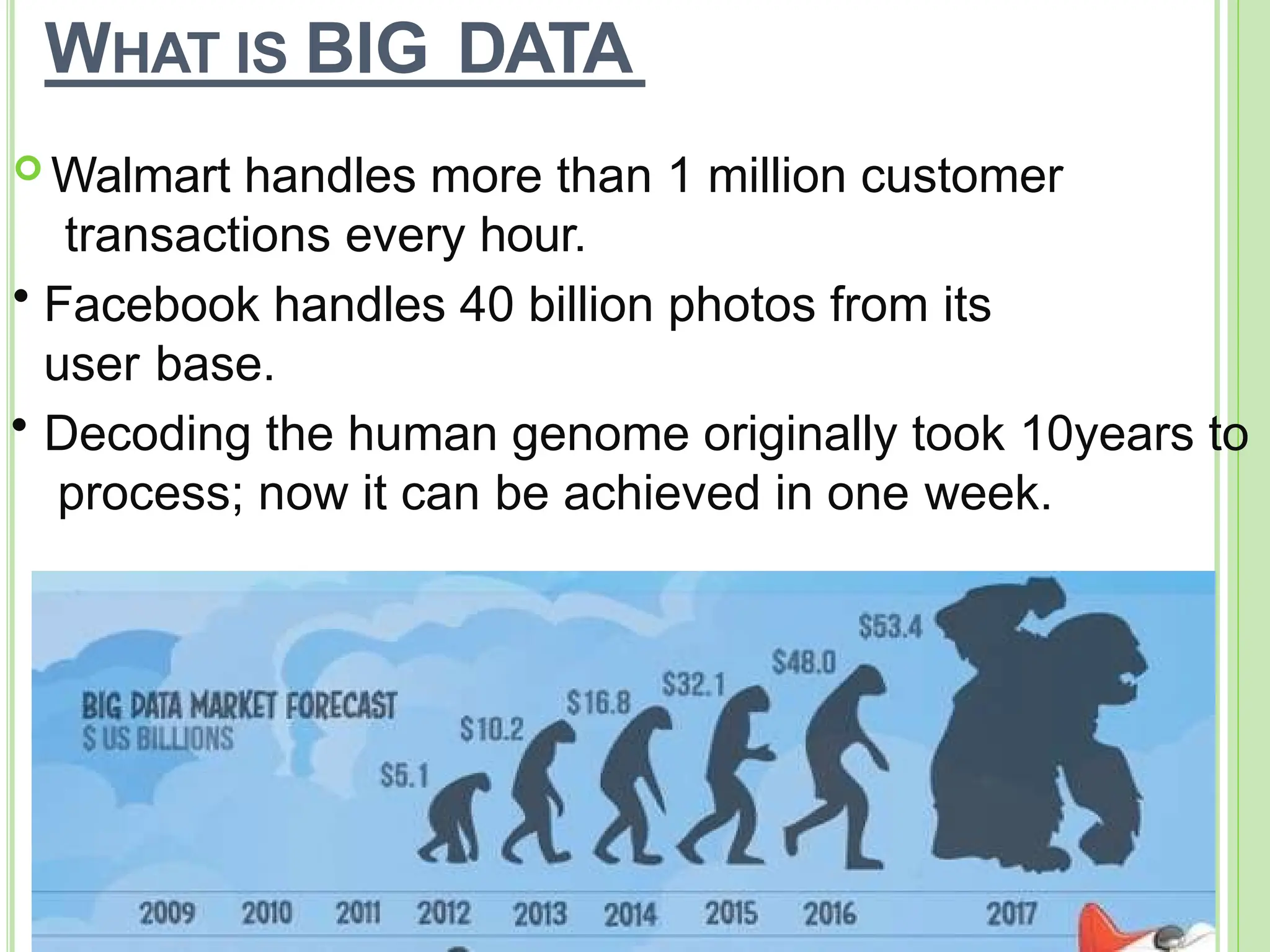
WHAT IS BIG DATA
 Walmart handles more than 1 million customer
transactions every hour.
• Facebook handles 40 billion photos from its
user base.
• Decoding the human genome originally took 10years to
process; now it can be achieved in one week.
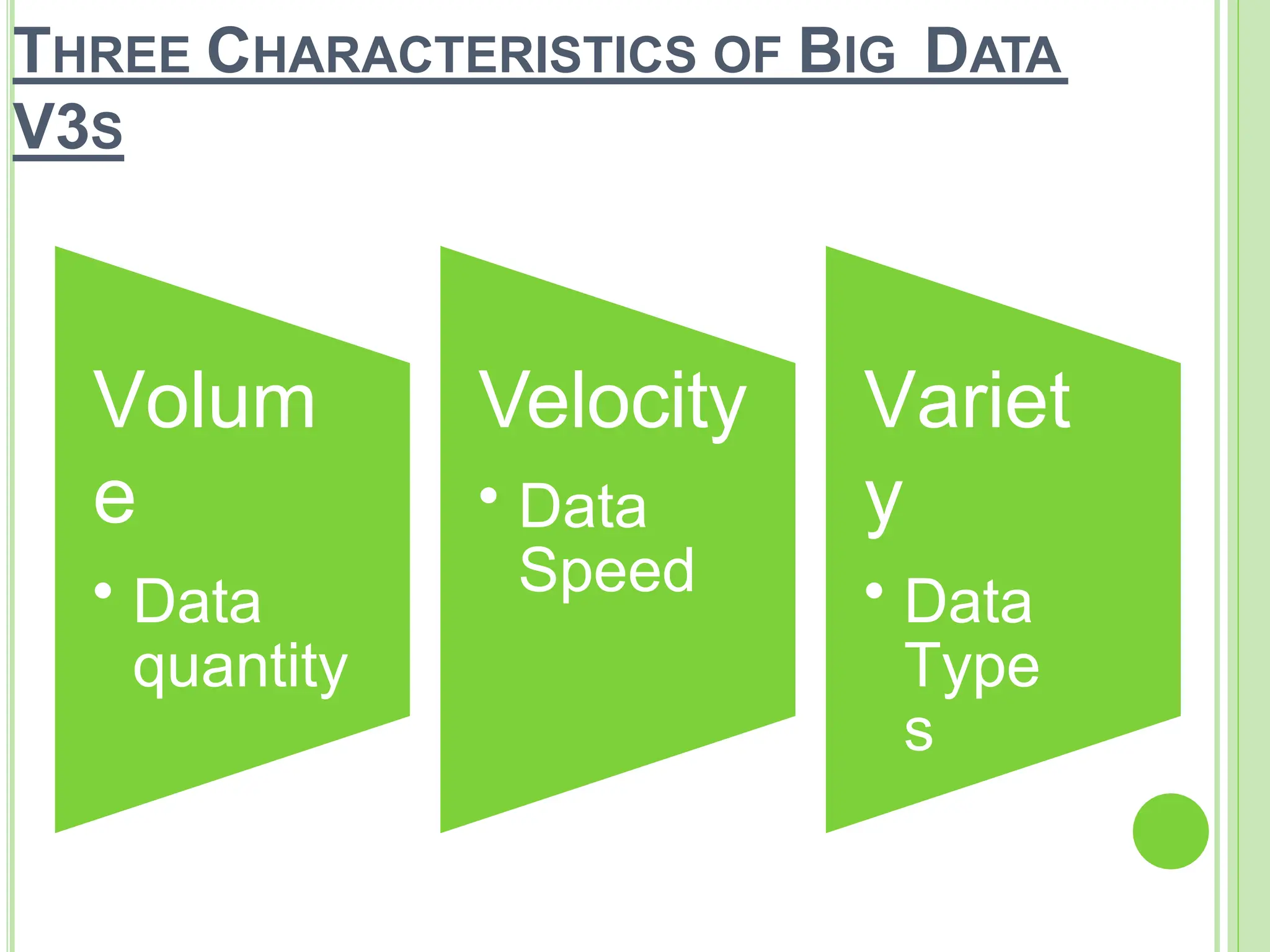
THREE CHARACTERISTICS OF BIG DATA
V3S
Volum
e
• Data
quantity
Velocity
• Data
Speed
Variet
y
• Data
Type
s
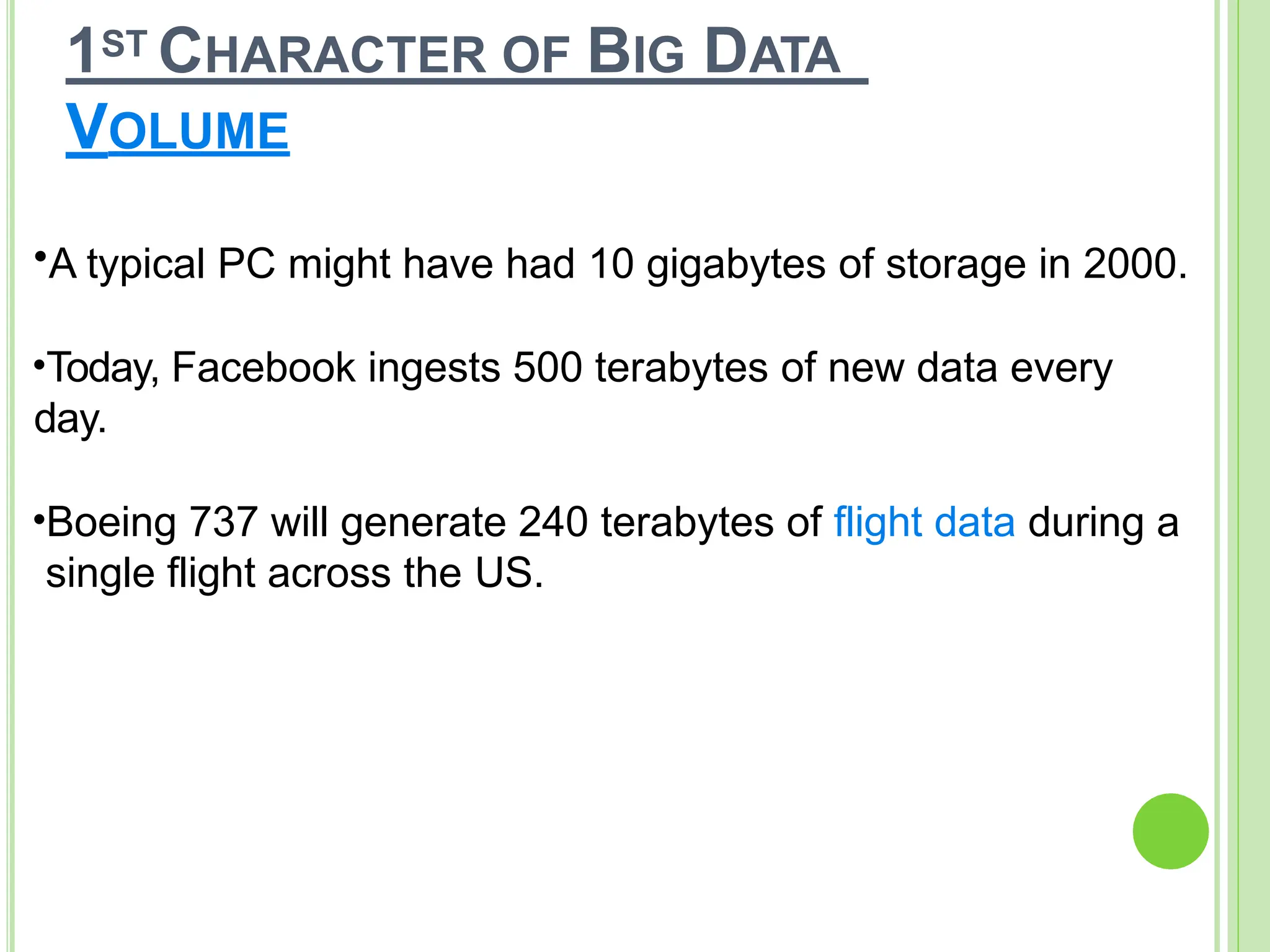
1ST CHARACTER OF BIG DATA
VOLUME
•A typical PC might have had 10 gigabytes of storage in 2000.
•Today, Facebook ingests 500 terabytes of new data every
day.
•Boeing 737 will generate 240 terabytes of flight data during a
single flight across the US.
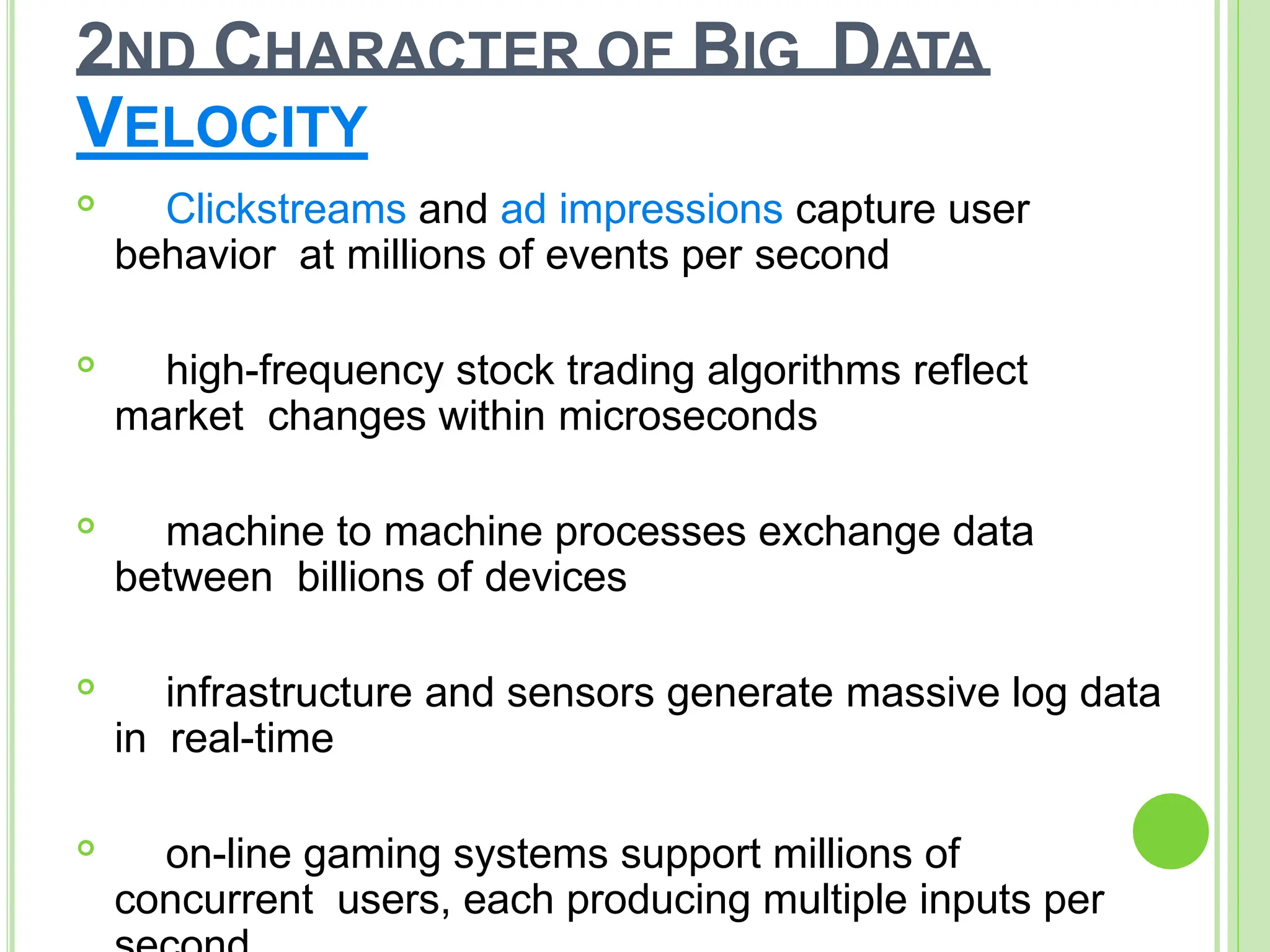
2ND CHARACTER OF BIG DATA
VELOCITY

Clickstreams and ad impressions capture user
behavior at millions of events per second

high-frequency stock trading algorithms reflect
market changes within microseconds

machine to machine processes exchange data
between billions of devices

infrastructure and sensors generate massive log data
in real-time

on-line gaming systems support millions of
concurrent users, each producing multiple inputs per
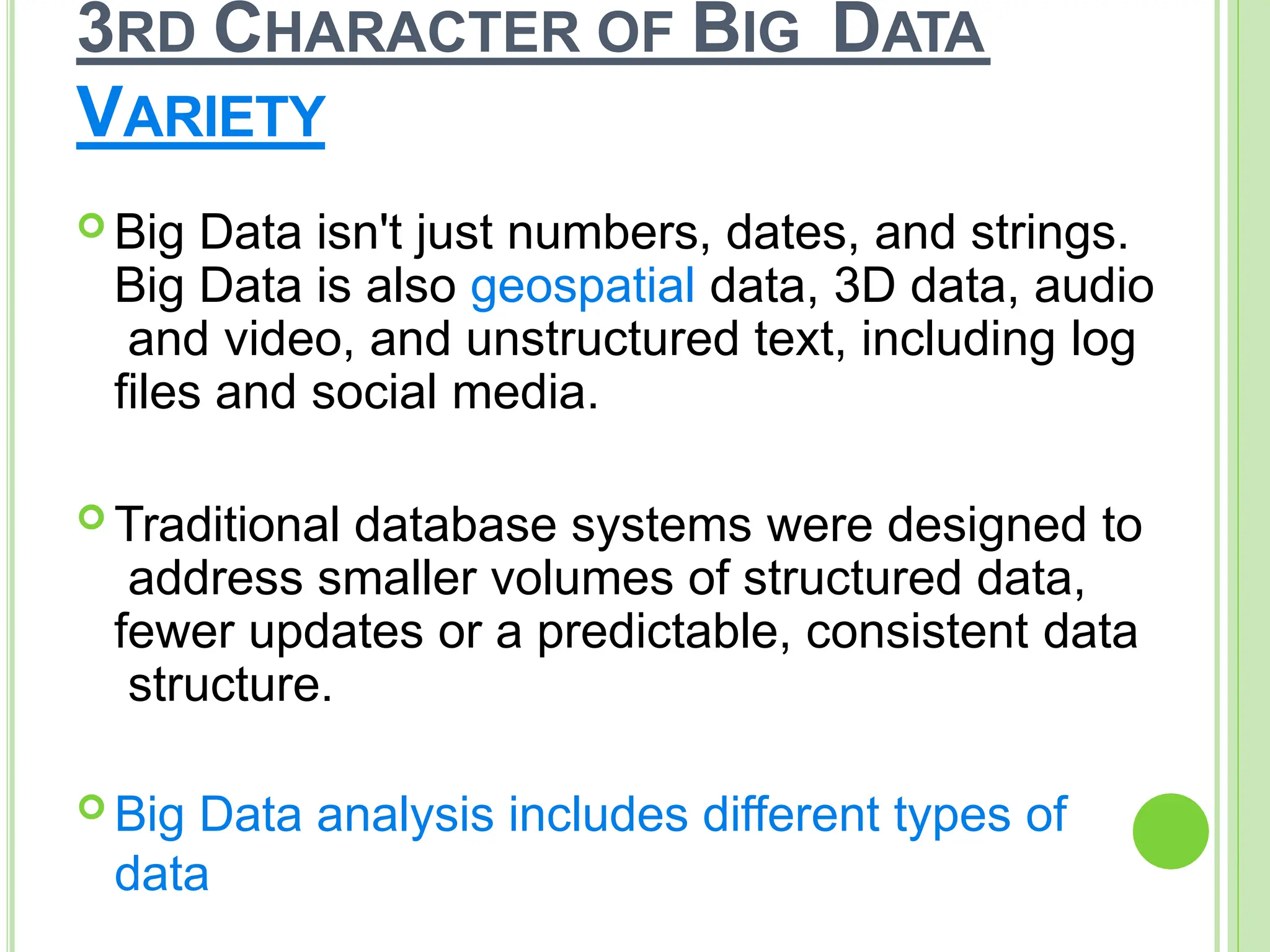
3RD CHARACTER OF BIG DATA
VARIETY
 Big Data isn't just numbers, dates, and strings.
Big Data is also geospatial data, 3D data, audio
and video, and unstructured text, including log
files and social media.
 Traditional database systems were designed to
address smaller volumes of structured data,
fewer updates or a predictable, consistent data
structure.
 Big Data analysis includes different types of
data
STORING BIG DATA
 Analyzing your data characteristics
 Selecting data sources for analysis
 Eliminating redundant data
 Establishing the role of NoSQL
 Overview of Big Data stores
 Data models: key value, graph, document, column-family
 Hadoop Distributed File System
 HBase
 Hive
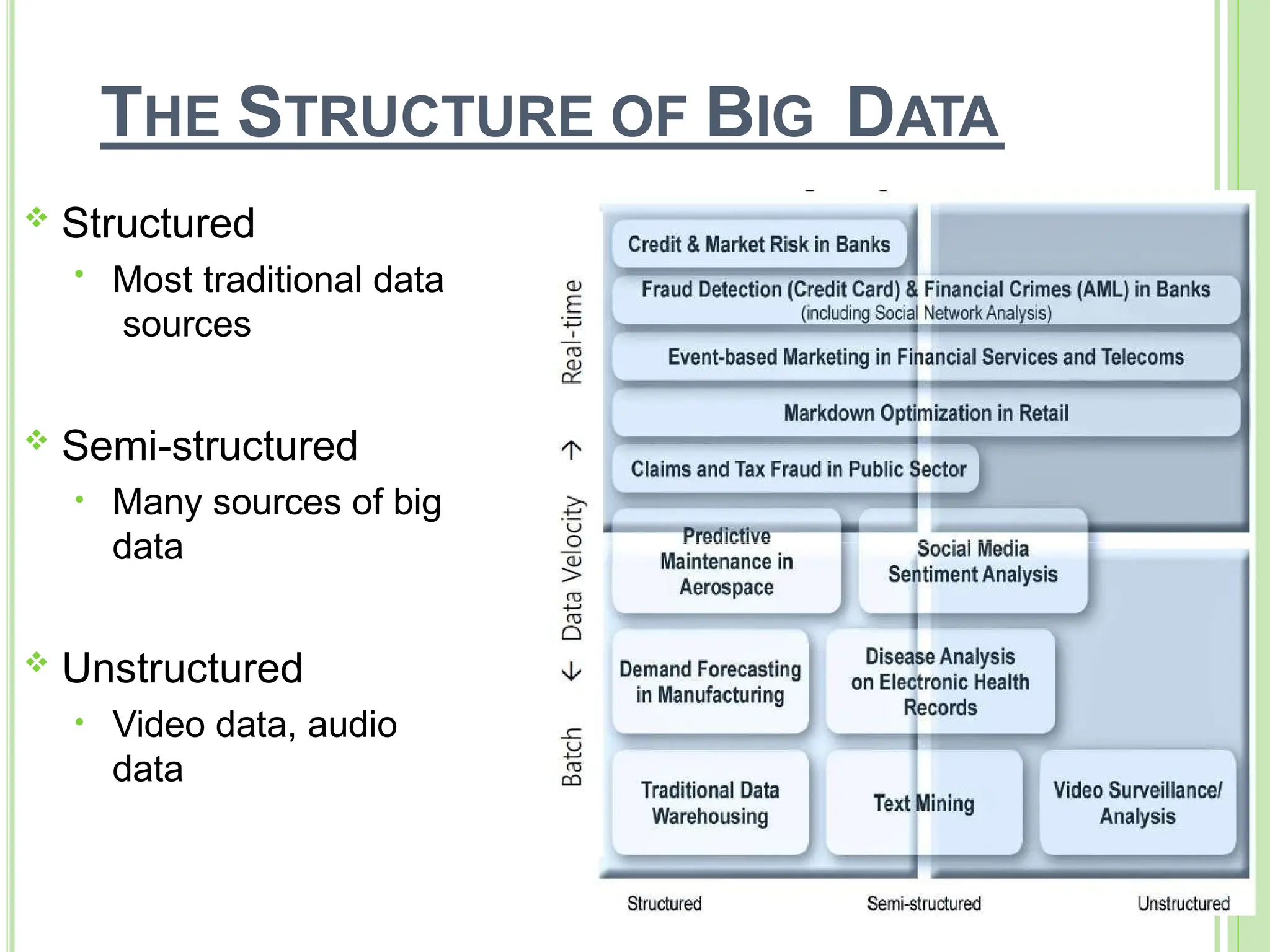
THE STRUCTURE OF BIG DATA
 Structured
• Most traditional data
sources
 Semi-structured
• Many sources of big
data
 Unstructured
• Video data, audio
data
11
WHY BIG DATA
• Growth of Big Data is needed
– Increase of storage capacities
– Increase of processing power
– Availability of data(different data types)
WHY BIG DATA
•FB generates 10TB
daily
•Twitter generates 7TB
of data
Daily
•IBM claims 90% of
today’s
stored data was
generated
in just the last
two years.
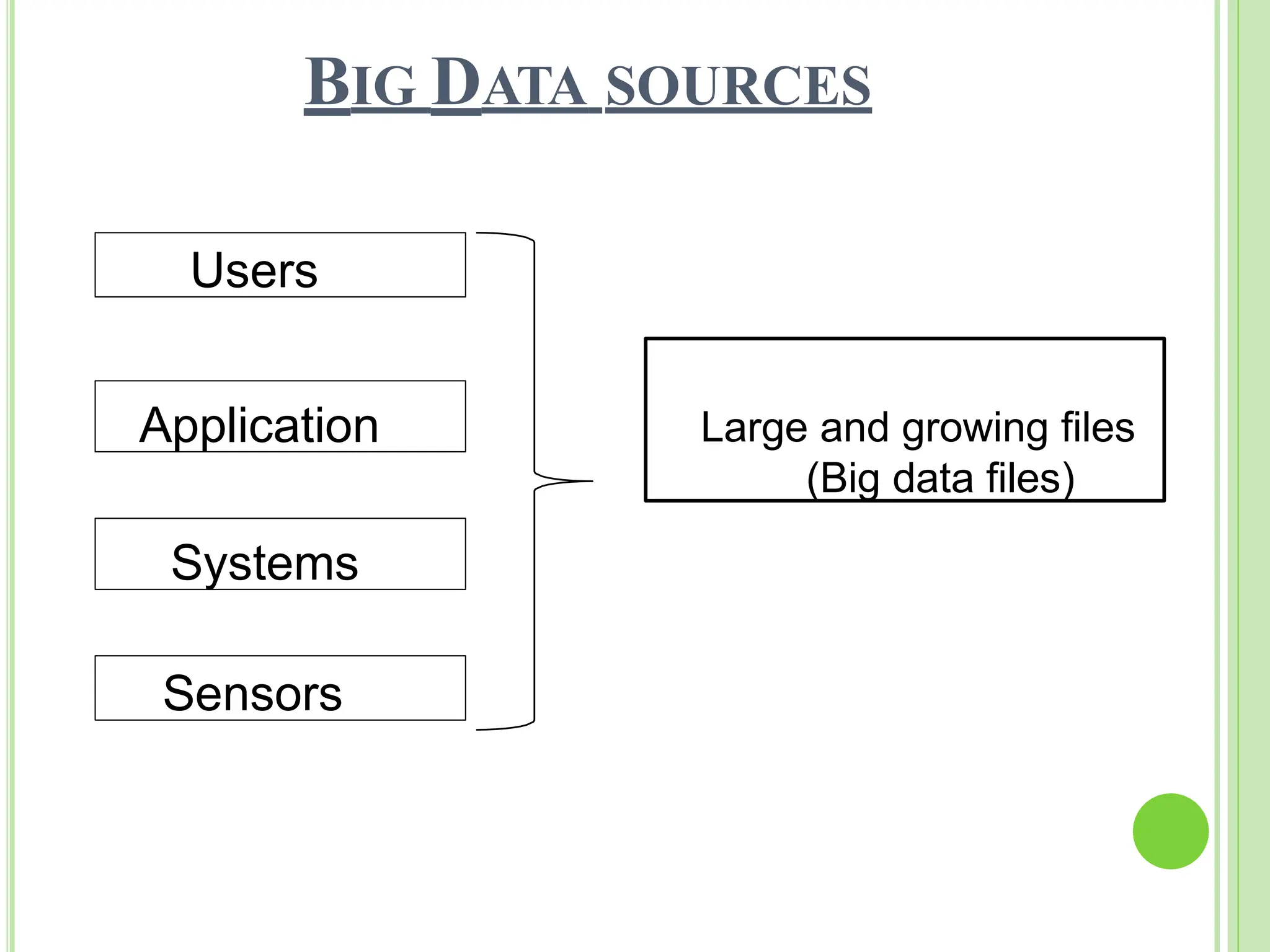
BIG DATA SOURCES
Users
Application
Systems
Sensors
Large and growing files
(Big data files)
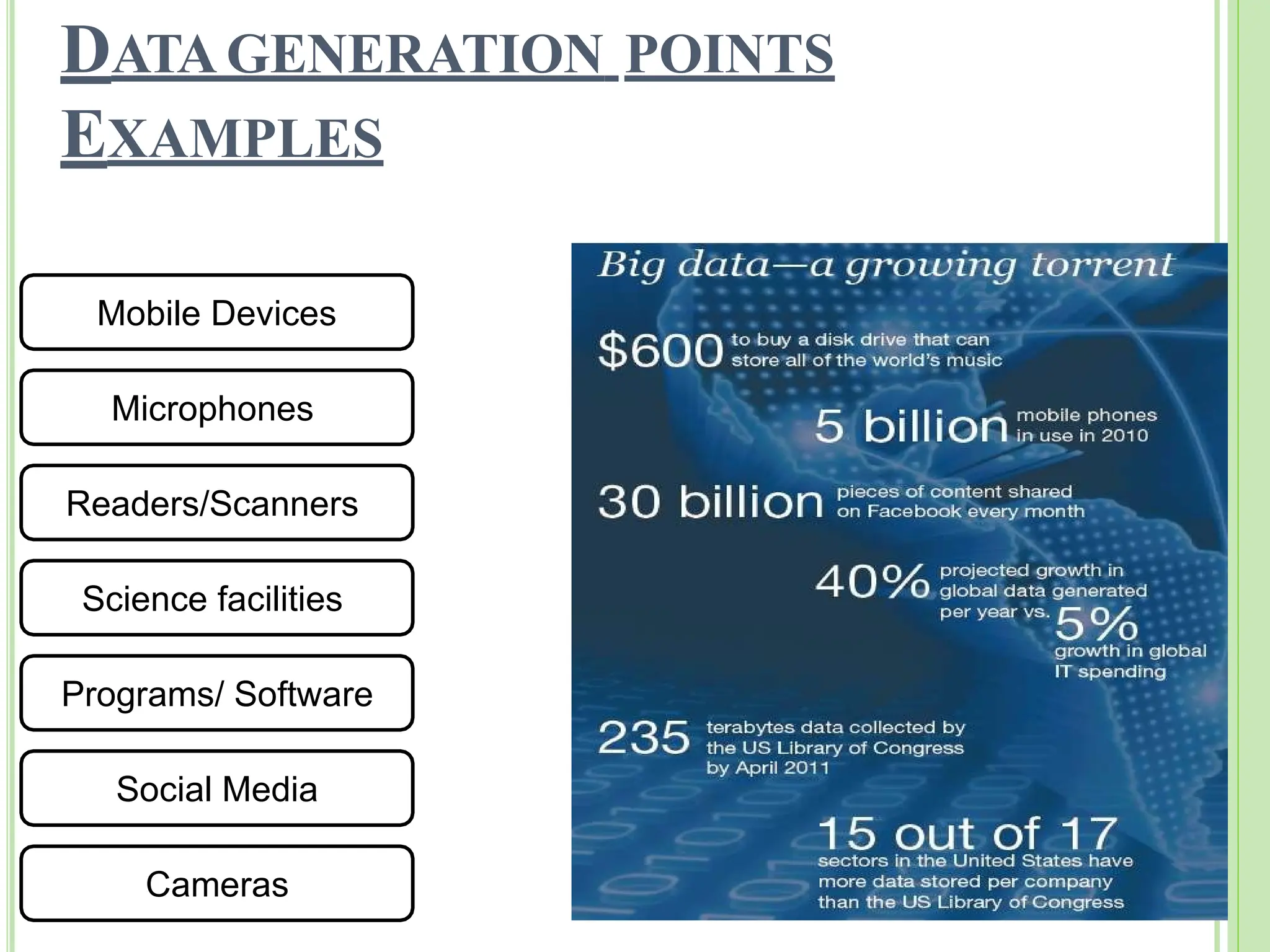
DATA GENERATION POINTS
EXAMPLES
Mobile Devices
Microphones
Readers/Scanners
Science facilities
Programs/ Software
Social Media
Cameras
BIG DATA ANALYTICS
 Examining large amount of data
 Appropriate information (about data)
 Identification of hidden patterns, unknown correlations
 Better business decisions: strategic and operational
 Effective marketing, customer satisfaction,
increased revenue
TYPES OF TOOLS USED IN BIG-DATA
 Where processing is hosted?
 Distributed Servers / Cloud (e.g. Amazon EC2)
 Where data is stored?
 Distributed Storage (e.g. Amazon S3)
 What is the programming model?
 Distributed Processing (e.g. MapReduce)
 How data is stored & indexed?
 High-performance schema-free databases (e.g. MongoDB)
 What operations are performed on data?
 Analytic / Semantic Processing
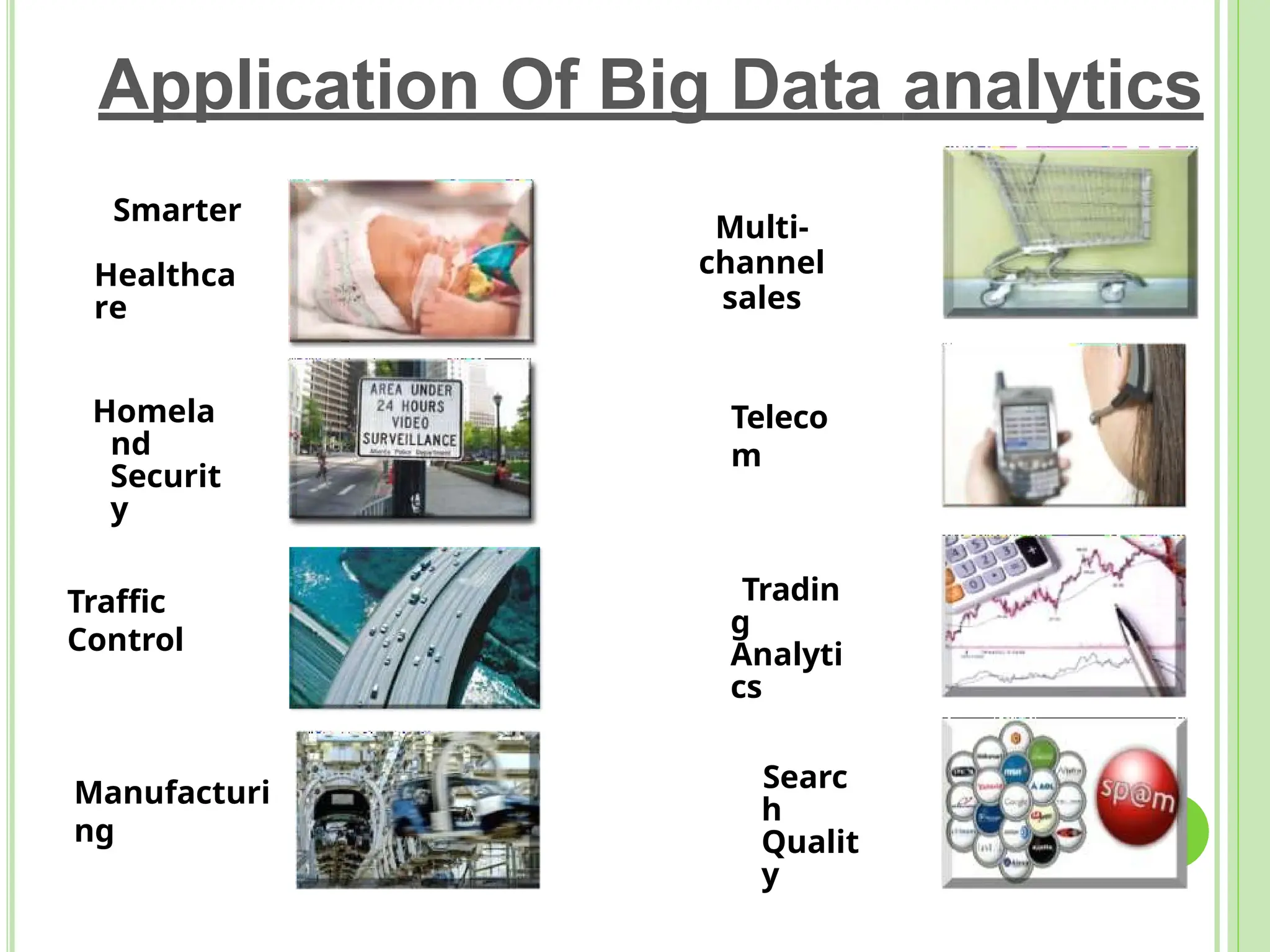
Application Of Big Data analytics
Homela
nd
Securit
y
Smarter
Healthca
re
Multi-
channel
sales
Teleco
m
Manufacturi
ng
Traffic
Control
Tradin
g
Analyti
cs
Searc
h
Qualit
y
RISKS OF BIG DATA
• Will be so overwhelmed
• Need the right people and solve the right problems
• Costs escalate too fast
• Isn’t necessary to capture 100%
• Many sources of big data
is privacy
• self-regulation (data
compression)
• Legal regulation 20
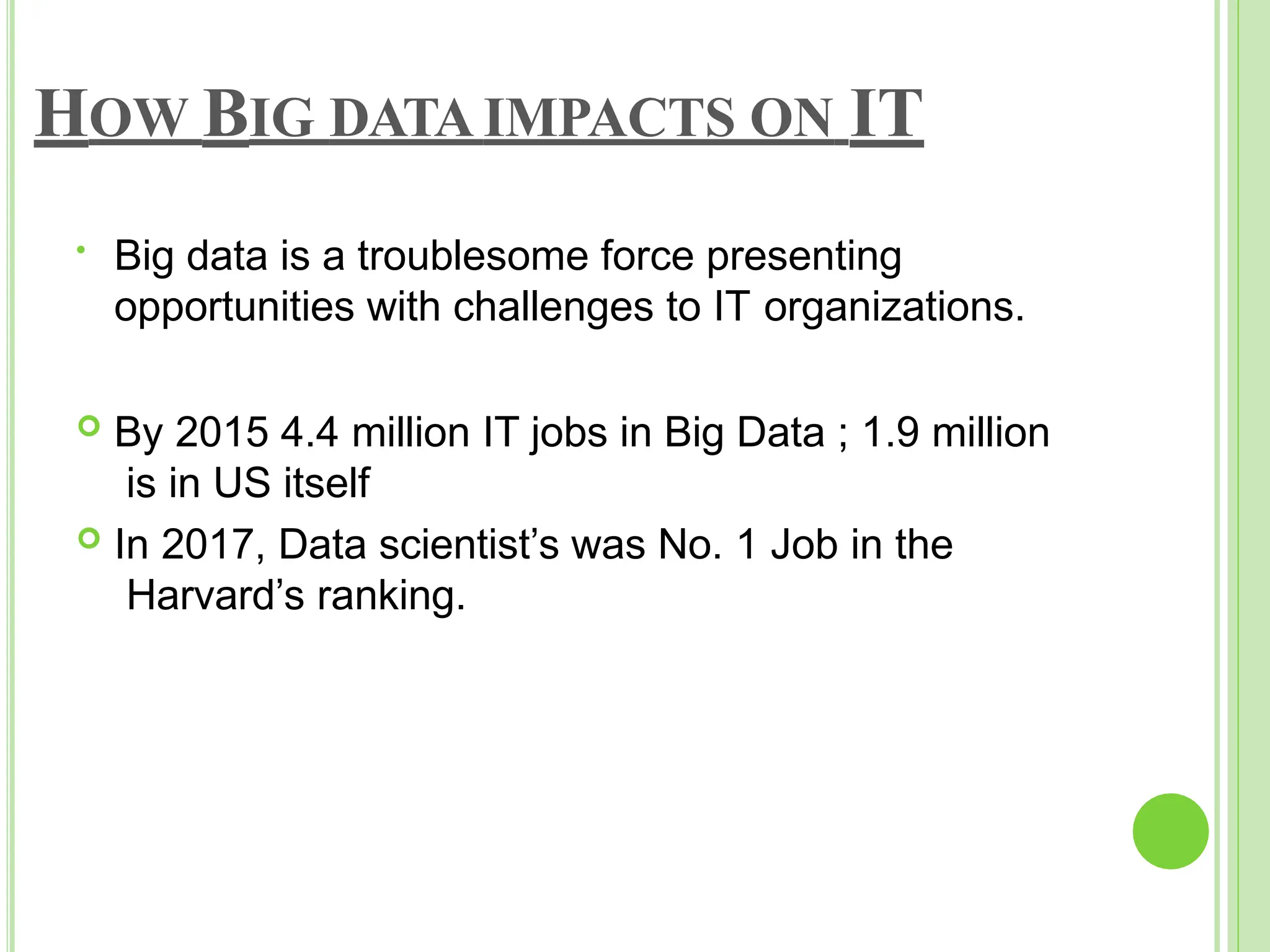
HOW BIG DATA IMPACTS ON IT
• Big data is a troublesome force presenting
opportunities with challenges to IT organizations.
 By 2015 4.4 million IT jobs in Big Data ; 1.9 million
is in US itself
 In 2017, Data scientist’s was No. 1 Job in the
Harvard’s ranking.
BENEFITS OF BIG DATA
•Real-time big data isn’t just a process for storing
petabytes or exabytes of data in a data warehouse,
It’s about the ability to make better decisions and take
meaningful actions at the right time.
•Fast forward to the present and technologies like
Hadoop give you the scale and flexibility to store data
before you know how you are going to process it.
•Technologies such as MapReduce,Hive and Impala
enable you to run queries without changing the
data structures underneath.
THANK YOU.

WHAT IS BIG DATA,THREE CHARACTERISTICS OF BIG DATA

  • 1.
  • 2.
    INTRODUCTION  Big Datamay well be the Next Big Thing in the IT world.  Big data burst upon the scene in the first decade of the 21st century.  The first organizations to embrace it were online and startup firms. Firms like Google, eBay, LinkedIn, and Facebook were built around big data from the beginning.  Like many new information technologies, big data can bring about dramatic cost reductions, substantial improvements in the time required to perform a computing task, or new product and service offerings.
  • 3.
    WHAT IS BIGDATA?  ‘Big Data’ is similar to ‘small data’, but bigger in size  but having data bigger it requires different approaches:  Techniques, tools and architecture  an aim to solve new problems or old problems in a better way  Big Data generates value from the storage and processing of very large quantities of digital information that cannot be analyzed with traditional computing techniques.
  • 4.
    WHAT IS BIGDATA  Walmart handles more than 1 million customer transactions every hour. • Facebook handles 40 billion photos from its user base. • Decoding the human genome originally took 10years to process; now it can be achieved in one week.
  • 5.
    THREE CHARACTERISTICS OFBIG DATA V3S Volum e • Data quantity Velocity • Data Speed Variet y • Data Type s
  • 6.
    1ST CHARACTER OFBIG DATA VOLUME •A typical PC might have had 10 gigabytes of storage in 2000. •Today, Facebook ingests 500 terabytes of new data every day. •Boeing 737 will generate 240 terabytes of flight data during a single flight across the US.
  • 7.
    2ND CHARACTER OFBIG DATA VELOCITY  Clickstreams and ad impressions capture user behavior at millions of events per second  high-frequency stock trading algorithms reflect market changes within microseconds  machine to machine processes exchange data between billions of devices  infrastructure and sensors generate massive log data in real-time  on-line gaming systems support millions of concurrent users, each producing multiple inputs per
  • 8.
    3RD CHARACTER OFBIG DATA VARIETY  Big Data isn't just numbers, dates, and strings. Big Data is also geospatial data, 3D data, audio and video, and unstructured text, including log files and social media.  Traditional database systems were designed to address smaller volumes of structured data, fewer updates or a predictable, consistent data structure.  Big Data analysis includes different types of data
  • 9.
    STORING BIG DATA Analyzing your data characteristics  Selecting data sources for analysis  Eliminating redundant data  Establishing the role of NoSQL  Overview of Big Data stores  Data models: key value, graph, document, column-family  Hadoop Distributed File System  HBase  Hive
  • 10.
    THE STRUCTURE OFBIG DATA  Structured • Most traditional data sources  Semi-structured • Many sources of big data  Unstructured • Video data, audio data 11
  • 11.
    WHY BIG DATA •Growth of Big Data is needed – Increase of storage capacities – Increase of processing power – Availability of data(different data types)
  • 12.
    WHY BIG DATA •FBgenerates 10TB daily •Twitter generates 7TB of data Daily •IBM claims 90% of today’s stored data was generated in just the last two years.
  • 13.
  • 14.
    DATA GENERATION POINTS EXAMPLES MobileDevices Microphones Readers/Scanners Science facilities Programs/ Software Social Media Cameras
  • 15.
    BIG DATA ANALYTICS Examining large amount of data  Appropriate information (about data)  Identification of hidden patterns, unknown correlations  Better business decisions: strategic and operational  Effective marketing, customer satisfaction, increased revenue
  • 16.
    TYPES OF TOOLSUSED IN BIG-DATA  Where processing is hosted?  Distributed Servers / Cloud (e.g. Amazon EC2)  Where data is stored?  Distributed Storage (e.g. Amazon S3)  What is the programming model?  Distributed Processing (e.g. MapReduce)  How data is stored & indexed?  High-performance schema-free databases (e.g. MongoDB)  What operations are performed on data?  Analytic / Semantic Processing
  • 17.
    Application Of BigData analytics Homela nd Securit y Smarter Healthca re Multi- channel sales Teleco m Manufacturi ng Traffic Control Tradin g Analyti cs Searc h Qualit y
  • 18.
    RISKS OF BIGDATA • Will be so overwhelmed • Need the right people and solve the right problems • Costs escalate too fast • Isn’t necessary to capture 100% • Many sources of big data is privacy • self-regulation (data compression) • Legal regulation 20
  • 19.
    HOW BIG DATAIMPACTS ON IT • Big data is a troublesome force presenting opportunities with challenges to IT organizations.  By 2015 4.4 million IT jobs in Big Data ; 1.9 million is in US itself  In 2017, Data scientist’s was No. 1 Job in the Harvard’s ranking.
  • 20.
    BENEFITS OF BIGDATA •Real-time big data isn’t just a process for storing petabytes or exabytes of data in a data warehouse, It’s about the ability to make better decisions and take meaningful actions at the right time. •Fast forward to the present and technologies like Hadoop give you the scale and flexibility to store data before you know how you are going to process it. •Technologies such as MapReduce,Hive and Impala enable you to run queries without changing the data structures underneath.
  • 21.