GRAMMAR PAST VERB
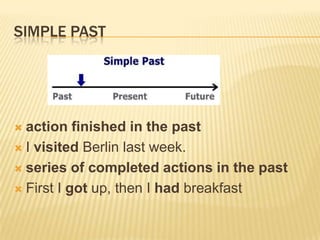
SIMPLE PAST

action finished in the past
 I visited Berlin last week.
 series of completed actions in the past
 First I got up, then I had breakfast

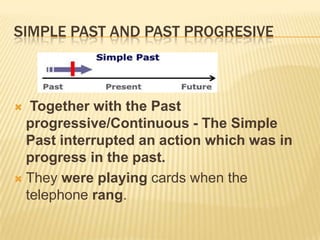
SIMPLE PAST AND PAST PROGRESIVE

Together with the Past
progressive/Continuous - The Simple
Past interrupted an action which was in
progress in the past.
 They were playing cards when the
telephone rang.

Signal words
 yesterday, last week, a month ago, in 2002
 Form


With regular verbs: infinitive + -ed
 Affirmative sentences
 I played football.
 We visited Alaska last year.

IRREGULAR VERBS

I went to the cinema. (go)
 We were in Rome yesterday. (be)
 He wrote same letter yesterday (write)
 I sent an e-mail to my friend (send)

REGULAR AND IRREGULAR VERB
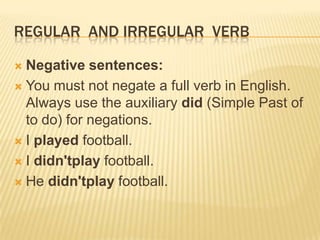
Negative sentences:
 You must not negate a full verb in English.
Always use the auxiliary did (Simple Past of
to do) for negations.
 I played football.
 I didn'tplay football.
 He didn'tplay football.

REGULAR AND IRREGULAR VERB
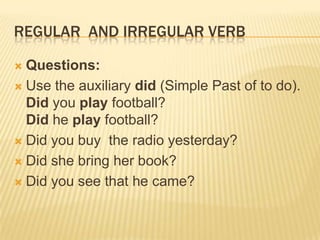
Questions:
 Use the auxiliary did (Simple Past of to do).
Did you play football?
Did he play football?
 Did you buy the radio yesterday?
 Did she bring her book?
 Did you see that he came?

IRREGULAR VERBS
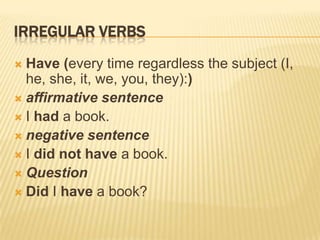
Have (every time regardless the subject (I,
he, she, it, we, you, they):)
 affirmative sentence
 I had a book.
 negative sentence
 I did not have a book.
 Question
 Did I have a book?

IRREGULAR VERBS
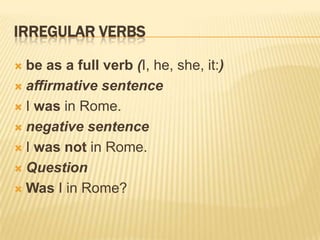
be as a full verb (I, he, she, it:)
 affirmative sentence
 I was in Rome.
 negative sentence
 I was not in Rome.
 Question
 Was I in Rome?

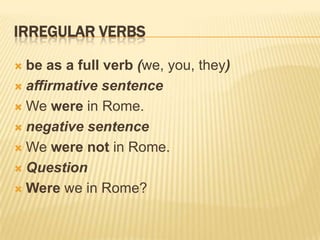
IRREGULAR VERBS
be as a full verb (we, you, they)
 affirmative sentence
 We were in Rome.
 negative sentence
 We were not in Rome.
 Question
 Were we in Rome?


Presentation of past verb

  • 1.
  • 2.
    SIMPLE PAST action finishedin the past  I visited Berlin last week.  series of completed actions in the past  First I got up, then I had breakfast 
  • 3.
    SIMPLE PAST ANDPAST PROGRESIVE Together with the Past progressive/Continuous - The Simple Past interrupted an action which was in progress in the past.  They were playing cards when the telephone rang. 
  • 4.
    Signal words  yesterday,last week, a month ago, in 2002  Form  With regular verbs: infinitive + -ed  Affirmative sentences  I played football.  We visited Alaska last year. 
  • 5.
    IRREGULAR VERBS I wentto the cinema. (go)  We were in Rome yesterday. (be)  He wrote same letter yesterday (write)  I sent an e-mail to my friend (send) 
  • 6.
    REGULAR AND IRREGULARVERB Negative sentences:  You must not negate a full verb in English. Always use the auxiliary did (Simple Past of to do) for negations.  I played football.  I didn'tplay football.  He didn'tplay football. 
  • 7.
    REGULAR AND IRREGULARVERB Questions:  Use the auxiliary did (Simple Past of to do). Did you play football? Did he play football?  Did you buy the radio yesterday?  Did she bring her book?  Did you see that he came? 
  • 8.
    IRREGULAR VERBS Have (everytime regardless the subject (I, he, she, it, we, you, they):)  affirmative sentence  I had a book.  negative sentence  I did not have a book.  Question  Did I have a book? 
  • 9.
    IRREGULAR VERBS be asa full verb (I, he, she, it:)  affirmative sentence  I was in Rome.  negative sentence  I was not in Rome.  Question  Was I in Rome? 
  • 10.
    IRREGULAR VERBS be asa full verb (we, you, they)  affirmative sentence  We were in Rome.  negative sentence  We were not in Rome.  Question  Were we in Rome? 