IB504 GLOBAL STRATEGIC MANAGEMENT
TERM PAPER
NORA-SAKARI: A PROPOSED JV IN MALAYSIA
HUSEYIN TEKLER
KHANGAI BATBAYAR
SOD-OCHIR BADAMDORJ
MOHAMMED BOUHOUN ALI
YOURA LY
IBW 2017539015
AEW2017539031
IBW 2017539038
IBW 2017539039
AEW2017539019
ii
CONTENTS
1. Executive Summary (Abstract) 1
2. Introduction 1
3. Companies Background 2
a. Nora 2
b. Sakari 2
4. Basic Information of Malaysia 3
a. PEST 3
i. Political 3
ii. Economic 4
iii. Sociological 6
iv. Technological 7
5. Industry Trend 8
6. Theoretical Framework of JV 9
7. Why Nora Looking for JV 12
8. Problems 13
9. Recommendations 15
10.Conclusion 17
11.References 18
1. Executive Summary
The concept of creating competitive advantage through strategic alliances for companies
has been widely discussed since the late 1980s. Over the past three decades, there has been a
significant increase in the number of international joint ventures (JVs) as a result of companies'
efforts to be more dependent on each other globally. These initiatives, which are a special type
of strategic cooperation, allow participating firms to combine different qualifications and
complementary resources.
In order for the joint ventures to be established, it must pass through a successful
negotiation process. Negotiations are an important part of international business. Parties
involved in a negotiation face different problems in reaching a successful outcome. When the
parties have different cultural backgrounds, the faced problems become more complex.
In this study, we will try to analyze the problems encountered by Nora and Sakkari firms
in the process of joint venture agreement and to produce solutions.
2. Introduction
This case involves the construction of a joint venture between a Malaysian company, Nora
Holdings Sdn Bhd (Nora), and Sakari Oy (Sakari), a conglomerate from Finland. Nora is one of
the major suppliers of telecommunication solutions in Malaysia while Sakari has expertise in
mobile phones, digital exchanges is a niche player in the global switching market, and has a
major share of the Finnish mobile market. Nora submitted a bid for tenders that were floated by
Malaysia’s national telecommunication company, Telekom Malaysia Bhd (TMB), to develop the
country’s telecommunication infrastructure, to supply and install 4G LTE equipment supporting
1200 cell sites, to align with the government’s “Vision 2020” program. TMB neither had the
technical know-how nor the expertise to take on the massive infrastructure project. Nora was
one of the five companies short-listed by TMB, all offering their partner's technology. Nora
needed the JV with Sakari to ensure it could meet the obligations for the TMB contract, learn
from their success, and replicate their model in the Malaysian market. It had government ties,
had won a part of the bid, Nora also always wanted to increase its influence on the South Asian
market, and it is a chance for Nora to reach its aim by piggybacking on Sakari’s technology, and
above all, had knowledge of the Malaysian market. Sakari, on the other hand, wanted to enter
the Asian market because of the opportunities it offered and had technology that Nora was
looking for. The negotiations between Nora and Sakari included twenty meetings and each side
had invested not less than RM 4 million in securing the JV. The following personnel participated
in the negotiations.
2
After long negotiations, there were still problems that could not be solved. These included
aspects of equity ownership, technology transfer, royalty payment, expatriate's salaries and
perks, and arbitration. But, Nora will soon have to fulfill the contract with TMB and time is
running out. So what should Zanial do? Reconcile with Sakari or find another partner for the big
contract?
3. Companies Background
a. Nora
Nora Sdn Bhd is Malaysian family name, one of the famous organizations in the
telecommunication business was set up in 1975 with a paid-up capital of RM2 million. Nora
Holdings have 35 subsidiaries, 2 public-listed companies: Multiphone Bhd and Nora
Telecommunications Bhd and Nora had 5,545employees, of which 923 were categorized as
managerial (including 440 engineers) and 4,622 as non-managerial (including 484 engineers and
technicians).
Nora had become a well-known name in Malaysia as a phone manufacturer. It started in
1980 when the organization got an agreement to supply telephone sets to the state-owned
telecommunication company, TMB. In 1985, Nora secured licenses from Siemens and Nortel to
make phone handsets and accordingly built up its own phone set.
In 2011, Nora gained S&B Telecom's business for RM80 million, with the purpose of
securing a foothold into the fast developing and high-profit margin mobile network service
business. S&B Telecom's work involved in the installation, commissioning, and maintenance of
mobile cell tower equipment and laying fiber optic cables to connect the cell towers with the
fixed network. Nora saw this line of business as urgent for winning the TMB 4G LTE contract
and building up a fruitful joint venture with MNC suppliers
b. Sakari
Sakari Oy from Finland was established in 1865 and began as a pulp and paper mill
production company. In the 1960s, Sakari expanded into the rubber and cable industry. In1975,
Sakari entered into the computers, consumer electronics, and cellular phones industries via a
series of acquisitions, mergers, and alliances. In 1979, a JV between Sakari and Vantala was set
up to develop and manufacture mobile telephones and gained a large percentage of the world,
European including the United Kingdom, Malaysian, and Thailand market for the production of
mobile phones and mobile phone handsets. In using the technology gained from their previous
acquisitions and working experience, Sakari Oy gained an edge and distinct advantage in the
telecom industry by selling switching systems licensed from France's Alcatel and by developing
3
the software and systems to suit needs of small Finish phone companies. In order to avoid
competition, Sakari concentrated on developing dedicated telecom networks for large private
users such as utility and railway companies.
In 2001, Sakari was Finland's largest publicly-traded industrial company and derived the
majority of its total sales from exports and over-sea operations.
in 2007, Sakari consolidates its telecoms infrastructure activities with those of Magma to
frame a joint venture named Sakari-Magma(SM). The arrangement was to lessen fetched,
distinguish item and administration correlative, and give a better market elective than both
Ericsson's top of the line offering and Huawei's low-cost arrangement. SM turned into a main
worldwide supplier of both remote and landline telecom foundation gear telecom
administrators around the globe. In 2011, SM reported that it would cut 17,000 occupations
throughout the following two years and rebuild its business to center around the versatile
broadband arrangement.
4. Basic Information of Malaysia
Malaysia is centrally located in South-east Asia. It consists of Peninsular Malaysia, bordered
by Thailand in the north and Singapore in the south, and the states of Sabah and Sarawak on the
island of Borneo. Malaysia has a total land area of about 330,000 square kilometers, of which 80
percent is covered with tropical rainforest. Malaysia has an equatorial climate with high
humidity and high daily temperatures of about 26 degrees Celsius throughout the year.
a. PEST
PEST analysis (political, economic, socio-cultural and technological) describes a
framework of macro-environmental factors used in the environmental scanning component of
strategic management. It is part of an external analysis when conducting a strategic analysis or
doing market research, and gives an overview of the different macroenvironmental factors to be
taken into consideration. It is a strategic tool for understanding market growth or decline,
business position, potential and direction for operations.
i. Political
Malaysia is a parliamentary democracy under a constitutional monarchy. The Yang
DiPertuan Agung (the king) is the supreme head and appoints the head of the ruling political
party to be the prime minister. In 2000 the Barisan Nasional, a coalition of several political
parties representing various ethnic groups, was the ruling political party in Malaysia. Its
4
predominance had contributed not only to the political stability and economic progress of the
country in the last two decades but also to the fast recovery from the 1997 Asian economic crisis.
ii. Economic
Malaysia is a relatively open state-oriented and newly industrialized market economy.
The state plays a significant but declining role in guiding economic activity through
macroeconomic plans. Malaysia has had one of the best economic records in Asia, with GDP
growing an average 6.5 percent annually from 1957 to 2005. Malaysia's economy in 2014–2015
was one of the most competitive in Asia, ranking 6th in Asia and 20th in the world, higher than
countries like Australia, France, and South Korea. In 2014, Malaysia's economy grew 6%, the
second highest growth in ASEAN behind the Philippines' growth of 6.1%. The economy of
Malaysia in terms of gross domestic product (GDP) at purchasing power parity (PPP) in 2014
was $746.821 billion, the third largest in ASEAN behind more populous Indonesia and Thailand
and the 28th largest in the world.
In 1991, former Prime Minister of Malaysia, Mahathir Mohamad outlined his ideal in
Vision 2020, in which Malaysia would become a self-sufficient industrialized nation by 2020. It
will need to develop an endogenous capacity in innovation, however, to reach its goal of
becoming a high-income country by 2020. Najib Razak has said Malaysia could attain developed
country status much earlier from the actual target in 2020, adding the country has two program
concept such as Government Transformation Programme and the Economic Transformation
Programme. According to an HSBC report, Malaysia will become the world's 21st largest
economy by 2050, with a GDP of $1.2 trillion (the Year 2000 dollars) and a GDP per capita of
$29,247 (the Year 2000 dollars). The report also says "The electronic equipment, petroleum, and
liquefied natural gas producer will see a substantial increase in income per capita. Malaysian life
expectancy, relatively high level of schooling, and above average fertility rate will help in its
rapid expansion". Viktor Shvets, the managing director of Credit Suisse, has said: "Malaysia has
all the right ingredients to become a developed nation".
International trade, facilitated by the shipping route in adjacent Strait of Malacca, and
manufacturing are the key sectors. Malaysia is an exporter of natural and agricultural resources,
and petroleum is a major export. Malaysia has once been the largest producer of tin, rubber and
palm oil in the world. Manufacturing has a large influence on the country's economy, although
Malaysia's economic structure has been moving away from it. Malaysia remains one of the
world's largest producers of palm oil.
In an effort to diversify the economy and make it less dependent on export goods, the
government has pushed to increase tourism to Malaysia. As a result, tourism has become
Malaysia's third largest source of foreign exchange, although it is threatened by the negative
effects of the growing industrial economy, with large amounts of air and water pollution along
with deforestation affecting tourism. The tourism sector came under some pressure in 2014
when the national carrier Malaysia Airlines had one of its planes disappear in March, while
5
another was brought down by a missile over Ukraine in July, resulting in the loss of a total 537
passengers and crew. The state of the airline, which had been unprofitable for 3 years, prompted
the government in August 2014 to nationalize the airline by buying up the 30 per cent it did not
already own. Between 2013 and 2014, Malaysia has been listed as one of the best places to retire
to in the world, with the country in the third position on the Global Retirement Index. This in
part was the result of Malaysia My Second Home programme to allow foreigners to live in the
country on a long-stay visa for up to 10 years. In 2016, Malaysia ranked the fifth position on The
World's Best Retirement Havens while getting in the first place as the best place in Asia to retire.
Warm climate with British colonial background made foreigners easy to interact with the locals.
The recession of the mid-1980s led to structural changes in the Malaysian economy
which had been too dependent on primary commodities (rubber, tin, palm oil and timber) and
had a very narrow export base. To promote the establishment of export-oriented industries, the
government directed resources to the manufacturing sector, introduced generous incentives and
relaxed foreign equity restrictions. In the meantime, heavy investments were made to
modernize the country’s infrastructure. These moves led to rapid economic growth in the late
1980s and early 1990s. The growth had been mostly driven by exports, particularly of electronics.
The Malaysian economy was hard hit by the 1997 Asian economic crisis. However,
Malaysia was the fastest country to recover from the crisis after declining IMF assistance. It
achieved this by pegging its currency to the USD, restricting the outflow of money from the
country, banning illegal overseas derivative trading of Malaysian securities and setting up asset
management companies to facilitate the orderly recovery of bad loans. The real GDP growth rate
in 1999 and 2000 were 5.4% and 8.6%, respectively (Table 1).
Malaysia was heavily affected by the global economic downturn and the slump in the IT
sector in 2001 and 2002 due to its export-based economy. GDP in 2001 grew only 0.4% due to an
11% decrease in exports. A US $1.9 billion fiscal stimulus package helped the country ward off
the worst of the recession and the GDP growth rate rebounded to 4.2% in 2002 (Table 1). A
relatively small foreign debt and adequate foreign exchange reserves make a crisis similar to the
1997 one unlikely. Nevertheless, the economy remains vulnerable to a more protracted
slowdown in the US and Japan, top export destinations and key sources of foreign investment.
In 2002, the manufacturing sector was the leading contributor to the economy,
accounting for about 30 percent of gross national product (GDP). Malaysia’s major trading
partners are United States, Singapore, Japan, China, Taiwan, Hong Kong and Korea. (Young,
1993)
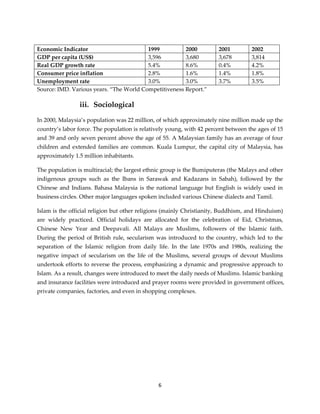
TABLE 1: MALAYSIAN ECONOMIC PERFORMANCE
6
Economic Indicator 1999 2000 2001 2002
GDP per capita (US$) 3,596 3,680 3,678 3,814
Real GDP growth rate 5.4% 8.6% 0.4% 4.2%
Consumer price inflation 2.8% 1.6% 1.4% 1.8%
Unemployment rate 3.0% 3.0% 3.7% 3.5%
Source: IMD. Various years. “The World Competitiveness Report.”
iii. Sociological
In 2000, Malaysia’s population was 22 million, of which approximately nine million made up the
country’s labor force. The population is relatively young, with 42 percent between the ages of 15
and 39 and only seven percent above the age of 55. A Malaysian family has an average of four
children and extended families are common. Kuala Lumpur, the capital city of Malaysia, has
approximately 1.5 million inhabitants.
The population is multiracial; the largest ethnic group is the Bumiputeras (the Malays and other
indigenous groups such as the Ibans in Sarawak and Kadazans in Sabah), followed by the
Chinese and Indians. Bahasa Malaysia is the national language but English is widely used in
business circles. Other major languages spoken included various Chinese dialects and Tamil.
Islam is the official religion but other religions (mainly Christianity, Buddhism, and Hinduism)
are widely practiced. Official holidays are allocated for the celebration of Eid, Christmas,
Chinese New Year and Deepavali. All Malays are Muslims, followers of the Islamic faith.
During the period of British rule, secularism was introduced to the country, which led to the
separation of the Islamic religion from daily life. In the late 1970s and 1980s, realizing the
negative impact of secularism on the life of the Muslims, several groups of devout Muslims
undertook efforts to reverse the process, emphasizing a dynamic and progressive approach to
Islam. As a result, changes were introduced to meet the daily needs of Muslims. Islamic banking
and insurance facilities were introduced and prayer rooms were provided in government offices,
private companies, factories, and even in shopping complexes.
7
iv. Technological
Infrastructure
The overall infrastructure of Malaysia is one of the most developed in Asia and ranked
8th in Asia and 25th in the world. Malaysia is ranked 19th in the world for its quality roads,
quality of port infrastructure and quality of air transport infrastructure but ranked 39th in
quality of electricity supply. Its telecommunications network is second only to Singapore's in
Southeast Asia, with 4.7 million fixed-line subscribers and more than 30 million cellular
subscribers. The country has seven international ports, the major one being the Port Klang.
There are 200 industrial parks along with specialized parks such as Technology Park Malaysia
and Kulim Hi-Tech Park. Freshwater is available to over 95 percent of the population. During
the colonial period, development was mainly concentrated in economically powerful cities and
in areas forming security concerns. Although rural areas have been the focus of great
development, they still lag behind areas such as the West Coast of Peninsular Malaysia. The
telecommunication network, although strong in urban areas, is less available to the rural
population.
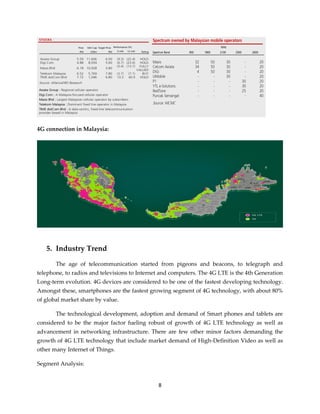
Malaysia Telecom Sector 4G connection in Malaysia:
Axiata, DiGi, and Maxis plunged by 8.5%, 4.3%, and 6.4% respectively on heavy volume.
In total, this had wiped out RM9.4bn off their market capitalization. Since there is no precedent
and given the lack of details, we believe the market is pricing in a very bearish scenario where
the Government will try to extract as much revenue as possible from the telco sector (high
auction price, 900 MHz and 1800 MHz refarming, front-loaded payment terms, etc.). Not
helping either is that Telekom Malaysia also signed a domestic roaming agreement with Axiata
on the same day, officially marking an entry of a new player into the crowded mobile market.
In response, the Malaysian Communication and Multimedia Commission (MCMC)
issued a press release saying that this exercise will bring benefits to the industry and consumers,
as well as allowing telco players to obtain spectrum in a fair and equitable manner. With the
spectrum redistribution, new services such as 4G LTE could be expanded to more areas
(whether urban or rural) and offered at more affordable rates.
8
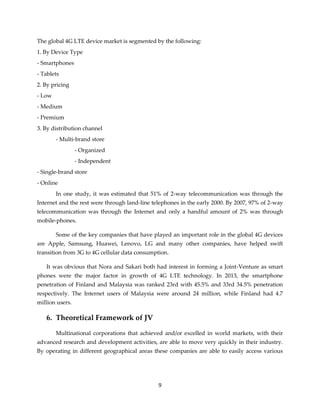
4G connection in Malaysia:
5. Industry Trend
The age of telecommunication started from pigeons and beacons, to telegraph and
telephone, to radios and televisions to Internet and computers. The 4G LTE is the 4th Generation
Long-term evolution. 4G devices are considered to be one of the fastest developing technology.
Amongst these, smartphones are the fastest growing segment of 4G technology, with about 80%
of global market share by value.
The technological development, adoption and demand of Smart phones and tablets are
considered to be the major factor fueling robust of growth of 4G LTE technology as well as
advancement in networking infrastructure. There are few other minor factors demanding the
growth of 4G LTE technology that include market demand of High-Definition Video as well as
other many Internet of Things.
Segment Analysis:
9
The global 4G LTE device market is segmented by the following:
1. By Device Type
- Smartphones
- Tablets
2. By pricing
- Low
- Medium
- Premium
3. By distribution channel
- Multi-brand store
- Organized
- Independent
- Single-brand store
- Online
In one study, it was estimated that 51% of 2-way telecommunication was through the
Internet and the rest were through land-line telephones in the early 2000. By 2007, 97% of 2-way
telecommunication was through the Internet and only a handful amount of 2% was through
mobile-phones.
Some of the key companies that have played an important role in the global 4G devices
are Apple, Samsung, Huawei, Lenovo, LG and many other companies, have helped swift
transition from 3G to 4G cellular data consumption.
It was obvious that Nora and Sakari both had interest in forming a Joint-Venture as smart
phones were the major factor in growth of 4G LTE technology. In 2013, the smartphone
penetration of Finland and Malaysia was ranked 23rd with 45.5% and 33rd 34.5% penetration
respectively. The Internet users of Malaysia were around 24 million, while Finland had 4.7
million users.
6. Theoretical Framework of JV
Multinational corporations that achieved and/or excelled in world markets, with their
advanced research and development activities, are able to move very quickly in their industry.
By operating in different geographical areas these companies are able to easily access various
10
inputs and develop products that can be produced anywhere and sold anywhere.a So while the
global economy keeps some companies away from the investment, it offers opportunities for
multinational companies to enter, grow and develop in different international markets.
The existing conditions in the companies' own countries (driving forces such as
inadequate market share, contraction in demand, increasing competition, rapid deterioration of
products, production of quality products, high labor force, transportation costs, taxes and
government restrictions) and the various factors (attractive factors such as cheap labor,
investment facilities, wide market share) in the countries where they want to invest have
prompted companies to establish ventures and become multinational. A joint venture is a third
company that is separate from the parent companies in terms of ownership, activities,
responsibilities, financial risks, which they have created by bringing together the resources of a
multinational company and the local company.b It can be formed in different sectors and
different species. The control center of at least one of the parties forming the joint venture is
outside the country in which the joint venture operates the activities of this new venture, the
basic investment, production, marketing, and management policies, are jointly controlled by
parent companies that are economically and legally independent of each other.c Partners can
participate in partnership with resources such as technology, patents, general management
information, physical assets such as machines, equipment, information about the market,
distribution channels, materials, labor, finance. Thus, the parties obtain their inadequate
resources through another enterprise and share the project risk when a new product is
developed.
The partnerships established by two foreign firms in a third country for the same
purposes today are also referred to as joint ventures. The share of one parent company that has
capital in a joint venture is defined as less than 90% of the capital, and the other's share is more
than 10%. Companies with a capital share of 90% or more are considered to be a separate
enterprise, i.e. a wholly owned subsidiary. In some sources, it is considered as a subsidiary that
the company has 95% capital share.
The reasons why multinational corporations use the joint venture strategy can be briefly
explained as follows:
1. Shared investment
a
Czinkota, M. & Ronkainen, I. J Int Bus Stud (1997) 28: 827. https://doi.org/10.1057/palgrave.jibs.8490121
b
Hall, 1984:19; Harrigan, 1984: 7; Zeiralshenkal, 1987:547; Sulel, 1998; Triantis, 1999: 105
c
An empirical investigation of joint venture dynamics : Evidence from U.S.-Japan joint ventures. / Nakamura,
Masao; Shaver, J. Myles; Yeung, Bernard.
11
Each party in the venture contributes a certain amount of initial capital to the project,
depending upon the contract terms and thus alleviating some of the financial burden placed on
each company.
2. Shared expenses
Each party shares the common pool of resources and thus brings down the cost on an
overall basis.
3. Technical expertise and know-how
Each party to the business often brings specialized expertise and knowledge, which
helps the joint venture become more competent and strong enough to move aggressively in a
specified direction.
4. New market penetration
A joint venture allows companies to enter a new market very quickly as all relevant
regulations and logistics are taken care of by the local player. Hence, with the formation of the
venture, the companies are able to expand their product portfolio and market size.
5. New revenue streams
Small businesses face limited resources and capital for growth projects. By entering into
a joint venture with a stronger and more established partner, the small business can expand its
sales force and distribution channels, resulting in larger and more diversified revenue streams.
6. Intellectual property gains
The critical intellectual property, technology or other resources are often difficult to build
in-house. Businesses then enter into joint ventures with businesses that possess these resources
in order to gain access to such assets.
7. Synergy benefits
With the expansion in product portfolio, venturing into new market and sharing of
common expenses and expertise, it allows synergy to come quickly in the JV.
8. Enhanced credibility
It takes lots of time for a young business to build market credibility and a strong
customer base. For these companies, forming a joint venture with a larger, well-known brand
can help them grow faster and achieve more credibility and visibility.
12
9. Barriers to competition
One of the reasons for forming a joint venture is also to avoid competition and pricing
pressure. With collaboration with other companies, market penetration builds barriers for
competitors that are effectively difficult to penetrate.
10. Improved economies of scale
A bigger company always enjoys the economies of scale, which again is enjoyed by all the
parties in the JV.
7. Why Nora Looking for JV
Two and a half years before the declaration of TBM's 1 billion RM 4G infrastructure
project, Sakari was looking for the opportunity to enter the Asian mobile broadband network
market which has a huge development potential. Nora and Sakari had discussed the potential
forming a JV in Malaysia for more than two years.
In August 2012, TBM called for tenders to bid on a two-year project worth 1 billion RM
for building an LTE radio access network in various parts of the country. The project involved
deploying cell sites, comprising antennae, amplifiers, LTE base stations, and switches, laying
fiber optic cable to connect cell sites with the fixed broadband network, and implementing
network planning and optimization software. Nora was interested in securing a share of the RM
1 billion contract from TMB and more importantly, in acquiring the knowledge in LTE
technology from its partnership with a telecom MNC. During the initial stages, when Nora first
began to consider potential partners in the bid for this contract, MNCs such as Samsung and
NEC seemed appropriate candidates. Nora also had the experience of long-term working
relationship with Japanese partners, including a fiber optic joint venture with NEC, and a five-
year technical assistance agreement with Samsung to manufacture telephone handsets. Alcatel-
Lucent and Ericsson were not considered, as they were already involved with other local
competitors. But, Zainal, who is vice-chairmen of Nora, wanted to get to western technology
more. He thought Nora could have an edge on the market with Sakari. With the announcement
of successful bidders of TBM’s project, JV negotiations gained a more serious momentum,
because Nora was awarded one-third share of project contract. With this project, Nora would be
responsible for delivering 400 cell sites over a period of two years. Then, he decided to consider
Sakari as a serious potential partner. He was briefed about Sakari’s SK4LTE, which is advanced
and open to development 4G LTE platform. (Ainuddin, 2015)
13
8. Problems
1. Equity Ownership
Both companies have agreed to form the Joint-Venture with a paid-up capital of RM8
million. However, they disagreed on the equity share proposed by each-side. Sakari proposed a
equity split of 49 per cent for Sakari and 51 per cent for Nora. Nora, on the other hand, proposed
a 30 per cent for Sakari and 70 per cent Nora split. Nora’s proposal was based on the common
practice in Malaysia as a result of historical foreign equity regulation set by the Malaysian
government that allowed a maximum of 30 per cent foreign equity ownership unless the
company would export a certain percentage of its products. Thought these regulations were
liberalized by the Malaysian government effective from July, 1998. The new regulation had
replaced the old ones, the 30-70 foreign-Malaysian ownership divide was still commonly
observed.
2. Technology Transfer
Sakari proposed to provide the JV with the basic structure of the SK 10 base station. The
JV company would assemble the base stations at the JV plant and subsequently install the
exchanges in designated locations identified by TMB. By offering Nora only the basic structure
of the SK 10, the core of Sakari’s 4G LTE platforms would still be well-protected. It was in
Sakari’s interest to protect its platform while supplying the JV company with necessary
technology.
Nora on the other hand, proposed that the basic structure of the SK 10 base station to be
developed at the JV Company. This was because Sakari’s proposal was perceived as only the
technical aspects in assembling and installing the SK 10 would be obtained. This was perceived
as another “screw-driver” form of technology transfer while the core technology associated with
making the base stations would be still unknown to Nora. This was not a good deal for Nora
and they wanted Sakari’s all the “know-hows” of the 4G technology.
3. Royalty Payment
Closely related to the issue of technology transfer was the payment of royalty for the
technology used in building the base stations. Sakari proposed a royalty payment of 5 per cent
of the JV gross sales while Nora proposed a payment of 2 per cent of net sales. The net sales
were overall sales minus returns, allowances for damaged or missing goods, plus any discounts.
Nora considered the royalty rate of 5 per cent too high because it would affect Nora’s
financial situation. Financial simulations prepared by Nora’s managers indicated that its return
on investment would be less than the desired 10 per cent if royalty rates exceeded 3 per cent of
14
the net sales. This was because Nora had already agreed to make large additional investments in
support of the JV. Nora would invest in a building to be rented to the JV Company to
accommodate an office and the base station plant. Nora would also invest in another plant to
supply the JV with antennae and amplifiers required for the cell sites.
An added argument raised by the Nora negotiators in support of a 2 per cent royalty was
that Sakari would receive benefits from the JV’s access to Japanese technology used in
manufacturing antennae and amplifiers. Apparently the Japanese technology was more
advanced that Sakari’s present technology.
4. Expatriates’ Salaries and Perks
To allay Sakari’s concerns over Nora’s level of efficiency, Nora suggested that Sakari
provide the necessary training for the JV technical employees. Subsequently, Sakari had agreed
to provide eight engineering experts for the JV company on two types of contracts, short-term
and long-term. Experts employed on a short-term basis would be paid a daily rate of US$1260
plus travel/accommodation. The permanent experts would be paid a monthly salary of
US$20,000. Three permanent experts would be attached to the JV company once it was
established and the number would gradually be reduced to only one, after two years. Five
experts would be available on a short-term basis to provide specific training needs for durations
of not more than three months each year.
The Nora negotiation team was appalled at the exorbitant amount proposed by the
Sakari negotiators. They were surprised that the Sakari team had not surveyed the industry
rates, as the Japanese and other western negotiators would normally have done. Apparently
Sakari had not taken into consideration the relatively low cost of living in Malaysia compared to
Finland. In response to Sakari’s proposal, Nora negotiators adopted an unusual “take-it or
leave-it” stance. They deemed the following proposal reasonable in view of the comparisons
made with other JVs which Nora had entered into with other foreign parties:
Permanent experts’ monthly salary ranges to be paid by the JV company were as follows:
(1) Senior expert (seven to 10 years experience)....RM24,300–RM27,900
(2) Expert (four to six years experience)............. RM22,500–RM25,200
(3) Junior expert (two to three years experience)... RM20,700–RM23,400
(4) Any Malaysian income taxes payable would be added to the salaries.
(5) A car for personal use.
(6) Annual paid vacation of five weeks.
(7) Return flight tickets to home country once a year for the whole family of married persons
and twice a year for singles according to Sakari’s general scheme.
(8) Any expenses incurred during official travelling.
15
Temporary experts are persons invited by the JV company for various technical assistance tasks
and would not be granted residence status. They would be paid the following fees:
(1) Senior expert........................................RM1,350 per working day
(2) Expert.................................................RM1,170 per working day
(3) The JV company would not reimburse the following:
Flight tickets between Finland (or any other country) and Malaysia.
Hotel or any other form of accommodation.
Local transportation.
In defense of their proposed rates, Sakari’s negotiators argued that the rates presented by
Nora were too low. Sakari suggested that Nora’s negotiators take into consideration the fact that
Sakari would have to subsidize the difference between the experts’ present salaries and the
amount paid by the JV company. A large difference would require that large amounts of
subsidy payments be made to the affected employees.
5. Arbitration
Nora and Sakari both agreed to an arbitration process in the event of future disputes,
they agreed on the location for disputes resolution. Nora insisted that arbitration sites to be
placed in capital city of Malaysia, Kuala Lumpur as Nora will be holding majority of
stakeholders. Sakari on the other hand suggested the arbitration site to be in Helsinki, Finland
capital, as it was a common practice for Finnish companies.
9. Recommendations
According to our analyses, Nora has only two options:
Option one: Terminating the negotiations
We know that Nora has previous experiences with Japanese companies and other
companies so Nora can cancel the negotiations with Sakari and try to make a deal with one of
her old partners.
But from Nora perspective, terminating negotiations would mean starting all over from
scratch. It will take time for it to find another right partner, to enter into negotiations with it and
to then plan and form a JV with the chosen partner.
Time is already running short as under contract, Nora is obliged to install the digital
exchanges in five years. The lack of time may also affect the choice of partner Nora makes in the
16
future and that choice may not be the best one and best suited to the requirements of the
company. There is also the possibility of the worst case scenario coming to pass whereby Nora
fails to come to an agreement with the new chosen partner during the negotiations phase. The
choices available to Nora are not as attractive since the solutions offered by companies other
than Sakari aren't as customized and hence serve not only urban environments but also rural
ones. The solutions offered by companies other than Sakari are apparently not that adaptable
and compatible either.
All this lead us to choose option two;
Option two: Renegotiate with Sakari
If Nora decides to renegotiate with Sakari, how should we restructure the terms of the
deal?
Nora and Sakari both are very successful in their respective field of business. Nora is one
of the leading suppliers of the telecommunication equipment in Malaysia. Sakari can gain a lot
from Nora’s strengths and knowledge about the culture and market. On the other hand, Sakari
is one of the successful niche market players for supplying digital switches technology.
Therefore, both the companies have their own strengths and advantages over another and both
the partners can learn and gain a lot from each other. Therefore, in our opinion, both the
company should compromise on something in order to materialize the contract.
While talking about the restructuring the negotiations, following are the key areas where
we would restructure the negotiations:
Ownership: The first key issue that should be restructured is about equity ownership and
power control. In our opinion, Nora should posse’s greater portion of JV equity (60 percent for
Nora and 40 percent for Sakari) for two reasons. First is that JV will operate in Malaysia and not
in Finland and they understand their culture better than that of Sakari. And the second reason is
that Nora has the competitive and suitable managerial forces to manage the JV. Therefore, it
would be better if Nora holds a larger percentage of share than that of Sakari.
Technology: Second, the key area is technology transfer in which it would be better if Nora
accepts the Sakari’s proposal. Every company wants to control the technology transfer in the
highest degree. Therefore, Nora should let the Sakari to keep the technology development in-
house and accept the Sakari’s proposed assembly and installations plan.
Royalty: In our opinion, Royalties should be compromised as Nora because the financial
stimulation prepared by Nora’s manager’s indicated that Nora’s return on investment would be
less than the desired 10% if royalty rates exceeded 3 % of net sales.
17
Arbitration: In our opinion, for arbitration, a neutral location other than KL and Helsinki should
be chosen so that none of the company feel like the other party is gaining an advantage over
themselves in terms of possible future disputes, for example, Singapore International
Arbitration Center.
Salaries and Perks: Salaries and Perks should be given as per the conditions in Helsinki because
both the companies and their JV need expertise of the Finnish experts who will be working for
Sakari. Therefore, salaries and perks should be given as per the rules and rate in Helsinki.
Therefore, it would be better if Nora agrees with Sakari regarding Salaries and Perks.
10.Conclusion
After all our analysis in this case we can say that the main problem faced in this long
negotiation between Nora and Sakari are:
1. Cultural differences;
2. Difference in management styles.
3. Inability of both parties to compromise on key issues;
As we know Finland and Malaysia are completely different from each other, the culture
not the same also the language, the way of thinking totally different, and that we sow during the
negotiations (Nora’s team think that Sakari’s team is too serious). And we can say that both
teams didn’t prepare very well for the negotiations, and that’s the reason of the large gap
between the views of the teams.
And as a conclusion we can say that:
In setting up joint ventures, managers should venture into negotiations being prepared and
having and understanding of the cultural differences that may arise. Market research and
industry research will enable the parties involved to anticipate what these problems will be so
that they will be better able to combat the problems as well as efficiently negotiate terms.
18
11.References
 Boulton, William; Pecht, Michael; Tucker, William; Wennberg, Sam (May 1997).
"Electronics Manufacturing in the Pacific Rim, World Technology Evaluation Center,
Chapter 4: Malaysia". The World Technology Evaluation Center, Inc. Retrieved on 1
November 2010.
 CHI, TaHanI MCGUIRE, Donald (1996), "Collaborative Ventures and Value of
Learning: Integrating the Transaction Cost and Strategic Option Perspectives of the
Choice of Market Entry Modes," Journal of International Business Studies, Vol. 27:
285-308.
 CHEN, Haiyang Hu, Michael, Y. vd. (1991), "The Wealth Effect of
International Joint Ventures:
 CZINKOTA, Michael R.I RONKAINEN, Ikka A. (1993), International Marketing
(Florida: The Dryden Press, Third Edition).
 DBS Group Research . Equity 29 Jan 2016
 Hall, 1984:19; Harrigan, 1984: 7; Zeiralshenkal, 1987:547; Sulel, 1998; Triantis, 1999:
105.
 Nakamura Shaver Young 1996: 522; Glaister Buckley, 1998:170; Tayeb/Contractor,
2001: 56; Ineci:5; Newburry/Zeira, 1997: 89.
 NAKAMURA, Masao ISHAVER, J.Mylesl YEUNG, Bernard (1996), "An Empirical
Investigation of Joint Venture Dynamics: Evidence From U.S.-Japan Joint Ventures,"
International Journal of Industrial Organization, 14: 521-541.
 YOUNG, Stephen! HAMILL, James vd. (1989), International Market Entry and
Development (Harvester Wheatsheaf, first published): 208.221The Case of U.S.
Investment in China," Financial Management, Vol. 20, Issue 4: 31-42.
 "WEF" World Economic Forum. Competitiveness Rankings. Retrieved 13 February
2015.

Nora sakari a joint venture

  • 1.
    IB504 GLOBAL STRATEGICMANAGEMENT TERM PAPER NORA-SAKARI: A PROPOSED JV IN MALAYSIA HUSEYIN TEKLER KHANGAI BATBAYAR SOD-OCHIR BADAMDORJ MOHAMMED BOUHOUN ALI YOURA LY IBW 2017539015 AEW2017539031 IBW 2017539038 IBW 2017539039 AEW2017539019
  • 2.
    ii CONTENTS 1. Executive Summary(Abstract) 1 2. Introduction 1 3. Companies Background 2 a. Nora 2 b. Sakari 2 4. Basic Information of Malaysia 3 a. PEST 3 i. Political 3 ii. Economic 4 iii. Sociological 6 iv. Technological 7 5. Industry Trend 8 6. Theoretical Framework of JV 9 7. Why Nora Looking for JV 12 8. Problems 13 9. Recommendations 15 10.Conclusion 17 11.References 18
  • 3.
    1. Executive Summary Theconcept of creating competitive advantage through strategic alliances for companies has been widely discussed since the late 1980s. Over the past three decades, there has been a significant increase in the number of international joint ventures (JVs) as a result of companies' efforts to be more dependent on each other globally. These initiatives, which are a special type of strategic cooperation, allow participating firms to combine different qualifications and complementary resources. In order for the joint ventures to be established, it must pass through a successful negotiation process. Negotiations are an important part of international business. Parties involved in a negotiation face different problems in reaching a successful outcome. When the parties have different cultural backgrounds, the faced problems become more complex. In this study, we will try to analyze the problems encountered by Nora and Sakkari firms in the process of joint venture agreement and to produce solutions. 2. Introduction This case involves the construction of a joint venture between a Malaysian company, Nora Holdings Sdn Bhd (Nora), and Sakari Oy (Sakari), a conglomerate from Finland. Nora is one of the major suppliers of telecommunication solutions in Malaysia while Sakari has expertise in mobile phones, digital exchanges is a niche player in the global switching market, and has a major share of the Finnish mobile market. Nora submitted a bid for tenders that were floated by Malaysia’s national telecommunication company, Telekom Malaysia Bhd (TMB), to develop the country’s telecommunication infrastructure, to supply and install 4G LTE equipment supporting 1200 cell sites, to align with the government’s “Vision 2020” program. TMB neither had the technical know-how nor the expertise to take on the massive infrastructure project. Nora was one of the five companies short-listed by TMB, all offering their partner's technology. Nora needed the JV with Sakari to ensure it could meet the obligations for the TMB contract, learn from their success, and replicate their model in the Malaysian market. It had government ties, had won a part of the bid, Nora also always wanted to increase its influence on the South Asian market, and it is a chance for Nora to reach its aim by piggybacking on Sakari’s technology, and above all, had knowledge of the Malaysian market. Sakari, on the other hand, wanted to enter the Asian market because of the opportunities it offered and had technology that Nora was looking for. The negotiations between Nora and Sakari included twenty meetings and each side had invested not less than RM 4 million in securing the JV. The following personnel participated in the negotiations.
  • 4.
    2 After long negotiations,there were still problems that could not be solved. These included aspects of equity ownership, technology transfer, royalty payment, expatriate's salaries and perks, and arbitration. But, Nora will soon have to fulfill the contract with TMB and time is running out. So what should Zanial do? Reconcile with Sakari or find another partner for the big contract? 3. Companies Background a. Nora Nora Sdn Bhd is Malaysian family name, one of the famous organizations in the telecommunication business was set up in 1975 with a paid-up capital of RM2 million. Nora Holdings have 35 subsidiaries, 2 public-listed companies: Multiphone Bhd and Nora Telecommunications Bhd and Nora had 5,545employees, of which 923 were categorized as managerial (including 440 engineers) and 4,622 as non-managerial (including 484 engineers and technicians). Nora had become a well-known name in Malaysia as a phone manufacturer. It started in 1980 when the organization got an agreement to supply telephone sets to the state-owned telecommunication company, TMB. In 1985, Nora secured licenses from Siemens and Nortel to make phone handsets and accordingly built up its own phone set. In 2011, Nora gained S&B Telecom's business for RM80 million, with the purpose of securing a foothold into the fast developing and high-profit margin mobile network service business. S&B Telecom's work involved in the installation, commissioning, and maintenance of mobile cell tower equipment and laying fiber optic cables to connect the cell towers with the fixed network. Nora saw this line of business as urgent for winning the TMB 4G LTE contract and building up a fruitful joint venture with MNC suppliers b. Sakari Sakari Oy from Finland was established in 1865 and began as a pulp and paper mill production company. In the 1960s, Sakari expanded into the rubber and cable industry. In1975, Sakari entered into the computers, consumer electronics, and cellular phones industries via a series of acquisitions, mergers, and alliances. In 1979, a JV between Sakari and Vantala was set up to develop and manufacture mobile telephones and gained a large percentage of the world, European including the United Kingdom, Malaysian, and Thailand market for the production of mobile phones and mobile phone handsets. In using the technology gained from their previous acquisitions and working experience, Sakari Oy gained an edge and distinct advantage in the telecom industry by selling switching systems licensed from France's Alcatel and by developing
  • 5.
    3 the software andsystems to suit needs of small Finish phone companies. In order to avoid competition, Sakari concentrated on developing dedicated telecom networks for large private users such as utility and railway companies. In 2001, Sakari was Finland's largest publicly-traded industrial company and derived the majority of its total sales from exports and over-sea operations. in 2007, Sakari consolidates its telecoms infrastructure activities with those of Magma to frame a joint venture named Sakari-Magma(SM). The arrangement was to lessen fetched, distinguish item and administration correlative, and give a better market elective than both Ericsson's top of the line offering and Huawei's low-cost arrangement. SM turned into a main worldwide supplier of both remote and landline telecom foundation gear telecom administrators around the globe. In 2011, SM reported that it would cut 17,000 occupations throughout the following two years and rebuild its business to center around the versatile broadband arrangement. 4. Basic Information of Malaysia Malaysia is centrally located in South-east Asia. It consists of Peninsular Malaysia, bordered by Thailand in the north and Singapore in the south, and the states of Sabah and Sarawak on the island of Borneo. Malaysia has a total land area of about 330,000 square kilometers, of which 80 percent is covered with tropical rainforest. Malaysia has an equatorial climate with high humidity and high daily temperatures of about 26 degrees Celsius throughout the year. a. PEST PEST analysis (political, economic, socio-cultural and technological) describes a framework of macro-environmental factors used in the environmental scanning component of strategic management. It is part of an external analysis when conducting a strategic analysis or doing market research, and gives an overview of the different macroenvironmental factors to be taken into consideration. It is a strategic tool for understanding market growth or decline, business position, potential and direction for operations. i. Political Malaysia is a parliamentary democracy under a constitutional monarchy. The Yang DiPertuan Agung (the king) is the supreme head and appoints the head of the ruling political party to be the prime minister. In 2000 the Barisan Nasional, a coalition of several political parties representing various ethnic groups, was the ruling political party in Malaysia. Its
  • 6.
    4 predominance had contributednot only to the political stability and economic progress of the country in the last two decades but also to the fast recovery from the 1997 Asian economic crisis. ii. Economic Malaysia is a relatively open state-oriented and newly industrialized market economy. The state plays a significant but declining role in guiding economic activity through macroeconomic plans. Malaysia has had one of the best economic records in Asia, with GDP growing an average 6.5 percent annually from 1957 to 2005. Malaysia's economy in 2014–2015 was one of the most competitive in Asia, ranking 6th in Asia and 20th in the world, higher than countries like Australia, France, and South Korea. In 2014, Malaysia's economy grew 6%, the second highest growth in ASEAN behind the Philippines' growth of 6.1%. The economy of Malaysia in terms of gross domestic product (GDP) at purchasing power parity (PPP) in 2014 was $746.821 billion, the third largest in ASEAN behind more populous Indonesia and Thailand and the 28th largest in the world. In 1991, former Prime Minister of Malaysia, Mahathir Mohamad outlined his ideal in Vision 2020, in which Malaysia would become a self-sufficient industrialized nation by 2020. It will need to develop an endogenous capacity in innovation, however, to reach its goal of becoming a high-income country by 2020. Najib Razak has said Malaysia could attain developed country status much earlier from the actual target in 2020, adding the country has two program concept such as Government Transformation Programme and the Economic Transformation Programme. According to an HSBC report, Malaysia will become the world's 21st largest economy by 2050, with a GDP of $1.2 trillion (the Year 2000 dollars) and a GDP per capita of $29,247 (the Year 2000 dollars). The report also says "The electronic equipment, petroleum, and liquefied natural gas producer will see a substantial increase in income per capita. Malaysian life expectancy, relatively high level of schooling, and above average fertility rate will help in its rapid expansion". Viktor Shvets, the managing director of Credit Suisse, has said: "Malaysia has all the right ingredients to become a developed nation". International trade, facilitated by the shipping route in adjacent Strait of Malacca, and manufacturing are the key sectors. Malaysia is an exporter of natural and agricultural resources, and petroleum is a major export. Malaysia has once been the largest producer of tin, rubber and palm oil in the world. Manufacturing has a large influence on the country's economy, although Malaysia's economic structure has been moving away from it. Malaysia remains one of the world's largest producers of palm oil. In an effort to diversify the economy and make it less dependent on export goods, the government has pushed to increase tourism to Malaysia. As a result, tourism has become Malaysia's third largest source of foreign exchange, although it is threatened by the negative effects of the growing industrial economy, with large amounts of air and water pollution along with deforestation affecting tourism. The tourism sector came under some pressure in 2014 when the national carrier Malaysia Airlines had one of its planes disappear in March, while
  • 7.
    5 another was broughtdown by a missile over Ukraine in July, resulting in the loss of a total 537 passengers and crew. The state of the airline, which had been unprofitable for 3 years, prompted the government in August 2014 to nationalize the airline by buying up the 30 per cent it did not already own. Between 2013 and 2014, Malaysia has been listed as one of the best places to retire to in the world, with the country in the third position on the Global Retirement Index. This in part was the result of Malaysia My Second Home programme to allow foreigners to live in the country on a long-stay visa for up to 10 years. In 2016, Malaysia ranked the fifth position on The World's Best Retirement Havens while getting in the first place as the best place in Asia to retire. Warm climate with British colonial background made foreigners easy to interact with the locals. The recession of the mid-1980s led to structural changes in the Malaysian economy which had been too dependent on primary commodities (rubber, tin, palm oil and timber) and had a very narrow export base. To promote the establishment of export-oriented industries, the government directed resources to the manufacturing sector, introduced generous incentives and relaxed foreign equity restrictions. In the meantime, heavy investments were made to modernize the country’s infrastructure. These moves led to rapid economic growth in the late 1980s and early 1990s. The growth had been mostly driven by exports, particularly of electronics. The Malaysian economy was hard hit by the 1997 Asian economic crisis. However, Malaysia was the fastest country to recover from the crisis after declining IMF assistance. It achieved this by pegging its currency to the USD, restricting the outflow of money from the country, banning illegal overseas derivative trading of Malaysian securities and setting up asset management companies to facilitate the orderly recovery of bad loans. The real GDP growth rate in 1999 and 2000 were 5.4% and 8.6%, respectively (Table 1). Malaysia was heavily affected by the global economic downturn and the slump in the IT sector in 2001 and 2002 due to its export-based economy. GDP in 2001 grew only 0.4% due to an 11% decrease in exports. A US $1.9 billion fiscal stimulus package helped the country ward off the worst of the recession and the GDP growth rate rebounded to 4.2% in 2002 (Table 1). A relatively small foreign debt and adequate foreign exchange reserves make a crisis similar to the 1997 one unlikely. Nevertheless, the economy remains vulnerable to a more protracted slowdown in the US and Japan, top export destinations and key sources of foreign investment. In 2002, the manufacturing sector was the leading contributor to the economy, accounting for about 30 percent of gross national product (GDP). Malaysia’s major trading partners are United States, Singapore, Japan, China, Taiwan, Hong Kong and Korea. (Young, 1993) TABLE 1: MALAYSIAN ECONOMIC PERFORMANCE
  • 8.
    6 Economic Indicator 19992000 2001 2002 GDP per capita (US$) 3,596 3,680 3,678 3,814 Real GDP growth rate 5.4% 8.6% 0.4% 4.2% Consumer price inflation 2.8% 1.6% 1.4% 1.8% Unemployment rate 3.0% 3.0% 3.7% 3.5% Source: IMD. Various years. “The World Competitiveness Report.” iii. Sociological In 2000, Malaysia’s population was 22 million, of which approximately nine million made up the country’s labor force. The population is relatively young, with 42 percent between the ages of 15 and 39 and only seven percent above the age of 55. A Malaysian family has an average of four children and extended families are common. Kuala Lumpur, the capital city of Malaysia, has approximately 1.5 million inhabitants. The population is multiracial; the largest ethnic group is the Bumiputeras (the Malays and other indigenous groups such as the Ibans in Sarawak and Kadazans in Sabah), followed by the Chinese and Indians. Bahasa Malaysia is the national language but English is widely used in business circles. Other major languages spoken included various Chinese dialects and Tamil. Islam is the official religion but other religions (mainly Christianity, Buddhism, and Hinduism) are widely practiced. Official holidays are allocated for the celebration of Eid, Christmas, Chinese New Year and Deepavali. All Malays are Muslims, followers of the Islamic faith. During the period of British rule, secularism was introduced to the country, which led to the separation of the Islamic religion from daily life. In the late 1970s and 1980s, realizing the negative impact of secularism on the life of the Muslims, several groups of devout Muslims undertook efforts to reverse the process, emphasizing a dynamic and progressive approach to Islam. As a result, changes were introduced to meet the daily needs of Muslims. Islamic banking and insurance facilities were introduced and prayer rooms were provided in government offices, private companies, factories, and even in shopping complexes.
  • 9.
    7 iv. Technological Infrastructure The overallinfrastructure of Malaysia is one of the most developed in Asia and ranked 8th in Asia and 25th in the world. Malaysia is ranked 19th in the world for its quality roads, quality of port infrastructure and quality of air transport infrastructure but ranked 39th in quality of electricity supply. Its telecommunications network is second only to Singapore's in Southeast Asia, with 4.7 million fixed-line subscribers and more than 30 million cellular subscribers. The country has seven international ports, the major one being the Port Klang. There are 200 industrial parks along with specialized parks such as Technology Park Malaysia and Kulim Hi-Tech Park. Freshwater is available to over 95 percent of the population. During the colonial period, development was mainly concentrated in economically powerful cities and in areas forming security concerns. Although rural areas have been the focus of great development, they still lag behind areas such as the West Coast of Peninsular Malaysia. The telecommunication network, although strong in urban areas, is less available to the rural population. Malaysia Telecom Sector 4G connection in Malaysia: Axiata, DiGi, and Maxis plunged by 8.5%, 4.3%, and 6.4% respectively on heavy volume. In total, this had wiped out RM9.4bn off their market capitalization. Since there is no precedent and given the lack of details, we believe the market is pricing in a very bearish scenario where the Government will try to extract as much revenue as possible from the telco sector (high auction price, 900 MHz and 1800 MHz refarming, front-loaded payment terms, etc.). Not helping either is that Telekom Malaysia also signed a domestic roaming agreement with Axiata on the same day, officially marking an entry of a new player into the crowded mobile market. In response, the Malaysian Communication and Multimedia Commission (MCMC) issued a press release saying that this exercise will bring benefits to the industry and consumers, as well as allowing telco players to obtain spectrum in a fair and equitable manner. With the spectrum redistribution, new services such as 4G LTE could be expanded to more areas (whether urban or rural) and offered at more affordable rates.
  • 10.
    8 4G connection inMalaysia: 5. Industry Trend The age of telecommunication started from pigeons and beacons, to telegraph and telephone, to radios and televisions to Internet and computers. The 4G LTE is the 4th Generation Long-term evolution. 4G devices are considered to be one of the fastest developing technology. Amongst these, smartphones are the fastest growing segment of 4G technology, with about 80% of global market share by value. The technological development, adoption and demand of Smart phones and tablets are considered to be the major factor fueling robust of growth of 4G LTE technology as well as advancement in networking infrastructure. There are few other minor factors demanding the growth of 4G LTE technology that include market demand of High-Definition Video as well as other many Internet of Things. Segment Analysis:
  • 11.
    9 The global 4GLTE device market is segmented by the following: 1. By Device Type - Smartphones - Tablets 2. By pricing - Low - Medium - Premium 3. By distribution channel - Multi-brand store - Organized - Independent - Single-brand store - Online In one study, it was estimated that 51% of 2-way telecommunication was through the Internet and the rest were through land-line telephones in the early 2000. By 2007, 97% of 2-way telecommunication was through the Internet and only a handful amount of 2% was through mobile-phones. Some of the key companies that have played an important role in the global 4G devices are Apple, Samsung, Huawei, Lenovo, LG and many other companies, have helped swift transition from 3G to 4G cellular data consumption. It was obvious that Nora and Sakari both had interest in forming a Joint-Venture as smart phones were the major factor in growth of 4G LTE technology. In 2013, the smartphone penetration of Finland and Malaysia was ranked 23rd with 45.5% and 33rd 34.5% penetration respectively. The Internet users of Malaysia were around 24 million, while Finland had 4.7 million users. 6. Theoretical Framework of JV Multinational corporations that achieved and/or excelled in world markets, with their advanced research and development activities, are able to move very quickly in their industry. By operating in different geographical areas these companies are able to easily access various
  • 12.
    10 inputs and developproducts that can be produced anywhere and sold anywhere.a So while the global economy keeps some companies away from the investment, it offers opportunities for multinational companies to enter, grow and develop in different international markets. The existing conditions in the companies' own countries (driving forces such as inadequate market share, contraction in demand, increasing competition, rapid deterioration of products, production of quality products, high labor force, transportation costs, taxes and government restrictions) and the various factors (attractive factors such as cheap labor, investment facilities, wide market share) in the countries where they want to invest have prompted companies to establish ventures and become multinational. A joint venture is a third company that is separate from the parent companies in terms of ownership, activities, responsibilities, financial risks, which they have created by bringing together the resources of a multinational company and the local company.b It can be formed in different sectors and different species. The control center of at least one of the parties forming the joint venture is outside the country in which the joint venture operates the activities of this new venture, the basic investment, production, marketing, and management policies, are jointly controlled by parent companies that are economically and legally independent of each other.c Partners can participate in partnership with resources such as technology, patents, general management information, physical assets such as machines, equipment, information about the market, distribution channels, materials, labor, finance. Thus, the parties obtain their inadequate resources through another enterprise and share the project risk when a new product is developed. The partnerships established by two foreign firms in a third country for the same purposes today are also referred to as joint ventures. The share of one parent company that has capital in a joint venture is defined as less than 90% of the capital, and the other's share is more than 10%. Companies with a capital share of 90% or more are considered to be a separate enterprise, i.e. a wholly owned subsidiary. In some sources, it is considered as a subsidiary that the company has 95% capital share. The reasons why multinational corporations use the joint venture strategy can be briefly explained as follows: 1. Shared investment a Czinkota, M. & Ronkainen, I. J Int Bus Stud (1997) 28: 827. https://doi.org/10.1057/palgrave.jibs.8490121 b Hall, 1984:19; Harrigan, 1984: 7; Zeiralshenkal, 1987:547; Sulel, 1998; Triantis, 1999: 105 c An empirical investigation of joint venture dynamics : Evidence from U.S.-Japan joint ventures. / Nakamura, Masao; Shaver, J. Myles; Yeung, Bernard.
  • 13.
    11 Each party inthe venture contributes a certain amount of initial capital to the project, depending upon the contract terms and thus alleviating some of the financial burden placed on each company. 2. Shared expenses Each party shares the common pool of resources and thus brings down the cost on an overall basis. 3. Technical expertise and know-how Each party to the business often brings specialized expertise and knowledge, which helps the joint venture become more competent and strong enough to move aggressively in a specified direction. 4. New market penetration A joint venture allows companies to enter a new market very quickly as all relevant regulations and logistics are taken care of by the local player. Hence, with the formation of the venture, the companies are able to expand their product portfolio and market size. 5. New revenue streams Small businesses face limited resources and capital for growth projects. By entering into a joint venture with a stronger and more established partner, the small business can expand its sales force and distribution channels, resulting in larger and more diversified revenue streams. 6. Intellectual property gains The critical intellectual property, technology or other resources are often difficult to build in-house. Businesses then enter into joint ventures with businesses that possess these resources in order to gain access to such assets. 7. Synergy benefits With the expansion in product portfolio, venturing into new market and sharing of common expenses and expertise, it allows synergy to come quickly in the JV. 8. Enhanced credibility It takes lots of time for a young business to build market credibility and a strong customer base. For these companies, forming a joint venture with a larger, well-known brand can help them grow faster and achieve more credibility and visibility.
  • 14.
    12 9. Barriers tocompetition One of the reasons for forming a joint venture is also to avoid competition and pricing pressure. With collaboration with other companies, market penetration builds barriers for competitors that are effectively difficult to penetrate. 10. Improved economies of scale A bigger company always enjoys the economies of scale, which again is enjoyed by all the parties in the JV. 7. Why Nora Looking for JV Two and a half years before the declaration of TBM's 1 billion RM 4G infrastructure project, Sakari was looking for the opportunity to enter the Asian mobile broadband network market which has a huge development potential. Nora and Sakari had discussed the potential forming a JV in Malaysia for more than two years. In August 2012, TBM called for tenders to bid on a two-year project worth 1 billion RM for building an LTE radio access network in various parts of the country. The project involved deploying cell sites, comprising antennae, amplifiers, LTE base stations, and switches, laying fiber optic cable to connect cell sites with the fixed broadband network, and implementing network planning and optimization software. Nora was interested in securing a share of the RM 1 billion contract from TMB and more importantly, in acquiring the knowledge in LTE technology from its partnership with a telecom MNC. During the initial stages, when Nora first began to consider potential partners in the bid for this contract, MNCs such as Samsung and NEC seemed appropriate candidates. Nora also had the experience of long-term working relationship with Japanese partners, including a fiber optic joint venture with NEC, and a five- year technical assistance agreement with Samsung to manufacture telephone handsets. Alcatel- Lucent and Ericsson were not considered, as they were already involved with other local competitors. But, Zainal, who is vice-chairmen of Nora, wanted to get to western technology more. He thought Nora could have an edge on the market with Sakari. With the announcement of successful bidders of TBM’s project, JV negotiations gained a more serious momentum, because Nora was awarded one-third share of project contract. With this project, Nora would be responsible for delivering 400 cell sites over a period of two years. Then, he decided to consider Sakari as a serious potential partner. He was briefed about Sakari’s SK4LTE, which is advanced and open to development 4G LTE platform. (Ainuddin, 2015)
  • 15.
    13 8. Problems 1. EquityOwnership Both companies have agreed to form the Joint-Venture with a paid-up capital of RM8 million. However, they disagreed on the equity share proposed by each-side. Sakari proposed a equity split of 49 per cent for Sakari and 51 per cent for Nora. Nora, on the other hand, proposed a 30 per cent for Sakari and 70 per cent Nora split. Nora’s proposal was based on the common practice in Malaysia as a result of historical foreign equity regulation set by the Malaysian government that allowed a maximum of 30 per cent foreign equity ownership unless the company would export a certain percentage of its products. Thought these regulations were liberalized by the Malaysian government effective from July, 1998. The new regulation had replaced the old ones, the 30-70 foreign-Malaysian ownership divide was still commonly observed. 2. Technology Transfer Sakari proposed to provide the JV with the basic structure of the SK 10 base station. The JV company would assemble the base stations at the JV plant and subsequently install the exchanges in designated locations identified by TMB. By offering Nora only the basic structure of the SK 10, the core of Sakari’s 4G LTE platforms would still be well-protected. It was in Sakari’s interest to protect its platform while supplying the JV company with necessary technology. Nora on the other hand, proposed that the basic structure of the SK 10 base station to be developed at the JV Company. This was because Sakari’s proposal was perceived as only the technical aspects in assembling and installing the SK 10 would be obtained. This was perceived as another “screw-driver” form of technology transfer while the core technology associated with making the base stations would be still unknown to Nora. This was not a good deal for Nora and they wanted Sakari’s all the “know-hows” of the 4G technology. 3. Royalty Payment Closely related to the issue of technology transfer was the payment of royalty for the technology used in building the base stations. Sakari proposed a royalty payment of 5 per cent of the JV gross sales while Nora proposed a payment of 2 per cent of net sales. The net sales were overall sales minus returns, allowances for damaged or missing goods, plus any discounts. Nora considered the royalty rate of 5 per cent too high because it would affect Nora’s financial situation. Financial simulations prepared by Nora’s managers indicated that its return on investment would be less than the desired 10 per cent if royalty rates exceeded 3 per cent of
  • 16.
    14 the net sales.This was because Nora had already agreed to make large additional investments in support of the JV. Nora would invest in a building to be rented to the JV Company to accommodate an office and the base station plant. Nora would also invest in another plant to supply the JV with antennae and amplifiers required for the cell sites. An added argument raised by the Nora negotiators in support of a 2 per cent royalty was that Sakari would receive benefits from the JV’s access to Japanese technology used in manufacturing antennae and amplifiers. Apparently the Japanese technology was more advanced that Sakari’s present technology. 4. Expatriates’ Salaries and Perks To allay Sakari’s concerns over Nora’s level of efficiency, Nora suggested that Sakari provide the necessary training for the JV technical employees. Subsequently, Sakari had agreed to provide eight engineering experts for the JV company on two types of contracts, short-term and long-term. Experts employed on a short-term basis would be paid a daily rate of US$1260 plus travel/accommodation. The permanent experts would be paid a monthly salary of US$20,000. Three permanent experts would be attached to the JV company once it was established and the number would gradually be reduced to only one, after two years. Five experts would be available on a short-term basis to provide specific training needs for durations of not more than three months each year. The Nora negotiation team was appalled at the exorbitant amount proposed by the Sakari negotiators. They were surprised that the Sakari team had not surveyed the industry rates, as the Japanese and other western negotiators would normally have done. Apparently Sakari had not taken into consideration the relatively low cost of living in Malaysia compared to Finland. In response to Sakari’s proposal, Nora negotiators adopted an unusual “take-it or leave-it” stance. They deemed the following proposal reasonable in view of the comparisons made with other JVs which Nora had entered into with other foreign parties: Permanent experts’ monthly salary ranges to be paid by the JV company were as follows: (1) Senior expert (seven to 10 years experience)....RM24,300–RM27,900 (2) Expert (four to six years experience)............. RM22,500–RM25,200 (3) Junior expert (two to three years experience)... RM20,700–RM23,400 (4) Any Malaysian income taxes payable would be added to the salaries. (5) A car for personal use. (6) Annual paid vacation of five weeks. (7) Return flight tickets to home country once a year for the whole family of married persons and twice a year for singles according to Sakari’s general scheme. (8) Any expenses incurred during official travelling.
  • 17.
    15 Temporary experts arepersons invited by the JV company for various technical assistance tasks and would not be granted residence status. They would be paid the following fees: (1) Senior expert........................................RM1,350 per working day (2) Expert.................................................RM1,170 per working day (3) The JV company would not reimburse the following: Flight tickets between Finland (or any other country) and Malaysia. Hotel or any other form of accommodation. Local transportation. In defense of their proposed rates, Sakari’s negotiators argued that the rates presented by Nora were too low. Sakari suggested that Nora’s negotiators take into consideration the fact that Sakari would have to subsidize the difference between the experts’ present salaries and the amount paid by the JV company. A large difference would require that large amounts of subsidy payments be made to the affected employees. 5. Arbitration Nora and Sakari both agreed to an arbitration process in the event of future disputes, they agreed on the location for disputes resolution. Nora insisted that arbitration sites to be placed in capital city of Malaysia, Kuala Lumpur as Nora will be holding majority of stakeholders. Sakari on the other hand suggested the arbitration site to be in Helsinki, Finland capital, as it was a common practice for Finnish companies. 9. Recommendations According to our analyses, Nora has only two options: Option one: Terminating the negotiations We know that Nora has previous experiences with Japanese companies and other companies so Nora can cancel the negotiations with Sakari and try to make a deal with one of her old partners. But from Nora perspective, terminating negotiations would mean starting all over from scratch. It will take time for it to find another right partner, to enter into negotiations with it and to then plan and form a JV with the chosen partner. Time is already running short as under contract, Nora is obliged to install the digital exchanges in five years. The lack of time may also affect the choice of partner Nora makes in the
  • 18.
    16 future and thatchoice may not be the best one and best suited to the requirements of the company. There is also the possibility of the worst case scenario coming to pass whereby Nora fails to come to an agreement with the new chosen partner during the negotiations phase. The choices available to Nora are not as attractive since the solutions offered by companies other than Sakari aren't as customized and hence serve not only urban environments but also rural ones. The solutions offered by companies other than Sakari are apparently not that adaptable and compatible either. All this lead us to choose option two; Option two: Renegotiate with Sakari If Nora decides to renegotiate with Sakari, how should we restructure the terms of the deal? Nora and Sakari both are very successful in their respective field of business. Nora is one of the leading suppliers of the telecommunication equipment in Malaysia. Sakari can gain a lot from Nora’s strengths and knowledge about the culture and market. On the other hand, Sakari is one of the successful niche market players for supplying digital switches technology. Therefore, both the companies have their own strengths and advantages over another and both the partners can learn and gain a lot from each other. Therefore, in our opinion, both the company should compromise on something in order to materialize the contract. While talking about the restructuring the negotiations, following are the key areas where we would restructure the negotiations: Ownership: The first key issue that should be restructured is about equity ownership and power control. In our opinion, Nora should posse’s greater portion of JV equity (60 percent for Nora and 40 percent for Sakari) for two reasons. First is that JV will operate in Malaysia and not in Finland and they understand their culture better than that of Sakari. And the second reason is that Nora has the competitive and suitable managerial forces to manage the JV. Therefore, it would be better if Nora holds a larger percentage of share than that of Sakari. Technology: Second, the key area is technology transfer in which it would be better if Nora accepts the Sakari’s proposal. Every company wants to control the technology transfer in the highest degree. Therefore, Nora should let the Sakari to keep the technology development in- house and accept the Sakari’s proposed assembly and installations plan. Royalty: In our opinion, Royalties should be compromised as Nora because the financial stimulation prepared by Nora’s manager’s indicated that Nora’s return on investment would be less than the desired 10% if royalty rates exceeded 3 % of net sales.
  • 19.
    17 Arbitration: In ouropinion, for arbitration, a neutral location other than KL and Helsinki should be chosen so that none of the company feel like the other party is gaining an advantage over themselves in terms of possible future disputes, for example, Singapore International Arbitration Center. Salaries and Perks: Salaries and Perks should be given as per the conditions in Helsinki because both the companies and their JV need expertise of the Finnish experts who will be working for Sakari. Therefore, salaries and perks should be given as per the rules and rate in Helsinki. Therefore, it would be better if Nora agrees with Sakari regarding Salaries and Perks. 10.Conclusion After all our analysis in this case we can say that the main problem faced in this long negotiation between Nora and Sakari are: 1. Cultural differences; 2. Difference in management styles. 3. Inability of both parties to compromise on key issues; As we know Finland and Malaysia are completely different from each other, the culture not the same also the language, the way of thinking totally different, and that we sow during the negotiations (Nora’s team think that Sakari’s team is too serious). And we can say that both teams didn’t prepare very well for the negotiations, and that’s the reason of the large gap between the views of the teams. And as a conclusion we can say that: In setting up joint ventures, managers should venture into negotiations being prepared and having and understanding of the cultural differences that may arise. Market research and industry research will enable the parties involved to anticipate what these problems will be so that they will be better able to combat the problems as well as efficiently negotiate terms.
  • 20.
    18 11.References  Boulton, William;Pecht, Michael; Tucker, William; Wennberg, Sam (May 1997). "Electronics Manufacturing in the Pacific Rim, World Technology Evaluation Center, Chapter 4: Malaysia". The World Technology Evaluation Center, Inc. Retrieved on 1 November 2010.  CHI, TaHanI MCGUIRE, Donald (1996), "Collaborative Ventures and Value of Learning: Integrating the Transaction Cost and Strategic Option Perspectives of the Choice of Market Entry Modes," Journal of International Business Studies, Vol. 27: 285-308.  CHEN, Haiyang Hu, Michael, Y. vd. (1991), "The Wealth Effect of International Joint Ventures:  CZINKOTA, Michael R.I RONKAINEN, Ikka A. (1993), International Marketing (Florida: The Dryden Press, Third Edition).  DBS Group Research . Equity 29 Jan 2016  Hall, 1984:19; Harrigan, 1984: 7; Zeiralshenkal, 1987:547; Sulel, 1998; Triantis, 1999: 105.  Nakamura Shaver Young 1996: 522; Glaister Buckley, 1998:170; Tayeb/Contractor, 2001: 56; Ineci:5; Newburry/Zeira, 1997: 89.  NAKAMURA, Masao ISHAVER, J.Mylesl YEUNG, Bernard (1996), "An Empirical Investigation of Joint Venture Dynamics: Evidence From U.S.-Japan Joint Ventures," International Journal of Industrial Organization, 14: 521-541.  YOUNG, Stephen! HAMILL, James vd. (1989), International Market Entry and Development (Harvester Wheatsheaf, first published): 208.221The Case of U.S. Investment in China," Financial Management, Vol. 20, Issue 4: 31-42.  "WEF" World Economic Forum. Competitiveness Rankings. Retrieved 13 February 2015.