U
HELMET DETECTION USING
MACHINE LEARNING
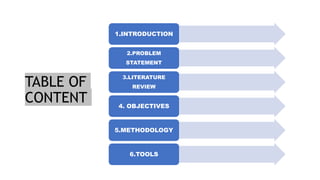
TABLE OF
CONTENT
1.INTRODUCTION
2.PROBLEM
STATEMENT
3.LITERATURE
REVIEW
4. OBJECTIVES
5.METHODOLOGY
6.TOOLS
INTRODUCTION
•Introduction: The use of helmets is crucial for safety in various
activities, such as riding motorcycles, bicycles, and in construction
industries.
•Motivation: To develop a system that can automatically detect
whether individuals are wearing helmets, which can be useful for
enhancing safety measures and enforcing helmet-wearing policies.
PROBLEM STATEMENT
HELMET DETECTION
USING MACHINE LEARNING
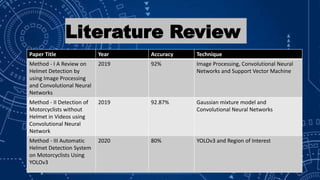
Literature Review
Paper Title Year Accuracy Technique
Method - I A Review on
Helmet Detection by
using Image Processing
and Convolutional Neural
Networks
2019 92% Image Processing, Convolutional Neural
Networks and Support Vector Machine
Method - II Detection of
Motorcyclists without
Helmet in Videos using
Convolutional Neural
Network
2019 92.87% Gaussian mixture model and
Convolutional Neural Networks
Method - III Automatic
Helmet Detection System
on Motorcyclists Using
YOLOv3
2020 80% YOLOv3 and Region of Interest
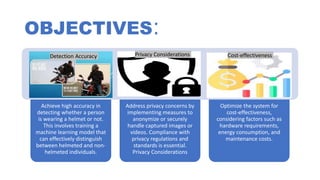
OBJECTIVES:
Achieve high accuracy in
detecting whether a person
is wearing a helmet or not.
This involves training a
machine learning model that
can effectively distinguish
between helmeted and non-
helmeted individuals.
Address privacy concerns by
implementing measures to
anonymize or securely
handle captured images or
videos. Compliance with
privacy regulations and
standards is essential.
Privacy Considerations
Optimize the system for
cost-effectiveness,
considering factors such as
hardware requirements,
energy consumption, and
maintenance costs.
Detection Accuracy Privacy Considerations Cost-effectiveness
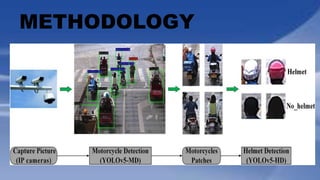
METHODOLOGY
TOOLS/PLATFORMS
• PROGRAMMING LANGUAGE: PYTHON
• DATA STRUCTURE CONCEPTS: LIST, ARRAY
• DATA ANNOTATION: LABELIMG, LABELBOX
Presentation of Helmet Detection Using Machine Learning.pptx

Presentation of Helmet Detection Using Machine Learning.pptx

  • 1.
  • 2.
  • 3.
    INTRODUCTION •Introduction: The useof helmets is crucial for safety in various activities, such as riding motorcycles, bicycles, and in construction industries. •Motivation: To develop a system that can automatically detect whether individuals are wearing helmets, which can be useful for enhancing safety measures and enforcing helmet-wearing policies.
  • 4.
  • 5.
    Literature Review Paper TitleYear Accuracy Technique Method - I A Review on Helmet Detection by using Image Processing and Convolutional Neural Networks 2019 92% Image Processing, Convolutional Neural Networks and Support Vector Machine Method - II Detection of Motorcyclists without Helmet in Videos using Convolutional Neural Network 2019 92.87% Gaussian mixture model and Convolutional Neural Networks Method - III Automatic Helmet Detection System on Motorcyclists Using YOLOv3 2020 80% YOLOv3 and Region of Interest
  • 6.
    OBJECTIVES: Achieve high accuracyin detecting whether a person is wearing a helmet or not. This involves training a machine learning model that can effectively distinguish between helmeted and non- helmeted individuals. Address privacy concerns by implementing measures to anonymize or securely handle captured images or videos. Compliance with privacy regulations and standards is essential. Privacy Considerations Optimize the system for cost-effectiveness, considering factors such as hardware requirements, energy consumption, and maintenance costs. Detection Accuracy Privacy Considerations Cost-effectiveness
  • 7.
  • 8.
    TOOLS/PLATFORMS • PROGRAMMING LANGUAGE:PYTHON • DATA STRUCTURE CONCEPTS: LIST, ARRAY • DATA ANNOTATION: LABELIMG, LABELBOX