Doug Drabkowski
Director of Strategic Initiatives and Research

The Association of Public Health Laboratories


                            2025 M Street, NW, Suite 550
                            Washington, DC 20036
                            www.aphl.org
APHL’s Vision and Mission
   A Healthier World Through Quality
          Laboratory Practice


 The mission of APHL is to promote the role of public
 health laboratories in support of national and global
  objectives, and to promote policies and programs
which assure continuous improvement in the quality of
                  laboratory practice
Core Functions of Public Health
            Laboratories
   Disease Prevention, Control and Surveillance
   Integrated Data Management
   Reference and Specialized Testing
   Environmental Health and Protection
   Food Safety
   Lab Improvement, Regulation and Policy
    Development
   Emergency Response
   Public Health Related Research
   Training and Education
   Partnerships and Communication
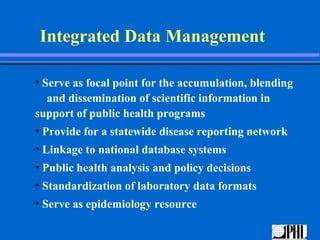
Integrated Data Management

• Serve as focal point for the accumulation, blending
   and dissemination of scientific information in
support of public health programs
• Provide for a statewide disease reporting network
• Linkage to national database systems
• Public health analysis and policy decisions
• Standardization of laboratory data formats
• Serve as epidemiology resource
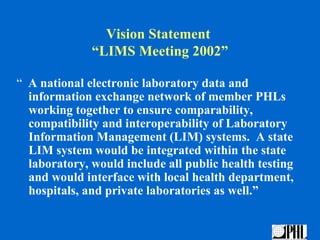
Vision Statement
              “LIMS Meeting 2002”

“ A national electronic laboratory data and
  information exchange network of member PHLs
  working together to ensure comparability,
  compatibility and interoperability of Laboratory
  Information Management (LIM) systems. A state
  LIM system would be integrated within the state
  laboratory, would include all public health testing
  and would interface with local health department,
  hospitals, and private laboratories as well.”
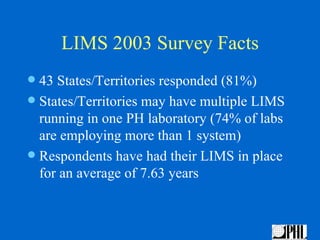
LIMS 2003 Survey Facts
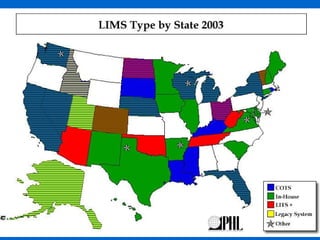
 43 States/Territories responded (81%)
 States/Territories may have multiple LIMS
  running in one PH laboratory (74% of labs
  are employing more than 1 system)
 Respondents have had their LIMS in place
  for an average of 7.63 years
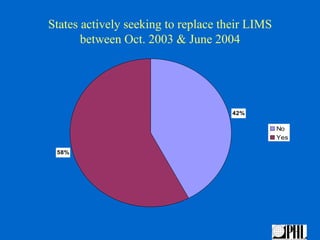
States actively seeking to replace their LIMS
       between Oct. 2003 & June 2004


                                     42%

                                                No
                                                Yes

 58%
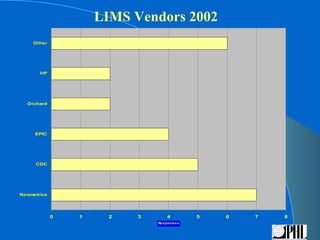
LIMS Vendors 2002
    Other


       HP


  Orchard


     EPIC


     CDC


Neometrics


             0   1     2   3        4         5   6   7   8
                               Re s ponse s
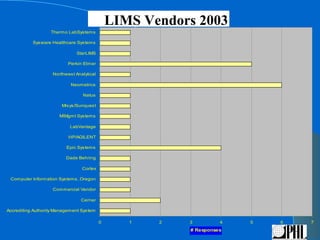
LIMS Vendors 2003
                                            LIMS Vendors 2003
                   Thermo LabSystems

           Sysware Healthcare Systems

                               StarLIMS

                           Perkin Elmer

                    Northwest Analytical

                            Neometrics

                                  Natus

                        Misys/Sunquest

                       MMgmt Systems

                            LabVantage

                           HP/AGILENT

                          Epic Systems

                          Dade Behring

                                 Cortex

 Computer Information Systems, Oregon

                    Commercial Vendor

                                 Cerner

Accrediting Authority Management System

                                           0   1   2   3         4   5   6   7
                                                       # Responses
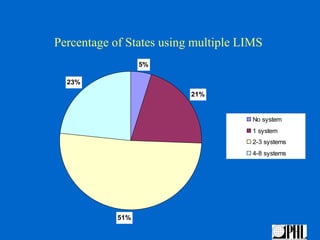
Percentage of States using multiple LIMS
                  5%

  23%
                          21%


                                      No system
                                      1 system
                                      2-3 systems
                                      4-8 systems


            51%
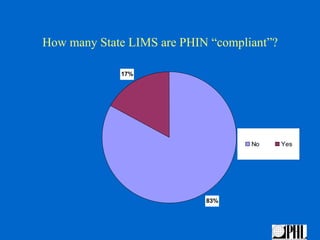
How many State LIMS are PHIN “compliant”?

             17%


                                    No      Yes


                            83%
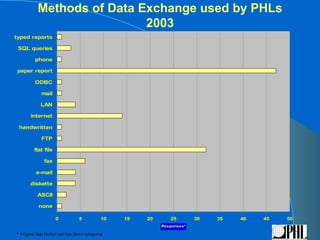
Methods of Data Exchange used by PHLs
                            2003
typed reports

 SQL queries

          phone

paper report

          ODBC

             mail

             LAN

       internet

 handwritten

             FTP

         flat file

               fax

          e-mail

       diskette

           ASCII

            none

                     0            5           10   15   20      25        30   35   40   45   50
                                                             Responses*

* Original data broken out into above categories
Participation with PHDSC
   Develop electronic messaging capabilities for
    LIMS
   Address diverse PHL programs needs including
    bioterrorism, genetic diseases, environmental
    quality, radiation monitoring, food safety,
    newborn screening and chronic diseases.
   Update and maintain coding standards specific to
    laboratory nomenclature

Presentation for lims

  • 1.
    Doug Drabkowski Director ofStrategic Initiatives and Research The Association of Public Health Laboratories 2025 M Street, NW, Suite 550 Washington, DC 20036 www.aphl.org
  • 2.
    APHL’s Vision andMission A Healthier World Through Quality Laboratory Practice The mission of APHL is to promote the role of public health laboratories in support of national and global objectives, and to promote policies and programs which assure continuous improvement in the quality of laboratory practice
  • 3.
    Core Functions ofPublic Health Laboratories  Disease Prevention, Control and Surveillance  Integrated Data Management  Reference and Specialized Testing  Environmental Health and Protection  Food Safety  Lab Improvement, Regulation and Policy Development  Emergency Response  Public Health Related Research  Training and Education  Partnerships and Communication
  • 4.
    Integrated Data Management •Serve as focal point for the accumulation, blending and dissemination of scientific information in support of public health programs • Provide for a statewide disease reporting network • Linkage to national database systems • Public health analysis and policy decisions • Standardization of laboratory data formats • Serve as epidemiology resource
  • 5.
    Vision Statement “LIMS Meeting 2002” “ A national electronic laboratory data and information exchange network of member PHLs working together to ensure comparability, compatibility and interoperability of Laboratory Information Management (LIM) systems. A state LIM system would be integrated within the state laboratory, would include all public health testing and would interface with local health department, hospitals, and private laboratories as well.”
  • 6.
    LIMS 2003 SurveyFacts  43 States/Territories responded (81%)  States/Territories may have multiple LIMS running in one PH laboratory (74% of labs are employing more than 1 system)  Respondents have had their LIMS in place for an average of 7.63 years
  • 7.
    States actively seekingto replace their LIMS between Oct. 2003 & June 2004 42% No Yes 58%
  • 9.
    LIMS Vendors 2002 Other HP Orchard EPIC CDC Neometrics 0 1 2 3 4 5 6 7 8 Re s ponse s
  • 10.
    LIMS Vendors 2003 LIMS Vendors 2003 Thermo LabSystems Sysware Healthcare Systems StarLIMS Perkin Elmer Northwest Analytical Neometrics Natus Misys/Sunquest MMgmt Systems LabVantage HP/AGILENT Epic Systems Dade Behring Cortex Computer Information Systems, Oregon Commercial Vendor Cerner Accrediting Authority Management System 0 1 2 3 4 5 6 7 # Responses
  • 11.
    Percentage of Statesusing multiple LIMS 5% 23% 21% No system 1 system 2-3 systems 4-8 systems 51%
  • 12.
    How many StateLIMS are PHIN “compliant”? 17% No Yes 83%
  • 13.
    Methods of DataExchange used by PHLs 2003 typed reports SQL queries phone paper report ODBC mail LAN internet handwritten FTP flat file fax e-mail diskette ASCII none 0 5 10 15 20 25 30 35 40 45 50 Responses* * Original data broken out into above categories
  • 16.
    Participation with PHDSC  Develop electronic messaging capabilities for LIMS  Address diverse PHL programs needs including bioterrorism, genetic diseases, environmental quality, radiation monitoring, food safety, newborn screening and chronic diseases.  Update and maintain coding standards specific to laboratory nomenclature

Editor's Notes

  • #4 Capture important laboratory data essential for public health analysis and decision making. Assure ability to maintain and communicate public health laboratory data related to the identification and control of disease in standardized data formats. Provide primary data to drive planning and policy decisions. Provide a statewide disease-reporting network with centralized facilities for receipt, storage, retrieval and analysis of data. Serve the data needs of state epidemiologists, other laboratories, and practitioners, to identify trends and "sentinel events" that indicate an emerging health problem Participate as a key link in national database systems to collect, monitor and analyze laboratory data ( Serve as a primary data link with the Centers for Disease Control and Prevention (CDC) for surveillance of diseases of national and global concern