Presentation etnography in anthropological research
1.
Submitted To -The Department of Anthropology
University of Lucknow
Under Guidance Of - Submitted by-
Dr. Keya Pandey Ratnpriya
Mishra
MSc. 1st
sem.
I.D.- 200014115003
Topic -Ethnography
2.
It is asystematic study and
documentation of human activity
without imposing a prior
interpretation on it via immersion
in the environment of it and
observation of the practices that
constitute it.
Ethnography
3.
Definitions
According to Burkeand Kirk, “a method of
observing human interactions in social
settings and activities”.
According to Merriam-Webster,” the study
and systematic recording of human
cultures”.
4.
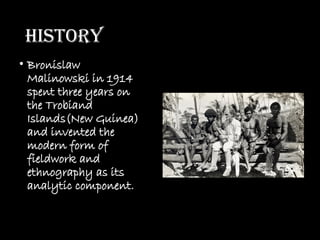
History
• Bronislaw
Malinowski in1914
spent three years on
the Trobiand
Islands(New Guinea)
and invented the
modern form of
fieldwork and
ethnography as its
analytic component.
5.
Methodology
1. Preparation
• Familiarizeyourself with
organization policies,
current systems and its
history.
• Identify the focus of the
study.
• Gain access and
permission.
2. Field Study
• Establish rapport with
managers and users.
• Record the observations,
impressions and feelings.
• Prepare field notes, audio or
video recordings.
6.
3. Analysis
• Compiledata into
numerical, textual and
multimedia databases.
• Interpret data.
• Review and redevelop the
ideas.
4. Reporting
• Prepare a report and present
the findings.
• Have debriefing meetings.
7.
The ethnographer isconcerned more about
major ethical issues-
Informed consent
Privacy
Harm
Exploitation
Ethical concerns in Ethnographic Research
8.
Types of Ethnographic
Research
1.Business Ethnographic Research
It involves observing consumer habits and target markets in order to discover
true market needs and the overall disposition to the product or service.
9.
2.Medical Ethnographic
Research
• Itis used for qualitative
investigation in health care.
• It helps medical
practitioners to understand
the disposition of patients
ranging from the simplest
to the most complex
behavioral patterns.
3.Educational
Ethnographic Research
• It involves observing,
teaching and learning
methods and how these
effect classroom behavior.
• It pays attention to
pedagogy.
10.
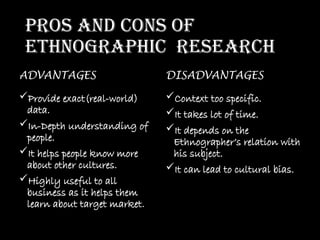
Pros and Consof
Ethnographic Research
ADVANTAGES
Provide exact(real-world)
data.
In-Depth understanding of
people.
It helps people know more
about other cultures.
Highly useful to all
business as it helps them
learn about target market.
DISADVANTAGES
Context too specific.
It takes lot of time.
It depends on the
Ethnographer’s relation with
his subject.
It can lead to cultural bias.