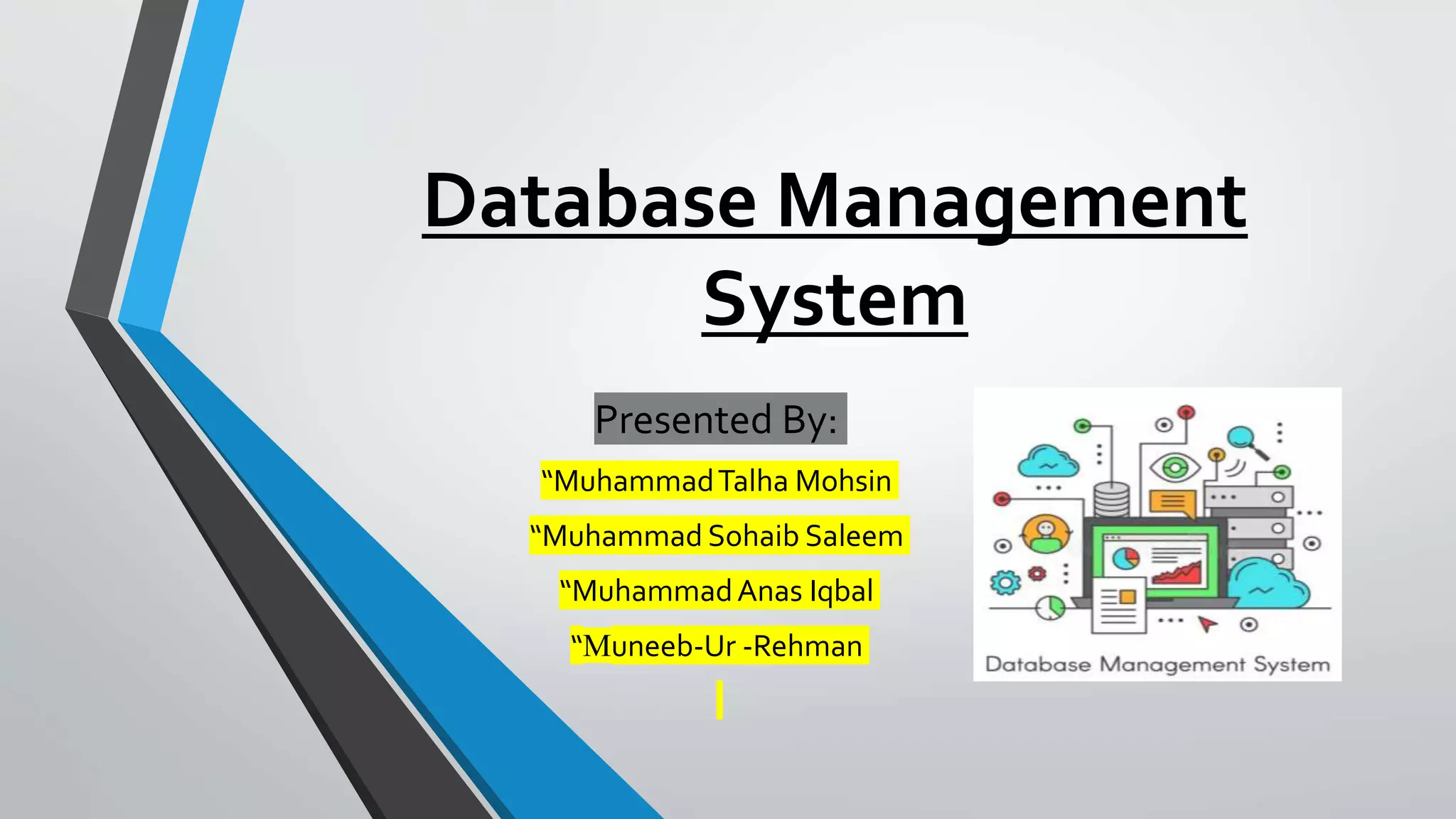
Database Management
System
Presented By:
“MuhammadTalha Mohsin
“Muhammad Sohaib Saleem
“MuhammadAnas Iqbal
“Muneeb-Ur -Rehman
Database
•Database is a place where related piece of information is
stored, and various operations can be performed on it.
•Database means collection of interrelated data where
data can be easily accesses, managed and updated.
•Databases do most of the work and the information
systems that we use every day.
DBMS (DataBase Management System)
• A database management system is a software that provides user to store
data.
• In DBMS it is easier to retrieve, manipulate and produce information for
user.
• Some popular examples for DBMS are MySQL, Oracle,Sybase,MS Access
and IBMDB2.
Why Study Databases?
• Databases have incredible value to business.
• Probably the most important technology for supporting operations.
• Vastly superior to file processing systems
• Businesses cannot survive without quality data about their
• internal operations.
• external environment.
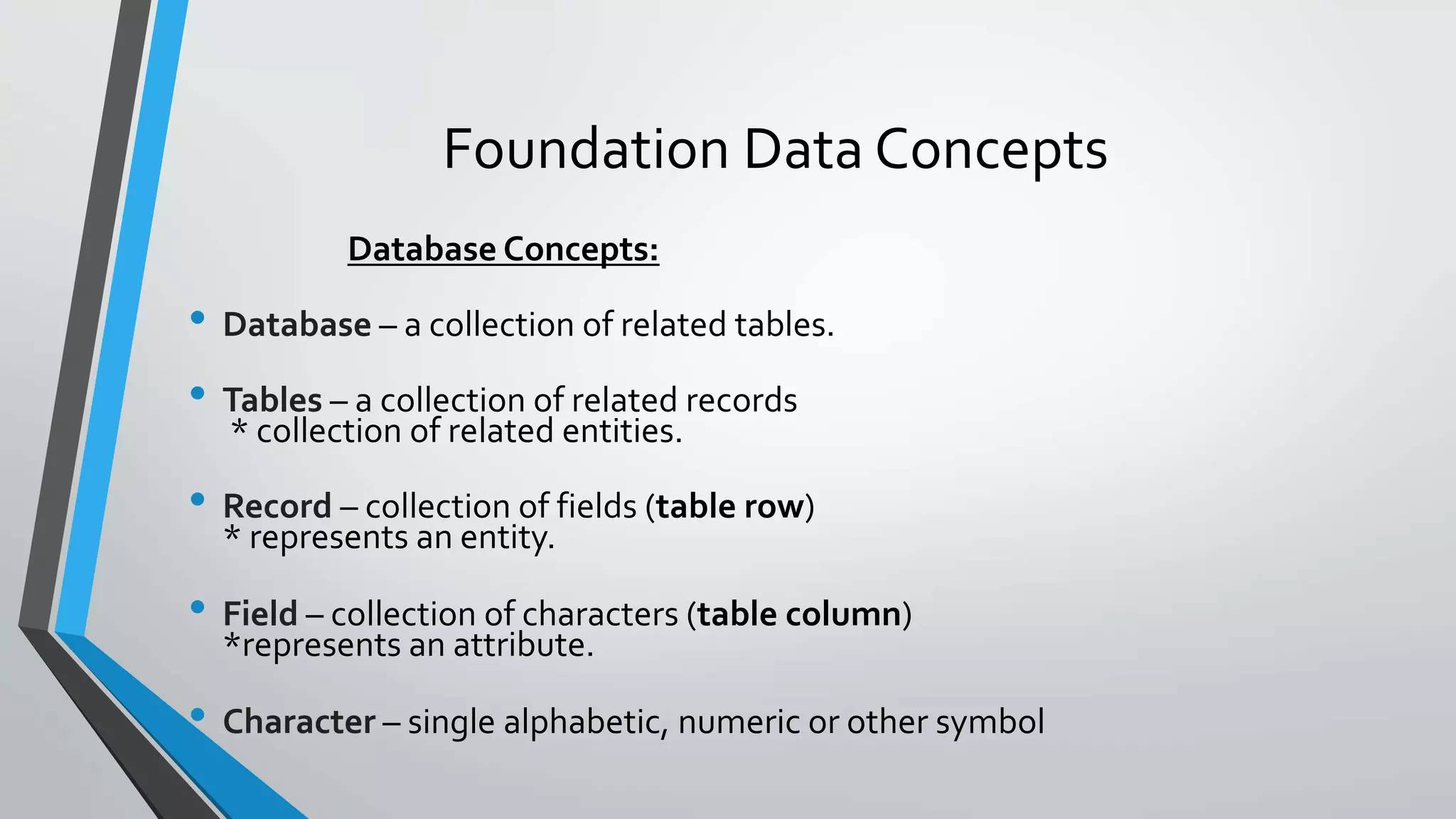
Foundation Data Concepts
Database Concepts:
• Database – a collection of related tables.
• Tables – a collection of related records
* collection of related entities.
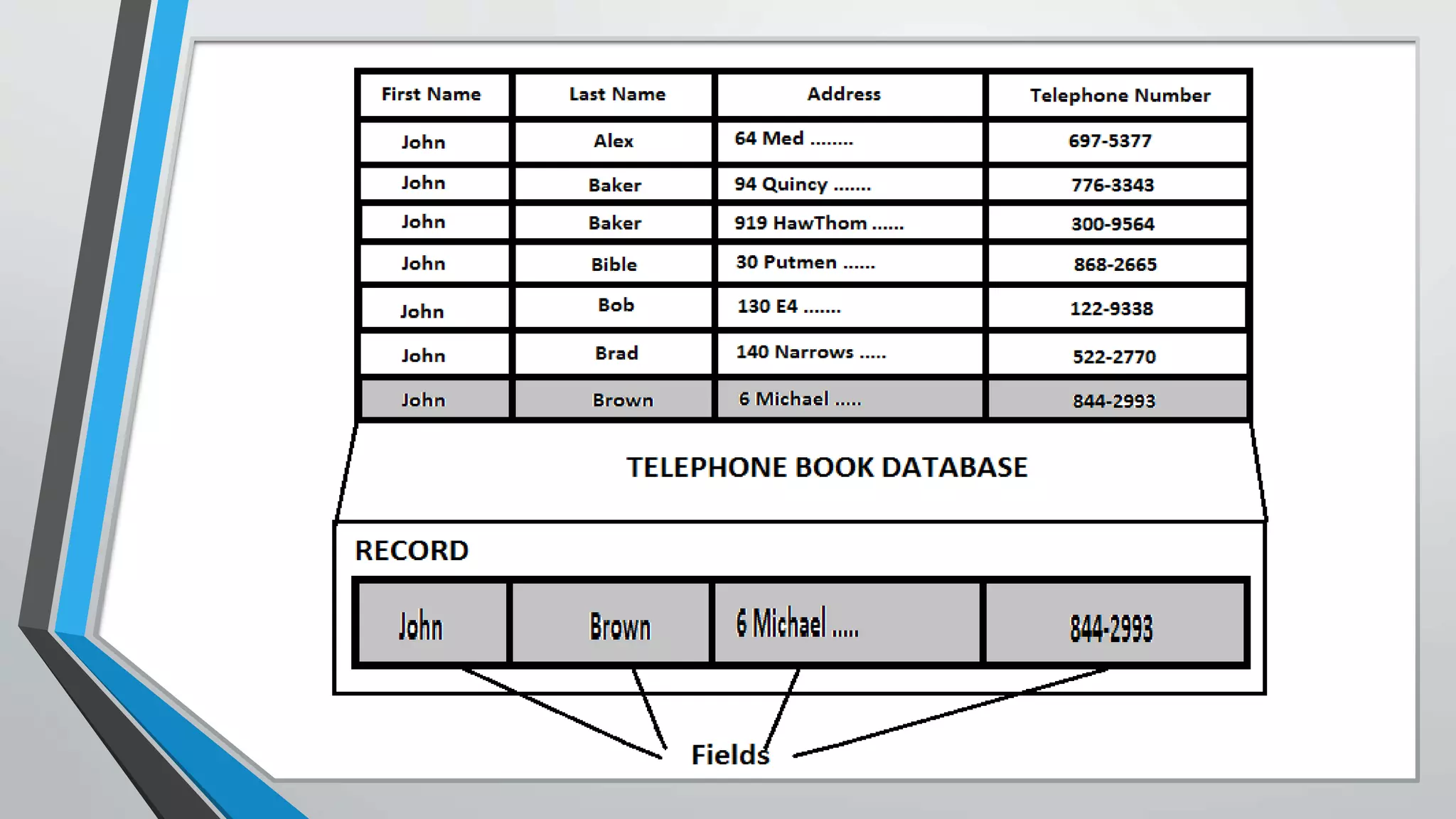
• Record – collection of fields (table row)
* represents an entity.
• Field – collection of characters (table column)
*represents an attribute.
• Character – single alphabetic, numeric or other symbol
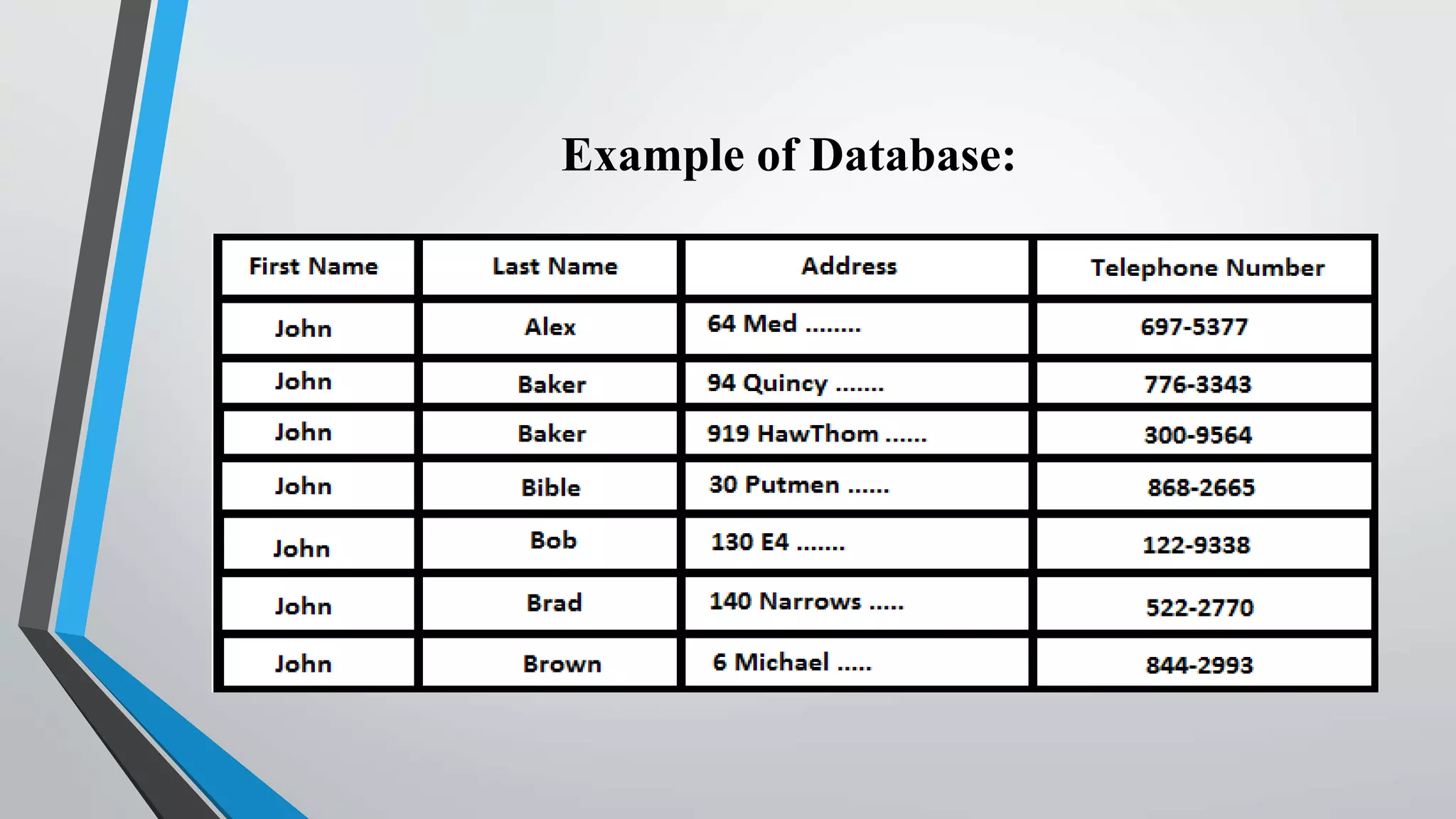
Example of Database:
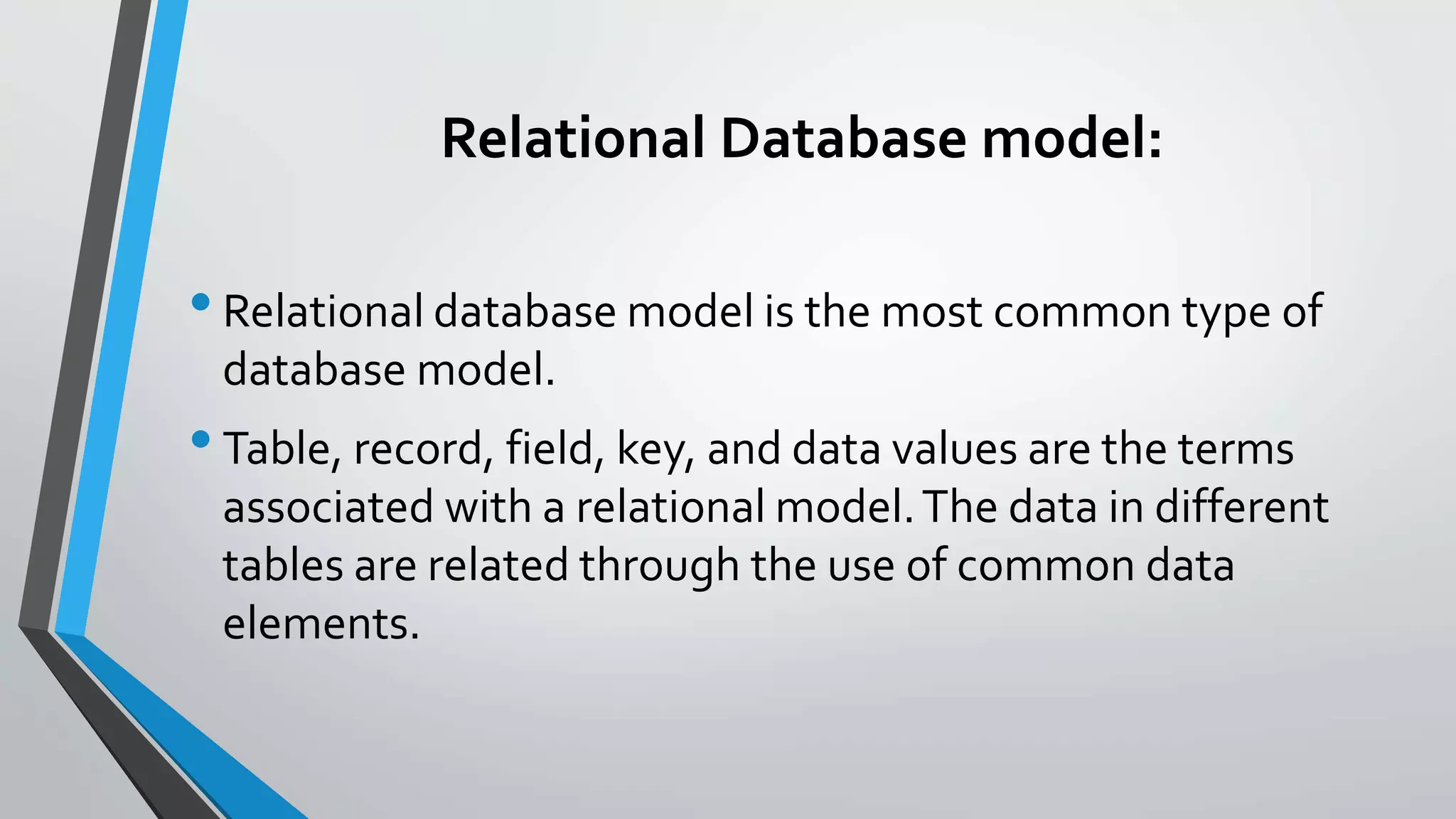
Relational Database model:
•Relational database model is the most common type of
database model.
•Table, record, field, key, and data values are the terms
associated with a relational model.The data in different
tables are related through the use of common data
elements.
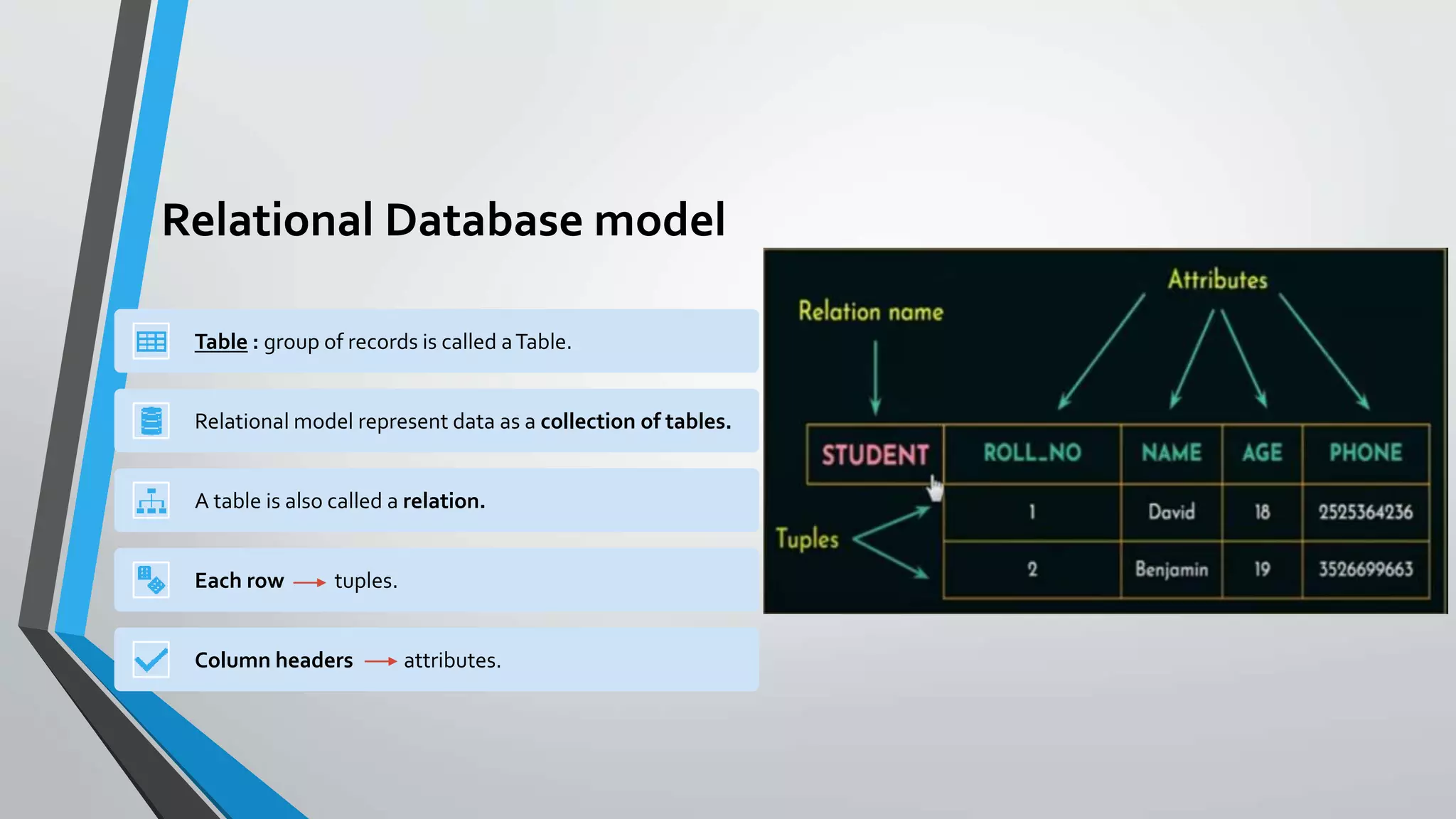
Relational Database model
Table : group of records is called aTable.
Relational model represent data as a collection of tables.
A table is also called a relation.
Each row tuples.
Column headers attributes.
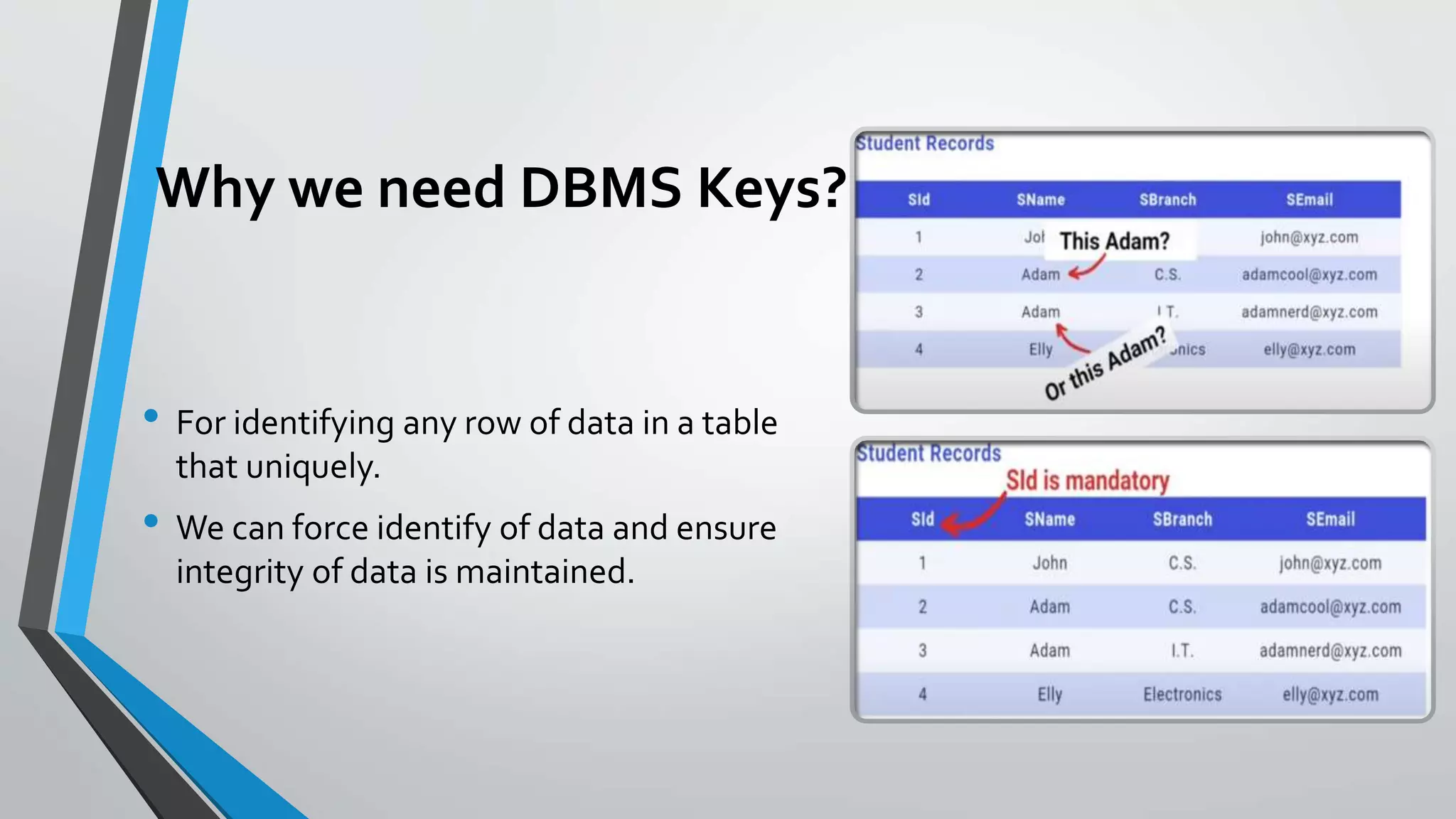
Why we need DBMS Keys?
• For identifying any row of data in a table
that uniquely.
• We can force identify of data and ensure
integrity of data is maintained.
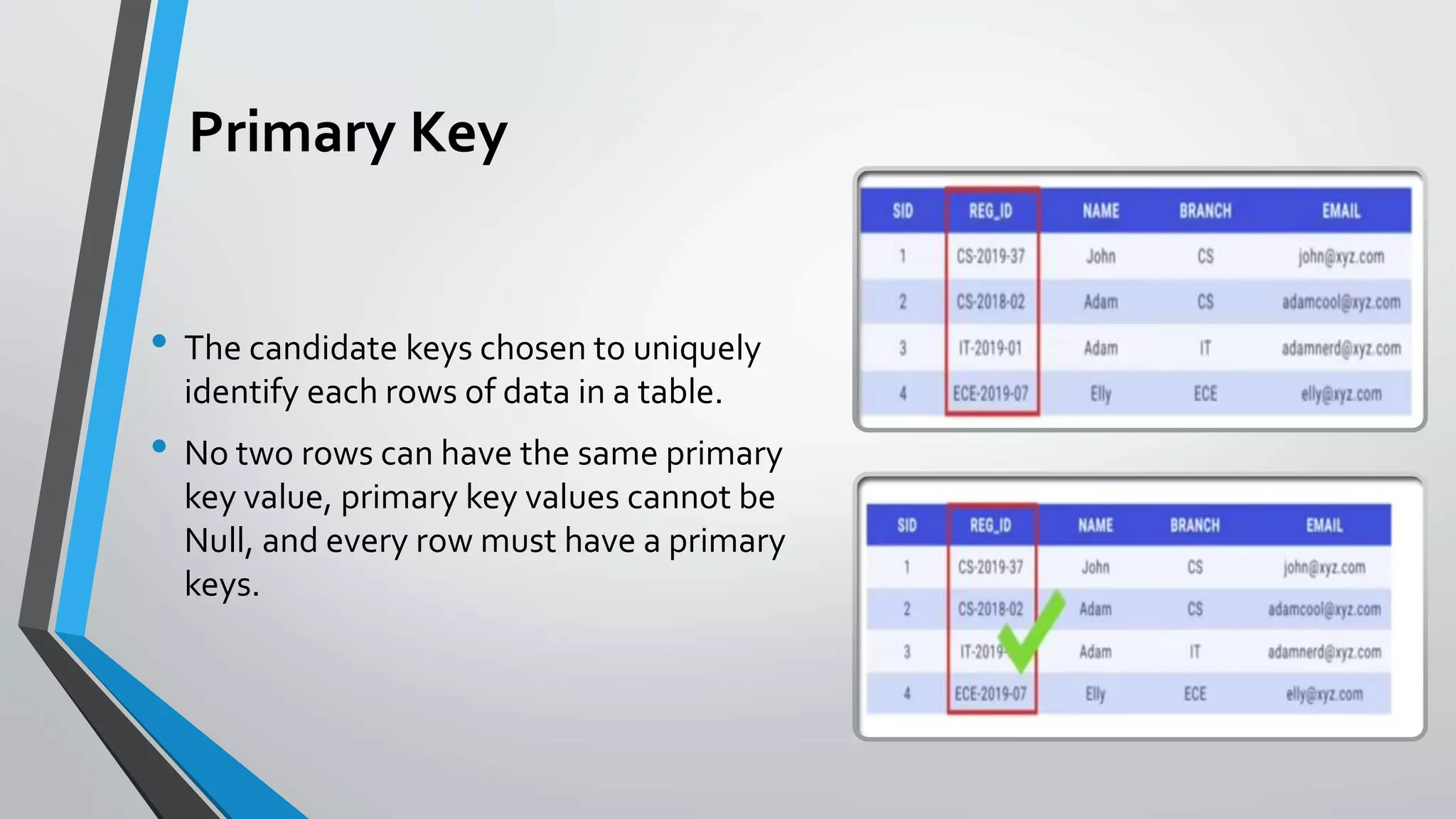
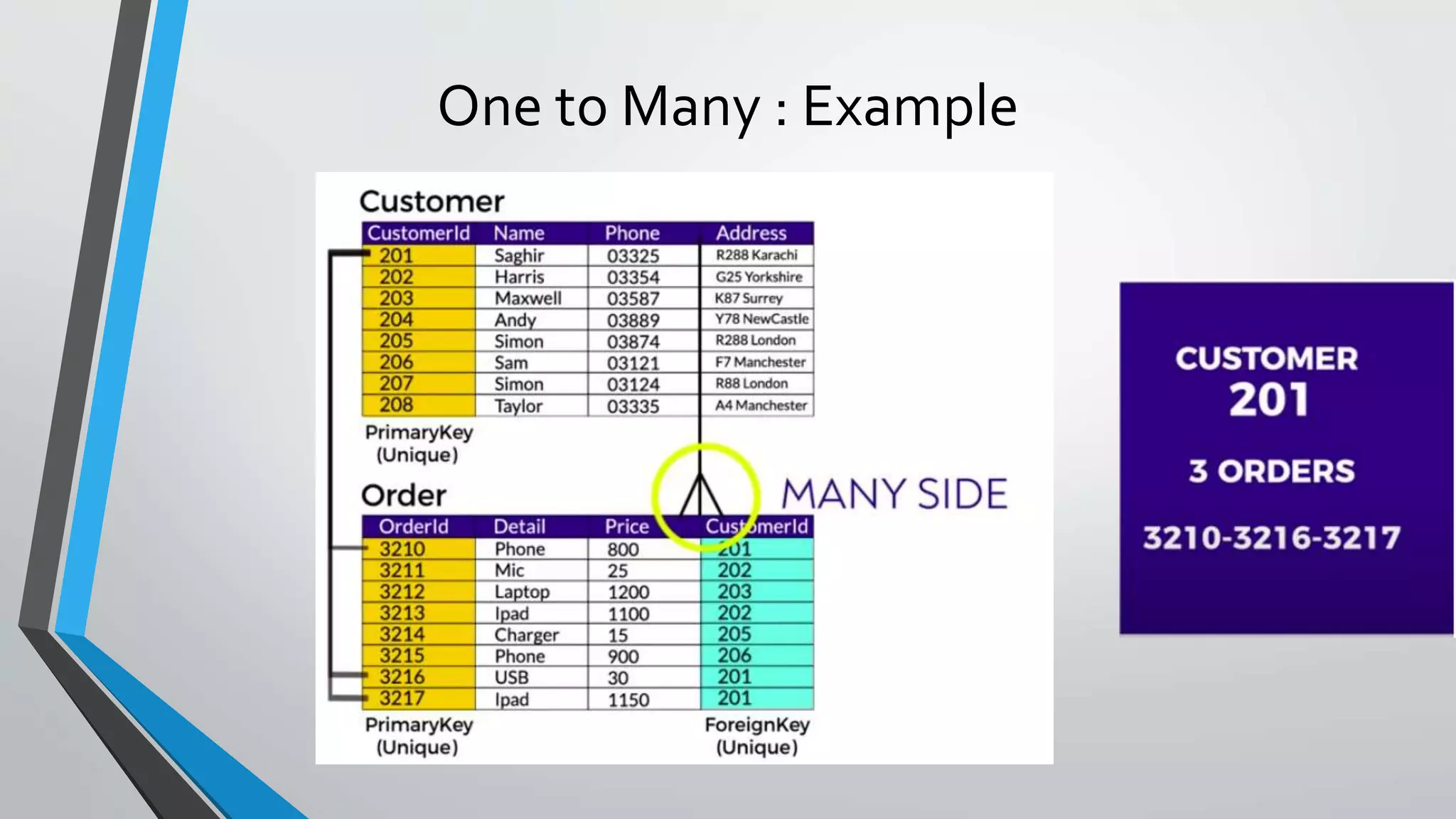
Primary Key
• The candidate keys chosen to uniquely
identify each rows of data in a table.
• No two rows can have the same primary
key value, primary key values cannot be
Null, and every row must have a primary
keys.
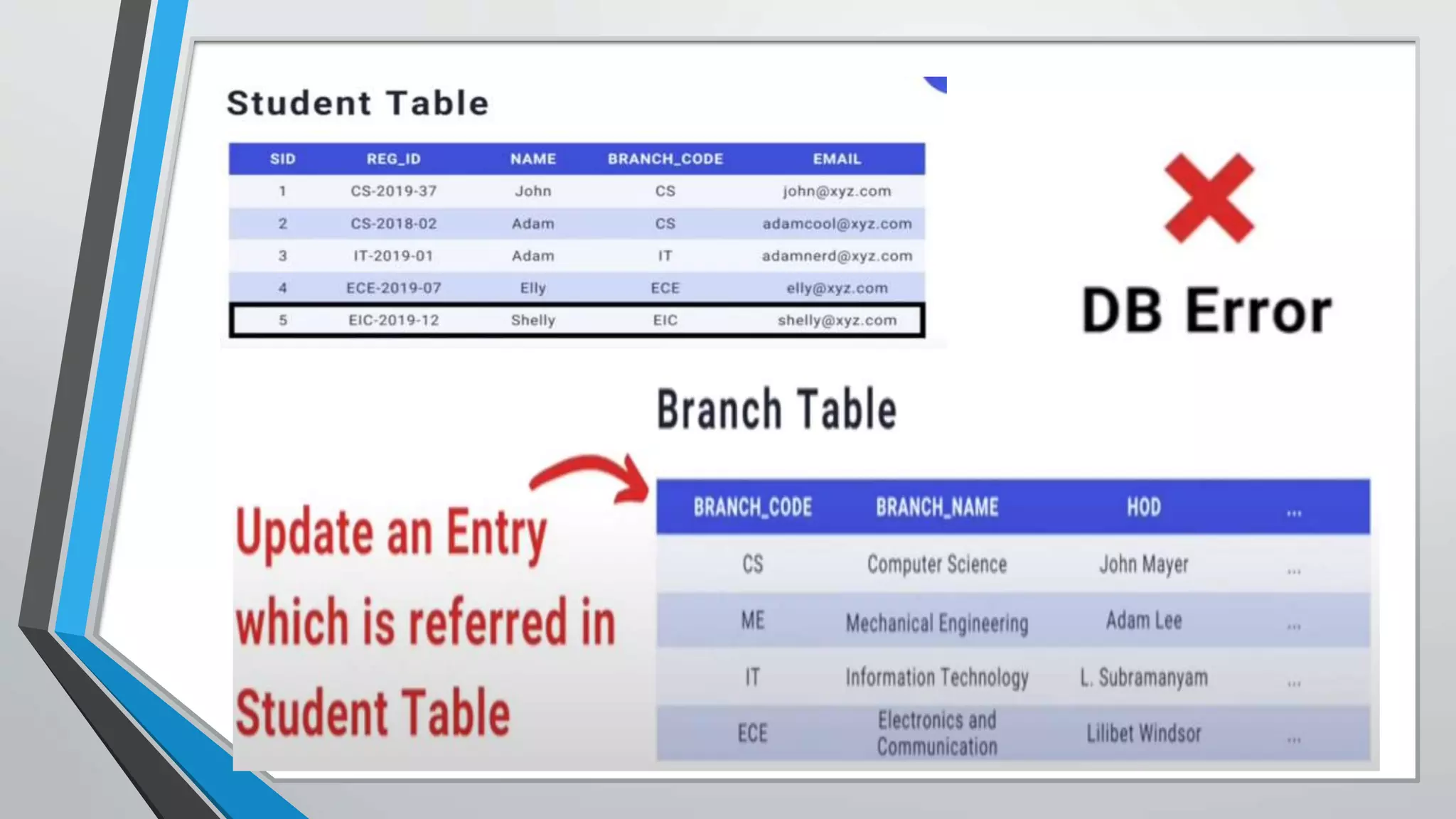
Foreign Key:
• It is an attributes in a table which is used to define its
relationship with another table.
• Using foreign key helps in maintaining data integrity for
table in relationship.
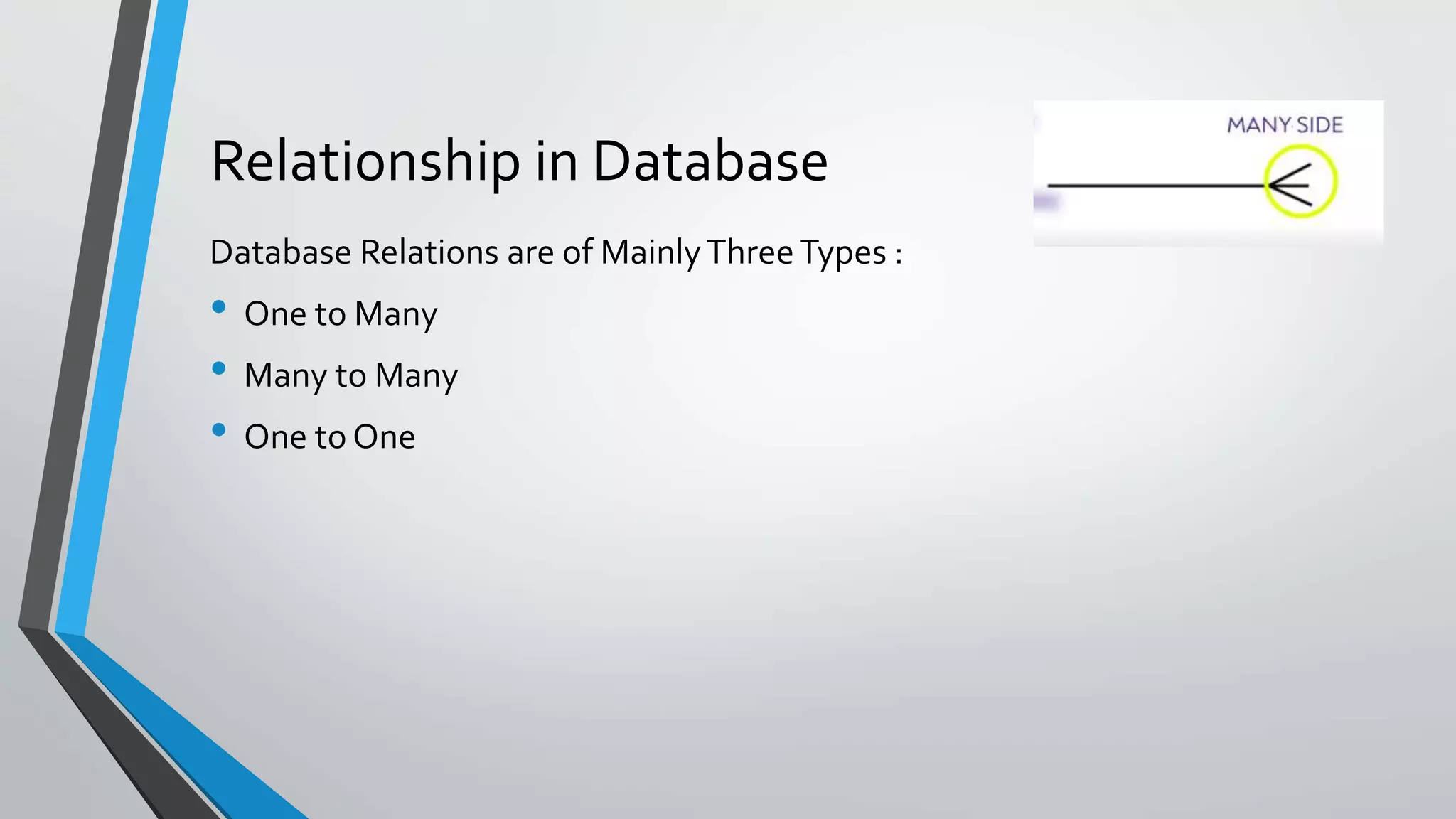
Relationship in Database
Database Relations are of MainlyThreeTypes :
• One to Many
• Many to Many
• One to One
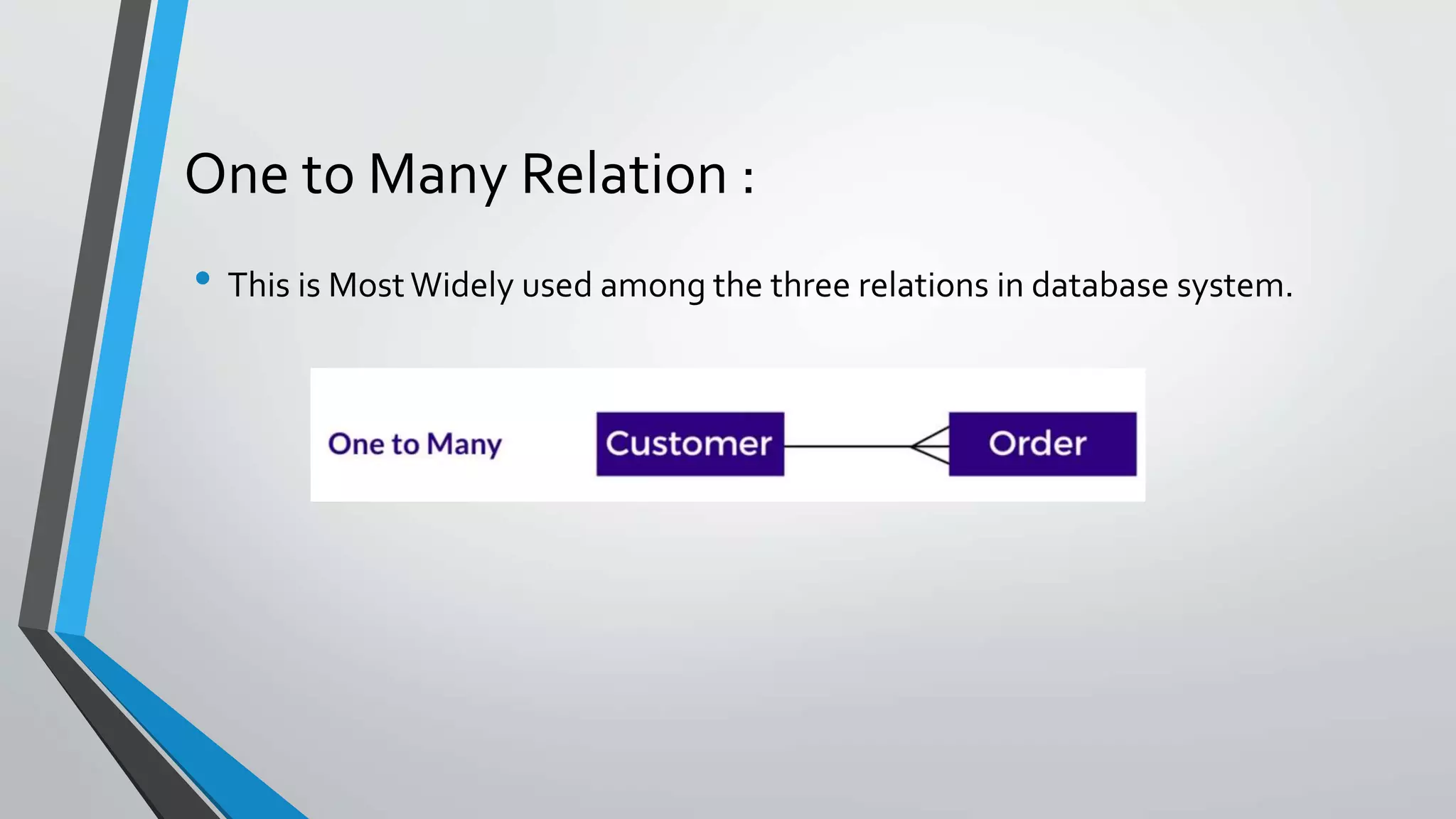
One to Many Relation :
• This is MostWidely used among the three relations in database system.
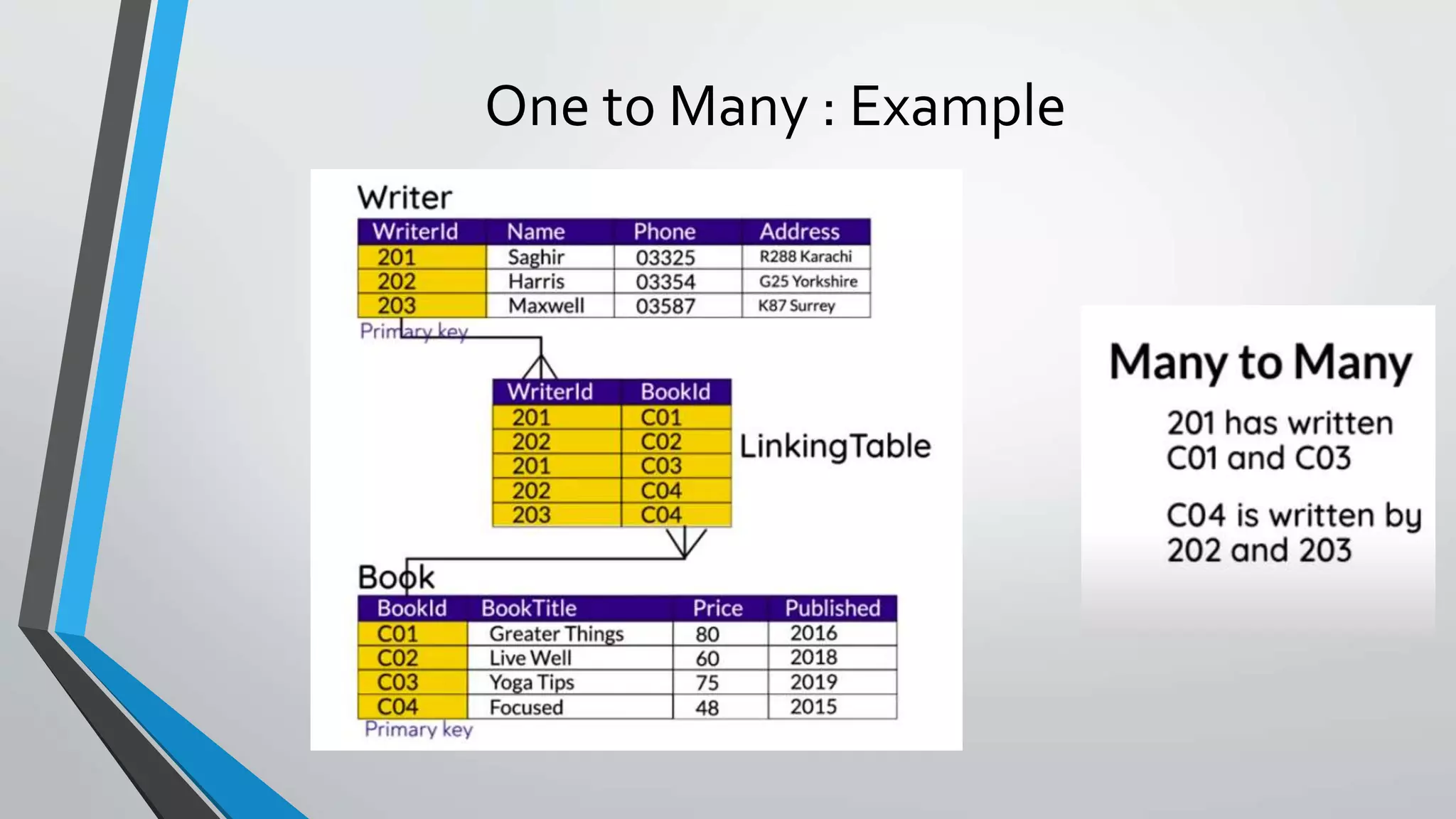
One to Many : Example
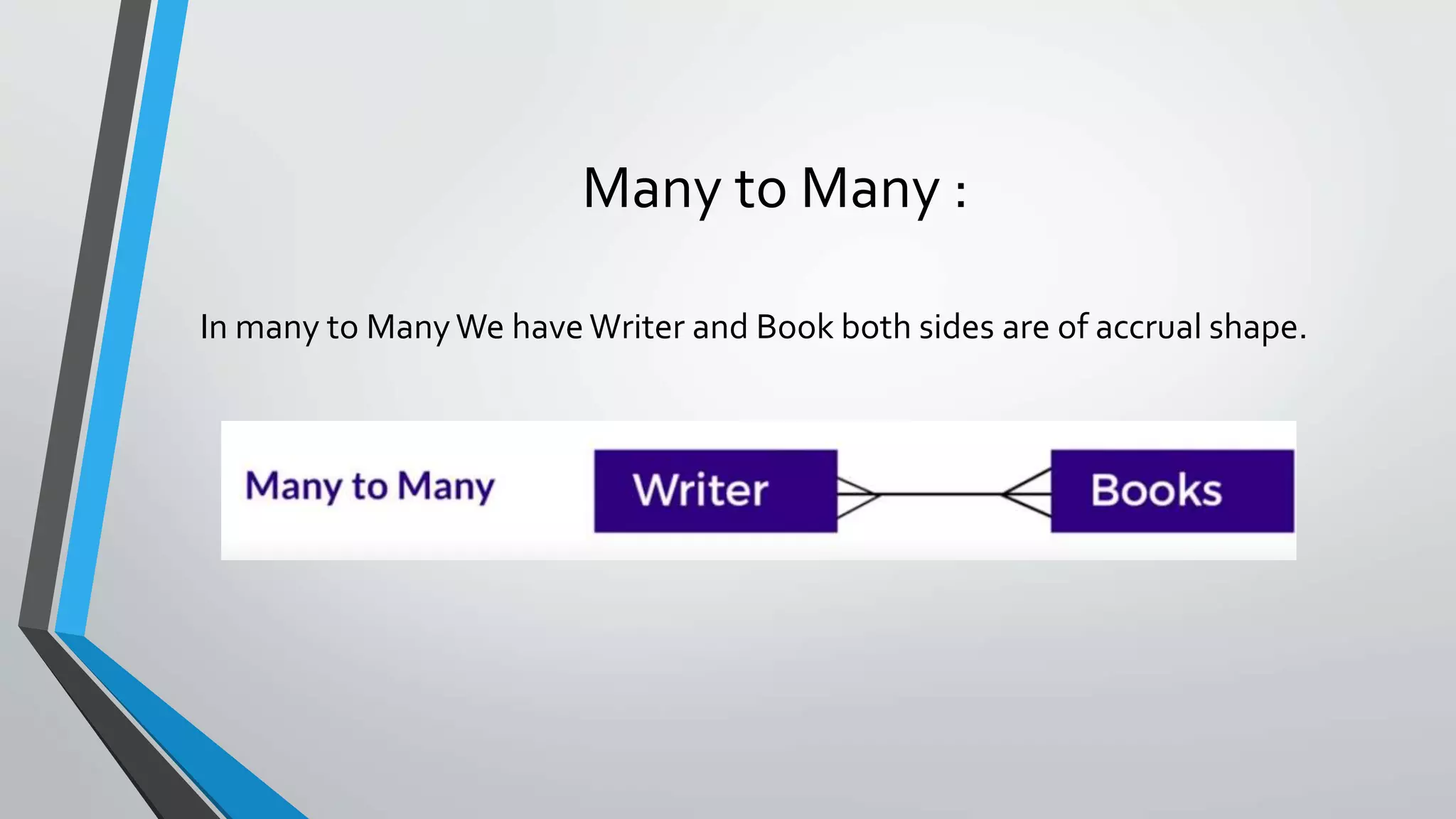
Many to Many :
In many to ManyWe have Writer and Book both sides are of accrual shape.
One to Many : Example
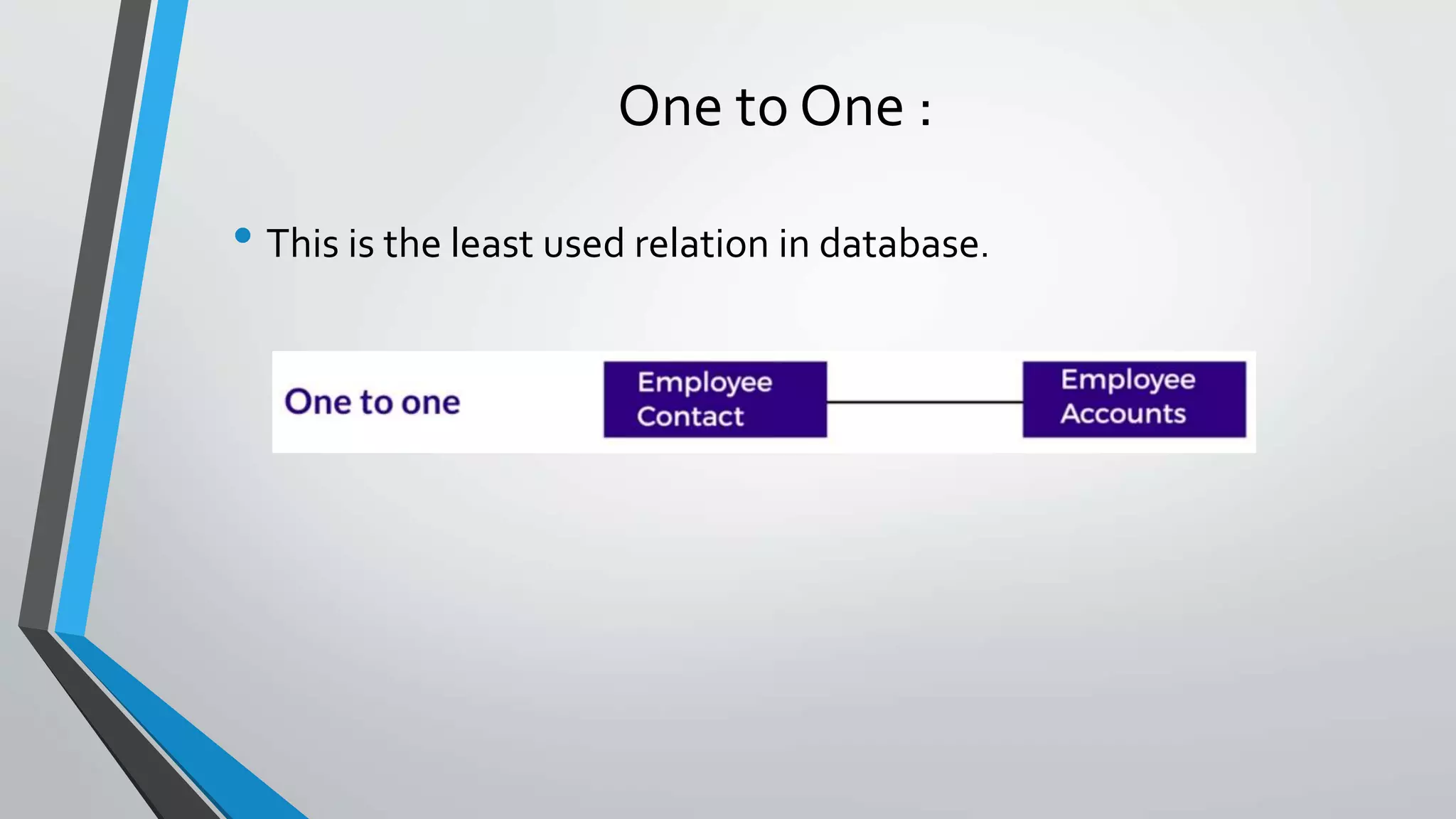
One to One :
• This is the least used relation in database.
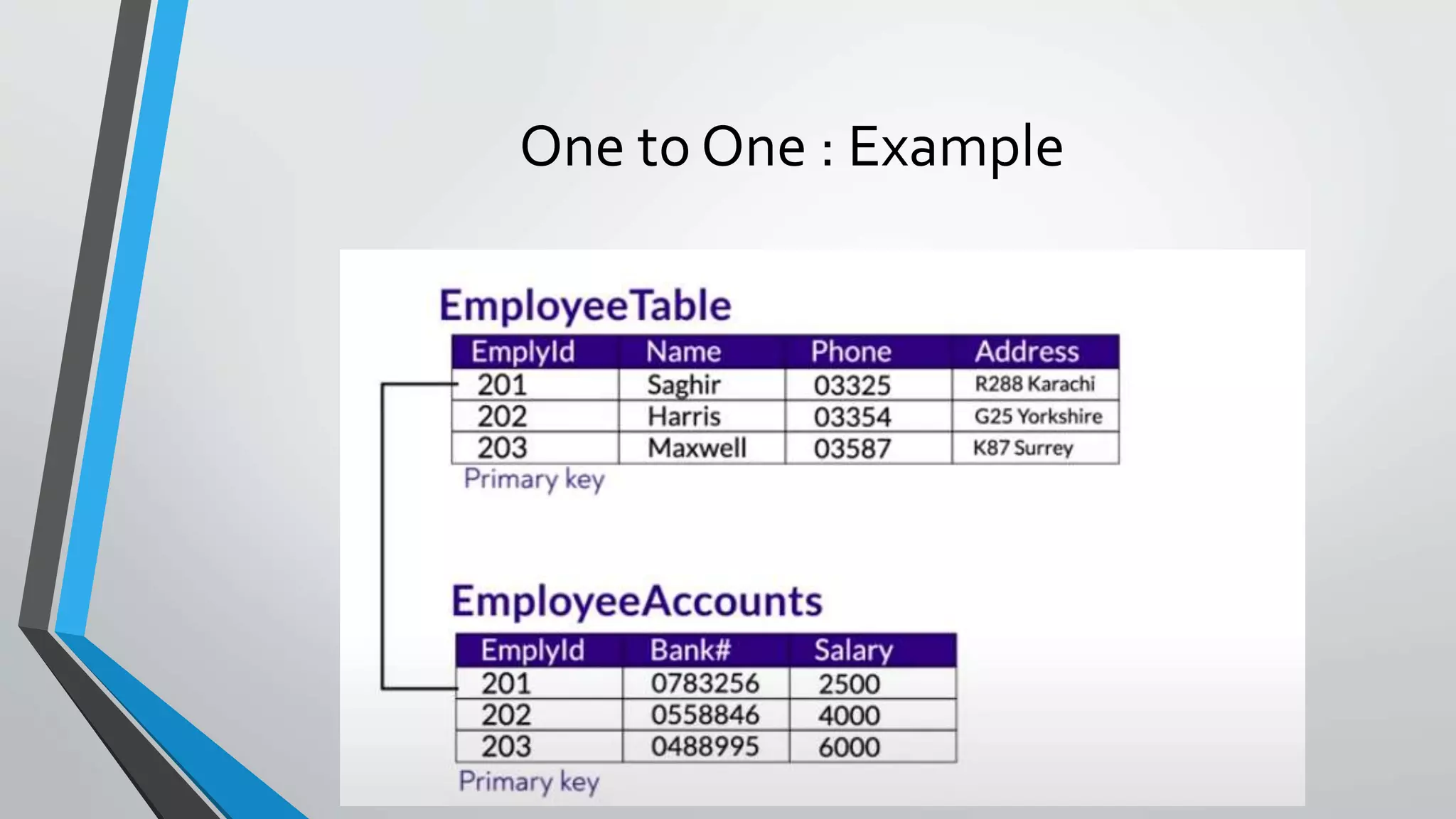
One to One : Example
Problems of File Management System :
Data redundancy and inconsistency.
Data redundancy occurs when the same piece of data exists in multiple places, whereas data inconsistency
is when the same data exists in different formats in multiple tables
Integrity Problems.
Data integrity is imposed within a database when it is designed and is authenticated through the ongoing use
of error checking and validation routines.
Security Problems.
File processing system does not provide adequate security on data. In some situations, it is required to
provide different types of access to data for different users. For example, a data entry operator should only
be allowed to enter data.
Difficulty in accessing data.
May have to write a new application program to satisfy an unusual request. Data isolation − Data in
different files in different formats and even difficult to write new application programs.
• When Update in a Single File it has to be Updated in All Files.
Advantages of Database Management System :
Improves Data Sharing.
Database management systems help users share data quickly, effectively, and securely across an
organization. By providing quick solutions to database queries, a data management system enables
faster access to more accurate data.
Reduce Data Redundancy.
Redundancy can be avoided using Master Data. Master data is a single source of data
accessed by several applications and systems. Proper database architecture design can avoid
data redundancy.
Proper Data Integration.
Data integration is a common industry term referring to the requirement to combine
data from multiple separate business systems into a single unified view, often called
a single view of the truth Maintain Data Consistency.
Data Security.
Database security refers to the various measures organizations like yours take to ensure
their databases are protected from internal and external threats.
Cont.….
Maintains Privacy.
It is nothing but the securing of data which is present in the database. Generally, we used to store a large
amount of data in the database
Increase end-user Productivity.
The data which is available with the help of a combination of tools that transform data into useful information,
helps end-users to make quick, informative, and better decisions that can make difference between success
and failure in the global economy.
Data Backup and Recovery.
the process of creating and storing copies of data that can be used to protect organizations against data loss.
This is sometimes referred to as operational recovery.
Thank you!!!!

Presentation Datatbase Final.pptx

  • 1.
    Database Management System Presented By: “MuhammadTalhaMohsin “Muhammad Sohaib Saleem “MuhammadAnas Iqbal “Muneeb-Ur -Rehman
  • 2.
    Database •Database is aplace where related piece of information is stored, and various operations can be performed on it. •Database means collection of interrelated data where data can be easily accesses, managed and updated. •Databases do most of the work and the information systems that we use every day.
  • 3.
    DBMS (DataBase ManagementSystem) • A database management system is a software that provides user to store data. • In DBMS it is easier to retrieve, manipulate and produce information for user. • Some popular examples for DBMS are MySQL, Oracle,Sybase,MS Access and IBMDB2.
  • 4.
    Why Study Databases? •Databases have incredible value to business. • Probably the most important technology for supporting operations. • Vastly superior to file processing systems • Businesses cannot survive without quality data about their • internal operations. • external environment.
  • 5.
    Foundation Data Concepts DatabaseConcepts: • Database – a collection of related tables. • Tables – a collection of related records * collection of related entities. • Record – collection of fields (table row) * represents an entity. • Field – collection of characters (table column) *represents an attribute. • Character – single alphabetic, numeric or other symbol
  • 6.
  • 8.
    Relational Database model: •Relationaldatabase model is the most common type of database model. •Table, record, field, key, and data values are the terms associated with a relational model.The data in different tables are related through the use of common data elements.
  • 9.
    Relational Database model Table: group of records is called aTable. Relational model represent data as a collection of tables. A table is also called a relation. Each row tuples. Column headers attributes.
  • 10.
    Why we needDBMS Keys? • For identifying any row of data in a table that uniquely. • We can force identify of data and ensure integrity of data is maintained.
  • 11.
    Primary Key • Thecandidate keys chosen to uniquely identify each rows of data in a table. • No two rows can have the same primary key value, primary key values cannot be Null, and every row must have a primary keys.
  • 12.
    Foreign Key: • Itis an attributes in a table which is used to define its relationship with another table. • Using foreign key helps in maintaining data integrity for table in relationship.
  • 14.
    Relationship in Database DatabaseRelations are of MainlyThreeTypes : • One to Many • Many to Many • One to One
  • 15.
    One to ManyRelation : • This is MostWidely used among the three relations in database system.
  • 16.
    One to Many: Example
  • 17.
    Many to Many: In many to ManyWe have Writer and Book both sides are of accrual shape.
  • 18.
    One to Many: Example
  • 19.
    One to One: • This is the least used relation in database.
  • 20.
    One to One: Example
  • 21.
    Problems of FileManagement System : Data redundancy and inconsistency. Data redundancy occurs when the same piece of data exists in multiple places, whereas data inconsistency is when the same data exists in different formats in multiple tables Integrity Problems. Data integrity is imposed within a database when it is designed and is authenticated through the ongoing use of error checking and validation routines. Security Problems. File processing system does not provide adequate security on data. In some situations, it is required to provide different types of access to data for different users. For example, a data entry operator should only be allowed to enter data. Difficulty in accessing data. May have to write a new application program to satisfy an unusual request. Data isolation − Data in different files in different formats and even difficult to write new application programs. • When Update in a Single File it has to be Updated in All Files.
  • 22.
    Advantages of DatabaseManagement System : Improves Data Sharing. Database management systems help users share data quickly, effectively, and securely across an organization. By providing quick solutions to database queries, a data management system enables faster access to more accurate data. Reduce Data Redundancy. Redundancy can be avoided using Master Data. Master data is a single source of data accessed by several applications and systems. Proper database architecture design can avoid data redundancy. Proper Data Integration. Data integration is a common industry term referring to the requirement to combine data from multiple separate business systems into a single unified view, often called a single view of the truth Maintain Data Consistency. Data Security. Database security refers to the various measures organizations like yours take to ensure their databases are protected from internal and external threats.
  • 23.
    Cont.…. Maintains Privacy. It isnothing but the securing of data which is present in the database. Generally, we used to store a large amount of data in the database Increase end-user Productivity. The data which is available with the help of a combination of tools that transform data into useful information, helps end-users to make quick, informative, and better decisions that can make difference between success and failure in the global economy. Data Backup and Recovery. the process of creating and storing copies of data that can be used to protect organizations against data loss. This is sometimes referred to as operational recovery.
  • 24.