MS Marketing 2nd
Institute of Business & Management Science,
University of Agriculture, Faisalabad
Aaqib
Shahbaz Butt
2014-ag-9086
Muhammad
Shahid Ayub
2014-ag-9413
Today’s
Presenters
Courteous Thanks to
Dr. Abdul Ghafor
Assistant Professor
Institute of Business & Management Sciences, University of Agriculture,
Faisalabad
Authors
Patrick M. Kreiser, Louis D. Marino, Pat Dickson & K. Mark Weaver
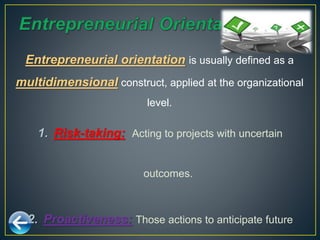
1. Risk-taking: Acting to projects with uncertain
outcomes.
2. Proactiveness: Those actions to anticipate future
Entrepreneurial orientation is usually defined as a
multidimensional construct, applied at the organizational
level.
Authors
Patrick M. Kreiser, Louis D. Marino, Pat Dickson & K. Mark Weaver
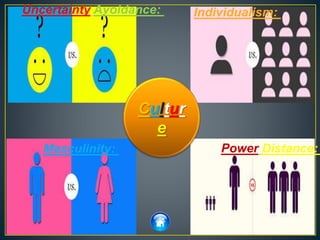
Culture is a system of collective values that
distinguishes the members of one group from
another.1. Uncertainty Avoidance: Tolerance level for
uncertainty.
2. Individualism: Individual & Collectivity culture in
organization.
3. Masculinity: Masculine & Famine culture of
organization
Uncertainty Avoidance: Individualism:
Masculinity: Power Distance:
Cultur
e
Authors
Patrick M. Kreiser, Louis D. Marino, Pat Dickson & K. Mark Weaver
• The concept of risk taking has frequently been
associated with entrepreneurial behavior.
• The commitment to venturing and receptivity to
the idea of starting a venture.
Authors
Patrick M. Kreiser, Louis D. Marino, Pat Dickson & K. Mark Weaver
• Acting Advance for a future issue and taking control on
future.
• Effectuation theory who belief that If I can control the
future, I do not need to predict it
Authors
Patrick M. Kreiser, Louis D. Marino, Pat Dickson & K. Mark Weaver
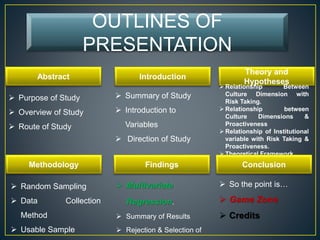
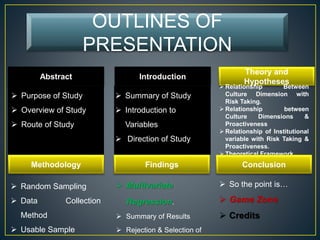
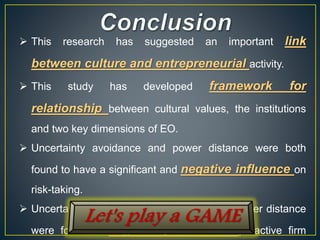
OUTLINES OF
PRESENTATION
Abstract Introduction
Theory and
Hypotheses
 Purpose of Study
 Overview of Study
 Route of Study
Methodology
 So the point is…
 Game Zone

 Credits
 Random Sampling
 Data Collection
Method
 Usable Sample
 Relationship Between
Culture Dimension with
Risk Taking.
 Relationship between
Culture Dimensions &
Proactiveness
 Relationship of Institutional
variable with Risk Taking &
Proactiveness.
 Theoretical Framework.
ConclusionFindings
 Summary of Study
 Introduction to
Variables
 Direction of Study
 Multivariate
Regression.
 Summary of Results
 Rejection & Selection of
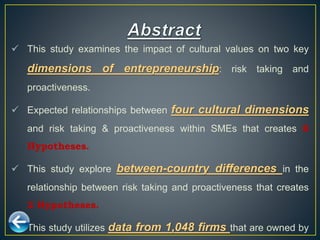
 This study examines the impact of cultural values on two key
dimensions of entrepreneurship: risk taking and
proactiveness.
 Expected relationships between four cultural dimensions
and risk taking & proactiveness within SMEs that creates 8
Hypotheses.
 This study explore between-country differences in the
relationship between risk taking and proactiveness that creates
2 Hypotheses.
 This study utilizes data from 1,048 firms that are owned by
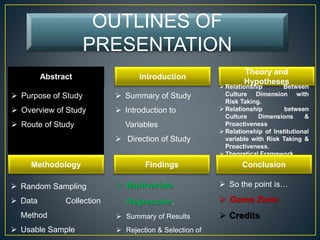
OUTLINES OF
PRESENTATION
Abstract Introduction
Theory and
Hypotheses
 Purpose of Study
 Overview of Study
 Route of Study
Methodology
 So the point is…
 Game Zone
 Credits
 Random Sampling
 Data Collection
Method
 Usable Sample
 Relationship Between
Culture Dimension with
Risk Taking.
 Relationship between
Culture Dimensions &
Proactiveness
 Relationship of Institutional
variable with Risk Taking &
Proactiveness.
 Theoretical Framework.
ConclusionFindings
 Summary of Study
 Introduction to
Variables
 Direction of Study
 Multivariate
Regression.
 Summary of Results
 Rejection & Selection of
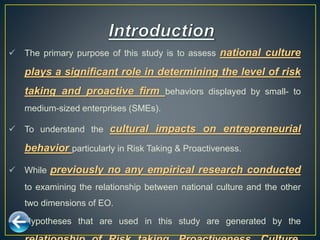
 The primary purpose of this study is to assess national culture
plays a significant role in determining the level of risk
taking and proactive firm behaviors displayed by small- to
medium-sized enterprises (SMEs).
 To understand the cultural impacts on entrepreneurial
behavior particularly in Risk Taking & Proactiveness.
 While previously no any empirical research conducted
to examining the relationship between national culture and the other
two dimensions of EO.
 Hypotheses that are used in this study are generated by the
OUTLINES OF
PRESENTATION
Abstract Introduction
Theory and
Hypotheses
 Purpose of Study
 Overview of Study
 Route of Study
Methodology
 So the point is…
 Game Zone
 Credits
 Random Sampling
 Data Collection
Method
 Usable Sample
 Relationship Between
Culture Dimension with
Risk Taking.
 Relationship between
Culture Dimensions &
Proactiveness
 Relationship of Institutional
variable with Risk Taking &
Proactiveness.
 Theoretical Framework.
ConclusionFindings
 Summary of Study
 Introduction to
Variables
 Direction of Study
 Multivariate
Regression.
 Summary of Results
 Rejection & Selection of
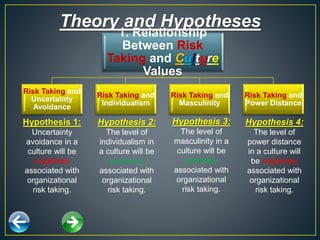
Hypothesis 4:
The level of
power distance
in a culture will
be negatively
associated with
organizational
risk taking.
1. Relationship
Between Risk
Taking and Culture
Values
Risk Taking and
Uncertainty
Avoidance
Risk Taking and
Individualism
Risk Taking and
Masculinity
Risk Taking and
Power Distance
Theory and Hypotheses
Hypothesis 1:
Uncertainty
avoidance in a
culture will be
negatively
associated with
organizational
risk taking.
Hypothesis 2:
The level of
individualism in
a culture will be
positively
associated with
organizational
risk taking.
Hypothesis 3:
The level of
masculinity in a
culture will be
positively
associated with
organizational
risk taking.
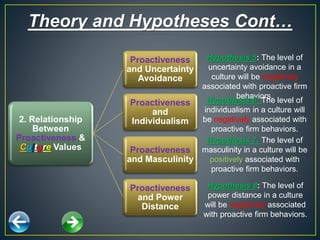
Hypothesis 8: The level of
power distance in a culture
will be negatively associated
with proactive firm behaviors.
2. Relationship
Between
Proactiveness &
Culture Values
Proactiveness
and Uncertainty
Avoidance
Proactiveness
and
Individualism
Proactiveness
and Masculinity
Proactiveness
and Power
Distance
Hypothesis 5: The level of
uncertainty avoidance in a
culture will be negatively
associated with proactive firm
behaviors.
Hypothesis 6: The level of
individualism in a culture will
be negatively associated with
proactive firm behaviors.
Hypothesis 7: The level of
masculinity in a culture will be
positively associated with
proactive firm behaviors.
Theory and Hypotheses Cont…
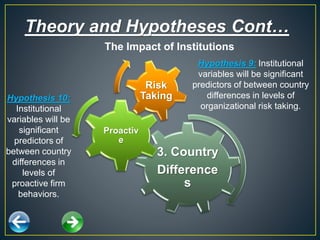
The Impact of Institutions
Hypothesis 10:
Institutional
variables will be
significant
predictors of
between country
differences in
levels of
proactive firm
behaviors.
3. Country
Difference
s
Proactiv
e
Risk
Taking
Hypothesis 9: Institutional
variables will be significant
predictors of between country
differences in levels of
organizational risk taking.
Theory and Hypotheses Cont…
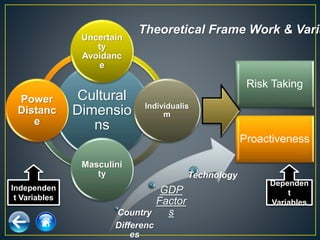
Risk Taking
Proactiveness
Cultural
Dimensio
ns
Uncertain
ty
Avoidanc
e
Individualis
m
Masculini
ty
Power
Distanc
e
Country
Differenc
es
GDP
Factor
s
Technology
Dependen
t
Variables
Independen
t Variables
Theoretical Frame Work & Varia
OUTLINES OF
PRESENTATION
Abstract Introduction
Theory and
Hypotheses
 Purpose of Study
 Overview of Study
 Route of Study
Methodology
 So the point is…
 Game Zone
 Credits
 Random Sampling
 Data Collection
Method
 Usable Sample
 Relationship Between
Culture Dimension with
Risk Taking.
 Relationship between
Culture Dimensions &
Proactiveness
 Relationship of Institutional
variable with Risk Taking &
Proactiveness.
 Theoretical Framework.
ConclusionFindings
 Summary of Study
 Introduction to
Variables
 Direction of Study
 Multivariate
Regression.
 Summary of Results
 Rejection & Selection of
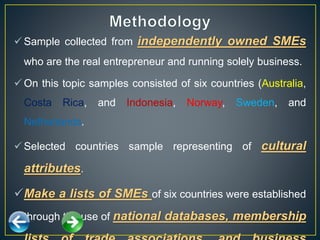
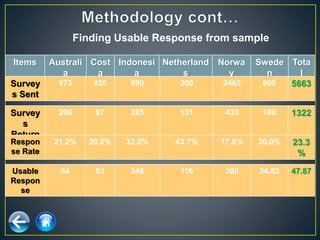
 Sample collected from independently owned SMEs
who are the real entrepreneur and running solely business.
 On this topic samples consisted of six countries (Australia,
Costa Rica, and Indonesia, Norway, Sweden, and
Netherlands.
 Selected countries sample representing of cultural
attributes.
Make a lists of SMEs of six countries were established
through the use of national databases, membership
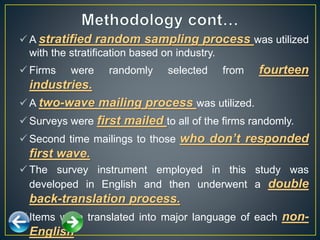
 A stratified random sampling process was utilized
with the stratification based on industry.
 Firms were randomly selected from fourteen
industries.
 A two-wave mailing process was utilized.
 Surveys were first mailed to all of the firms randomly.
 Second time mailings to those who don’t responded
first wave.
 The survey instrument employed in this study was
developed in English and then underwent a double
back-translation process.
 Items were translated into major language of each non-
English
Items Australi
a
Cost
a
Indonesi
a
Netherland
s
Norwa
y
Swede
n
Tota
l
Survey
s
Return
ed
206 87 285 131 433 180 1322
Survey
s Sent
973 435 890 300 2465 600 5663
Respon
se Rate
21.2% 20.0% 32.0% 43.7% 17.6% 30.0% 23.3
%
Usable
Respon
se
84 63 246 116 380 34.82 47.87
Finding Usable Response from sample
OUTLINES OF
PRESENTATION
Abstract Introduction
Theory and
Hypotheses
 Purpose of Study
 Overview of Study
 Route of Study
Methodology
 So the point is…
 Game Zone
 Credits
 Random Sampling
 Data Collection
Method
 Usable Sample
 Relationship Between
Culture Dimension with
Risk Taking.
 Relationship between
Culture Dimensions &
Proactiveness
 Relationship of Institutional
variable with Risk Taking &
Proactiveness.
 Theoretical Framework.
ConclusionFindings
 Summary of Study
 Introduction to
Variables
 Direction of Study
 Multivariate
Regression.
 Summary of Results
 Rejection & Selection of
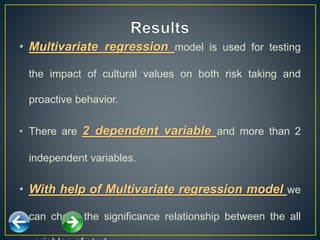
• Multivariate regression model is used for testing
the impact of cultural values on both risk taking and
proactive behavior.
• There are 2 dependent variable and more than 2
independent variables.
• With help of Multivariate regression model we
can check the significance relationship between the all
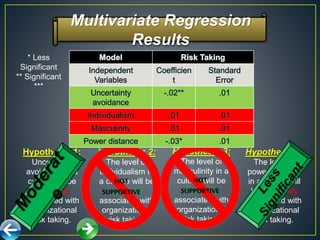
Hypothesis 4:
The level of
power distance
in a culture will
be negatively
associated with
organizational
risk taking.
Hypothesis 1:
Uncertainty
avoidance in a
culture will be
negatively
associated with
organizational
risk taking.
Hypothesis 2:
The level of
individualism in
a culture will be
positively
associated with
organizational
risk taking.
Hypothesis 3:
The level of
masculinity in a
culture will be
positively
associated with
organizational
risk taking.
NOT
SUPPORTIVE
NOT
SUPPORTIVE
Model Risk Taking
Independent
Variables
Coefficien
t
Standard
Error
Uncertainty
avoidance
-.02** .01
Individualism .01 .01
Masculinity .01 .01
Power distance -.03* .01
Multivariate Regression
Results
* Less
Significant
** Significant
***
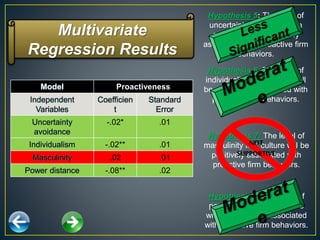
Model Proactiveness
Independent
Variables
Coefficien
t
Standard
Error
Uncertainty
avoidance
-.02* .01
Individualism -.02** .01
Masculinity .02 .01
Power distance -.08** .02
Hypothesis 8: The level of
power distance in a culture
will be negatively associated
with proactive firm behaviors.
Hypothesis 5: The level of
uncertainty avoidance in a
culture will be negatively
associated with proactive firm
behaviors.
Hypothesis 6: The level of
individualism in a culture will
be negatively associated with
proactive firm behaviors.
Hypothesis 7: The level of
masculinity in a culture will be
positively associated with
proactive firm behaviors.
NOT
SUPPORTIVE
Multivariate
Regression Results
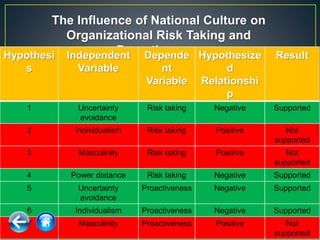
The Influence of National Culture on
Organizational Risk Taking and
ProactivenessHypothesi
s
Independent
Variable
Depende
nt
Variable
Hypothesize
d
Relationshi
p
Result
1 Uncertainty
avoidance
Risk taking Negative Supported
2 Individualism Risk taking Positive Not
supported
3 Masculinity Risk taking Positive Not
supported
4 Power distance Risk taking Negative Supported
5 Uncertainty
avoidance
Proactiveness Negative Supported
6 Individualism Proactiveness Negative Supported
7 Masculinity Proactiveness Positive Not
supported
OUTLINES OF
PRESENTATION
Abstract Introduction
Theory and
Hypotheses
 Purpose of Study
 Overview of Study
 Route of Study
Methodology
 So the point is…
 Game Zone
 Credits
 Random Sampling
 Data Collection
Method
 Usable Sample
 Relationship Between
Culture Dimension with
Risk Taking.
 Relationship between
Culture Dimensions &
Proactiveness
 Relationship of Institutional
variable with Risk Taking &
Proactiveness.
 Theoretical Framework.
ConclusionFindings
 Summary of Study
 Introduction to
Variables
 Direction of Study
 Multivariate
Regression.
 Summary of Results
 Rejection & Selection of
 This research has suggested an important link
between culture and entrepreneurial activity.
 This study has developed framework for
relationship between cultural values, the institutions
and two key dimensions of EO.
 Uncertainty avoidance and power distance were both
found to have a significant and negative influence on
risk-taking.
 Uncertainty avoidance, individualism, and power distance
were found to negatively influence proactive firm
?
Rs. 10,000,000/-
PKR
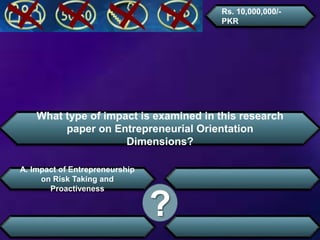
What type of impact is examined in this research
paper on Entrepreneurial Orientation
Dimensions?
?
Rs. 10,000,000/-
PKR
What type of impact is examined in this research
paper on Entrepreneurial Orientation
Dimensions?
A. Impact of Entrepreneurship
on Risk Taking and
Proactiveness
?
Rs. 10,000,000/-
PKR
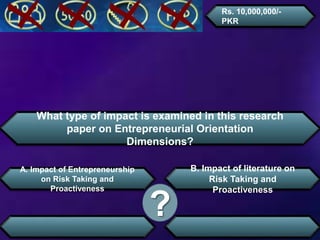
What type of impact is examined in this research
paper on Entrepreneurial Orientation
Dimensions?
A. Impact of Entrepreneurship
on Risk Taking and
Proactiveness
B. Impact of literature on
Risk Taking and
Proactiveness
?
Rs. 10,000,000/-
PKR
What type of impact is examined in this research
paper on Entrepreneurial Orientation
Dimensions?
A. Impact of Entrepreneurship
on Risk Taking and
Proactiveness
B. Impact of literature on
Risk Taking and
Proactiveness
C. Impact of Culture on
Risk Taking and
?
Rs. 10,000,000/-
PKR
What type of impact is examined in this research
paper on Entrepreneurial Orientation
Dimensions?
A. Impact of Entrepreneurship
on Risk Taking and
Proactiveness
D. Impact of Innovations
on Risk Taking and
B. Impact of literature on
Risk Taking and
Proactiveness
C. Impact of Culture on
Risk Taking and
?
Rs. 10,000,000/-
PKR
What type of impact is examined in this research
paper on Entrepreneurial Orientation
Dimensions?
A. Impact of Entrepreneurship
on Risk Taking and
Proactiveness
D. Impact of Innovations
on Risk Taking and
B. Impact of literature on
Risk Taking and
Proactiveness
C. Impact of Culture on
Risk Taking and
?
Rs. 10,000,000/-
PKR
What type of impact is examined in this research
paper on Entrepreneurial Orientation
Dimensions?
A. Impact of Entrepreneurship
on Risk Taking and
Proactiveness
D. Impact of Innovations
on Risk Taking and
B. Impact of literature on
Risk Taking and
Proactiveness
C. Impact of Culture on
Risk Taking and
?
Rs. 10,000,000/-
PKR
Presenter
Aaqib Shahbaz Butt
(B.B.A in Banking & Finance from GCUF; Lecturer of Commerce)
Shahid Ayub
(BS in Commerce from GCUF; Own Business)
Presenting to
Dr. Abdul Ghafor (Assistant Professor at UAF)
Class of MS Marketing 2nd & 3rd
Research Paper
Cultural Influences on Entrepreneurial Orientation: The Impact of National Culture on Risk Taking and
Proactiveness in SMEs
Acknowledgement
A Special thanks to Sir. Abdul Ghafor for supporting us and giving guide line in beautiful environment, thanks
Sir.
A Big thanks to my Teacher, Class Fellow & Friend Mr. Izhar ul Haq
Dedication
We dedicate this presentation to our beloved parents.

Presentation

  • 2.
    MS Marketing 2nd Instituteof Business & Management Science, University of Agriculture, Faisalabad Aaqib Shahbaz Butt 2014-ag-9086 Muhammad Shahid Ayub 2014-ag-9413 Today’s Presenters
  • 3.
    Courteous Thanks to Dr.Abdul Ghafor Assistant Professor Institute of Business & Management Sciences, University of Agriculture, Faisalabad
  • 4.
    Authors Patrick M. Kreiser,Louis D. Marino, Pat Dickson & K. Mark Weaver
  • 5.
    1. Risk-taking: Actingto projects with uncertain outcomes. 2. Proactiveness: Those actions to anticipate future Entrepreneurial orientation is usually defined as a multidimensional construct, applied at the organizational level.
  • 6.
    Authors Patrick M. Kreiser,Louis D. Marino, Pat Dickson & K. Mark Weaver
  • 7.
    Culture is asystem of collective values that distinguishes the members of one group from another.1. Uncertainty Avoidance: Tolerance level for uncertainty. 2. Individualism: Individual & Collectivity culture in organization. 3. Masculinity: Masculine & Famine culture of organization
  • 8.
  • 9.
    Authors Patrick M. Kreiser,Louis D. Marino, Pat Dickson & K. Mark Weaver
  • 10.
    • The conceptof risk taking has frequently been associated with entrepreneurial behavior. • The commitment to venturing and receptivity to the idea of starting a venture.
  • 11.
    Authors Patrick M. Kreiser,Louis D. Marino, Pat Dickson & K. Mark Weaver
  • 12.
    • Acting Advancefor a future issue and taking control on future. • Effectuation theory who belief that If I can control the future, I do not need to predict it
  • 13.
    Authors Patrick M. Kreiser,Louis D. Marino, Pat Dickson & K. Mark Weaver
  • 14.
    OUTLINES OF PRESENTATION Abstract Introduction Theoryand Hypotheses  Purpose of Study  Overview of Study  Route of Study Methodology  So the point is…  Game Zone  Credits  Random Sampling  Data Collection Method  Usable Sample  Relationship Between Culture Dimension with Risk Taking.  Relationship between Culture Dimensions & Proactiveness  Relationship of Institutional variable with Risk Taking & Proactiveness.  Theoretical Framework. ConclusionFindings  Summary of Study  Introduction to Variables  Direction of Study  Multivariate Regression.  Summary of Results  Rejection & Selection of
  • 16.
     This studyexamines the impact of cultural values on two key dimensions of entrepreneurship: risk taking and proactiveness.  Expected relationships between four cultural dimensions and risk taking & proactiveness within SMEs that creates 8 Hypotheses.  This study explore between-country differences in the relationship between risk taking and proactiveness that creates 2 Hypotheses.  This study utilizes data from 1,048 firms that are owned by
  • 17.
    OUTLINES OF PRESENTATION Abstract Introduction Theoryand Hypotheses  Purpose of Study  Overview of Study  Route of Study Methodology  So the point is…  Game Zone  Credits  Random Sampling  Data Collection Method  Usable Sample  Relationship Between Culture Dimension with Risk Taking.  Relationship between Culture Dimensions & Proactiveness  Relationship of Institutional variable with Risk Taking & Proactiveness.  Theoretical Framework. ConclusionFindings  Summary of Study  Introduction to Variables  Direction of Study  Multivariate Regression.  Summary of Results  Rejection & Selection of
  • 19.
     The primarypurpose of this study is to assess national culture plays a significant role in determining the level of risk taking and proactive firm behaviors displayed by small- to medium-sized enterprises (SMEs).  To understand the cultural impacts on entrepreneurial behavior particularly in Risk Taking & Proactiveness.  While previously no any empirical research conducted to examining the relationship between national culture and the other two dimensions of EO.  Hypotheses that are used in this study are generated by the
  • 20.
    OUTLINES OF PRESENTATION Abstract Introduction Theoryand Hypotheses  Purpose of Study  Overview of Study  Route of Study Methodology  So the point is…  Game Zone  Credits  Random Sampling  Data Collection Method  Usable Sample  Relationship Between Culture Dimension with Risk Taking.  Relationship between Culture Dimensions & Proactiveness  Relationship of Institutional variable with Risk Taking & Proactiveness.  Theoretical Framework. ConclusionFindings  Summary of Study  Introduction to Variables  Direction of Study  Multivariate Regression.  Summary of Results  Rejection & Selection of
  • 22.
    Hypothesis 4: The levelof power distance in a culture will be negatively associated with organizational risk taking. 1. Relationship Between Risk Taking and Culture Values Risk Taking and Uncertainty Avoidance Risk Taking and Individualism Risk Taking and Masculinity Risk Taking and Power Distance Theory and Hypotheses Hypothesis 1: Uncertainty avoidance in a culture will be negatively associated with organizational risk taking. Hypothesis 2: The level of individualism in a culture will be positively associated with organizational risk taking. Hypothesis 3: The level of masculinity in a culture will be positively associated with organizational risk taking.
  • 23.
    Hypothesis 8: Thelevel of power distance in a culture will be negatively associated with proactive firm behaviors. 2. Relationship Between Proactiveness & Culture Values Proactiveness and Uncertainty Avoidance Proactiveness and Individualism Proactiveness and Masculinity Proactiveness and Power Distance Hypothesis 5: The level of uncertainty avoidance in a culture will be negatively associated with proactive firm behaviors. Hypothesis 6: The level of individualism in a culture will be negatively associated with proactive firm behaviors. Hypothesis 7: The level of masculinity in a culture will be positively associated with proactive firm behaviors. Theory and Hypotheses Cont…
  • 24.
    The Impact ofInstitutions Hypothesis 10: Institutional variables will be significant predictors of between country differences in levels of proactive firm behaviors. 3. Country Difference s Proactiv e Risk Taking Hypothesis 9: Institutional variables will be significant predictors of between country differences in levels of organizational risk taking. Theory and Hypotheses Cont…
  • 25.
  • 26.
    OUTLINES OF PRESENTATION Abstract Introduction Theoryand Hypotheses  Purpose of Study  Overview of Study  Route of Study Methodology  So the point is…  Game Zone  Credits  Random Sampling  Data Collection Method  Usable Sample  Relationship Between Culture Dimension with Risk Taking.  Relationship between Culture Dimensions & Proactiveness  Relationship of Institutional variable with Risk Taking & Proactiveness.  Theoretical Framework. ConclusionFindings  Summary of Study  Introduction to Variables  Direction of Study  Multivariate Regression.  Summary of Results  Rejection & Selection of
  • 28.
     Sample collectedfrom independently owned SMEs who are the real entrepreneur and running solely business.  On this topic samples consisted of six countries (Australia, Costa Rica, and Indonesia, Norway, Sweden, and Netherlands.  Selected countries sample representing of cultural attributes. Make a lists of SMEs of six countries were established through the use of national databases, membership
  • 29.
     A stratifiedrandom sampling process was utilized with the stratification based on industry.  Firms were randomly selected from fourteen industries.  A two-wave mailing process was utilized.  Surveys were first mailed to all of the firms randomly.  Second time mailings to those who don’t responded first wave.  The survey instrument employed in this study was developed in English and then underwent a double back-translation process.  Items were translated into major language of each non- English
  • 30.
    Items Australi a Cost a Indonesi a Netherland s Norwa y Swede n Tota l Survey s Return ed 206 87285 131 433 180 1322 Survey s Sent 973 435 890 300 2465 600 5663 Respon se Rate 21.2% 20.0% 32.0% 43.7% 17.6% 30.0% 23.3 % Usable Respon se 84 63 246 116 380 34.82 47.87 Finding Usable Response from sample
  • 31.
    OUTLINES OF PRESENTATION Abstract Introduction Theoryand Hypotheses  Purpose of Study  Overview of Study  Route of Study Methodology  So the point is…  Game Zone  Credits  Random Sampling  Data Collection Method  Usable Sample  Relationship Between Culture Dimension with Risk Taking.  Relationship between Culture Dimensions & Proactiveness  Relationship of Institutional variable with Risk Taking & Proactiveness.  Theoretical Framework. ConclusionFindings  Summary of Study  Introduction to Variables  Direction of Study  Multivariate Regression.  Summary of Results  Rejection & Selection of
  • 33.
    • Multivariate regressionmodel is used for testing the impact of cultural values on both risk taking and proactive behavior. • There are 2 dependent variable and more than 2 independent variables. • With help of Multivariate regression model we can check the significance relationship between the all
  • 34.
    Hypothesis 4: The levelof power distance in a culture will be negatively associated with organizational risk taking. Hypothesis 1: Uncertainty avoidance in a culture will be negatively associated with organizational risk taking. Hypothesis 2: The level of individualism in a culture will be positively associated with organizational risk taking. Hypothesis 3: The level of masculinity in a culture will be positively associated with organizational risk taking. NOT SUPPORTIVE NOT SUPPORTIVE Model Risk Taking Independent Variables Coefficien t Standard Error Uncertainty avoidance -.02** .01 Individualism .01 .01 Masculinity .01 .01 Power distance -.03* .01 Multivariate Regression Results * Less Significant ** Significant ***
  • 35.
    Model Proactiveness Independent Variables Coefficien t Standard Error Uncertainty avoidance -.02* .01 Individualism-.02** .01 Masculinity .02 .01 Power distance -.08** .02 Hypothesis 8: The level of power distance in a culture will be negatively associated with proactive firm behaviors. Hypothesis 5: The level of uncertainty avoidance in a culture will be negatively associated with proactive firm behaviors. Hypothesis 6: The level of individualism in a culture will be negatively associated with proactive firm behaviors. Hypothesis 7: The level of masculinity in a culture will be positively associated with proactive firm behaviors. NOT SUPPORTIVE Multivariate Regression Results
  • 36.
    The Influence ofNational Culture on Organizational Risk Taking and ProactivenessHypothesi s Independent Variable Depende nt Variable Hypothesize d Relationshi p Result 1 Uncertainty avoidance Risk taking Negative Supported 2 Individualism Risk taking Positive Not supported 3 Masculinity Risk taking Positive Not supported 4 Power distance Risk taking Negative Supported 5 Uncertainty avoidance Proactiveness Negative Supported 6 Individualism Proactiveness Negative Supported 7 Masculinity Proactiveness Positive Not supported
  • 37.
    OUTLINES OF PRESENTATION Abstract Introduction Theoryand Hypotheses  Purpose of Study  Overview of Study  Route of Study Methodology  So the point is…  Game Zone  Credits  Random Sampling  Data Collection Method  Usable Sample  Relationship Between Culture Dimension with Risk Taking.  Relationship between Culture Dimensions & Proactiveness  Relationship of Institutional variable with Risk Taking & Proactiveness.  Theoretical Framework. ConclusionFindings  Summary of Study  Introduction to Variables  Direction of Study  Multivariate Regression.  Summary of Results  Rejection & Selection of
  • 39.
     This researchhas suggested an important link between culture and entrepreneurial activity.  This study has developed framework for relationship between cultural values, the institutions and two key dimensions of EO.  Uncertainty avoidance and power distance were both found to have a significant and negative influence on risk-taking.  Uncertainty avoidance, individualism, and power distance were found to negatively influence proactive firm
  • 40.
  • 41.
    What type ofimpact is examined in this research paper on Entrepreneurial Orientation Dimensions? ? Rs. 10,000,000/- PKR
  • 42.
    What type ofimpact is examined in this research paper on Entrepreneurial Orientation Dimensions? A. Impact of Entrepreneurship on Risk Taking and Proactiveness ? Rs. 10,000,000/- PKR
  • 43.
    What type ofimpact is examined in this research paper on Entrepreneurial Orientation Dimensions? A. Impact of Entrepreneurship on Risk Taking and Proactiveness B. Impact of literature on Risk Taking and Proactiveness ? Rs. 10,000,000/- PKR
  • 44.
    What type ofimpact is examined in this research paper on Entrepreneurial Orientation Dimensions? A. Impact of Entrepreneurship on Risk Taking and Proactiveness B. Impact of literature on Risk Taking and Proactiveness C. Impact of Culture on Risk Taking and ? Rs. 10,000,000/- PKR
  • 45.
    What type ofimpact is examined in this research paper on Entrepreneurial Orientation Dimensions? A. Impact of Entrepreneurship on Risk Taking and Proactiveness D. Impact of Innovations on Risk Taking and B. Impact of literature on Risk Taking and Proactiveness C. Impact of Culture on Risk Taking and ? Rs. 10,000,000/- PKR
  • 46.
    What type ofimpact is examined in this research paper on Entrepreneurial Orientation Dimensions? A. Impact of Entrepreneurship on Risk Taking and Proactiveness D. Impact of Innovations on Risk Taking and B. Impact of literature on Risk Taking and Proactiveness C. Impact of Culture on Risk Taking and ? Rs. 10,000,000/- PKR
  • 47.
    What type ofimpact is examined in this research paper on Entrepreneurial Orientation Dimensions? A. Impact of Entrepreneurship on Risk Taking and Proactiveness D. Impact of Innovations on Risk Taking and B. Impact of literature on Risk Taking and Proactiveness C. Impact of Culture on Risk Taking and ? Rs. 10,000,000/- PKR
  • 49.
    Presenter Aaqib Shahbaz Butt (B.B.Ain Banking & Finance from GCUF; Lecturer of Commerce) Shahid Ayub (BS in Commerce from GCUF; Own Business) Presenting to Dr. Abdul Ghafor (Assistant Professor at UAF) Class of MS Marketing 2nd & 3rd Research Paper Cultural Influences on Entrepreneurial Orientation: The Impact of National Culture on Risk Taking and Proactiveness in SMEs Acknowledgement A Special thanks to Sir. Abdul Ghafor for supporting us and giving guide line in beautiful environment, thanks Sir. A Big thanks to my Teacher, Class Fellow & Friend Mr. Izhar ul Haq Dedication We dedicate this presentation to our beloved parents.