The Meanings and Dimensions of Culture and Managing Across CultureMike, Roy, and Tianfan
What is Culture?An acquired knowledge that people use to interpret experiences and generate social behaviorForms ValuesCreates attitudesInfluences behaviors6 Characteristics of CultureLearnedSharedTransgenerationalSymbolicPatternedAdaptive
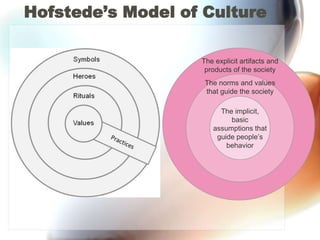
Hofstede’s Model of CultureThe explicit artifacts and products of the societyThe norms and values that guide the societyThe implicit, basic assumptions that guide people’s behavior
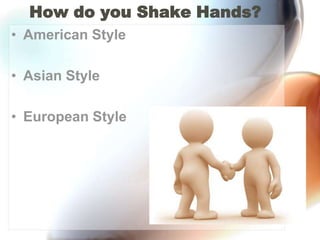
How do you Shake Hands?American StyleAsian StyleEuropean Style
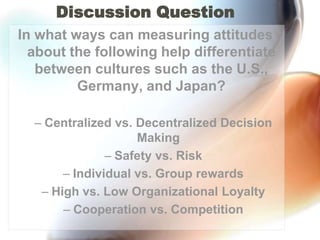
Discussion QuestionIn what ways can measuring attitudes about the following help differentiate between cultures such as the U.S., Germany, and Japan?Centralized vs. Decentralized Decision Making Safety vs. RiskIndividual vs. Group rewardsHigh vs. Low Organizational LoyaltyCooperation vs. Competition
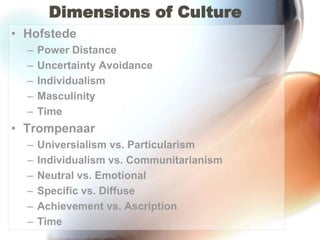
Dimensions of CultureHofstedePower DistanceUncertainty AvoidanceIndividualismMasculinityTimeTrompenaarUniversialism vs. ParticularismIndividualism vs. CommunitarianismNeutral vs. EmotionalSpecific vs. DiffuseAchievement vs. AscriptionTime
Time and Environment
Discussion QuestionIn what way is time a cultural factor? In what way is the need to control the environment a cultural factor?
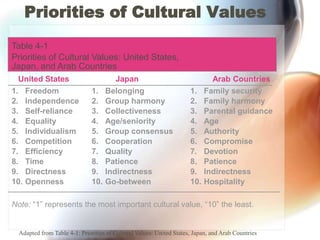
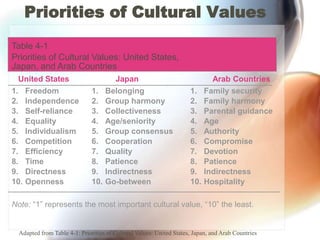
Priorities of Cultural ValuesTable 4-1Priorities of Cultural Values: United States, Japan, and Arab Countries	United States	Japan	Arab CountriesFreedomIndependenceSelf-relianceEqualityIndividualismCompetitionEfficiencyTimeDirectnessOpennessBelongingGroup harmonyCollectivenessAge/seniorityGroup consensusCooperationQualityPatienceIndirectnessGo-betweenFamily securityFamily harmonyParental guidanceAgeAuthorityCompromiseDevotionPatienceIndirectnessHospitalityNote: “1” represents the most important cultural value, “10” the least.Adapted from Table 4-1: Priorities of Cultural Values: United States, Japan, and Arab Countries
Discussion Question	Looking at the lists of these values for their respective countries what kind of managing styles would managers from these countries have and why?
Priorities of Cultural ValuesTable 4-1Priorities of Cultural Values: United States, Japan, and Arab Countries	United States	Japan	Arab CountriesFreedomIndependenceSelf-relianceEqualityIndividualismCompetitionEfficiencyTimeDirectnessOpennessBelongingGroup harmonyCollectivenessAge/seniorityGroup consensusCooperationQualityPatienceIndirectnessGo-betweenFamily securityFamily harmonyParental guidanceAgeAuthorityCompromiseDevotionPatienceIndirectnessHospitalityNote: “1” represents the most important cultural value, “10” the least.Adapted from Table 4-1: Priorities of Cultural Values: United States, Japan, and Arab Countries
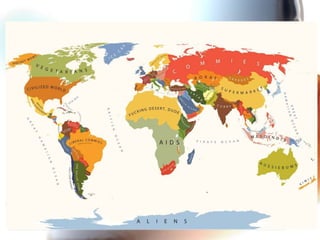
Parochialism	The tendency to view the world through one’s own eyes and perspective.
SimplificationThe process of exhibiting the same orientation toward different cultural groups.
Discussion QuestionIn what way are parochialism and simplification barriers to effective cross-cultural management?
Case StudyBeijing, here we come!
Doing Business in ChinaTechnical competenceTime concept and reluctanceGUANXI! “who you know>what you know”! Very Important!#1 Priority=Personal well-being: think of Chinese negotiators as humans first
About the Case A Canadian toy company wants to invest in the PRC5 year contract and the PRC will take control of the plant after 5 yearsThis would allow for maximized profit They were formerly contracted to a Taiwanese company which is becoming more expensiveThey must renew before the end of 60 daysThe contract there will be extended another 24 months if renewed
DiscussionWhat is the likelihood that the Canadians will be able to reach an agreement with the mainland Chinese and not have to go back to their Taiwanese supplier?Are the Canadians making a strategically wise decision in letting the Chinese from the PRC handle the manufacturing, or should they insist on getting more actively involved in the production process?What specific cultural suggestions would you make to the Canadians regarding how to do business with the mainland Chinese?
So what about this…As people engage in more international travel and become more familiar with other countries, will cultural differences decline as a roadblock to international understanding, or will they continue to be a major barrier?What are potential benefits of cultural differences within the globalized business world?

Meeting 4 team a

  • 1.
    The Meanings andDimensions of Culture and Managing Across CultureMike, Roy, and Tianfan
  • 2.
    What is Culture?Anacquired knowledge that people use to interpret experiences and generate social behaviorForms ValuesCreates attitudesInfluences behaviors6 Characteristics of CultureLearnedSharedTransgenerationalSymbolicPatternedAdaptive
  • 3.
    Hofstede’s Model ofCultureThe explicit artifacts and products of the societyThe norms and values that guide the societyThe implicit, basic assumptions that guide people’s behavior
  • 4.
    How do youShake Hands?American StyleAsian StyleEuropean Style
  • 5.
    Discussion QuestionIn whatways can measuring attitudes about the following help differentiate between cultures such as the U.S., Germany, and Japan?Centralized vs. Decentralized Decision Making Safety vs. RiskIndividual vs. Group rewardsHigh vs. Low Organizational LoyaltyCooperation vs. Competition
  • 6.
    Dimensions of CultureHofstedePowerDistanceUncertainty AvoidanceIndividualismMasculinityTimeTrompenaarUniversialism vs. ParticularismIndividualism vs. CommunitarianismNeutral vs. EmotionalSpecific vs. DiffuseAchievement vs. AscriptionTime
  • 7.
  • 8.
    Discussion QuestionIn whatway is time a cultural factor? In what way is the need to control the environment a cultural factor?
  • 9.
    Priorities of CulturalValuesTable 4-1Priorities of Cultural Values: United States, Japan, and Arab Countries United States Japan Arab CountriesFreedomIndependenceSelf-relianceEqualityIndividualismCompetitionEfficiencyTimeDirectnessOpennessBelongingGroup harmonyCollectivenessAge/seniorityGroup consensusCooperationQualityPatienceIndirectnessGo-betweenFamily securityFamily harmonyParental guidanceAgeAuthorityCompromiseDevotionPatienceIndirectnessHospitalityNote: “1” represents the most important cultural value, “10” the least.Adapted from Table 4-1: Priorities of Cultural Values: United States, Japan, and Arab Countries
  • 10.
    Discussion Question Looking atthe lists of these values for their respective countries what kind of managing styles would managers from these countries have and why?
  • 11.
    Priorities of CulturalValuesTable 4-1Priorities of Cultural Values: United States, Japan, and Arab Countries United States Japan Arab CountriesFreedomIndependenceSelf-relianceEqualityIndividualismCompetitionEfficiencyTimeDirectnessOpennessBelongingGroup harmonyCollectivenessAge/seniorityGroup consensusCooperationQualityPatienceIndirectnessGo-betweenFamily securityFamily harmonyParental guidanceAgeAuthorityCompromiseDevotionPatienceIndirectnessHospitalityNote: “1” represents the most important cultural value, “10” the least.Adapted from Table 4-1: Priorities of Cultural Values: United States, Japan, and Arab Countries
  • 12.
    Parochialism The tendency toview the world through one’s own eyes and perspective.
  • 14.
    SimplificationThe process ofexhibiting the same orientation toward different cultural groups.
  • 16.
    Discussion QuestionIn whatway are parochialism and simplification barriers to effective cross-cultural management?
  • 17.
  • 18.
    Doing Business inChinaTechnical competenceTime concept and reluctanceGUANXI! “who you know>what you know”! Very Important!#1 Priority=Personal well-being: think of Chinese negotiators as humans first
  • 20.
    About the CaseA Canadian toy company wants to invest in the PRC5 year contract and the PRC will take control of the plant after 5 yearsThis would allow for maximized profit They were formerly contracted to a Taiwanese company which is becoming more expensiveThey must renew before the end of 60 daysThe contract there will be extended another 24 months if renewed
  • 21.
    DiscussionWhat is thelikelihood that the Canadians will be able to reach an agreement with the mainland Chinese and not have to go back to their Taiwanese supplier?Are the Canadians making a strategically wise decision in letting the Chinese from the PRC handle the manufacturing, or should they insist on getting more actively involved in the production process?What specific cultural suggestions would you make to the Canadians regarding how to do business with the mainland Chinese?
  • 22.
    So what aboutthis…As people engage in more international travel and become more familiar with other countries, will cultural differences decline as a roadblock to international understanding, or will they continue to be a major barrier?What are potential benefits of cultural differences within the globalized business world?

Editor's Notes