VECTORS
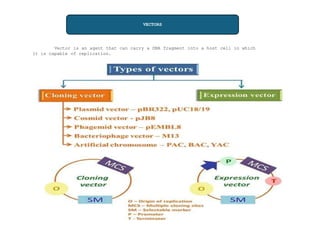
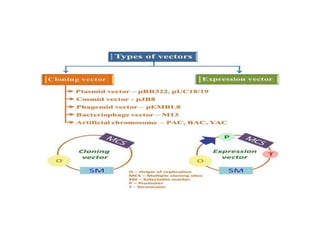
Vector is an agent that can carry a DNA fragment into a host cell in which
it is capable of replication.
RECOMBINANT DNA TECHNOLOGY
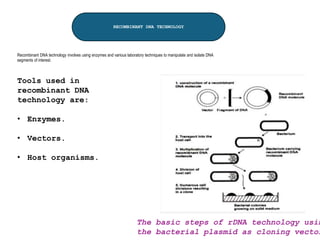
Recombinant DNA technology involves using enzymes and various laboratory techniques to manipulate and isolate DNA
segments of interest.
The basic steps of rDNA technology usin
the bacterial plasmid as cloning vector
Tools used in
recombinant DNA
technology are:
• Enzymes.
• Vectors.
• Host organisms.
DEPARTMENT OF P G STUDIES IN BOTANY
TOPIC:pBR322 plasmid
vector.
PRESENTED BY:
SHRAVANI.G
MSC(II YEAR)
PLASMIDS –VEHICLES FOR CLONING
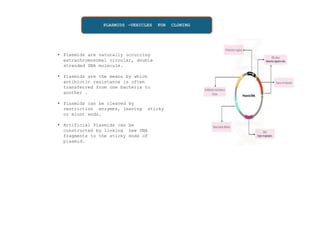
• Plasmids are naturally occurring
extrachromosomal circular, double
stranded DNA molecule.
• Plasmids are the means by which
antibiotic resistance is often
transferred from one bacteria to
another .
• Plasmids can be cleaved by
restriction enzymes, leaving sticky
or blunt ends.
• Artificial Plasmids can be
constructed by linking new DNA
fragments to the sticky ends of
plasmid.
Referen
• REFERENCE:
• https://www.slideshare.net/ThippeswamyM2/cloning-vectors-238854304
• https://images.app.goo.gl/yavCFRUpHWDUGqWP8
• https://www.slideshare.net/vidhyakalaivani29/p-br322
• https://www.slideshare.net/AhimaEnaam/comparison-between-different-
types-of-vectors-235722637
• https://microbenotes.com/pbr322-vector-structure-applications/
CONCLUSION
• pBR322 DNA is a commonly used plasmid cloning vector in E.coli.
• The molecule is a double-stranded circle 4,361* base pairs in length.
• pBR322 contains the genes for resistance to ampicillin and tetracycline.
• The molecular weight is 2.83 x 10⁶ daltons.
ADVANTAGES:
Small size (-4.4kb) enables easy purification and
manipulation.
Two selectable markers (Amp,Tet)allows easy
selection of recombinant DNA.
Presence of multiple restriction enzyme sites which
makes the plasmid compatible in many ways.
DISADVANTAGES:
It has very high mobility I,e. It can move to
another cell in the presence of conjugation plasmid
like F-factor.
There is limitation in the size of the gene of
interest that can accommodate.
Low number of copies per cell.
APPLICATIONS
The pBR322 vector has a wide range of applications in molecular biology and
molecular biology and genetic engineering.
It’s unique combination of antibiotic resistance genes restriction enzyme sites
restriction enzyme sites and other important features make it an ideal took for :
make it an ideal took for :
• Cloning.
• Gene expression.
• Site-directed mutagenesis.
• Antibiotic resistance selection.
BASED ON THE ORIGIN OR SOURCE OF PLASMIDS
Two major classes:
1. Natural plasmids:
They occur naturally in prokaryotes.
Example:ColE1.
2. Artificial plasmids:
They are constructed in-vitro by recombinant
selected segmented of two or more plasmids.
Example:pBR322. 322
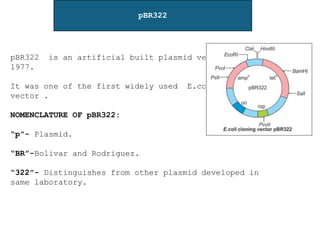
pBR322
pBR322 is an artificial built plasmid vector in
1977.
It was one of the first widely used E.coli cloning
vector .
NOMENCLATURE OF pBR322:
“p”- Plasmid.
“BR”-Bolivar and Rodriguez.
“322”- Distinguishes from other plasmid developed in
same laboratory.
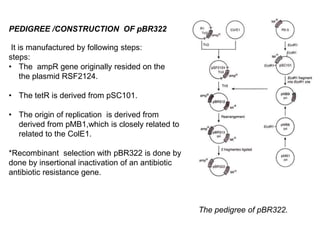
PEDIGREE /CONSTRUCTION OF pBR322
It is manufactured by following steps:
steps:
• The ampR gene originally resided on the
the plasmid RSF2124.
• The tetR is derived from pSC101.
• The origin of replication is derived from
derived from pMB1,which is closely related to
related to the ColE1.
*Recombinant selection with pBR322 is done by
done by insertional inactivation of an antibiotic
antibiotic resistance gene.
The pedigree of pBR322.
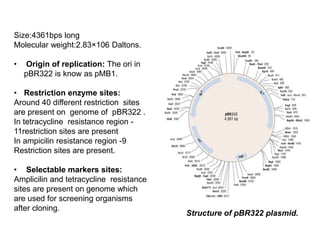
Structure of pBR322 plasmid.
Size:4361bps long
Molecular weight:2.83×10⁶ Daltons.
• Origin of replication: The ori in
pBR322 is know as pMB1.
• Restriction enzyme sites:
Around 40 different restriction sites
are present on genome of pBR322 .
In tetracycline resistance region -
11restriction sites are present
In ampicilin resistance region -9
Restriction sites are present.
• Selectable markers sites:
Amplicilin and tetracycline resistance
sites are present on genome which
are used for screening organisms
after cloning.

Presentation (3).pptx very useful see it niv

  • 4.
    VECTORS Vector is anagent that can carry a DNA fragment into a host cell in which it is capable of replication.
  • 5.
    RECOMBINANT DNA TECHNOLOGY RecombinantDNA technology involves using enzymes and various laboratory techniques to manipulate and isolate DNA segments of interest. The basic steps of rDNA technology usin the bacterial plasmid as cloning vector Tools used in recombinant DNA technology are: • Enzymes. • Vectors. • Host organisms.
  • 8.
    DEPARTMENT OF PG STUDIES IN BOTANY TOPIC:pBR322 plasmid vector. PRESENTED BY: SHRAVANI.G MSC(II YEAR)
  • 9.
    PLASMIDS –VEHICLES FORCLONING • Plasmids are naturally occurring extrachromosomal circular, double stranded DNA molecule. • Plasmids are the means by which antibiotic resistance is often transferred from one bacteria to another . • Plasmids can be cleaved by restriction enzymes, leaving sticky or blunt ends. • Artificial Plasmids can be constructed by linking new DNA fragments to the sticky ends of plasmid.
  • 10.
  • 11.
    • REFERENCE: • https://www.slideshare.net/ThippeswamyM2/cloning-vectors-238854304 •https://images.app.goo.gl/yavCFRUpHWDUGqWP8 • https://www.slideshare.net/vidhyakalaivani29/p-br322 • https://www.slideshare.net/AhimaEnaam/comparison-between-different- types-of-vectors-235722637 • https://microbenotes.com/pbr322-vector-structure-applications/
  • 12.
    CONCLUSION • pBR322 DNAis a commonly used plasmid cloning vector in E.coli. • The molecule is a double-stranded circle 4,361* base pairs in length. • pBR322 contains the genes for resistance to ampicillin and tetracycline. • The molecular weight is 2.83 x 10⁶ daltons.
  • 13.
    ADVANTAGES: Small size (-4.4kb)enables easy purification and manipulation. Two selectable markers (Amp,Tet)allows easy selection of recombinant DNA. Presence of multiple restriction enzyme sites which makes the plasmid compatible in many ways. DISADVANTAGES: It has very high mobility I,e. It can move to another cell in the presence of conjugation plasmid like F-factor. There is limitation in the size of the gene of interest that can accommodate. Low number of copies per cell.
  • 14.
    APPLICATIONS The pBR322 vectorhas a wide range of applications in molecular biology and molecular biology and genetic engineering. It’s unique combination of antibiotic resistance genes restriction enzyme sites restriction enzyme sites and other important features make it an ideal took for : make it an ideal took for : • Cloning. • Gene expression. • Site-directed mutagenesis. • Antibiotic resistance selection.
  • 15.
    BASED ON THEORIGIN OR SOURCE OF PLASMIDS Two major classes: 1. Natural plasmids: They occur naturally in prokaryotes. Example:ColE1. 2. Artificial plasmids: They are constructed in-vitro by recombinant selected segmented of two or more plasmids. Example:pBR322. 322
  • 16.
    pBR322 pBR322 is anartificial built plasmid vector in 1977. It was one of the first widely used E.coli cloning vector . NOMENCLATURE OF pBR322: “p”- Plasmid. “BR”-Bolivar and Rodriguez. “322”- Distinguishes from other plasmid developed in same laboratory.
  • 17.
    PEDIGREE /CONSTRUCTION OFpBR322 It is manufactured by following steps: steps: • The ampR gene originally resided on the the plasmid RSF2124. • The tetR is derived from pSC101. • The origin of replication is derived from derived from pMB1,which is closely related to related to the ColE1. *Recombinant selection with pBR322 is done by done by insertional inactivation of an antibiotic antibiotic resistance gene. The pedigree of pBR322.
  • 18.
    Structure of pBR322plasmid. Size:4361bps long Molecular weight:2.83×10⁶ Daltons. • Origin of replication: The ori in pBR322 is know as pMB1. • Restriction enzyme sites: Around 40 different restriction sites are present on genome of pBR322 . In tetracycline resistance region - 11restriction sites are present In ampicilin resistance region -9 Restriction sites are present. • Selectable markers sites: Amplicilin and tetracycline resistance sites are present on genome which are used for screening organisms after cloning.