Type-Directed TDD in Rust
A case study using FizzBuzz
Franklin Chen
http://franklinchen.com/
July 21, 2014
Pittsburgh Code and Supply
Franklin Chen http://franklinchen.com/ Type-Directed TDD in Rust Pittsburgh Code and Supply 1 / 78
Outline
1 Introduction
2 Original FizzBuzz problem
3 FizzBuzz 2: user configuration
4 FizzBuzz 3: FizzBuzzPop and beyond
5 Parallel FizzBuzz
6 Conclusion
Franklin Chen http://franklinchen.com/ Type-Directed TDD in Rust Pittsburgh Code and Supply 2 / 78
Outline
1 Introduction
2 Original FizzBuzz problem
3 FizzBuzz 2: user configuration
4 FizzBuzz 3: FizzBuzzPop and beyond
5 Parallel FizzBuzz
6 Conclusion
Franklin Chen http://franklinchen.com/ Type-Directed TDD in Rust Pittsburgh Code and Supply 3 / 78
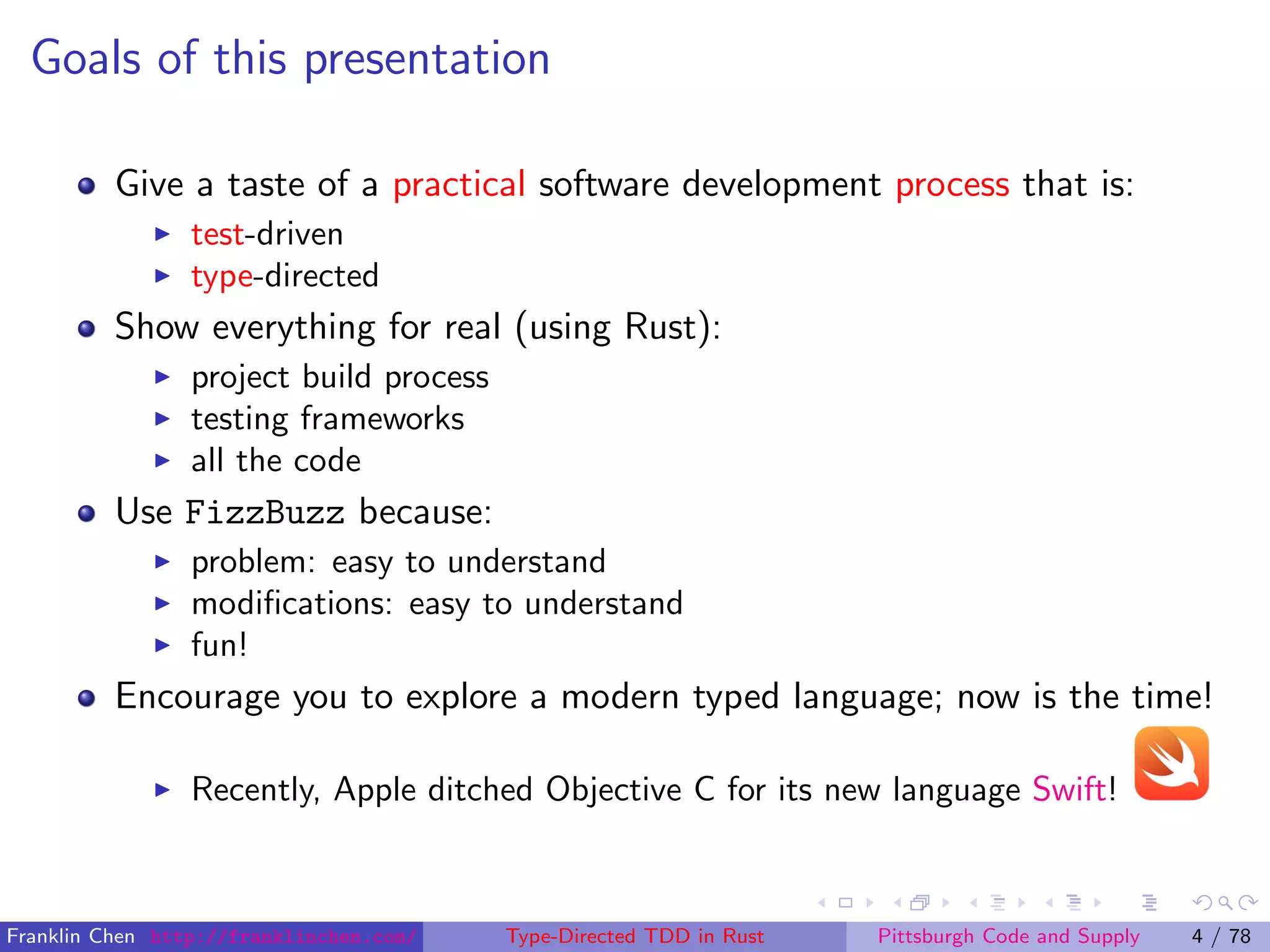
Goals of this presentation
Give a taste of a practical software development process that is:
test-driven
type-directed
Show everything for real (using Rust):
project build process
testing frameworks
all the code
Use FizzBuzz because:
problem: easy to understand
modifications: easy to understand
fun!
Encourage you to explore a modern typed language; now is the time!
Recently, Apple ditched Objective C for its new language Swift!
Franklin Chen http://franklinchen.com/ Type-Directed TDD in Rust Pittsburgh Code and Supply 4 / 78
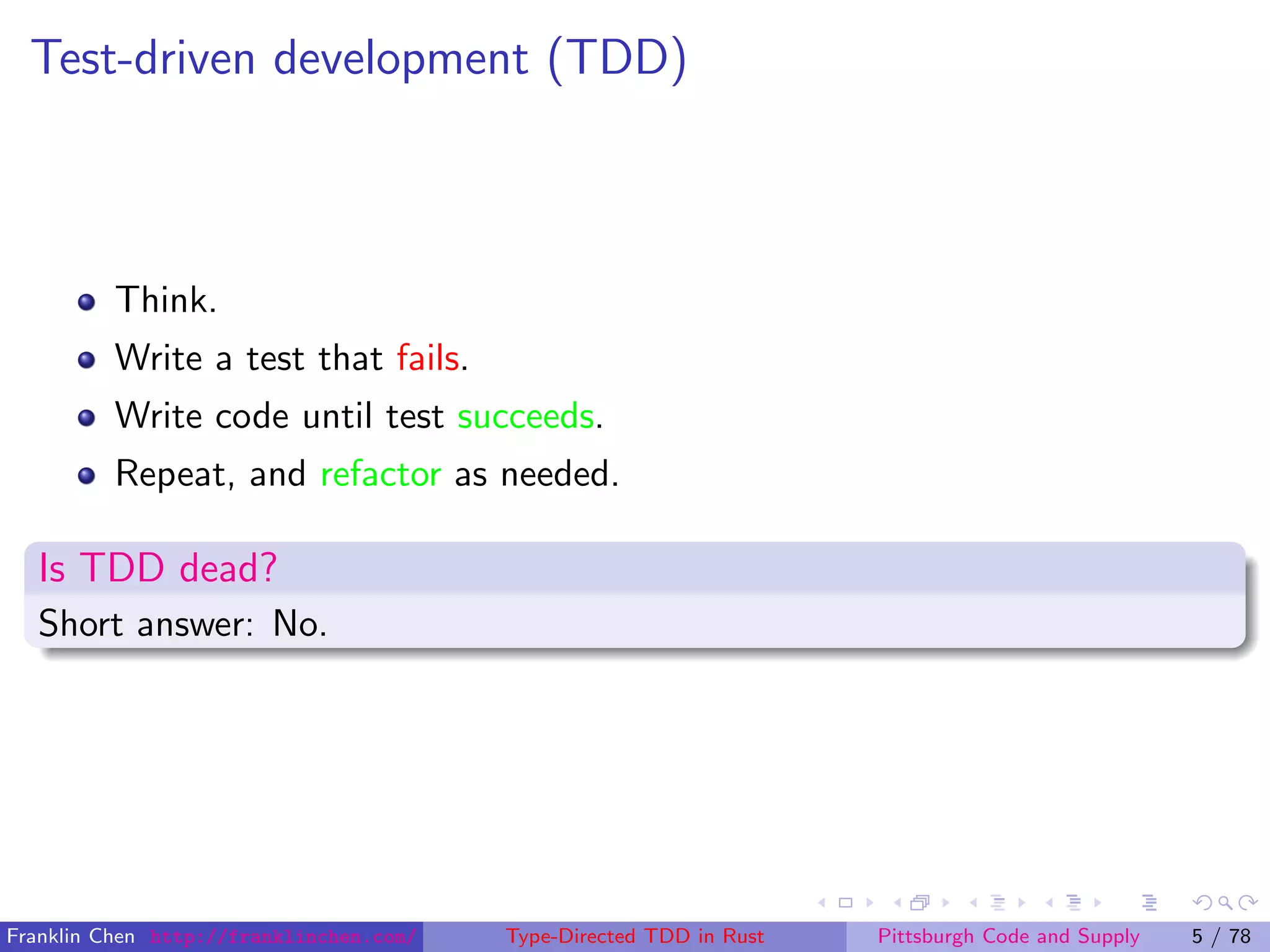
Test-driven development (TDD)
Think.
Write a test that fails.
Write code until test succeeds.
Repeat, and refactor as needed.
Is TDD dead?
Short answer: No.
Franklin Chen http://franklinchen.com/ Type-Directed TDD in Rust Pittsburgh Code and Supply 5 / 78
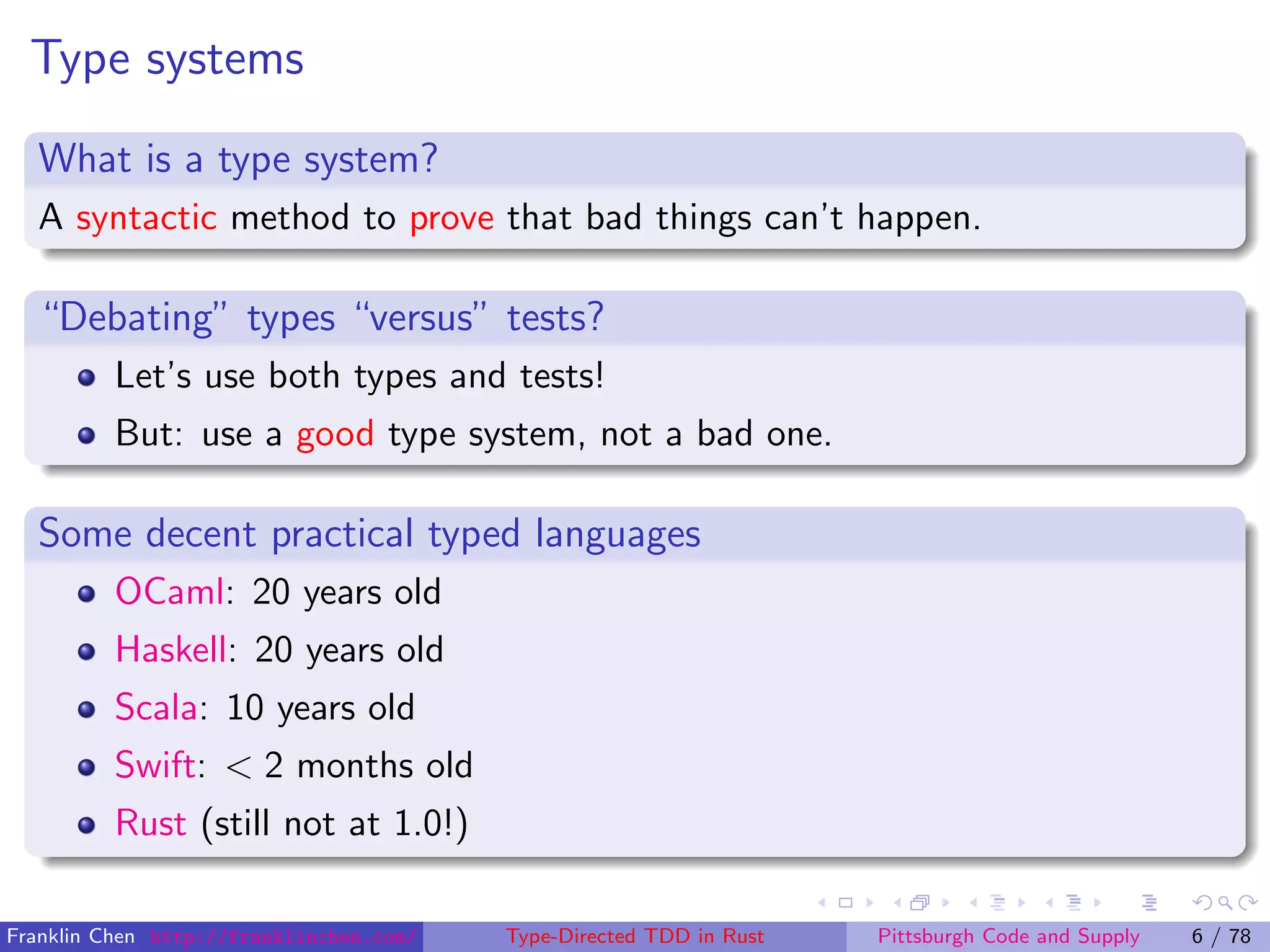
Type systems
What is a type system?
A syntactic method to prove that bad things can’t happen.
“Debating” types “versus” tests?
Let’s use both types and tests!
But: use a good type system, not a bad one.
Some decent practical typed languages
OCaml: 20 years old
Haskell: 20 years old
Scala: 10 years old
Swift: < 2 months old
Rust (still not at 1.0!)
Franklin Chen http://franklinchen.com/ Type-Directed TDD in Rust Pittsburgh Code and Supply 6 / 78
Outline
1 Introduction
2 Original FizzBuzz problem
3 FizzBuzz 2: user configuration
4 FizzBuzz 3: FizzBuzzPop and beyond
5 Parallel FizzBuzz
6 Conclusion
Franklin Chen http://franklinchen.com/ Type-Directed TDD in Rust Pittsburgh Code and Supply 8 / 78
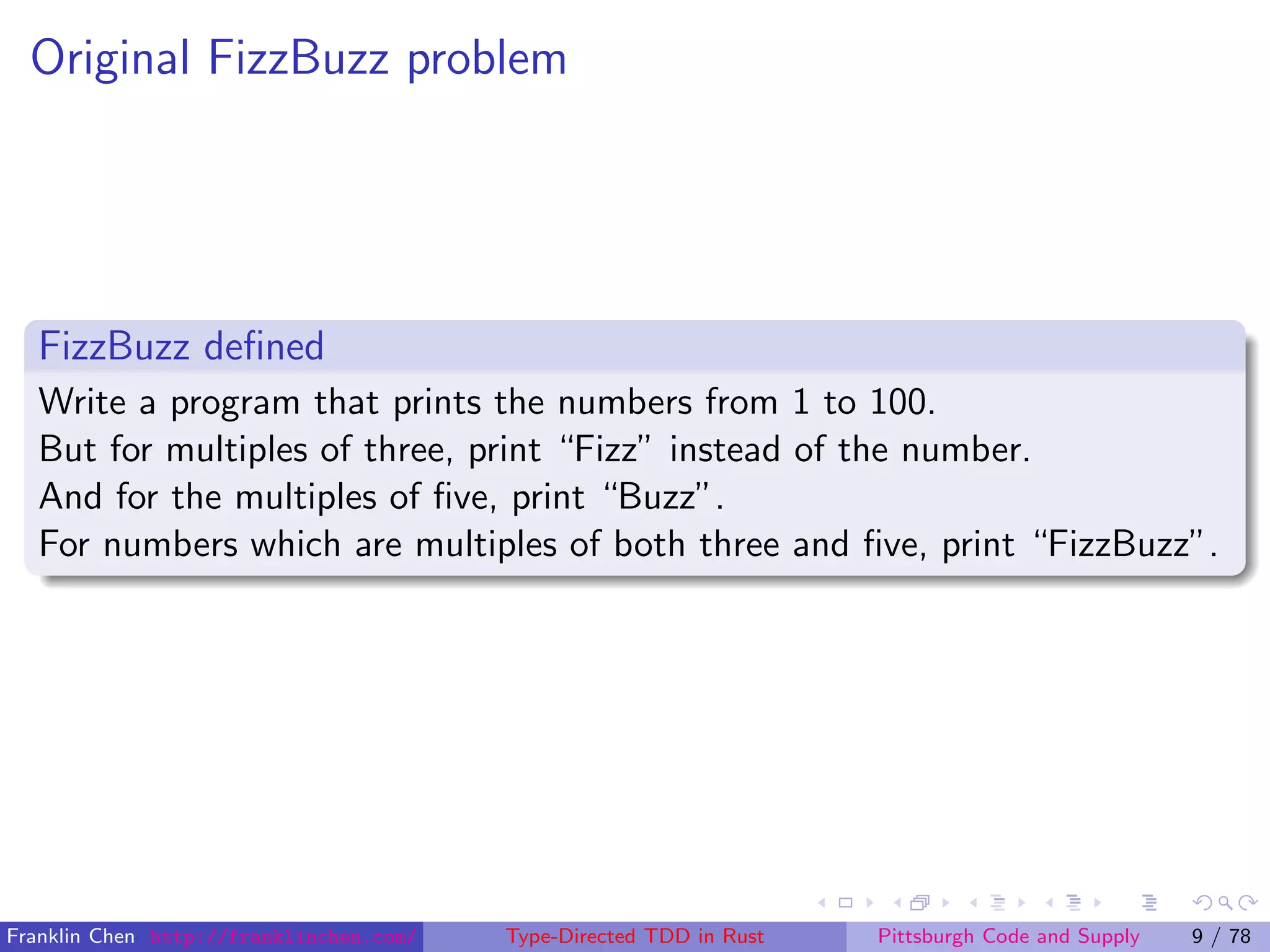
Original FizzBuzz problem
FizzBuzz defined
Write a program that prints the numbers from 1 to 100.
But for multiples of three, print “Fizz” instead of the number.
And for the multiples of five, print “Buzz”.
For numbers which are multiples of both three and five, print “FizzBuzz”.
Franklin Chen http://franklinchen.com/ Type-Directed TDD in Rust Pittsburgh Code and Supply 9 / 78
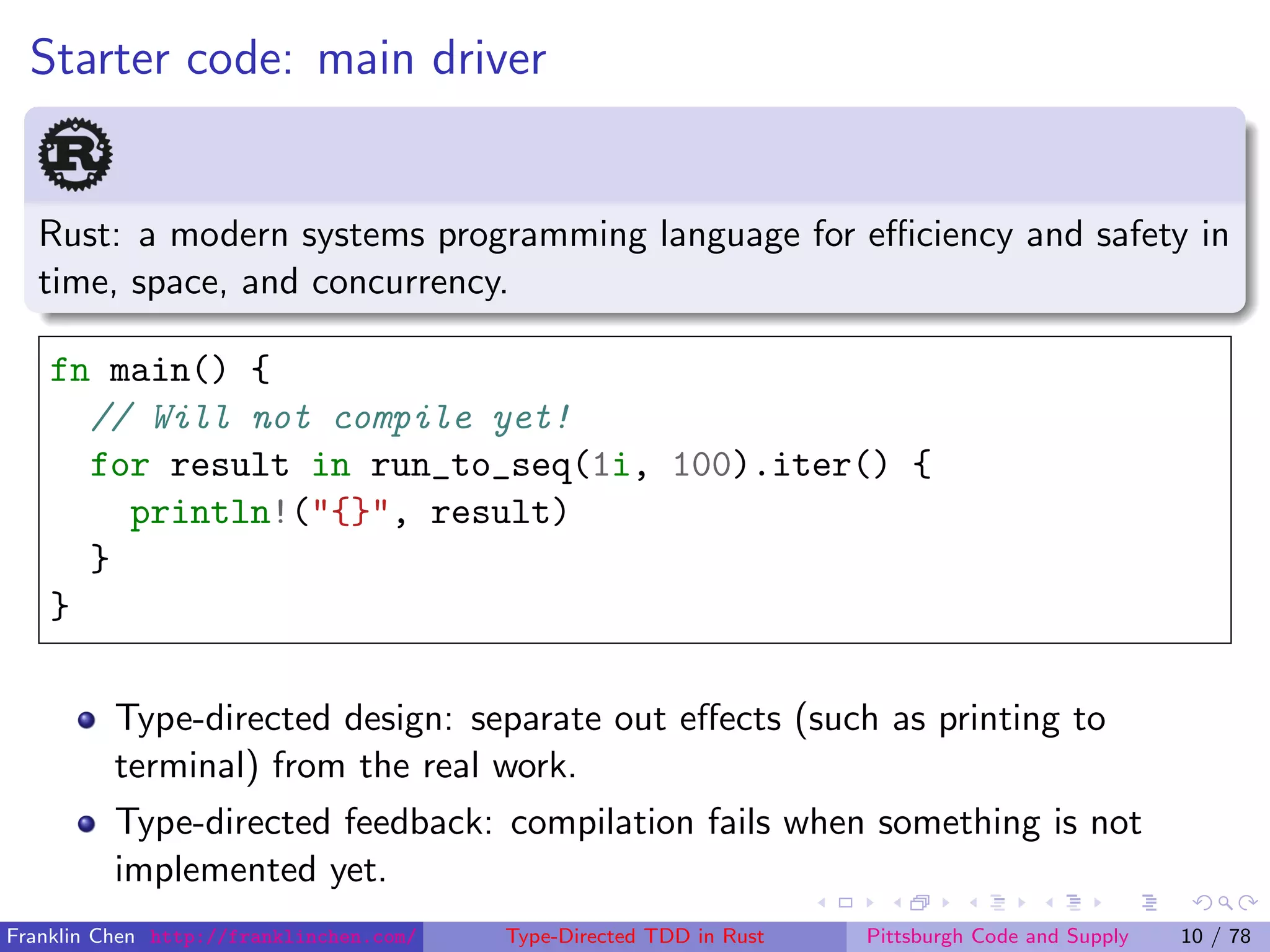
Starter code: main driver
Rust: a modern systems programming language for efficiency and safety in
time, space, and concurrency.
fn main() {
// Will not compile yet!
for result in run_to_seq(1i, 100).iter() {
println!("{}", result)
}
}
Type-directed design: separate out effects (such as printing to
terminal) from the real work.
Type-directed feedback: compilation fails when something is not
implemented yet.
Franklin Chen http://franklinchen.com/ Type-Directed TDD in Rust Pittsburgh Code and Supply 10 / 78
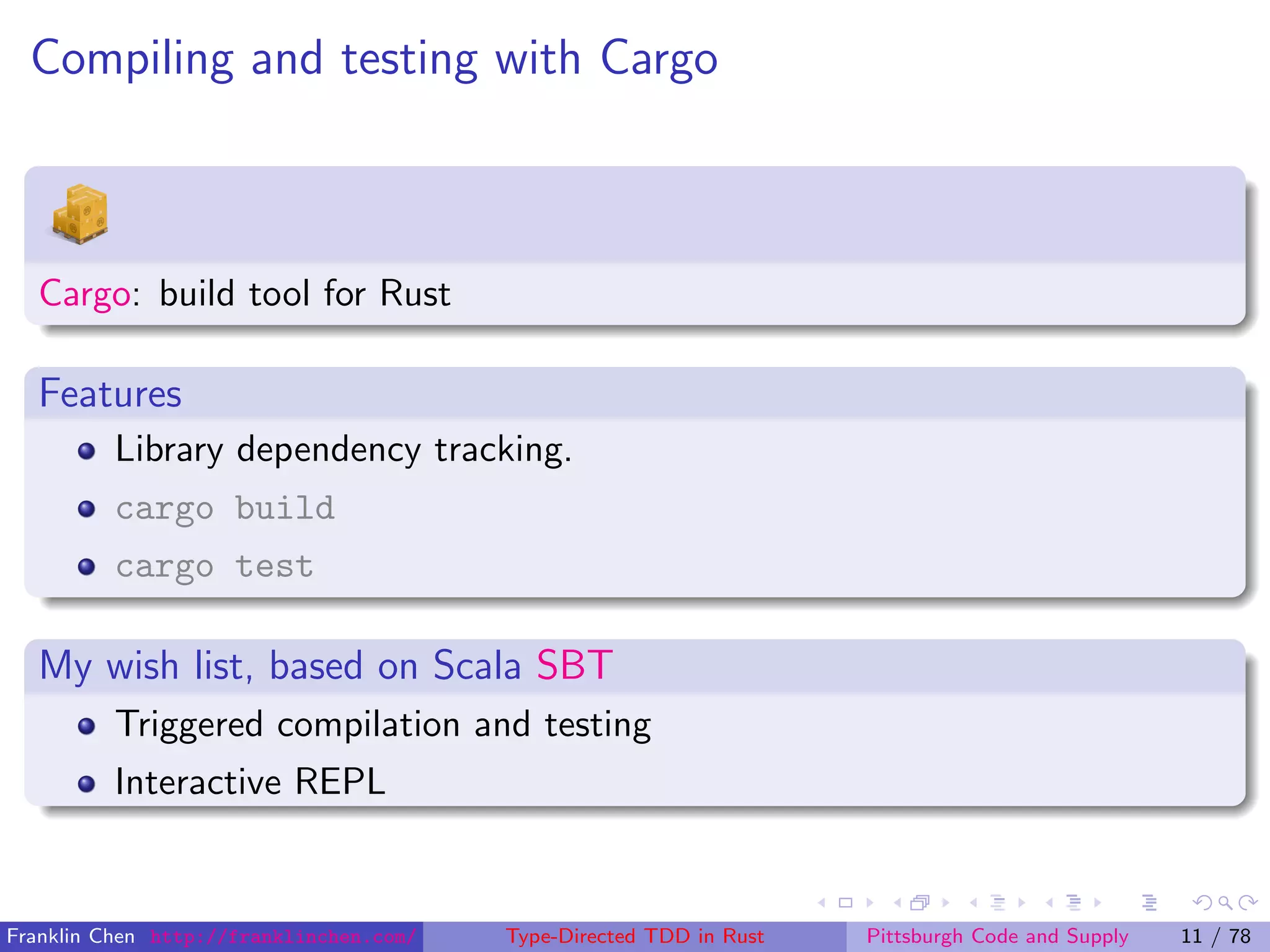
Compiling and testing with Cargo
Cargo: build tool for Rust
Features
Library dependency tracking.
cargo build
cargo test
My wish list, based on Scala SBT
Triggered compilation and testing
Interactive REPL
Franklin Chen http://franklinchen.com/ Type-Directed TDD in Rust Pittsburgh Code and Supply 11 / 78
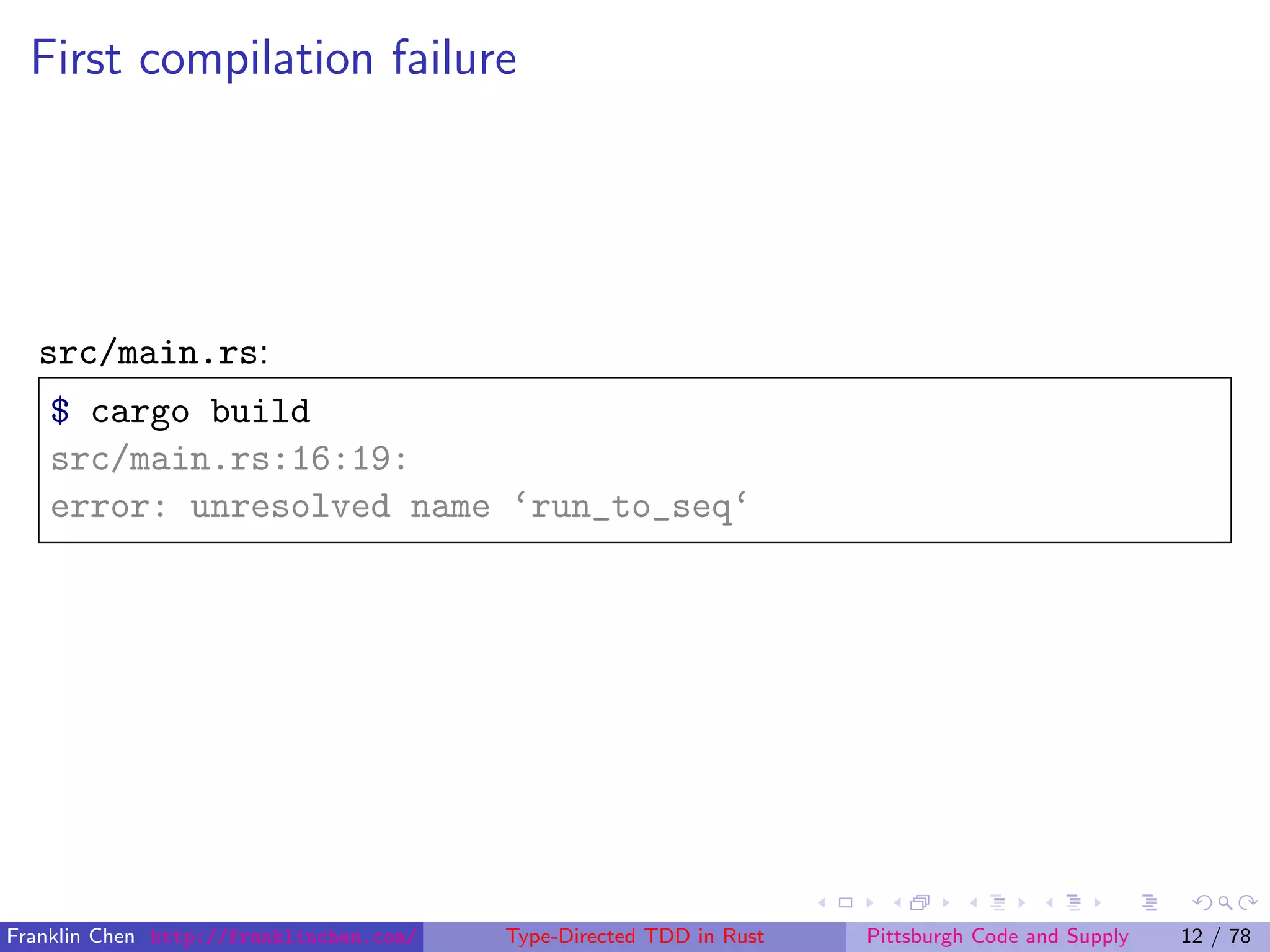
First compilation failure
src/main.rs:
$ cargo build
src/main.rs:16:19:
error: unresolved name ‘run_to_seq‘
Franklin Chen http://franklinchen.com/ Type-Directed TDD in Rust Pittsburgh Code and Supply 12 / 78
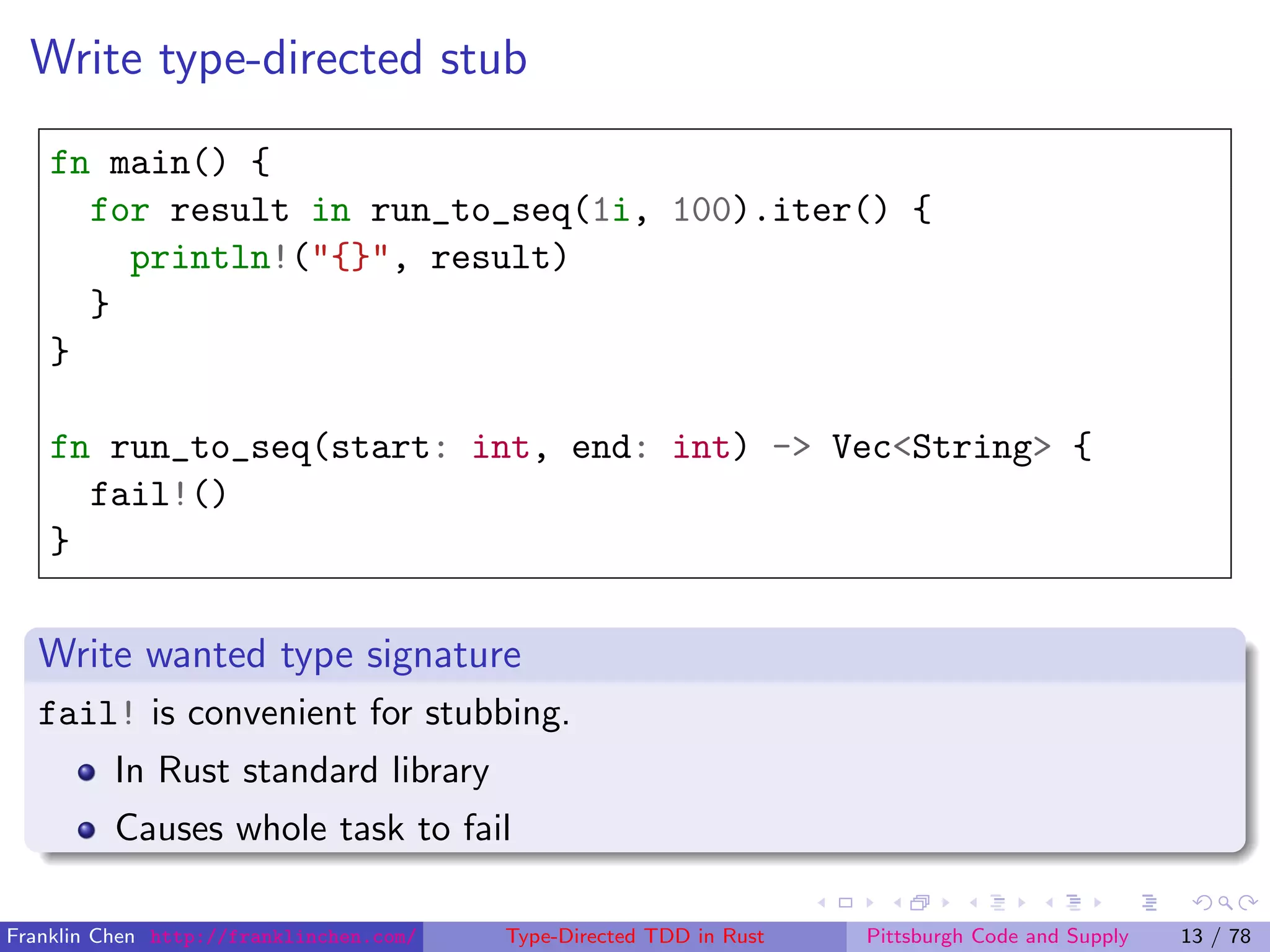
Write type-directed stub
fn main() {
for result in run_to_seq(1i, 100).iter() {
println!("{}", result)
}
}
fn run_to_seq(start: int, end: int) -> Vec<String> {
fail!()
}
Write wanted type signature
fail! is convenient for stubbing.
In Rust standard library
Causes whole task to fail
Franklin Chen http://franklinchen.com/ Type-Directed TDD in Rust Pittsburgh Code and Supply 13 / 78
Write acceptance test (simplified)
#[test]
fn test_1_to_16() {
let expected = vec![
"1", "2", "Fizz", "4", "Buzz", "Fizz",
"7", "8", "Fizz", "Buzz", "11", "Fizz",
"13", "14", "FizzBuzz", "16",
]
.iter()
.map(|&s| s.to_string())
.collect();
assert_eq!(run_to_seq(1, 16), expected)
}
Franklin Chen http://franklinchen.com/ Type-Directed TDD in Rust Pittsburgh Code and Supply 14 / 78
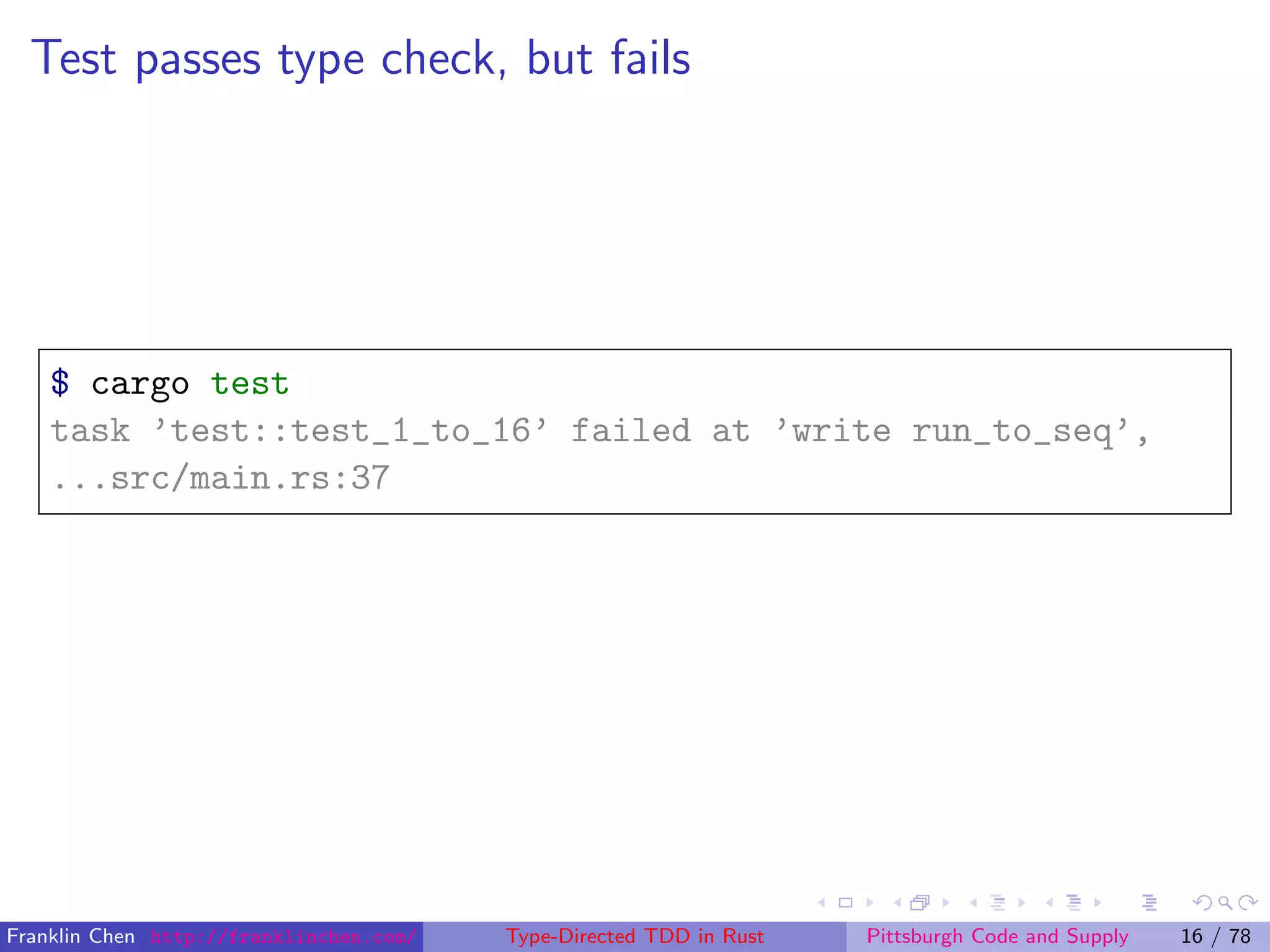
Test passes type check, but fails
$ cargo test
task ’test::test_1_to_16’ failed at ’write run_to_seq’,
...src/main.rs:37
Franklin Chen http://franklinchen.com/ Type-Directed TDD in Rust Pittsburgh Code and Supply 16 / 78
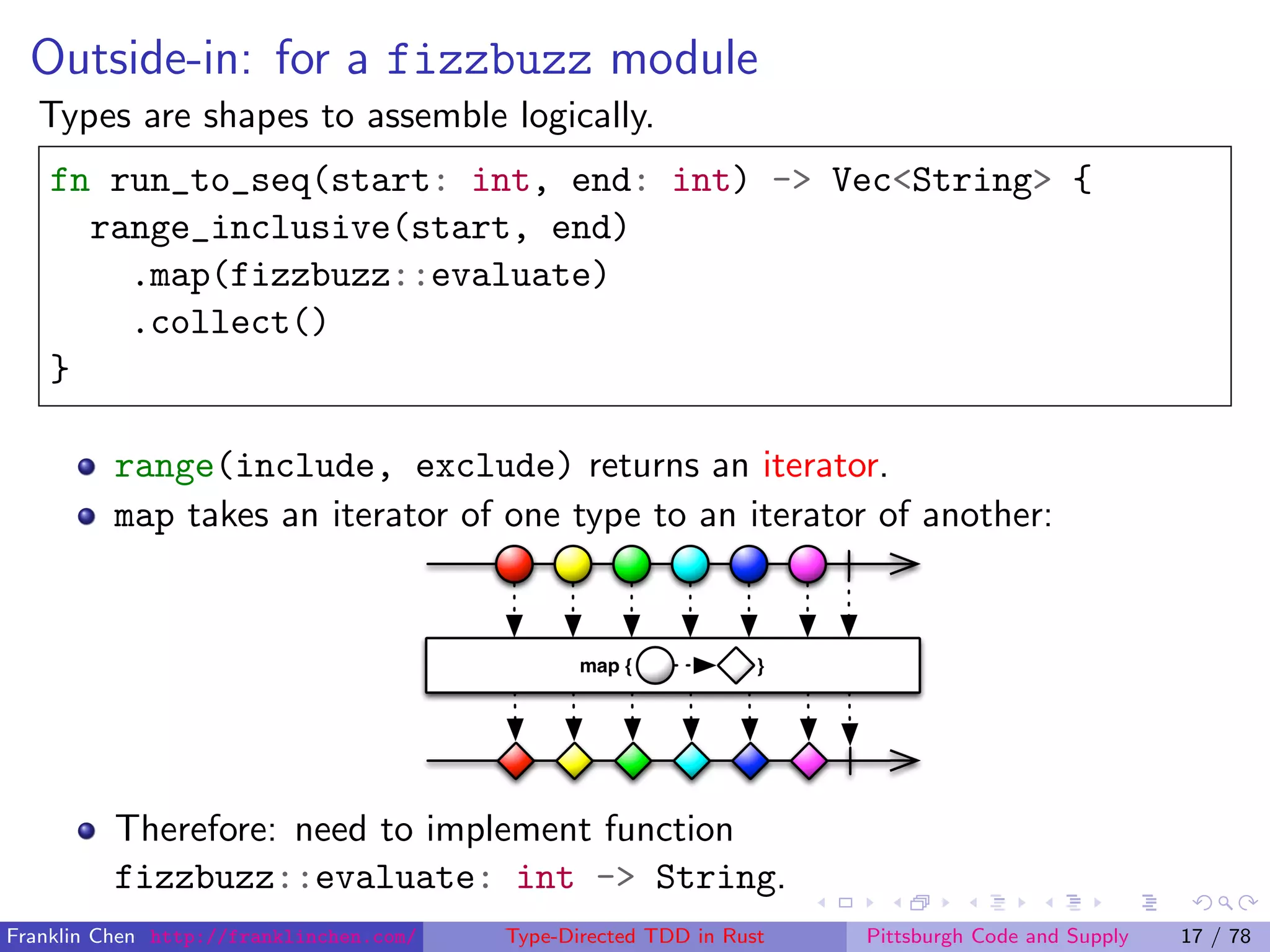
Outside-in: for a fizzbuzz module
Types are shapes to assemble logically.
fn run_to_seq(start: int, end: int) -> Vec<String> {
range_inclusive(start, end)
.map(fizzbuzz::evaluate)
.collect()
}
range(include, exclude) returns an iterator.
map takes an iterator of one type to an iterator of another:
Therefore: need to implement function
fizzbuzz::evaluate: int -> String.
Franklin Chen http://franklinchen.com/ Type-Directed TDD in Rust Pittsburgh Code and Supply 17 / 78
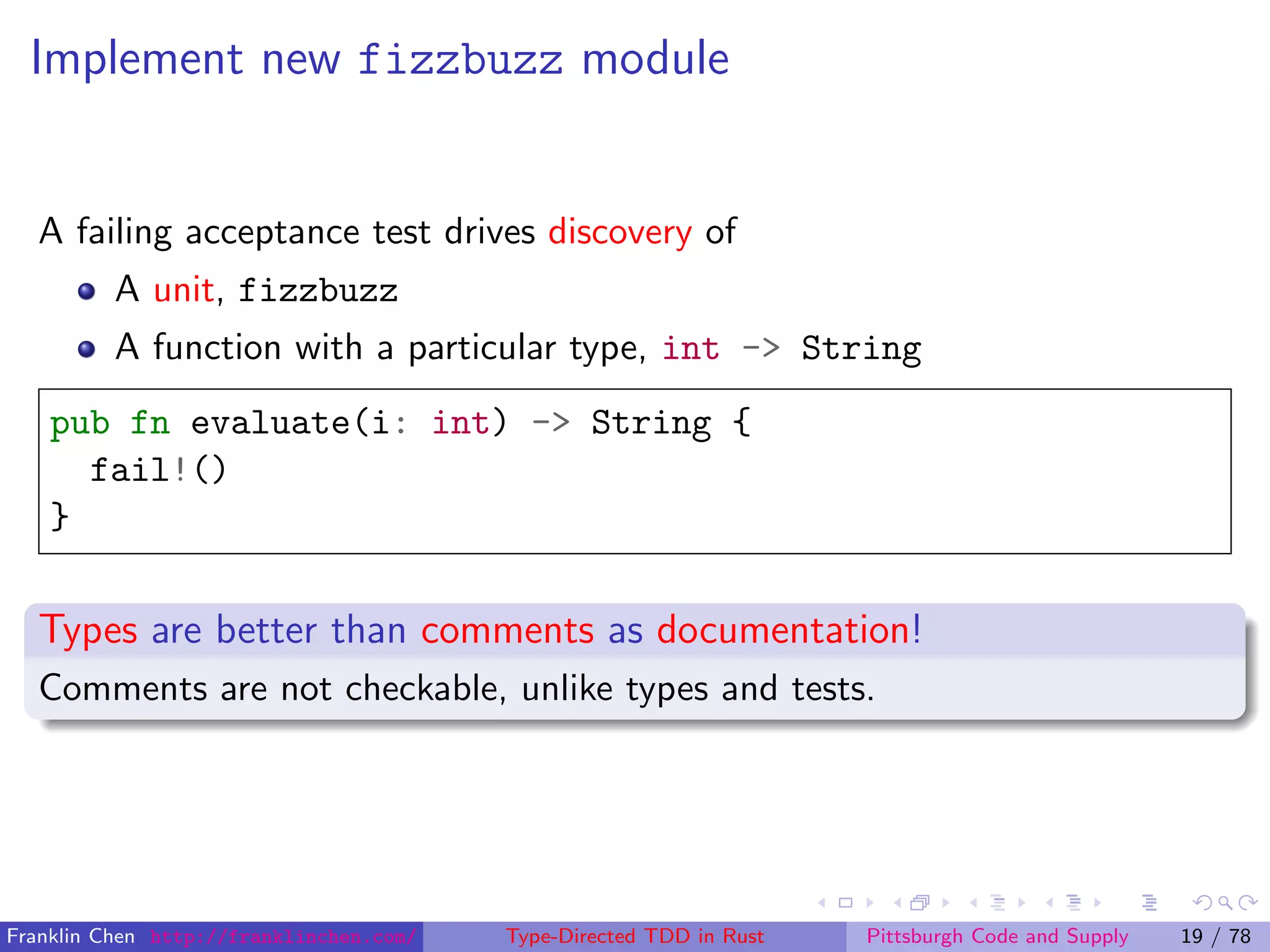
Implement new fizzbuzz module
A failing acceptance test drives discovery of
A unit, fizzbuzz
A function with a particular type, int -> String
pub fn evaluate(i: int) -> String {
fail!()
}
Types are better than comments as documentation!
Comments are not checkable, unlike types and tests.
Franklin Chen http://franklinchen.com/ Type-Directed TDD in Rust Pittsburgh Code and Supply 19 / 78
First part of unit test: example-based
Manually write some examples.
#[test] fn test_15() {
assert_eq!(evaluate(15), "FizzBuzz".to_string())
}
#[test] fn test_20() {
assert_eq!(evaluate(20), "Buzz".to_string())
}
#[test] fn test_6() {
assert_eq!(evaluate(6), "Fizz".to_string())
}
#[test] fn test_17() {
assert_eq!(evaluate(17), "17".to_string())
}
Franklin Chen http://franklinchen.com/ Type-Directed TDD in Rust Pittsburgh Code and Supply 20 / 78
The joy of property-based tests
QuickCheck for Rust: a framework for writing property-based tests.
#[quickcheck]
fn multiple_of_both_3_and_5(i: int) -> TestResult {
if i % 3 == 0 && i % 5 == 0 {
TestResult::from_bool(evaluate(i) ==
"FizzBuzz".to_string())
} else {
TestResult::discard()
}
}
Winning features
Auto-generates random tests for each property (100 by default).
Type-driven: here, generates random int values.
Franklin Chen http://franklinchen.com/ Type-Directed TDD in Rust Pittsburgh Code and Supply 21 / 78
Property-based tests (continued)
#[quickcheck]
fn multiple_of_only_3(i: int) -> TestResult {
if i % 3 == 0 && i % 5 != 0 {
TestResult::from_bool(evaluate(i) == "Fizz".to_string())
} else {
TestResult::discard()
}
}
#[quickcheck]
fn not_multiple_of_3_and_5(i: int) -> TestResult {
if i % 3 != 0 && i % 5 != 0 {
TestResult::from_bool(evaluate(i) == i.to_string())
} else {
TestResult::discard()
}
}
Franklin Chen http://franklinchen.com/ Type-Directed TDD in Rust Pittsburgh Code and Supply 23 / 78
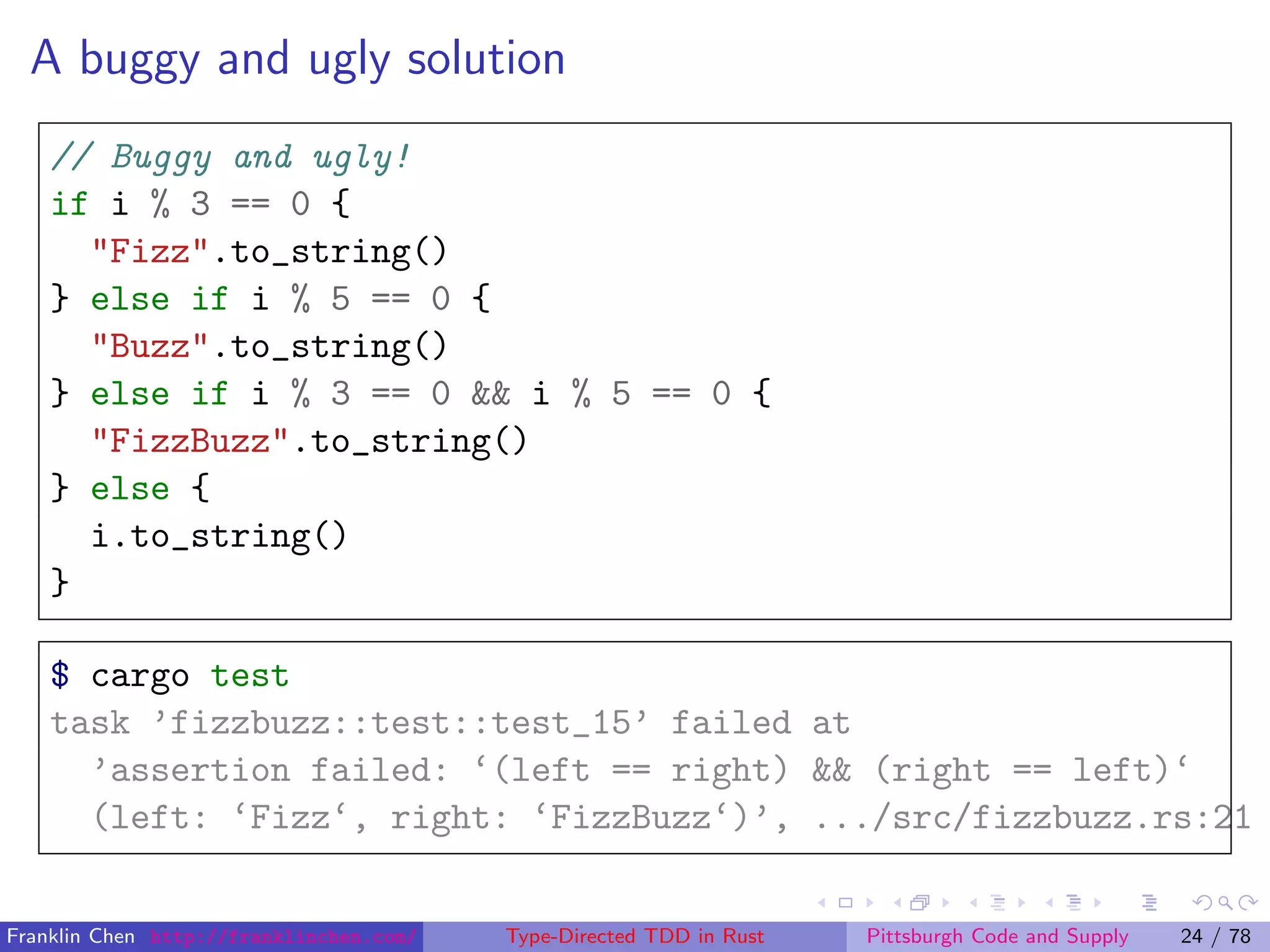
A buggy and ugly solution
// Buggy and ugly!
if i % 3 == 0 {
"Fizz".to_string()
} else if i % 5 == 0 {
"Buzz".to_string()
} else if i % 3 == 0 && i % 5 == 0 {
"FizzBuzz".to_string()
} else {
i.to_string()
}
$ cargo test
task ’fizzbuzz::test::test_15’ failed at
’assertion failed: ‘(left == right) && (right == left)‘
(left: ‘Fizz‘, right: ‘FizzBuzz‘)’, .../src/fizzbuzz.rs:21
Franklin Chen http://franklinchen.com/ Type-Directed TDD in Rust Pittsburgh Code and Supply 24 / 78
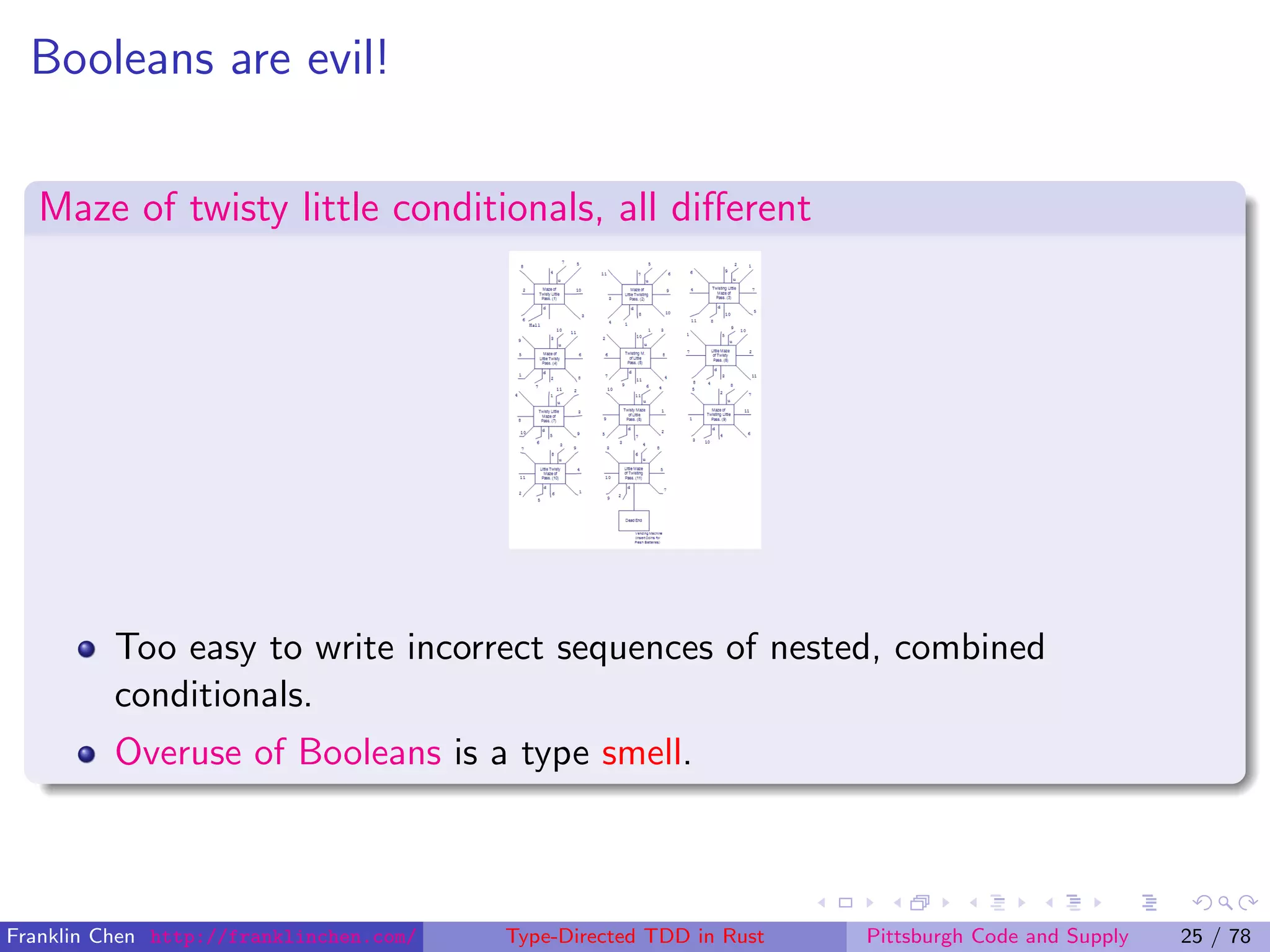
Booleans are evil!
Maze of twisty little conditionals, all different
Too easy to write incorrect sequences of nested, combined
conditionals.
Overuse of Booleans is a type smell.
Franklin Chen http://franklinchen.com/ Type-Directed TDD in Rust Pittsburgh Code and Supply 25 / 78
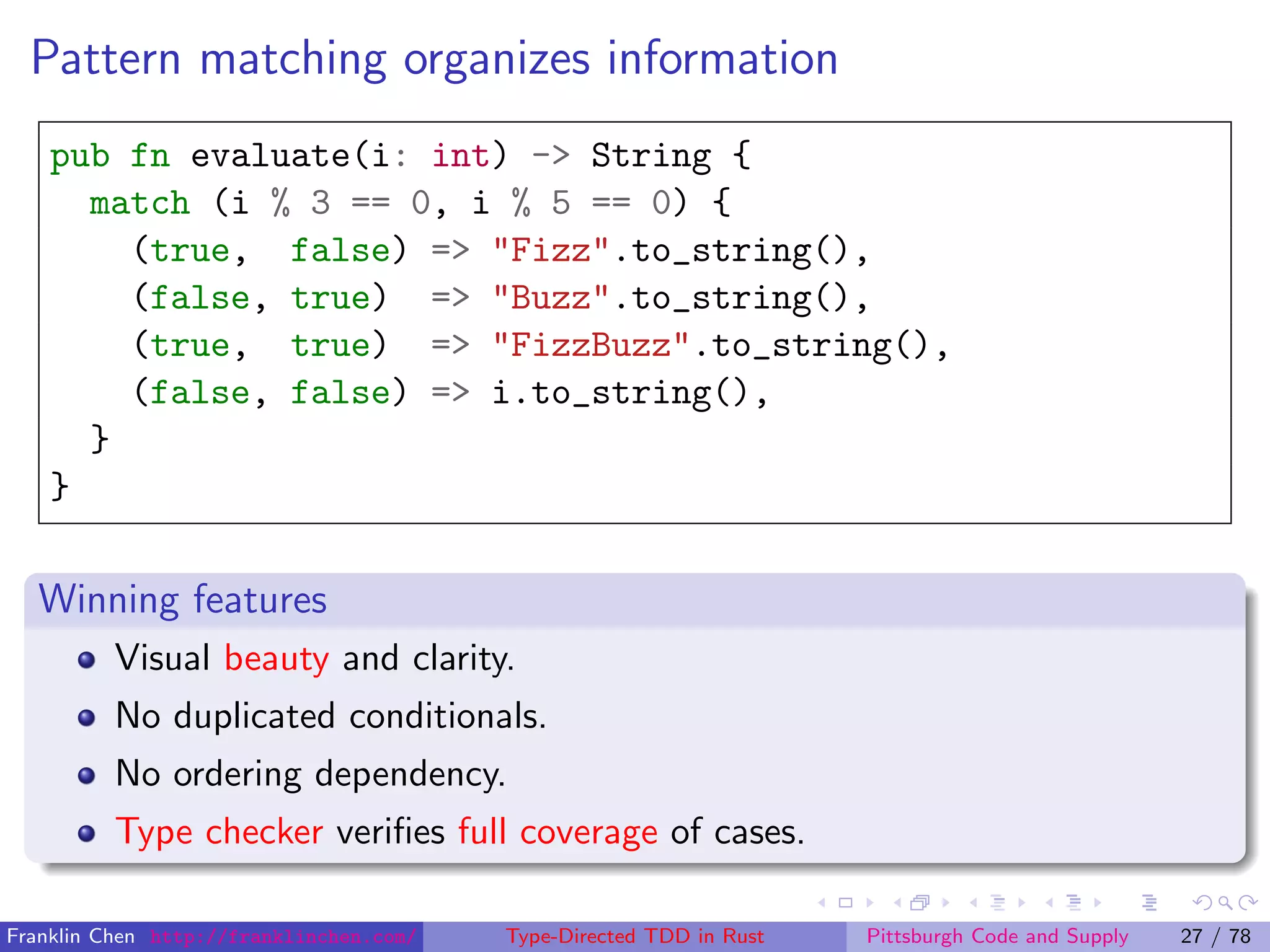
Pattern matching organizes information
pub fn evaluate(i: int) -> String {
match (i % 3 == 0, i % 5 == 0) {
(true, false) => "Fizz".to_string(),
(false, true) => "Buzz".to_string(),
(true, true) => "FizzBuzz".to_string(),
(false, false) => i.to_string(),
}
}
Winning features
Visual beauty and clarity.
No duplicated conditionals.
No ordering dependency.
Type checker verifies full coverage of cases.
Franklin Chen http://franklinchen.com/ Type-Directed TDD in Rust Pittsburgh Code and Supply 27 / 78
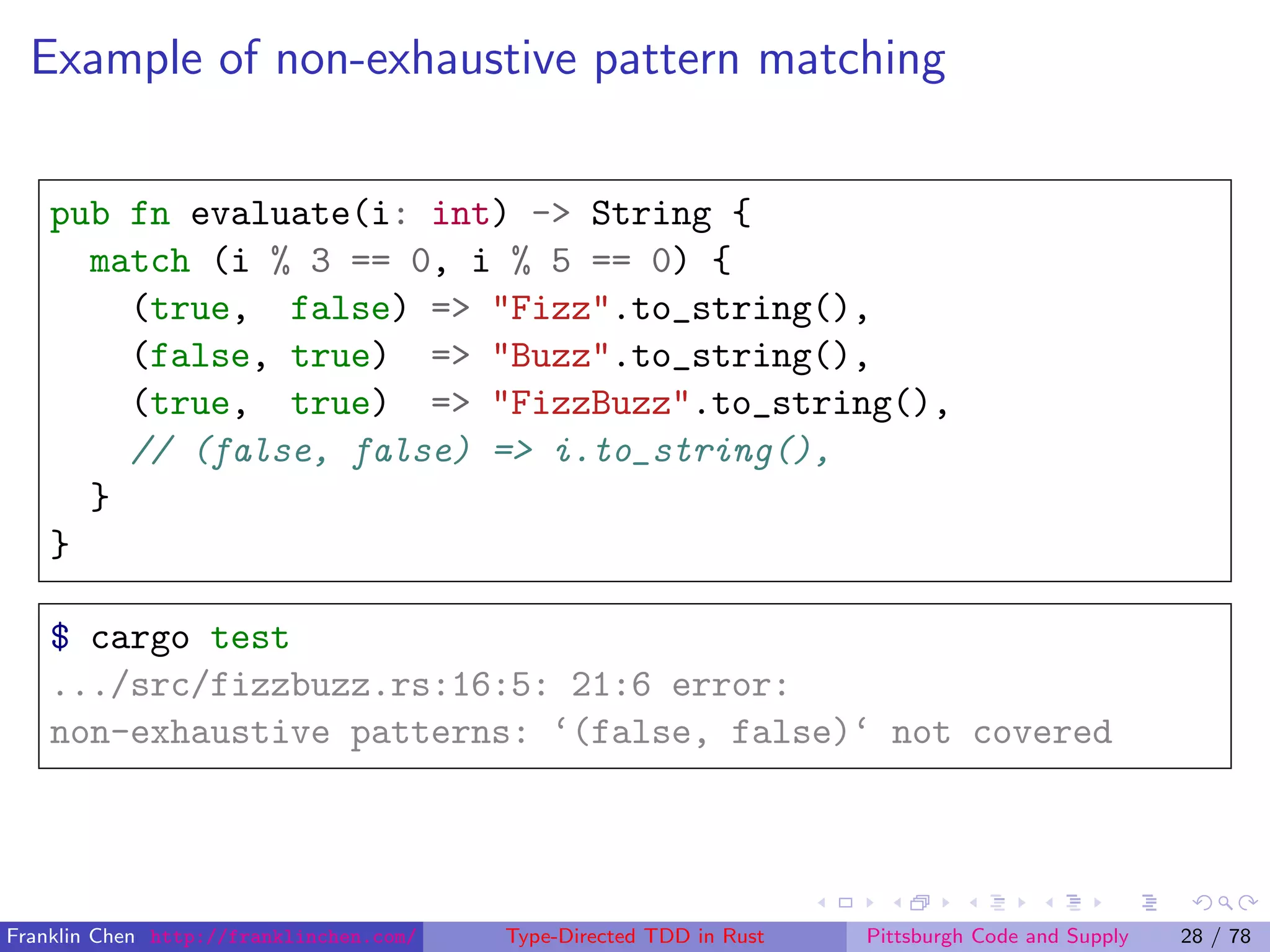
Example of non-exhaustive pattern matching
pub fn evaluate(i: int) -> String {
match (i % 3 == 0, i % 5 == 0) {
(true, false) => "Fizz".to_string(),
(false, true) => "Buzz".to_string(),
(true, true) => "FizzBuzz".to_string(),
// (false, false) => i.to_string(),
}
}
$ cargo test
.../src/fizzbuzz.rs:16:5: 21:6 error:
non-exhaustive patterns: ‘(false, false)‘ not covered
Franklin Chen http://franklinchen.com/ Type-Directed TDD in Rust Pittsburgh Code and Supply 28 / 78
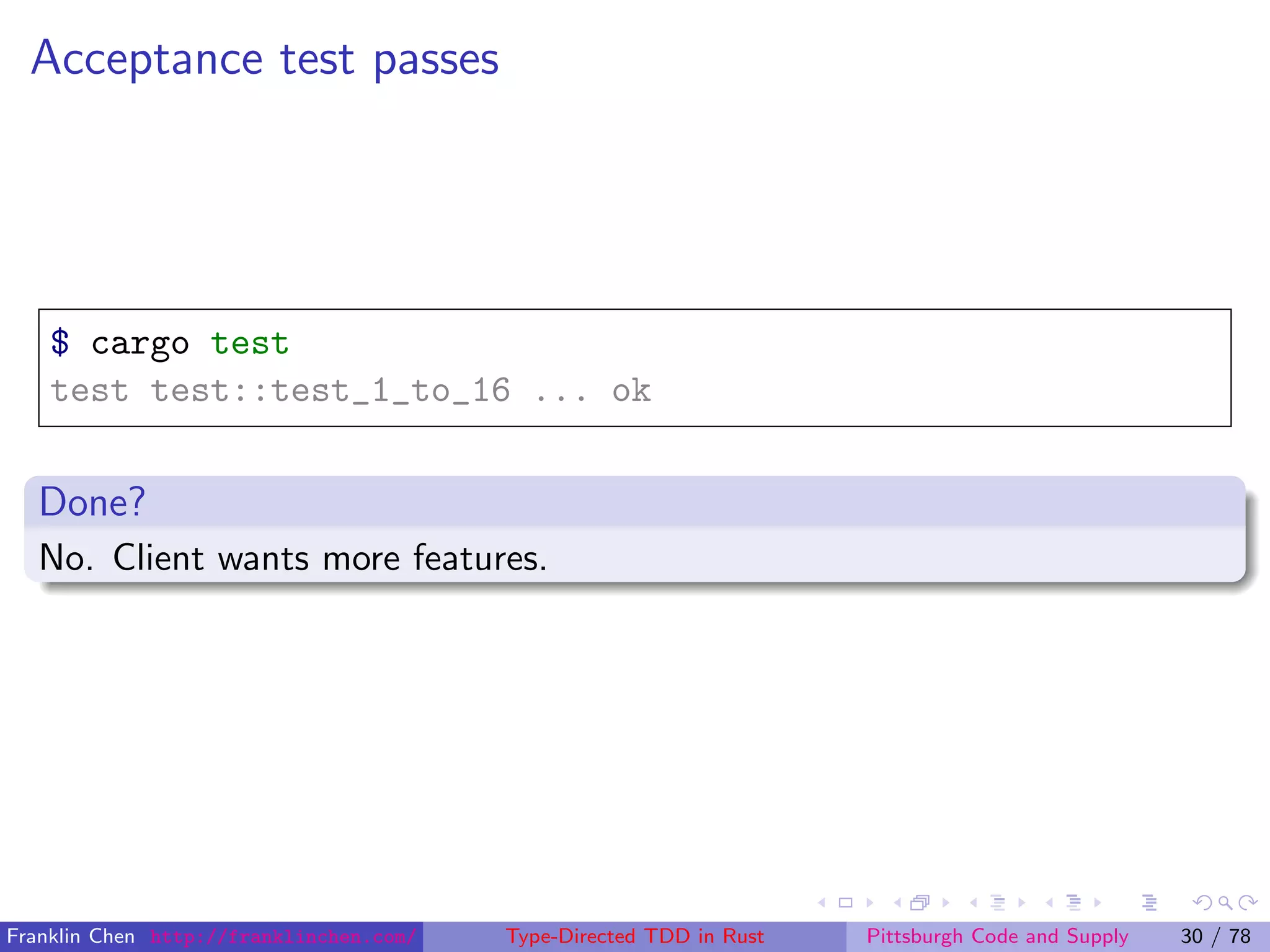
Acceptance test passes
$ cargo test
test test::test_1_to_16 ... ok
Done?
No. Client wants more features.
Franklin Chen http://franklinchen.com/ Type-Directed TDD in Rust Pittsburgh Code and Supply 30 / 78
Outline
1 Introduction
2 Original FizzBuzz problem
3 FizzBuzz 2: user configuration
4 FizzBuzz 3: FizzBuzzPop and beyond
5 Parallel FizzBuzz
6 Conclusion
Franklin Chen http://franklinchen.com/ Type-Directed TDD in Rust Pittsburgh Code and Supply 31 / 78
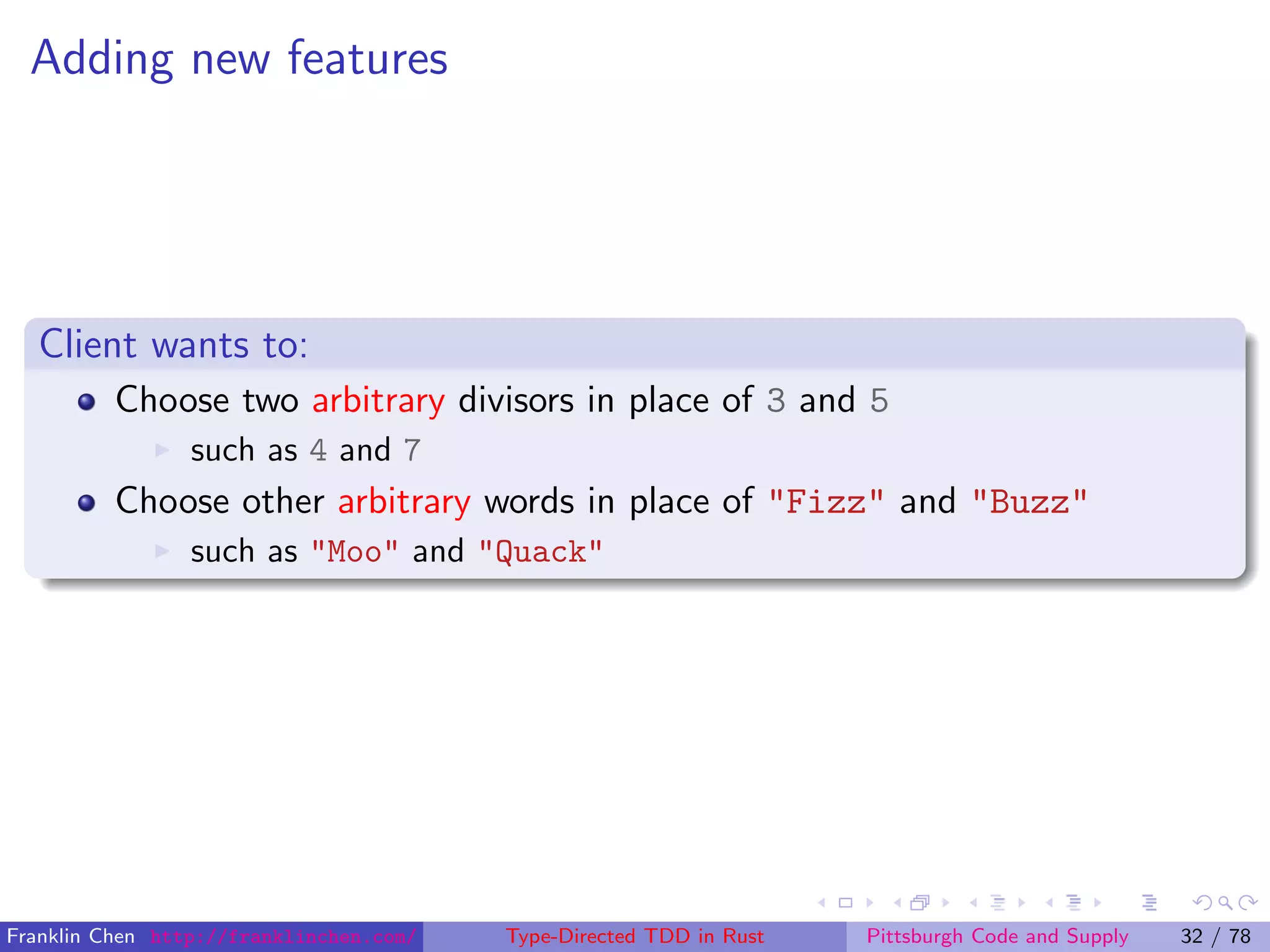
Adding new features
Client wants to:
Choose two arbitrary divisors in place of 3 and 5
such as 4 and 7
Choose other arbitrary words in place of "Fizz" and "Buzz"
such as "Moo" and "Quack"
Franklin Chen http://franklinchen.com/ Type-Directed TDD in Rust Pittsburgh Code and Supply 32 / 78
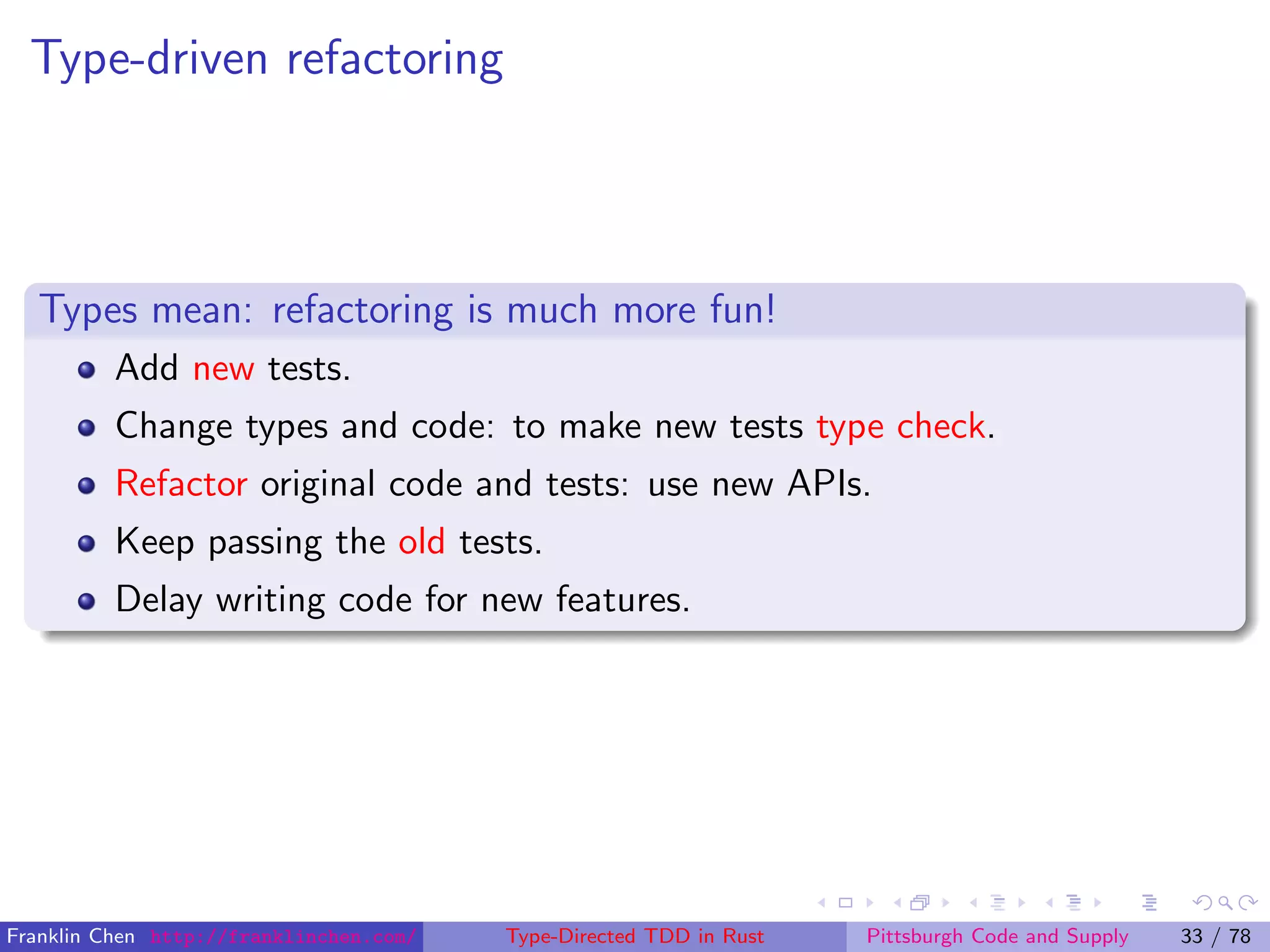
Type-driven refactoring
Types mean: refactoring is much more fun!
Add new tests.
Change types and code: to make new tests type check.
Refactor original code and tests: use new APIs.
Keep passing the old tests.
Delay writing code for new features.
Franklin Chen http://franklinchen.com/ Type-Directed TDD in Rust Pittsburgh Code and Supply 33 / 78
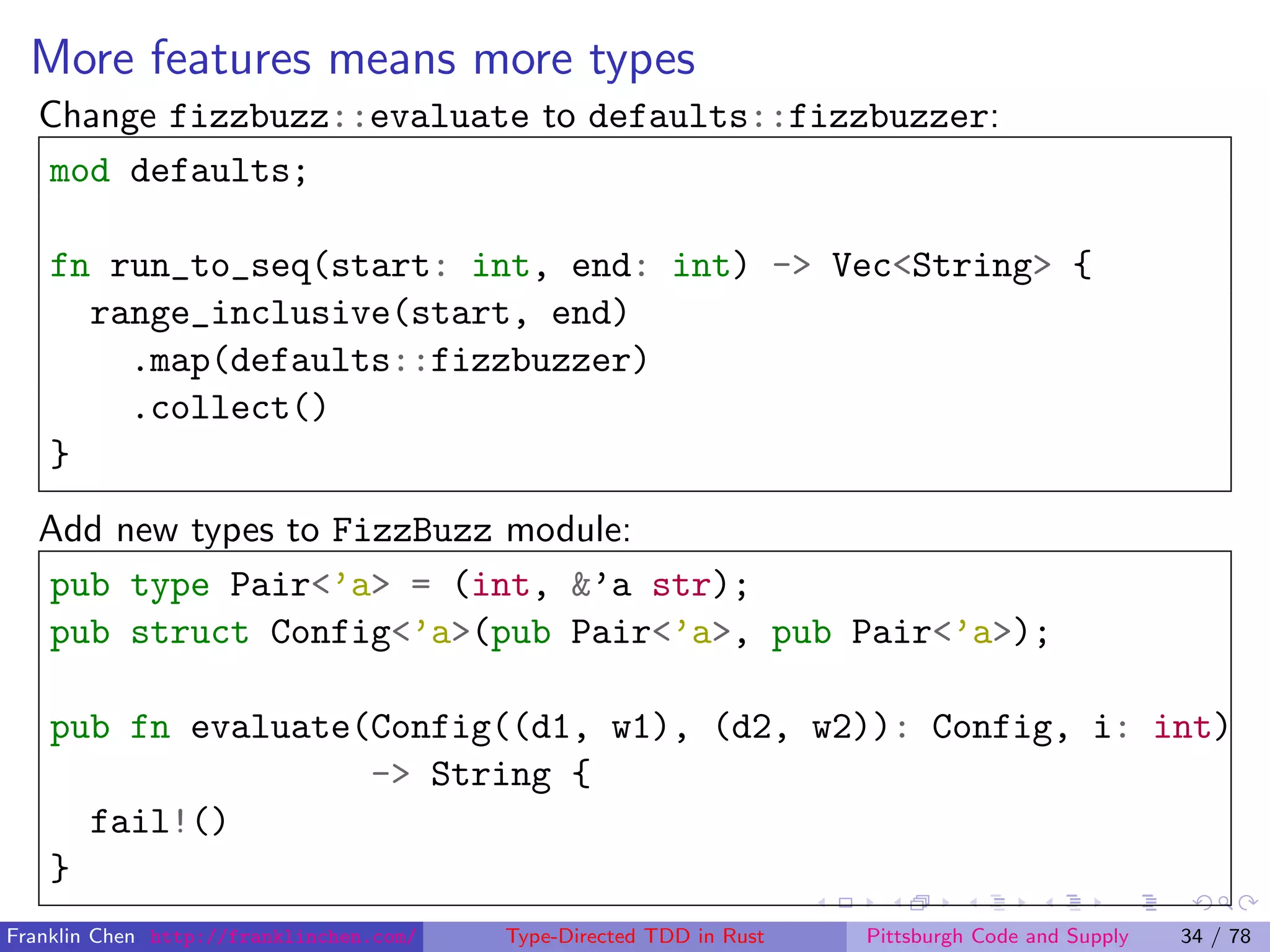
More features means more types
Change fizzbuzz::evaluate to defaults::fizzbuzzer:
mod defaults;
fn run_to_seq(start: int, end: int) -> Vec<String> {
range_inclusive(start, end)
.map(defaults::fizzbuzzer)
.collect()
}
Add new types to FizzBuzz module:
pub type Pair<’a> = (int, &’a str);
pub struct Config<’a>(pub Pair<’a>, pub Pair<’a>);
pub fn evaluate(Config((d1, w1), (d2, w2)): Config, i: int)
-> String {
fail!()
}
Franklin Chen http://franklinchen.com/ Type-Directed TDD in Rust Pittsburgh Code and Supply 34 / 78
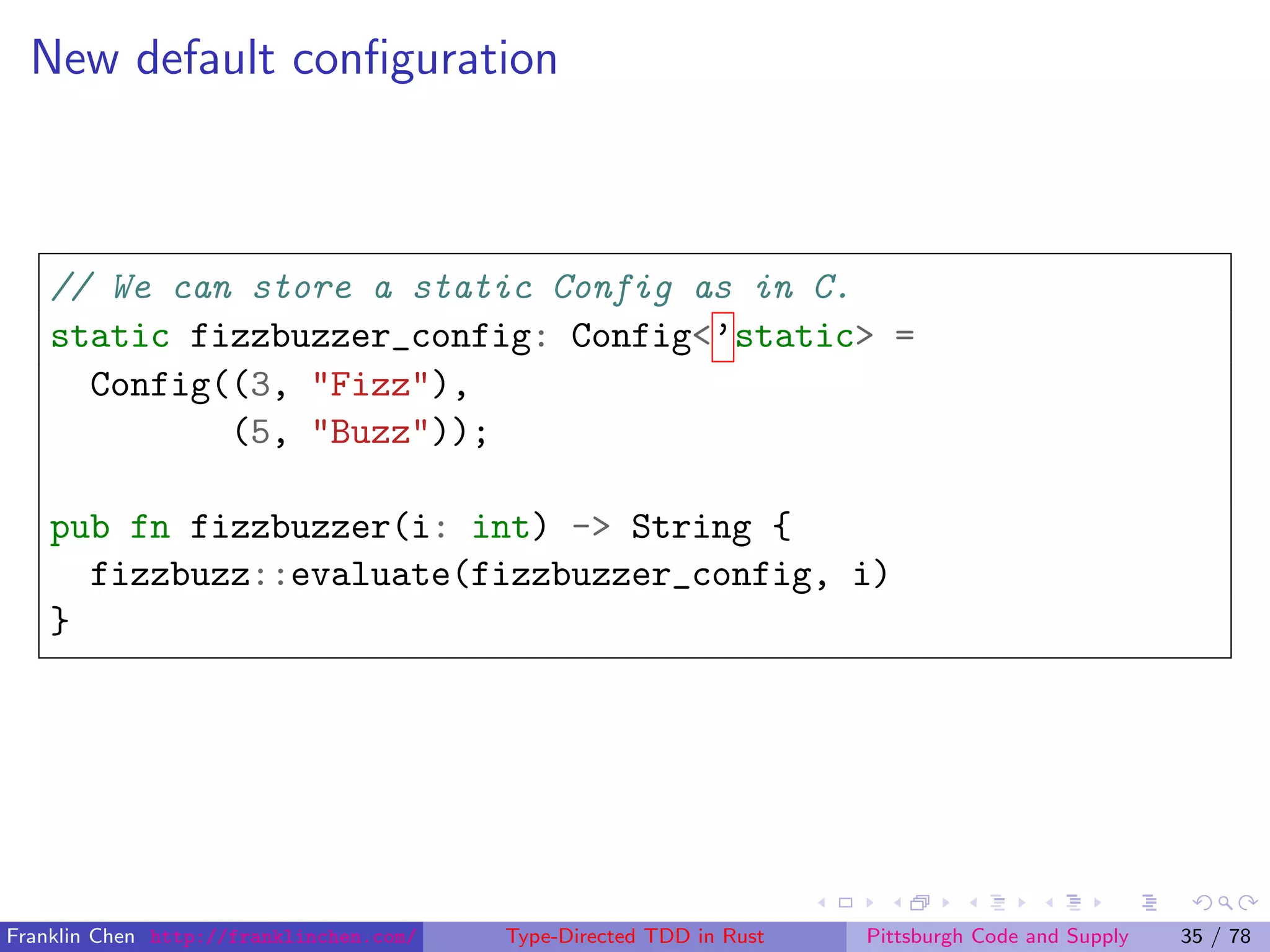
New default configuration
// We can store a static Config as in C.
static fizzbuzzer_config: Config<’static> =
Config((3, "Fizz"),
(5, "Buzz"));
pub fn fizzbuzzer(i: int) -> String {
fizzbuzz::evaluate(fizzbuzzer_config, i)
}
Franklin Chen http://franklinchen.com/ Type-Directed TDD in Rust Pittsburgh Code and Supply 35 / 78
More types means more tests
Write new property-based test over arbitrary user configurations:
#[quickcheck]
fn d1_but_not_d2((d1, w1): (int, String),
(d2, w2): (int, String),
i: int) -> TestResult {
let config = Config((d1, w1.as_slice()),
(d2, w2.as_slice()));
if i % d1 == 0 && i % d2 != 0 {
TestResult::from_bool(fizzbuzzer(i) == w1)
} else {
TestResult::discard()
}
}
Franklin Chen http://franklinchen.com/ Type-Directed TDD in Rust Pittsburgh Code and Supply 36 / 78
Problem: coarse Config type
$ cargo test
task ’fizzbuzz::test::d1_but_not_d2’ failed at
’[quickcheck] TEST FAILED (runtime error).
Arguments: ((0, ), (0, ), 0)’
0 as a divisor crashes!
We discovered client’s underspecification.
Client says: meant to allow only divisors within 2 and 100.
We need to:
Add runtime validation when constructing Config.
Refine Config random generator.
Franklin Chen http://franklinchen.com/ Type-Directed TDD in Rust Pittsburgh Code and Supply 37 / 78
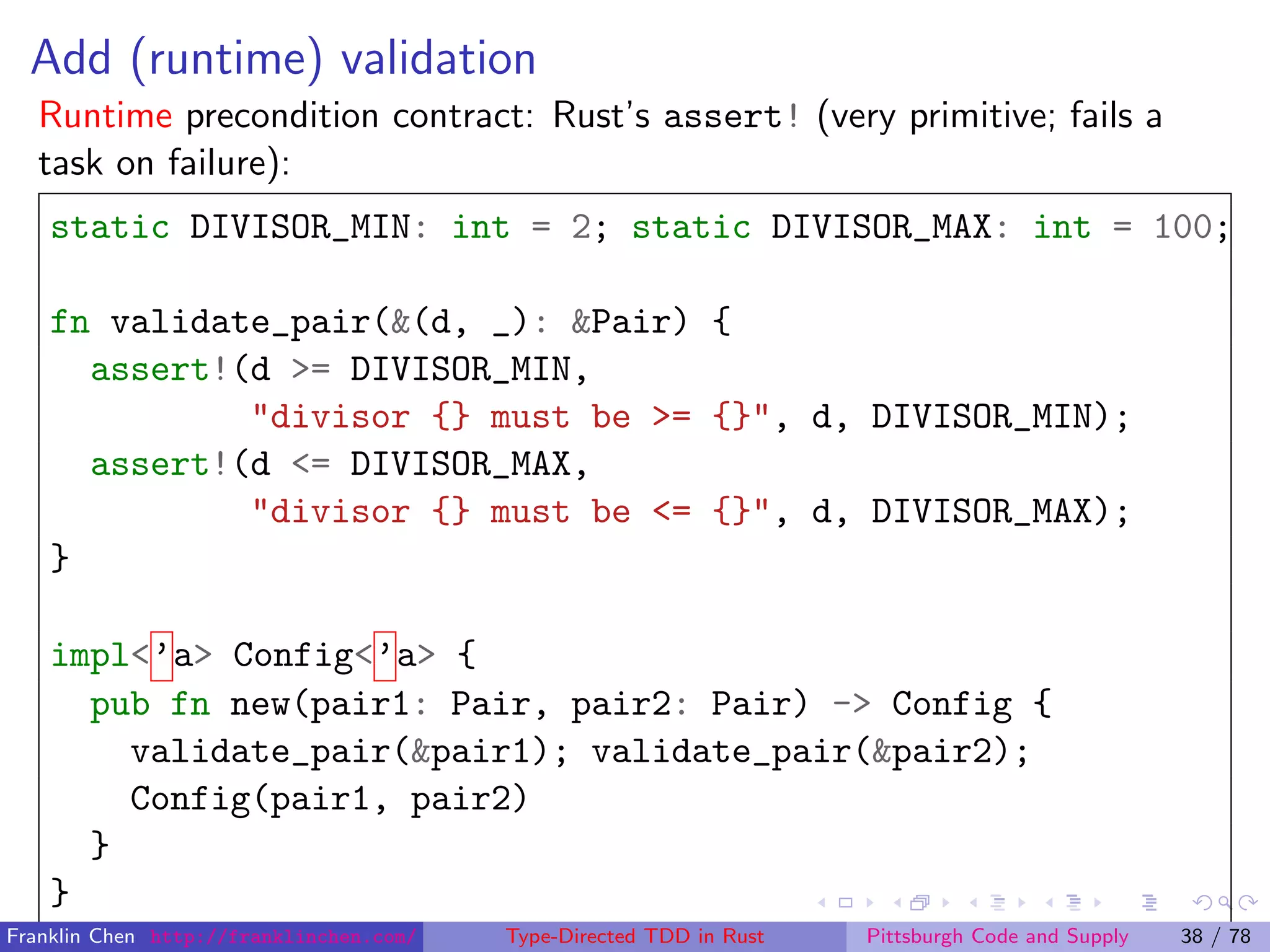
Add (runtime) validation
Runtime precondition contract: Rust’s assert! (very primitive; fails a
task on failure):
static DIVISOR_MIN: int = 2; static DIVISOR_MAX: int = 100;
fn validate_pair(&(d, _): &Pair) {
assert!(d >= DIVISOR_MIN,
"divisor {} must be >= {}", d, DIVISOR_MIN);
assert!(d <= DIVISOR_MAX,
"divisor {} must be <= {}", d, DIVISOR_MAX);
}
impl<’a> Config<’a> {
pub fn new(pair1: Pair, pair2: Pair) -> Config {
validate_pair(&pair1); validate_pair(&pair2);
Config(pair1, pair2)
}
}
Franklin Chen http://franklinchen.com/ Type-Directed TDD in Rust Pittsburgh Code and Supply 38 / 78
A note on error handling
Rust does not have exceptions!
Exceptions are evil because they escape the type system.
Rust task failures are brutal.
Outside scope of this presentation: principled type-based error
handling using Result<T, E>:
Franklin Chen http://franklinchen.com/ Type-Directed TDD in Rust Pittsburgh Code and Supply 39 / 78
Some changes to defaults setup
// Cannot be static variable because of runtime
// validation and also use of Vector.
fn fizzbuzzer_config<’a>() -> Config<’a> {
Config::new(vec![(3, "Fizz"),
(5, "Buzz")])
}
pub fn fizzbuzzer(i: int) -> String {
fizzbuzz::evaluate(fizzbuzzer_config(), i)
}
Franklin Chen http://franklinchen.com/ Type-Directed TDD in Rust Pittsburgh Code and Supply 41 / 78
Improve Config random generator
#[quickcheck]
fn d1_but_not_d2((d1, w1): (int, String),
(d2, w2): (int, String),
i: int) -> TestResult {
if (d1 >= DIVISOR_MIN && d1 <= DIVISOR_MAX)
&& (d2 >= DIVISOR_MIN && d2 <= DIVISOR_MAX) {
let config = Config::new(vec![(d1, w1.as_slice()),
(d2, w2.as_slice())]);
if i % d1 == 0 && i % d2 != 0 {
TestResult::from_bool(evaluate(config, i) == w1)
} else { TestResult::discard() }
}
Franklin Chen http://franklinchen.com/ Type-Directed TDD in Rust Pittsburgh Code and Supply 42 / 78
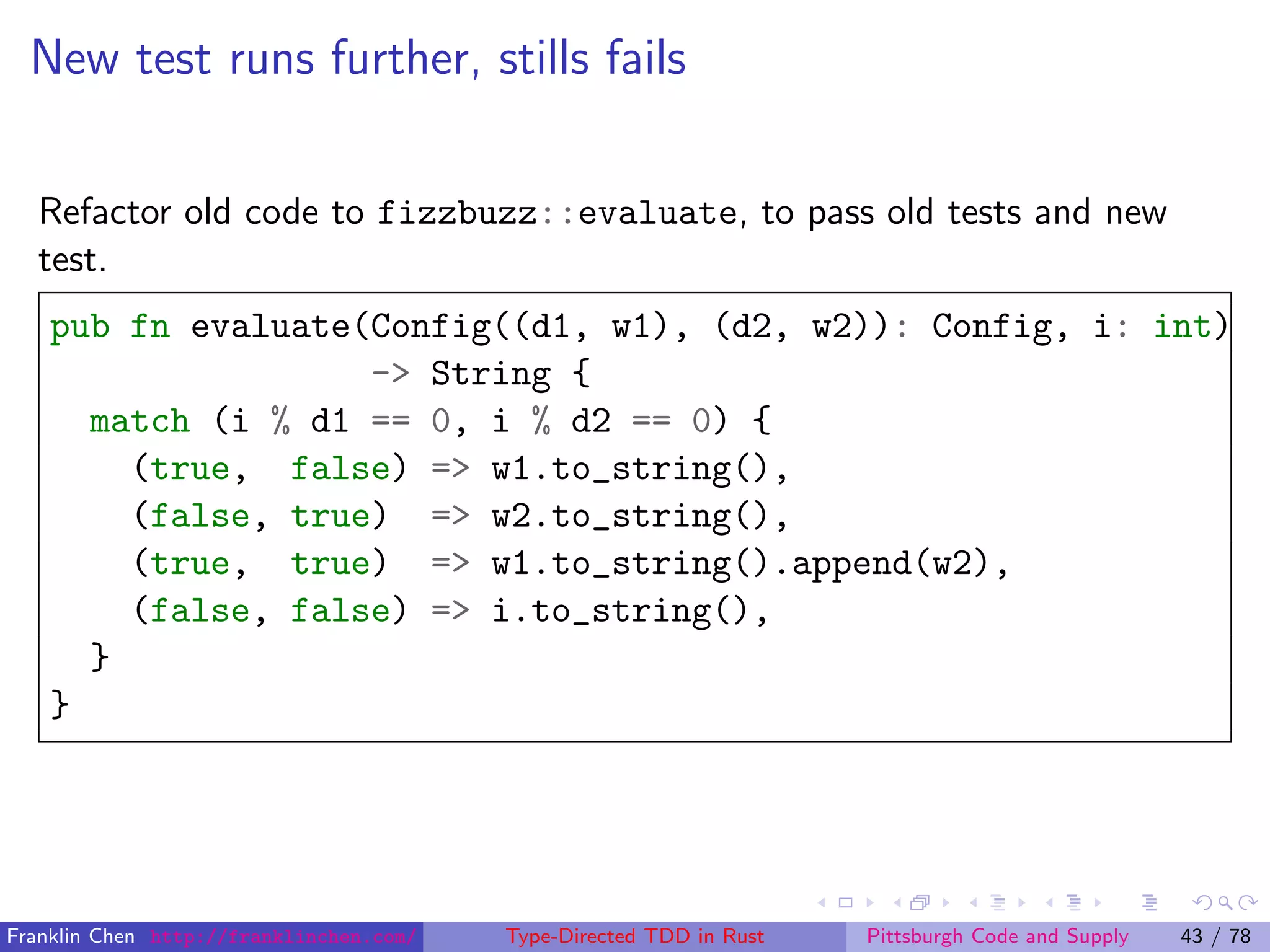
New test runs further, stills fails
Refactor old code to fizzbuzz::evaluate, to pass old tests and new
test.
pub fn evaluate(Config((d1, w1), (d2, w2)): Config, i: int)
-> String {
match (i % d1 == 0, i % d2 == 0) {
(true, false) => w1.to_string(),
(false, true) => w2.to_string(),
(true, true) => w1.to_string().append(w2),
(false, false) => i.to_string(),
}
}
Franklin Chen http://franklinchen.com/ Type-Directed TDD in Rust Pittsburgh Code and Supply 43 / 78
Outline
1 Introduction
2 Original FizzBuzz problem
3 FizzBuzz 2: user configuration
4 FizzBuzz 3: FizzBuzzPop and beyond
5 Parallel FizzBuzz
6 Conclusion
Franklin Chen http://franklinchen.com/ Type-Directed TDD in Rust Pittsburgh Code and Supply 44 / 78
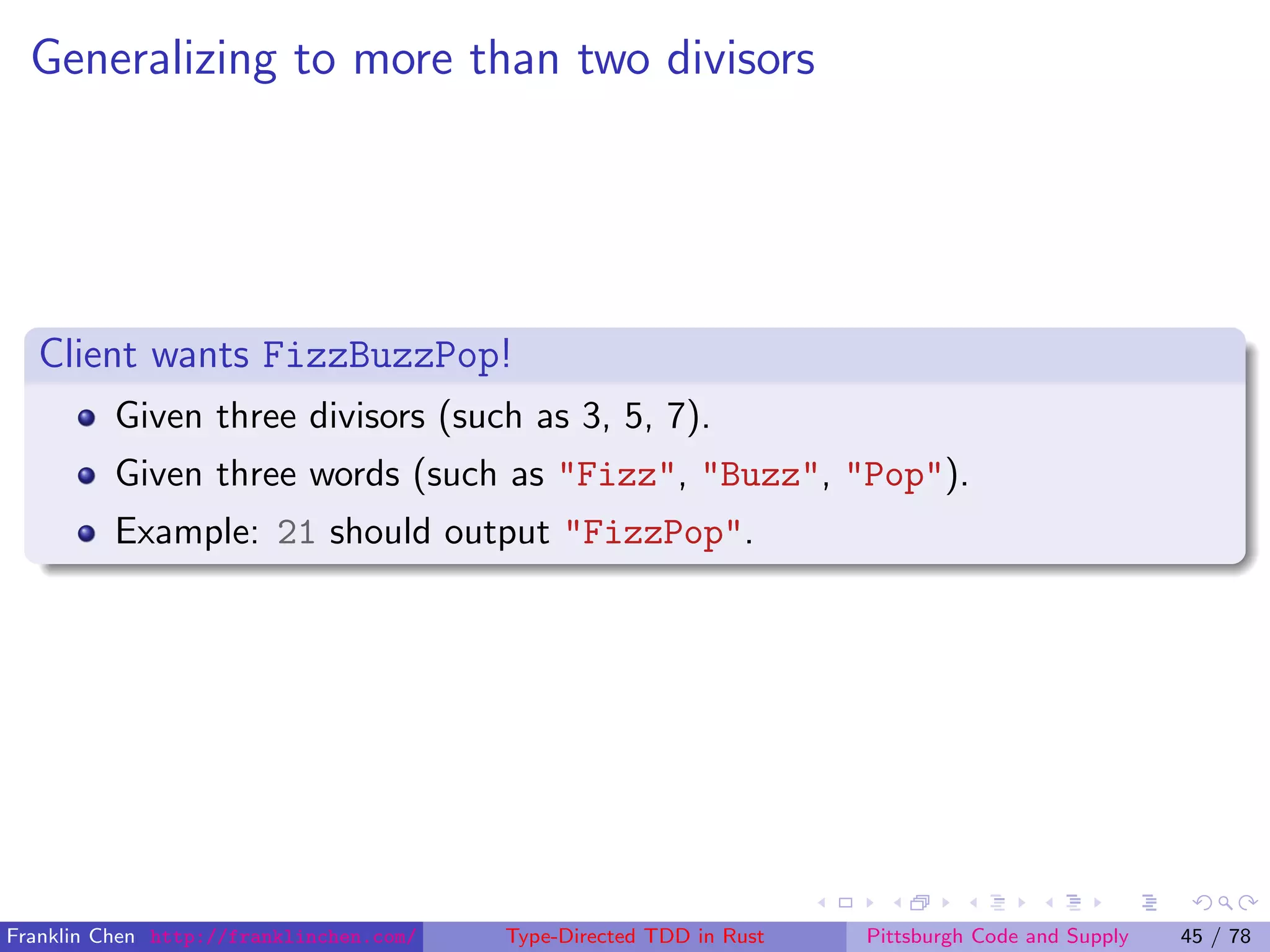
Generalizing to more than two divisors
Client wants FizzBuzzPop!
Given three divisors (such as 3, 5, 7).
Given three words (such as "Fizz", "Buzz", "Pop").
Example: 21 should output "FizzPop".
Franklin Chen http://franklinchen.com/ Type-Directed TDD in Rust Pittsburgh Code and Supply 45 / 78
More features means more tests
Write new tests for new defaults::fizzbuzzpopper:
#[test] fn test_fizzbuzzpopper_2() {
assert_eq!(fizzbuzzpopper(2), "2".to_string())
}
#[test] fn test_fizzbuzzpopper_21() {
assert_eq!(fizzbuzzpopper(21), "FizzPop".to_string())
}
#[test] fn test_fizzbuzzpopper_9() {
assert_eq!(fizzbuzzpopper(9), "Fizz".to_string())
}
#[test] fn test_fizzbuzzpopper_7() {
assert_eq!(fizzbuzzpopper(7), "Pop".to_string())
}
#[test] fn test_fizzbuzzpopper_35() {
assert_eq!(fizzbuzzpopper(35), "BuzzPop".to_string())
}
Change configuration: to Seq of pairs, instead of just two:Franklin Chen http://franklinchen.com/ Type-Directed TDD in Rust Pittsburgh Code and Supply 47 / 78
More tests means more (or changed) types
error: this function takes 2 parameters
but 1 parameter was supplied
Config::new(vec![(3, "Fizz"),
(5, "Buzz")])
Change type Config to allow a sequence of pairs:
pub struct Config(pub Vec<Pair>);
impl<’a> Config<’a> {
pub fn new(pairs: Vec<Pair>) -> Config {
for pair in pairs.iter() {
validate_pair(pair);
}
Config(pairs)
}
}
Franklin Chen http://franklinchen.com/ Type-Directed TDD in Rust Pittsburgh Code and Supply 48 / 78
Fix remaining type errors
Refactoring reveals need to implement case of more than two divisors.
pub fn evaluate(Config(pairs): Config, i: int)
-> String {
// Can crash! And incorrect except for 2 pairs.
let (d1, w1) = pairs[0];
let (d2, w2) = pairs[1];
match (i % d1 == 0, i % d2 == 0) {
(true, false) => w1.to_string(),
(false, true) => w2.to_string(),
(true, true) => w1.to_string().append(w2),
(false, false) => i.to_string(),
}
}
Franklin Chen http://franklinchen.com/ Type-Directed TDD in Rust Pittsburgh Code and Supply 49 / 78
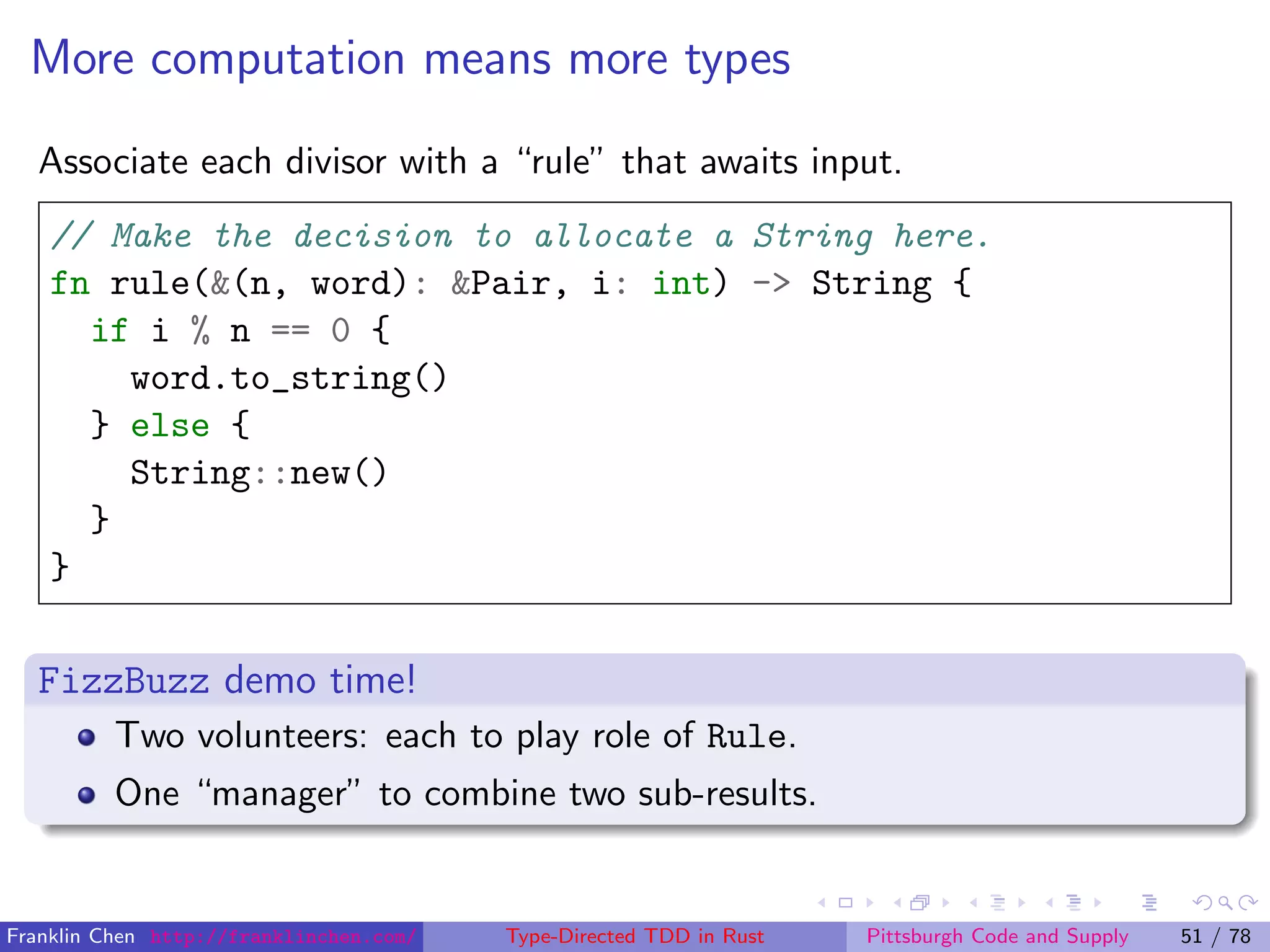
More computation means more types
Associate each divisor with a “rule” that awaits input.
// Make the decision to allocate a String here.
fn rule(&(n, word): &Pair, i: int) -> String {
if i % n == 0 {
word.to_string()
} else {
String::new()
}
}
FizzBuzz demo time!
Two volunteers: each to play role of Rule.
One “manager” to combine two sub-results.
Franklin Chen http://franklinchen.com/ Type-Directed TDD in Rust Pittsburgh Code and Supply 51 / 78
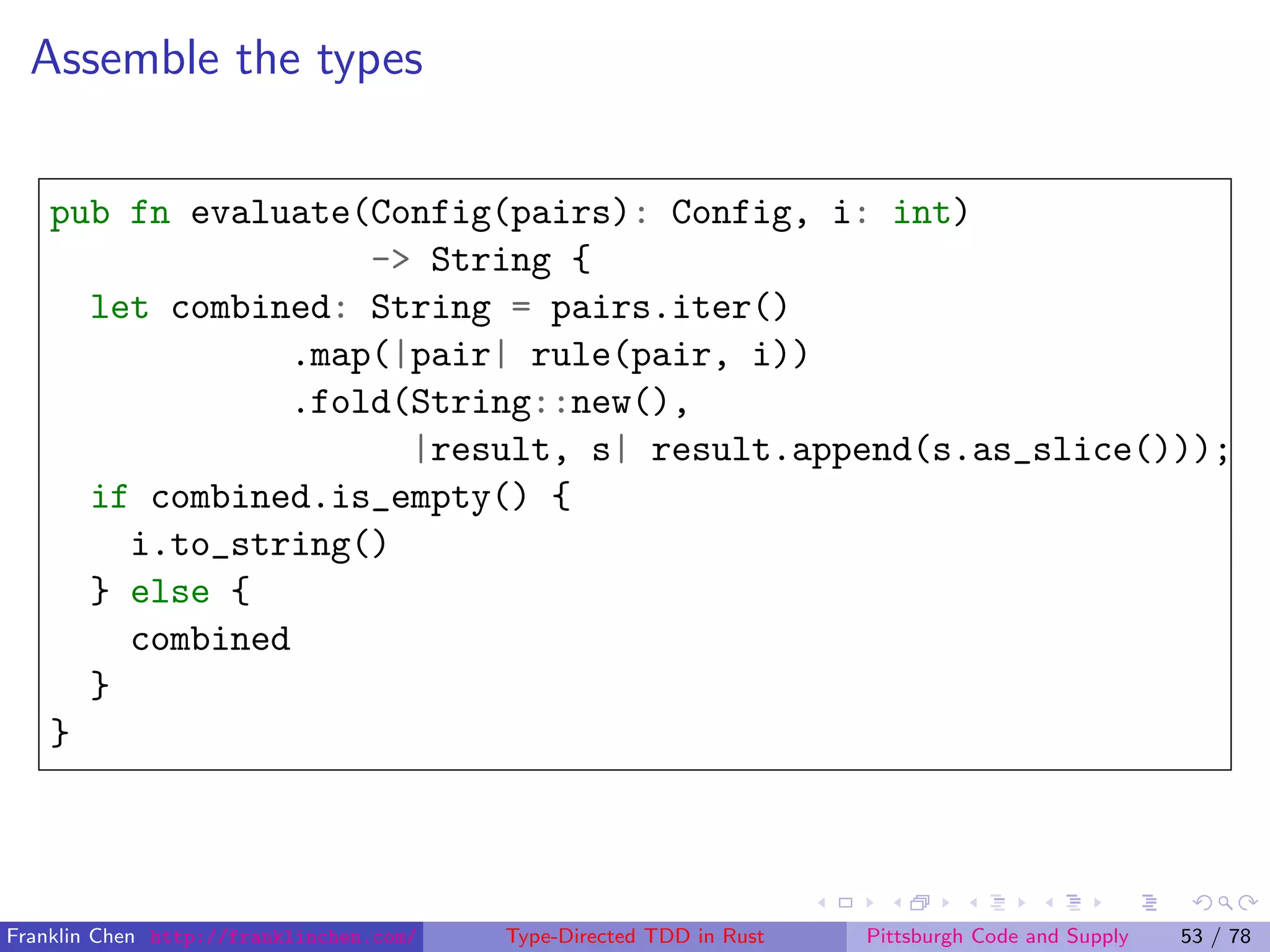
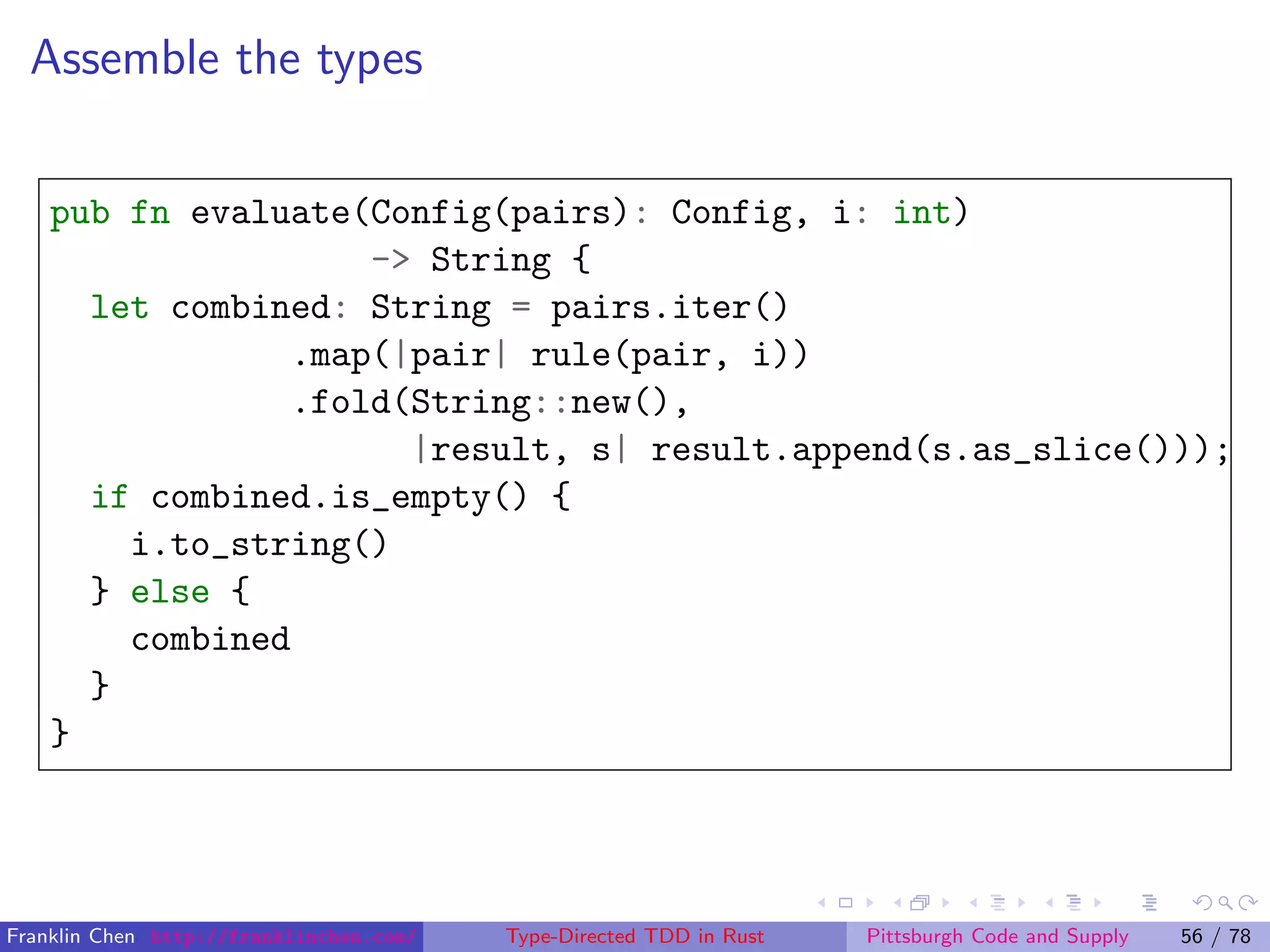
Assemble the types
pub fn evaluate(Config(pairs): Config, i: int)
-> String {
let combined: String = pairs.iter()
.map(|pair| rule(pair, i))
.fold(String::new(),
|result, s| result.append(s.as_slice()));
if combined.is_empty() {
i.to_string()
} else {
combined
}
}
Franklin Chen http://franklinchen.com/ Type-Directed TDD in Rust Pittsburgh Code and Supply 53 / 78
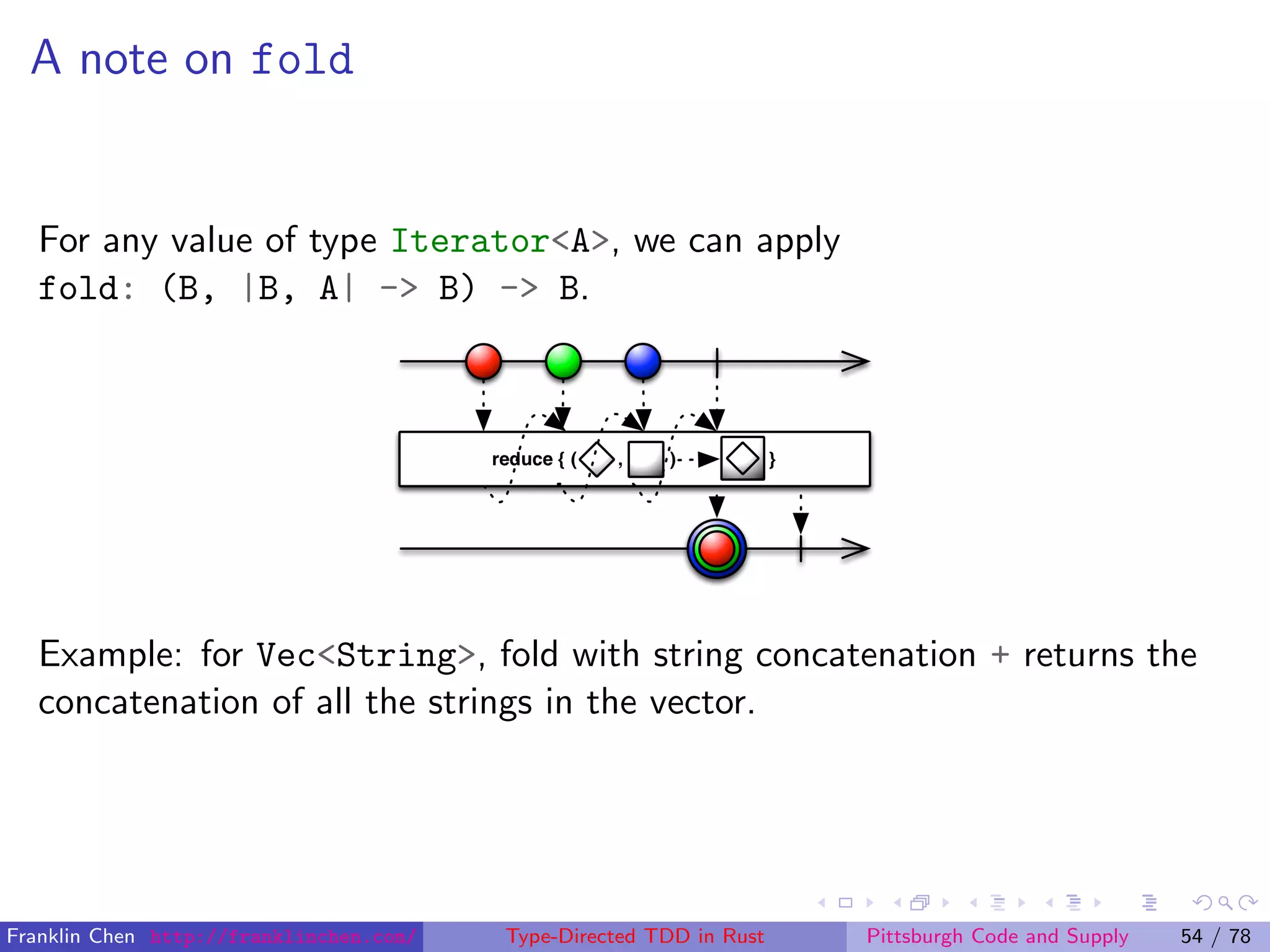
A note on fold
For any value of type Iterator<A>, we can apply
fold: (B, |B, A| -> B) -> B.
Example: for Vec<String>, fold with string concatenation + returns the
concatenation of all the strings in the vector.
Franklin Chen http://franklinchen.com/ Type-Directed TDD in Rust Pittsburgh Code and Supply 54 / 78
Test failure: coarse types again
$ cargo test
task ’fizzbuzz::test::d1_but_not_d2’ failed at
’[quickcheck] TEST FAILED.
Arguments: ((2, ), (3, ), 2)’
Demo time!
Configuration: vec![(3, ""), (5, "Buzz")]
Input: 9 (note: divisible by 2)
Output: should be "" (because of the part divisible by 3)
Output was: "9"
Franklin Chen http://franklinchen.com/ Type-Directed TDD in Rust Pittsburgh Code and Supply 55 / 78
Assemble the types
pub fn evaluate(Config(pairs): Config, i: int)
-> String {
let combined: String = pairs.iter()
.map(|pair| rule(pair, i))
.fold(String::new(),
|result, s| result.append(s.as_slice()));
if combined.is_empty() {
i.to_string()
} else {
combined
}
}
Franklin Chen http://franklinchen.com/ Type-Directed TDD in Rust Pittsburgh Code and Supply 56 / 78
Property-based testing rescued us again!
Be honest: would you have caught this bug manually?
I didn’t.
I never wrote FizzBuzzPop examples testing empty strings.
Property-based testing reveals unexpected corner cases.
(Empty “fizz” and “buzz” word strings).
Franklin Chen http://franklinchen.com/ Type-Directed TDD in Rust Pittsburgh Code and Supply 57 / 78
An empty string is not equivalent to no string
Presence of something “empty” is not equivalent to no thing.
Sending someone an empty email versus not sending any email.
Many programming languages get this wrong.
Franklin Chen http://franklinchen.com/ Type-Directed TDD in Rust Pittsburgh Code and Supply 58 / 78
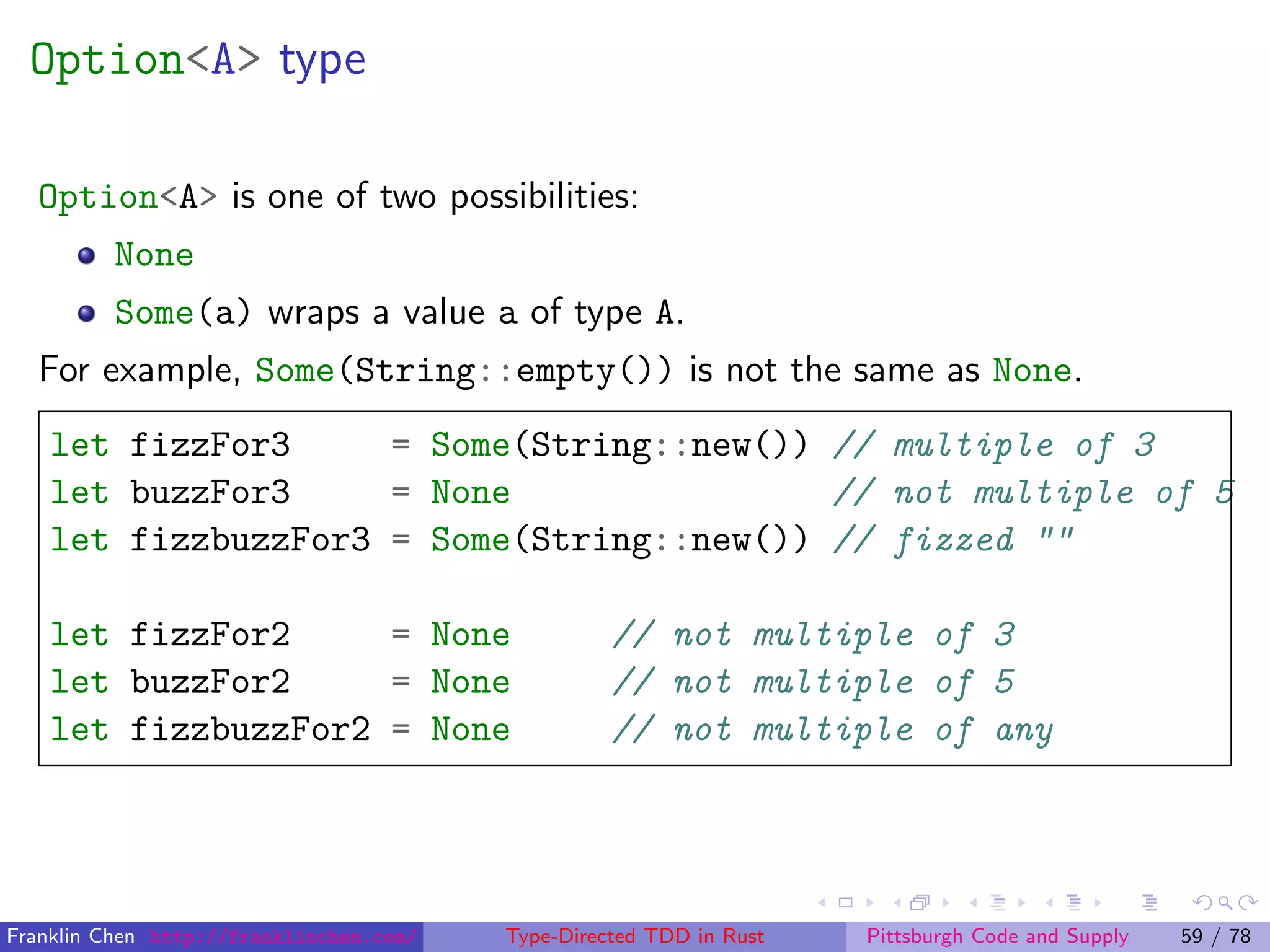
Option<A> type
Option<A> is one of two possibilities:
None
Some(a) wraps a value a of type A.
For example, Some(String::empty()) is not the same as None.
let fizzFor3 = Some(String::new()) // multiple of 3
let buzzFor3 = None // not multiple of 5
let fizzbuzzFor3 = Some(String::new()) // fizzed ""
let fizzFor2 = None // not multiple of 3
let buzzFor2 = None // not multiple of 5
let fizzbuzzFor2 = None // not multiple of any
Franklin Chen http://franklinchen.com/ Type-Directed TDD in Rust Pittsburgh Code and Supply 59 / 78
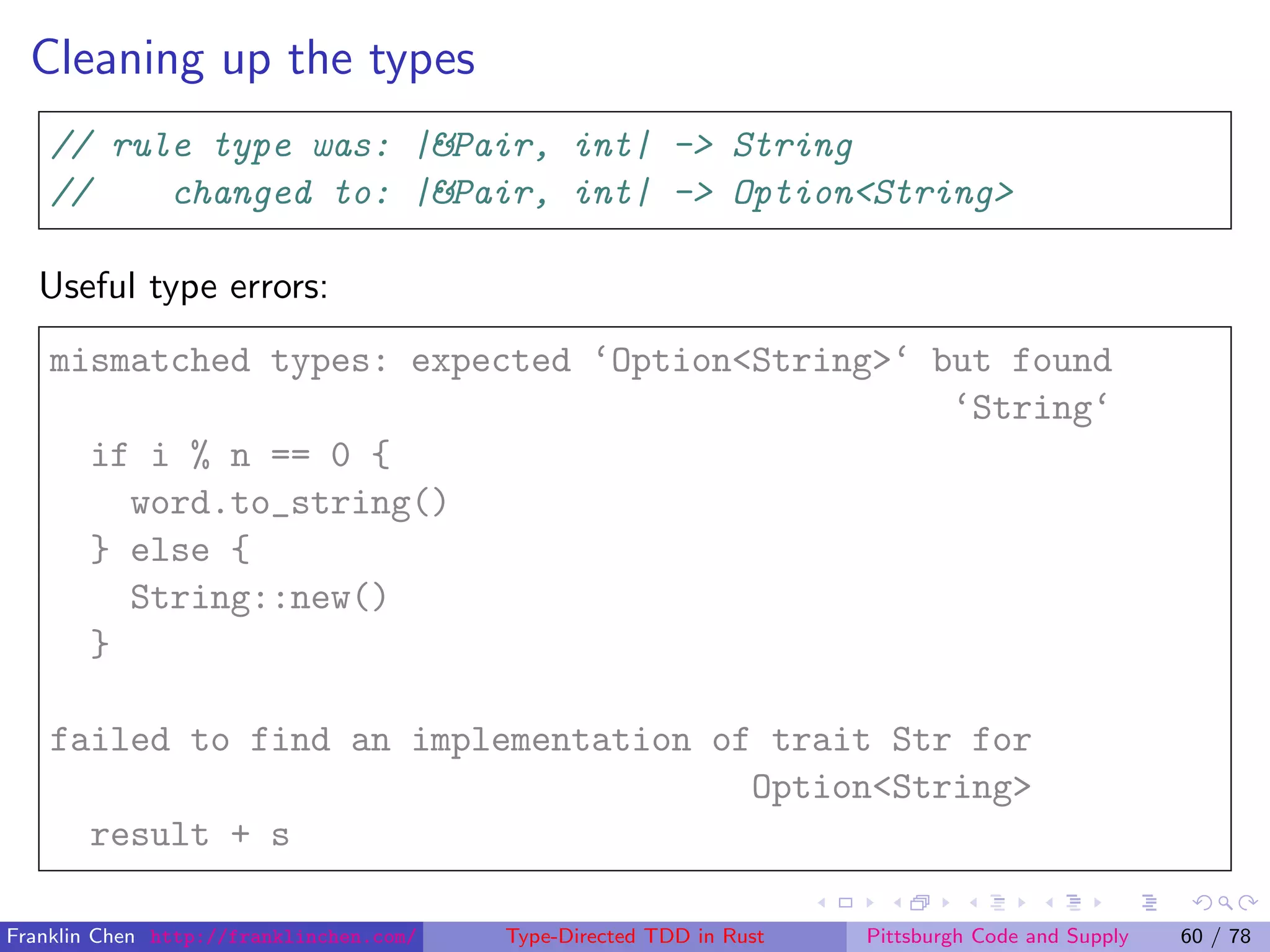
Cleaning up the types
// rule type was: |&Pair, int| -> String
// changed to: |&Pair, int| -> Option<String>
Useful type errors:
mismatched types: expected ‘Option<String>‘ but found
‘String‘
if i % n == 0 {
word.to_string()
} else {
String::new()
}
failed to find an implementation of trait Str for
Option<String>
result + s
Franklin Chen http://franklinchen.com/ Type-Directed TDD in Rust Pittsburgh Code and Supply 60 / 78
Fix the type errors: our rule builder
fn rule(&(n, ref word): &Pair, i: int) -> Option<String> {
if i % n == 0 {
Some(word.to_string())
} else {
None
}
}
Demo time!
(Instructions: for result Some(s), hold up the string, else don’t hold
up anything)
Configuration: vec![(3, ""), (5, "Buzz")]
Input: 9
Output: now correctly is ""
Franklin Chen http://franklinchen.com/ Type-Directed TDD in Rust Pittsburgh Code and Supply 61 / 78
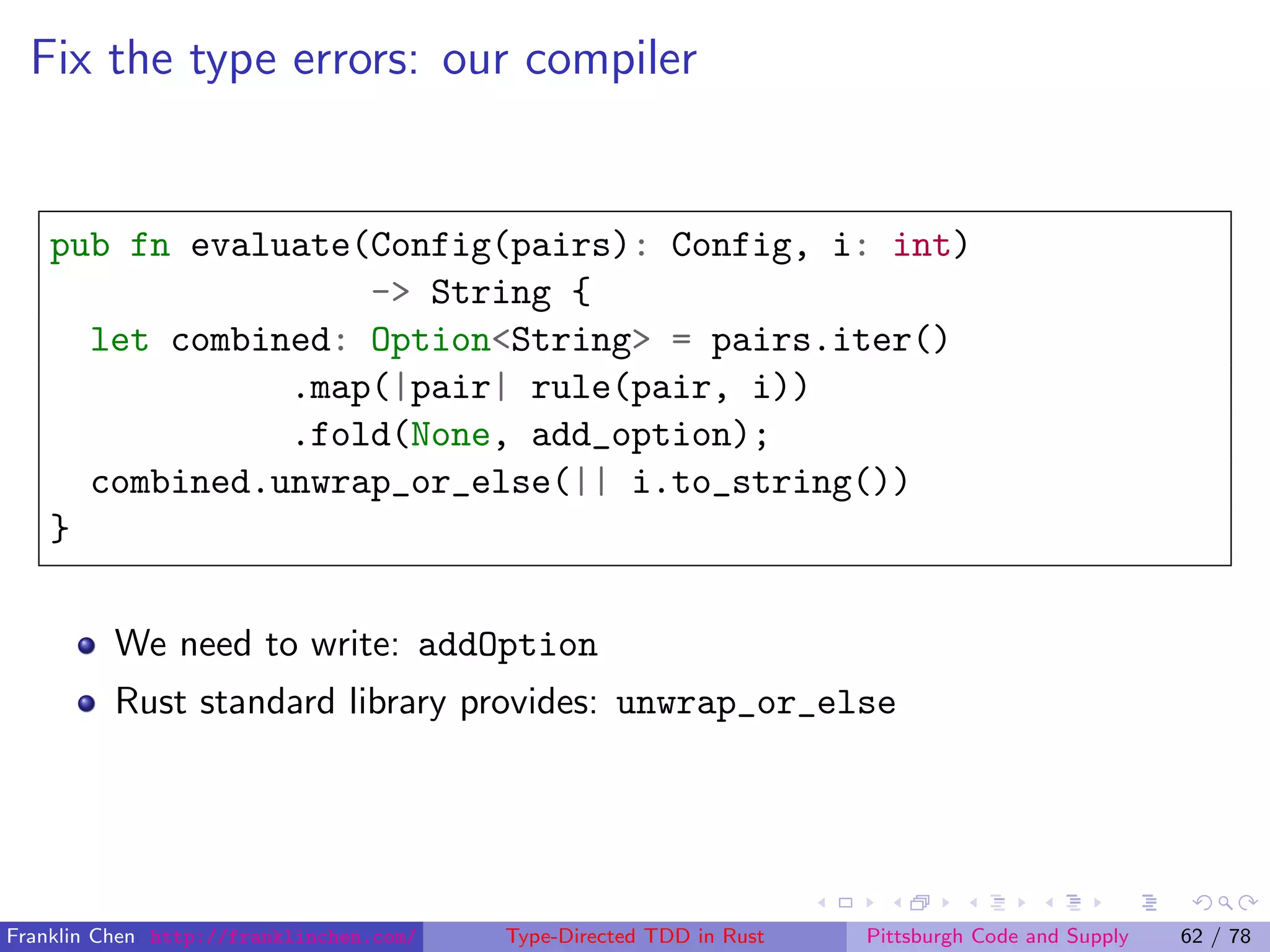
Fix the type errors: our compiler
pub fn evaluate(Config(pairs): Config, i: int)
-> String {
let combined: Option<String> = pairs.iter()
.map(|pair| rule(pair, i))
.fold(None, add_option);
combined.unwrap_or_else(|| i.to_string())
}
We need to write: addOption
Rust standard library provides: unwrap_or_else
Franklin Chen http://franklinchen.com/ Type-Directed TDD in Rust Pittsburgh Code and Supply 62 / 78
“Addition” for Option[String]
fn add_option(a1: Option<String>, a2: Option<String>)
-> Option<String> {
match (a1, a2) {
(Some(s1), None) => Some(s1),
(None, Some(s2)) => Some(s2),
(Some(s1), Some(s2)) => Some(s1.append(s2)),
(None, None) => None,
}
}
Franklin Chen http://franklinchen.com/ Type-Directed TDD in Rust Pittsburgh Code and Supply 63 / 78
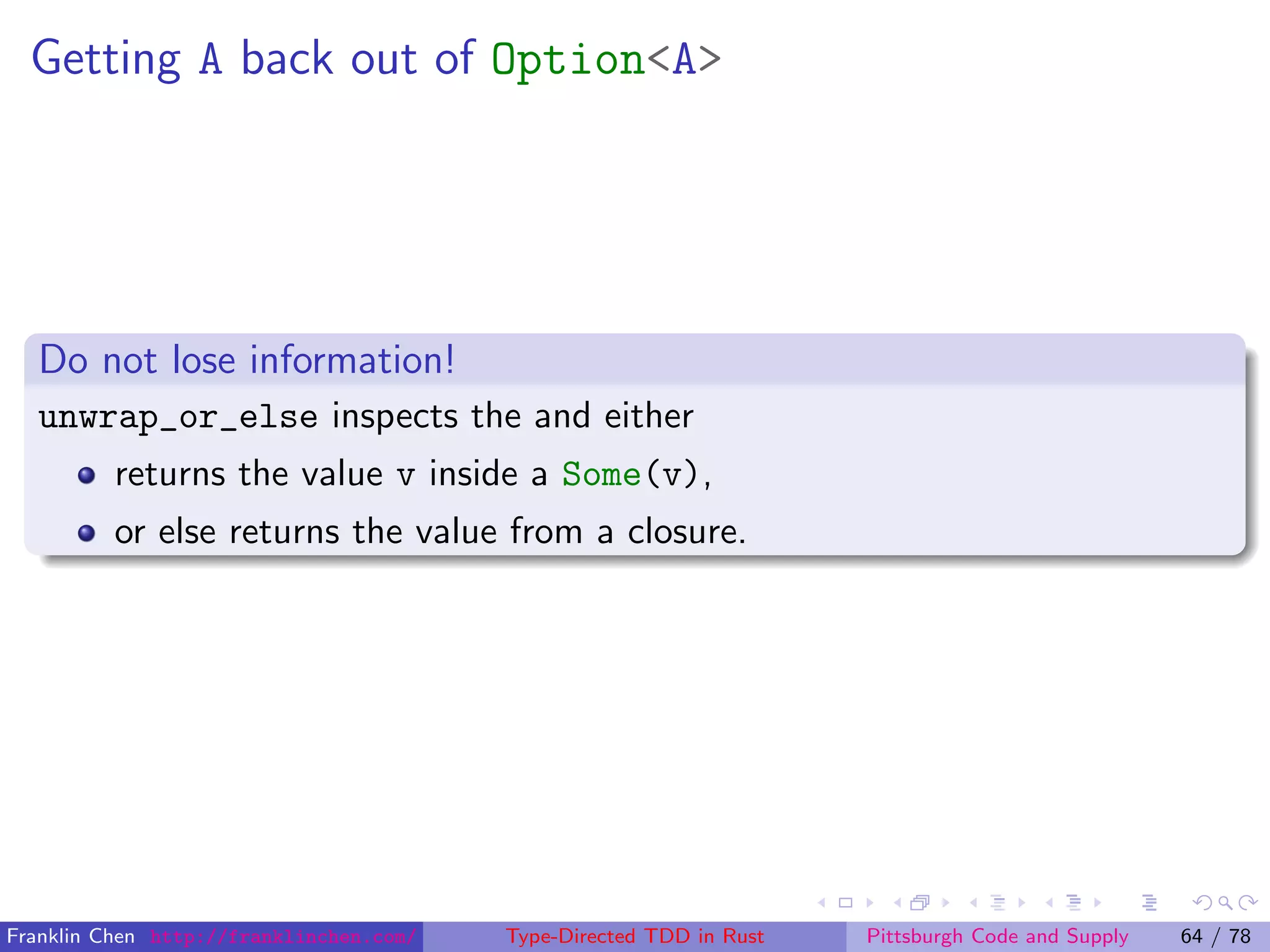
Getting A back out of Option<A>
Do not lose information!
unwrap_or_else inspects the and either
returns the value v inside a Some(v),
or else returns the value from a closure.
Franklin Chen http://franklinchen.com/ Type-Directed TDD in Rust Pittsburgh Code and Supply 64 / 78
Transform information; don’t destroy it
Our complete code only uses if in one place.
Bug cause: destroying information, using if
if i % n == 0 { word } else { String::new() }
if combined.is_empty() {i.to_string()} else {combined}
Transforming information
To Option[String]:
if i % n == 0 { Some(word.to_string()) } else { None }
Back to String: combined.unwrap_or_else(|| i.to_string())
Type-directed design tip
We could have saved trouble up front, by using precise types.
Avoid if, when possible.
Avoid String (but required at I/O boundaries of program).
Franklin Chen http://franklinchen.com/ Type-Directed TDD in Rust Pittsburgh Code and Supply 67 / 78
Outline
1 Introduction
2 Original FizzBuzz problem
3 FizzBuzz 2: user configuration
4 FizzBuzz 3: FizzBuzzPop and beyond
5 Parallel FizzBuzz
6 Conclusion
Franklin Chen http://franklinchen.com/ Type-Directed TDD in Rust Pittsburgh Code and Supply 68 / 78
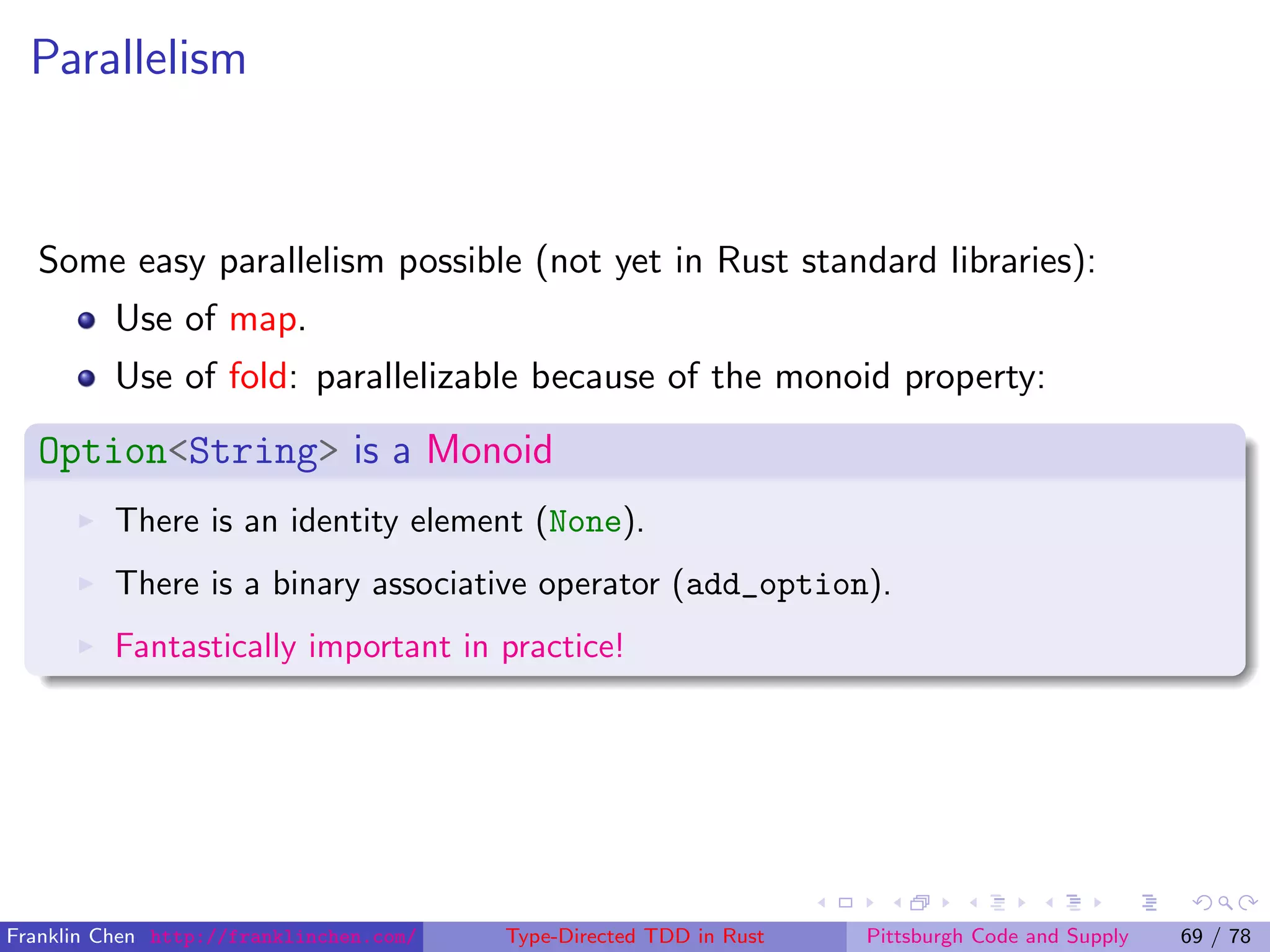
Parallelism
Some easy parallelism possible (not yet in Rust standard libraries):
Use of map.
Use of fold: parallelizable because of the monoid property:
Option<String> is a Monoid
There is an identity element (None).
There is a binary associative operator (add_option).
Fantastically important in practice!
Franklin Chen http://franklinchen.com/ Type-Directed TDD in Rust Pittsburgh Code and Supply 69 / 78
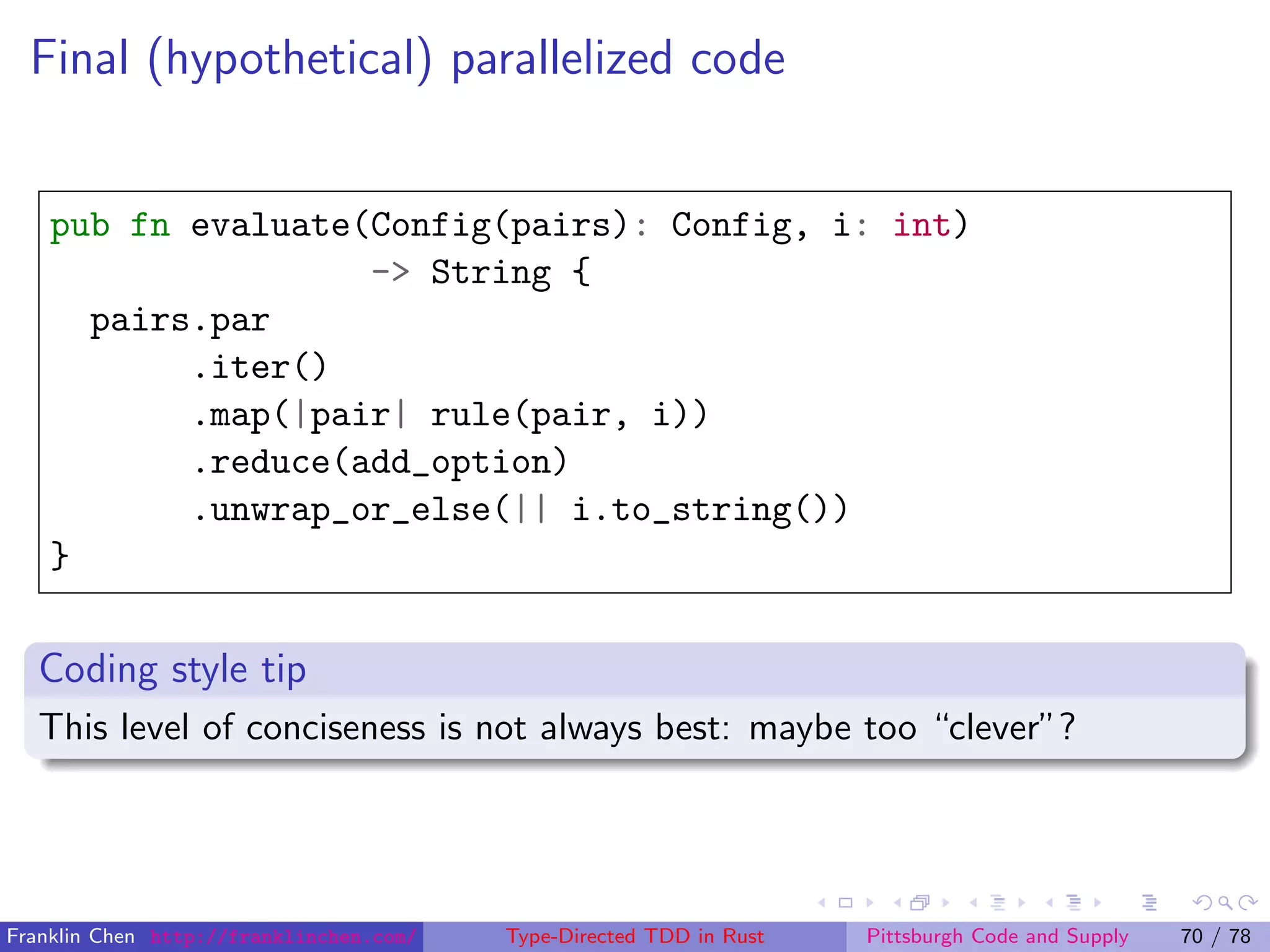
Final (hypothetical) parallelized code
pub fn evaluate(Config(pairs): Config, i: int)
-> String {
pairs.par
.iter()
.map(|pair| rule(pair, i))
.reduce(add_option)
.unwrap_or_else(|| i.to_string())
}
Coding style tip
This level of conciseness is not always best: maybe too “clever”?
Franklin Chen http://franklinchen.com/ Type-Directed TDD in Rust Pittsburgh Code and Supply 70 / 78
Final demo!
Demo time!
Configuration:
vec![(3, "Fizz"), (5, "Buzz"), (7, "Pop"), (2, "Boom")]
Tree of volunteers to simulate concurrency:
Four at leaves.
Two “middle managers” each handling two leaves.
One top-level manager handling two middle managers.
Input: 42
Output: "FizzPopBoom"
Franklin Chen http://franklinchen.com/ Type-Directed TDD in Rust Pittsburgh Code and Supply 71 / 78
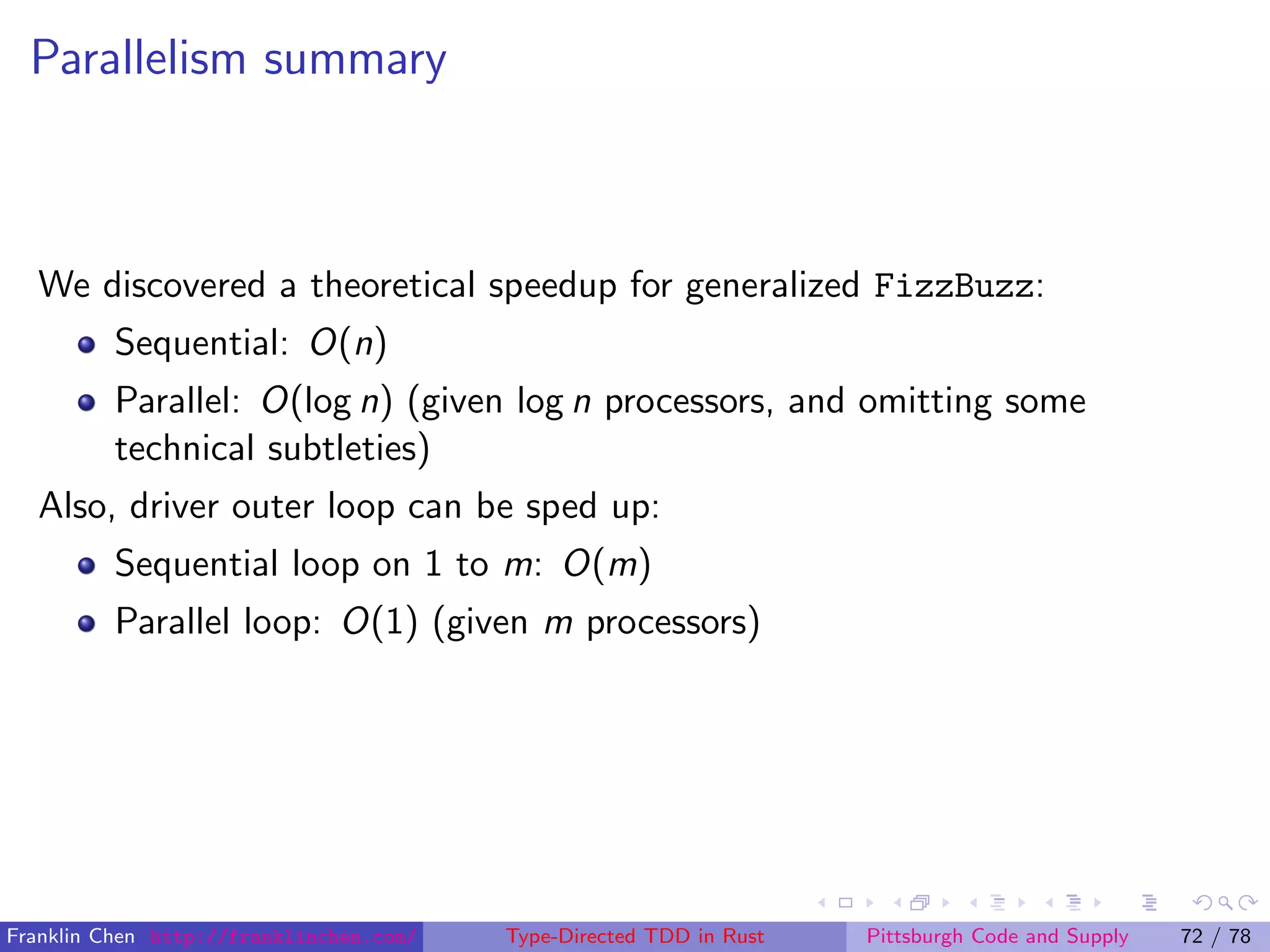
Parallelism summary
We discovered a theoretical speedup for generalized FizzBuzz:
Sequential: O(n)
Parallel: O(log n) (given log n processors, and omitting some
technical subtleties)
Also, driver outer loop can be sped up:
Sequential loop on 1 to m: O(m)
Parallel loop: O(1) (given m processors)
Franklin Chen http://franklinchen.com/ Type-Directed TDD in Rust Pittsburgh Code and Supply 72 / 78
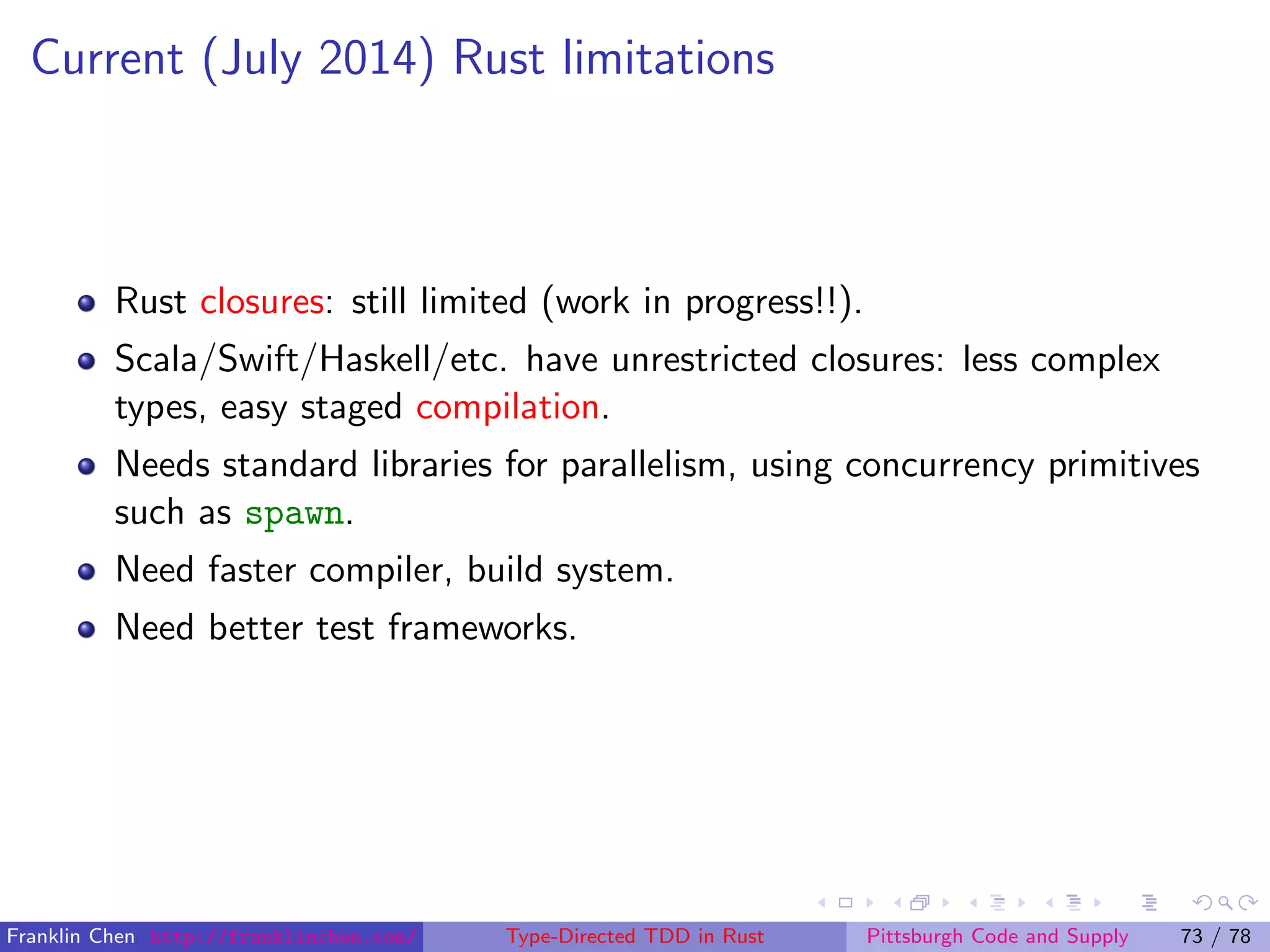
Current (July 2014) Rust limitations
Rust closures: still limited (work in progress!!).
Scala/Swift/Haskell/etc. have unrestricted closures: less complex
types, easy staged compilation.
Needs standard libraries for parallelism, using concurrency primitives
such as spawn.
Need faster compiler, build system.
Need better test frameworks.
Franklin Chen http://franklinchen.com/ Type-Directed TDD in Rust Pittsburgh Code and Supply 73 / 78
Outline
1 Introduction
2 Original FizzBuzz problem
3 FizzBuzz 2: user configuration
4 FizzBuzz 3: FizzBuzzPop and beyond
5 Parallel FizzBuzz
6 Conclusion
Franklin Chen http://franklinchen.com/ Type-Directed TDD in Rust Pittsburgh Code and Supply 76 / 78
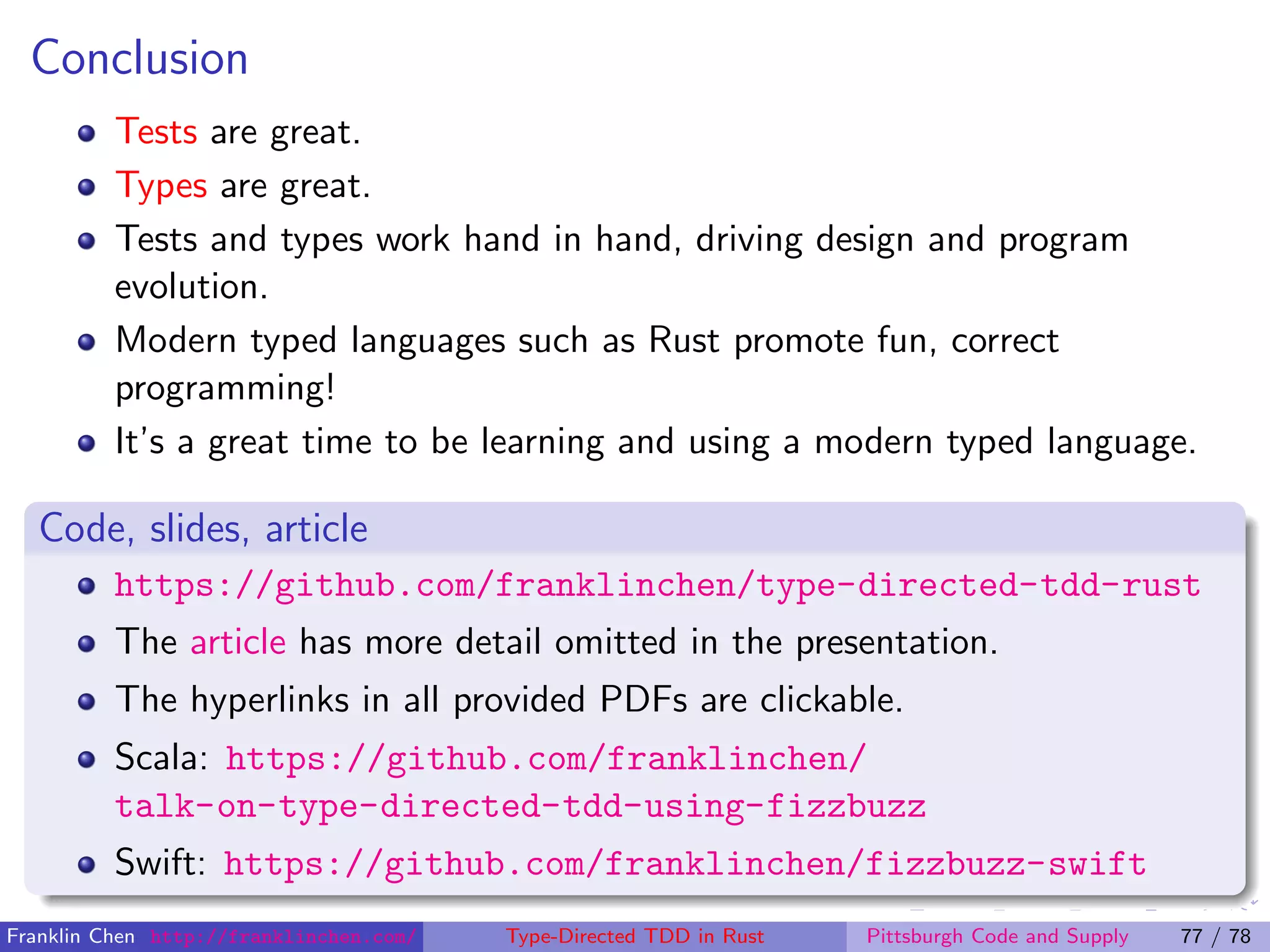
Conclusion
Tests are great.
Types are great.
Tests and types work hand in hand, driving design and program
evolution.
Modern typed languages such as Rust promote fun, correct
programming!
It’s a great time to be learning and using a modern typed language.
Code, slides, article
https://github.com/franklinchen/type-directed-tdd-rust
The article has more detail omitted in the presentation.
The hyperlinks in all provided PDFs are clickable.
Scala: https://github.com/franklinchen/
talk-on-type-directed-tdd-using-fizzbuzz
Swift: https://github.com/franklinchen/fizzbuzz-swift
Franklin Chen http://franklinchen.com/ Type-Directed TDD in Rust Pittsburgh Code and Supply 77 / 78

Type-Directed TDD in Rust: a case study using FizzBuzz

  • 1.
    Type-Directed TDD inRust A case study using FizzBuzz Franklin Chen http://franklinchen.com/ July 21, 2014 Pittsburgh Code and Supply Franklin Chen http://franklinchen.com/ Type-Directed TDD in Rust Pittsburgh Code and Supply 1 / 78
  • 2.
    Outline 1 Introduction 2 OriginalFizzBuzz problem 3 FizzBuzz 2: user configuration 4 FizzBuzz 3: FizzBuzzPop and beyond 5 Parallel FizzBuzz 6 Conclusion Franklin Chen http://franklinchen.com/ Type-Directed TDD in Rust Pittsburgh Code and Supply 2 / 78
  • 3.
    Outline 1 Introduction 2 OriginalFizzBuzz problem 3 FizzBuzz 2: user configuration 4 FizzBuzz 3: FizzBuzzPop and beyond 5 Parallel FizzBuzz 6 Conclusion Franklin Chen http://franklinchen.com/ Type-Directed TDD in Rust Pittsburgh Code and Supply 3 / 78
  • 4.
    Goals of thispresentation Give a taste of a practical software development process that is: test-driven type-directed Show everything for real (using Rust): project build process testing frameworks all the code Use FizzBuzz because: problem: easy to understand modifications: easy to understand fun! Encourage you to explore a modern typed language; now is the time! Recently, Apple ditched Objective C for its new language Swift! Franklin Chen http://franklinchen.com/ Type-Directed TDD in Rust Pittsburgh Code and Supply 4 / 78
  • 5.
    Test-driven development (TDD) Think. Writea test that fails. Write code until test succeeds. Repeat, and refactor as needed. Is TDD dead? Short answer: No. Franklin Chen http://franklinchen.com/ Type-Directed TDD in Rust Pittsburgh Code and Supply 5 / 78
  • 6.
    Type systems What isa type system? A syntactic method to prove that bad things can’t happen. “Debating” types “versus” tests? Let’s use both types and tests! But: use a good type system, not a bad one. Some decent practical typed languages OCaml: 20 years old Haskell: 20 years old Scala: 10 years old Swift: < 2 months old Rust (still not at 1.0!) Franklin Chen http://franklinchen.com/ Type-Directed TDD in Rust Pittsburgh Code and Supply 6 / 78
  • 7.
    Outline 1 Introduction 2 OriginalFizzBuzz problem 3 FizzBuzz 2: user configuration 4 FizzBuzz 3: FizzBuzzPop and beyond 5 Parallel FizzBuzz 6 Conclusion Franklin Chen http://franklinchen.com/ Type-Directed TDD in Rust Pittsburgh Code and Supply 8 / 78
  • 8.
    Original FizzBuzz problem FizzBuzzdefined Write a program that prints the numbers from 1 to 100. But for multiples of three, print “Fizz” instead of the number. And for the multiples of five, print “Buzz”. For numbers which are multiples of both three and five, print “FizzBuzz”. Franklin Chen http://franklinchen.com/ Type-Directed TDD in Rust Pittsburgh Code and Supply 9 / 78
  • 9.
    Starter code: maindriver Rust: a modern systems programming language for efficiency and safety in time, space, and concurrency. fn main() { // Will not compile yet! for result in run_to_seq(1i, 100).iter() { println!("{}", result) } } Type-directed design: separate out effects (such as printing to terminal) from the real work. Type-directed feedback: compilation fails when something is not implemented yet. Franklin Chen http://franklinchen.com/ Type-Directed TDD in Rust Pittsburgh Code and Supply 10 / 78
  • 10.
    Compiling and testingwith Cargo Cargo: build tool for Rust Features Library dependency tracking. cargo build cargo test My wish list, based on Scala SBT Triggered compilation and testing Interactive REPL Franklin Chen http://franklinchen.com/ Type-Directed TDD in Rust Pittsburgh Code and Supply 11 / 78
  • 11.
    First compilation failure src/main.rs: $cargo build src/main.rs:16:19: error: unresolved name ‘run_to_seq‘ Franklin Chen http://franklinchen.com/ Type-Directed TDD in Rust Pittsburgh Code and Supply 12 / 78
  • 12.
    Write type-directed stub fnmain() { for result in run_to_seq(1i, 100).iter() { println!("{}", result) } } fn run_to_seq(start: int, end: int) -> Vec<String> { fail!() } Write wanted type signature fail! is convenient for stubbing. In Rust standard library Causes whole task to fail Franklin Chen http://franklinchen.com/ Type-Directed TDD in Rust Pittsburgh Code and Supply 13 / 78
  • 13.
    Write acceptance test(simplified) #[test] fn test_1_to_16() { let expected = vec![ "1", "2", "Fizz", "4", "Buzz", "Fizz", "7", "8", "Fizz", "Buzz", "11", "Fizz", "13", "14", "FizzBuzz", "16", ] .iter() .map(|&s| s.to_string()) .collect(); assert_eq!(run_to_seq(1, 16), expected) } Franklin Chen http://franklinchen.com/ Type-Directed TDD in Rust Pittsburgh Code and Supply 14 / 78
  • 14.
    Test passes typecheck, but fails $ cargo test task ’test::test_1_to_16’ failed at ’write run_to_seq’, ...src/main.rs:37 Franklin Chen http://franklinchen.com/ Type-Directed TDD in Rust Pittsburgh Code and Supply 16 / 78
  • 15.
    Outside-in: for afizzbuzz module Types are shapes to assemble logically. fn run_to_seq(start: int, end: int) -> Vec<String> { range_inclusive(start, end) .map(fizzbuzz::evaluate) .collect() } range(include, exclude) returns an iterator. map takes an iterator of one type to an iterator of another: Therefore: need to implement function fizzbuzz::evaluate: int -> String. Franklin Chen http://franklinchen.com/ Type-Directed TDD in Rust Pittsburgh Code and Supply 17 / 78
  • 16.
    Implement new fizzbuzzmodule A failing acceptance test drives discovery of A unit, fizzbuzz A function with a particular type, int -> String pub fn evaluate(i: int) -> String { fail!() } Types are better than comments as documentation! Comments are not checkable, unlike types and tests. Franklin Chen http://franklinchen.com/ Type-Directed TDD in Rust Pittsburgh Code and Supply 19 / 78
  • 17.
    First part ofunit test: example-based Manually write some examples. #[test] fn test_15() { assert_eq!(evaluate(15), "FizzBuzz".to_string()) } #[test] fn test_20() { assert_eq!(evaluate(20), "Buzz".to_string()) } #[test] fn test_6() { assert_eq!(evaluate(6), "Fizz".to_string()) } #[test] fn test_17() { assert_eq!(evaluate(17), "17".to_string()) } Franklin Chen http://franklinchen.com/ Type-Directed TDD in Rust Pittsburgh Code and Supply 20 / 78
  • 18.
    The joy ofproperty-based tests QuickCheck for Rust: a framework for writing property-based tests. #[quickcheck] fn multiple_of_both_3_and_5(i: int) -> TestResult { if i % 3 == 0 && i % 5 == 0 { TestResult::from_bool(evaluate(i) == "FizzBuzz".to_string()) } else { TestResult::discard() } } Winning features Auto-generates random tests for each property (100 by default). Type-driven: here, generates random int values. Franklin Chen http://franklinchen.com/ Type-Directed TDD in Rust Pittsburgh Code and Supply 21 / 78
  • 19.
    Property-based tests (continued) #[quickcheck] fnmultiple_of_only_3(i: int) -> TestResult { if i % 3 == 0 && i % 5 != 0 { TestResult::from_bool(evaluate(i) == "Fizz".to_string()) } else { TestResult::discard() } } #[quickcheck] fn not_multiple_of_3_and_5(i: int) -> TestResult { if i % 3 != 0 && i % 5 != 0 { TestResult::from_bool(evaluate(i) == i.to_string()) } else { TestResult::discard() } } Franklin Chen http://franklinchen.com/ Type-Directed TDD in Rust Pittsburgh Code and Supply 23 / 78
  • 20.
    A buggy andugly solution // Buggy and ugly! if i % 3 == 0 { "Fizz".to_string() } else if i % 5 == 0 { "Buzz".to_string() } else if i % 3 == 0 && i % 5 == 0 { "FizzBuzz".to_string() } else { i.to_string() } $ cargo test task ’fizzbuzz::test::test_15’ failed at ’assertion failed: ‘(left == right) && (right == left)‘ (left: ‘Fizz‘, right: ‘FizzBuzz‘)’, .../src/fizzbuzz.rs:21 Franklin Chen http://franklinchen.com/ Type-Directed TDD in Rust Pittsburgh Code and Supply 24 / 78
  • 21.
    Booleans are evil! Mazeof twisty little conditionals, all different Too easy to write incorrect sequences of nested, combined conditionals. Overuse of Booleans is a type smell. Franklin Chen http://franklinchen.com/ Type-Directed TDD in Rust Pittsburgh Code and Supply 25 / 78
  • 22.
    Pattern matching organizesinformation pub fn evaluate(i: int) -> String { match (i % 3 == 0, i % 5 == 0) { (true, false) => "Fizz".to_string(), (false, true) => "Buzz".to_string(), (true, true) => "FizzBuzz".to_string(), (false, false) => i.to_string(), } } Winning features Visual beauty and clarity. No duplicated conditionals. No ordering dependency. Type checker verifies full coverage of cases. Franklin Chen http://franklinchen.com/ Type-Directed TDD in Rust Pittsburgh Code and Supply 27 / 78
  • 23.
    Example of non-exhaustivepattern matching pub fn evaluate(i: int) -> String { match (i % 3 == 0, i % 5 == 0) { (true, false) => "Fizz".to_string(), (false, true) => "Buzz".to_string(), (true, true) => "FizzBuzz".to_string(), // (false, false) => i.to_string(), } } $ cargo test .../src/fizzbuzz.rs:16:5: 21:6 error: non-exhaustive patterns: ‘(false, false)‘ not covered Franklin Chen http://franklinchen.com/ Type-Directed TDD in Rust Pittsburgh Code and Supply 28 / 78
  • 24.
    Acceptance test passes $cargo test test test::test_1_to_16 ... ok Done? No. Client wants more features. Franklin Chen http://franklinchen.com/ Type-Directed TDD in Rust Pittsburgh Code and Supply 30 / 78
  • 25.
    Outline 1 Introduction 2 OriginalFizzBuzz problem 3 FizzBuzz 2: user configuration 4 FizzBuzz 3: FizzBuzzPop and beyond 5 Parallel FizzBuzz 6 Conclusion Franklin Chen http://franklinchen.com/ Type-Directed TDD in Rust Pittsburgh Code and Supply 31 / 78
  • 26.
    Adding new features Clientwants to: Choose two arbitrary divisors in place of 3 and 5 such as 4 and 7 Choose other arbitrary words in place of "Fizz" and "Buzz" such as "Moo" and "Quack" Franklin Chen http://franklinchen.com/ Type-Directed TDD in Rust Pittsburgh Code and Supply 32 / 78
  • 27.
    Type-driven refactoring Types mean:refactoring is much more fun! Add new tests. Change types and code: to make new tests type check. Refactor original code and tests: use new APIs. Keep passing the old tests. Delay writing code for new features. Franklin Chen http://franklinchen.com/ Type-Directed TDD in Rust Pittsburgh Code and Supply 33 / 78
  • 28.
    More features meansmore types Change fizzbuzz::evaluate to defaults::fizzbuzzer: mod defaults; fn run_to_seq(start: int, end: int) -> Vec<String> { range_inclusive(start, end) .map(defaults::fizzbuzzer) .collect() } Add new types to FizzBuzz module: pub type Pair<’a> = (int, &’a str); pub struct Config<’a>(pub Pair<’a>, pub Pair<’a>); pub fn evaluate(Config((d1, w1), (d2, w2)): Config, i: int) -> String { fail!() } Franklin Chen http://franklinchen.com/ Type-Directed TDD in Rust Pittsburgh Code and Supply 34 / 78
  • 29.
    New default configuration //We can store a static Config as in C. static fizzbuzzer_config: Config<’static> = Config((3, "Fizz"), (5, "Buzz")); pub fn fizzbuzzer(i: int) -> String { fizzbuzz::evaluate(fizzbuzzer_config, i) } Franklin Chen http://franklinchen.com/ Type-Directed TDD in Rust Pittsburgh Code and Supply 35 / 78
  • 30.
    More types meansmore tests Write new property-based test over arbitrary user configurations: #[quickcheck] fn d1_but_not_d2((d1, w1): (int, String), (d2, w2): (int, String), i: int) -> TestResult { let config = Config((d1, w1.as_slice()), (d2, w2.as_slice())); if i % d1 == 0 && i % d2 != 0 { TestResult::from_bool(fizzbuzzer(i) == w1) } else { TestResult::discard() } } Franklin Chen http://franklinchen.com/ Type-Directed TDD in Rust Pittsburgh Code and Supply 36 / 78
  • 31.
    Problem: coarse Configtype $ cargo test task ’fizzbuzz::test::d1_but_not_d2’ failed at ’[quickcheck] TEST FAILED (runtime error). Arguments: ((0, ), (0, ), 0)’ 0 as a divisor crashes! We discovered client’s underspecification. Client says: meant to allow only divisors within 2 and 100. We need to: Add runtime validation when constructing Config. Refine Config random generator. Franklin Chen http://franklinchen.com/ Type-Directed TDD in Rust Pittsburgh Code and Supply 37 / 78
  • 32.
    Add (runtime) validation Runtimeprecondition contract: Rust’s assert! (very primitive; fails a task on failure): static DIVISOR_MIN: int = 2; static DIVISOR_MAX: int = 100; fn validate_pair(&(d, _): &Pair) { assert!(d >= DIVISOR_MIN, "divisor {} must be >= {}", d, DIVISOR_MIN); assert!(d <= DIVISOR_MAX, "divisor {} must be <= {}", d, DIVISOR_MAX); } impl<’a> Config<’a> { pub fn new(pair1: Pair, pair2: Pair) -> Config { validate_pair(&pair1); validate_pair(&pair2); Config(pair1, pair2) } } Franklin Chen http://franklinchen.com/ Type-Directed TDD in Rust Pittsburgh Code and Supply 38 / 78
  • 33.
    A note onerror handling Rust does not have exceptions! Exceptions are evil because they escape the type system. Rust task failures are brutal. Outside scope of this presentation: principled type-based error handling using Result<T, E>: Franklin Chen http://franklinchen.com/ Type-Directed TDD in Rust Pittsburgh Code and Supply 39 / 78
  • 34.
    Some changes todefaults setup // Cannot be static variable because of runtime // validation and also use of Vector. fn fizzbuzzer_config<’a>() -> Config<’a> { Config::new(vec![(3, "Fizz"), (5, "Buzz")]) } pub fn fizzbuzzer(i: int) -> String { fizzbuzz::evaluate(fizzbuzzer_config(), i) } Franklin Chen http://franklinchen.com/ Type-Directed TDD in Rust Pittsburgh Code and Supply 41 / 78
  • 35.
    Improve Config randomgenerator #[quickcheck] fn d1_but_not_d2((d1, w1): (int, String), (d2, w2): (int, String), i: int) -> TestResult { if (d1 >= DIVISOR_MIN && d1 <= DIVISOR_MAX) && (d2 >= DIVISOR_MIN && d2 <= DIVISOR_MAX) { let config = Config::new(vec![(d1, w1.as_slice()), (d2, w2.as_slice())]); if i % d1 == 0 && i % d2 != 0 { TestResult::from_bool(evaluate(config, i) == w1) } else { TestResult::discard() } } else { TestResult::discard() } } Franklin Chen http://franklinchen.com/ Type-Directed TDD in Rust Pittsburgh Code and Supply 42 / 78
  • 36.
    New test runsfurther, stills fails Refactor old code to fizzbuzz::evaluate, to pass old tests and new test. pub fn evaluate(Config((d1, w1), (d2, w2)): Config, i: int) -> String { match (i % d1 == 0, i % d2 == 0) { (true, false) => w1.to_string(), (false, true) => w2.to_string(), (true, true) => w1.to_string().append(w2), (false, false) => i.to_string(), } } Franklin Chen http://franklinchen.com/ Type-Directed TDD in Rust Pittsburgh Code and Supply 43 / 78
  • 37.
    Outline 1 Introduction 2 OriginalFizzBuzz problem 3 FizzBuzz 2: user configuration 4 FizzBuzz 3: FizzBuzzPop and beyond 5 Parallel FizzBuzz 6 Conclusion Franklin Chen http://franklinchen.com/ Type-Directed TDD in Rust Pittsburgh Code and Supply 44 / 78
  • 38.
    Generalizing to morethan two divisors Client wants FizzBuzzPop! Given three divisors (such as 3, 5, 7). Given three words (such as "Fizz", "Buzz", "Pop"). Example: 21 should output "FizzPop". Franklin Chen http://franklinchen.com/ Type-Directed TDD in Rust Pittsburgh Code and Supply 45 / 78
  • 39.
    More features meansmore tests Write new tests for new defaults::fizzbuzzpopper: #[test] fn test_fizzbuzzpopper_2() { assert_eq!(fizzbuzzpopper(2), "2".to_string()) } #[test] fn test_fizzbuzzpopper_21() { assert_eq!(fizzbuzzpopper(21), "FizzPop".to_string()) } #[test] fn test_fizzbuzzpopper_9() { assert_eq!(fizzbuzzpopper(9), "Fizz".to_string()) } #[test] fn test_fizzbuzzpopper_7() { assert_eq!(fizzbuzzpopper(7), "Pop".to_string()) } #[test] fn test_fizzbuzzpopper_35() { assert_eq!(fizzbuzzpopper(35), "BuzzPop".to_string()) } Change configuration: to Seq of pairs, instead of just two:Franklin Chen http://franklinchen.com/ Type-Directed TDD in Rust Pittsburgh Code and Supply 47 / 78
  • 40.
    More tests meansmore (or changed) types error: this function takes 2 parameters but 1 parameter was supplied Config::new(vec![(3, "Fizz"), (5, "Buzz")]) Change type Config to allow a sequence of pairs: pub struct Config(pub Vec<Pair>); impl<’a> Config<’a> { pub fn new(pairs: Vec<Pair>) -> Config { for pair in pairs.iter() { validate_pair(pair); } Config(pairs) } } Franklin Chen http://franklinchen.com/ Type-Directed TDD in Rust Pittsburgh Code and Supply 48 / 78
  • 41.
    Fix remaining typeerrors Refactoring reveals need to implement case of more than two divisors. pub fn evaluate(Config(pairs): Config, i: int) -> String { // Can crash! And incorrect except for 2 pairs. let (d1, w1) = pairs[0]; let (d2, w2) = pairs[1]; match (i % d1 == 0, i % d2 == 0) { (true, false) => w1.to_string(), (false, true) => w2.to_string(), (true, true) => w1.to_string().append(w2), (false, false) => i.to_string(), } } Franklin Chen http://franklinchen.com/ Type-Directed TDD in Rust Pittsburgh Code and Supply 49 / 78
  • 42.
    More computation meansmore types Associate each divisor with a “rule” that awaits input. // Make the decision to allocate a String here. fn rule(&(n, word): &Pair, i: int) -> String { if i % n == 0 { word.to_string() } else { String::new() } } FizzBuzz demo time! Two volunteers: each to play role of Rule. One “manager” to combine two sub-results. Franklin Chen http://franklinchen.com/ Type-Directed TDD in Rust Pittsburgh Code and Supply 51 / 78
  • 43.
    Assemble the types pubfn evaluate(Config(pairs): Config, i: int) -> String { let combined: String = pairs.iter() .map(|pair| rule(pair, i)) .fold(String::new(), |result, s| result.append(s.as_slice())); if combined.is_empty() { i.to_string() } else { combined } } Franklin Chen http://franklinchen.com/ Type-Directed TDD in Rust Pittsburgh Code and Supply 53 / 78
  • 44.
    A note onfold For any value of type Iterator<A>, we can apply fold: (B, |B, A| -> B) -> B. Example: for Vec<String>, fold with string concatenation + returns the concatenation of all the strings in the vector. Franklin Chen http://franklinchen.com/ Type-Directed TDD in Rust Pittsburgh Code and Supply 54 / 78
  • 45.
    Test failure: coarsetypes again $ cargo test task ’fizzbuzz::test::d1_but_not_d2’ failed at ’[quickcheck] TEST FAILED. Arguments: ((2, ), (3, ), 2)’ Demo time! Configuration: vec![(3, ""), (5, "Buzz")] Input: 9 (note: divisible by 2) Output: should be "" (because of the part divisible by 3) Output was: "9" Franklin Chen http://franklinchen.com/ Type-Directed TDD in Rust Pittsburgh Code and Supply 55 / 78
  • 46.
    Assemble the types pubfn evaluate(Config(pairs): Config, i: int) -> String { let combined: String = pairs.iter() .map(|pair| rule(pair, i)) .fold(String::new(), |result, s| result.append(s.as_slice())); if combined.is_empty() { i.to_string() } else { combined } } Franklin Chen http://franklinchen.com/ Type-Directed TDD in Rust Pittsburgh Code and Supply 56 / 78
  • 47.
    Property-based testing rescuedus again! Be honest: would you have caught this bug manually? I didn’t. I never wrote FizzBuzzPop examples testing empty strings. Property-based testing reveals unexpected corner cases. (Empty “fizz” and “buzz” word strings). Franklin Chen http://franklinchen.com/ Type-Directed TDD in Rust Pittsburgh Code and Supply 57 / 78
  • 48.
    An empty stringis not equivalent to no string Presence of something “empty” is not equivalent to no thing. Sending someone an empty email versus not sending any email. Many programming languages get this wrong. Franklin Chen http://franklinchen.com/ Type-Directed TDD in Rust Pittsburgh Code and Supply 58 / 78
  • 49.
    Option<A> type Option<A> isone of two possibilities: None Some(a) wraps a value a of type A. For example, Some(String::empty()) is not the same as None. let fizzFor3 = Some(String::new()) // multiple of 3 let buzzFor3 = None // not multiple of 5 let fizzbuzzFor3 = Some(String::new()) // fizzed "" let fizzFor2 = None // not multiple of 3 let buzzFor2 = None // not multiple of 5 let fizzbuzzFor2 = None // not multiple of any Franklin Chen http://franklinchen.com/ Type-Directed TDD in Rust Pittsburgh Code and Supply 59 / 78
  • 50.
    Cleaning up thetypes // rule type was: |&Pair, int| -> String // changed to: |&Pair, int| -> Option<String> Useful type errors: mismatched types: expected ‘Option<String>‘ but found ‘String‘ if i % n == 0 { word.to_string() } else { String::new() } failed to find an implementation of trait Str for Option<String> result + s Franklin Chen http://franklinchen.com/ Type-Directed TDD in Rust Pittsburgh Code and Supply 60 / 78
  • 51.
    Fix the typeerrors: our rule builder fn rule(&(n, ref word): &Pair, i: int) -> Option<String> { if i % n == 0 { Some(word.to_string()) } else { None } } Demo time! (Instructions: for result Some(s), hold up the string, else don’t hold up anything) Configuration: vec![(3, ""), (5, "Buzz")] Input: 9 Output: now correctly is "" Franklin Chen http://franklinchen.com/ Type-Directed TDD in Rust Pittsburgh Code and Supply 61 / 78
  • 52.
    Fix the typeerrors: our compiler pub fn evaluate(Config(pairs): Config, i: int) -> String { let combined: Option<String> = pairs.iter() .map(|pair| rule(pair, i)) .fold(None, add_option); combined.unwrap_or_else(|| i.to_string()) } We need to write: addOption Rust standard library provides: unwrap_or_else Franklin Chen http://franklinchen.com/ Type-Directed TDD in Rust Pittsburgh Code and Supply 62 / 78
  • 53.
    “Addition” for Option[String] fnadd_option(a1: Option<String>, a2: Option<String>) -> Option<String> { match (a1, a2) { (Some(s1), None) => Some(s1), (None, Some(s2)) => Some(s2), (Some(s1), Some(s2)) => Some(s1.append(s2)), (None, None) => None, } } Franklin Chen http://franklinchen.com/ Type-Directed TDD in Rust Pittsburgh Code and Supply 63 / 78
  • 54.
    Getting A backout of Option<A> Do not lose information! unwrap_or_else inspects the and either returns the value v inside a Some(v), or else returns the value from a closure. Franklin Chen http://franklinchen.com/ Type-Directed TDD in Rust Pittsburgh Code and Supply 64 / 78
  • 55.
    Transform information; don’tdestroy it Our complete code only uses if in one place. Bug cause: destroying information, using if if i % n == 0 { word } else { String::new() } if combined.is_empty() {i.to_string()} else {combined} Transforming information To Option[String]: if i % n == 0 { Some(word.to_string()) } else { None } Back to String: combined.unwrap_or_else(|| i.to_string()) Type-directed design tip We could have saved trouble up front, by using precise types. Avoid if, when possible. Avoid String (but required at I/O boundaries of program). Franklin Chen http://franklinchen.com/ Type-Directed TDD in Rust Pittsburgh Code and Supply 67 / 78
  • 56.
    Outline 1 Introduction 2 OriginalFizzBuzz problem 3 FizzBuzz 2: user configuration 4 FizzBuzz 3: FizzBuzzPop and beyond 5 Parallel FizzBuzz 6 Conclusion Franklin Chen http://franklinchen.com/ Type-Directed TDD in Rust Pittsburgh Code and Supply 68 / 78
  • 57.
    Parallelism Some easy parallelismpossible (not yet in Rust standard libraries): Use of map. Use of fold: parallelizable because of the monoid property: Option<String> is a Monoid There is an identity element (None). There is a binary associative operator (add_option). Fantastically important in practice! Franklin Chen http://franklinchen.com/ Type-Directed TDD in Rust Pittsburgh Code and Supply 69 / 78
  • 58.
    Final (hypothetical) parallelizedcode pub fn evaluate(Config(pairs): Config, i: int) -> String { pairs.par .iter() .map(|pair| rule(pair, i)) .reduce(add_option) .unwrap_or_else(|| i.to_string()) } Coding style tip This level of conciseness is not always best: maybe too “clever”? Franklin Chen http://franklinchen.com/ Type-Directed TDD in Rust Pittsburgh Code and Supply 70 / 78
  • 59.
    Final demo! Demo time! Configuration: vec![(3,"Fizz"), (5, "Buzz"), (7, "Pop"), (2, "Boom")] Tree of volunteers to simulate concurrency: Four at leaves. Two “middle managers” each handling two leaves. One top-level manager handling two middle managers. Input: 42 Output: "FizzPopBoom" Franklin Chen http://franklinchen.com/ Type-Directed TDD in Rust Pittsburgh Code and Supply 71 / 78
  • 60.
    Parallelism summary We discovereda theoretical speedup for generalized FizzBuzz: Sequential: O(n) Parallel: O(log n) (given log n processors, and omitting some technical subtleties) Also, driver outer loop can be sped up: Sequential loop on 1 to m: O(m) Parallel loop: O(1) (given m processors) Franklin Chen http://franklinchen.com/ Type-Directed TDD in Rust Pittsburgh Code and Supply 72 / 78
  • 61.
    Current (July 2014)Rust limitations Rust closures: still limited (work in progress!!). Scala/Swift/Haskell/etc. have unrestricted closures: less complex types, easy staged compilation. Needs standard libraries for parallelism, using concurrency primitives such as spawn. Need faster compiler, build system. Need better test frameworks. Franklin Chen http://franklinchen.com/ Type-Directed TDD in Rust Pittsburgh Code and Supply 73 / 78
  • 62.
    Outline 1 Introduction 2 OriginalFizzBuzz problem 3 FizzBuzz 2: user configuration 4 FizzBuzz 3: FizzBuzzPop and beyond 5 Parallel FizzBuzz 6 Conclusion Franklin Chen http://franklinchen.com/ Type-Directed TDD in Rust Pittsburgh Code and Supply 76 / 78
  • 63.
    Conclusion Tests are great. Typesare great. Tests and types work hand in hand, driving design and program evolution. Modern typed languages such as Rust promote fun, correct programming! It’s a great time to be learning and using a modern typed language. Code, slides, article https://github.com/franklinchen/type-directed-tdd-rust The article has more detail omitted in the presentation. The hyperlinks in all provided PDFs are clickable. Scala: https://github.com/franklinchen/ talk-on-type-directed-tdd-using-fizzbuzz Swift: https://github.com/franklinchen/fizzbuzz-swift Franklin Chen http://franklinchen.com/ Type-Directed TDD in Rust Pittsburgh Code and Supply 77 / 78