Introducción práctica a
Test-Driven Development
Software Craftsmanship Alicante
Who am I?
• Rubén Antón A.K.A
@rubocoptero
• Crafting code for Flywire
• h4ckademy alumni
What’s TDD?
TDD is not testing!
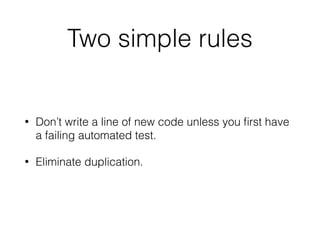
Two simple rules
• Don’t write a line of new code unless you first have
a failing automated test.
• Eliminate duplication.
What is TDD?
• XP practice that combines Test-First and
Refactoring
• Tests as a design tool
• KISS
• Baby steps
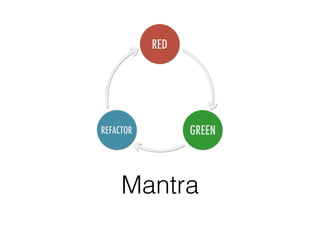
Mantra
Steps
1. ROJO: write a little test that doesn’t work, perhaps
doesn’t even compile at first
2. GREEN: make the test work quickly, committing
whatever sins necessary in the process
3. REFACTOR: eliminate all the duplication created
in just getting the test to work.
Why use TDD?
Benefits
• Manually verification is time consuming
• Break down our work into manageable chunks
• Source of documentation
• Avoid over-engineering
• Safety net
• Encourages Loosely Coupled Design
–Chris Jordan
“Software is inherently complex, and being able
to make things easier for ourselves as
developers is a crucial part of our role to deliver
high quality software.”
Techniques
Fake it (’til you make it)
1. Return a constant to make it pass
2. Gradually replace constants with variables until
you have the real code
[TestMethod]
public void TestSum()
{
Assert.Equals(4, Sum(3, 1));
}
private int Sum(int x, int y)
{
return 4
}
[TestMethod]
public void TestSum()
{
Assert.Equals(4, Sum(3, 1));
}
private int Sum(int x, int y)
{
return 3 + 1;
}
[TestMethod]
public void TestSum()
{
Assert.Equals(4, Sum(3, 1));
Assert.Equals(5, Sum(3, 2));
}
private int Sum(int x, int y)
{
return x + y;
}
Triangulation
• Use two or three test cases before to generalize.
• Only use it when completely unsure of how to refactor.
• What axes of variability are you trying to support in
your design?
[TestMethod]
public void TestSum()
{
Assert.Equals(4, Sum(3, 1));
}
private int Sum(int x, int y)
{
return 4
}
[TestMethod]
public void TestSum()
{
Assert.Equals(4, Sum(3, 1));
Assert.Equals(5, Sum(3, 2));
}
private int Sum(int x, int y)
{
return x + y;
}
[TestMethod]
public void TestSum()
{
Assert.Equals(4, Sum(3, 1));
Assert.Equals(5, Sum(3, 2));
}
private int Sum(int x, int y)
{
return x + y;
}
Obvious Implementation
• Fake it and Triangulation use baby steps.
• If you think it’s obvious, type in the real
implementation.
• It’s a "second gear".
• If you get an unexpected red bar, back up.
–Kent Beck
“Remember, TDD is not about taking teensy tiny
steps, it’s about being able to take teensy tiny
steps. Would I code day-to-day with steps this
small? No. But when things get the least bit
weird, I’m glad I can.”
Let’s practice…
just a few last things before to start.
Rules
• 30 seconds to go from RED to GREEN
• Don’t lose the GREEN in the refactoring phase.
• No debug
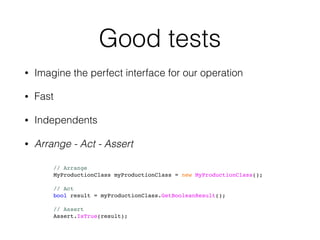
Good tests
• Imagine the perfect interface for our operation
• Fast
• Independents
• Arrange - Act - Assert
// Arrange
MyProductionClass myProductionClass = new MyProductionClass();
// Act
bool result = myProductionClass.GetBooleanResult();
// Assert
Assert.IsTrue(result);
Before you start
• The focus is to practice writing the best code we
can possibly write and challenge ourselves. It is
important to mention that the goal is not to finish
the exercise as soon as posible, but to learn during
the process via the discussion with our partner.
• Do one task at a time. The trick is to learn to work
incrementally.
• Make sure you only test for correct inputs. there is
no need to test for invalid inputs for this kata
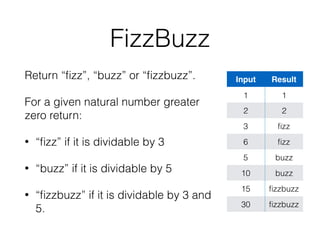
FizzBuzz
Return “fizz”, “buzz” or “fizzbuzz”.
For a given natural number greater
zero return:
• “fizz” if it is dividable by 3
• “buzz” if it is dividable by 5
• “fizzbuzz” if it is dividable by 3 and
5.
Input Result
1 1
2 2
3 fizz
6 fizz
5 buzz
10 buzz
15 fizzbuzz
30 fizzbuzz
FizzBuzz continuation
• A number is "fizz" if it is divisible by 3 or if it has a 3
in it.
• A number is "buzz" if it is divisible by 5 or if it has a
5 in it.
Retrospective time
• What difficulties do we found?
• What we have done?
• What we have learnt?
TDD economy
• Either you will have to be able to write twice as
many lines per day as before, or write half as many
lines for the same functionality.
• You’ll have to measure and see what effect TDD
has on your own practice.
• Be sure to factor debugging, integrating, and
explaining time into your metrics, though.
More than TDD
• Extreme Programming
practices
• SOLID
• Clean Code
• 4 rules of simple design
How can I learn it?
• Practice, practice and practice!
• Read good books
• TDD by example - Kent Beck
• Clean Code - Uncle Bob
• Refactoring - Martin Fowler
• Test Driven - Lasse Koskela
• …
Thank you all!

Introducción práctica a Test-Driven Development (TDD)

  • 1.
    Introducción práctica a Test-DrivenDevelopment Software Craftsmanship Alicante
  • 2.
    Who am I? •Rubén Antón A.K.A @rubocoptero • Crafting code for Flywire • h4ckademy alumni
  • 3.
  • 4.
    TDD is nottesting!
  • 5.
    Two simple rules •Don’t write a line of new code unless you first have a failing automated test. • Eliminate duplication.
  • 6.
    What is TDD? •XP practice that combines Test-First and Refactoring • Tests as a design tool • KISS • Baby steps
  • 7.
  • 8.
    Steps 1. ROJO: writea little test that doesn’t work, perhaps doesn’t even compile at first 2. GREEN: make the test work quickly, committing whatever sins necessary in the process 3. REFACTOR: eliminate all the duplication created in just getting the test to work.
  • 9.
  • 10.
    Benefits • Manually verificationis time consuming • Break down our work into manageable chunks • Source of documentation • Avoid over-engineering • Safety net • Encourages Loosely Coupled Design
  • 11.
    –Chris Jordan “Software isinherently complex, and being able to make things easier for ourselves as developers is a crucial part of our role to deliver high quality software.”
  • 12.
  • 13.
    Fake it (’tilyou make it) 1. Return a constant to make it pass 2. Gradually replace constants with variables until you have the real code [TestMethod] public void TestSum() { Assert.Equals(4, Sum(3, 1)); } private int Sum(int x, int y) { return 4 } [TestMethod] public void TestSum() { Assert.Equals(4, Sum(3, 1)); } private int Sum(int x, int y) { return 3 + 1; } [TestMethod] public void TestSum() { Assert.Equals(4, Sum(3, 1)); Assert.Equals(5, Sum(3, 2)); } private int Sum(int x, int y) { return x + y; }
  • 14.
    Triangulation • Use twoor three test cases before to generalize. • Only use it when completely unsure of how to refactor. • What axes of variability are you trying to support in your design? [TestMethod] public void TestSum() { Assert.Equals(4, Sum(3, 1)); } private int Sum(int x, int y) { return 4 } [TestMethod] public void TestSum() { Assert.Equals(4, Sum(3, 1)); Assert.Equals(5, Sum(3, 2)); } private int Sum(int x, int y) { return x + y; } [TestMethod] public void TestSum() { Assert.Equals(4, Sum(3, 1)); Assert.Equals(5, Sum(3, 2)); } private int Sum(int x, int y) { return x + y; }
  • 15.
    Obvious Implementation • Fakeit and Triangulation use baby steps. • If you think it’s obvious, type in the real implementation. • It’s a "second gear". • If you get an unexpected red bar, back up.
  • 16.
    –Kent Beck “Remember, TDDis not about taking teensy tiny steps, it’s about being able to take teensy tiny steps. Would I code day-to-day with steps this small? No. But when things get the least bit weird, I’m glad I can.”
  • 17.
    Let’s practice… just afew last things before to start.
  • 18.
    Rules • 30 secondsto go from RED to GREEN • Don’t lose the GREEN in the refactoring phase. • No debug
  • 19.
    Good tests • Imaginethe perfect interface for our operation • Fast • Independents • Arrange - Act - Assert // Arrange MyProductionClass myProductionClass = new MyProductionClass(); // Act bool result = myProductionClass.GetBooleanResult(); // Assert Assert.IsTrue(result);
  • 20.
    Before you start •The focus is to practice writing the best code we can possibly write and challenge ourselves. It is important to mention that the goal is not to finish the exercise as soon as posible, but to learn during the process via the discussion with our partner. • Do one task at a time. The trick is to learn to work incrementally. • Make sure you only test for correct inputs. there is no need to test for invalid inputs for this kata
  • 21.
    FizzBuzz Return “fizz”, “buzz”or “fizzbuzz”. For a given natural number greater zero return: • “fizz” if it is dividable by 3 • “buzz” if it is dividable by 5 • “fizzbuzz” if it is dividable by 3 and 5. Input Result 1 1 2 2 3 fizz 6 fizz 5 buzz 10 buzz 15 fizzbuzz 30 fizzbuzz
  • 22.
    FizzBuzz continuation • Anumber is "fizz" if it is divisible by 3 or if it has a 3 in it. • A number is "buzz" if it is divisible by 5 or if it has a 5 in it.
  • 23.
    Retrospective time • Whatdifficulties do we found? • What we have done? • What we have learnt?
  • 24.
    TDD economy • Eitheryou will have to be able to write twice as many lines per day as before, or write half as many lines for the same functionality. • You’ll have to measure and see what effect TDD has on your own practice. • Be sure to factor debugging, integrating, and explaining time into your metrics, though.
  • 25.
    More than TDD •Extreme Programming practices • SOLID • Clean Code • 4 rules of simple design
  • 26.
    How can Ilearn it? • Practice, practice and practice! • Read good books • TDD by example - Kent Beck • Clean Code - Uncle Bob • Refactoring - Martin Fowler • Test Driven - Lasse Koskela • …
  • 27.