Grade 8 Problem 1: 
Source parcc.pearson.com 
Click the  to see the answer
Grade 8 Problem 1 : 
Source parcc.pearson.com 
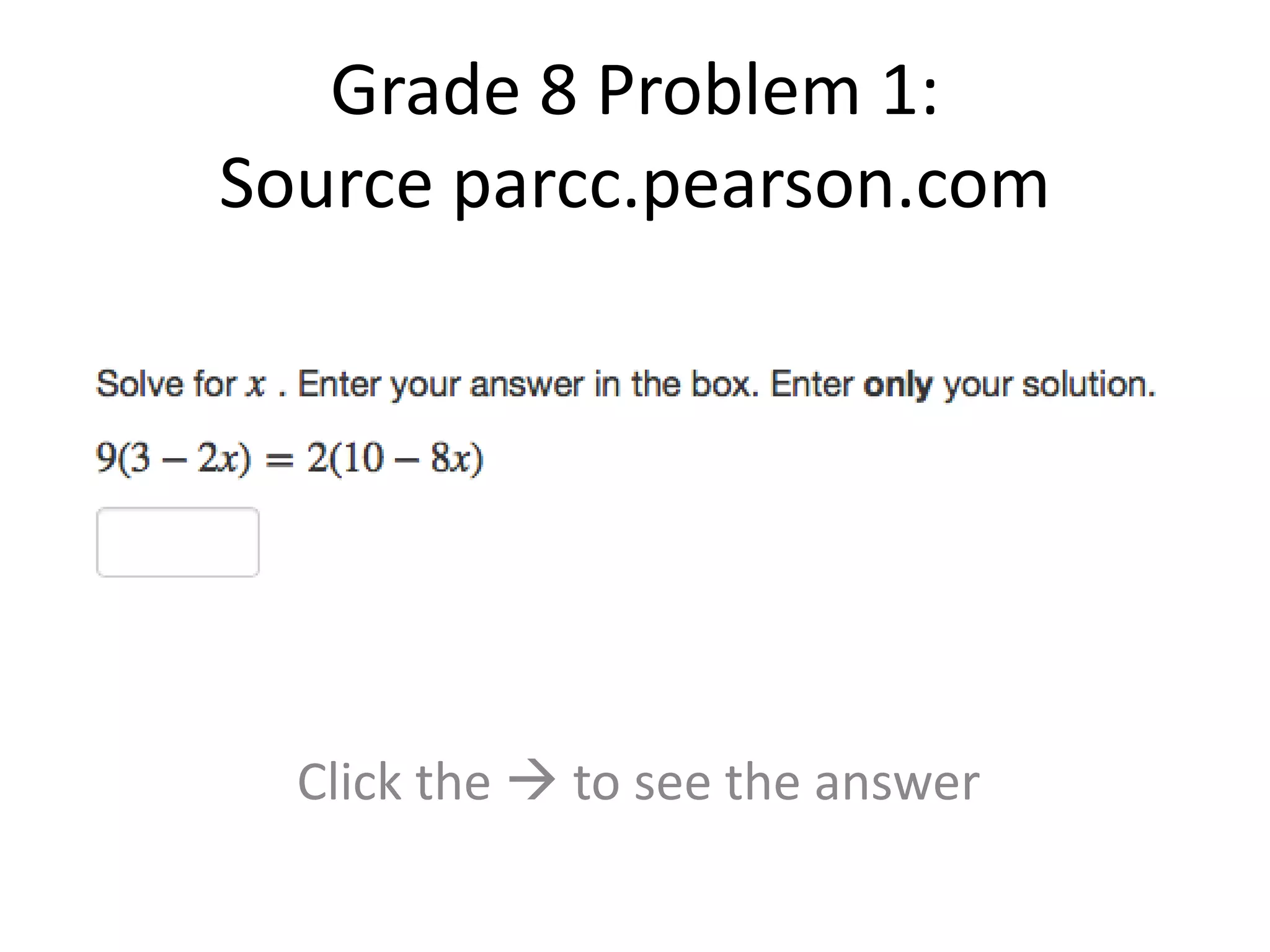
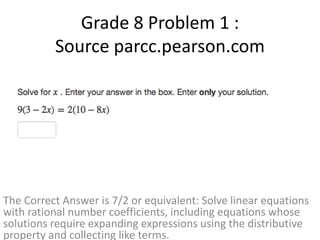
The Correct Answer is 7/2 or equivalent: Solve linear equations 
with rational number coefficients, including equations whose 
solutions require expanding expressions using the distributive 
property and collecting like terms.
Grade 8 Problem 2: 
Source parcc.pearson.com 
Click the  to see the answer
Grade 8 Problem 2 : 
Source parcc.pearson.com 
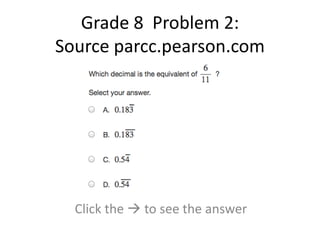
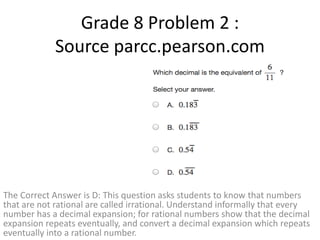
The Correct Answer is D: This question asks students to know that numbers 
that are not rational are called irrational. Understand informally that every 
number has a decimal expansion; for rational numbers show that the decimal 
expansion repeats eventually, and convert a decimal expansion which repeats 
eventually into a rational number.
Grade 8 Problem 3: 
Source parcc.pearson.com 
Click the  to see the answer
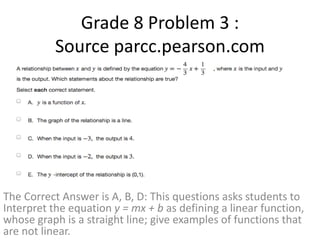
Grade 8 Problem 3 : 
Source parcc.pearson.com 
The Correct Answer is A, B, D: This questions asks students to 
Interpret the equation y = mx + b as defining a linear function, 
whose graph is a straight line; give examples of functions that 
are not linear.
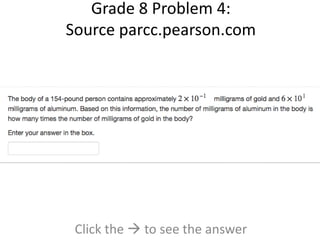
Grade 8 Problem 4: 
Source parcc.pearson.com 
Click the  to see the answer
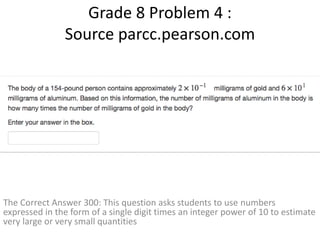
Grade 8 Problem 4 : 
Source parcc.pearson.com 
The Correct Answer 300: This question asks students to use numbers 
expressed in the form of a single digit times an integer power of 10 to estimate 
very large or very small quantities

Parcc 8

  • 1.
    Grade 8 Problem1: Source parcc.pearson.com Click the  to see the answer
  • 2.
    Grade 8 Problem1 : Source parcc.pearson.com The Correct Answer is 7/2 or equivalent: Solve linear equations with rational number coefficients, including equations whose solutions require expanding expressions using the distributive property and collecting like terms.
  • 3.
    Grade 8 Problem2: Source parcc.pearson.com Click the  to see the answer
  • 4.
    Grade 8 Problem2 : Source parcc.pearson.com The Correct Answer is D: This question asks students to know that numbers that are not rational are called irrational. Understand informally that every number has a decimal expansion; for rational numbers show that the decimal expansion repeats eventually, and convert a decimal expansion which repeats eventually into a rational number.
  • 5.
    Grade 8 Problem3: Source parcc.pearson.com Click the  to see the answer
  • 6.
    Grade 8 Problem3 : Source parcc.pearson.com The Correct Answer is A, B, D: This questions asks students to Interpret the equation y = mx + b as defining a linear function, whose graph is a straight line; give examples of functions that are not linear.
  • 7.
    Grade 8 Problem4: Source parcc.pearson.com Click the  to see the answer
  • 8.
    Grade 8 Problem4 : Source parcc.pearson.com The Correct Answer 300: This question asks students to use numbers expressed in the form of a single digit times an integer power of 10 to estimate very large or very small quantities