z
Are Organic
foods really
better?
Hailey Weijlard
z
z
What are organic foods?
Crops generally grown without synthetic
pesticides, artifical fertilizer, irradiation, or
biotechnology
Organic meats are Animals that eat
organically grown feed, aren't confined 100
percent of the time, and are raised without
antibiotics or synthetic growth hormones
z
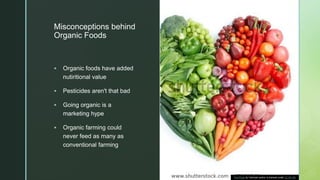
Misconceptions behind
Organic Foods
 Organic foods have added
nutiritional value
 Pesticides aren't that bad
 Going organic is a
marketing hype
 Organic farming could
never feed as many as
conventional farming
This Photo by Unknown author is licensed under CC BY-ND.
z
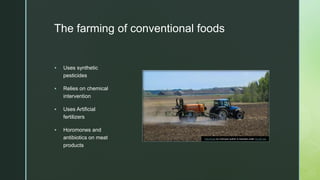
The farming of conventional foods
 Uses synthetic
pesticides
 Relies on chemical
intervention
 Uses Artificial
fertilizers
 Horomones and
antibiotics on meat
products
This Photo by Unknown author is licensed under CC BY-SA.
z
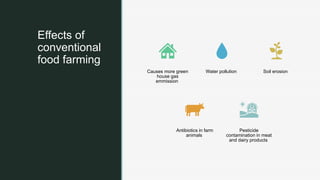
Effects of
conventional
food farming
Causes more green
house gas
emmission
Water pollution Soil erosion
Antibiotics in farm
animals
Pesticide
contamination in meat
and dairy products
z
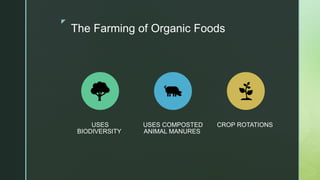
The Farming of Organic Foods
USES
BIODIVERSITY
USES COMPOSTED
ANIMAL MANURES
CROP ROTATIONS
z
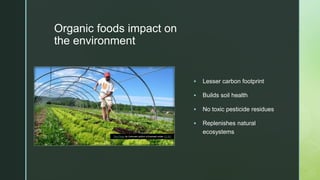
Organic foods impact on
the environment
 Lesser carbon footprint
 Builds soil health
 No toxic pesticide residues
 Replenishes natural
ecosystems
This Photo by Unknown author is licensed under CC BY.
z
The Health Harms of Pesticides
Linked to many types of cancer
In 2010 the university of Montreal and Harvard university released
a study that exposure could double a childs chance of developing
ADHD
Another study by public health institutions found a sixfold increase
in risk factors for autism spectrum disorder
Pesticide exposure causes farm workers to suffer more chemical
related injuries and illnesses
This Photo by Unknown author is licensed under CC BY-SA.
z
Problems with choosing
an organic lifestyle
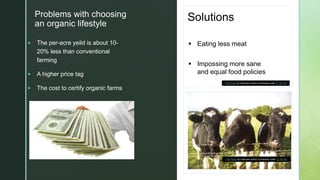
 The per-acre yeild is about 10-
20% less than conventional
farming
 A higher price tag
 The cost to certify organic farms
Solutions
 Eating less meat
 Impossing more sane
and equal food policies
This Photo by Unknown author is licensed under CC BY-NC.
This Photo by Unknown author is licensed under CC BY-SA.
z
Why go Organic?
A mostly organic diet led to a 90% reduction in pesticide
levels detected in urine
Better for the environment
Better working conditions for farm workers
Better taste
Organic farms use 50% less energy than conventional
farms
z
Work cited
Aubrey, Allison, and Dan Charles. “Why Organic Food May Not Be Healthier For You.” NPR, NPR, 4 Sept.
2012, www.npr.org/sections/thesalt/2012/09/04/160395259/why-organic-food-may-not-be-healthier-for-you.
Chait, Jennifer. “Top 8 Myths on Buying Organic (and Why They're Mostly Not True).” The Balance Small Business,
The Balance Small Business, 20 Nov. 2019, www.thebalancesmb.com/top-myths-about-organic-food-2538174.
DeCostole, Jessica. “5 Things You Should Know About Organic Food.” Redbook, Redbook, 5 Nov. 2018,
www.redbookmag.com/body/healthy-eating/a2016/truth-about-organic-foods/.
Harvard Health Publishing. “Should You Go Organic?” Harvard Health, Sept. 2015, www.health.harvard.edu/staying-
healthy/should-you-go-organic.
“Organic vs Conventional.” Rodale Institute, 2020, rodaleinstitute.org/why-organic/organic-basics/organic-vs-
conventional/.
Robbins, Ocean. “Is Organic Food Worth the Cost?” Foodrevolution.org, 19 Apr. 2019,
foodrevolution.org/blog/organic-food-prices/.

Presentation

  • 1.
  • 2.
    z z What are organicfoods? Crops generally grown without synthetic pesticides, artifical fertilizer, irradiation, or biotechnology Organic meats are Animals that eat organically grown feed, aren't confined 100 percent of the time, and are raised without antibiotics or synthetic growth hormones
  • 3.
    z Misconceptions behind Organic Foods Organic foods have added nutiritional value  Pesticides aren't that bad  Going organic is a marketing hype  Organic farming could never feed as many as conventional farming This Photo by Unknown author is licensed under CC BY-ND.
  • 4.
    z The farming ofconventional foods  Uses synthetic pesticides  Relies on chemical intervention  Uses Artificial fertilizers  Horomones and antibiotics on meat products This Photo by Unknown author is licensed under CC BY-SA.
  • 5.
    z Effects of conventional food farming Causesmore green house gas emmission Water pollution Soil erosion Antibiotics in farm animals Pesticide contamination in meat and dairy products
  • 6.
    z The Farming ofOrganic Foods USES BIODIVERSITY USES COMPOSTED ANIMAL MANURES CROP ROTATIONS
  • 7.
    z Organic foods impacton the environment  Lesser carbon footprint  Builds soil health  No toxic pesticide residues  Replenishes natural ecosystems This Photo by Unknown author is licensed under CC BY.
  • 8.
    z The Health Harmsof Pesticides Linked to many types of cancer In 2010 the university of Montreal and Harvard university released a study that exposure could double a childs chance of developing ADHD Another study by public health institutions found a sixfold increase in risk factors for autism spectrum disorder Pesticide exposure causes farm workers to suffer more chemical related injuries and illnesses This Photo by Unknown author is licensed under CC BY-SA.
  • 9.
    z Problems with choosing anorganic lifestyle  The per-acre yeild is about 10- 20% less than conventional farming  A higher price tag  The cost to certify organic farms Solutions  Eating less meat  Impossing more sane and equal food policies This Photo by Unknown author is licensed under CC BY-NC. This Photo by Unknown author is licensed under CC BY-SA.
  • 10.
    z Why go Organic? Amostly organic diet led to a 90% reduction in pesticide levels detected in urine Better for the environment Better working conditions for farm workers Better taste Organic farms use 50% less energy than conventional farms
  • 11.
    z Work cited Aubrey, Allison,and Dan Charles. “Why Organic Food May Not Be Healthier For You.” NPR, NPR, 4 Sept. 2012, www.npr.org/sections/thesalt/2012/09/04/160395259/why-organic-food-may-not-be-healthier-for-you. Chait, Jennifer. “Top 8 Myths on Buying Organic (and Why They're Mostly Not True).” The Balance Small Business, The Balance Small Business, 20 Nov. 2019, www.thebalancesmb.com/top-myths-about-organic-food-2538174. DeCostole, Jessica. “5 Things You Should Know About Organic Food.” Redbook, Redbook, 5 Nov. 2018, www.redbookmag.com/body/healthy-eating/a2016/truth-about-organic-foods/. Harvard Health Publishing. “Should You Go Organic?” Harvard Health, Sept. 2015, www.health.harvard.edu/staying- healthy/should-you-go-organic. “Organic vs Conventional.” Rodale Institute, 2020, rodaleinstitute.org/why-organic/organic-basics/organic-vs- conventional/. Robbins, Ocean. “Is Organic Food Worth the Cost?” Foodrevolution.org, 19 Apr. 2019, foodrevolution.org/blog/organic-food-prices/.

Editor's Notes

  • #3 As you can see from the slide the difference between organic foods and conventional foods is in the way that they are produced. The USDA certifies organic crops, animal products, and processed foods and must be 95% organic to carry a USDA organic seal. 
  • #4 The organic food industry is a booming and $29 billion industry. With growing popularity comes an increase in misconceptions as well as new research for and against organic foods. The biggest misconception is that I found was many consumers think that organic foods have more nutritional value than conventional foods. The evidence to support that claim is very weak but somehow it still seems to be one of the biggest selling points. Consumers are buying organic foods are being purchased for the wrong reasons. The argument that will be made in this presentation is that organic foods are better but for another reason. 
  • #5 Thoroughout this course we have been exposed to the world of agriculture. The foods that we eat everyday are filled with pesticides, antibiotics, and horomones. Consumers are lied to a lot by big companies and conventional farming is not nearly as regulated as organic farms. 
  • #6 The farming methods used by conventional farms have devastating consequences on the environment. There is no definitive evidence to suggest that the health of individuals is neccesarily affected however many researchers have found that the farming is not good from an environmental stand point. 
  • #7 Biodiversity is the variation of life on earth which is used to an advantage with the farming of organic foods, where as conventional farming destroys diodiversity. The farming of organic foods doesn’t focus on not inputting conventional chemicals but instead just really emphasizes the natural process of the growth of crops.  
  • #8 The farming of organic foods has a good impact on the environment which in turn has a good impact on our health. The farming of these crops is focused on overall system health and replenishing soil fertility and has many strategies to develop and maintain biological diversity. 
  • #9 The use of pesticides harms everyone. There is clear research that pesticides harm our health and build up in our systems as the years go by. For me that’s a very scary thought when you break it down that you have this toxic product building up in our systems. Also Runnoff from pesticides is spreading thorughout nature and causing pollution in soil and water and killing animals and plants. 
  • #10 One of the main problems with making the switch to organic is that the cost of organic foods is higher. This is due to a number of things but mostly because food policies make it more expensive to have a more environmentally friendly production and healthier foods. Organic food is more expensive because those farms have to get certified and have a lot more regulations while conventional farms have a lot less regulations. There should be a fee those farms that are causing enironmental contamination. It almost like the policies are punishing farms that are trying to make the world a better place. Implimenting something like this would bring the cost of organic foods and conventional foods to a more equal level. Eating less meat would also help solve the problem of per acre yield as half of the worlds crops go to be feed for farm animals. If the need for farm animals were to decrease then organic cropping would be able to produce the same amount as conventional farming. 
  • #11 Organic foods are better for everyone. An individual eating organic helps others as it takes away business from those farms that are polluting the world we live in. After one week of an organic diet pesticide levels were decresed by 90%. That is a tremendous difference in just a week. Organic foods might not have an added nutritional value but definitely have an amazing effect on the body and the environment