Organic Food
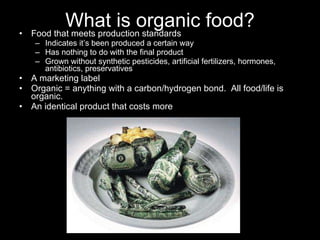
What is organic food? Food that meets production standards Indicates it’s been produced a certain way Has nothing to do with the final product Grown without synthetic pesticides, artificial fertilizers, hormones, antibiotics, preservatives A marketing label Organic = anything with a carbon/hydrogen bond.  All food/life is organic. An identical product that costs more
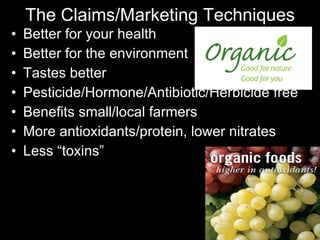
The Claims/Marketing Techniques Better for your health Better for the environment Tastes better Pesticide/Hormone/Antibiotic/Herbicide free Benefits small/local farmers More antioxidants/protein, lower nitrates Less “toxins”
Key words/phrases/scare tactics for marketing Organic Food Chemical/Pesticide/Hormone free “ Go organic for what’s  not  in the food” Natural Closer to nature Referring to conventional farming methods as: Chemical farming Industrial Agriculture
The Truth Is organic food better for your health? No scientific evidence (Britain’s Food Standards Agency, 2009) Nutrient content determined primarily by plant’s heredity Is pesticide/herbicide residue harmful? No scientific evidence for cancer (ACS, 2006) May even be beneficial Natural chemicals in plants more toxic than residual pesticides Is it better for the environment? More land for the same amount of food Biodiversity results from management, not unique to organic farming Is natural (cow manure) fertilizer better than synthetic? Greater chance for E. coli, salmonella Are you supporting small/local farmers? Most comes from the big “evil” corporations in California, 20% from China Does buying organic protect farm workers? 2/3 are suicides Illnesses are proportional between organic/conventional farming <1% occur in the US. Does organic farming use pesticides? Non-synthetic pesticides are used Does organic food taste better? Qualitative differences may be attributed to growing conditions, not due to organic farming standards Influenced by freshness http:// www.youtube.com/watch?v =8Zqe4ZV9LDs#t=2m45s
Crop Yield Organic farming produces lower yields Forage land for cows (natural fertilizer) Crop production has tripled between 1950 and 2000, land use only increased 10% Organic farming can only feed 4 billion ~2.5 billion would have to starve to death
Genetically Modified Foods Does not meet organic standards Takes at least 5 years for approval Must pass USDA, EPA, FDA standards Easier, less costly, more chemical free No evidence for “taking up” GMO’s genes into our chromosomes DNA is broken down The genes only work in plants anyways Not less nutritious Only known genes/proteins
Oprah’s Stance Website article references Britain’s Food Standards Agency’s article on nutritional differences (none) Rest of the article was dedicated to the organic movement side, tips A 2006 show featured Julia Roberts and author Sophie Uliano ( Gorgeously Green ) No opposing, scientific viewpoint was taken into consideration.  The show was intended to sell a product (Uliano’s book)
Ellen Degeneres Part of the Tierra Miguel Foundation’s Home Veggie Delivery Foundation delivers organic vegetables from local farms Website claims the food is “healthier and tastier” Teamed up with Halo Produces organic pet food
Sources Barrett, Stephen. “’Organic’ Foods: Certification Does Not Protect Consumers.”  Quackwatch.  Retrieved 9 April 2010.  < http://www.quackwatch.org/01QuackeryRelatedTopics/organic.html > Dangour, Alan et al. “Nutritional quality of organic foods: a systematic  review.” The American Journal of Clinical Nutrition.  29 July 2009.  Retrieved 7 April 2010.  http://www.ajcn.org/cgi/content/abstract/ajcn.2009.28041v1 Goldberg, Bob. “The Hypocrisy of Organic Farmers.” 5 June 2000. Retrieved 7  April 2010.  http://www.agbioworld.org/biotech-info/articles/biotech-art/hypocrisy.html Leonard, Andrew. “Save the rain forest – boycott organic?” 11 December 2006.  Retrieved 7 April 2010.  < http://www.salon.com/technology/how_the_world_works/2006/12/11/borlaug >  MacKerron D.K.L. et al. &quot;Organic farming: science and belief.&quot;  Individual articles  from the 1998/99 Report.  Scottish Crop Research Institute, 1 Dec. 1999.  Retrieved 7 April 2010.  <http://www.scri.ac.uk/scri/file/individualreports/1999/06ORGFAR.PDF>  Shea, Erin. “The Costs and Benefits of Buying Organic Food.” 13 August 2009.  Retrieved 7 April 2010.  < http:// www.oprah.com /health/Should-You-Buy-Organic-Food/ >

Organic Food

  • 1.
  • 2.
    What is organicfood? Food that meets production standards Indicates it’s been produced a certain way Has nothing to do with the final product Grown without synthetic pesticides, artificial fertilizers, hormones, antibiotics, preservatives A marketing label Organic = anything with a carbon/hydrogen bond. All food/life is organic. An identical product that costs more
  • 3.
    The Claims/Marketing TechniquesBetter for your health Better for the environment Tastes better Pesticide/Hormone/Antibiotic/Herbicide free Benefits small/local farmers More antioxidants/protein, lower nitrates Less “toxins”
  • 4.
    Key words/phrases/scare tacticsfor marketing Organic Food Chemical/Pesticide/Hormone free “ Go organic for what’s not in the food” Natural Closer to nature Referring to conventional farming methods as: Chemical farming Industrial Agriculture
  • 5.
    The Truth Isorganic food better for your health? No scientific evidence (Britain’s Food Standards Agency, 2009) Nutrient content determined primarily by plant’s heredity Is pesticide/herbicide residue harmful? No scientific evidence for cancer (ACS, 2006) May even be beneficial Natural chemicals in plants more toxic than residual pesticides Is it better for the environment? More land for the same amount of food Biodiversity results from management, not unique to organic farming Is natural (cow manure) fertilizer better than synthetic? Greater chance for E. coli, salmonella Are you supporting small/local farmers? Most comes from the big “evil” corporations in California, 20% from China Does buying organic protect farm workers? 2/3 are suicides Illnesses are proportional between organic/conventional farming <1% occur in the US. Does organic farming use pesticides? Non-synthetic pesticides are used Does organic food taste better? Qualitative differences may be attributed to growing conditions, not due to organic farming standards Influenced by freshness http:// www.youtube.com/watch?v =8Zqe4ZV9LDs#t=2m45s
  • 6.
    Crop Yield Organicfarming produces lower yields Forage land for cows (natural fertilizer) Crop production has tripled between 1950 and 2000, land use only increased 10% Organic farming can only feed 4 billion ~2.5 billion would have to starve to death
  • 7.
    Genetically Modified FoodsDoes not meet organic standards Takes at least 5 years for approval Must pass USDA, EPA, FDA standards Easier, less costly, more chemical free No evidence for “taking up” GMO’s genes into our chromosomes DNA is broken down The genes only work in plants anyways Not less nutritious Only known genes/proteins
  • 8.
    Oprah’s Stance Websitearticle references Britain’s Food Standards Agency’s article on nutritional differences (none) Rest of the article was dedicated to the organic movement side, tips A 2006 show featured Julia Roberts and author Sophie Uliano ( Gorgeously Green ) No opposing, scientific viewpoint was taken into consideration. The show was intended to sell a product (Uliano’s book)
  • 9.
    Ellen Degeneres Partof the Tierra Miguel Foundation’s Home Veggie Delivery Foundation delivers organic vegetables from local farms Website claims the food is “healthier and tastier” Teamed up with Halo Produces organic pet food
  • 10.
    Sources Barrett, Stephen.“’Organic’ Foods: Certification Does Not Protect Consumers.” Quackwatch. Retrieved 9 April 2010. < http://www.quackwatch.org/01QuackeryRelatedTopics/organic.html > Dangour, Alan et al. “Nutritional quality of organic foods: a systematic review.” The American Journal of Clinical Nutrition. 29 July 2009. Retrieved 7 April 2010. http://www.ajcn.org/cgi/content/abstract/ajcn.2009.28041v1 Goldberg, Bob. “The Hypocrisy of Organic Farmers.” 5 June 2000. Retrieved 7 April 2010. http://www.agbioworld.org/biotech-info/articles/biotech-art/hypocrisy.html Leonard, Andrew. “Save the rain forest – boycott organic?” 11 December 2006. Retrieved 7 April 2010. < http://www.salon.com/technology/how_the_world_works/2006/12/11/borlaug > MacKerron D.K.L. et al. &quot;Organic farming: science and belief.&quot;  Individual articles from the 1998/99 Report.  Scottish Crop Research Institute, 1 Dec. 1999. Retrieved 7 April 2010. <http://www.scri.ac.uk/scri/file/individualreports/1999/06ORGFAR.PDF> Shea, Erin. “The Costs and Benefits of Buying Organic Food.” 13 August 2009. Retrieved 7 April 2010. < http:// www.oprah.com /health/Should-You-Buy-Organic-Food/ >

Editor's Notes

  • #6 No cases of anyone becoming ill from consuming produce contaminated with residue from pesticides or herbicides, either organic or synthetic. Both are certified safe for human exposure, and both are applied at trace levels well below safety standards.