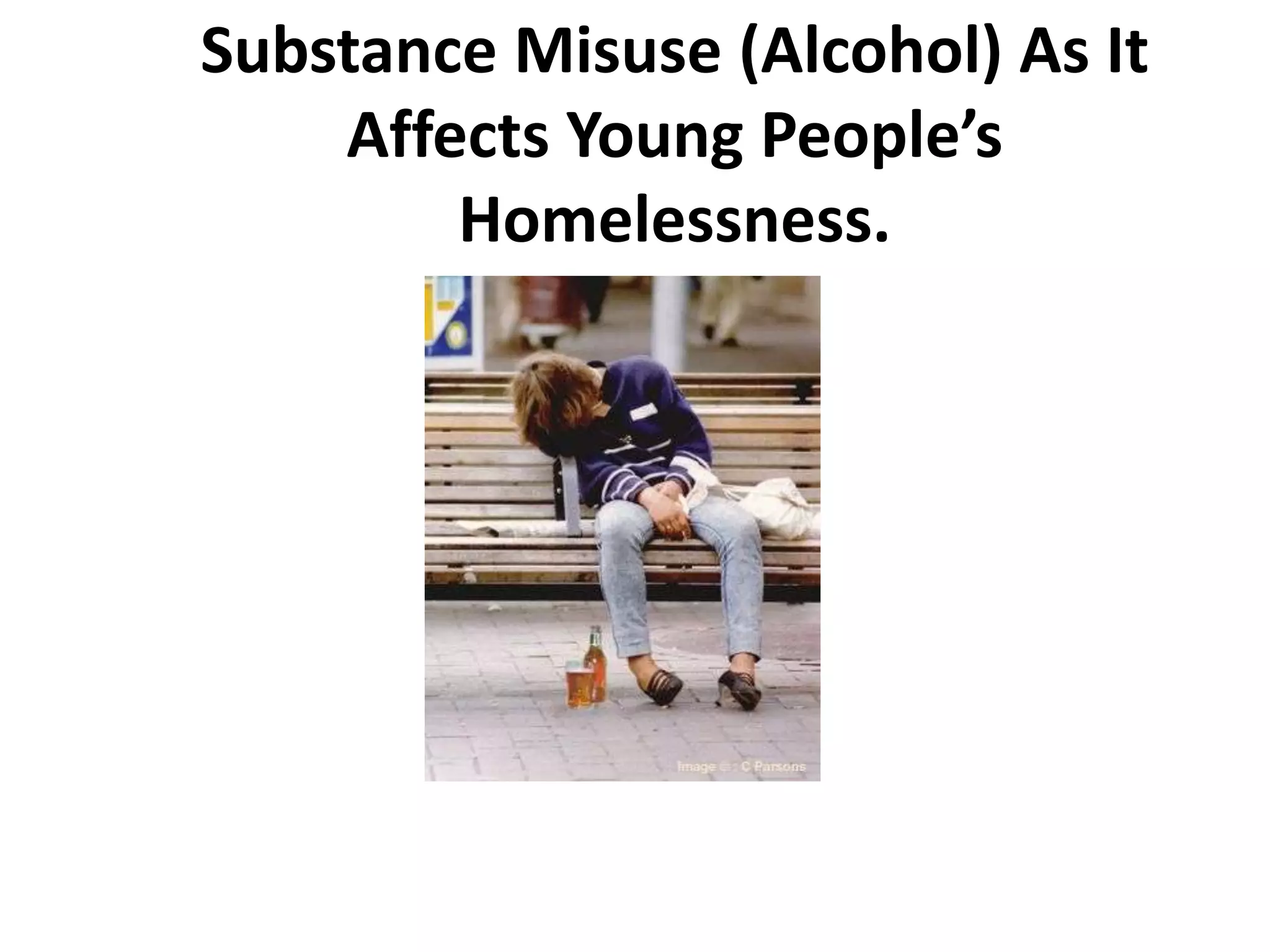
Substance Misuse (Alcohol) As It
    Affects Young People’s
        Homelessness.
• In this presentation, i am going to define
  alcohol misuse, its effects which shall be
  linked to homelessness and as conclusion
  support available to young people under this
  situation.
• Alcohol misuse which lead to binge drinking has
  been defined by the National Institute of Health
  (NIH) as a form of alcohol abuse, alcohol
  addiction, alcohol dependence or alcoholism. The
  NIH described all of these as the continued use of
  alcohol, irrespective of the development of social,
  legal or health problems. But what is alcohol?
  Again, NIH defined it as the intoxicating chemical
  in drinks such as beer, wine and distilled liquor
  with the formula C2H5OH.
• Problems with binge drinking:
• These are social, physical and health. Socially,
  8% of young male and 7% of young female
  drinkers get into trouble with the police after
  being drunk and most young people who are
  binge drunk damage objects, lose money, get
  involved in a traffic accident or have
  unprotected sex (Institute of Alcohol Studies).
• Physically, IAS reveals that many young people
  have done physical harm to themselves
  through accidents sustained while drink
  driving.
• Health wise, IAS has revealed in their studies that
  alcohol affects the whole of the brain in particular the
  frontal lobes which are responsible for higher level
  thinking such as planning, decision making and judging
  the likely consequences of action. Therefore, they said
  brain abnormalities are found in young people with
  alcohol disorders and in those who have never
  consumed alcohol but have a family history of abuse.
  Rainstrick and Davidson(1985) stated that gastritis and
  vitamin deficiency are more likely to occur among
  drinkers of spirits. Abuse of alcohol can also cause
  other medical problems including; liver disease,
  hepatitis, cardiovascular disease etc.
• How will the above problems create
  homelessness:
• Based on the Housing Pathway theory of Ford et
  al (2002) where they studied young people
  housing transition, The ‘chaotic pathway where it
  has been associated with no planning, constraint
  and absent of family support is more likely to be
  associated with YP abusing alcohol (substance)
  since they are often with the problems
  mentioned above including; police
  trouble, antisocial behaviour and sickness.
• The ‘unplanned pathways’ with no planning and substantial
  constraint could as well be linked to alcohol abuse with the same
  numerous social, physical and medical problems as mentioned
  above. More over, binge drinkers among young people are likely not
  to be in education, employment or training (NEET) and therefore
  would not have money, to buy or even rent accommodation
  therefore be homeless. Culturally, some parents especially ethnic
  black Africans parents would see it as a disgrace to see their child
  being alcoholic and therefore could expel their children away from
  home making such a child to be homeless since such child would
  not be able to afford a home for themselves.

• Marianne, B. M. (2009) suggested that a number of risk factors
  including substance use and anti-social behaviour might not be
  directly related to homelessness but rather share common causes
  like poor family relation that could lead to homelessness.
• In conclusion, there are support available to such
  young people and they include:
• Foyer; these are social charitable landlords who
  offer accommodation to venerable young people
  such as those abusing substance including
  alcohol. On admitting them they are sent to
  rehabilitation centre to help them recover from
  alcohol and further send them to training or even
  help them to find a job within the brief period
  they house them.
• For example, The Foyer Scheme aims to help
  single young vulnerable homeless people
  obtain confidence and independence thereby
  enabling them to achieve their full potential.
  By providing opportunities in areas such as
  training, employment and personal
  development the foyer can assist in breaking
  the no home-no-job-no home cycle’(2007)
References
• Ford, J., Rugg, J. And Burrows, R. (2002). Conceptualising the
  contemporary role of housing in the transition to adult life in England.
  Journal of Urban Studies, Vol.39, No.13 pp 2455-67.
• Marianne, B. M. Van den Bree, Katherine, S., Adrian, B., Sebastian, M.,
  Hollie, T. And Pamela, J. T. (2009). A longitudinal population-based study of
  factors in adolescence predicting homelessness in young adulthood.
  Journal of Adolescent Health,Vol. 45. pp. 571-578.
• Institute of Alcohol Studies (undated) Fact Sheet – Adolescent and Alcohol.
  [Internet] http://www.ias.org.uk?resources/factsheets.html-
  [Accessed]22/11/08.
• National Institute of Health (undated). Understanding Alcohol – Glossary.
  [Internet]
  http://science.education.nih.gov/supplements/nih3/alcohol/other/glossar
  y.htm [Accessed] 13/11/08.
• Rainstrick, D. And Davidson, R. (1985). Alcohol and Drug Addiction.
  London: Churchill Livingstone.

Presentation

  • 1.
    Substance Misuse (Alcohol)As It Affects Young People’s Homelessness.
  • 2.
    • In thispresentation, i am going to define alcohol misuse, its effects which shall be linked to homelessness and as conclusion support available to young people under this situation.
  • 3.
    • Alcohol misusewhich lead to binge drinking has been defined by the National Institute of Health (NIH) as a form of alcohol abuse, alcohol addiction, alcohol dependence or alcoholism. The NIH described all of these as the continued use of alcohol, irrespective of the development of social, legal or health problems. But what is alcohol? Again, NIH defined it as the intoxicating chemical in drinks such as beer, wine and distilled liquor with the formula C2H5OH.
  • 4.
    • Problems withbinge drinking: • These are social, physical and health. Socially, 8% of young male and 7% of young female drinkers get into trouble with the police after being drunk and most young people who are binge drunk damage objects, lose money, get involved in a traffic accident or have unprotected sex (Institute of Alcohol Studies).
  • 5.
    • Physically, IASreveals that many young people have done physical harm to themselves through accidents sustained while drink driving.
  • 6.
    • Health wise,IAS has revealed in their studies that alcohol affects the whole of the brain in particular the frontal lobes which are responsible for higher level thinking such as planning, decision making and judging the likely consequences of action. Therefore, they said brain abnormalities are found in young people with alcohol disorders and in those who have never consumed alcohol but have a family history of abuse. Rainstrick and Davidson(1985) stated that gastritis and vitamin deficiency are more likely to occur among drinkers of spirits. Abuse of alcohol can also cause other medical problems including; liver disease, hepatitis, cardiovascular disease etc.
  • 7.
    • How willthe above problems create homelessness: • Based on the Housing Pathway theory of Ford et al (2002) where they studied young people housing transition, The ‘chaotic pathway where it has been associated with no planning, constraint and absent of family support is more likely to be associated with YP abusing alcohol (substance) since they are often with the problems mentioned above including; police trouble, antisocial behaviour and sickness.
  • 8.
    • The ‘unplannedpathways’ with no planning and substantial constraint could as well be linked to alcohol abuse with the same numerous social, physical and medical problems as mentioned above. More over, binge drinkers among young people are likely not to be in education, employment or training (NEET) and therefore would not have money, to buy or even rent accommodation therefore be homeless. Culturally, some parents especially ethnic black Africans parents would see it as a disgrace to see their child being alcoholic and therefore could expel their children away from home making such a child to be homeless since such child would not be able to afford a home for themselves. • Marianne, B. M. (2009) suggested that a number of risk factors including substance use and anti-social behaviour might not be directly related to homelessness but rather share common causes like poor family relation that could lead to homelessness.
  • 9.
    • In conclusion,there are support available to such young people and they include: • Foyer; these are social charitable landlords who offer accommodation to venerable young people such as those abusing substance including alcohol. On admitting them they are sent to rehabilitation centre to help them recover from alcohol and further send them to training or even help them to find a job within the brief period they house them.
  • 10.
    • For example,The Foyer Scheme aims to help single young vulnerable homeless people obtain confidence and independence thereby enabling them to achieve their full potential. By providing opportunities in areas such as training, employment and personal development the foyer can assist in breaking the no home-no-job-no home cycle’(2007)
  • 11.
    References • Ford, J.,Rugg, J. And Burrows, R. (2002). Conceptualising the contemporary role of housing in the transition to adult life in England. Journal of Urban Studies, Vol.39, No.13 pp 2455-67. • Marianne, B. M. Van den Bree, Katherine, S., Adrian, B., Sebastian, M., Hollie, T. And Pamela, J. T. (2009). A longitudinal population-based study of factors in adolescence predicting homelessness in young adulthood. Journal of Adolescent Health,Vol. 45. pp. 571-578. • Institute of Alcohol Studies (undated) Fact Sheet – Adolescent and Alcohol. [Internet] http://www.ias.org.uk?resources/factsheets.html- [Accessed]22/11/08. • National Institute of Health (undated). Understanding Alcohol – Glossary. [Internet] http://science.education.nih.gov/supplements/nih3/alcohol/other/glossar y.htm [Accessed] 13/11/08. • Rainstrick, D. And Davidson, R. (1985). Alcohol and Drug Addiction. London: Churchill Livingstone.