BALTISTAN
INTRODUCTION
• Northern Pakistan , bordering
  Xinjiang Region of China
• Total Population: 300,000
• Area: 27400 Km2
• Language: Balti
• Tibetan King Control in 7th
  Century
• Islam Was First Introduced in
  16th Century
• became part of Pakistan of
  their own free will in 1948
• China
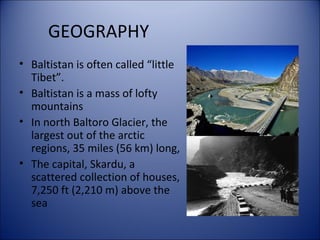
GEOGRAPHY
• Baltistan is often called “little
  Tibet”.
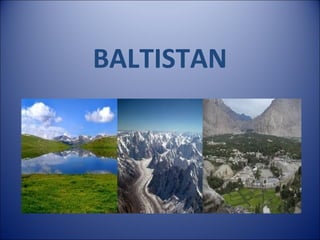
• Baltistan is a mass of lofty
  mountains
• In north Baltoro Glacier, the
  largest out of the arctic
  regions, 35 miles (56 km) long,
• The capital, Skardu, a
  scattered collection of houses,
  7,250 ft (2,210 m) above the
  sea
IMPORTANCE
• 29th august 2009
  Pakistan announced that
  the northern areas are a
  new province of
  Pakistan, Gilgit Baltistan.
• High touristic value.
• Highly valued for its
  strategic geo-political
  location.
 Culture of Baltistan is influenced by Central Asian, Tibetan
  and Indian civilizations.

 Absence of a written script in the last several centuries has
  led to loss of different cultural aspects.

 Whatever is available today is part of the oral traditions
  transmitted from generation to generation.

 Baltistan is home to a number of diversified cultures, ethnic
  groups, languages and various backgrounds.
 Baltistan region, which in its amazing history has been known
  by various names, has one of the unique geographical
  composition on the globe.


 Baltistan is like a paradise for
  mountaineers, trekkers and anglers.

 Baltistan is proud of her thousands of years of rich civilization,
  architecture, costumes, Foods, festivals, dances, language,
  script.
Traditional music has heavy influence from Central Asia, Tibet
and India.

Dancers wear long robes called Gonchas, Shoka and Choga
and dance in groups

Old Man Dance
This dance is performed by more than one man wear some
old style dresses and wear local hat and dance

Sword Dance
This unique dance is performed by men taking one sword in
right and Shield in left. One to six participants as pair can
dance.
DAKHON-KAREE DANCE (BALTISTAN)
GROUP DANCE (BALTISTAN)
DANCE OF THE MARKHOOR
      (BALTISTAN)
Instruments used in Baltistan are, Dadang (drum), Damal and
Surnai while some other instruments like Sitar, Gabi(flut) Rabab
and duff represent the different areas. Beside these khling-boo,
chang, porgho-too etc instruments are used in Baltistan region.

.
MUSICAL INSTRUMENTS
SUNA


                                DAANG


    DOLKI


BALTISTAN MUSICAL INSTRUMENTS
Jashne-e-Navroz,
 Jashn-e-Baharan
 Jashn-e-Ghanchee
 Cultural festivals.

• RELIGIOUS FESTIVALS
Eid – ul-Fitr and Eid-ul-azha is celebrated by all
   inhabitants of Baltistan.
Shia and NoorBakhshis celebrate Eid-e-Ghadir and
   other relegious events.
 Majority of the inhabitants are Muslims belonging
  to different communities of interpretations i.e.
  Sunnies, Shias and NoorBakshis.

 For religious practices Sunnies go to Masjid, Shias
  go to Imam Baraand Noorbakhshis go to Khankaah.
Foods of Baltistan Region


                                     Kiseer
Hrsapkhoor
Foods of Baltistan Region


                                         NAMKEEN CHEA


RGEARATEE - ROTI                         ZANGKHOOR
Foods of Baltistan Region


         MARZAAN


         PRAAPOO
Foods of Baltistan Region


BANGYAS                               BALAY


                                       ROTI +
                                      DARSAMIK
Foods of Baltistan Region


                PHEAKH-TAPH
Historical places
 A mosque was built by Amir -e- Kabir Syed Ali Hamdani
  in the 14th Century AD.it is located in SHIGAR VALLEY.

   The architectural design of the mosque is unique and
    presents the true picture of ancient Islamic art.
Historical places
•The original Shigar Fort Palace (known as Fong-
Khar, which in the local Balti language means,
"Palace on the Rock"), was built by Hassan Khan,
the 20th ruler of the Amacha Dynasty, in the
early 17th century.
Wedding Ceremonay:-

Marriage is believed to be a very vital part of the culture
and traditions of the people of Baltistan.

The marriage ceremony of Baltistan is very simple.

Dowery is totally absent in the tradition of there marriage
…

if a father wants to give something as a gift for his daughter
it is appreciated but it is not MUST to give dowery to the
bride..
Wedding Ceremonay:-


•The idea behind the absence of dowry is that girl
are must educated by their parents and almost 60%
of girls are well educated in recent years so
education is preferred the most as compared to
other needs and luxuries

•The suitable and favorable season for marriage in
Baltistan is in the month of JUNE,JULY and AUGUST
because these are the months when there is warm
weather and people and students on their summer
vacations enjoy wedding of their nears ones.
Games & Sports
Since old time many traditional games were played In
Baltistan including:
POLO: Game of kings
It is assumed in baltistan Polo came from a balti word Tra
polo
Tra means horse in balti and polo means round shape thing
According to a legend it was origanated in Gilgit Baltistan and
spread to far flung places
For example China, Central asia and India
It is played in its orignal unique style all around gilgit baltistan
without fouls
 Polo stick is called BINTOOK in balti
Games & Sports
Historical Equipment of Baltistan


 CHANG-RKEAL
 Made of animal
leather, used for
    storage.
Historical Equipment of Baltistan


 Local Weaving
   machine.


CHARA – A locally             KAAR – locally
  weaved Rug.                   weaved
Historical Equipment of Baltistan


           Locally produced
               pottery.
Historical Equipment of Baltistan


             RDOZANG – Local
              pottery made of
                   stone.
Old Houses of Baltistan


      An old house.
Historical Equipment of Baltistan


   Gor Gor – It is used for mixing of different
                    solutions.
Historical Equipment of Baltistan


    A man having a CHORONG on his back
    mainly used for agricultural purpose.
Baltistan

Baltistan

  • 1.
  • 2.
    INTRODUCTION • Northern Pakistan, bordering Xinjiang Region of China • Total Population: 300,000 • Area: 27400 Km2 • Language: Balti • Tibetan King Control in 7th Century • Islam Was First Introduced in 16th Century • became part of Pakistan of their own free will in 1948 • China
  • 3.
    GEOGRAPHY • Baltistan isoften called “little Tibet”. • Baltistan is a mass of lofty mountains • In north Baltoro Glacier, the largest out of the arctic regions, 35 miles (56 km) long, • The capital, Skardu, a scattered collection of houses, 7,250 ft (2,210 m) above the sea
  • 4.
    IMPORTANCE • 29th august2009 Pakistan announced that the northern areas are a new province of Pakistan, Gilgit Baltistan. • High touristic value. • Highly valued for its strategic geo-political location.
  • 5.
     Culture ofBaltistan is influenced by Central Asian, Tibetan and Indian civilizations.  Absence of a written script in the last several centuries has led to loss of different cultural aspects.  Whatever is available today is part of the oral traditions transmitted from generation to generation.  Baltistan is home to a number of diversified cultures, ethnic groups, languages and various backgrounds.
  • 6.
     Baltistan region,which in its amazing history has been known by various names, has one of the unique geographical composition on the globe.  Baltistan is like a paradise for mountaineers, trekkers and anglers.  Baltistan is proud of her thousands of years of rich civilization, architecture, costumes, Foods, festivals, dances, language, script.
  • 7.
    Traditional music hasheavy influence from Central Asia, Tibet and India. Dancers wear long robes called Gonchas, Shoka and Choga and dance in groups Old Man Dance This dance is performed by more than one man wear some old style dresses and wear local hat and dance Sword Dance This unique dance is performed by men taking one sword in right and Shield in left. One to six participants as pair can dance.
  • 8.
  • 9.
  • 10.
    DANCE OF THEMARKHOOR (BALTISTAN)
  • 11.
    Instruments used inBaltistan are, Dadang (drum), Damal and Surnai while some other instruments like Sitar, Gabi(flut) Rabab and duff represent the different areas. Beside these khling-boo, chang, porgho-too etc instruments are used in Baltistan region. .
  • 12.
  • 13.
    SUNA DAANG DOLKI BALTISTAN MUSICAL INSTRUMENTS
  • 14.
    Jashne-e-Navroz,  Jashn-e-Baharan  Jashn-e-Ghanchee Cultural festivals. • RELIGIOUS FESTIVALS Eid – ul-Fitr and Eid-ul-azha is celebrated by all inhabitants of Baltistan. Shia and NoorBakhshis celebrate Eid-e-Ghadir and other relegious events.
  • 15.
     Majority ofthe inhabitants are Muslims belonging to different communities of interpretations i.e. Sunnies, Shias and NoorBakshis.  For religious practices Sunnies go to Masjid, Shias go to Imam Baraand Noorbakhshis go to Khankaah.
  • 16.
  • 17.
    Foods of BaltistanRegion Kiseer Hrsapkhoor
  • 18.
    Foods of BaltistanRegion NAMKEEN CHEA RGEARATEE - ROTI ZANGKHOOR
  • 19.
    Foods of BaltistanRegion MARZAAN PRAAPOO
  • 20.
    Foods of BaltistanRegion BANGYAS BALAY ROTI + DARSAMIK
  • 21.
    Foods of BaltistanRegion PHEAKH-TAPH
  • 22.
    Historical places  Amosque was built by Amir -e- Kabir Syed Ali Hamdani in the 14th Century AD.it is located in SHIGAR VALLEY.  The architectural design of the mosque is unique and presents the true picture of ancient Islamic art.
  • 23.
    Historical places •The originalShigar Fort Palace (known as Fong- Khar, which in the local Balti language means, "Palace on the Rock"), was built by Hassan Khan, the 20th ruler of the Amacha Dynasty, in the early 17th century.
  • 24.
    Wedding Ceremonay:- Marriage isbelieved to be a very vital part of the culture and traditions of the people of Baltistan. The marriage ceremony of Baltistan is very simple. Dowery is totally absent in the tradition of there marriage … if a father wants to give something as a gift for his daughter it is appreciated but it is not MUST to give dowery to the bride..
  • 25.
    Wedding Ceremonay:- •The ideabehind the absence of dowry is that girl are must educated by their parents and almost 60% of girls are well educated in recent years so education is preferred the most as compared to other needs and luxuries •The suitable and favorable season for marriage in Baltistan is in the month of JUNE,JULY and AUGUST because these are the months when there is warm weather and people and students on their summer vacations enjoy wedding of their nears ones.
  • 26.
    Games & Sports Sinceold time many traditional games were played In Baltistan including: POLO: Game of kings It is assumed in baltistan Polo came from a balti word Tra polo Tra means horse in balti and polo means round shape thing According to a legend it was origanated in Gilgit Baltistan and spread to far flung places For example China, Central asia and India It is played in its orignal unique style all around gilgit baltistan without fouls Polo stick is called BINTOOK in balti
  • 27.
  • 28.
    Historical Equipment ofBaltistan CHANG-RKEAL Made of animal leather, used for storage.
  • 29.
    Historical Equipment ofBaltistan Local Weaving machine. CHARA – A locally KAAR – locally weaved Rug. weaved
  • 30.
    Historical Equipment ofBaltistan Locally produced pottery.
  • 31.
    Historical Equipment ofBaltistan RDOZANG – Local pottery made of stone.
  • 32.
    Old Houses ofBaltistan An old house.
  • 33.
    Historical Equipment ofBaltistan Gor Gor – It is used for mixing of different solutions.
  • 34.
    Historical Equipment ofBaltistan A man having a CHORONG on his back mainly used for agricultural purpose.