 Muzammil Nagri
 Tariq Balti
 M Suleman
 Shahab
 M Jawwad Shamsi
History of GILGIT BALTISTAN
o Formerly known as the Northern Areas,
o In 1948, Gilgit Baltistan emerged on the map
of the world
o The people of the region fought their own war
against the Dogra Raj and won their freedom in
1st Nov 1947.
o In 2009 Pakistan give provincial setup in Gilgit
Baltistan.
o Capital: GILGIT
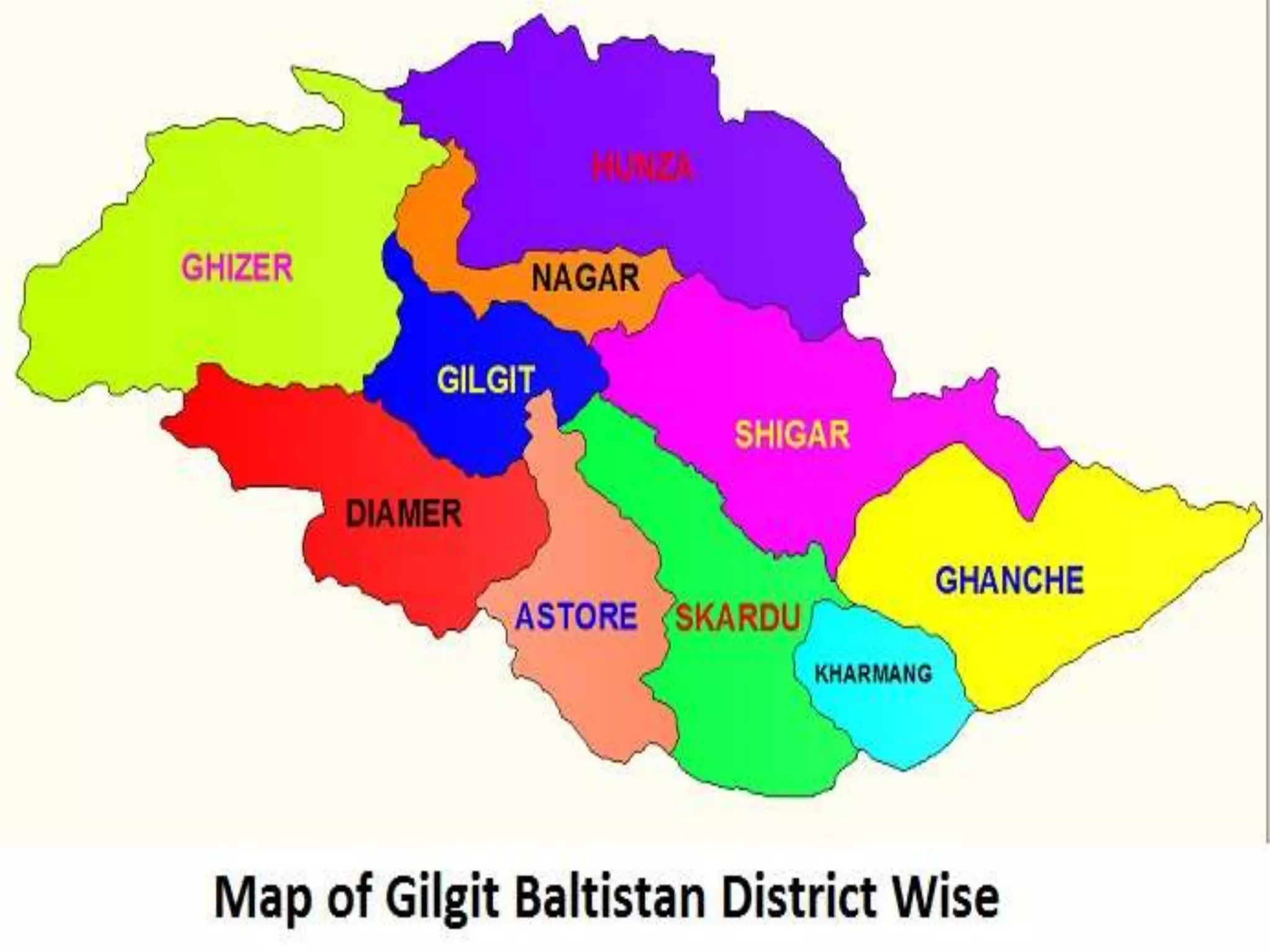
o Districts are 10.
o Largest city is Skardu.
o Population:22,00000.
o Area: 72,496 Square km.
 Ruled by Durani Empire of
AFGHANISTAN over the centuries.
 Muslim ruled about four centuries under
the Mughals (until 1751).
 B/w 1832 – 1860 the region conquered by
the Sikhs and Dogras.
 B/w 1935 – 1947 the territory of GILGIT
BALTISTAN was given to British on
lease.
 In 1947 , it came to under the control of
Pakistan.
• Culture shows moral and ethical values of a
region.
• Culture represents our history and the way our
ancestors lived and we have to transfer our rich
culture to our new youth.
• GILGIT BALTISTAN has its own rich and
unique culture and traditions which varies
from valley to valley
• People represents culture through different
famous festivals , dresses and foods.
 Culture of GILGIT BALTISTAN includes:-
 Sports
 Festivals
 Traditional dresses
 Foods
 Education system
 Languages
 Glaciers
 Forts
 Lakes
 Mountains
 Heroes
 Economy
 CONCLUSION
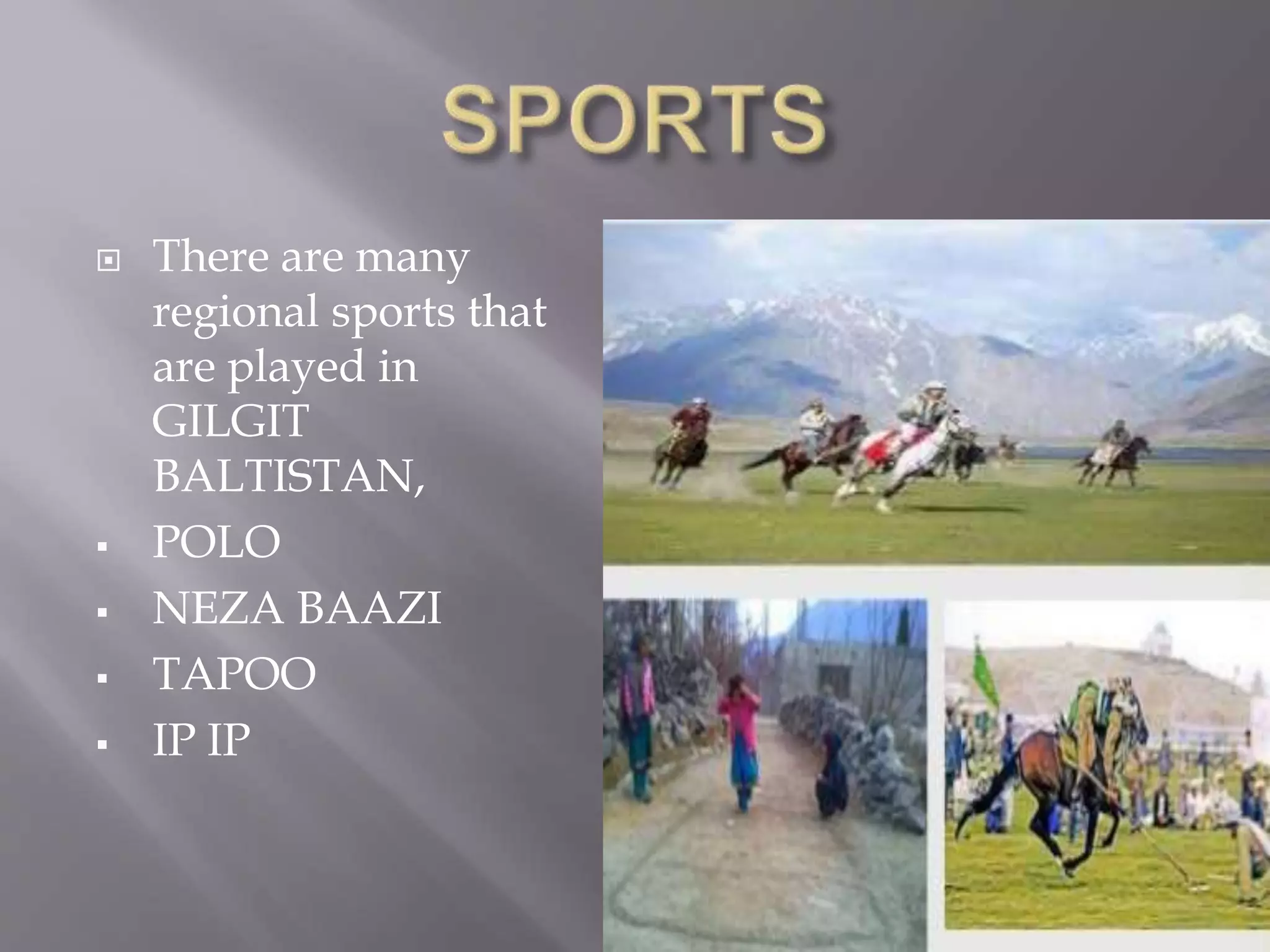
 There are many
regional sports that
are played in
GILGIT
BALTISTAN,
 POLO
 NEZA BAAZI
 TAPOO
 IP IP
 There are many religious and social / cultural
festivals celebrated by the people of GILGIT
BALTISTAN.
 Religious festivals are :-
o Eid ul Fitar
o Eid ul Adha
o Eid Milad un NABI
 Cultural festivals are:-
o Jashan e Bharaan.
o Shandoor Polo Festival.
o Babusar Polo Festival.
Except these fastivals some other
festivals are celebrated in GITGIT
baltistan which are shown below.
ABBASI KHUDAIE
 Giyaling Or Zaan
Go-Lee is to make your breakfast savory. It is
usually served on breakfast on usual occasions
but also cooked on special occasions as well.
Normally it is best with a Namkeen Chai, but
you can eat it with simple chai if you feel
uncomfortable with the
Namkeen thing. Giyaling is a local occasional
dish of a Hunza and Nagar valley. It is
specially made on the occasion of Gianni, and
Ginani is an event which is performed after the
cultivation of a crop especially the wheat.
 In the month of May
and June when
wheat began to
prepare, all the
owners of a land go
to their fields to
enjoy the Ginani
event with Giyaling.
Recipe of Giyaling.
Flat bread, made
with whole grain
flours, rich in
vitamin B-17. it is
served by spreading
butter on bread, on
extraordinary events.
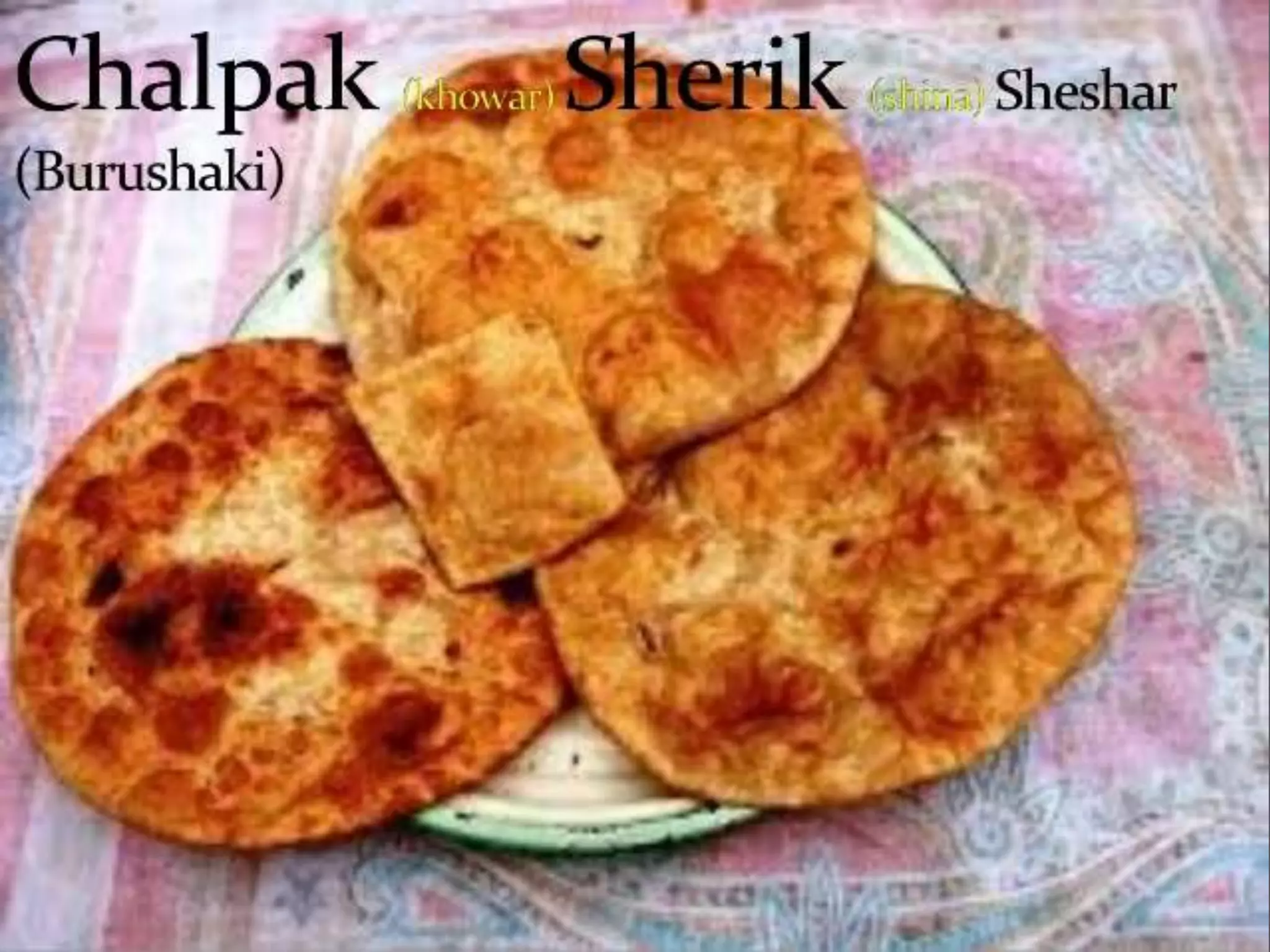
 Chapshuro is one of the most delicious dishes of
Gilgit Baltistan. It is the Gilgit Baltistan version of
pizza. Chap Shuroo is a bread filled with a mixture
of chopped Beef/ Yalk meat,
onion, and other spices. Chapshoro is filled with
chopped meat (lamb, beef), onions, Chile
peppers, tomato and fresh coriander leaves.
They are baked on medium heat on for 15 minutes,
until golden brown. Jugloot Gouro and Whole
Nagar are the famous places for most
delicious Chapchurro in Gilgit Baltistan
 Mamtu is delicious cubes meal flour centrally filled
with mutton/Beef and spicy ingredients. Life is so
endlessly delicious. Plan a tour to Gilgit Baltistan.
Take a taste of Mamtu and seize the moment for your
life. There is no love sincerer than the love of food.
Made your love for Mamtu lifetime. Mamtu, the
dumplings of North, is a unique and very tasty dish
in Gilgit Baltistan. Mamtu is very delicious fast
food originally came from China. In
Pakistan, you can only find Mamtu in Gilgit
Baltistan. Some may consider it a traditional
food of Gilgit Baltistan. It cooking process is
special as its taste. It is not cooked by any direct
means. It is cooked in a flow of steam.
 GILGIT BALTISTAN is the most literate region of
Pakistan.
 Literacy rate of HUNZA district touches about 100%
 Its people are well aware and committed.
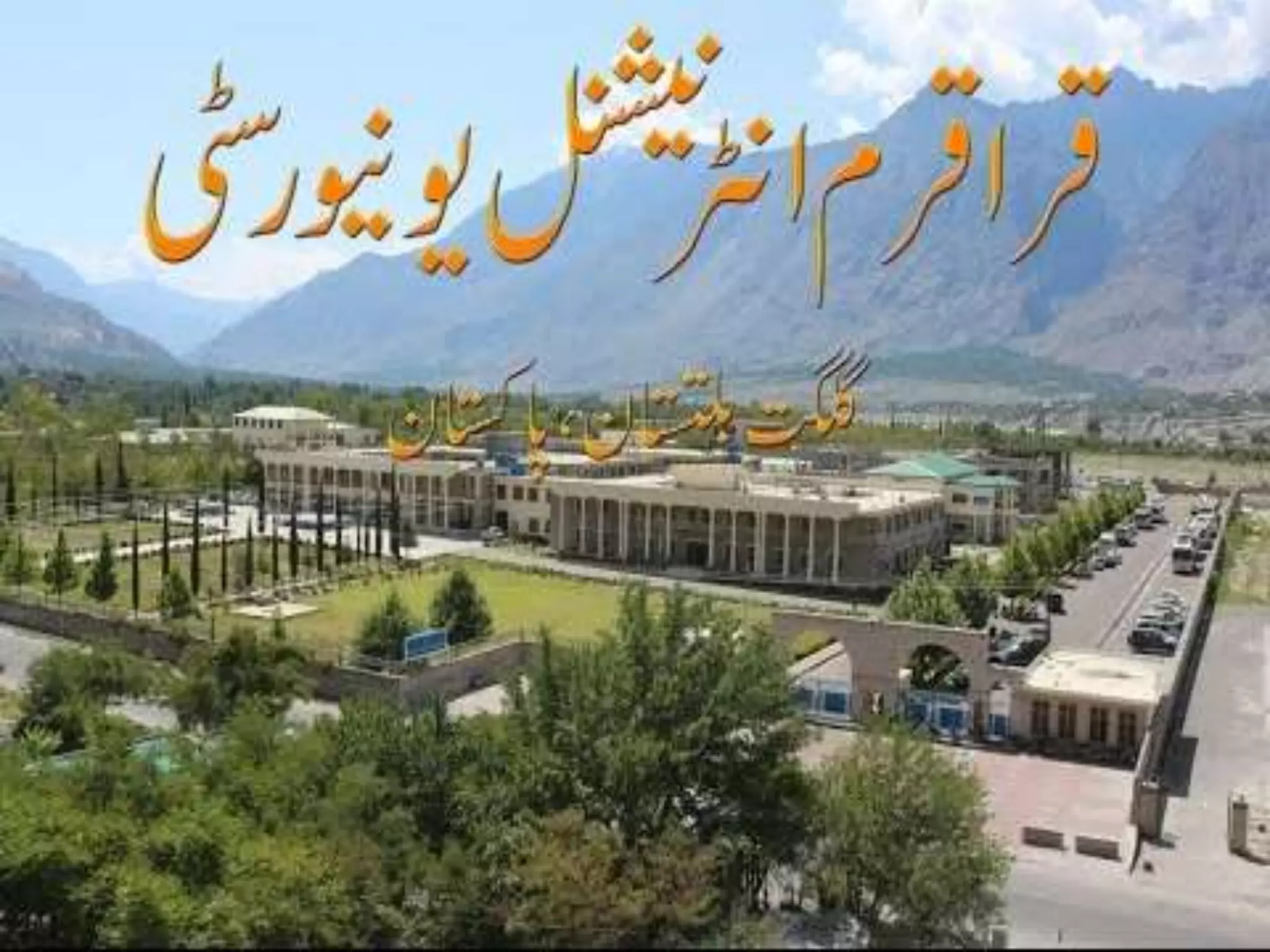
 GILGIT BALTISTAAN has one university KIU having
compuses in GILGIT & SKARDU.
 It has one cadet college in SKARDU and numerous
private institutions are providing quality education.
 GILGIT BALTISTAN has produced Gold Medalists of
various universities , schools and in other education
sectors.
 It has Scientist , Army officers , Engineers & Doctors.
Languages that are spoken in GILGIT
BALTISTAN are:-
 SHINA
 BALTI
 BUROSHASHKI
 KHOWAR
 WAKHI
 Siachin is the
2nd longest
glacier of the
world, The
length of this
glacier is
76km..
 The Baltoro Glacier
at 63 km (39 mi) in
length, is one of the
longest glaciers outs
ide the polar
regions. It is located
in the Gilgit-
Baltistan region of
northern Pakistan.
 Skardu
Fort or Kharpocho mea
ns The king of Forts is a
fort in Skardu city
in Gilgit-
Baltistan region of
Pakistan. Australian
mountaineer and film
maker Greg
Child writes that the
fort is "perched above
the junction of the
rivers" and overlooks
the Rock of Skardu.
 Altit Fort is an ancient
fort at Altit town in
the Hunza valley in Gilgit
Baltistan, Pakistan. It was
originally home to the
hereditary rulers of
the Hunza state who
carried the title Mir,
although they moved to
the somewhat
younger Baltit fort nearby
three centuries later. Altit
Fort and in particular the
Shikari tower is around
1100 years old which
makes it the oldest
monument in the Gilgit–
Baltistan
 Baltit Fort is a fort in
the Hunza valley,
near the town
of Karimabad, in
the Gilgit-
Baltistan region of
northern Pakistan.
Founded in the 8th
CE, it has been on
the UNESCO World
Heritage Tentative
list since 2004.
 Handrab Lake
is located in
GILGIT
BALTISTAN
and is over
10,000 feet
above sea level.
 Attabad Lake is
also known as
the Gojal Lake
and is situated
in Hunza’s
Gojal Valley.
 Naltar Lake is
also known as
the “Bashkiri
Lake” & is also
situated in
GILGIT-
BALTISTAN
 With close
proximity to
SKARDU,
GILGIT-
BALTISTAN,
satpara lake is
surrounded
mountains and
fed by the satpara
stream.
 World’s 9th
Highest
Mountain Peak is
located in
Western
Himalayas,
surrounded by
the Indus River,
with an elevation
of 26,660 ft.
 World 2nd Highest
Peak also known as
Mount Godwin-
Austin is the great
asset of Pakistan with
the height of 28,250
ft. K2 is located in the
extreme North of
Baltistan near the
Baltaro Glacier. 2nd
highest peak of the
world.
 From Yasin Ghizer.
 Embraced
Shahadat in 1999 ,
Kargil War.
 Awarded
NISHAAN e
HAIDER
 From Hunza.
 First pakistani
women to climb
mount everest.
 From Shiger ,
Baltistan.
 Served as IG
Police Sindh.
 Writer and
philanthropists
 From Bunji ,
Gilgit.
 Served as Core
Commander
Peshawer.
 Serving as head in
Kashmir Regment
of Pakistan Army.
 From Skardu.
 First person to
climb Mount
everest without
Oxygen.
 Died a natural
dead in 2016.
 Made & prepared by M JAWWAD SHAMSI.
 Contact at 03357496551 if u want to make your
presentation in reasonable prices.

Culture of Gilgit Baltistan / economy of gilgit baltistan / presentation about gilgit baltistan

  • 2.
     Muzammil Nagri Tariq Balti  M Suleman  Shahab  M Jawwad Shamsi
  • 4.
  • 5.
    o Formerly knownas the Northern Areas, o In 1948, Gilgit Baltistan emerged on the map of the world o The people of the region fought their own war against the Dogra Raj and won their freedom in 1st Nov 1947. o In 2009 Pakistan give provincial setup in Gilgit Baltistan. o Capital: GILGIT o Districts are 10. o Largest city is Skardu. o Population:22,00000. o Area: 72,496 Square km.
  • 6.
     Ruled byDurani Empire of AFGHANISTAN over the centuries.  Muslim ruled about four centuries under the Mughals (until 1751).  B/w 1832 – 1860 the region conquered by the Sikhs and Dogras.  B/w 1935 – 1947 the territory of GILGIT BALTISTAN was given to British on lease.  In 1947 , it came to under the control of Pakistan.
  • 7.
    • Culture showsmoral and ethical values of a region. • Culture represents our history and the way our ancestors lived and we have to transfer our rich culture to our new youth. • GILGIT BALTISTAN has its own rich and unique culture and traditions which varies from valley to valley • People represents culture through different famous festivals , dresses and foods.
  • 8.
     Culture ofGILGIT BALTISTAN includes:-  Sports  Festivals  Traditional dresses  Foods  Education system  Languages  Glaciers  Forts  Lakes  Mountains  Heroes  Economy  CONCLUSION
  • 9.
     There aremany regional sports that are played in GILGIT BALTISTAN,  POLO  NEZA BAAZI  TAPOO  IP IP
  • 10.
     There aremany religious and social / cultural festivals celebrated by the people of GILGIT BALTISTAN.  Religious festivals are :- o Eid ul Fitar o Eid ul Adha o Eid Milad un NABI
  • 11.
     Cultural festivalsare:- o Jashan e Bharaan. o Shandoor Polo Festival. o Babusar Polo Festival. Except these fastivals some other festivals are celebrated in GITGIT baltistan which are shown below.
  • 14.
  • 18.
     Giyaling OrZaan Go-Lee is to make your breakfast savory. It is usually served on breakfast on usual occasions but also cooked on special occasions as well. Normally it is best with a Namkeen Chai, but you can eat it with simple chai if you feel uncomfortable with the Namkeen thing. Giyaling is a local occasional dish of a Hunza and Nagar valley. It is specially made on the occasion of Gianni, and Ginani is an event which is performed after the cultivation of a crop especially the wheat.
  • 19.
     In themonth of May and June when wheat began to prepare, all the owners of a land go to their fields to enjoy the Ginani event with Giyaling. Recipe of Giyaling. Flat bread, made with whole grain flours, rich in vitamin B-17. it is served by spreading butter on bread, on extraordinary events.
  • 20.
     Chapshuro isone of the most delicious dishes of Gilgit Baltistan. It is the Gilgit Baltistan version of pizza. Chap Shuroo is a bread filled with a mixture of chopped Beef/ Yalk meat, onion, and other spices. Chapshoro is filled with chopped meat (lamb, beef), onions, Chile peppers, tomato and fresh coriander leaves. They are baked on medium heat on for 15 minutes, until golden brown. Jugloot Gouro and Whole Nagar are the famous places for most delicious Chapchurro in Gilgit Baltistan
  • 22.
     Mamtu isdelicious cubes meal flour centrally filled with mutton/Beef and spicy ingredients. Life is so endlessly delicious. Plan a tour to Gilgit Baltistan. Take a taste of Mamtu and seize the moment for your life. There is no love sincerer than the love of food. Made your love for Mamtu lifetime. Mamtu, the dumplings of North, is a unique and very tasty dish in Gilgit Baltistan. Mamtu is very delicious fast food originally came from China. In Pakistan, you can only find Mamtu in Gilgit Baltistan. Some may consider it a traditional food of Gilgit Baltistan. It cooking process is special as its taste. It is not cooked by any direct means. It is cooked in a flow of steam.
  • 26.
     GILGIT BALTISTANis the most literate region of Pakistan.  Literacy rate of HUNZA district touches about 100%  Its people are well aware and committed.  GILGIT BALTISTAAN has one university KIU having compuses in GILGIT & SKARDU.  It has one cadet college in SKARDU and numerous private institutions are providing quality education.  GILGIT BALTISTAN has produced Gold Medalists of various universities , schools and in other education sectors.  It has Scientist , Army officers , Engineers & Doctors.
  • 28.
    Languages that arespoken in GILGIT BALTISTAN are:-  SHINA  BALTI  BUROSHASHKI  KHOWAR  WAKHI
  • 30.
     Siachin isthe 2nd longest glacier of the world, The length of this glacier is 76km..
  • 31.
     The BaltoroGlacier at 63 km (39 mi) in length, is one of the longest glaciers outs ide the polar regions. It is located in the Gilgit- Baltistan region of northern Pakistan.
  • 33.
     Skardu Fort orKharpocho mea ns The king of Forts is a fort in Skardu city in Gilgit- Baltistan region of Pakistan. Australian mountaineer and film maker Greg Child writes that the fort is "perched above the junction of the rivers" and overlooks the Rock of Skardu.
  • 34.
     Altit Fortis an ancient fort at Altit town in the Hunza valley in Gilgit Baltistan, Pakistan. It was originally home to the hereditary rulers of the Hunza state who carried the title Mir, although they moved to the somewhat younger Baltit fort nearby three centuries later. Altit Fort and in particular the Shikari tower is around 1100 years old which makes it the oldest monument in the Gilgit– Baltistan
  • 35.
     Baltit Fortis a fort in the Hunza valley, near the town of Karimabad, in the Gilgit- Baltistan region of northern Pakistan. Founded in the 8th CE, it has been on the UNESCO World Heritage Tentative list since 2004.
  • 37.
     Handrab Lake islocated in GILGIT BALTISTAN and is over 10,000 feet above sea level.
  • 38.
     Attabad Lakeis also known as the Gojal Lake and is situated in Hunza’s Gojal Valley.
  • 39.
     Naltar Lakeis also known as the “Bashkiri Lake” & is also situated in GILGIT- BALTISTAN
  • 40.
     With close proximityto SKARDU, GILGIT- BALTISTAN, satpara lake is surrounded mountains and fed by the satpara stream.
  • 42.
     World’s 9th Highest MountainPeak is located in Western Himalayas, surrounded by the Indus River, with an elevation of 26,660 ft.
  • 43.
     World 2ndHighest Peak also known as Mount Godwin- Austin is the great asset of Pakistan with the height of 28,250 ft. K2 is located in the extreme North of Baltistan near the Baltaro Glacier. 2nd highest peak of the world.
  • 45.
     From YasinGhizer.  Embraced Shahadat in 1999 , Kargil War.  Awarded NISHAAN e HAIDER
  • 46.
     From Hunza. First pakistani women to climb mount everest.
  • 47.
     From Shiger, Baltistan.  Served as IG Police Sindh.  Writer and philanthropists
  • 48.
     From Bunji, Gilgit.  Served as Core Commander Peshawer.  Serving as head in Kashmir Regment of Pakistan Army.
  • 49.
     From Skardu. First person to climb Mount everest without Oxygen.  Died a natural dead in 2016.
  • 59.
     Made &prepared by M JAWWAD SHAMSI.  Contact at 03357496551 if u want to make your presentation in reasonable prices.