Isabel
Ahender
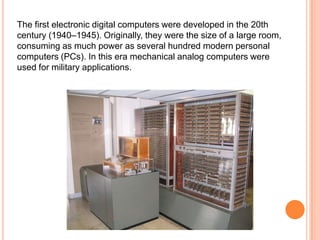
The first electronic digital computers were developed in the 20th
century (1940–1945). Originally, they were the size of a large room,
consuming as much power as several hundred modern personal
computers (PCs). In this era mechanical analog computers were
used for military applications.
Modern computers based on integrated circuits are millions to billions
of times more capable than the early machines, and occupy a fraction
of the space. Simple computers are small enough to fit into mobile
devices, and mobile computers can be powered by small batteries.
Personal computers in their various forms are icons of the Information
Age and are what most people think of as "computers". However, the
embedded computers found in many devices from mp3 players to
fighter aircraft and from toys to industrial robots are the most
numerous.
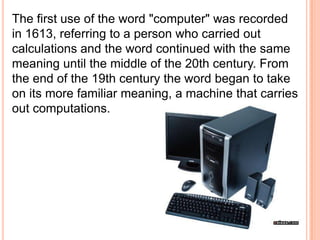
The first use of the word "computer" was recorded
in 1613, referring to a person who carried out
calculations and the word continued with the same
meaning until the middle of the 20th century. From
the end of the 19th century the word began to take
on its more familiar meaning, a machine that carries
out computations.
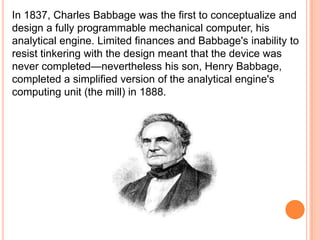
In 1837, Charles Babbage was the first to conceptualize and
design a fully programmable mechanical computer, his
analytical engine. Limited finances and Babbage's inability to
resist tinkering with the design meant that the device was
never completed—nevertheless his son, Henry Babbage,
completed a simplified version of the analytical engine's
computing unit (the mill) in 1888.
The Atanasoff–Berry Computer (ABC) was the world's first
electronic digital computer, albeit not programmable.
Atanasoff is considered to be one of the fathers of the
computer.
The first program-controlled computer was invented
by Konrad Zuse, who built the Z3, an
electromechanical computing machine, in 1941.
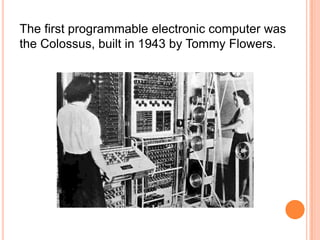
The first programmable electronic computer was
the Colossus, built in 1943 by Tommy Flowers.

man made things

  • 1.
  • 2.
    The first electronicdigital computers were developed in the 20th century (1940–1945). Originally, they were the size of a large room, consuming as much power as several hundred modern personal computers (PCs). In this era mechanical analog computers were used for military applications.
  • 3.
    Modern computers basedon integrated circuits are millions to billions of times more capable than the early machines, and occupy a fraction of the space. Simple computers are small enough to fit into mobile devices, and mobile computers can be powered by small batteries. Personal computers in their various forms are icons of the Information Age and are what most people think of as "computers". However, the embedded computers found in many devices from mp3 players to fighter aircraft and from toys to industrial robots are the most numerous.
  • 4.
    The first useof the word "computer" was recorded in 1613, referring to a person who carried out calculations and the word continued with the same meaning until the middle of the 20th century. From the end of the 19th century the word began to take on its more familiar meaning, a machine that carries out computations.
  • 5.
    In 1837, CharlesBabbage was the first to conceptualize and design a fully programmable mechanical computer, his analytical engine. Limited finances and Babbage's inability to resist tinkering with the design meant that the device was never completed—nevertheless his son, Henry Babbage, completed a simplified version of the analytical engine's computing unit (the mill) in 1888.
  • 6.
    The Atanasoff–Berry Computer(ABC) was the world's first electronic digital computer, albeit not programmable. Atanasoff is considered to be one of the fathers of the computer.
  • 7.
    The first program-controlledcomputer was invented by Konrad Zuse, who built the Z3, an electromechanical computing machine, in 1941.
  • 8.
    The first programmableelectronic computer was the Colossus, built in 1943 by Tommy Flowers.