PRESENT
PROGRESSIVE
FACULTY OF EDUCATION
ENGLISH LENGUAJE
DEGREE
Matter:
TIC
Students:
Isabel Morón Robles
Arely Balán Guevara
Mónica Janeth Charles
Martinez
INTRODUCTION
In the next topic, we will teach you about
“Present Progressive” in order that you
learn, the correct structure, how and in
what moments you can use it
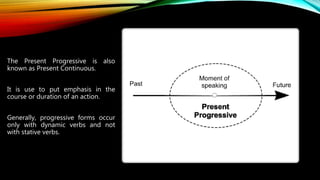
The Present Progressive is also
known as Present Continuous.
It is use to put emphasis in the
course or duration of an action.
Generally, progressive forms occur
only with dynamic verbs and not
with stative verbs.
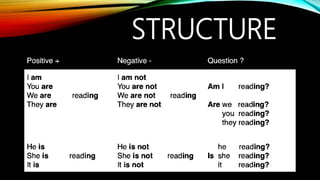
STRUCTURE
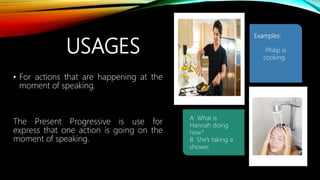
USAGES
• For actions that are happening at the
moment of speaking.
The Present Progressive is use for
express that one action is going on the
moment of speaking.
A: What is
Hannah doing
now?
B: She’s taking a
shower.
Examples:
Philip is
cooking.
Time expressions:
• Now
• At the moment
Note:
This signal words are not really necessary
because the moment is already expressed by
the tense itself.
• For temporary states.
It´s when we refer to actions or situations
that are happening now, at this moment.
These actions / situations began before now
and will continue after now, but they’re
temporary.
Time expressions: today, this day
EXAMPLES
• I‘m staying with a friend this week.
• She‘s living in Seoul for a few months.
• Jack‘s working at a cafe until he
finds a job in his field.
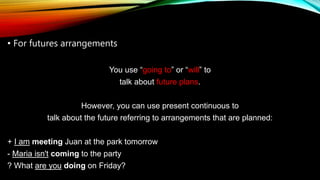
• For futures arrangements
You use “going to” or “will” to
talk about future plans.
However, you can use present continuous to
talk about the future referring to arrangements that are planned:
+ I am meeting Juan at the park tomorrow
- Maria isn't coming to the party
? What are you doing on Friday?
Time expressions:
→Tonight, tomorrow, this weekend
→Next week/month/year
→This summer/fall/winter/spring
→On Monday/Tuesday/etc.
→Next Monday/Wednesday/etc.
OTHER USAGES
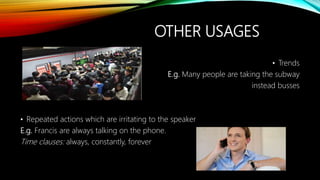
• Trends
E.g. Many people are taking the subway
instead busses
• Repeated actions which are irritating to the speaker
E.g. Francis are always talking on the phone.
Time clauses: always, constantly, forever
BIBLIOGRAPHY
• E. (Ed.). (n.d.). Present Progressive. Retrieved from https://www.englisch-
hilfen.de/en/grammar/pres_pro.htm
• Espresso English LLC (COMPANY). (2010). Present Continuous for arrangements.
May 25, 2018. Retrieved from https://www.espressoenglish.net/present-
continuous-for-future-arrangements
• GbR, L. (n.d.). Present Progressive - Use. Retrieved from https://www.ego4u.com/en/cram-
up/grammar/present-progressive/use
• Grammarly, Inc.. (2018). Present Continuous. 2018, de Grammarly blog. Retrieved
from https://www.grammarly.com/blog/present-continuous/
• Learnenglishlanguagewell. (n.d.). Present Continous. Retrieved from
http://www.learnenglishlanguagewell.com/grammar/present-continuous-
temporary-situations/

Present Progressive Tense

  • 1.
    PRESENT PROGRESSIVE FACULTY OF EDUCATION ENGLISHLENGUAJE DEGREE Matter: TIC Students: Isabel Morón Robles Arely Balán Guevara Mónica Janeth Charles Martinez
  • 2.
    INTRODUCTION In the nexttopic, we will teach you about “Present Progressive” in order that you learn, the correct structure, how and in what moments you can use it
  • 3.
    The Present Progressiveis also known as Present Continuous. It is use to put emphasis in the course or duration of an action. Generally, progressive forms occur only with dynamic verbs and not with stative verbs.
  • 4.
  • 5.
    USAGES • For actionsthat are happening at the moment of speaking. The Present Progressive is use for express that one action is going on the moment of speaking. A: What is Hannah doing now? B: She’s taking a shower. Examples: Philip is cooking.
  • 6.
    Time expressions: • Now •At the moment Note: This signal words are not really necessary because the moment is already expressed by the tense itself.
  • 7.
    • For temporarystates. It´s when we refer to actions or situations that are happening now, at this moment. These actions / situations began before now and will continue after now, but they’re temporary. Time expressions: today, this day
  • 8.
    EXAMPLES • I‘m stayingwith a friend this week. • She‘s living in Seoul for a few months. • Jack‘s working at a cafe until he finds a job in his field.
  • 9.
    • For futuresarrangements You use “going to” or “will” to talk about future plans. However, you can use present continuous to talk about the future referring to arrangements that are planned: + I am meeting Juan at the park tomorrow - Maria isn't coming to the party ? What are you doing on Friday?
  • 10.
    Time expressions: →Tonight, tomorrow,this weekend →Next week/month/year →This summer/fall/winter/spring →On Monday/Tuesday/etc. →Next Monday/Wednesday/etc.
  • 11.
    OTHER USAGES • Trends E.g.Many people are taking the subway instead busses • Repeated actions which are irritating to the speaker E.g. Francis are always talking on the phone. Time clauses: always, constantly, forever
  • 12.
    BIBLIOGRAPHY • E. (Ed.).(n.d.). Present Progressive. Retrieved from https://www.englisch- hilfen.de/en/grammar/pres_pro.htm • Espresso English LLC (COMPANY). (2010). Present Continuous for arrangements. May 25, 2018. Retrieved from https://www.espressoenglish.net/present- continuous-for-future-arrangements • GbR, L. (n.d.). Present Progressive - Use. Retrieved from https://www.ego4u.com/en/cram- up/grammar/present-progressive/use • Grammarly, Inc.. (2018). Present Continuous. 2018, de Grammarly blog. Retrieved from https://www.grammarly.com/blog/present-continuous/ • Learnenglishlanguagewell. (n.d.). Present Continous. Retrieved from http://www.learnenglishlanguagewell.com/grammar/present-continuous- temporary-situations/