Pre operative
Cardiac AssessmentBy
Dr.MOHAMED MOSTAFA
preoperative cardiac assessment
• Why do we need preoperative cardiac assessment ?
• What are the questions should be considered in the
pre operative cardiac assessment?
• How can we collect preoperative data in a guideline?
• What are the new concepts in preoperative cardiac assessment?
• Preoperative cardiological consultation is it a must?
• Would you recommend that the surgery be postponed
for a certain period of time?
Why do we need preoperative
cardiac assessment ?
preoperative cardiac assessment
• “Revascularization before noncardiac surgery to
enable the patient to ‘get through’ the procedure is
appropriate for only a small subset of patients.”
• Determine who can go directly to surgery.
• Determine who:
– have additional tests prior to surgery
– needs medical management prior to surgery
What are the questions should be
considered in the pre operative cardiac
assessment?
preoperative cardiac assessment
• The urgency of the operation.
• The recency of the cardiac evaluation and intervention
• Patient’s clinical predictors of the cardiac risk.
• The functional status of the patient.
• The risk of the surgery proposed.
Patient’s clinical predictors of the cardiac risk
I) Major Clinical predictors
1) Unstable coronary syndrome
– Acute MI within one week
– Recent MI > 1 week < 1 month
– Unstable angina
2) Decompensated heart failure
3) Significant arrhytmias
– High-grade A-V block
– Symptomatic ventricular arrhytmias
– S.V.T with uncontrolled heart rate
4) Severe valvular disease.
Patient’s clinical predictors of the cardiac risk
II) Intermediate clinical predictors
1) Mild angina pectoris class I,II
2) Previous MI by history or Q waves
3) Compensated or prior heart failure
4) Diabetes mellitus (insulin dependant)
5) Renal insufficiency (serum creatinine > 2.0 mg/dl
Patient’s clinical predictors of the cardiac risk
III) Minor clinical predictors
1) Advance age
2) Abnormal ECG (LV hypertrophy, LBBB, ST-T abnormalities)
3) Rhythm other than sinus (e.g. AF)
4) Low functional capacity.
5) History of stroke
6 ) Uncontrolled hypertension.
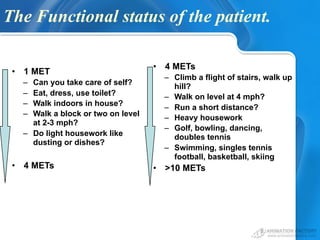
The Functional status of the patient.
• 1 MET
– Can you take care of self?
– Eat, dress, use toilet?
– Walk indoors in house?
– Walk a block or two on level
at 2-3 mph?
– Do light housework like
dusting or dishes?
• 4 METs
• 4 METs
– Climb a flight of stairs, walk up
hill?
– Walk on level at 4 mph?
– Run a short distance?
– Heavy housework
– Golf, bowling, dancing,
doubles tennis
– Swimming, singles tennis
football, basketball, skiing
• >10 METs
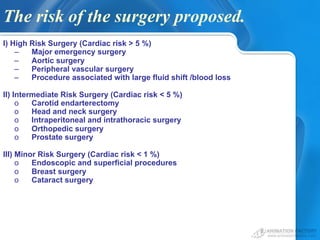
The risk of the surgery proposed.
I) High Risk Surgery (Cardiac risk > 5 %)
– Major emergency surgery
– Aortic surgery
– Peripheral vascular surgery
– Procedure associated with large fluid shift /blood loss
II) Intermediate Risk Surgery (Cardiac risk < 5 %)
o Carotid endarterectomy
o Head and neck surgery
o Intraperitoneal and intrathoracic surgery
o Orthopedic surgery
o Prostate surgery
III) Minor Risk Surgery (Cardiac risk < 1 %)
o Endoscopic and superficial procedures
o Breast surgery
o Cataract surgery
How can we collect preoperative data in a
guideline?
preoperative cardiac assessment
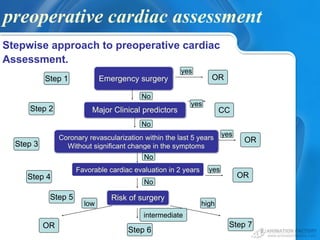
Stepwise approach to preoperative cardiac
Assessment.
Emergency surgery ORStep 1
Major Clinical predictors CCStep 2
Coronary revascularization within the last 5 years
Without significant change in the symptomsStep 3
OR
Favorable cardiac evaluation in 2 years
ORStep 4
Risk of surgery
OR
Step 6
Step 7
Step 5
yes
yes
yes
yes
No
No
No
No
low high
intermediate
preoperative cardiac assessment
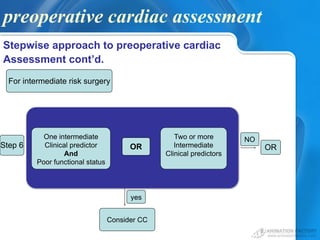
Stepwise approach to preoperative cardiac
Assessment cont’d.
One intermediate
Clinical predictor
And
Poor functional status
Two or more
Intermediate
Clinical predictors
OR
Consider CC
ORStep 6
NO
yes
For intermediate risk surgery
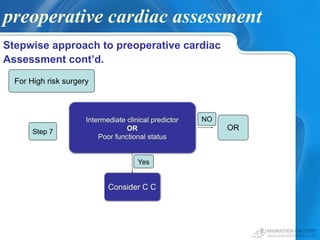
preoperative cardiac assessment
Stepwise approach to preoperative cardiac
Assessment cont’d.
Intermediate clinical predictor
OR
Poor functional status
Consider C C
ORStep 7
Yes
NO
For High risk surgery
What are the new concepts in
preoperative cardiac assessment?
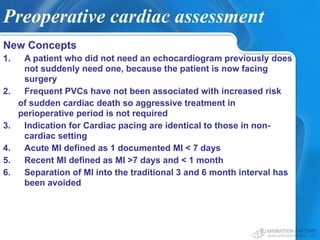
Preoperative cardiac assessment
New Concepts
1. A patient who did not need an echocardiogram previously does
not suddenly need one, because the patient is now facing
surgery
2. Frequent PVCs have not been associated with increased risk
of sudden cardiac death so aggressive treatment in
perioperative period is not required
3. Indication for Cardiac pacing are identical to those in non-
cardiac setting
4. Acute MI defined as 1 documented MI < 7 days
5. Recent MI defined as MI >7 days and < 1 month
6. Separation of MI into the traditional 3 and 6 month interval has
been avoided
Preoperative cardiological
consultation is it a must?
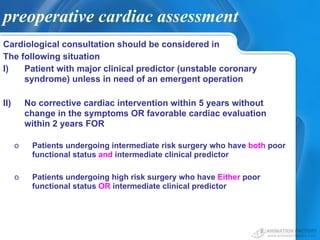
preoperative cardiac assessment
Cardiological consultation should be considered in
The following situation
I) Patient with major clinical predictor (unstable coronary
syndrome) unless in need of an emergent operation
II) No corrective cardiac intervention within 5 years without
change in the symptoms OR favorable cardiac evaluation
within 2 years FOR
o Patients undergoing intermediate risk surgery who have both poor
functional status and intermediate clinical predictor
o Patients undergoing high risk surgery who have Either poor
functional status OR intermediate clinical predictor
Would you recommend that the surgery be
postponed for a certain period of time?
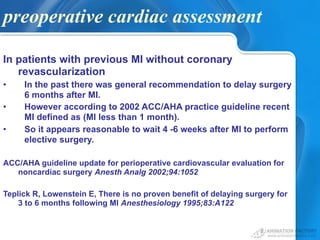
preoperative cardiac assessment
In patients with previous MI without coronary
revascularization
• In the past there was general recommendation to delay surgery
6 months after MI.
• However according to 2002 ACC/AHA practice guideline recent
MI defined as (MI less than 1 month).
• So it appears reasonable to wait 4 -6 weeks after MI to perform
elective surgery.
ACC/AHA guideline update for perioperative cardiovascular evaluation for
noncardiac surgery Anesth Analg 2002;94:1052
Teplick R, Lowenstein E, There is no proven benefit of delaying surgery for
3 to 6 months following MI Anesthesiology 1995;83:A122
preoperative cardiac assessment
These data suggest that if the patient requires a noncardiac
surgery that cannot be delayed 30 days or longer and also has
indications for coronary revascularization, performing coronary
revascularization either by PTCA or CABG may not result in
improved short-term survival.
The anesthesiologist or the surgeon may ask a cardiology
consultant to help determine whether to proceed with urgent
noncardiac surgery with B-adrenergic blockade and consider
coronary revascularization afterwards.
Case Discussion
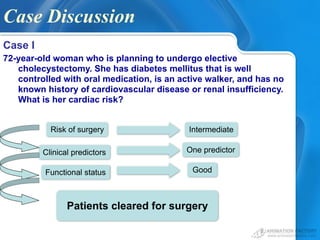
Case I
72-year-old woman who is planning to undergo elective
cholecystectomy. She has diabetes mellitus that is well
controlled with oral medication, is an active walker, and has no
known history of cardiovascular disease or renal insufficiency.
What is her cardiac risk?
Risk of surgery Intermediate
Clinical predictors One predictor
Functional status Good
Patients cleared for surgery
THANK YOU

Preoperative cardiacassessment

  • 1.
  • 2.
    preoperative cardiac assessment •Why do we need preoperative cardiac assessment ? • What are the questions should be considered in the pre operative cardiac assessment? • How can we collect preoperative data in a guideline? • What are the new concepts in preoperative cardiac assessment? • Preoperative cardiological consultation is it a must? • Would you recommend that the surgery be postponed for a certain period of time?
  • 3.
    Why do weneed preoperative cardiac assessment ?
  • 4.
    preoperative cardiac assessment •“Revascularization before noncardiac surgery to enable the patient to ‘get through’ the procedure is appropriate for only a small subset of patients.” • Determine who can go directly to surgery. • Determine who: – have additional tests prior to surgery – needs medical management prior to surgery
  • 5.
    What are thequestions should be considered in the pre operative cardiac assessment?
  • 6.
    preoperative cardiac assessment •The urgency of the operation. • The recency of the cardiac evaluation and intervention • Patient’s clinical predictors of the cardiac risk. • The functional status of the patient. • The risk of the surgery proposed.
  • 7.
    Patient’s clinical predictorsof the cardiac risk I) Major Clinical predictors 1) Unstable coronary syndrome – Acute MI within one week – Recent MI > 1 week < 1 month – Unstable angina 2) Decompensated heart failure 3) Significant arrhytmias – High-grade A-V block – Symptomatic ventricular arrhytmias – S.V.T with uncontrolled heart rate 4) Severe valvular disease.
  • 8.
    Patient’s clinical predictorsof the cardiac risk II) Intermediate clinical predictors 1) Mild angina pectoris class I,II 2) Previous MI by history or Q waves 3) Compensated or prior heart failure 4) Diabetes mellitus (insulin dependant) 5) Renal insufficiency (serum creatinine > 2.0 mg/dl
  • 9.
    Patient’s clinical predictorsof the cardiac risk III) Minor clinical predictors 1) Advance age 2) Abnormal ECG (LV hypertrophy, LBBB, ST-T abnormalities) 3) Rhythm other than sinus (e.g. AF) 4) Low functional capacity. 5) History of stroke 6 ) Uncontrolled hypertension.
  • 10.
    The Functional statusof the patient. • 1 MET – Can you take care of self? – Eat, dress, use toilet? – Walk indoors in house? – Walk a block or two on level at 2-3 mph? – Do light housework like dusting or dishes? • 4 METs • 4 METs – Climb a flight of stairs, walk up hill? – Walk on level at 4 mph? – Run a short distance? – Heavy housework – Golf, bowling, dancing, doubles tennis – Swimming, singles tennis football, basketball, skiing • >10 METs
  • 11.
    The risk ofthe surgery proposed. I) High Risk Surgery (Cardiac risk > 5 %) – Major emergency surgery – Aortic surgery – Peripheral vascular surgery – Procedure associated with large fluid shift /blood loss II) Intermediate Risk Surgery (Cardiac risk < 5 %) o Carotid endarterectomy o Head and neck surgery o Intraperitoneal and intrathoracic surgery o Orthopedic surgery o Prostate surgery III) Minor Risk Surgery (Cardiac risk < 1 %) o Endoscopic and superficial procedures o Breast surgery o Cataract surgery
  • 12.
    How can wecollect preoperative data in a guideline?
  • 13.
    preoperative cardiac assessment Stepwiseapproach to preoperative cardiac Assessment. Emergency surgery ORStep 1 Major Clinical predictors CCStep 2 Coronary revascularization within the last 5 years Without significant change in the symptomsStep 3 OR Favorable cardiac evaluation in 2 years ORStep 4 Risk of surgery OR Step 6 Step 7 Step 5 yes yes yes yes No No No No low high intermediate
  • 14.
    preoperative cardiac assessment Stepwiseapproach to preoperative cardiac Assessment cont’d. One intermediate Clinical predictor And Poor functional status Two or more Intermediate Clinical predictors OR Consider CC ORStep 6 NO yes For intermediate risk surgery
  • 15.
    preoperative cardiac assessment Stepwiseapproach to preoperative cardiac Assessment cont’d. Intermediate clinical predictor OR Poor functional status Consider C C ORStep 7 Yes NO For High risk surgery
  • 16.
    What are thenew concepts in preoperative cardiac assessment?
  • 17.
    Preoperative cardiac assessment NewConcepts 1. A patient who did not need an echocardiogram previously does not suddenly need one, because the patient is now facing surgery 2. Frequent PVCs have not been associated with increased risk of sudden cardiac death so aggressive treatment in perioperative period is not required 3. Indication for Cardiac pacing are identical to those in non- cardiac setting 4. Acute MI defined as 1 documented MI < 7 days 5. Recent MI defined as MI >7 days and < 1 month 6. Separation of MI into the traditional 3 and 6 month interval has been avoided
  • 18.
  • 19.
    preoperative cardiac assessment Cardiologicalconsultation should be considered in The following situation I) Patient with major clinical predictor (unstable coronary syndrome) unless in need of an emergent operation II) No corrective cardiac intervention within 5 years without change in the symptoms OR favorable cardiac evaluation within 2 years FOR o Patients undergoing intermediate risk surgery who have both poor functional status and intermediate clinical predictor o Patients undergoing high risk surgery who have Either poor functional status OR intermediate clinical predictor
  • 20.
    Would you recommendthat the surgery be postponed for a certain period of time?
  • 21.
    preoperative cardiac assessment Inpatients with previous MI without coronary revascularization • In the past there was general recommendation to delay surgery 6 months after MI. • However according to 2002 ACC/AHA practice guideline recent MI defined as (MI less than 1 month). • So it appears reasonable to wait 4 -6 weeks after MI to perform elective surgery. ACC/AHA guideline update for perioperative cardiovascular evaluation for noncardiac surgery Anesth Analg 2002;94:1052 Teplick R, Lowenstein E, There is no proven benefit of delaying surgery for 3 to 6 months following MI Anesthesiology 1995;83:A122
  • 22.
    preoperative cardiac assessment Thesedata suggest that if the patient requires a noncardiac surgery that cannot be delayed 30 days or longer and also has indications for coronary revascularization, performing coronary revascularization either by PTCA or CABG may not result in improved short-term survival. The anesthesiologist or the surgeon may ask a cardiology consultant to help determine whether to proceed with urgent noncardiac surgery with B-adrenergic blockade and consider coronary revascularization afterwards.
  • 23.
    Case Discussion Case I 72-year-oldwoman who is planning to undergo elective cholecystectomy. She has diabetes mellitus that is well controlled with oral medication, is an active walker, and has no known history of cardiovascular disease or renal insufficiency. What is her cardiac risk? Risk of surgery Intermediate Clinical predictors One predictor Functional status Good Patients cleared for surgery
  • 24.