Near miss documention and discussion
with PRE:HAZRD
Jan Ulbrich
November 2015
Accident, n: A condition in which
presence of mind is good, but
absence of body is better
Author unknown
Near miss: Unplanned event that did not
result in injury, illness, or damage – but had
the potential to do so. Only a fortunate
break in the chain of events prevented an
injury, fatality or damage.
Wikipedia
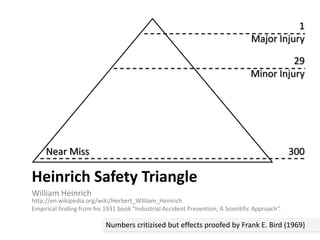
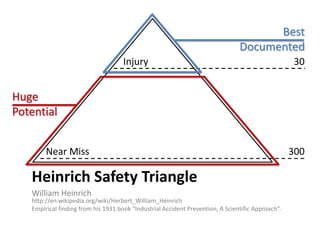
Heinrich Safety Triangle
William Heinrich
http://en.wikipedia.org/wiki/Herbert_William_Heinrich
Empirical finding from his 1931 book "Industrial Accident Prevention, A Scientific Approach“.
1
Major Injury
29
Minor Injury
300Near Miss
Numbers critizised but effects proofed by Frank E. Bird (1969)
Heinrich Safety Triangle
William Heinrich
http://en.wikipedia.org/wiki/Herbert_William_Heinrich
Empirical finding from his 1931 book "Industrial Accident Prevention, A Scientific Approach“.
Injury 30
300Near Miss
Huge
Potential
Best
Documented
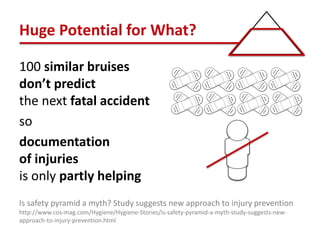
Huge Potential for What?
100 similar bruises
don’t predict
the next fatal accident
so
documentation
of injuries
is only partly helping
Is safety pyramid a myth? Study suggests new approach to injury prevention
http://www.cos-mag.com/Hygiene/Hygiene-Stories/is-safety-pyramid-a-myth-study-suggests-new-
approach-to-injury-prevention.html
Huge Potential for What??
• “The BST study suggests […] that serious
injuries have different underlying causes than
minor ones.”
• “These underlying factors — missing controls,
lax procedures, badly designed equipment —
create high-risk situations that are likely to
lead to a major incident.”
Is safety pyramid a myth? Study suggests new approach to injury prevention
http://www.cos-mag.com/Hygiene/Hygiene-Stories/is-safety-pyramid-a-myth-study-suggests-new-
approach-to-injury-prevention.html
Huge Potential for What???
Sharing incidents helps, as it
• causes awareness
• discovers patterns
• changes mentality
and it
• triggers active discussion of
safety protocols
• helps identifying high-risk situations (precursors)
Approach
Peer groups with
• decentralized and anonymous
documentation and
• discussion of incidents
Centrally managed
• monitoring of incidents tagged as dangerous
• search for patterns to take better precautions
PRE:HAZRD website with more information
https://www.prehazrd.com
How it Works
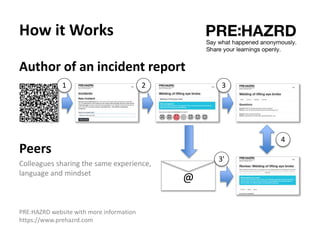
Author of an incident report
Peers
Colleagues sharing the same experience,
language and mindset
PRE:HAZRD website with more information
https://www.prehazrd.com
@
21 3
3'
4
Recap
• The Safety Triangle contains hidden gems
• There are tools for decentralized
documentation and discussion of incidents
• Anonymity is crucial
Last but not least this approach
• integrates nicely with expert tools
• plays along classical incident reporting
Thank you!

PRE:HAZRD Intro

  • 1.
    Near miss documentionand discussion with PRE:HAZRD Jan Ulbrich November 2015
  • 2.
    Accident, n: Acondition in which presence of mind is good, but absence of body is better Author unknown
  • 3.
    Near miss: Unplannedevent that did not result in injury, illness, or damage – but had the potential to do so. Only a fortunate break in the chain of events prevented an injury, fatality or damage. Wikipedia
  • 4.
    Heinrich Safety Triangle WilliamHeinrich http://en.wikipedia.org/wiki/Herbert_William_Heinrich Empirical finding from his 1931 book "Industrial Accident Prevention, A Scientific Approach“. 1 Major Injury 29 Minor Injury 300Near Miss Numbers critizised but effects proofed by Frank E. Bird (1969)
  • 5.
    Heinrich Safety Triangle WilliamHeinrich http://en.wikipedia.org/wiki/Herbert_William_Heinrich Empirical finding from his 1931 book "Industrial Accident Prevention, A Scientific Approach“. Injury 30 300Near Miss Huge Potential Best Documented
  • 6.
    Huge Potential forWhat? 100 similar bruises don’t predict the next fatal accident so documentation of injuries is only partly helping Is safety pyramid a myth? Study suggests new approach to injury prevention http://www.cos-mag.com/Hygiene/Hygiene-Stories/is-safety-pyramid-a-myth-study-suggests-new- approach-to-injury-prevention.html
  • 7.
    Huge Potential forWhat?? • “The BST study suggests […] that serious injuries have different underlying causes than minor ones.” • “These underlying factors — missing controls, lax procedures, badly designed equipment — create high-risk situations that are likely to lead to a major incident.” Is safety pyramid a myth? Study suggests new approach to injury prevention http://www.cos-mag.com/Hygiene/Hygiene-Stories/is-safety-pyramid-a-myth-study-suggests-new- approach-to-injury-prevention.html
  • 8.
    Huge Potential forWhat??? Sharing incidents helps, as it • causes awareness • discovers patterns • changes mentality and it • triggers active discussion of safety protocols • helps identifying high-risk situations (precursors)
  • 9.
    Approach Peer groups with •decentralized and anonymous documentation and • discussion of incidents Centrally managed • monitoring of incidents tagged as dangerous • search for patterns to take better precautions PRE:HAZRD website with more information https://www.prehazrd.com
  • 10.
    How it Works Authorof an incident report Peers Colleagues sharing the same experience, language and mindset PRE:HAZRD website with more information https://www.prehazrd.com @ 21 3 3' 4
  • 11.
    Recap • The SafetyTriangle contains hidden gems • There are tools for decentralized documentation and discussion of incidents • Anonymity is crucial Last but not least this approach • integrates nicely with expert tools • plays along classical incident reporting
  • 12.

Editor's Notes

  • #2 Slide 1: This is a short presentation about near miss documentation with PRE:HAZRD, an online platform where employees can anonymously share near miss events or actual accidents and get reviews from peers leading to learnings for the whole organization.
  • #3 Slide 2: We all know, that accidents happen —but they mostly happen to others. That’s something deeply rooted in our consciousness: We need to know that at the end everything will be OK. As soon as this doesn’t apply anymore, people won’t dare to leave their homes.
  • #4 Slide 3: And we all very well know when we witness a “near miss” — an unplanned event which we or others were fortunate enough to survive. Think about the last time you were texting while driving and nearly had a crash with a lazy guy crossing the road without paying attention. In this presentation we will talk about what to learn from a near miss during work and how discussing a near miss could prevent a real accident.
  • #5 Slide 4: Studies say that for every major injury there are about 29 minor injuries and about 300 near miss events. The original numbers for this are by Herbert William Heinrich published in a book in the 1930s. The result is what is called the Heinrich Safety Triangle. The numbers have been criticized and while the exact numbers may vary, the effects have been proofed e.g. by a huge study in the late 1960s.
  • #6 Slide 5: The top part of the Heinrich Safety Triangle — the minor and major injuries including fatal accidents — are best documented last but not least because insurances are involved at this level. You just can’t do without documentation, reviews and sometimes even changed safety protocols for these accidents. But obviously there is huge potential in the lower part of the Safety Triangle: These are high numbers which should tell us something…
  • #7 Slide 6: But what do they tell us? The classical way of treating minor injuries — which aren’t even part of that huge lower base of the Safety Triangle — is by counting them and then hoping that reduced numbers will reduce the numbers of real accidents. Studies tell us that this is just wishful thinking and misleading: While the numbers of minor injuries go down, the number of major accidents are constant.
  • #8 Slide 7: The reason for this is that the underlying causes are different: The biggest problems leading to major accidents are missing controls, lax procedures, badly designed equipment. For badly designed equipment it could be something like it was with the very first digital insulin pumps where it was too easy to add an additional digit — which made it too easy to treat a person with tenfold the wanted medication. Sounds easy to solve. For missing controls and lax procedures it is the mentally healthy belief that everything will work out fine. And it is missing awareness as these procedures are often created by other people than the ones having to follow them — or even by organizations outside the company. Why bother. Addressing this ignorance is the huge potential of the lower part of the Safety Triangle as every near miss might be an interesting story to share…
  • #9 Slide 8: …and humans learn best by sharing stories, so the best way to raise awareness would be by sharing stories about incidents. But often enough a near miss is embarrassing and anonymity is key to make people openly share what happened. And for learning to happen, the sharing of stories has to be between the right people — typical paper forms that go to human resources don’t help. It would be best to trigger an active discussion between peers — colleagues working in the same field and sharing the same language? There are software companies addressing exactly this field and one product is PRE:HAZRD.
  • #10 Slide 9: The approach of PRE:HAZRD is to provide an anonymous online platform where people post incident reports in peer groups — discussing incidents between colleagues working in the same field, sharing, language and mindset. Peers can ask questions, rate the severity of the incident and give advice which all leads to learnings. This creates awareness and the discussed near miss events become part of the shared memory of the company.
  • #11 Slide 10: The completely anonymous approach of PRE:HAZRD works like this: 1) A colleague experiencing a near miss opens the secret link of a incident topic — that can be a link shared by e-mail within a department or a QR-code as seen on this slide. 2) The page contains a form for creating a new incident report starting with a title. 3) That opens a new page with a unique link private to the author. This link has to be saved e.g. as bookmark to allow later access as author again. The platform is truly anonymous and there is nothing like a “send me my lost link” function. 3’) After writing the initial incident report, an e-mail is sent to peers configured for the incident topic. All peers receive the same link to a review page — again, the platform is anonymous and there is no way to track peers. 4) Peers enter the discussion about the incident by opening the link and they are allowed to ask questions as well as rate the severity of the incident and provide feedback. At some point the author is done with answering questions, filtering feedback and writing down learnings. They will close the incident report and this makes the report available to all people with access to the incident topic. That’s a brief tour through the functionality and there’s more information on the homepage of PRE:HAZRD (https://www.prehazrd.com).
  • #12 Slide 11: As a recap, this is what we covered in this presentation: Whatever the exact ratio between minor an major incidents is: The Safety Triangle contains a huge amount of undocumented near miss events as hidden gems. These near miss events can’t be handled centrally but modern online platforms like PRE:HAZRD help with a decentralized approach. It’s not only about documentation but about an active discussion as that creates the awareness we need to raise. Anonymity is crucial as a near miss is embarrassing and not easy to share. Last but not least this decentralized approach integrates nicely with expert tools — it generates the right questions and interesting cases. It also plays along classical incident reporting platforms — as it addresses a different part of the Safety Triangle.
  • #13 Slide 12: That‘s it. If you have questions, have a look at http://prehazrd.com or drop us an e-mail at info@prehazrd.com for more information. Thank you!