
Pregnancy	
  Kinesiology	
  Taping	
  Method	


Using	
  the	
  Fascial	
  System	
  as	
  Our	
  Guide:	
  The	
  Belly	
  Cradle	


Steven	
  Capobianco,	
  D.C,	
  DACRB,	
  CCSP	


Pregnant	
  women	
  have	
  frequently	
  been	
  at	
  a	
  loss	
  when	
  looking	
  for	
  answers	
  in	
  respect	
  
to	
  pain	
  associated	
  with	
  their	
  growing	
  abdomens.	
  Typical	
  recommendations	
  include	
  from	
  
strapping,	
  bracing,	
  compressive	
  garments,	
  and	
  ergonomic	
  pillows,	
  but	
  patient	
  compliance	
  is	
  
low	
  for	
  these	
  methods	
  because	
  of	
  comfort	
  and	
  cost	
  issues.	
  Some	
  health	
  care	
  practitioners	
  
have	
  attempted	
  taping	
  methods	
  similar	
  to	
  what	
  we	
  see	
  on	
  our	
  athlete	
  population,	
  using	
  
traditional	
  rigid	
  athletic	
  tape.	
  Unfortunately,	
  the	
  non-­‐elastic	
  qualities	
  of	
  this	
  type	
  of	
  tape	
  
often	
  result	
  in	
  skin	
  irritation.	
  In	
  addition,	
  taping	
  with	
  conventional	
  athletic	
  tape	
  typically	
  
will	
  only	
  last	
  a	
  day	
  at	
  best,	
  which	
  does	
  not	
  result	
  in	
  long	
  lasting	
  relief.	
  It	
  is	
  clear	
  that	
  this	
  
population	
  is	
  desperately	
  seeking	
  a	
  comfortable,	
  cost	
  effective,	
  skin	
  sparing,	
  postural	
  
correction	
  system	
  that	
  will	
  provide	
  pain	
  relief	
  for	
  multiple	
  days	
  and	
  nights.	


The	
  PowerTaping	
  for	
  Pregnancy	
  Method	
  introduced	
  by	
  RockTape,	
  Inc.,	
  provides	
  
exactly	
  the	
  long-­‐lasting	
  custom	
  support	
  pregnant	
  women	
  need.	
  Utilizing	
  the	
  concept	
  of	
  
“Taping	
  Movement,	
  Not	
  Muscles”,	
  RockTape	
  kinesiology	
  tape	
  is	
  applied	
  not	
  to	
  individual	
  
muscle	
  groups,	
  but	
  instead	
  along	
  fascial	
  vector	
  lines	
  to	
  aid	
  in	
  a	
  variety	
  of	
  the	
  aches	
  and	
  
pains	
  associated	
  with	
  pregnancy.	
  Proper	
  taping	
  methods	
  will	
  alleviate	
  neck-­‐postural	
  stress,	
  
lower	
  back	
  pain,	
  sacroiliac	
  pain	
  and	
  possibly	
  most	
  importantly,	
  the	
  pain	
  that	
  results	
  from	
  
the	
  additional	
  weight	
  of	
  the	
  growing	
  abdomen.	


Figure	
  1	
  depicts	
  the	
  finished	
  application	
  of	
  the	
  PowerTaping	
  Pregnancy	
  Taping	
  
Method	
  “Baby	
  Belt.	
  This	
  application	
  offloads	
  the	
  anterior	
  carriage	
  system	
  (growing	
  
abdomen)	
  by	
  redistributing	
  the	
  stress	
  to	
  the	
  upper	
  scapula-­‐thoracic	
  region	
  via	
  the	
  “Spiral	
  
and	
  Superficial	
  Front	
  Lines”,	
  a	
  fascial	
  sling	
  described	
  by	
  Thomas	
  Myers	
  in	
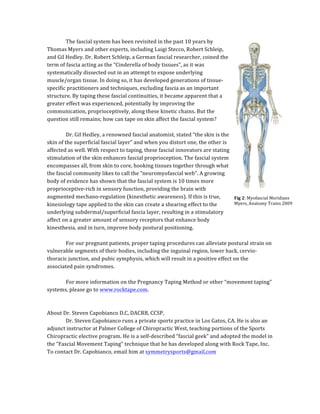
  “Anatomy	
  Trains:	
  
Myofascial	
  Meridians	
  for	
  Manual	
  and	
  Movement	
  Therapists	
  (2009)”.	


Anterior	
  View	


  Lateral	
  View	


  Posterior	
  View	
  
Figure	
  1:	
  Belly	
  Belt	
  System	
  
The	
  fascial	
  system	
  has	
  been	
  revisited	
  in	
  the	
  past	
  10	
  years	
  by	
  
Thomas	
  Myers	
  and	
  other	
  experts,	
  including	
  Luigi	
  Stecco,	
  Robert	
  Schleip,	
  
and	
  Gil	
  Hedley.	
  Dr.	
  Robert	
  Schleip,	
  a	
  German	
  fascial	
  researcher,	
  coined	
  the	
  
term	
  of	
  fascia	
  acting	
  as	
  the	
  “Cinderella	
  of	
  body	
  tissues”,	
  as	
  it	
  was	
  
systematically	
  dissected	
  out	
  in	
  an	
  attempt	
  to	
  expose	
  underlying	
  
muscle/organ	
  tissue.	
  In	
  doing	
  so,	
  it	
  has	
  developed	
  generations	
  of	
  tissue-­‐
specific	
  practitioners	
  and	
  techniques,	
  excluding	
  fascia	
  as	
  an	
  important	
  
structure.	
  By	
  taping	
  these	
  fascial	
  continuities,	
  it	
  became	
  apparent	
  that	
  a	
  
greater	
  effect	
  was	
  experienced,	
  potentially	
  by	
  improving	
  the	
  
communication,	
  proprioceptively,	
  along	
  these	
  kinetic	
  chains.	
  But	
  the	
  
question	
  still	
  remains;	
  how	
  can	
  tape	
  on	
  skin	
  affect	
  the	
  fascial	
  system?	


Dr.	
  Gil	
  Hedley,	
  a	
  renowned	
  fascial	
  anatomist,	
  stated	
  “the	
  skin	
  is	
  the	
  
skin	
  of	
  the	
  superficial	
  fascial	
  layer”	
  and	
  when	
  you	
  distort	
  one,	
  the	
  other	
  is	
  
affected	
  as	
  well.	
  With	
  respect	
  to	
  taping,	
  these	
  fascial	
  innovators	
  are	
  stating	
  
stimulation	
  of	
  the	
  skin	
  enhances	
  fascial	
  proprioception.	
  The	
  fascial	
  system	
  
encompasses	
  all,	
  from	
  skin	
  to	
  core,	
  hooking	
  tissues	
  together	
  through	
  what	
  
the	
  fascial	
  community	
  likes	
  to	
  call	
  the	
  “neuromyofascial	
  web”.	
  A	
  growing	
  
body	
  of	
  evidence	
  has	
  shown	
  that	
  the	
  fascial	
  system	
  is	
  10	
  times	
  more	
  
proprioceptive-­‐rich	
  in	
  sensory	
  function,	
  providing	
  the	
  brain	
  with	
  
augmented	
  mechano-­‐regulation	
  (kinesthetic	
  awareness).	
  If	
  this	
  is	
  true,	
  
kinesiology	
  tape	
  applied	
  to	
  the	
  skin	
  can	
  create	
  a	
  shearing	
  effect	
  to	
  the	
  
underlying	
  subdermal/superficial	
  fascia	
  layer,	
  resulting	
  in	
  a	
  stimulatory	
  
affect	
  on	
  a	
  greater	
  amount	
  of	
  sensory	
  receptors	
  that	
  enhance	
  body	
  
kinesthesia,	
  and	
  in	
  turn,	
  improve	
  body	
  postural	
  positioning.	


For	
  our	
  pregnant	
  patients,	
  proper	
  taping	
  procedures	
  can	
  alleviate	
  postural	
  strain	
  on	
  
vulnerable	
  segments	
  of	
  their	
  bodies,	
  including	
  the	
  inguinal	
  region,	
  lower	
  back,	
  cervio-­‐
thoracic	
  junction,	
  and	
  pubic	
  symphysis,	
  which	
  will	
  result	
  in	
  a	
  positive	
  effect	
  on	
  the	
  
associated	
  pain	
  syndromes.	


For	
  more	
  information	
  on	
  the	
  Pregnancy	
  Taping	
  Method	
  or	
  other	
  “movement	
  taping”	
  
systems,	
  please	
  go	
  to	
  www.rocktape.com.	


About	
  Dr.	
  Steven	
  Capobianco	
  D.C,	
  DACRB,	
  CCSP,	
  
Dr.	
  Steven	
  Capobianco	
  runs	
  a	
  private	
  sports	
  practice	
  in	
  Los	
  Gatos,	
  CA.	
  He	
  is	
  also	
  an	
  
adjunct	
  instructor	
  at	
  Palmer	
  College	
  of	
  Chiropractic	
  West,	
  teaching	
  portions	
  of	
  the	
  Sports	
  
Chiropractic	
  elective	
  program.	
  He	
  is	
  a	
  self-­‐described	
  “fascial	
  geek”	
  and	
  adopted	
  the	
  model	
  in	
  
the	
  “Fascial	
  Movement	
  Taping”	
  technique	
  that	
  he	
  has	
  developed	
  along	
  with	
  Rock	
  Tape,	
  Inc.	
  
To	
  contact	
  Dr.	
  Capobianco,	
  email	
  him	
  at	
  symmetrysports@gmail.com	


Fig	
  2:	
  Myofascial	
  Meridians	
  	
  
Myers,	
  Anatomy	
  Trains	
  2009	
  
References
	
  
1. Fuller, R.B. 1975. Synergetics. New York: Macmillan
2. Ingber, D. 2008. Tensegrity and mechanotransduction. Journal of
Bodywork and Movement Therapies, 12 (3), 198-200.	
  
3. Fascia Congress. 2009. www.fasciacongress.org/2009
4. Myers, T.W. 2009. Anatomy Trains: Myofascial Meridans for Manual and
Movement Therapists. New York: Churchill-Livingston.
5. Schleip, R. 2003. Fascial plasticity—a new neurobiological explanation.
Journal of Bodywork and Movement Therapies. Part 1: 2003, 7 (1), 11–
19; part 2: 2003, (2), 104–16.


Kinesiology Taping for Pregnancy

  • 1.
    Pregnancy  Kinesiology  Taping  Method     Using  the  Fascial  System  as  Our  Guide:  The  Belly  Cradle       Steven  Capobianco,  D.C,  DACRB,  CCSP     Pregnant  women  have  frequently  been  at  a  loss  when  looking  for  answers  in  respect   to  pain  associated  with  their  growing  abdomens.  Typical  recommendations  include  from   strapping,  bracing,  compressive  garments,  and  ergonomic  pillows,  but  patient  compliance  is   low  for  these  methods  because  of  comfort  and  cost  issues.  Some  health  care  practitioners   have  attempted  taping  methods  similar  to  what  we  see  on  our  athlete  population,  using   traditional  rigid  athletic  tape.  Unfortunately,  the  non-­‐elastic  qualities  of  this  type  of  tape   often  result  in  skin  irritation.  In  addition,  taping  with  conventional  athletic  tape  typically   will  only  last  a  day  at  best,  which  does  not  result  in  long  lasting  relief.  It  is  clear  that  this   population  is  desperately  seeking  a  comfortable,  cost  effective,  skin  sparing,  postural   correction  system  that  will  provide  pain  relief  for  multiple  days  and  nights.       The  PowerTaping  for  Pregnancy  Method  introduced  by  RockTape,  Inc.,  provides   exactly  the  long-­‐lasting  custom  support  pregnant  women  need.  Utilizing  the  concept  of   “Taping  Movement,  Not  Muscles”,  RockTape  kinesiology  tape  is  applied  not  to  individual   muscle  groups,  but  instead  along  fascial  vector  lines  to  aid  in  a  variety  of  the  aches  and   pains  associated  with  pregnancy.  Proper  taping  methods  will  alleviate  neck-­‐postural  stress,   lower  back  pain,  sacroiliac  pain  and  possibly  most  importantly,  the  pain  that  results  from   the  additional  weight  of  the  growing  abdomen.       Figure  1  depicts  the  finished  application  of  the  PowerTaping  Pregnancy  Taping   Method  “Baby  Belt.  This  application  offloads  the  anterior  carriage  system  (growing   abdomen)  by  redistributing  the  stress  to  the  upper  scapula-­‐thoracic  region  via  the  “Spiral   and  Superficial  Front  Lines”,  a  fascial  sling  described  by  Thomas  Myers  in  “Anatomy  Trains:   Myofascial  Meridians  for  Manual  and  Movement  Therapists  (2009)”.       Anterior  View                      Lateral  View                Posterior  View   Figure  1:  Belly  Belt  System  
  • 2.
    The  fascial  system  has  been  revisited  in  the  past  10  years  by   Thomas  Myers  and  other  experts,  including  Luigi  Stecco,  Robert  Schleip,   and  Gil  Hedley.  Dr.  Robert  Schleip,  a  German  fascial  researcher,  coined  the   term  of  fascia  acting  as  the  “Cinderella  of  body  tissues”,  as  it  was   systematically  dissected  out  in  an  attempt  to  expose  underlying   muscle/organ  tissue.  In  doing  so,  it  has  developed  generations  of  tissue-­‐ specific  practitioners  and  techniques,  excluding  fascia  as  an  important   structure.  By  taping  these  fascial  continuities,  it  became  apparent  that  a   greater  effect  was  experienced,  potentially  by  improving  the   communication,  proprioceptively,  along  these  kinetic  chains.  But  the   question  still  remains;  how  can  tape  on  skin  affect  the  fascial  system?       Dr.  Gil  Hedley,  a  renowned  fascial  anatomist,  stated  “the  skin  is  the   skin  of  the  superficial  fascial  layer”  and  when  you  distort  one,  the  other  is   affected  as  well.  With  respect  to  taping,  these  fascial  innovators  are  stating   stimulation  of  the  skin  enhances  fascial  proprioception.  The  fascial  system   encompasses  all,  from  skin  to  core,  hooking  tissues  together  through  what   the  fascial  community  likes  to  call  the  “neuromyofascial  web”.  A  growing   body  of  evidence  has  shown  that  the  fascial  system  is  10  times  more   proprioceptive-­‐rich  in  sensory  function,  providing  the  brain  with   augmented  mechano-­‐regulation  (kinesthetic  awareness).  If  this  is  true,   kinesiology  tape  applied  to  the  skin  can  create  a  shearing  effect  to  the   underlying  subdermal/superficial  fascia  layer,  resulting  in  a  stimulatory   affect  on  a  greater  amount  of  sensory  receptors  that  enhance  body   kinesthesia,  and  in  turn,  improve  body  postural  positioning.       For  our  pregnant  patients,  proper  taping  procedures  can  alleviate  postural  strain  on   vulnerable  segments  of  their  bodies,  including  the  inguinal  region,  lower  back,  cervio-­‐ thoracic  junction,  and  pubic  symphysis,  which  will  result  in  a  positive  effect  on  the   associated  pain  syndromes.       For  more  information  on  the  Pregnancy  Taping  Method  or  other  “movement  taping”   systems,  please  go  to  www.rocktape.com.       About  Dr.  Steven  Capobianco  D.C,  DACRB,  CCSP,   Dr.  Steven  Capobianco  runs  a  private  sports  practice  in  Los  Gatos,  CA.  He  is  also  an   adjunct  instructor  at  Palmer  College  of  Chiropractic  West,  teaching  portions  of  the  Sports   Chiropractic  elective  program.  He  is  a  self-­‐described  “fascial  geek”  and  adopted  the  model  in   the  “Fascial  Movement  Taping”  technique  that  he  has  developed  along  with  Rock  Tape,  Inc.   To  contact  Dr.  Capobianco,  email  him  at  symmetrysports@gmail.com         Fig  2:  Myofascial  Meridians     Myers,  Anatomy  Trains  2009  
  • 3.
    References   1. Fuller,R.B. 1975. Synergetics. New York: Macmillan 2. Ingber, D. 2008. Tensegrity and mechanotransduction. Journal of Bodywork and Movement Therapies, 12 (3), 198-200.   3. Fascia Congress. 2009. www.fasciacongress.org/2009 4. Myers, T.W. 2009. Anatomy Trains: Myofascial Meridans for Manual and Movement Therapists. New York: Churchill-Livingston. 5. Schleip, R. 2003. Fascial plasticity—a new neurobiological explanation. Journal of Bodywork and Movement Therapies. Part 1: 2003, 7 (1), 11– 19; part 2: 2003, (2), 104–16.